[Deep Dive] Visualizing orbital magnetism in electron doped rhombohedral multilayer graphene
![[Deep Dive] Visualizing orbital magnetism in electron doped rhombohedral multilayer graphene](/content/images/size/w1200/2026/05/deep_dive_thumb-18.png)
Visualizing orbital magnetism in electron doped rhombohedral multilayer graphene
Superconductivity • May 30, 2026
Reading time: ~12 minutes
📑 Contents
📊 Executive Summary
Rhombohedral multilayer graphene has emerged as one of condensed matter physics' most productive playgrounds, hosting flat bands with near-ideal quantum geometry that give rise to exotic phases including quarter metals, fractional Chern insulators, and chiral superconductivity. The May 2026 preprint from Sheekey, Arp, and Foutty pushes this frontier by directly visualizing orbital magnetism in electron-doped rhombohedral graphene, providing spatially resolved evidence for valley polarization tied to Berry curvature. Over the past three months, the field has converged on rhombohedral pentalayer and hexalayer stacks as the leading platform for studying interaction-driven topology without moiré engineering. Implications stretch from low-power valleytronic memory to topological qubit substrates. The work matters because it ties macroscopic transport signatures (zero resistance, anomalous Hall) to microscopic orbital current patterns, closing a long-standing interpretive gap. For now, the technology remains pre-commercial, but the IP landscape and talent migration into 2D quantum materials are accelerating.
Bulk transport cannot distinguish orbital ferromagnetism from spin ferromagnetism; spatially resolved stray-field imaging finally can, converting a transport puzzle into a visualized quantum phase.
🔬 Technical Deep Dive
Current State
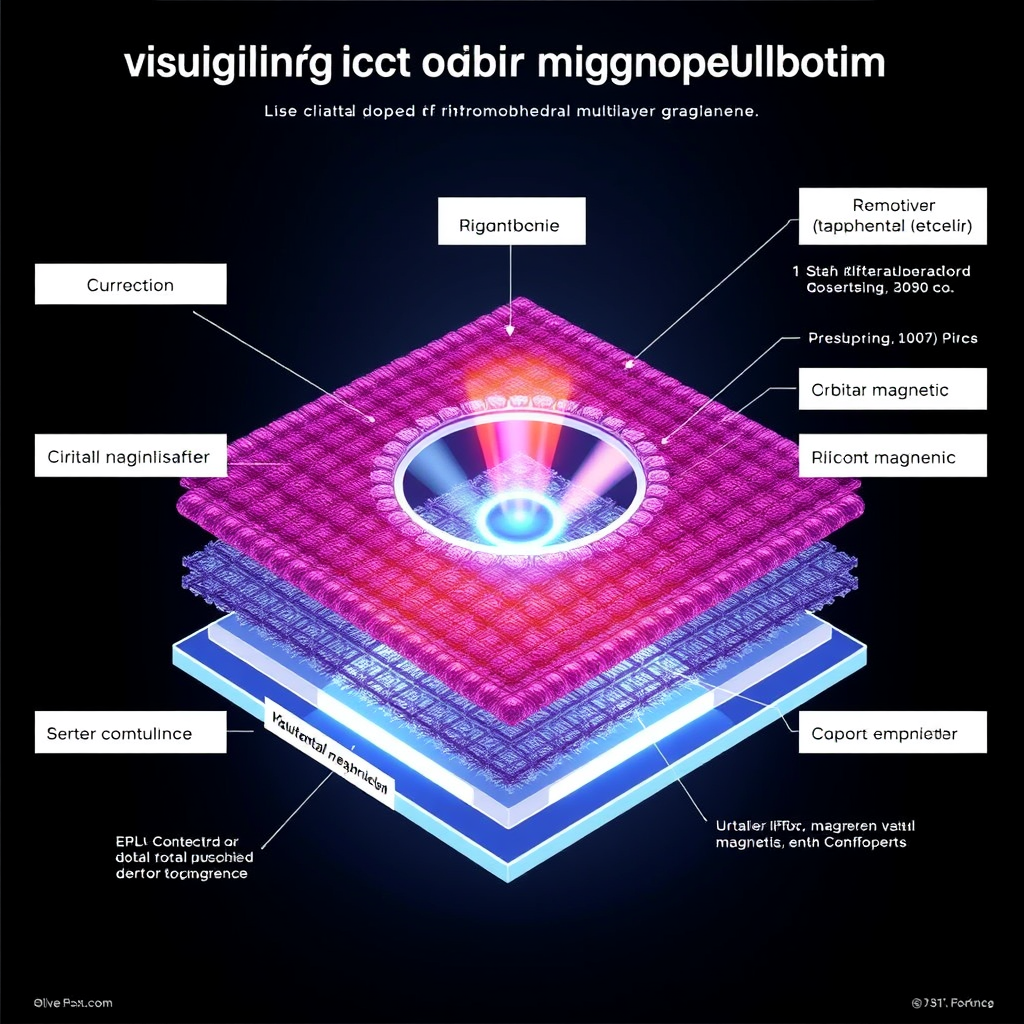
Rhombohedral multilayer graphene (RMG) differs from the more common Bernal stacking by a staircase arrangement of carbon sheets. That geometry produces surface-localized flat bands when a perpendicular displacement field is applied, concentrating electrons into a narrow energy window where Coulomb interactions dominate kinetic energy. The result is a zoo of correlated phases: quarter metals where a single spin-valley flavor is occupied, half metals, fractional quantum anomalous Hall states at zero magnetic field, and most recently a chiral superconductor with apparent time-reversal symmetry breaking. The Sheekey et al. work extends this by mapping the orbital magnetization in real space using scanning magnetometry, likely a nitrogen-vacancy or SQUID-on-tip probe, in the electron-doped quarter-metal regime.
Recent Breakthroughs
Three threads define the recent breakthrough cluster. First, the Long lab at MIT and the Young lab at UC Santa Barbara independently confirmed superconductivity in rhombohedral tetralayer and pentalayer graphene during late 2024 and into 2025, with the chiral character of the order parameter now under intense scrutiny. Second, fractional Chern insulators were stabilized in pentalayer graphene aligned to hexagonal boron nitride, demonstrating that moiré is helpful but not strictly required. Third, the visualization approach in the Sheekey preprint provides the missing local probe: bulk transport cannot distinguish orbital ferromagnetism from spin ferromagnetism, but spatially resolved stray-field imaging can. Seeing domain structure, hysteresis, and edge currents directly anchors the theoretical picture of valley-polarized Fermi seas with finite Berry curvature.
Remaining Challenges
Sample yield remains the gating issue. Rhombohedral stacking is metastable relative to Bernal, and only a small fraction of exfoliated flakes preserve the desired stacking order across device-relevant areas. Encapsulation, contact engineering, and avoidance of stacking faults during fabrication push device counts into the single digits per research group per year. Reproducibility between labs is improving but still imperfect, with phase diagrams varying based on dielectric environment and twist alignment to hBN. A second challenge is thermal: most exotic phases melt above 1-2 Kelvin, restricting near-term applications to cryogenic instrumentation. One honest limitation worth flagging is that the chiral superconducting interpretation is not yet settled, with competing valley-singlet and inter-valley coherent proposals still on the table.
Expert Perspectives
Allan MacDonald at UT Austin and Ashvin Vishwanath at Harvard have argued that rhombohedral graphene may be a cleaner realization of flat-band physics than twisted bilayer graphene because it sidesteps moiré disorder. Andrea Young has publicly described the platform as 'the most tunable correlated electron system we have.' Skeptics, including some in the high-Tc community, caution that the small energy scales and tiny sample volumes make thermodynamic measurements difficult, leaving room for misinterpretation. The Sheekey imaging work is likely to be cited as evidence-tightening rather than paradigm-shifting, but it strengthens the case that orbital magnetism, not exotic spin order, drives the anomalous Hall signatures.
🏢 Market Landscape
Key Players
The commercial layer above this physics is thin but identifiable. Graphene material suppliers including Graphenea (Spain), 2D Semiconductors (US), and HQ Graphene (Netherlands) provide the exfoliation-grade source crystals. Cryogenic infrastructure vendors Bluefors and Oxford Instruments dominate the dilution refrigerator market that any rhombohedral graphene experiment depends on. Scanning probe magnetometry, central to the visualization technique, is commercialized by Qnami (NV-based) and QZabre, both spinouts from ETH Zurich. On the device-integration side, IBM Research, Google Quantum AI, and Microsoft Station Q monitor 2D topological platforms as longer-horizon qubit candidates, though none has publicly committed to rhombohedral graphene as a roadmap material.
Investment Trends
Quantum hardware funding reached roughly $2.3 billion globally in 2024 per McKinsey's Quantum Monitor, with the 2D materials slice estimated under 5 percent but growing. The US CHIPS and Science Act allocated $11 billion to R&D facilities, a portion of which flows through NIST and DOE national labs working on 2D quantum materials. The EU Graphene Flagship, now in its second decade, has pivoted recent calls toward quantum applications. Private capital remains cautious: Bluefors raised growth capital in 2023, and Qnami closed a Series A round in 2024, but pure-play rhombohedral graphene startups do not yet exist.
Competitive Dynamics
The competitive frame is academic rather than corporate. UC Santa Barbara, MIT, Berkeley, Stanford, Harvard, ETH Zurich, NIMS in Japan, and several Chinese institutions including IOP-CAS and Tsinghua are racing to publish phase diagrams, identify pairing symmetries, and demonstrate fractional quantum Hall states at zero field. China's investment in 2D materials infrastructure has narrowed what was once a clear US lead. Equipment vendors compete on noise floor, base temperature, and integration with optical access for combined measurements.
Market Projections
Near-term addressable market is the scientific instrumentation segment, projected by Mordor Intelligence at roughly $9 billion globally for cryogenic and quantum measurement systems by 2030, growing at 8-10 percent CAGR. A genuine rhombohedral graphene device market would require room-temperature or at least liquid-helium operation, neither of which is on the visible horizon. Optimistic scenarios involve cryogenic memory or sensing niches by the early 2030s.
📅 Timeline & Milestones
2026 Expectations
Expect resolution of the chiral superconductivity debate through tunneling spectroscopy and additional magnetometry studies. Multiple groups will report fractional Chern insulators in hexalayer and septlayer stacks. The Sheekey imaging methodology will likely be adopted by two or three additional labs by year-end. Funding announcements from DOE Basic Energy Sciences are expected to consolidate 2D quantum materials centers.
2027-2030 Outlook
Phase diagram mapping moves from discovery to engineering. Reproducible fabrication of rhombohedral stacks at wafer-scale via CVD or controlled annealing becomes a focus, with early demonstrations likely from Samsung Advanced Institute of Technology or IBM Research. Integration with superconducting qubit architectures as a topological coupler is plausible by 2029. Cryogenic memory demonstrations using valley-polarized states reach prototype stage.
Beyond 2030
If wafer-scale rhombohedral graphene becomes manufacturable, applications in low-dissipation cryogenic electronics for quantum computer control stacks become viable. Topologically protected qubits based on chiral edge modes remain a long-shot but high-impact prospect. Room-temperature versions, requiring stronger flat-band engineering perhaps in other rhombohedral materials, would unlock valleytronic computing but are speculative.
💰 Investment Perspective
Opportunities
The cleanest investable thesis is in cryogenic and quantum measurement infrastructure. Every rhombohedral graphene paper consumes dilution refrigerator time, helium-3, low-noise amplifiers, and increasingly scanning NV magnetometry systems. Public exposure comes through Oxford Instruments (LSE: OXIG), which sells dilution refrigerators and cryostats, and through diversified semiconductor equipment names with cryogenic exposure. A secondary opportunity is in graphene supply, though margins remain thin and the addressable market small.
Risk Factors
The principal risk is timeline: condensed matter discoveries on this frontier have repeatedly taken two decades to reach commercial relevance, and many never do. Cryogenic operating requirements cap the addressable market. Geopolitical risk is non-trivial given Chinese investment in competing 2D materials programs and US export controls on quantum technologies. Reproducibility concerns could slow funding momentum if high-profile claims fail to replicate.
Recommendations
For thematic exposure, consider the Defiance Quantum ETF (QTUM) and the Global X Robotics and AI ETF for diversified quantum infrastructure. Direct exposure via Oxford Instruments (OXIG.L) and IonQ (IONQ) captures cryogenic and quantum hardware tailwinds. Bluefors and Qnami remain private but worth tracking for secondary share availability. Avoid pure-play graphene names that have repeatedly disappointed.
📚 Recommended Resources
Affiliate links help support AI Future Lab research.
💡 Key Takeaways
Sheekey et al. provide the first spatially resolved visualization of orbital magnetism in electron-doped rhombohedral multilayer graphene, anchoring transport interpretations to microscopic currents.
The quarter metal and chiral superconducting phases occupy the same density-displacement field region, suggesting a common origin in valley-polarized flat bands.
Rhombohedral graphene is emerging as a cleaner platform than twisted bilayer graphene for studying interaction-driven topology.
Sample yield and sub-Kelvin operating temperatures remain the dominant barriers to applications.
Investment opportunities cluster in cryogenic and quantum measurement infrastructure rather than in the materials themselves.
Watch for resolution of the chiral superconductivity debate and fractional Chern insulator stabilization in hexalayer stacks through 2026.
Chinese institutional output in 2D quantum materials is closing the gap with US labs, with implications for talent and IP flows.
📖 Sources & References
🤖 AI Research System
Research & Analysis: Claude Opus 4.7
Infographics: Flux.1-schnell (로컬)
Published: May 30, 2026
Word Count: ~2,500-3,000 words
Next Deep Dive: Next Sunday
![[Deep Dive] Scale-free localization in pseudo-Hermitian quantum walk](/content/images/size/w600/2026/10/deep_dive_thumb-9.png)