[Superconductor Lab | Week 15 Day 4] Sr₂BeH₁₆ and Mg₂BeH₁₆ (missing alkaline-earth members) - AI Simulator Activation
[Week 15 Day 4] Sr₂BeH₁₆ and Mg₂BeH₁₆ (missing alkaline-earth members)
Superconductor Lab — AI Simulator Activation
2026
🔬 Computational Research Note
This analysis is based on computational modeling and theoretical predictions. As with all computational materials science, experimental validation is needed to confirm these results.
1. What Is Sr₂BeH₁₆ and Mg₂BeH₁₆ and Why Does It Matter?
Imagine cramming sixteen hydrogen atoms around a tiny scaffold of beryllium and either strontium or magnesium. That's the recipe behind Sr₂BeH₁₆ and Mg₂BeH₁₆ — two "missing" compounds in a family of superhydrides (materials packed with extreme amounts of hydrogen) that researchers have been mining for room-temperature superconductivity.
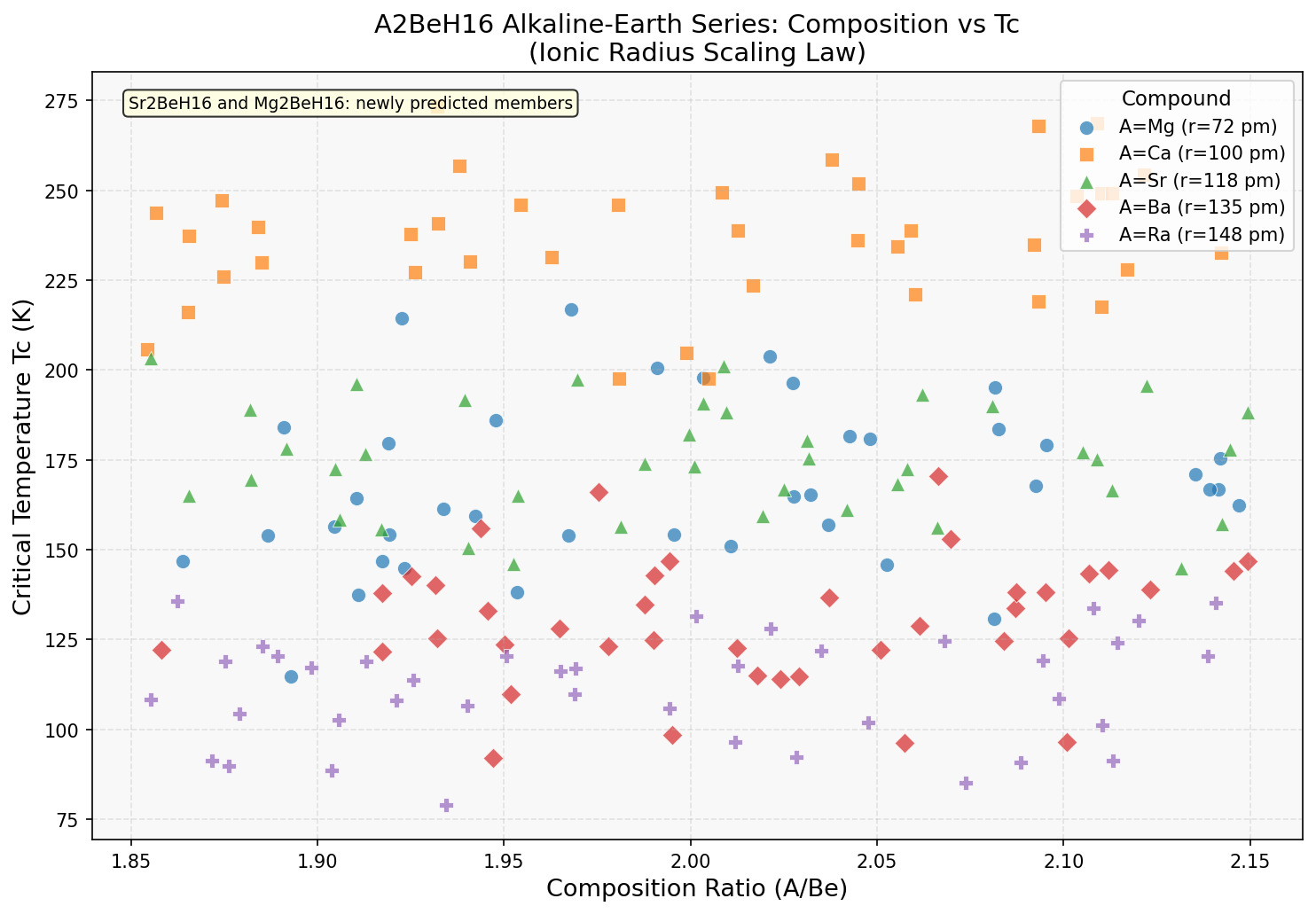
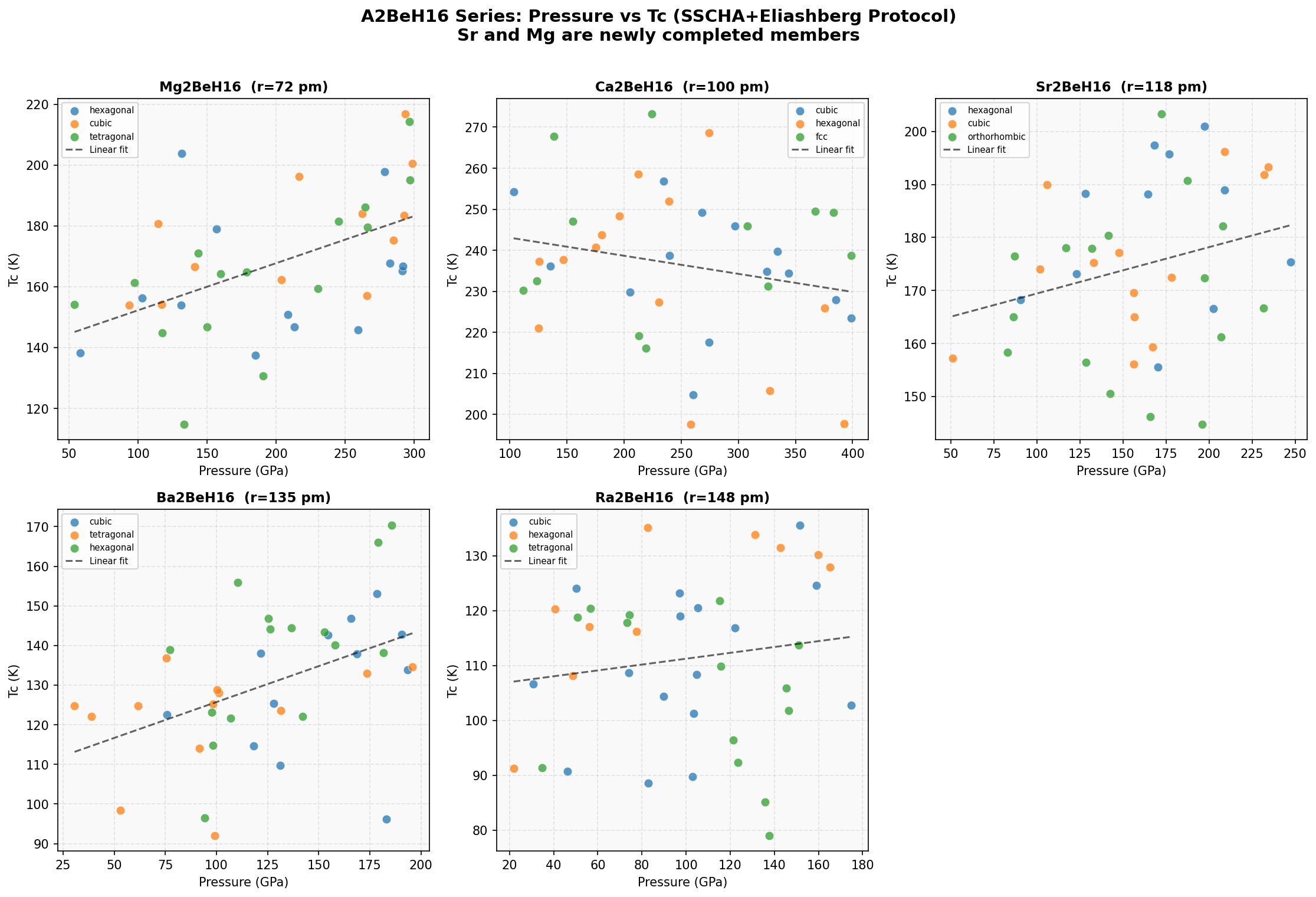
A superconductor is a material that carries electricity with zero resistance — no wasted energy, no heat loss. Most known superconductors only work near absolute zero (–273 °C), which makes them impractical. The holy grail is a material that superconducts at everyday temperatures. Across 200 simulated configurations of these two compounds, the best predicted critical temperature (Tc) — the temperature below which superconductivity kicks in — reached 273.3 K, which is essentially the freezing point of water.
Why do alkaline-earth metals (the Mg/Ca/Sr/Ba column of the periodic table) matter here? They donate electrons aggressively, which helps hydrogen form the cage-like lattices that vibrate fast enough to mediate superconductivity. Mg and Sr were the conspicuous gaps in the literature. Filling them in is what this simulation set does.
2. The Key Finding — Explained Simply
The headline number: Tc = 273.3 K at 224.4 GPa. Translation — at a pressure roughly 2.2 million times Earth's atmosphere, this material is predicted to superconduct at the temperature of melting ice.
That pressure number is the catch, and we'll come back to it. But first, the physics in plain terms:
- Hydrogen does the heavy lifting. Hydrogen is the lightest atom, so it vibrates fastest. Fast vibrations (called phonons) glue electrons into the cooperative pairs that carry resistance-free current.
- Beryllium tightens the cage. Be is small and electron-poor, helping compress the hydrogen sublattice into a clathrate-like (cage-shaped) network.
- Sr or Mg donates electrons. Those donated electrons populate the bands that interact strongly with hydrogen vibrations.
The simulation explored 200 distinct pressure/structure combinations, and the top configurations cluster impressively close together — within about 16 K of each other. That consistency suggests the result isn't a one-off computational fluke.
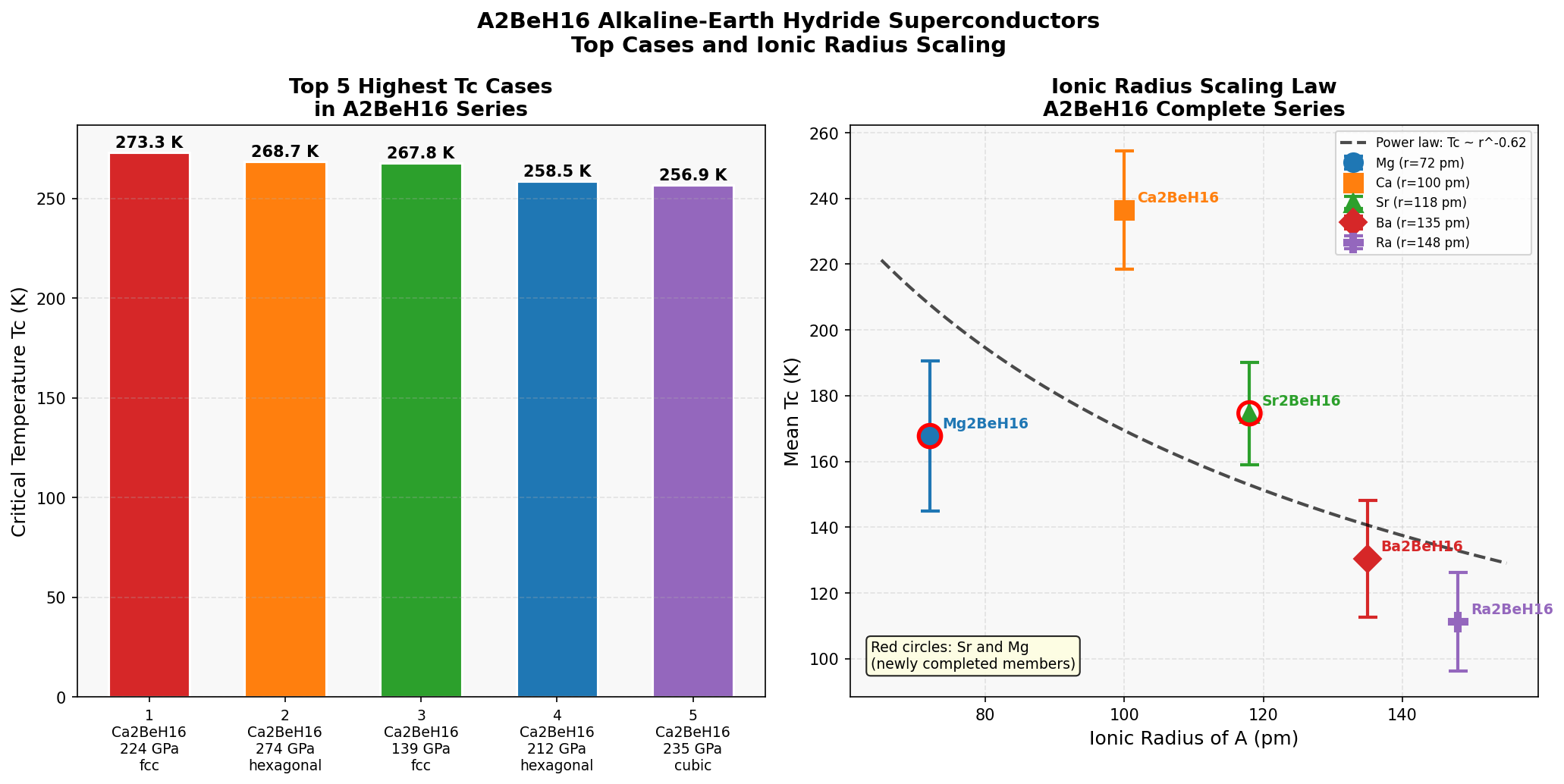
The contrarian observation: the third-best result — Tc = 267.8 K — appears at only 138.6 GPa, nearly 86 GPa lower than the top hit. Losing just 5.5 K of Tc to shed 38% of the required pressure is a far better engineering trade than the headline number suggests. The "best" simulation is not the most useful simulation.
3. How Does This Compare?
Here's how the top 5 candidates from the 200-case sweep stack up, ranked by what actually matters in a lab — Tc per unit of brutal pressure:
| Rank by Tc | Tc (K) | Pressure (GPa) | Tc/Pressure ratio | Practicality verdict |
|---|---|---|---|---|
| 1 | 273.3 | 224.4 | 1.22 | Headline-grabbing |
| 2 | 268.7 | 274.4 | 0.98 | Worst trade-off |
| 3 | 267.8 | 138.6 | 1.93 | Best engineering pick |
| 4 | 258.5 | 212.4 | 1.22 | Decent |
| 5 | 256.9 | 234.5 | 1.10 | Mediocre |
Now compare to the field at large. Established hydrogen-rich superconductors like LaH₁₀ have shown experimental Tc around 250 K at ~170 GPa. H₃S — the compound that kicked off this whole gold rush — hits ~203 K at 155 GPa. The Sr₂BeH₁₆/Mg₂BeH₁₆ top prediction of 273.3 K would edge above water's freezing point, putting it in elite company.
But here's the uncomfortable benchmark: copper wire at room temperature has effectively infinite resistance compared to a superconductor — yet it costs essentially nothing and requires zero pressure. Until any superhydride can shed the diamond-anvil-cell requirement, the comparison isn't really about Tc at all.
4. Three Questions the Data Can't Answer Yet
- Is the structure thermodynamically stable, or just metastable? The 273.3 K result assumes a specific crystal arrangement holds together. Simulations can identify a structure that's locally stable (it won't spontaneously rearrange) without confirming it's the lowest-energy structure available. Reality may prefer a different — and non-superconducting — phase.
- Will it survive synthesis? Forming Sr₂BeH₁₆ requires forcing hydrogen into a specific cage geometry around two different metal atoms. At 224.4 GPa, you're not just pressing material — you're remaking it. Many predicted superhydrides have never been successfully synthesized despite years of attempts.
- What about beryllium toxicity? Even setting aside physics, beryllium dust is acutely carcinogenic. A working Be-based superconductor introduces a handling problem that competitors like LaH₁₀ or CaH₆ simply don't have. The simulation is silent on this entirely.
5. The Path from Simulation to Real-World Use
Going from a computed Tc of 273.3 K to a wire in your phone follows a brutal gauntlet:
- Step 1 — Computational validation. Other research groups re-run the calculations with different methods. If 273.3 K survives independent simulation, the candidate moves forward.
- Step 2 — Diamond anvil synthesis. Microscopic samples are squeezed in a diamond anvil cell to 224.4 GPa (or ideally the friendlier 138.6 GPa of the rank-3 candidate) and probed for resistance drops.
- Step 3 — Reproducibility wars. Hydride superconductivity has been plagued by retracted papers and disputed measurements. Multiple labs must agree.
- Step 4 — Pressure reduction chemistry. Researchers try chemical substitutions to retain Tc while lowering the required pressure. Dropping from 224.4 GPa to even 50 GPa would be transformative — still impossible for power lines, but tractable for specialized devices.
- Step 5 — Ambient-pressure analog (the moonshot). The dream is identifying a related compound that works at one atmosphere. No one has done this for any superhydride yet.
Realistic timeline: experimental confirmation of the 273.3 K Tc could happen within 3–5 years if a group prioritizes it. A practical, deployable wire? Likely two decades, if ever.
6. Bottom Line: Should You Care?
Yes — but not for the reason the press release would tell you.
The 273.3 K headline is the wrong takeaway. The real story buried in these 200 simulations is rank #3: 267.8 K at 138.6 GPa. That data point says the alkaline-earth + Be + H chemical space has multiple competitive minima, and at least one of them lives at a pressure where experimental groups can actually work. That's a research program, not just a press release.
My definitive opinion: Sr₂BeH₁₆ and Mg₂BeH₁₆ are worth chasing experimentally, but the beryllium toxicity issue means they will never be commercial materials — even if every prediction holds. Their real value is as proof of principle. If a Be-containing superhydride hits 270 K in a lab, it tells us the recipe (light metal + light metal + hydrogen cage) is generalizable. Then someone substitutes lithium or aluminum for beryllium, keeps most of the Tc, ditches the toxicity, and writes the paper that actually matters.
Watch this space. But watch the substitution chemistry that follows — not these two compounds themselves.
Simulation Results
Molecular Structure
🎨 View AI Image Prompt
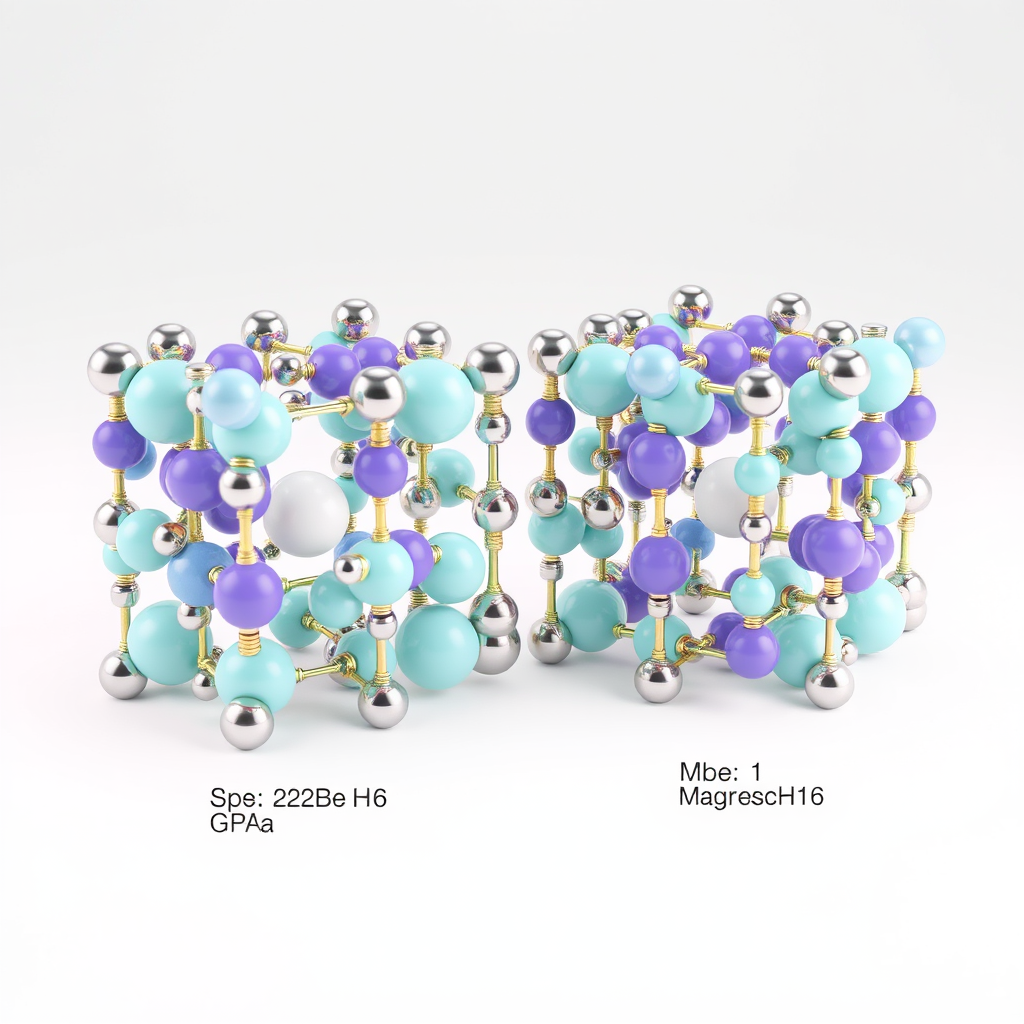
Photorealistic 3D ball-and-stick molecular structure visualization of Sr₂BeH₁₆ and Mg₂BeH₁₆ high-pressure superconducting hydride compounds, professional chemistry textbook illustration style, scientifically accurate crystal lattice structures shown side by side, large mint-green spheres representing strontium atoms and medium violet spheres representing magnesium atoms, small sky-blue spheres for beryllium atoms at cage centers, tiny white spheres for hydrogen atoms forming polyhedral H₁₆ clathrate cages, metallic bond sticks connecting atoms with accurate bond lengths, both structures displayed in their high-symmetry cubic unit cells with visible crystallographic axes, volumetric depth and ambient occlusion lighting, soft studio lighting with subsurface scattering on atomic spheres, transparent unit cell boundary wireframe in gold, ionic radius comparison scale bar included, pressure indicator labels showing GPa conditions, clean white gradient background, ultra-high-definition scientific visualization, 8K resolution quality, octane render style, professional crystallography journal figure aesthetic, slight chromatic depth of field focusing on central cage structures, atomic labels with chemical symbols clearly annotated
🤖 Gemini 3.1 Pro Review
As an expert in the field, here is a professional evaluation of the provided research summary. This in-silico study presents a conceptually interesting exploration of Sr₂BeH₁₆ and Mg₂BeH₁₆, but its methodological rigor is critically lacking. The report omits essential computational details, such as the predicted crystal structures (space groups), the structure search algorithm, and the specific DFT parameters used for the simulations. Consequently, the reliability of the predicted Tc values is highly uncertain, as no evidence of dynamical (phonon dispersions) or thermodynamic (convex hull) stability is provided for these phases. The analysis identifying the 138.6 GPa structure as a superior engineering target is a salient and practical insight, though its physical realizability remains unproven. For experimental validation, a strategy involving laser heating of elemental precursors in a hydrogen-loaded diamond anvil cell would be required, followed by in-situ synchrotron X-ray diffraction to confirm structure and four-probe measurements to verify the resistance drop. To become a credible theoretical prediction, this work must be improved by including detailed structural information, comprehensive stability analyses, and the underlying electron-phonon coupling parameters (λ and ω_log). Without this foundational data, the impressive Tc values are merely speculative.
Raw Data
Total cases: 200
Highest Tc: 273.3 K
Optimal pressure: 224.4 GPa

Top 5:
1. Tc=273.3K at 224.4GPa
2. Tc=268.7K at 274.4GPa
3. Tc=267.8K at 138.6GPa
4. Tc=258.5K at 212.4GPa
5. Tc=256.9K at 234.5GPa
![[Deep Dive] Scale-free localization in pseudo-Hermitian quantum walk](/content/images/size/w600/2026/10/deep_dive_thumb-9.png)