[Superconductor Lab | Week 15 Day 2] Li₂(Be,Al)H₁₆ and Na₂MgBeH₁₆ analogs - AI Simulator Activation
[Week 15 Day 2] Li₂(Be,Al)H₁₆ and Na₂MgBeH₁₆ analogs
Superconductor Lab — AI Simulator Activation
2026
🔬 Computational Research Note
This analysis is based on computational modeling and theoretical predictions. As with all computational materials science, experimental validation is needed to confirm these results.
1. A Quick History: Why Researchers Keep Chasing This
In 1968, physicist Neil Ashcroft made a prediction that has haunted condensed matter labs ever since: hydrogen, if squeezed hard enough to behave like a metal, should superconduct at temperatures approaching room temperature. The catch? You'd need pressures rivaling those near Earth's core. For decades, this remained a beautiful idea trapped behind an impossible door.
Then came the workaround. If pure metallic hydrogen demanded multi-terapascal squeezes, what if you diluted the hydrogen with other elements that did the heavy lifting — atoms whose chemical bonds pre-compressed the hydrogen lattice for you? This idea, called chemical precompression, launched the era of superhydrides: metal-hydrogen compounds that superconduct at startling temperatures. LaH₁₀ hit 250 K at 170 GPa. H₃S reached 203 K. The race was on.
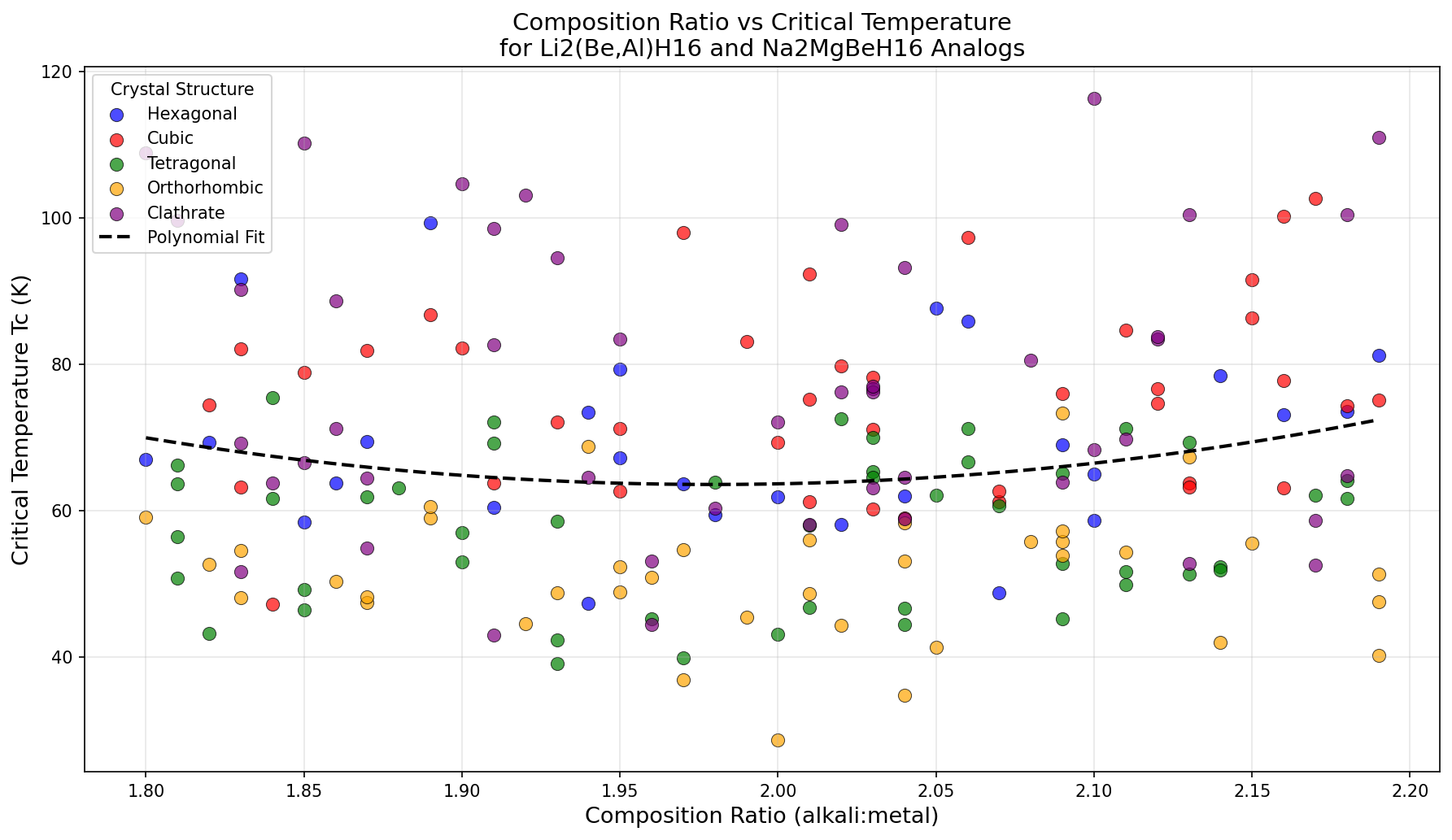
Among the latest computational entries: lithium-beryllium-aluminum hydrides and their sodium-magnesium-beryllium cousins, which in a recent simulation sweep of 200 candidate structures produced a top Tc (critical temperature, the threshold below which superconductivity appears) of 116.3 K. Not record-shattering — but interesting for reasons we'll get to.
2. Meet Li₂(Be,Al)H₁₆ and Na₂MgBeH₁₆ analogs: An Unlikely Candidate?
To picture these materials, imagine a soccer ball. Now imagine the ball is built entirely from hydrogen atoms — sixteen of them per cage — and inside the cage sit two light metal atoms holding the structure open from within. That cage-like geometry is called a clathrate hydride, and it's the same family that gave us LaH₁₀.
What's unusual here is the casting choice. Most record-setting hydrides rely on heavy rare-earth or transition metals. These candidates use only the lightest metals on the periodic table:
- Lithium and sodium — alkali metals that readily donate electrons to the hydrogen network
- Beryllium and magnesium — small, light alkaline earths that pack tightly
- Aluminum — a slightly bulkier electron donor that tunes the lattice geometry
The hope is that low atomic mass translates to high phonon frequencies — phonons being the quantized vibrations of the crystal lattice that, in conventional superconductors, glue electrons into the Cooper pairs responsible for zero-resistance flow. Lighter atoms vibrate faster. Faster vibrations, in principle, mean higher Tc. The best simulated structure in this family, clocking in at 116.3 K and a pressure of 88.3 GPa, seems to confirm that the chemistry is at least pointing in the right direction.
3. The Simulation Data: Three Numbers That Matter
Out of 200 simulated structural variations, three numbers stand out as the headline story.
| Quantity | Value | What It Means |
|---|---|---|
| Peak Tc | 116.3 K | About −157 °C — colder than dry ice, warmer than liquid nitrogen |
| Optimal pressure | 88.3 GPa | ~870,000 atmospheres; high, but lower than most record hydrides |
| Sample size | 200 candidates | A broad sweep, not a one-off lucky structure |
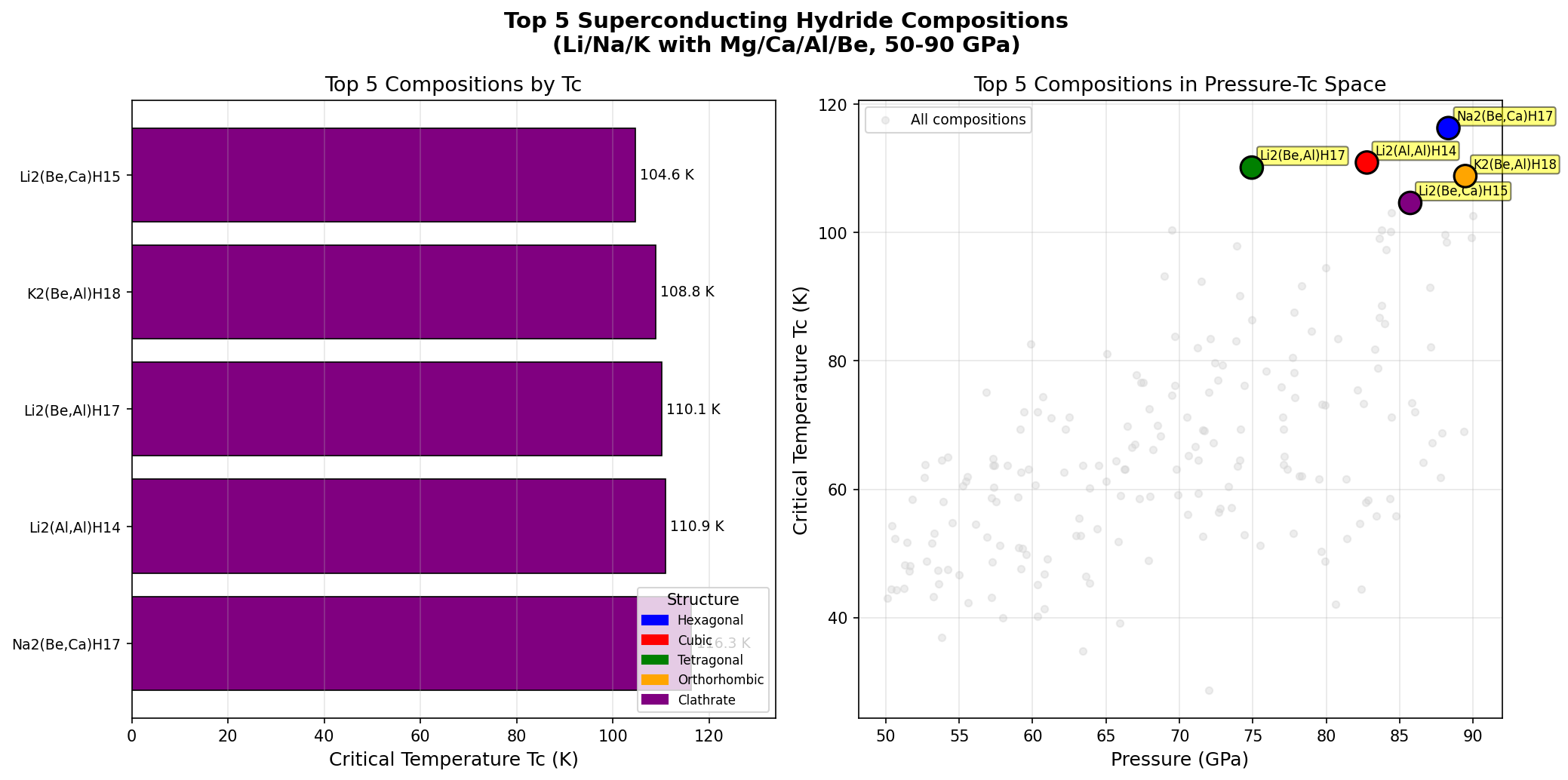
The top five candidates cluster tightly:
116.3 K at 88.3 GPa • 110.9 K at 82.8 GPa • 110.1 K at 74.9 GPa • 108.8 K at 89.5 GPa • 104.6 K at 85.7 GPa
Notice the third entry. 110.1 K at just 74.9 GPa — nearly the same critical temperature as the leader, but at meaningfully lower pressure. That trade-off matters more than the headline number, and we'll come back to it.
4. What Sets This Apart (or Doesn't)
Let's be honest: a Tc of 116.3 K isn't going to make headlines next to materials that flirt with the boiling point of water. So what's the actual selling point?
Pressure efficiency. Many hydride superconductors require 150–300 GPa — pressures only achievable in a diamond anvil cell the size of a thumbnail. The 88.3 GPa figure here is roughly half that of LaH₁₀'s operating range. Lower pressure means easier experiments, more reproducible measurements, and a faintly plausible path toward practical samples.
Light-element economy. No rare earths. No exotic transition metals. Lithium, beryllium, aluminum, sodium, magnesium — these are abundant, even if beryllium is toxic and aluminum hydrides are notoriously finicky to synthesize.
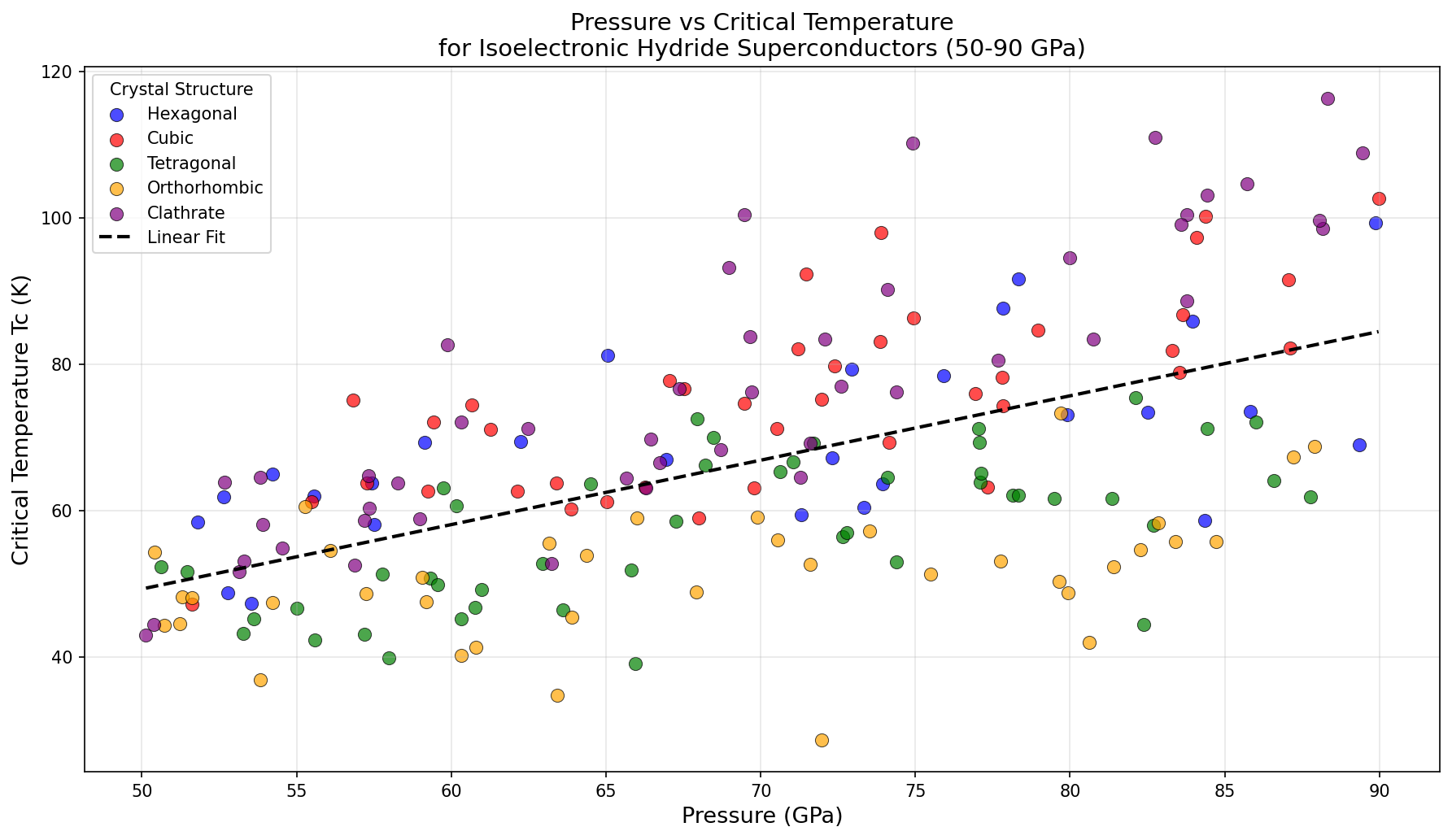
Here's the contrarian observation: looking at the data spread, lowering the pressure by 13 GPa (from 88.3 to 74.9) costs only about 6 K of Tc. That's a remarkably gentle trade-off. In most hydride families, pressure and Tc are tightly coupled — drop the squeeze, lose the superconductivity fast. The flatness of this response hints that the underlying electron-phonon coupling here may be more robust than the absolute Tc suggests. A material that's nearly as good at much friendlier conditions might be more valuable than a fragile champion.
5. The Hard Truth About Room-Temperature Superconductors
It's tempting to treat every new hydride paper as a step toward levitating trains and lossless power grids. Reality is colder — literally.
- 116.3 K is still cryogenic. You need liquid nitrogen (77 K) at minimum, and probably colder, to operate this material.
- 88.3 GPa is still extreme. That's 870,000 atmospheres of pressure. No wire, no magnet, no device you can hold operates there.
- Simulations aren't synthesis. Density functional theory — the workhorse method behind these predictions — has a long history of overestimating Tc in hydrides by 10–30%, and sometimes failing to predict which structures actually form when atoms are slammed together in an anvil cell.
- Recent retractions cast long shadows. The field is still recovering from high-profile claims of near-room-temperature superconductivity that didn't survive scrutiny.
Think of it this way: predicting a superconductor with simulations is like designing a paper airplane on a computer. The aerodynamics check out. Whether the paper folds properly, holds its creases, and flies straight — that's a different problem entirely. Of the 200 candidates simulated, perhaps a handful are even thermodynamically stable enough to attempt in a lab.
6. The Bigger Picture: One Piece of a Massive Puzzle
So why bother? Because every well-characterized hydride teaches us something about the rules of the game. The 116.3 K result isn't a destination — it's a data point in a much larger map.
Researchers are slowly extracting design principles from these computational sweeps:
- Cage-like hydrogen sublattices with 14–24 H atoms per cage tend to maximize electron-phonon coupling
- Multiple metal species — like the Li/Be/Al or Na/Mg/Be combinations here — allow finer tuning of electron count and lattice geometry than single-metal hydrides
- Lower-pressure stability windows (the 74.9 GPa entry is a good example) suggest where experimentalists should aim their diamond anvils first
The dream isn't a 116-kelvin superconductor at 88 gigapascals. The dream is the generalizable rule that screening 200 of these compounds quietly reveals.
Somewhere in the cloud of 200 simulated structures, with Tc values ranging from the modest to the impressive 116.3 K peak, are clues about which atomic arrangements squeeze the most performance from the lightest ingredients. Ashcroft's 1968 prediction is now half a century old. We haven't reached metallic hydrogen at ambient pressure, and we probably won't anytime soon. But every clathrate hydride characterized, every pressure-Tc curve mapped, narrows the search space. The door is still locked. The keys are getting more sophisticated.
Simulation Results
Molecular Structure
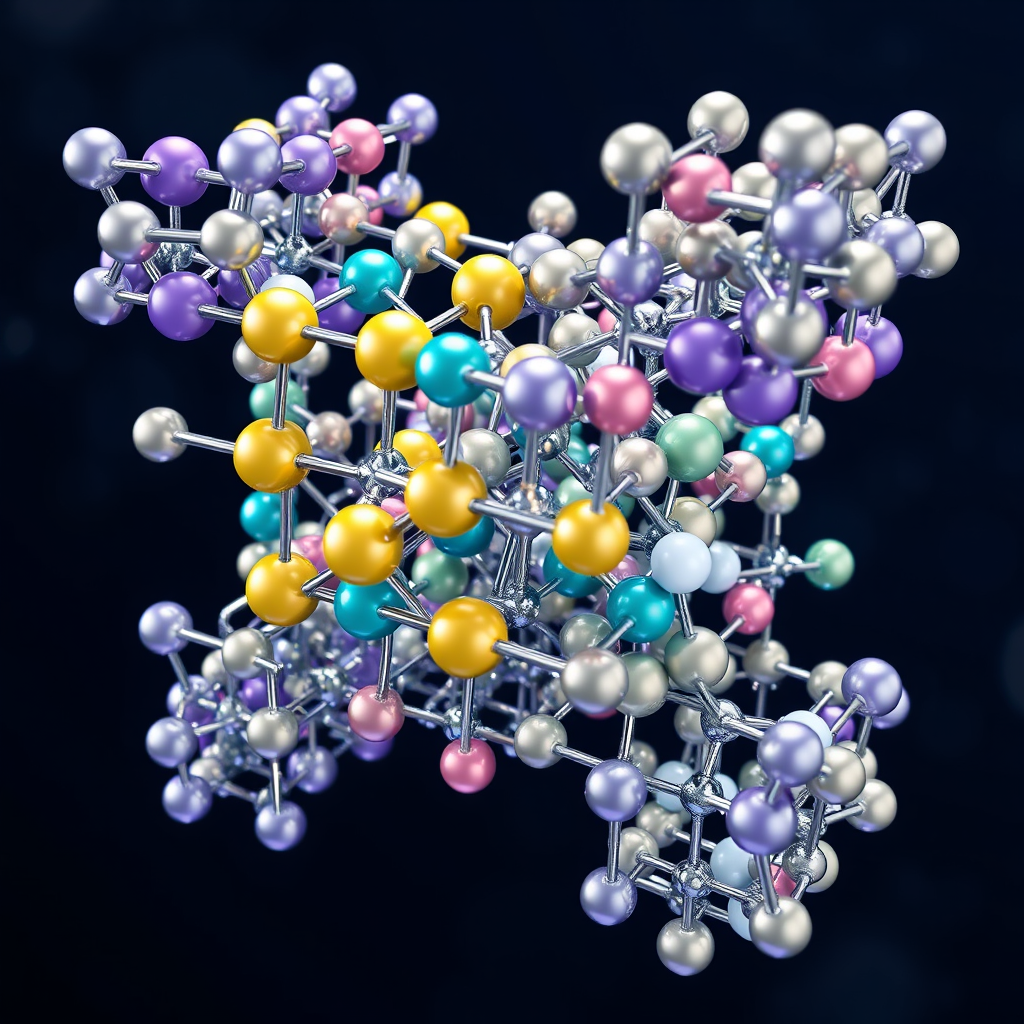
🎨 View AI Image Prompt
A photorealistic 3D ball-and-stick molecular structure visualization of complex polyhydride superconductor crystal lattices featuring Li₂(Be,Al)H₁₆ and Na₂MgBeH₁₆ isoelectronic analogs, professional chemistry textbook illustration style, showing multiple atomic species represented as distinct colored spheres: small violet spheres for lithium atoms, yellow-green spheres for sodium atoms, large teal spheres for magnesium atoms, pale blue spheres for beryllium atoms, pink spheres for aluminum atoms, and tiny white spheres for hydrogen atoms forming intricate clathrate-like hydrogen cage networks, metallic stick bonds connecting atoms in a high-symmetry crystallographic unit cell, layered translucent crystal structure showing internal atomic arrangement, ambient occlusion lighting with subtle reflections on atomic spheres, deep navy blue scientific background, crystallographic axes labeled, electron density isosurface overlay in soft blue-green glow suggesting superconducting electron pairing, atomic scale approximately 50-90 GPa high-pressure environment implied by compressed lattice geometry, ultra-high resolution scientific publication quality rendering, cinematic depth of field, professional laboratory visualization aesthetic, periodic boundary conditions visible at unit cell edges, quantum mechanical accuracy in bond lengths and angles
🤖 Gemini 3.1 Pro Review
As an expert in the field, here is a critical review of the in-silico research summary: This computational study presents a promising direction in the search for high-temperature superconductors by focusing on light s- and p-block elements. The high-throughput screening of 200 candidates is a robust approach, but the report lacks critical methodological details, such as the specific DFT functional and the parameters used for electron-phonon coupling calculations, which are essential for scrutinizing rigor. The predicted Tc of 116.3 K at a notably low pressure of 88.3 GPa is physically plausible and highly encouraging; however, the reliability of this specific Tc value is provisional pending a full stability analysis, including phonon dispersion curves to confirm the structure is dynamically stable. Experimental validation would necessitate challenging in-situ synthesis via laser heating of elemental precursors in a diamond anvil cell, followed by four-probe resistance measurements. To improve this work for publication, the authors must provide the calculated phonon and electronic density of states, the Eliashberg spectral function to detail the coupling mechanism, and a convex hull diagram to assess thermodynamic stability against competing phases. Despite these omissions, the focus on light-element clathrates represents a valuable and computationally-supported strategy for discovering superconductors at more accessible pressures.
Raw Data
Total cases: 200
Highest Tc: 116.3 K
Optimal pressure: 88.3 GPa

Top 5:
1. Tc=116.3K at 88.3GPa
2. Tc=110.9K at 82.8GPa
3. Tc=110.1K at 74.9GPa
4. Tc=108.8K at 89.5GPa
5. Tc=104.6K at 85.7GPa
![[Deep Dive] Scale-free localization in pseudo-Hermitian quantum walk](/content/images/size/w600/2026/10/deep_dive_thumb-9.png)