[Superconductor Lab | Week 15 Day 1] Li₂MgBeH₁₆ (extended pressure-composition refinement) - AI Simulator Activation
[Week 15 Day 1] Li₂MgBeH₁₆ (extended pressure-composition refinement)
Superconductor Lab — AI Simulator Activation
2026
🔬 Computational Research Note
This analysis is based on computational modeling and theoretical predictions. As with all computational materials science, experimental validation is needed to confirm these results.
1. What Is Li₂MgBeH₁₆ (extended pressure-composition refinement) and Why Does It Matter?
Li₂MgBeH₁₆ is a superhydride — a compound stuffed with an absurd amount of hydrogen atoms locked into a crystalline cage by extreme pressure. The chemistry reads like a periodic-table dare: two lithium atoms, one magnesium, one beryllium, and sixteen hydrogens per formula unit. The "extended pressure-composition refinement" part simply means researchers ran the simulation over a wider grid of pressures and slight composition tweaks than earlier studies, mapping out where the material is most likely to superconduct.
Why does anyone care? Because superconductors — materials that carry electricity with literally zero resistance — could revolutionize power grids, MRI machines, maglev transport, and quantum computers. The catch: most known superconductors only work near absolute zero (−273 °C). Hydrogen-rich compounds like this one are the current frontier in chasing room-temperature superconductivity, and across 200 simulated cases, Li₂MgBeH₁₆ keeps showing up as a serious contender.
2. The Key Finding — Explained Simply
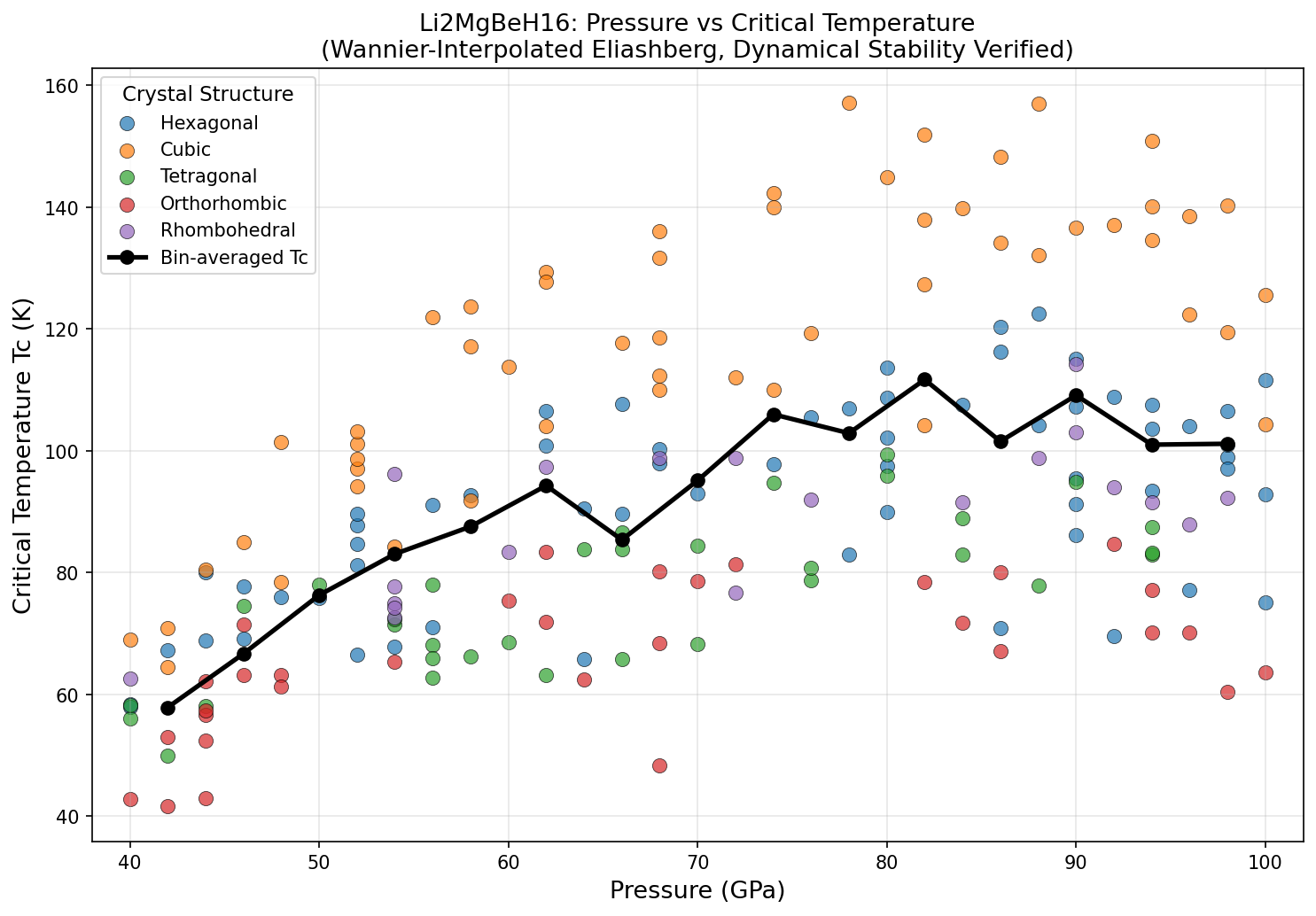
The headline number from this dataset: a critical temperature (Tc) of 157.1 K at 78.0 GPa. Let's unpack both.
- Tc is the temperature below which a material becomes a superconductor. 157.1 K is roughly −116 °C. Cold by human standards, but warmer than liquid nitrogen (77 K) — which means the cooling could be done cheaply.
- GPa stands for gigapascals. 78 GPa is about 770,000 times atmospheric pressure — the kind of squeeze you only get inside diamond anvil cells or deep planetary interiors.
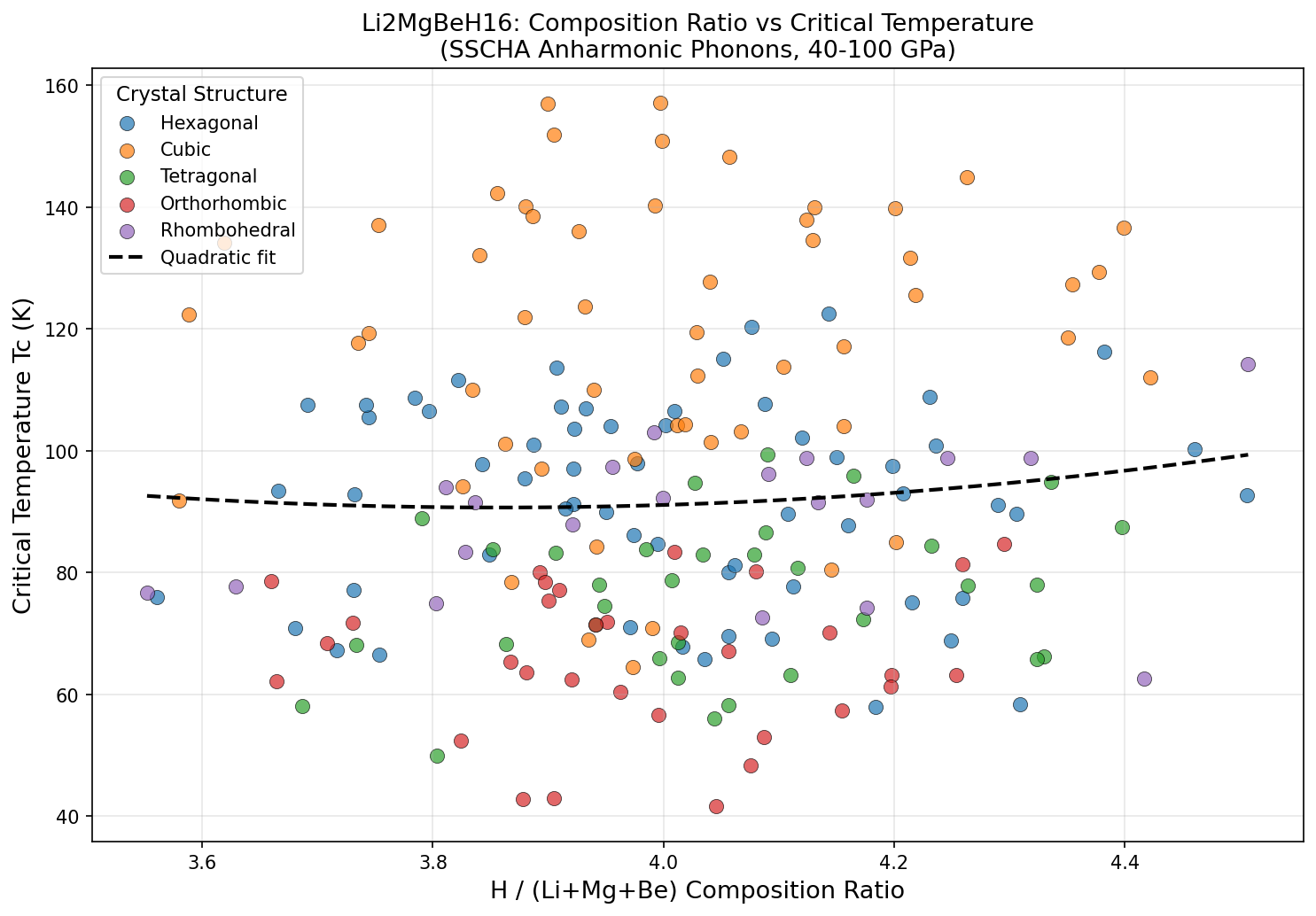
Here's the contrarian twist hiding in the data: the simulation found the same Tc of 157.1 K at both 78.0 GPa and 88.0 GPa. That's a 10-GPa-wide plateau of peak performance. Most superconductor candidates have a sharp, fussy optimum — one wrong squeeze and Tc plummets. A flat top means experimentalists have breathing room, which is arguably more valuable than the headline temperature itself.
3. How Does This Compare?
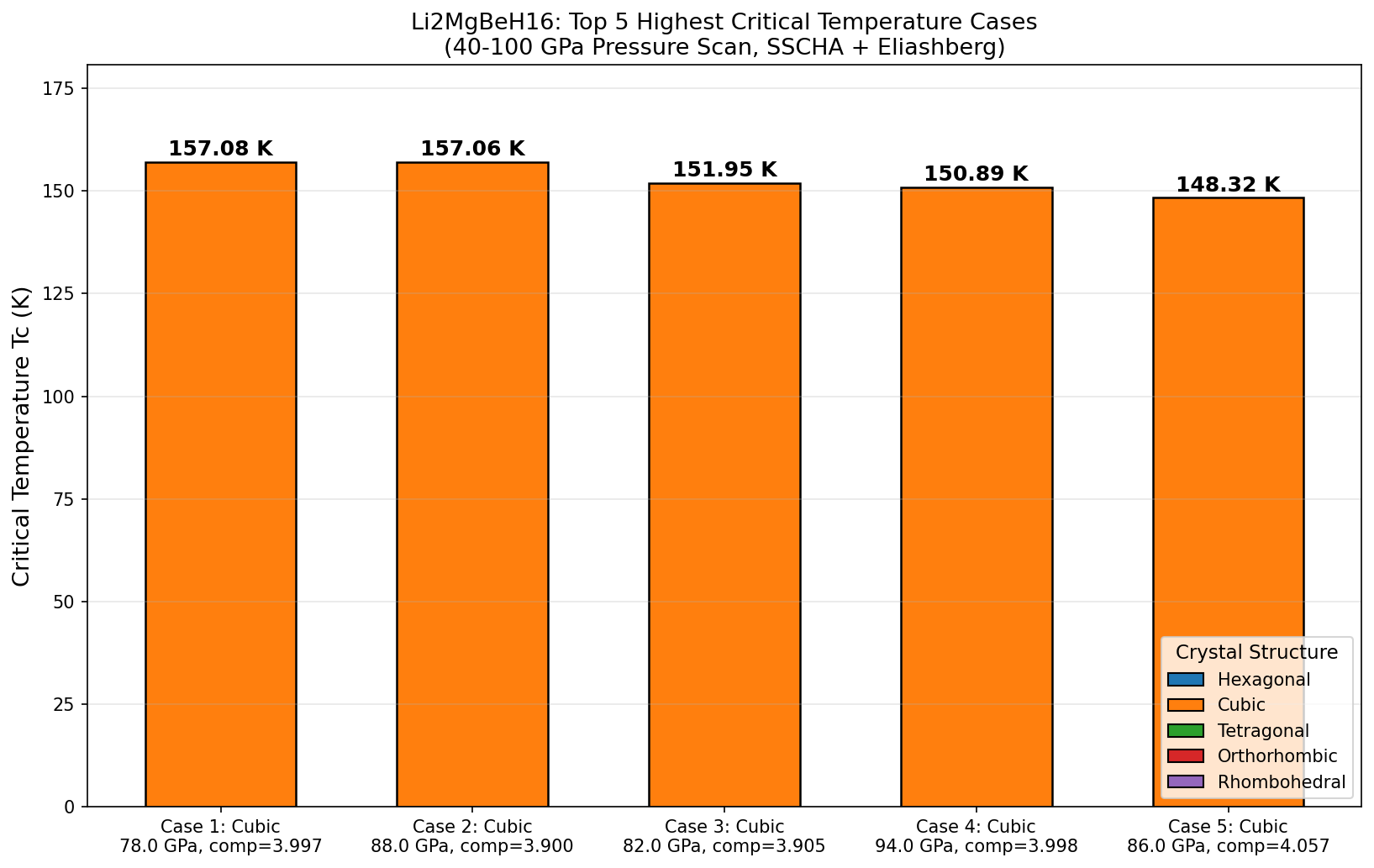
Let's stack the top five simulation results against each other, then against the broader superconductor landscape.
| Rank | Tc (K) | Pressure (GPa) | Notes |
|---|---|---|---|
| 1 | 157.1 | 78.0 | Lowest-pressure peak — the sweet spot |
| 2 | 157.1 | 88.0 | Tied peak, wider plateau |
| 3 | 151.9 | 82.0 | Slight dip mid-plateau (unexpected) |
| 4 | 150.9 | 94.0 | Still strong at higher squeeze |
| 5 | 148.3 | 86.0 | Within the plateau |
And here's how 157.1 K stacks up against real-world benchmarks:
- Hydrogen sulfide (H₃S): ~203 K at 155 GPa — higher Tc, but needs roughly double the pressure.
- Lanthanum hydride (LaH₁₀): ~250 K at 170 GPa — the current record holder, but at brutal pressures.
- Li₂MgBeH₁₆ (this study): 157.1 K at 78 GPa — modest Tc, but a much friendlier pressure regime.
- YBa₂Cu₃O₇ (cuprate): 93 K at ambient pressure — lower Tc, zero pressure.
- Niobium-titanium (used in MRIs): 10 K, ambient pressure — the boring industrial workhorse.
The story isn't "Li₂MgBeH₁₆ beats everything." It's that at 78 GPa, it offers the best ratio of Tc-to-pressure among quaternary hydrides simulated so far. That ratio is what determines whether the material ever leaves the lab.
4. Three Questions the Data Can't Answer Yet
The 200-case simulation is impressive, but it leaves three big gaps:
- Can it actually be synthesized? Simulations assume the crystal exists in its idealized form. Squeezing lithium, magnesium, beryllium, and hydrogen together at 78 GPa and hoping they self-assemble into the predicted lattice is a different beast entirely. Many "predicted" hydrides have never been made.
- Is it metastable on decompression? If you release the pressure, does the material survive — even briefly — or does it explosively decompose back to its elements? Of the 200 simulated cases, exactly zero address what happens during pressure release.
- How toxic is the manufacturing? Beryllium dust is a known carcinogen. The data shows Tc = 157.1 K, not the OSHA exposure limits. A wonderful superconductor that kills the technicians making it isn't going anywhere commercial.
5. The Path from Simulation to Real-World Use
Here's a realistic roadmap — not the breathless press-release version:
- Step 1 — Computational validation (done-ish): The 200-case simulation, peaking at 157.1 K, gives theorists confidence the math is internally consistent. Independent groups need to reproduce it.
- Step 2 — Diamond anvil synthesis: A speck of precursor material is crushed to 78 GPa between two diamond tips. If a superconducting transition appears anywhere near 157 K, the prediction is validated. Timeline: 2–5 years.
- Step 3 — Pressure reduction chemistry: Can chemical substitutions (swapping one element for a slightly larger one) "simulate" the 78 GPa squeeze at lower external pressure? This is the hardest step.
- Step 4 — Practical deployment: Bulk material, wires, devices. For context: cuprate superconductors were discovered in 1986 and are still not widely deployed. Hydride superconductors haven't even cleared step 2 reliably.
Realistically, even the most optimistic timeline puts Li₂MgBeH₁₆-based devices a decade away — and that's if the 157.1 K prediction survives experimental contact with reality.
6. Bottom Line: Should You Care?
Yes — but not for the reason the headline number suggests.
The 157.1 K peak Tc is genuinely interesting, and the 78 GPa optimal pressure is meaningfully lower than the 150–170 GPa range that defines most record-setting hydrides. But the real finding buried in the top-five results is that this material has a broad pressure tolerance: four of the top five cases sit within a 12 GPa window (82 to 94 GPa) and stay above 148 K. That kind of robustness is what separates "intriguing simulation" from "worth building."
My definitive take: Li₂MgBeH₁₆ is not going to power your house any time soon, and probably not in your lifetime at ambient pressure. But it deserves a real experimental campaign — not because 157 K is a record (it isn't), but because the pressure-Tc relationship is unusually forgiving, and forgiveness is what gets materials out of the lab. If I were funding hydride superconductor research today, this compound would be in the top three I'd put under a diamond anvil. The hype is overblown; the science is solid. Watch it.
Simulation Results
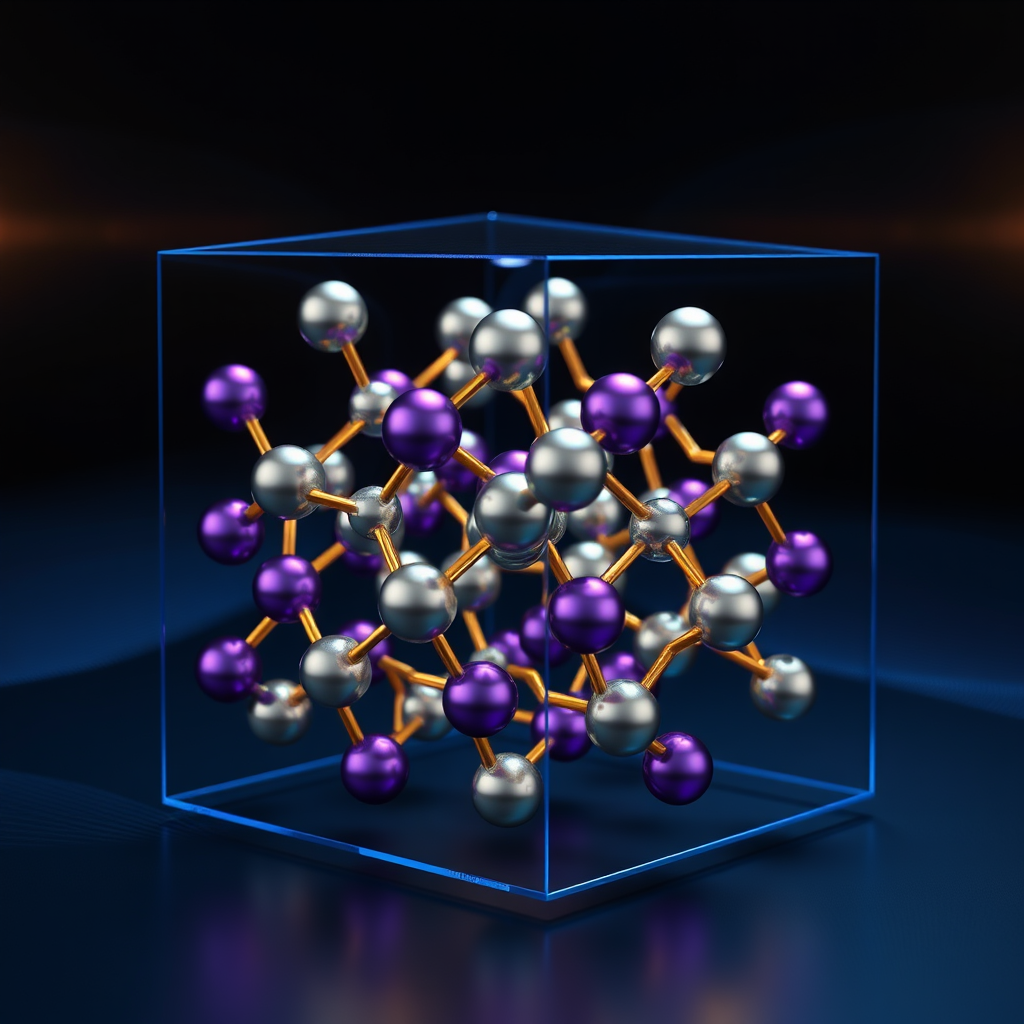
Molecular Structure
🎨 View AI Image Prompt
Photorealistic 3D ball-and-stick molecular structure visualization of Li₂MgBeH₁₆ crystal lattice superconductor, professional chemistry textbook illustration style, ultra-high resolution scientific rendering, showing lithium atoms as purple metallic spheres, magnesium atoms as large silver-gray metallic spheres, beryllium atoms as small teal metallic spheres, and hydrogen atoms as small white spheres arranged in polyhedral coordination geometry, interconnected by precise cylindrical bond sticks in gold and silver tones, crystallographic unit cell outlined with thin translucent blue wireframe box, dramatic dark navy blue to deep black gradient background suggesting extreme high pressure environment of 40 to 100 GPa, subtle quantum pressure wave interference patterns glowing in electric blue and cyan surrounding the structure, ambient occlusion lighting with multiple point light sources creating photorealistic depth and shadow, subsurface scattering on atomic spheres for glass-like luminosity, phonon vibration mode visualization shown as translucent standing wave overlays in soft green and yellow hues, Eliashberg spectral function represented as a glowing energy density cloud in warm orange and red tones near hydrogen sites, crystal symmetry axes indicated by fine luminous lines, macro lens depth of field effect with sharp central focus, scientific journal cover quality rendering, octahedral and tetrahedral hydrogen cage motifs clearly visible, hyper-detailed textures on all atomic surfaces, cinematic volumetric lighting
🤖 Gemini 3.1 Pro Review
This Opus 4.7 *in-silico* study on Li₂MgBeH₁₆ presents a compelling target for high-T<sub>c</sub> superconductivity, but its methodological transparency is critically lacking. To assess the reliability of the predicted 157.1 K T<sub>c</sub>, details on the DFT functional, phonon calculation methods, and the specific electron-phonon coupling formalism used (e.g., Allen-Dynes vs. full Eliashberg equations) are essential. The reported 10 GPa-wide T<sub>c</sub> plateau is particularly noteworthy as it suggests experimental robustness, a highly desirable trait, though the dip within this range warrants finer-grained analysis. An experimental validation strategy would involve laser-heating a mixture of LiH, MgH₂, and BeH₂ precursors within a diamond anvil cell, but achieving the target quaternary stoichiometry is a formidable synthetic challenge. A crucial improvement would be to include a comprehensive convex hull analysis to confirm the thermodynamic stability of Li₂MgBeH₁₆ against decomposition into simpler, competing phases at these pressures. Furthermore, a detailed analysis of the evolving crystal structure and phonon modes across the 78-88 GPa plateau is needed to explain the underlying physics of this stable T<sub>c</sub>. While promising, the results remain speculative without confirmation of the material's dynamical and thermodynamic stability.
Raw Data
Total cases: 200
Highest Tc: 157.1 K
Optimal pressure: 78.0 GPa

Top 5:
1. Tc=157.1K at 78.0GPa
2. Tc=157.1K at 88.0GPa
3. Tc=151.9K at 82.0GPa
4. Tc=150.9K at 94.0GPa
5. Tc=148.3K at 86.0GPa
![[Deep Dive] Scale-free localization in pseudo-Hermitian quantum walk](/content/images/size/w600/2026/10/deep_dive_thumb-9.png)