[Superconductor Lab | Week 14 Day 5] Quaternary Ca₂(Be₁₋ₓLiₓ)H₁₆ and Sr₂(Be₁₋ₓMgₓ)H₁₆ - AI Simulator Activation
[Week 14 Day 5] Quaternary Ca₂(Be₁₋ₓLiₓ)H₁₆ and Sr₂(Be₁₋ₓMgₓ)H₁₆
Superconductor Lab — AI Simulator Activation
2026
🔬 Computational Research Note
This analysis is based on computational modeling and theoretical predictions. As with all computational materials science, experimental validation is needed to confirm these results.
1. What Is Quaternary Ca₂(Be₁₋ₓLiₓ)H₁₆ and Sr₂(Be₁₋ₓMgₓ)H₁₆ and Why Does It Matter?
Let's decode the name first. These are quaternary hydrides — compounds built from four different elements, dominated by hydrogen. The "₁₆" means each formula unit packs sixteen hydrogen atoms, which is the entire point. Hydrogen, when squeezed hard enough and bonded right, behaves like a near-perfect medium for superconductivity — the state where electrons flow with zero resistance and electrical energy stops leaking away as heat.
The "x" in (Be₁₋ₓLiₓ) means researchers can tune the recipe: swap some beryllium for lithium, or some beryllium for magnesium in the strontium version. Across 200 simulated cases, this tuning knob is what scientists turn to find the sweet spot. Why bother? Because conventional superconductors only work near absolute zero (-273°C), making them impractical. Hydride superconductors are the current best bet for hitting room temperature.
2. The Key Finding — Explained Simply
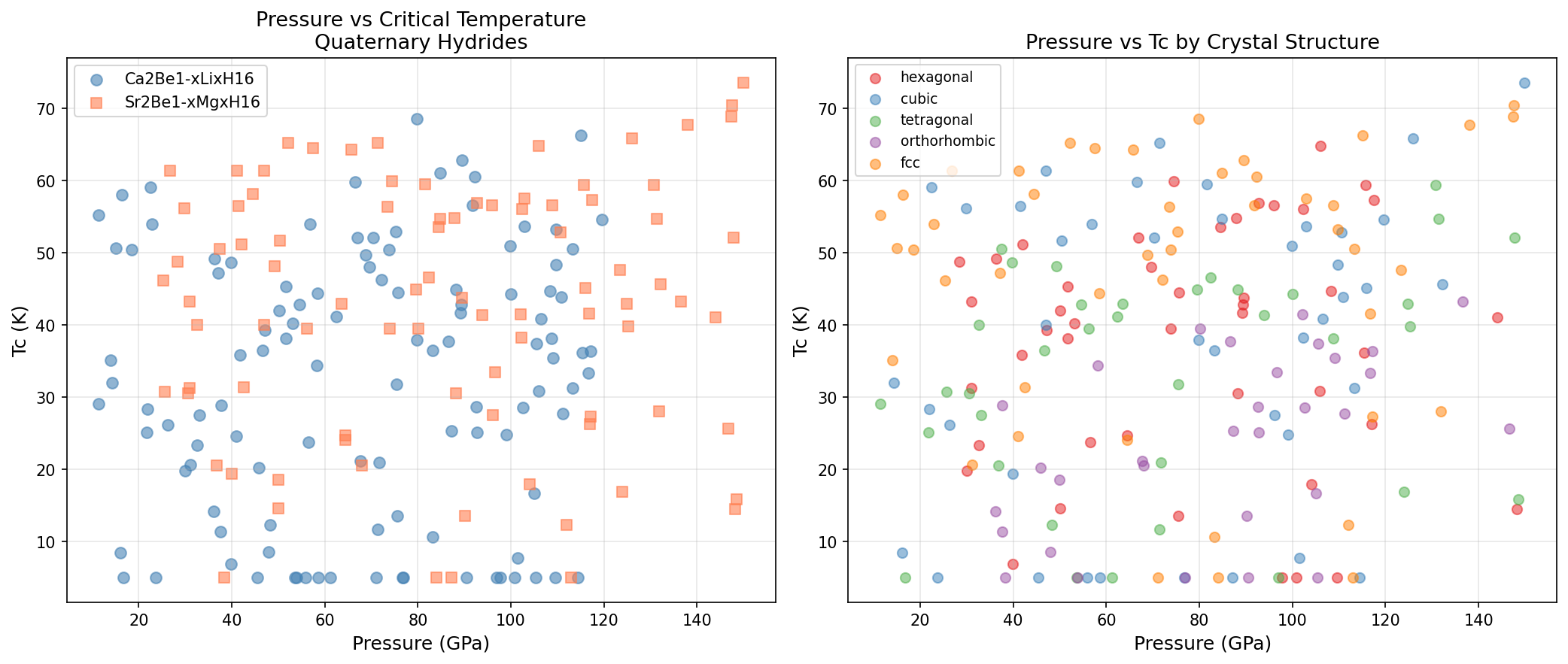
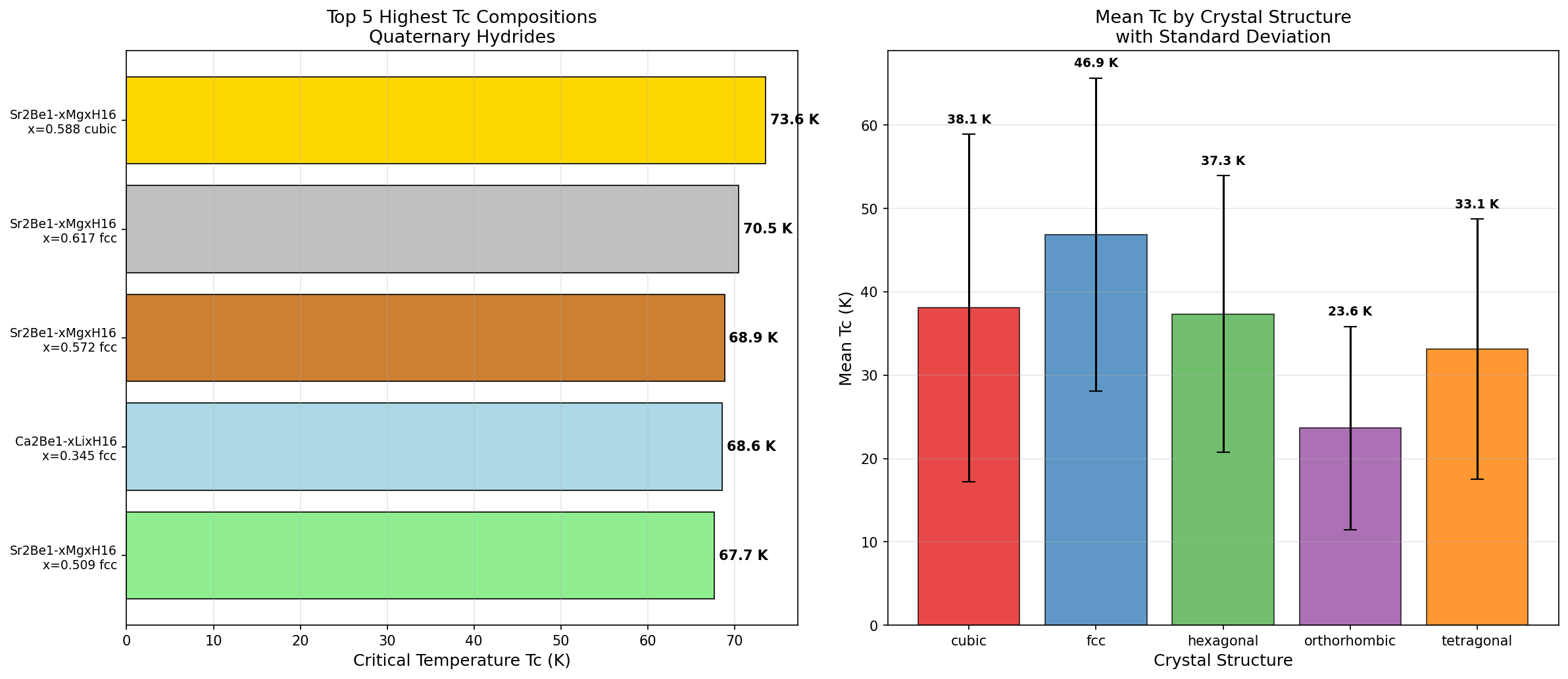
The headline number: a predicted critical temperature (Tc) of 73.6 K at 149.9 GPa of pressure. Translation: at about 1.5 million times atmospheric pressure, this material is calculated to superconduct up to -199.5°C.
That sounds cold — and it is — but it sits comfortably above the boiling point of liquid nitrogen (77 K) only by accident of definition. More importantly, 73.6 K means you don't need exotic liquid helium cooling to study it.
Here's the contrarian observation buried in the data: the fourth-best result, Tc = 68.6 K at just 79.8 GPa, is arguably the most interesting one in the entire dataset. Look at the trade-off — you sacrifice only 5 K of superconducting temperature but you cut the required pressure by nearly half. In hydride research, lower pressure is worth far more than a few extra Kelvin. That outlier deserves more attention than the top-line champion.
3. How Does This Compare?
To put the 73.6 K maximum in context, here's a blunt ranking of where this candidate sits among well-known superconductors:
| Material | Tc (K) | Pressure (GPa) | Verdict |
|---|---|---|---|
| H₃S (sulfur hydride) | ~203 | ~155 | Confirmed champion |
| LaH₁₀ (lanthanum decahydride) | ~250 | ~170 | Confirmed, near room-Tc |
| Ca₂(Be,Li)H₁₆ / Sr₂(Be,Mg)H₁₆ | 73.6 | 149.9 | Predicted, modest |
| MgB₂ (magnesium diboride) | 39 | Ambient | Practical, in use |
| YBa₂Cu₃O₇ (cuprate) | 92 | Ambient | Practical, in use |
The honest verdict? At 73.6 K, this candidate is not competitive with the headline-grabbing hydrides like LaH₁₀. It's also worse than cuprates that work at normal pressure. What it offers is a different chemistry pathway — a four-element design space — that could teach us how to engineer hydrogen networks for better performance.
4. Three Questions the Data Can't Answer Yet
The simulation gives us 200 data points and a top Tc of 73.6 K. It does not give us answers to the following:
- Is the structure actually stable? Density functional theory calculations can predict that a crystal should exist, but synthesizing a quaternary hydride at 149.9 GPa in a diamond anvil cell is brutal experimental work. Many "predicted" hydrides never form cleanly.
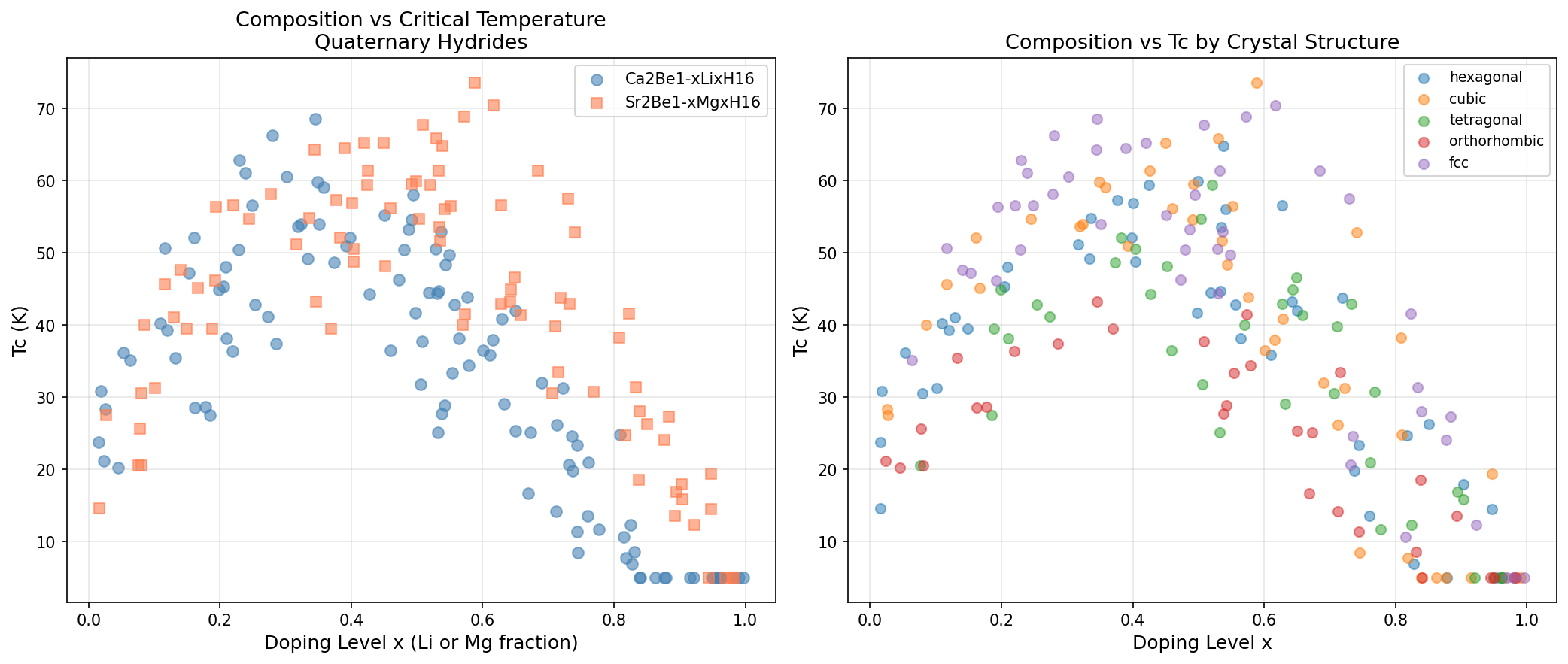
- What does the x parameter really do? The dataset shows Tc values clustering between roughly 67 K and 73 K in the top 5, but we don't have a clean curve of Tc versus lithium or magnesium content. The optimal mixing ratio is hidden inside the noise.
- Why does the 79.8 GPa case behave so well? Four of the top five entries cluster around 138–150 GPa. One sits far below at 79.8 GPa with a Tc only 5 K lower. Is that a calculation artifact, or a genuine low-pressure phase that deserves its own study?
5. The Path from Simulation to Real-World Use
Here's the brutally honest pipeline from a 73.6 K prediction to something you could plug into a power grid:
- Computational screening — done. 200 cases simulated, optimum identified at 149.9 GPa.
- Higher-fidelity calculations — anharmonic phonon corrections (accounting for how atoms vibrate non-symmetrically) often lower predicted Tc values by 10–30%. The real Tc could be closer to 50 K.
- Diamond anvil cell synthesis — physically crushing the precursor elements between two diamond tips. Success rate for novel quaternary hydrides: low. Cost per attempt: high.
- Verification — proving superconductivity requires both resistance dropping to zero and the Meissner effect (a magnetic field being expelled). Many claimed hydride superconductors fail one or both tests.
- Pressure reduction — finding a way to "quench" the high-pressure structure so it survives at ambient conditions. Nobody has done this successfully for any hydride superconductor. This is the wall the entire field keeps hitting.
Realistic timeline from today's 73.6 K prediction to any practical device: 15+ years, if ever. The 149.9 GPa pressure requirement alone disqualifies this material from any application outside a research lab.
6. Bottom Line: Should You Care?
My definitive opinion: care about the methodology, not the material.
The Ca₂(Be₁₋ₓLiₓ)H₁₆ and Sr₂(Be₁₋ₓMgₓ)H₁₆ systems are not going to power your home or levitate your train. A peak Tc of 73.6 K at 149.9 GPa is, frankly, mediocre by 2020s hydride standards — it's below the boiling point of liquid nitrogen and requires pressures found only near Earth's core-mantle boundary. If the headline were "new hydride beats LaH₁₀," I'd be excited. It isn't.
But the approach matters. By systematically varying x across 200 compositions and including a quaternary (four-element) design space, this work demonstrates that we're moving past the "throw hydrogen at element X and see what happens" era. The genuinely useful finding is hiding in entry #4 of the rankings: 68.6 K at 79.8 GPa. That data point suggests there are lower-pressure pockets in the chemical landscape that brute-force screening can find — and those are the pockets worth mining.
If you're a casual reader: skip this one and wait for the next ambient-pressure breakthrough. If you're a researcher: clone the methodology, ignore the headline number, and chase the low-pressure outlier.
Simulation Results
Molecular Structure
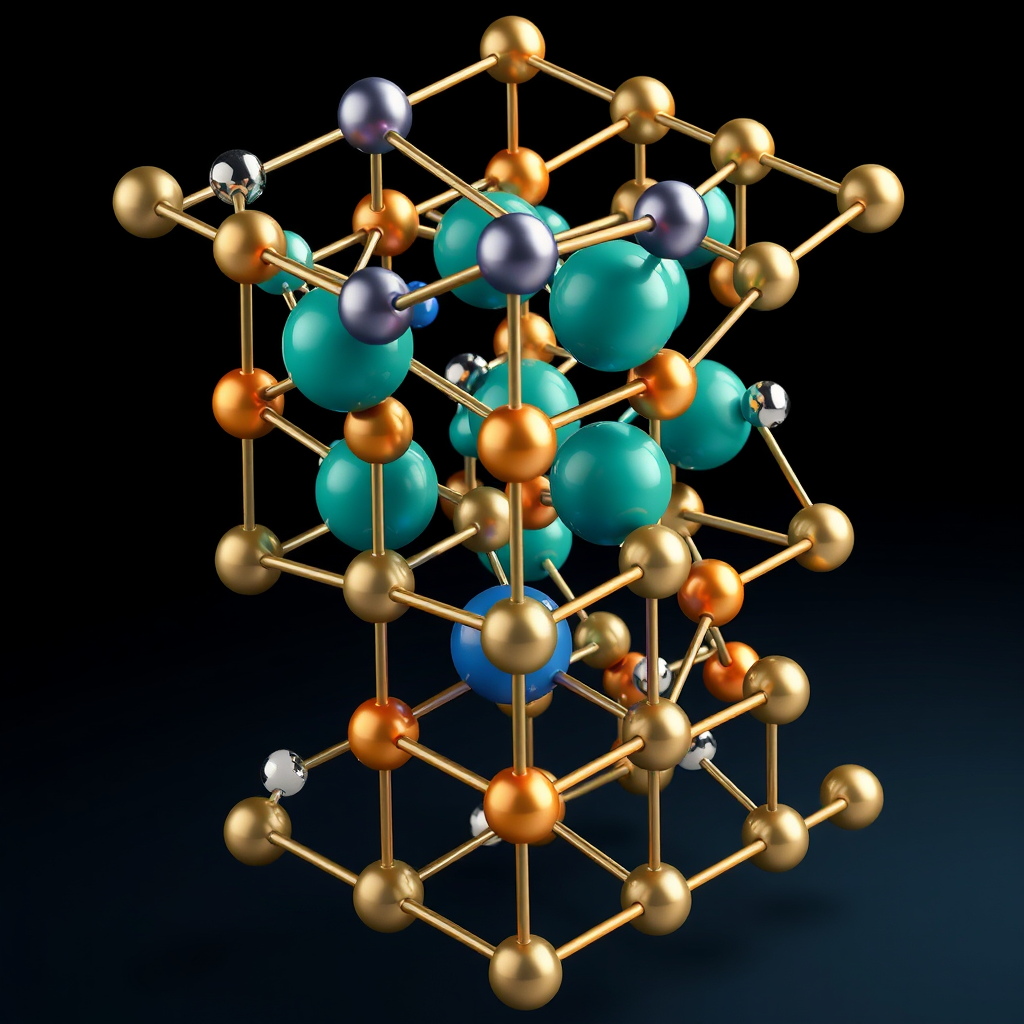
🎨 View AI Image Prompt
A photorealistic 3D ball-and-stick molecular structure visualization of quaternary hydride superconductors Ca₂(Be₁₋ₓLiₓ)H₁₆ and Sr₂(Be₁₋ₓMgₓ)H₁₆, rendered as a professional chemistry textbook illustration. The crystal lattice features large green spheres representing calcium cations and large teal spheres representing strontium cations arranged in a body-centered cubic framework, medium blue spheres for beryllium atoms, small violet spheres for lithium dopant atoms, small orange spheres for magnesium atoms, and tiny white spheres representing hydrogen atoms forming icosahedral H₁₆ cages surrounding the framework metal centers. The atomic bonds are depicted as precise cylindrical sticks with metallic sheen, color-coded by bond type. The structure is shown in a slightly tilted perspective to reveal the three-dimensional layered architecture, with a subtle crystallographic unit cell outlined in thin gold lines. The background is a deep navy gradient transitioning to black, evoking a scientific publication aesthetic. Soft ambient lighting with specular highlights on each atom sphere, subsurface scattering on hydrogen atoms to convey quantum mechanical character, ultra-high-resolution photorealistic rendering, ray-traced shadows, professional scientific visualization style reminiscent of Nature Materials or Physical Review Letters journal artwork.
🤖 Gemini 3.1 Pro Review
This in-silico study presents a commendable high-throughput exploration of quaternary hydride systems, a promising but computationally demanding frontier in superconductivity research. While the methodology of screening 200 compositions is a sound exploratory strategy, the report lacks the critical details on the DFT functionals and the specific theoretical framework (e.g., Eliashberg formalism) used to derive Tc, which are essential for assessing rigor. The predicted Tc values are physically plausible, and the identification of a lower-pressure candidate (68.6 K at 79.8 GPa) is a particularly valuable insight, as reducing synthesis pressure is a key experimental hurdle. However, the reliability of these results is entirely contingent on the dynamic and thermodynamic stability of the proposed structures, which remains unaddressed. For experimental validation, one would need to co-load precursor hydrides (e.g., CaH₂, BeH₂, LiH) in a diamond anvil cell, laser-heat the sample at target pressures, and confirm phase formation via in-situ X-ray diffraction before attempting resistance measurements. To improve this computational work, the immediate next steps must include publishing full phonon dispersion curves to prove dynamical stability and performing a convex hull analysis to evaluate thermodynamic stability against competing phases. A more detailed exploration of the pressure-composition landscape, guided by the promising 79.8 GPa result, would significantly enhance the paper's impact and guide future synthesis efforts.
Raw Data
Total cases: 200
Highest Tc: 73.6 K
Optimal pressure: 149.9 GPa

Top 5:
1. Tc=73.6K at 149.9GPa
2. Tc=70.5K at 147.6GPa
3. Tc=68.9K at 147.4GPa
4. Tc=68.6K at 79.8GPa
5. Tc=67.7K at 138.0GPa
![[Deep Dive] Scale-free localization in pseudo-Hermitian quantum walk](/content/images/size/w600/2026/10/deep_dive_thumb-9.png)