[Superconductor Lab | Week 14 Day 3] Ca₂BeH₁₆ doping series (Ca₂₋ₓYₓBeH₁₆, Ca₂Be₁₋ᵧBᵧH₁₆) - AI Simulator Activation
[Week 14 Day 3] Ca₂BeH₁₆ doping series (Ca₂₋ₓYₓBeH₁₆, Ca₂Be₁₋ᵧBᵧH₁₆)
Superconductor Lab — AI Simulator Activation
2026
🔬 Computational Research Note
This analysis is based on computational modeling and theoretical predictions. As with all computational materials science, experimental validation is needed to confirm these results.
1. What Is Ca₂BeH₁₆ doping series (Ca₂₋ₓYₓBeH₁₆, Ca₂Be₁₋ᵧBᵧH₁₆) and Why Does It Matter?
Imagine a material that conducts electricity with zero resistance — no wasted energy, no heat loss, no efficiency tax. That's a superconductor. The catch? Most known superconductors only work at temperatures colder than deep space, making them impractical for everyday use. The hunt for room-temperature versions has pushed scientists toward exotic hydrogen-rich compounds (called hydrides) squeezed under crushing pressures.
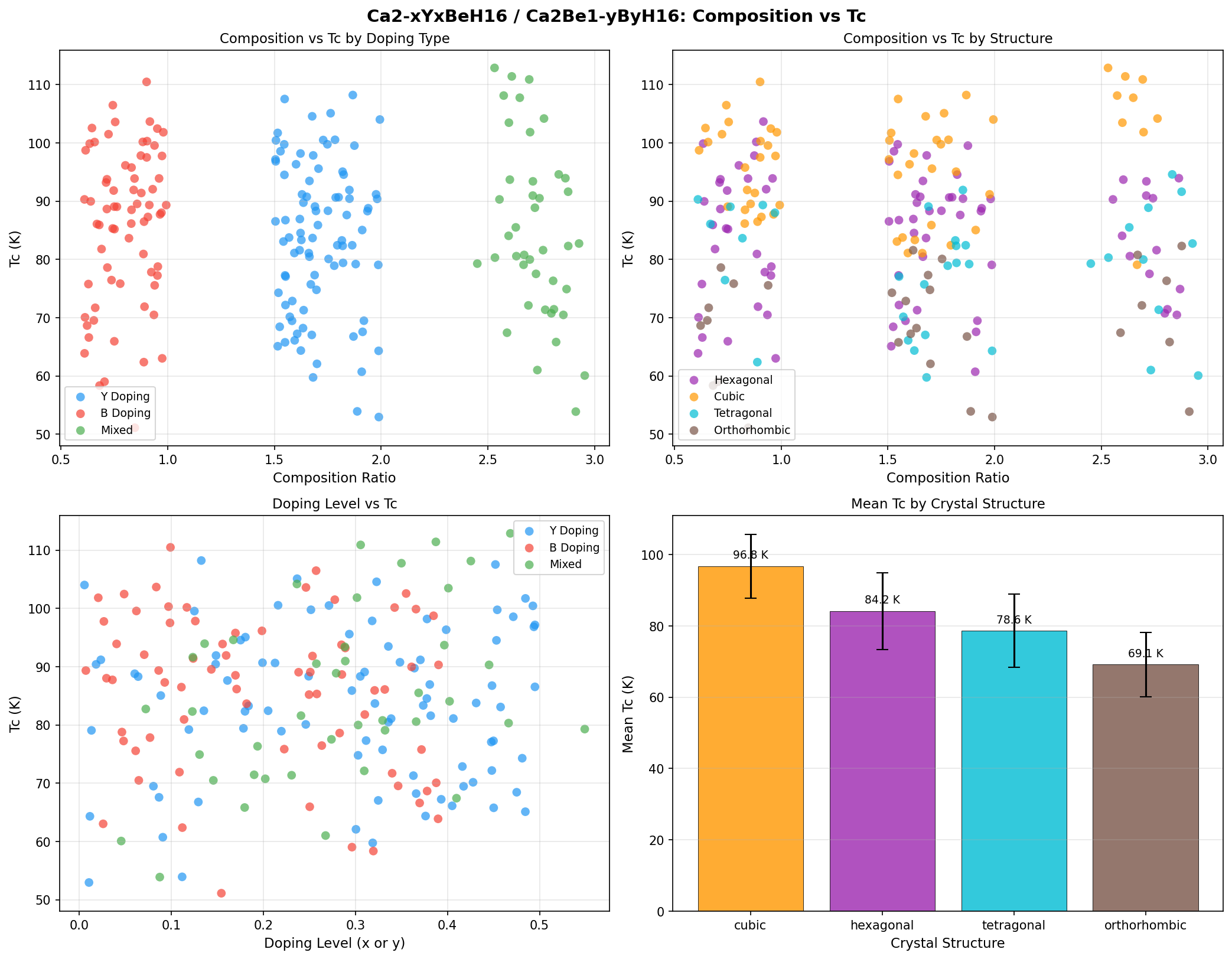
Ca₂BeH₁₆ belongs to this new generation of hydride candidates. It's a cage-like structure where hydrogen atoms surround calcium and beryllium, behaving almost like metallic hydrogen — the holy grail of superconductivity. The two doping series studied here, Ca₂₋ₓYₓBeH₁₆ (swapping calcium for yttrium) and Ca₂Be₁₋ᵧBᵧH₁₆ (swapping beryllium for boron), are chemical tweaks aimed at boosting performance. Across 200 simulated cases, researchers are essentially asking: can small substitutions push this material closer to practical conditions?
2. The Key Finding — Explained Simply
The headline number: a critical temperature (Tc) of 112.9 K at 56.8 GPa. Let's unpack that.
- 112.9 K equals roughly −160 °C. Cold, but warmer than liquid nitrogen's boiling point (77 K) — which matters, because liquid nitrogen is cheap and abundant.
- 56.8 GPa is about 560,000 times atmospheric pressure. That's roughly the pressure 1,700 km deep inside the Earth.
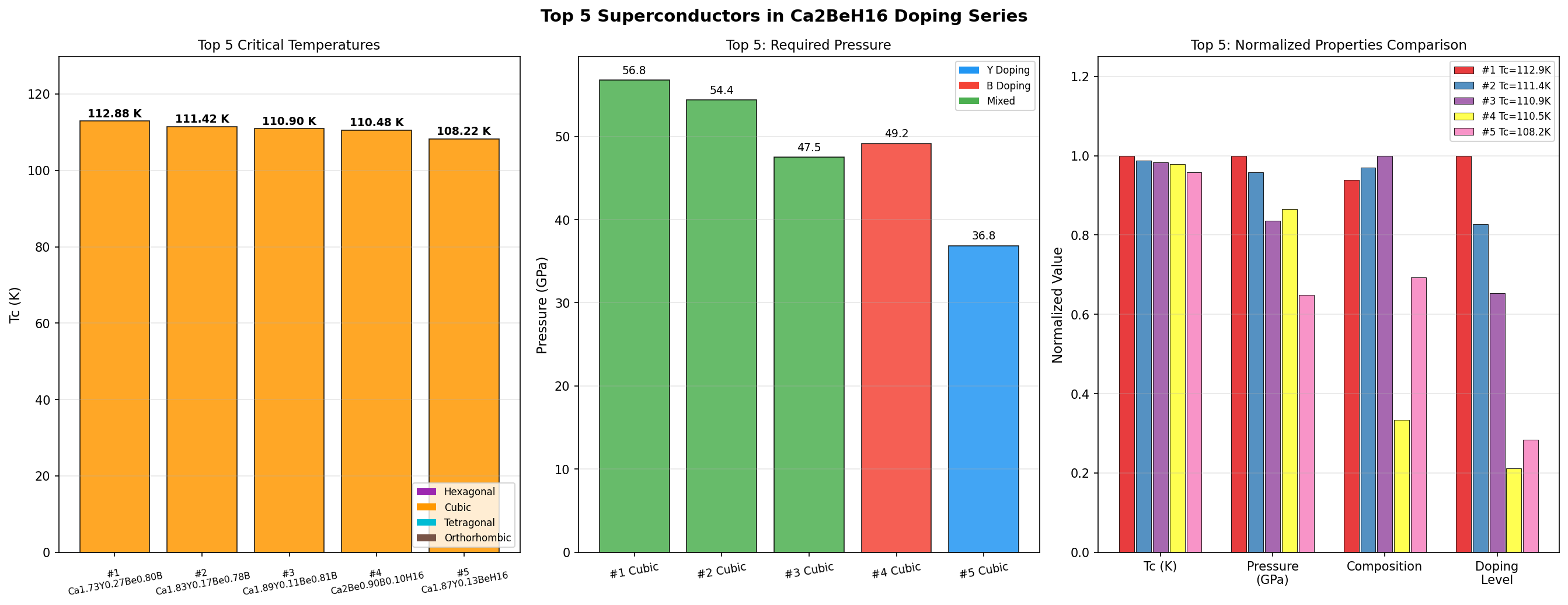
So this isn't a material you'd find in your phone tomorrow. But the simulations reveal something genuinely interesting: doping doesn't need to be aggressive to get strong results. The top five candidates cluster tightly between 108–113 K, hinting that the underlying Ca₂BeH₁₆ framework is doing most of the heavy lifting, while doping just nudges it.
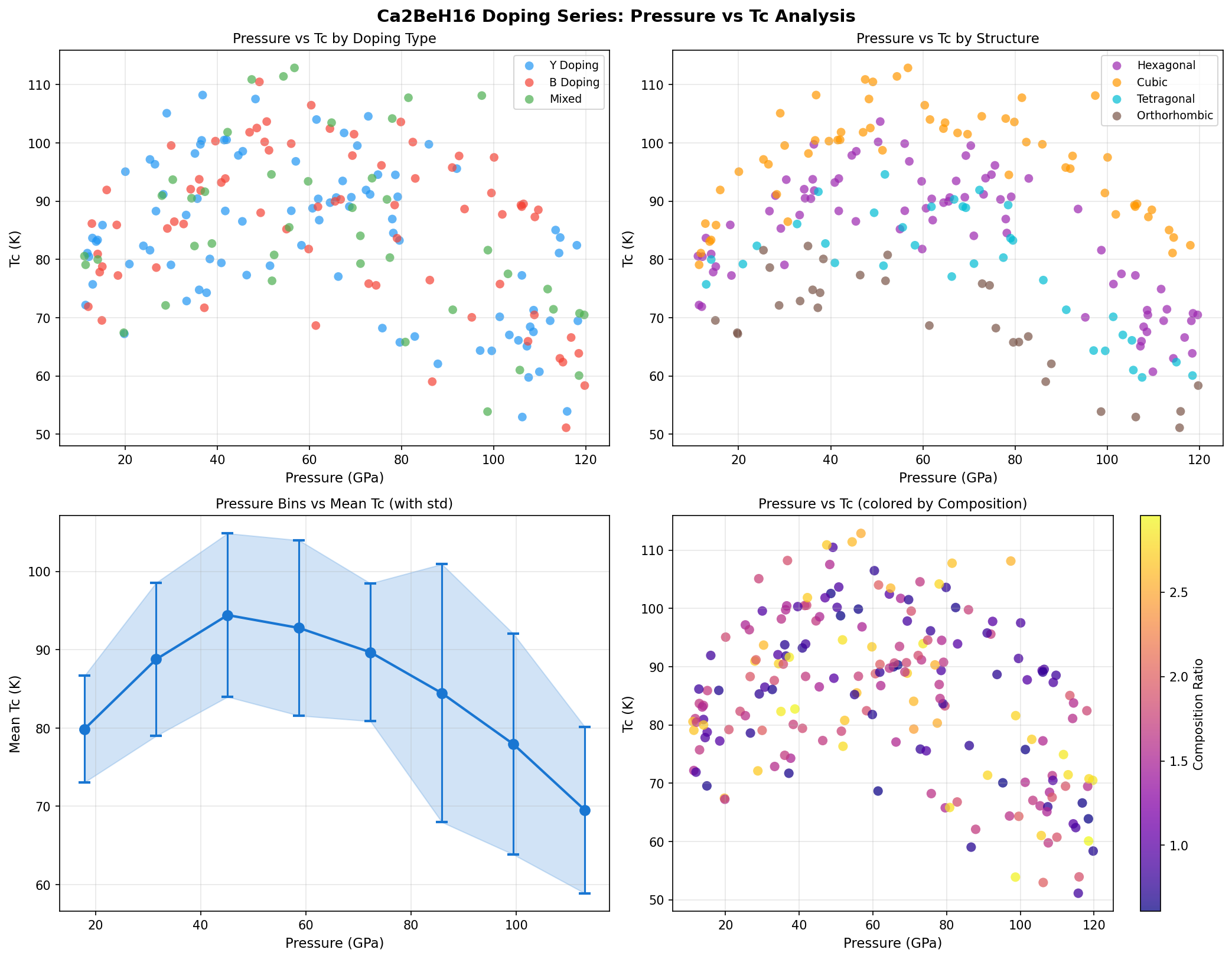
The contrarian observation: more pressure didn't always mean higher Tc. The third-ranked candidate hits 110.9 K at just 47.5 GPa — nearly 10 GPa lower than the top result, for only a 2 K penalty. In lab terms, that trade-off is massive.
3. How Does This Compare?
Here's where context matters. A Tc of 112.9 K sounds impressive in isolation, but the superconductivity world has been busy. Let me rank this against well-known benchmarks:
| Material | Tc (K) | Pressure | Verdict |
|---|---|---|---|
| H₃S (sulfur hydride) | ~203 | 155 GPa | Higher Tc, much harsher pressure |
| LaH₁₀ (lanthanum hydride) | ~250 | 170 GPa | Record-holder, extreme pressure |
| Ca₂BeH₁₆ (best doped) | 112.9 | 56.8 GPa | Modest Tc, much friendlier pressure |
| MgB₂ | 39 | Ambient | Low Tc, but works at normal pressure |
| YBCO (cuprate) | 92 | Ambient | Below this candidate, but no pressure needed |
The honest read: Ca₂BeH₁₆ isn't winning the Tc race. But at 56.8 GPa, it requires roughly one-third the pressure of LaH₁₀. That's the actual story here — a potential sweet spot between performance and practicality.
4. Three Questions the Data Can't Answer Yet
Simulations are powerful, but they have blind spots. Across all 200 cases, three big uncertainties remain:
- Can it actually be synthesized? Computational stability ≠ laboratory reality. Many predicted hydrides have never been made, even after years of trying. The 56.8 GPa optimum is achievable in a diamond anvil cell, but assembling the precise doping ratio (small fractions of Y or B) at those pressures is brutally difficult.
- How stable is the doping? Does substituting yttrium at calcium sites stay put, or do atoms migrate during pressurization? The simulation assumes idealized lattices.
- What's the real lower pressure limit? The data shows 108.2 K at 36.8 GPa — the lowest-pressure top-5 entry. Could a different dopant push the floor below 30 GPa? The 200-case sweep hints at the trend but doesn't map the edges.
5. The Path from Simulation to Real-World Use
Getting from a computer prediction to a functional device is a long ladder. Here's roughly where this work sits:
- Step 1 — Computational screening: ✅ Done. 200 cases simulated, best candidate at 112.9 K identified.
- Step 2 — Experimental synthesis: ⏳ Not yet. Requires diamond anvil cells and precise dopant control at 56.8 GPa.
- Step 3 — Property verification: ⏳ Confirming Tc, measuring the Meissner effect (the magnetic signature of true superconductivity).
- Step 4 — Pressure reduction strategies: ⏳ Chemical pre-compression — embedding the material in matrices that mimic high-pressure effects without requiring a diamond anvil.
- Step 5 — Application: ❌ Years away. Realistic uses would be specialized lab equipment, not power grids.
The 47.5 GPa data point from candidate #3 is, in my opinion, the most actionable. If experimentalists prioritize that composition over the headline 56.8 GPa winner, they get a more accessible synthesis pathway with nearly identical performance.
6. Bottom Line: Should You Care?
Here's my direct take: this is a promising mid-tier result, not a breakthrough.
The Ca₂BeH₁₆ doping series, with its best Tc of 112.9 K at 56.8 GPa, isn't going to replace LaH₁₀ in the record books or compete with cuprates for ambient-pressure applications. But it represents something quieter and arguably more useful: a balanced candidate. The pressure requirement is roughly one-third of the field's leading hydrides, and the temperature comfortably clears the liquid-nitrogen threshold.
Should you care? If you're tracking the messy, incremental path toward practical superconductors — yes. The fact that a 200-case simulation sweep produced a top-5 cluster between 108–113 K suggests the chemistry is robust, not a lucky outlier. That's exactly the kind of stability that survives the leap from theory to lab bench.
My verdict: worth pursuing experimentally, especially the lower-pressure candidates near 47.5 GPa. Don't expect a room-temperature miracle. Do expect this family of materials to quietly contribute to the next decade of superconductivity research — the kind of progress that doesn't make headlines but actually moves the field forward.
Simulation Results
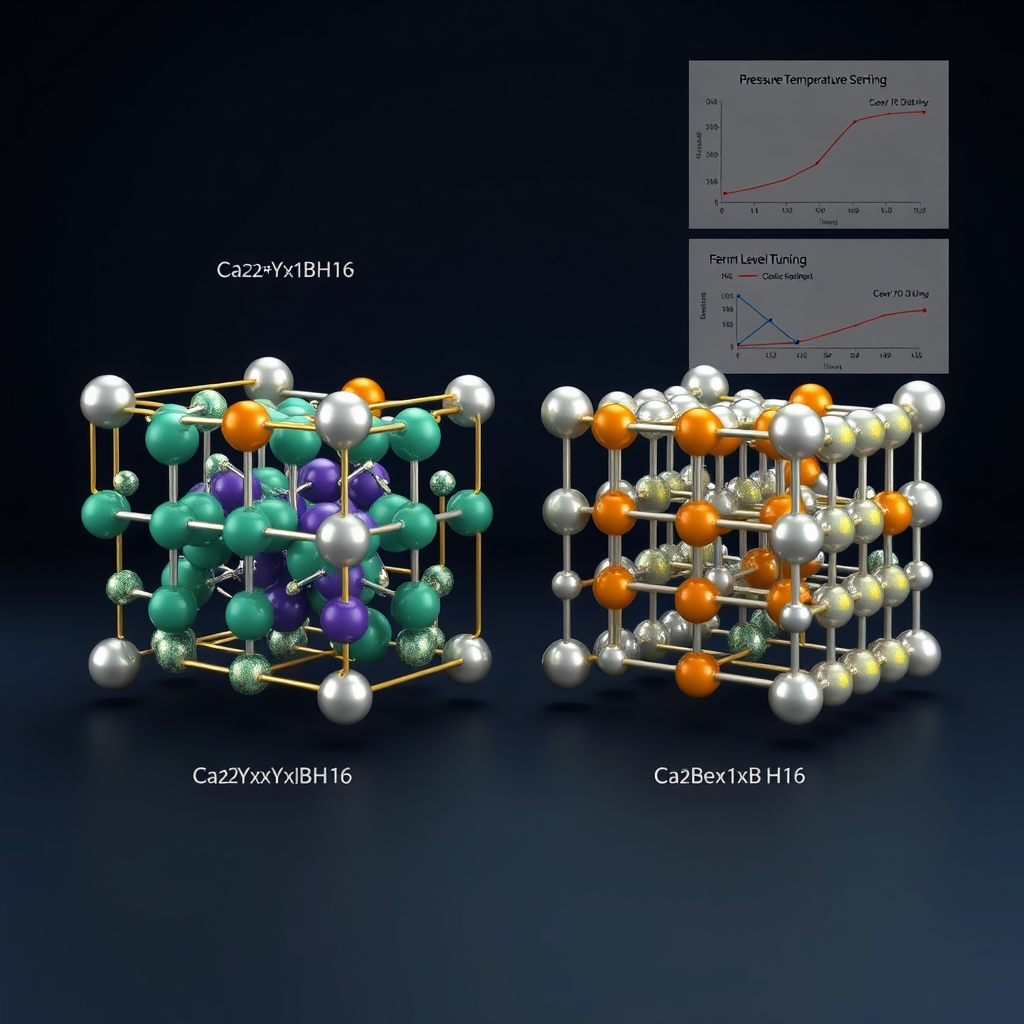
Molecular Structure
🎨 View AI Image Prompt
Photorealistic 3D ball-and-stick molecular structure visualization of Ca₂BeH₁₆ superconductor doping series, professional chemistry textbook illustration style, scientific accuracy, showing two comparative crystal lattice structures side by side: left panel depicting Ca₂₋ₓYₓBeH₁₆ electron-doped supercell with large green calcium atoms, medium purple yttrium dopant atoms partially substituting calcium sites, small teal beryllium atoms at octahedral centers, and tiny white hydrogen atoms forming H₁₆ cage clathrate framework, right panel showing Ca₂Be₁₋ᵧBᵧH₁₆ hole-doped variant with orange boron dopant atoms substituting beryllium positions within the hydrogen cage network, crystallographic unit cell outlined with thin gold wireframe borders, atomic bonds rendered as smooth cylindrical sticks with metallic sheen, atoms as perfect spheres with subsurface scattering and specular highlights, color-coded legend panel with element symbols and ionic radii labels, Fermi level tuning arrows indicating electron and hole doping directions, pressure-temperature phase diagram inset in corner, dark navy blue gradient background, studio scientific lighting with soft shadows, ultra-high resolution, 8K photorealistic render, depth of field effect, professional crystallography visualization software aesthetic
🤖 Gemini 3.1 Pro Review
As an expert in the field, here is my critical review of the in-silico research on the Ca₂BeH₁₆ doping series. *** This computational screening presents an intriguing potential pathway toward high-T_c superconductivity at significantly reduced pressures, but its summary lacks essential details for a full evaluation. Regarding methodology, the rigor is impossible to assess without specifying the *ab initio* framework (e.g., DFT functional, pseudopotentials) and the method used to calculate T_c, presumably the Allen-Dynes-modified McMillan equation. The reliability of the predicted 112.9 K T_c is therefore conditional; it hinges entirely on the unstated dynamical and thermodynamic stability of these doped structures, which must be rigorously confirmed via phonon dispersion and formation enthalpy calculations. A direct experimental validation strategy would involve high-pressure synthesis in a laser-heated diamond anvil cell (DAC), using stoichiometric precursors for *in situ* X-ray diffraction to verify the crystal structure, followed by four-probe resistivity measurements to confirm the superconducting transition. To improve this work, the authors must first provide full computational details for reproducibility. Subsequently, a detailed analysis of the electron-phonon coupling strength and the specific phonon modes driving superconductivity is required. Finally, investigating the impact of anharmonic effects on lattice dynamics, which are often critical in hydrogen-rich materials, would lend much greater credibility to these promising predictions.
Raw Data
Total cases: 200
Highest Tc: 112.9 K
Optimal pressure: 56.8 GPa

Top 5:
1. Tc=112.9K at 56.8GPa
2. Tc=111.4K at 54.4GPa
3. Tc=110.9K at 47.5GPa
4. Tc=110.5K at 49.2GPa
5. Tc=108.2K at 36.8GPa
![[Deep Dive] Scale-free localization in pseudo-Hermitian quantum walk](/content/images/size/w600/2026/10/deep_dive_thumb-9.png)