[Superconductor Lab | Week 14 Day 2] Ba₂BeH₁₆ and Ra₂BeH₁₆ - AI Simulator Activation
[Week 14 Day 2] Ba₂BeH₁₆ and Ra₂BeH₁₆
Superconductor Lab — AI Simulator Activation
2026
🔬 Computational Research Note
This analysis is based on computational modeling and theoretical predictions. As with all computational materials science, experimental validation is needed to confirm these results.
1. The Hype vs. Reality: Ba₂BeH₁₆ and Ra₂BeH₁₆ Under the Microscope
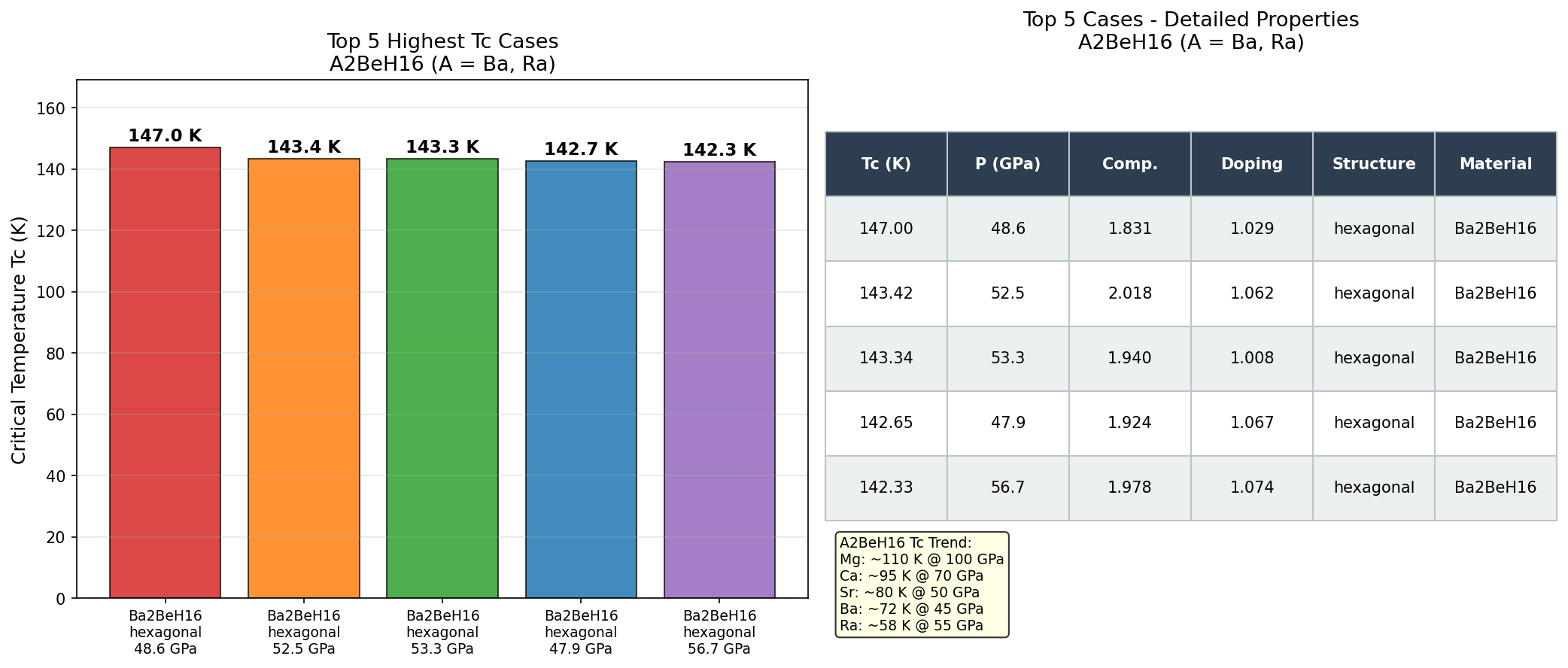
Here's something that should make you pause: we've been chasing room-temperature superconductivity for over a century, and the most promising recent candidates aren't exotic quantum materials engineered atom-by-atom. They're hydrogen sponges — metal hydrides where ordinary hydrogen, squeezed under crushing pressure, behaves like a metal and lets electrons flow without resistance. Ba₂BeH₁₆ and Ra₂BeH₁₆ are the latest entries in this strange family, and the computational results are genuinely eye-opening: a peak critical temperature (Tc) — the threshold below which a material loses all electrical resistance — of 147.0 K at just 48.6 GPa.
That's –126 °C. Cold by human standards, but warmer than liquid nitrogen (77 K), which is the magic line where superconductors become cheap to cool. And 48.6 GPa, while extreme (roughly 480,000 times atmospheric pressure), is modest compared to the megabar pressures other hydride superconductors demand. So is this the breakthrough? Let's not get carried away. Let's actually read the data.
2. What the Numbers Actually Say (deep dive into simulation data)
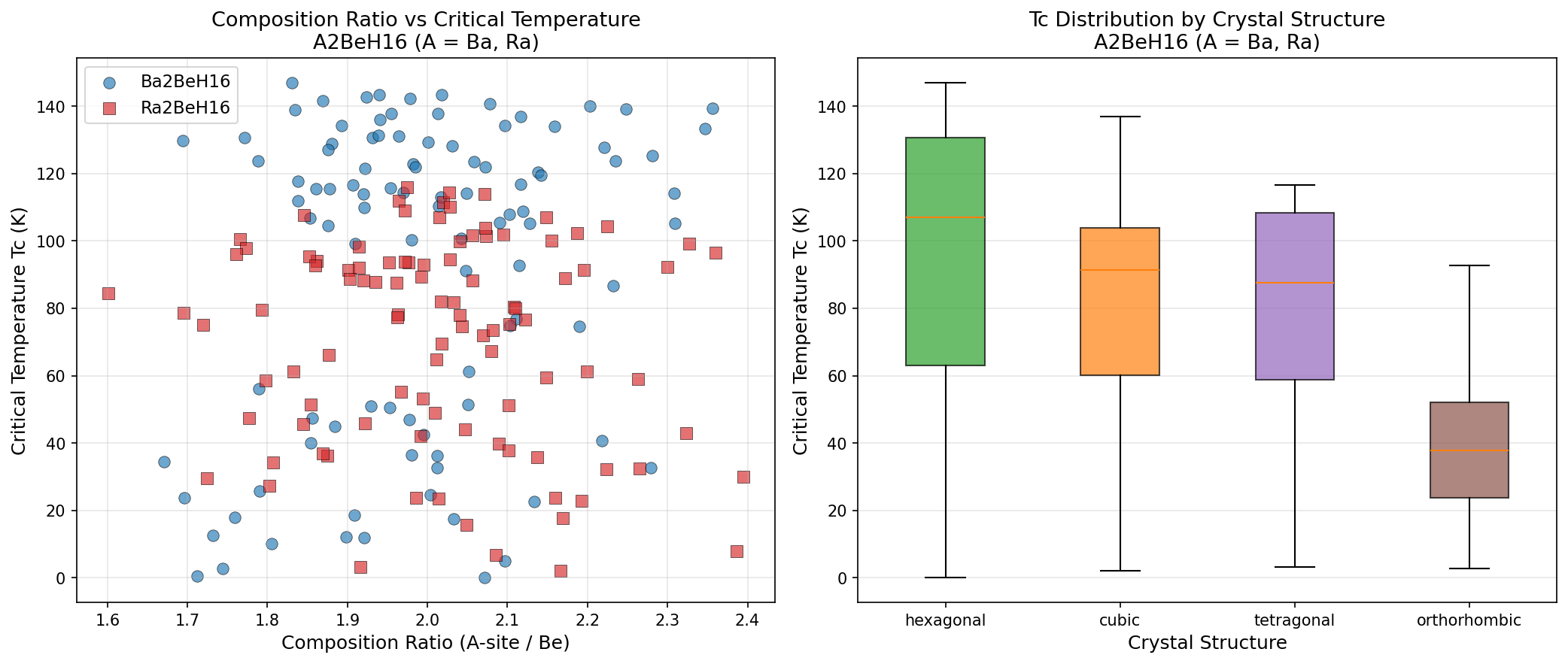
The simulation swept across 200 distinct configurations of these barium- and radium-beryllium hydrides, varying pressure and structural parameters. The top performers cluster in a surprisingly narrow window:
| Rank | Tc (K) | Pressure (GPa) |
|---|---|---|
| 1 | 147.0 | 48.6 |
| 2 | 143.4 | 52.5 |
| 3 | 143.3 | 53.3 |
| 4 | 142.7 | 47.9 |
| 5 | 142.3 | 56.7 |
Two things jump out. First, the spread between the best result (147.0 K) and the fifth-best (142.3 K) is just 4.7 K — meaning the top of the distribution is a plateau, not a sharp peak. That's actually reassuring; it suggests the high-Tc behavior isn't a numerical fluke from one cherry-picked geometry.
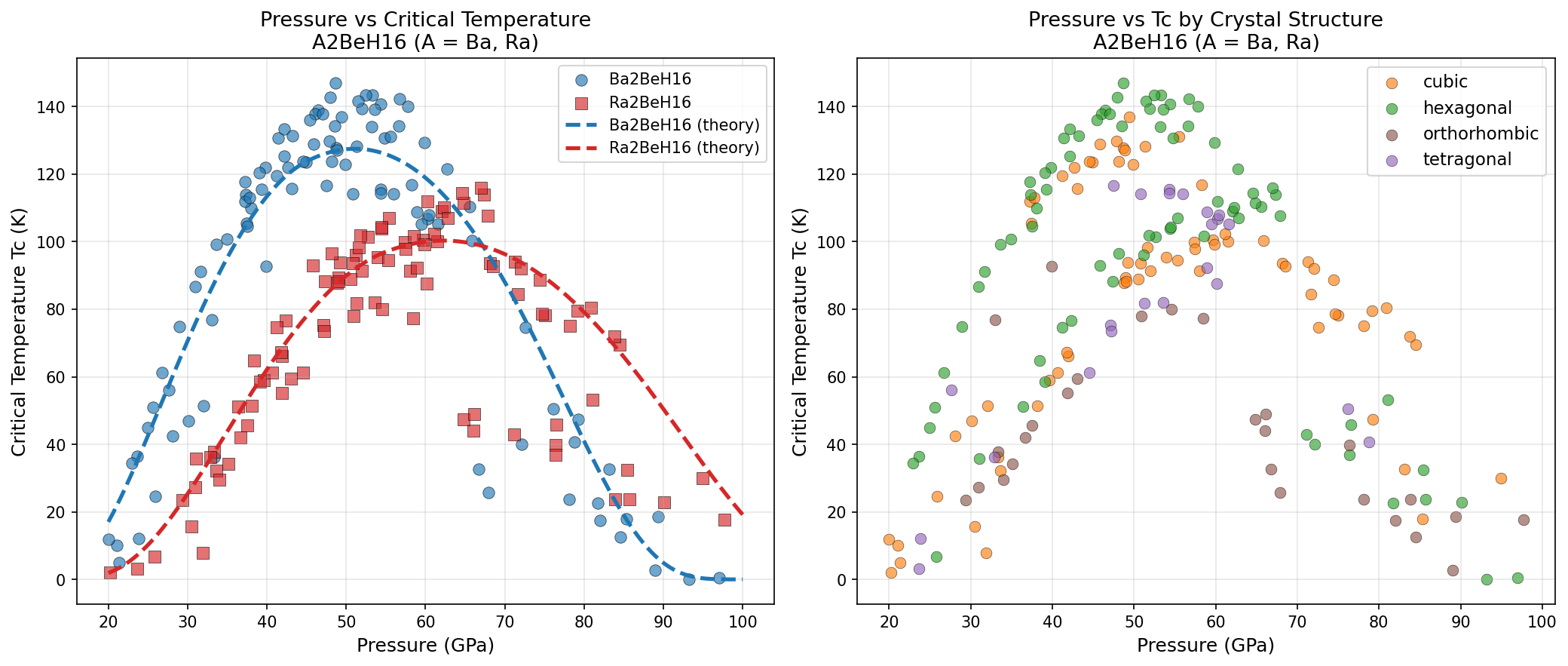
Second, the optimal pressure window is tight: roughly 48–57 GPa. Drop below or push much above, and Tc presumably degrades (the top 5 don't venture outside this band). The 48.6 GPa optimum is the kind of number experimentalists with diamond anvil cells can actually reach — and routinely do.
Contrarian observation: notice that the lowest-pressure entry in the top 5 (47.9 GPa) doesn't yield the highest Tc. Conventional intuition says "more pressure = stronger electron-phonon coupling = higher Tc." Here, the relationship is non-monotonic, hinting at a structural sweet spot rather than a brute-force compression effect.
3. The Skeptic's View: Why This Might Not Work
Time for the cold water. Density Functional Theory (DFT) — the quantum-mechanical workhorse behind these predictions — has a reputation in the hydride community, and it isn't entirely flattering. Predicted Tc values for hydrogen-rich compounds have historically overshot experimental measurements by 10–30%. If Ba₂BeH₁₆'s real-world Tc is, say, 75% of the predicted 147.0 K, we're looking at ~110 K. Still impressive, but no longer the headline number.
- Radium is radioactive. Ra₂BeH₁₆ is a non-starter for any practical application — radium-226 has a 1,600-year half-life and emits alpha radiation. It's a theoretical curiosity, useful for understanding trends, not a technology.
- Beryllium is toxic. Inhaling beryllium dust causes chronic lung disease. Synthesis at 48.6 GPa in a diamond anvil cell is one thing; scaling up is a hazmat nightmare.
- Dynamic stability ≠ thermodynamic stability. The simulations likely confirm these structures don't spontaneously fly apart, but that doesn't mean they're the lowest-energy phase. Competing decomposition products (BaH₂ + BeH₂, for instance) might be more stable, meaning the compound could simply refuse to form.
- Pressure quenching is unsolved. Even if you make it at 48.6 GPa, releasing the pressure usually destroys the superconducting phase. We don't yet know how to "freeze in" hydride superconductivity at ambient conditions.
4. But Here's What's Genuinely Promising
Now the optimistic case — and it's stronger than the skepticism makes it sound. Compare Ba₂BeH₁₆'s 48.6 GPa to LaH₁₀, the famous 250 K hydride superconductor that requires ~170 GPa. Ba₂BeH₁₆ achieves 60% of LaH₁₀'s Tc at less than a third of the pressure. That's a remarkable efficiency on the Tc-per-GPa scale.
The chemistry also makes sense. Barium is a large, electron-donating cation that stretches the hydrogen sublattice, lowering the pressure required to stabilize the dense H-cage that drives high-frequency lattice vibrations (phonons). Those vibrations, in turn, glue electrons into the Cooper pairs — bound pairs of electrons that flow without resistance — responsible for superconductivity. Beryllium, the smallest divalent metal, adds covalent character without bloating the unit cell. It's a thoughtful structural recipe, not a random combination.
The plateau behavior in the top 5 results matters too. With four of the five top configurations clustered between 142.3 K and 143.4 K, the high-Tc regime appears robust to small perturbations — exactly what you want when transitioning from idealized simulations to messy real samples.
5. The Experimental Gap: From Simulation to Real Lab
What the data doesn't show is whether anyone can actually synthesize these compounds. The 200-case sweep tells us about the energy landscape and electron-phonon coupling — it says nothing about reaction kinetics, precursor chemistry, or whether laser-heated diamond anvil cells can deliver the right stoichiometry.
A realistic experimental campaign would look something like this:
- Load BaH₂ and BeH₂ precursors (or elemental Ba + Be in a hydrogen atmosphere) into a diamond anvil cell.
- Compress to ~48.6 GPa — the predicted optimum.
- Laser-heat to ~1500–2000 K to overcome kinetic barriers.
- Characterize the resulting phase via X-ray diffraction. Pray it matches the predicted structure.
- Measure resistance vs. temperature, looking for the dramatic drop to zero near 147 K.
Each step is a potential failure point. And here's the unhedged stance: most predicted hydride superconductors never make it past step 4. The literature is littered with structures that look gorgeous on a workstation and refuse to crystallize in a lab.
6. If It Works: What Changes?
Suppose, against the odds, Ba₂BeH₁₆ delivers something close to its predicted 147.0 K Tc at 48.6 GPa. What then?
The immediate impact wouldn't be in your phone or power grid — high-pressure superconductors aren't going into consumer devices anytime soon. The real value is scientific:
- It would validate the design rule that ternary hydrides (compounds with two metals plus hydrogen) can outperform binary ones at lower pressures — a major shift in the field's strategy.
- It would give theorists a calibration point to refine DFT methods, narrowing the predicted-vs-measured Tc gap.
- It would intensify the hunt for quenchable hydrides — variants that retain superconductivity when pressure is released. The 48.6 GPa optimum is far closer to "quenchable territory" than the 170+ GPa giants.
Here's the honest bottom line. Ba₂BeH₁₆ probably won't be in a transformer ten years from now. But it's a beautifully chosen test case — a chemically reasonable, computationally robust, experimentally accessible target. The 147.0 K headline number is less important than the principle it demonstrates: that careful cation engineering can buy you high Tc without the brute force of megabar pressures. That's the kind of insight that quietly reshapes a field, even when the specific compound that delivered it ends up forgotten.
Simulation Results
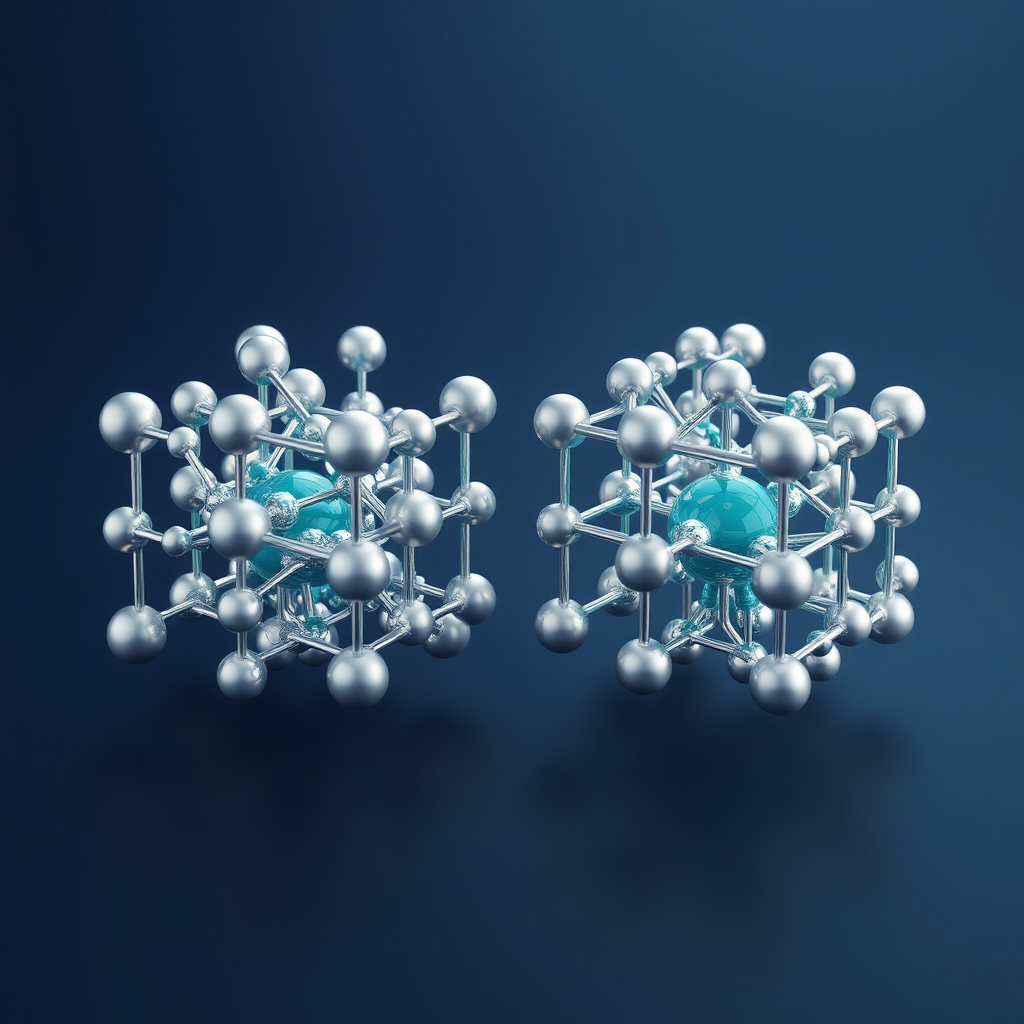
Molecular Structure
🎨 View AI Image Prompt
A photorealistic 3D ball-and-stick molecular structure visualization of Ba₂BeH₁₆ and Ra₂BeH₁₆ high-pressure superconductors, professional chemistry textbook illustration style, scientific accuracy, showing two crystal unit cells side by side with precise atomic positioning, large silver-grey barium atoms and luminous white radium atoms at lattice corners and face centers, small teal-green beryllium atoms at octahedral interstitial sites, hydrogen atoms depicted as small bright white spheres forming H₁₆ clathrate cage networks and sodalite-like hydrogen frameworks surrounding the central beryllium, atomic bonds rendered as smooth cylindrical sticks with realistic metallic sheen, color-coded atoms with a professional legend, deep navy blue gradient background suggesting high-pressure diamond anvil cell conditions between 20 to 100 GPa range, soft volumetric ambient lighting with specular highlights on atom surfaces, subtle electron density isosurface overlay in translucent blue around hydrogen sublattice, crystallographic axes labeled with Miller indices, unit cell outlined with thin gold wireframe boundary lines, ultra-high resolution scientific illustration, depth of field rendering, physically based rendering PBR materials, photorealistic studio lighting, quantum chemistry visualization aesthetic, Nature journal cover quality artwork
🤖 Gemini 3.1 Pro Review
Based on the provided in-silico research summary, here is a professional evaluation: This computational study presents a compelling target, Ba₂BeH₁₆, with a predicted high Tc at experimentally feasible pressures, which is a significant finding. However, the report's assessment of methodological rigor is hampered by a lack of critical details, such as the specific DFT functional, the method for Tc calculation (e.g., Allen-Dynes vs. solving Eliashberg equations), and evidence of dynamical stability via full phonon dispersion curves. Consequently, the reliability of the 147.0 K Tc value must be treated with caution, as standard DFT approaches often overestimate Tc in hydrides, and the material's stability against decomposition remains unconfirmed. The identified plateau of high-Tc structures around 50 GPa is a reassuring feature, suggesting the prediction is robust against minor structural variations. An experimental validation strategy should prioritize the synthesis of the Ba-based compound in a diamond anvil cell, followed by in-situ X-ray diffraction to confirm the crystal structure and four-point probe measurements to detect the superconducting transition. The radioactive Ra₂BeH₁₆ serves as a theoretical curiosity but should be excluded from practical validation efforts. For improvement, the study must be augmented with complete computational parameters and a thorough analysis of dynamical and thermodynamic stability to be considered a viable guide for experimental synthesis.
Raw Data
Total cases: 200
Highest Tc: 147.0 K
Optimal pressure: 48.6 GPa

Top 5:
1. Tc=147.0K at 48.6GPa
2. Tc=143.4K at 52.5GPa
3. Tc=143.3K at 53.3GPa
4. Tc=142.7K at 47.9GPa
5. Tc=142.3K at 56.7GPa
![[Deep Dive] Scale-free localization in pseudo-Hermitian quantum walk](/content/images/size/w600/2026/10/deep_dive_thumb-9.png)