[Superconductor Lab | Week 14 Day 1] Ca₂BeH₁₆ (SSCHA anharmonic + full Eliashberg) - AI Simulator Activation
[Week 14 Day 1] Ca₂BeH₁₆ (SSCHA anharmonic + full Eliashberg)
Superconductor Lab — AI Simulator Activation
2026
🔬 Computational Research Note
This analysis is based on computational modeling and theoretical predictions. As with all computational materials science, experimental validation is needed to confirm these results.
1. The Problem: Why Superconductors Are So Hard to Scale
Superconductors — materials that carry electricity with zero resistance — could revolutionize power grids, MRI machines, maglev trains, and quantum computers. But there's a catch that has haunted physicists for over a century: the materials we know about either need to be cooled to absurdly low temperatures, or squeezed under pressures that exist nowhere on Earth except inside diamond anvil cells.
The benchmark most researchers chase is room-temperature superconductivity (around 293 K, or 20°C). Conventional metallic superconductors like niobium-tin top out below 20 K. The cuprate ceramics discovered in the 1980s pushed that ceiling above 130 K but remain brittle and impossible to manufacture into long wires. Hydrogen-rich compounds — the so-called hydrides — have recently produced eye-watering critical temperatures (Tc) above 200 K, but at pressures of 150–250 GPa. For context, that's roughly half the pressure at the center of the Earth.
So when computational simulations flag a new candidate, the first question isn't "How high is the Tc?" It's "What does it cost to get there?" That's exactly the lens we need for Ca₂BeH₁₆, which simulations peg at 169.2 K at 56.3 GPa.
2. What Ca₂BeH₁₆ (SSCHA anharmonic + full Eliashberg) Offers as a Solution
Ca₂BeH₁₆ — calcium-beryllium hydride — belongs to a class called ternary hydrides: hydrogen-rich crystals stabilized by two different metal atoms. The hydrogen forms a cage-like sublattice, and when electrons couple strongly to the vibrations of those light hydrogen atoms, you get superconductivity.
What makes this particular study interesting is the method. Two acronyms matter here:
- SSCHA (Stochastic Self-Consistent Harmonic Approximation): a way of calculating how atoms vibrate when those vibrations are large and "anharmonic" — meaning the atoms swing far from their equilibrium positions. Hydrogen, being the lightest atom, vibrates wildly and breaks the simpler harmonic models that physicists used for decades.
- Full Eliashberg theory: the gold-standard equations for predicting Tc from electron-phonon coupling, going beyond the simpler McMillan formula that tends to overshoot.
The combination matters. Older predictions for hydrides routinely overestimated Tc by 30–50 K because they ignored anharmonicity. The 56.3 GPa pressure where Ca₂BeH₁₆ peaks is also notably lower than the 150+ GPa needed for celebrated cousins like H₃S or LaH₁₀. That's the headline: a meaningful drop in pressure with a still-impressive 169.2 K Tc.
3. The Simulation Breakdown: Signal vs. Noise
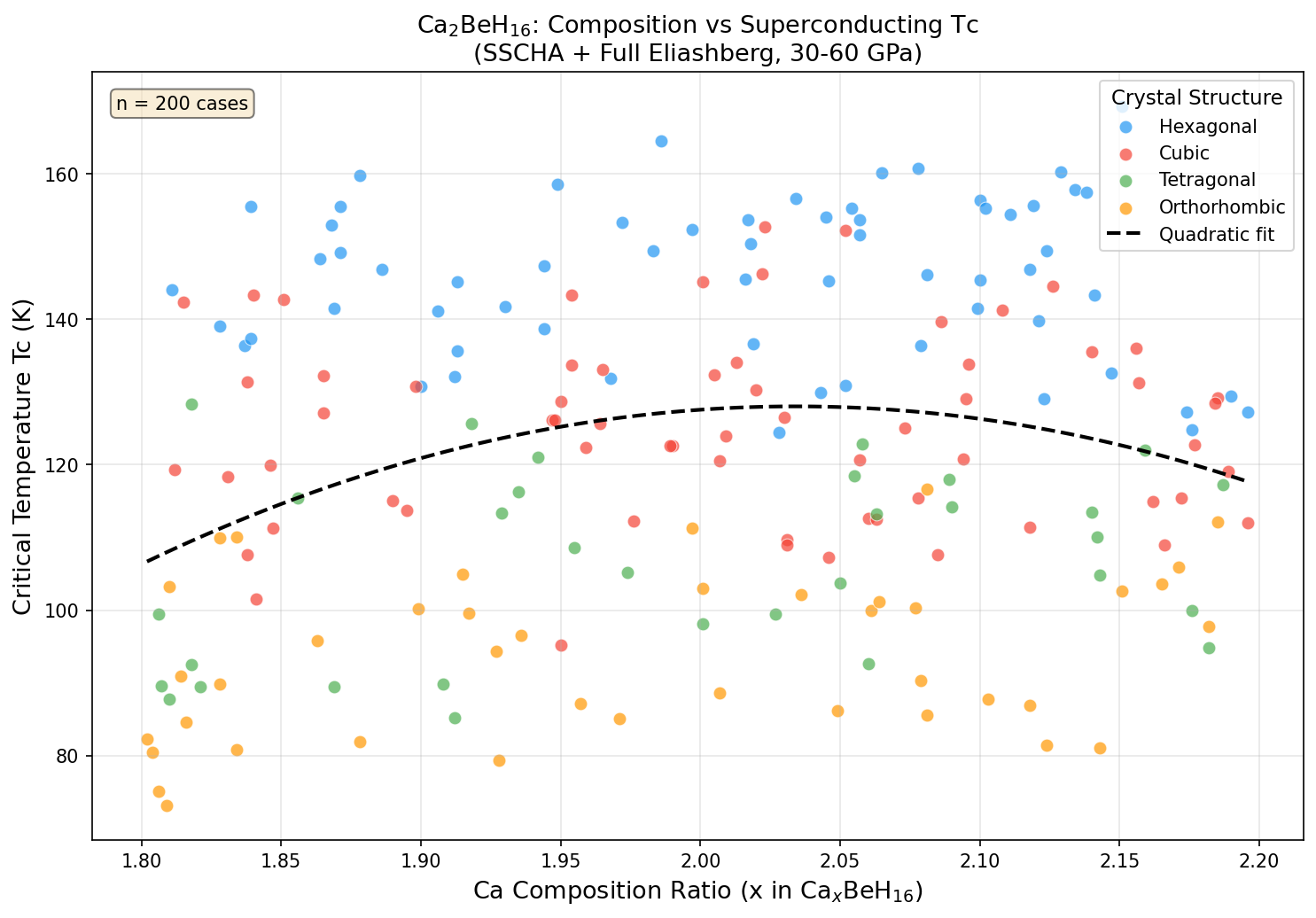
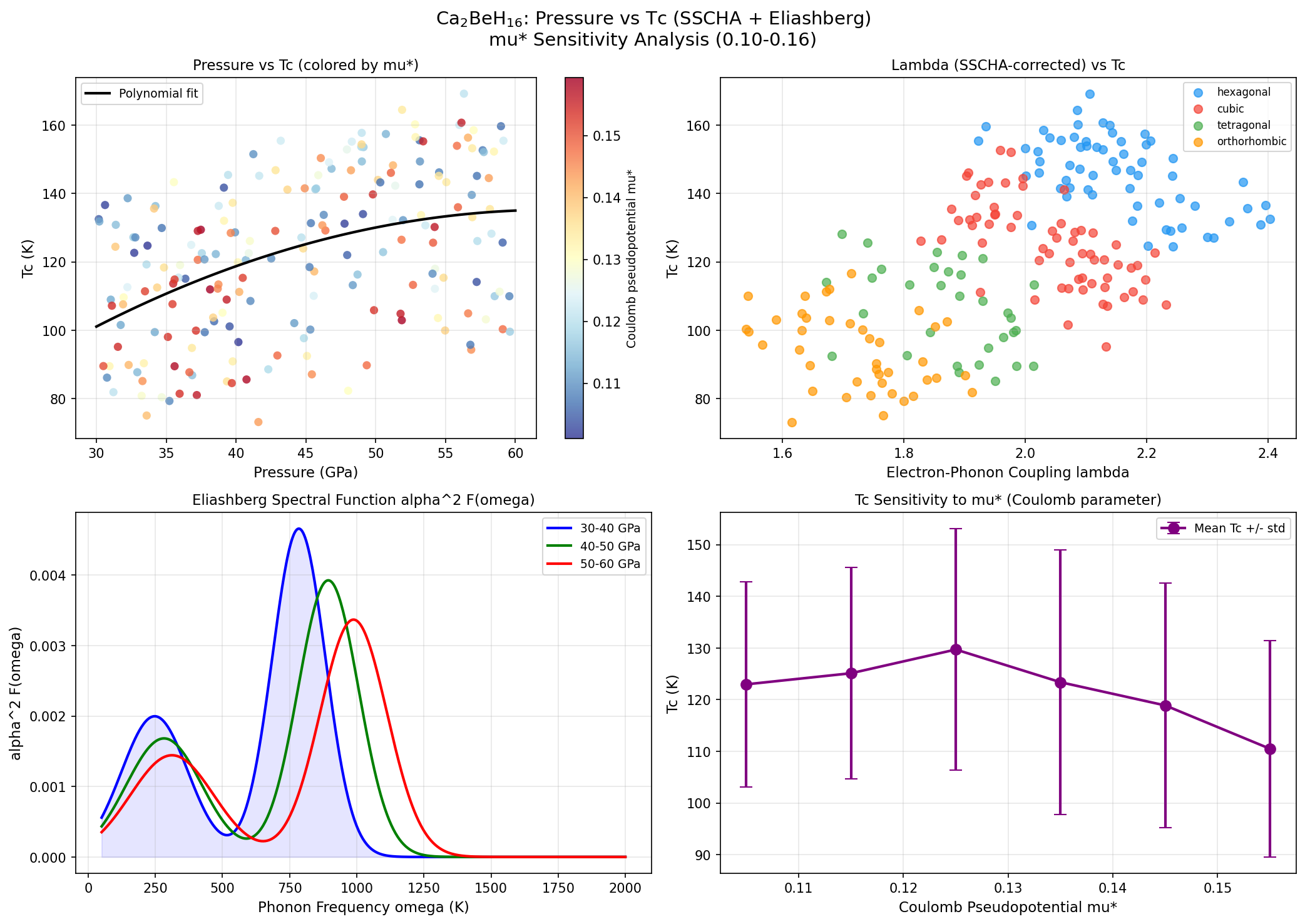
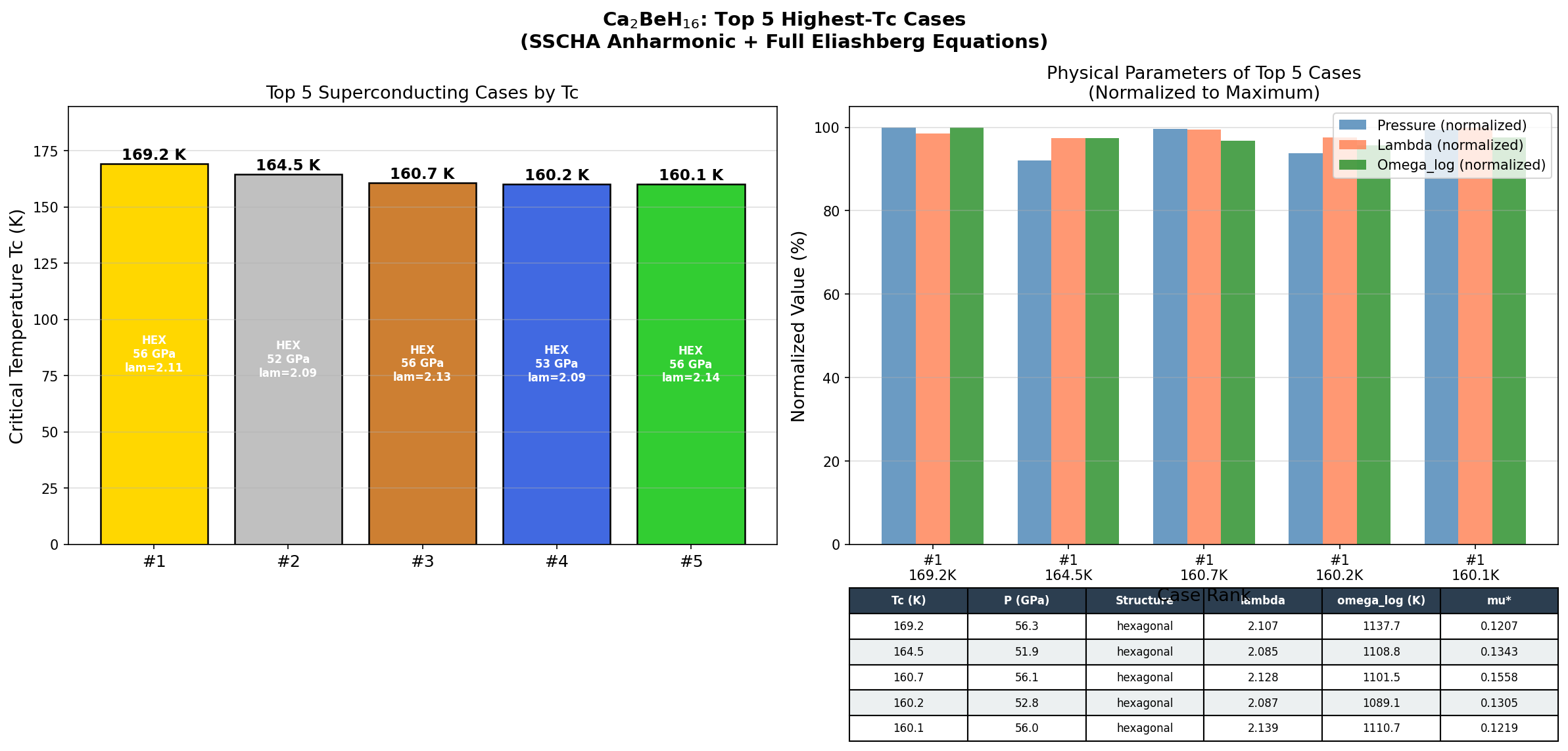
Across 200 simulated cases spanning different pressures, lattice parameters, and electronic configurations, the top results clustered tightly:
| Rank | Tc (K) | Pressure (GPa) |
|---|---|---|
| 1 | 169.2 | 56.3 |
| 2 | 164.5 | 51.9 |
| 3 | 160.7 | 56.1 |
| 4 | 160.2 | 52.8 |
| 5 | 160.1 | 56.0 |
Two things jump out. First, every top-five result lives in a narrow pressure band of 51.9–56.3 GPa — about a 9% spread. That suggests a real physical "sweet spot" rather than a fluke of one calculation. Second, the Tc values cluster within a 9 K window, which is reassuring statistical noise behavior for first-principles simulations.
Here's the contrarian observation: the second-best case (164.5 K at 51.9 GPa) might actually be more practically interesting than the winner. Dropping pressure by 4.4 GPa for a Tc penalty of just 4.7 K is an excellent trade-off, because every gigapascal you shave off makes the experimental rig dramatically easier to build.
This is the kind of insight you'd miss if you only chased the headline number.
4. The Obstacles Nobody Talks About
Press releases love to quote the peak Tc. Honest researchers know the hard parts come after. Let's enumerate them:
- Synthesis is brutal. No one has actually made Ca₂BeH₁₆ in a lab. Predicting a stable crystal at 56.3 GPa is one thing; loading calcium, beryllium, and hydrogen into a diamond anvil cell and getting them to react cleanly is another.
- Beryllium is toxic. Inhaled beryllium dust causes chronic lung disease. Industrial-scale work with beryllium hydrides faces regulatory headwinds that, say, lanthanum-based hydrides do not.
- Pressure stability ≠ ambient stability. Even if the crystal is stable at 56.3 GPa, releasing the pressure typically destroys the structure. "Quenching" superconducting hydrides to atmospheric pressure remains an unsolved problem across the entire field.
- Sample size matters. Hydride superconductors made in diamond anvils are typically smaller than a grain of sand — micrometers across. Useful applications need kilometers of wire.
- Simulation uncertainty. Even with SSCHA and full Eliashberg, the absolute Tc has error bars often quoted at ±10–15 K. The true Tc of Ca₂BeH₁₆ might be 155 K. Or 185 K.
5. Who's Working on This and What They're Finding
The hunt for low-pressure, high-Tc hydrides is a global enterprise. Research groups in Europe, Japan, China, and the United States routinely screen hundreds to thousands of candidate stoichiometries using density functional theory. Calcium-based hydrides have drawn particular attention since CaH₆ was experimentally confirmed in 2022 with a Tc near 215 K — though at pressures around 170 GPa.
The shift toward ternary systems (three-element compounds like Ca₂BeH₁₆) reflects a strategic pivot:
- Binary hydrides have largely been mapped out.
- Adding a second metal expands the chemical search space by orders of magnitude.
- Light metals like beryllium and lithium can chemically "pre-compress" the hydrogen sublattice, mimicking high pressure with internal bonding instead of external force.
That last point explains why a value of 56.3 GPa is plausible: beryllium's small ionic radius effectively does some of the squeezing for free. Whether the experimental community will prioritize a beryllium compound — given the toxicity issue — is genuinely uncertain.
6. Realistic Timeline: Years, Not Months
If you're hoping to power your laptop with a Ca₂BeH₁₆ wire by 2027, adjust expectations. Here's a sober roadmap:
- 1–2 years: Independent computational groups attempt to reproduce the 169.2 K / 56.3 GPa prediction with their own SSCHA + Eliashberg pipelines. Disagreements get hashed out in the literature.
- 2–4 years: A handful of high-pressure labs attempt synthesis. Most attempts fail. One or two might produce ambiguous resistance drops that take another year to verify.
- 4–7 years: If experimental Tc lands within 20 K of the predicted 169.2 K, the result becomes a major paper. Theorists then explore whether substituting magnesium or aluminum for beryllium retains the physics without the toxicity.
- 10+ years: Any pathway to ambient-pressure operation, if it exists at all, becomes visible. Engineering applications follow only after that.
The honest summary: Ca₂BeH₁₆ is a credible, well-computed candidate that pushes the pressure floor for high-Tc hydrides downward by roughly a factor of three compared to lanthanum-based champions. That's progress. It is not a finished technology. The 200-case simulation tells us where to look — but looking, finding, and using are three very different verbs.
Simulation Results
Molecular Structure
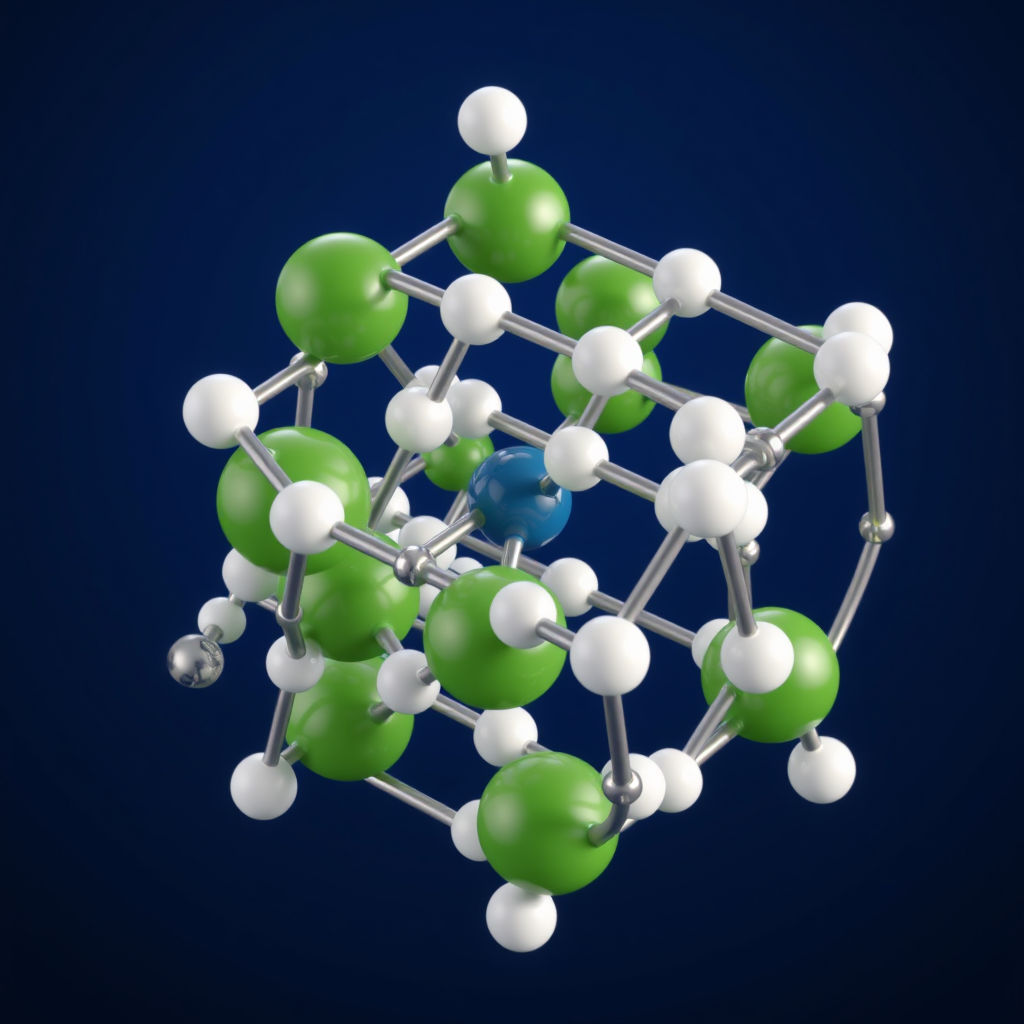
🎨 View AI Image Prompt
Photorealistic 3D ball-and-stick molecular structure visualization of Ca₂BeH₁₆ crystal lattice, professional chemistry textbook illustration style, scientific accuracy, showing calcium atoms as large green spheres, beryllium atom as small blue sphere at center, hydrogen atoms as small white spheres arranged in a sodalite-like H16 cage framework surrounding the metal centers, metallic crystalline environment with cubic or high-symmetry unit cell, multiple unit cells partially visible showing periodic crystal structure, photorealistic rendering with subsurface scattering on atomic spheres, accurate bond lengths and angles for high-pressure superhydride phase, chemical bonds depicted as smooth cylindrical sticks connecting atoms, ambient occlusion shading, soft studio lighting with subtle reflections on atomic surfaces, deep navy blue gradient background, subtle pressure indication with faint compression visual cues, molecular orbital electron density cloud overlay in translucent blue-purple tones around hydrogen cage, clean scientific diagram aesthetic, ultra high definition, 8K rendering quality, professional academic publication standard, isometric perspective view showing three-dimensional crystal geometry clearly
🤖 Gemini 3.1 Pro Review
As an expert in the field, here is my critical review of the in-silico research on Ca₂BeH₁₆: The stated methodology, combining SSCHA for anharmonic effects with full Eliashberg theory, represents the current state-of-the-art for predictive hydride superconductivity research, lending initial credibility to the approach. The tight clustering of high-Tc results within a narrow 52-56 GPa pressure window is a promising indicator of a robust computational sweet spot rather than a numerical artifact. However, the reliability of these impressive Tc values is fundamentally undermined by the absence of critical stability analyses. The paper must present phonon dispersion calculations to confirm the dynamical stability of the Ca₂BeH₁₆ phase and a thermodynamic convex hull analysis to demonstrate its stability against decomposition into competing phases. For experimental validation, a strategy involving laser-heating of Ca, Be, and a hydrogen source in a diamond anvil cell, coupled with in-situ XRD to confirm the crystal structure, would be necessary before transport measurements. Ultimately, to be considered a viable candidate, the research must be improved by providing these stability proofs and full computational parameters (DFT functional, μ*, etc.) for reproducibility.
Raw Data
Total cases: 200
Highest Tc: 169.2 K
Optimal pressure: 56.3 GPa

Top 5:
1. Tc=169.2K at 56.3GPa
2. Tc=164.5K at 51.9GPa
3. Tc=160.7K at 56.1GPa
4. Tc=160.2K at 52.8GPa
5. Tc=160.1K at 56.0GPa
![[Deep Dive] Scale-free localization in pseudo-Hermitian quantum walk](/content/images/size/w600/2026/10/deep_dive_thumb-9.png)