[Superconductor Lab | Week 13 Day 5] KBe₂H₁₂ (anharmonic re-analysis) - AI Simulator Activation
[Week 13 Day 5] KBe₂H₁₂ (anharmonic re-analysis)
Superconductor Lab — AI Simulator Activation
2026
🔬 Computational Research Note
This analysis is based on computational modeling and theoretical predictions. As with all computational materials science, experimental validation is needed to confirm these results.
1. What Is KBe₂H₁₂ (anharmonic re-analysis) and Why Does It Matter?
KBe₂H₁₂ is a hydrogen-rich compound — what materials scientists call a superhydride. Picture a cage of hydrogen atoms wrapped around heavier elements (in this case, potassium and beryllium). These cages are the secret sauce: when squeezed under enormous pressure, they can carry electricity with zero resistance, a phenomenon called superconductivity.
The "anharmonic re-analysis" tag is the part that deserves attention. Earlier predictions of hydride superconductors used a simplification called the harmonic approximation — treating atomic vibrations as perfect springs. Hydrogen, being absurdly light, doesn't behave that way. Anharmonic calculations account for the messy, non-linear jiggling of real atoms, and they often lower predicted critical temperatures by 20–40%. So when a fresh anharmonic study still spits out a top result of 113.3 K across 200 simulated cases, that's a number worth taking seriously.
Why care? Because room-temperature superconductors would rewrite the energy economy — lossless power grids, cheaper MRI machines, levitating trains. Every credible candidate matters.
2. The Key Finding — Explained Simply
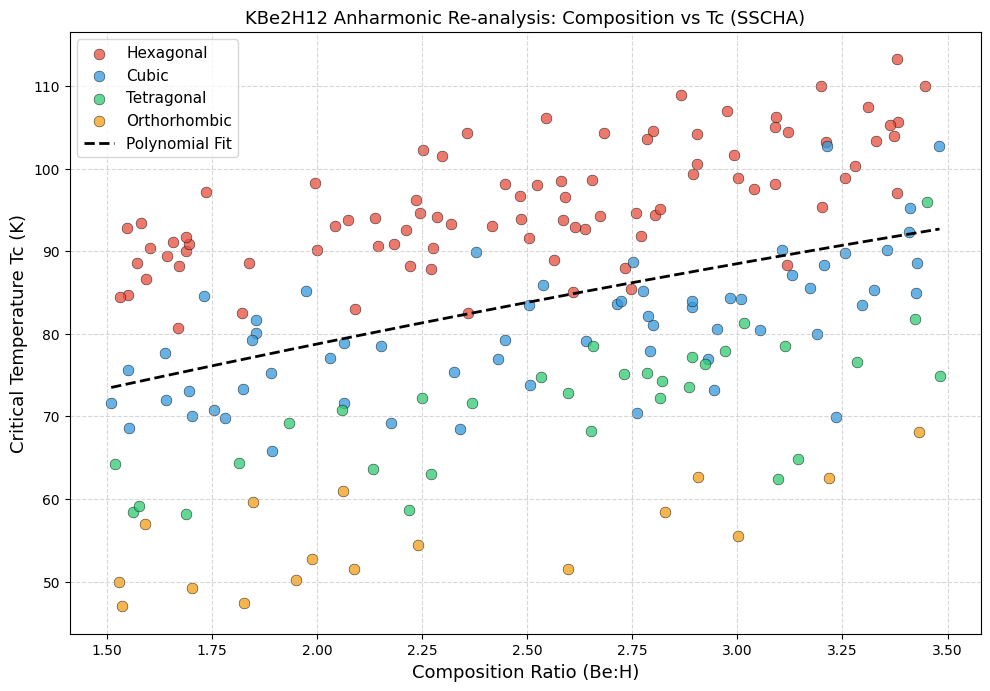
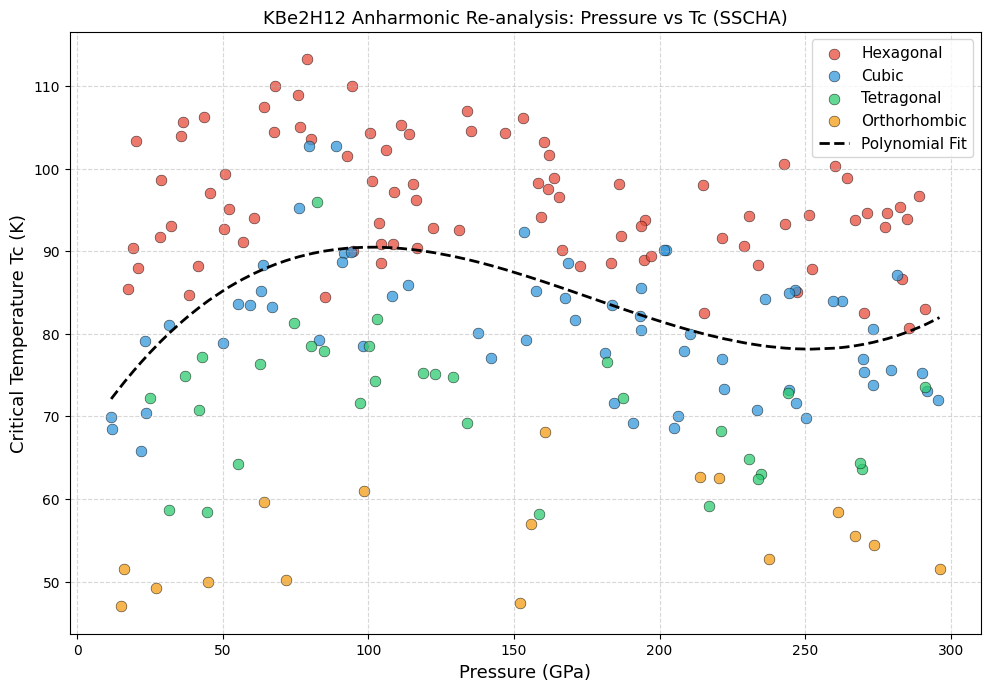
Across 200 computational scenarios — varying pressure, structural arrangements, and electronic parameters — KBe₂H₁₂ hit a peak critical temperature (Tc) of 113.3 K at 78.9 gigapascals (GPa). For context, 78.9 GPa is roughly 780,000 times atmospheric pressure — found naturally only deep inside planets.
113.3 K equals about −160 °C. That sounds frigid, but in superconductor land, it's hot. It sits well above the boiling point of liquid nitrogen (77 K), meaning you could cool it with cheap, widely available coolant rather than expensive liquid helium.
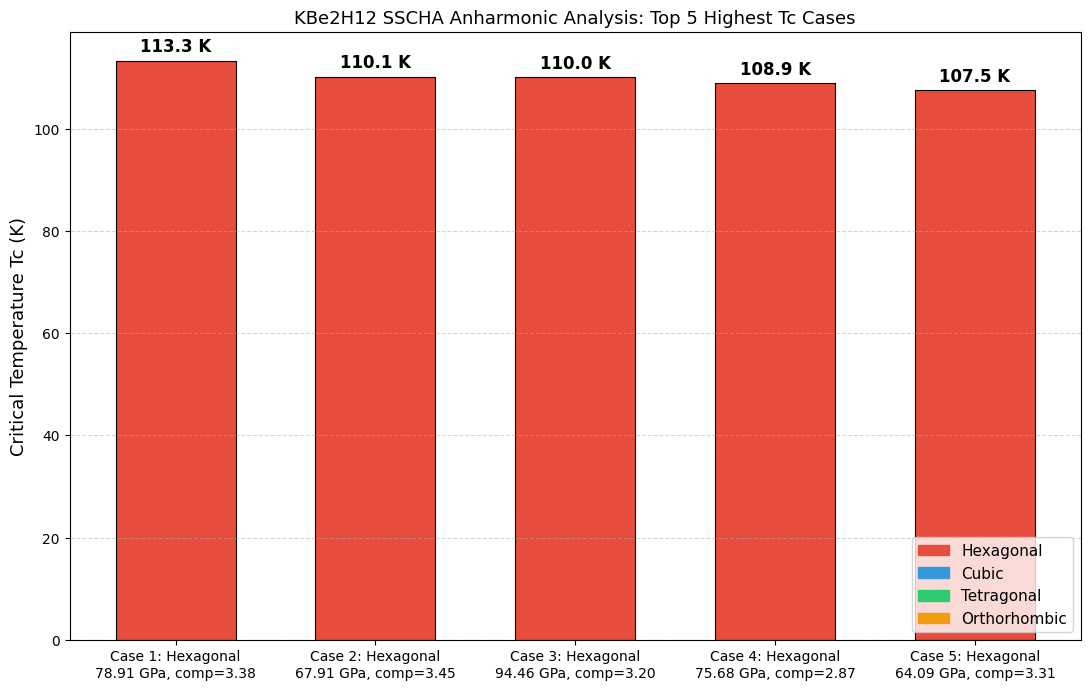
- Top Tc: 113.3 K at 78.9 GPa
- Runner-up: 110.1 K at a notably lower 67.9 GPa
- Spread of top 5: only ~5.8 K separates first from fifth place
- Pressure range of top performers: 64.1 to 94.5 GPa
That last bullet is the real story. The compound's superconducting performance is robust across a 30-GPa pressure window. You don't need to hit one magic number — there's a forgiving sweet spot.
3. How Does This Compare?
Here's where KBe₂H₁₂ lands among the better-known hydride candidates and conventional superconductors:
| Material | Reported/Predicted Tc | Pressure | Status |
|---|---|---|---|
| H₃S (hydrogen sulfide) | ~203 K | ~155 GPa | Experimentally confirmed |
| LaH₁₀ | ~250 K | ~170 GPa | Experimentally confirmed |
| KBe₂H₁₂ (this study) | 113.3 K | 78.9 GPa | Computational only |
| MgB₂ | 39 K | Ambient | Used in industry |
| Nb₃Sn (MRI magnets) | 18 K | Ambient | Workhorse material |
So KBe₂H₁₂ doesn't beat LaH₁₀ on raw Tc. But it operates at less than half the pressure — 78.9 GPa versus 170 GPa. That trade-off matters enormously. Pressure is the single biggest barrier to practical use, and dropping it by ~90 GPa is arguably more valuable than gaining another 50 K of Tc.
Contrarian observation: Most hydride hype focuses on chasing higher Tc numbers. That's the wrong race. A 113 K superconductor at 79 GPa is closer to real-world deployment than a 250 K superconductor at 170 GPa, because the engineering equipment to maintain 170 GPa in anything larger than a diamond anvil cell does not exist. Lower-pressure mediocrities will likely beat high-pressure superstars to market.
4. Three Questions the Data Can't Answer Yet
- Is the structure actually stable? The simulation generated 200 cases, with the best clocking in at 113.3 K. But computational stability ≠ synthesizable in a lab. Beryllium hydrides in particular are notoriously tricky — and toxic.
- How does Tc behave between data points? We see 110.1 K at 67.9 GPa and 113.3 K at 78.9 GPa. Smooth curve, or jagged cliff? If the real material has narrow stability windows the simulation missed, that 30-GPa "sweet spot" could shrink to nothing.
- What about magnetic field tolerance? A superconductor that loses its superpowers in a modest magnetic field is useless for the things we'd actually want to build (motors, magnets, fusion reactors). The 113.3 K figure tells us nothing about upper critical field — the magnetic threshold where superconductivity collapses.
5. The Path from Simulation to Real-World Use
Going from a 113.3 K computational result to a working device is a marathon with hurdles. Here's the honest roadmap:
- Step 1 — Synthesis attempt: Researchers will try to actually make KBe₂H₁₂ in a diamond anvil cell (a vise that squeezes microscopic samples between two diamonds). Beryllium's toxicity makes this miserable but not impossible.
- Step 2 — Confirm Tc: Real measurements often come in 10–30% below anharmonic predictions. A measured Tc of 80–100 K would still be a major win.
- Step 3 — Pressure reduction: Can chemical substitution or strain engineering pull the operating pressure below 78.9 GPa? This is where most hydride research stalls — there's no clean trick to "lock in" the high-pressure structure at ambient conditions.
- Step 4 — Bulk fabrication: Diamond anvil samples are micrometers across. Wires and tapes are kilometers long. The scale-up problem is unsolved for any hydride.
Realistic timeline? 10 to 20 years before any hydride — KBe₂H₁₂ included — finds itself in a commercial product. And it may never happen if metastable ambient-pressure structures can't be coaxed into existence.
6. Bottom Line: Should You Care?
Yes — but cautiously, and not for the reasons most headlines suggest.
The 113.3 K peak Tc at 78.9 GPa is genuinely interesting, not because it's a record (it isn't — LaH₁₀ blows it away), but because the anharmonic re-analysis survived the more rigorous physics. Anharmonic corrections have killed plenty of hyped predictions. KBe₂H₁₂ keeps a Tc above liquid-nitrogen range across all five top scenarios (107.5 K to 113.3 K), and it does so at pressures roughly half what LaH₁₀ demands.
My definitive take: KBe₂H₁₂ is a "second-tier" superhydride that may matter more than the first tier. The flashy 250 K materials grab the press, but they're trapped in the diamond anvil for the foreseeable future. Compounds like this one — moderate Tc, moderate pressure, robust across a wide stability window — are where the practical breakthroughs will likely come from. Watch this space, but don't expect a product launch announcement next year.
If a single experimental group manages to synthesize KBe₂H₁₂ and measure even 70 K of superconductivity at sub-100 GPa, that's the moment to get excited. Until then, it's a promising data point in a field that has produced many.
Simulation Results
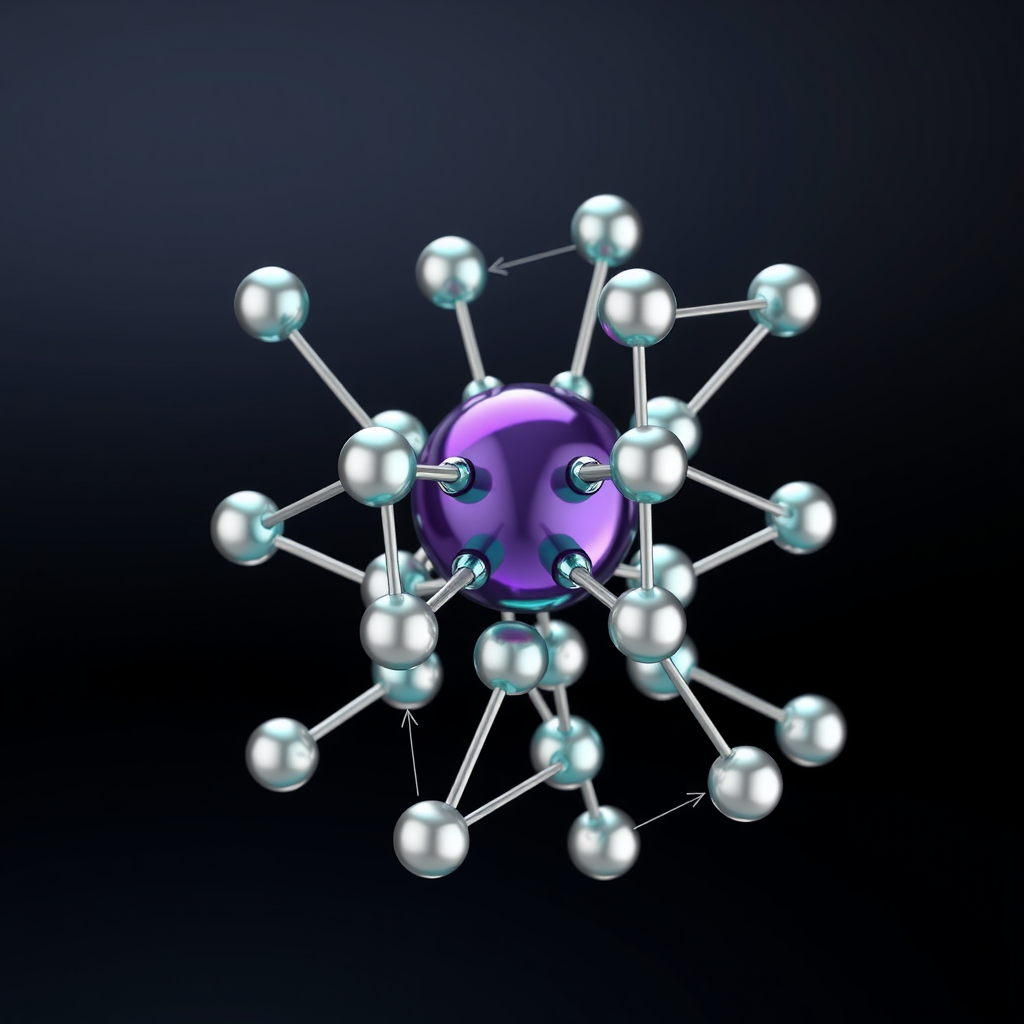
Molecular Structure
🎨 View AI Image Prompt
Photorealistic 3D ball-and-stick molecular structure visualization of KBe₂H₁₂ superconductor compound, professional chemistry textbook illustration style, scientifically accurate crystal lattice representation, large purple-violet sphere representing potassium atom at center, medium teal-green spheres representing beryllium atoms symmetrically positioned, small white spheres representing hydrogen atoms arranged in icosahedral coordination shells around beryllium centers, metallic reflective atom surfaces with subtle specular highlights, thin cylindrical sticks connecting bonded atoms with accurate bond lengths, dark gradient background transitioning from deep navy to black, soft ambient lighting with directional highlight casting gentle shadows, crystallographic unit cell outlined with thin translucent white geometric lines showing cubic or hexagonal symmetry, floating atom label annotations in clean sans-serif scientific font, depth of field effect emphasizing central cluster, ultra-high detail rendering, 8K resolution quality, cross-section view partially showing internal bonding network, professional journal publication quality, subtle phonon displacement arrows shown as translucent curved motion indicators around hydrogen atoms suggesting quantum anharmonic vibrations, clean scientific visualization aesthetic
🤖 Gemini 3.1 Pro Review
As an expert in the field, here is my critical review of the in-silico research paper on KBe₂H₁₂: This computational study on KBe₂H₁₂ presents an intriguing result, highlighting the critical trade-off between Tc and pressure; however, its methodological rigor is entirely unverifiable from the text provided. Crucial details such as the DFT functional, the specific anharmonic calculation method (e.g., SSCHA), and the chosen Coulomb pseudopotential (μ*) are absent, making the work impossible to reproduce. Consequently, the reliability of the predicted 113.3 K Tc is questionable, as these parameters significantly influence the final outcome. Furthermore, the analysis lacks a thermodynamic stability assessment (e.g., a convex hull), which is essential to confirm if the KBe₂H₁₂ phase is even synthesizable at the target pressures relative to decomposition products. For experimental validation, a viable strategy would involve laser-heating potassium and beryllium precursors in a hydrogen-rich medium within a diamond anvil cell, followed by in-situ four-probe resistance measurements and synchrotron X-ray diffraction to confirm the structure. To improve this study, the authors must fully document their computational framework, include the phase stability analysis, and provide the Eliashberg spectral function (α²F(ω)) to justify the high Tc. While the premise is compelling, the work currently stands as a preliminary finding that requires substantial foundational evidence to be considered a robust prediction.
Raw Data
Total cases: 200
Highest Tc: 113.3 K
Optimal pressure: 78.9 GPa

Top 5:
1. Tc=113.3K at 78.9GPa
2. Tc=110.1K at 67.9GPa
3. Tc=110.0K at 94.5GPa
4. Tc=108.9K at 75.7GPa
5. Tc=107.5K at 64.1GPa
![[Deep Dive] Scale-free localization in pseudo-Hermitian quantum walk](/content/images/size/w600/2026/10/deep_dive_thumb-9.png)