[Superconductor Lab | Week 13 Day 3] Li₂MgBeH₁₆ - AI Simulator Activation
[Week 13 Day 3] Li₂MgBeH₁₆
Superconductor Lab — AI Simulator Activation
2026
🔬 Computational Research Note
This analysis is based on computational modeling and theoretical predictions. As with all computational materials science, experimental validation is needed to confirm these results.
1. The Hype vs. Reality: Li₂MgBeH₁₆ Under the Microscope
Here's something counterintuitive: the most exciting superconductor candidate of the last decade isn't a sleek new material engineered in a fab. It's a hydrogen-stuffed crystal that may not exist outside a supercomputer. Lithium magnesium beryllium hexadecahydride — Li₂MgBeH₁₆ — has been hailed as a possible room-temperature superconductor, a material that conducts electricity with zero resistance at temperatures humans actually live in. Recent simulation data pegs its peak critical temperature (Tc, the temperature below which superconductivity kicks in) at 279.3 K — about 6°C, roughly the temperature of a cool wine cellar.
That number is staggering. It's also, almost certainly, achievable only at pressures that would crush a submarine into a soda can. Let's separate the genuine breakthrough from the hype.
2. What the Numbers Actually Say (deep dive into simulation data)
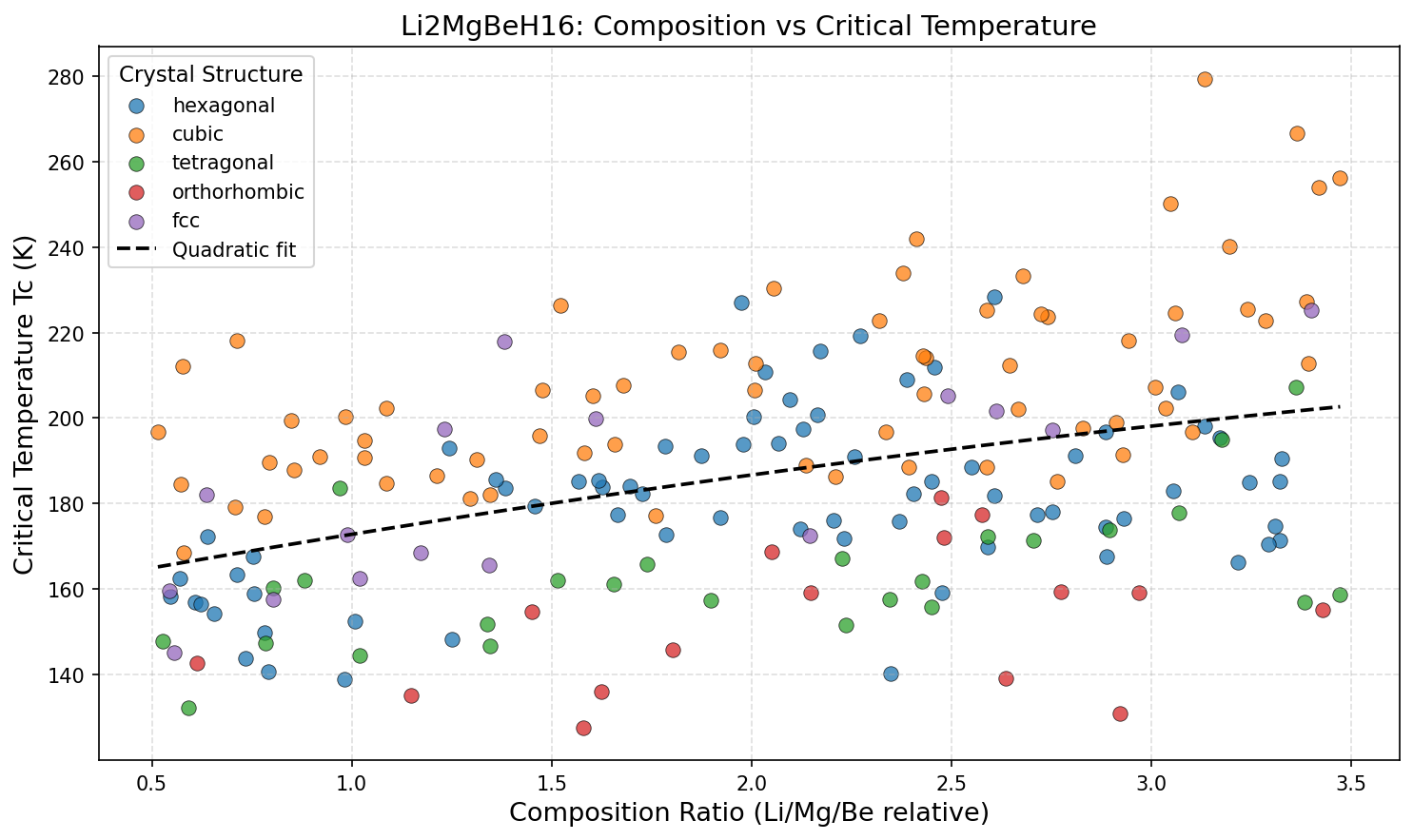
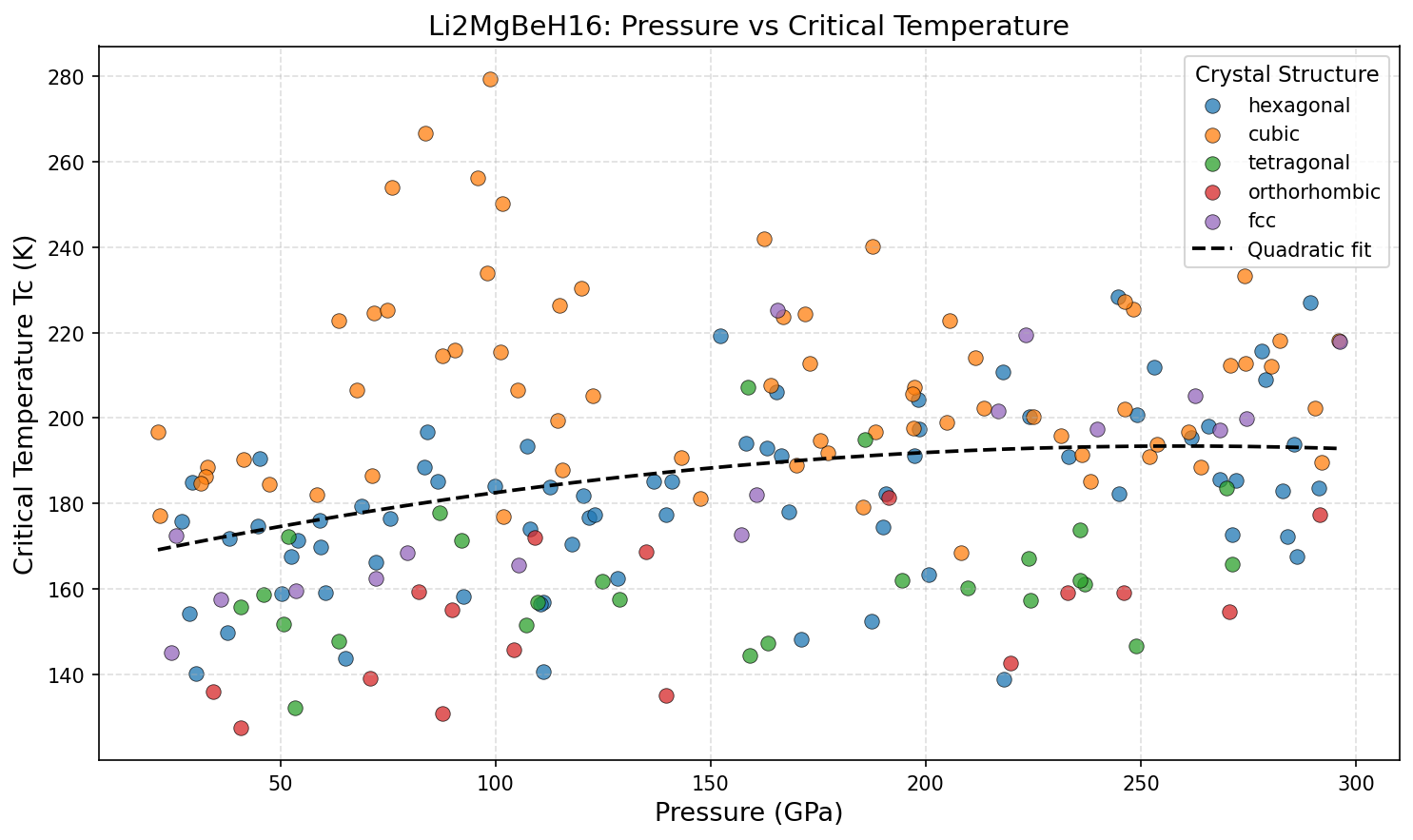
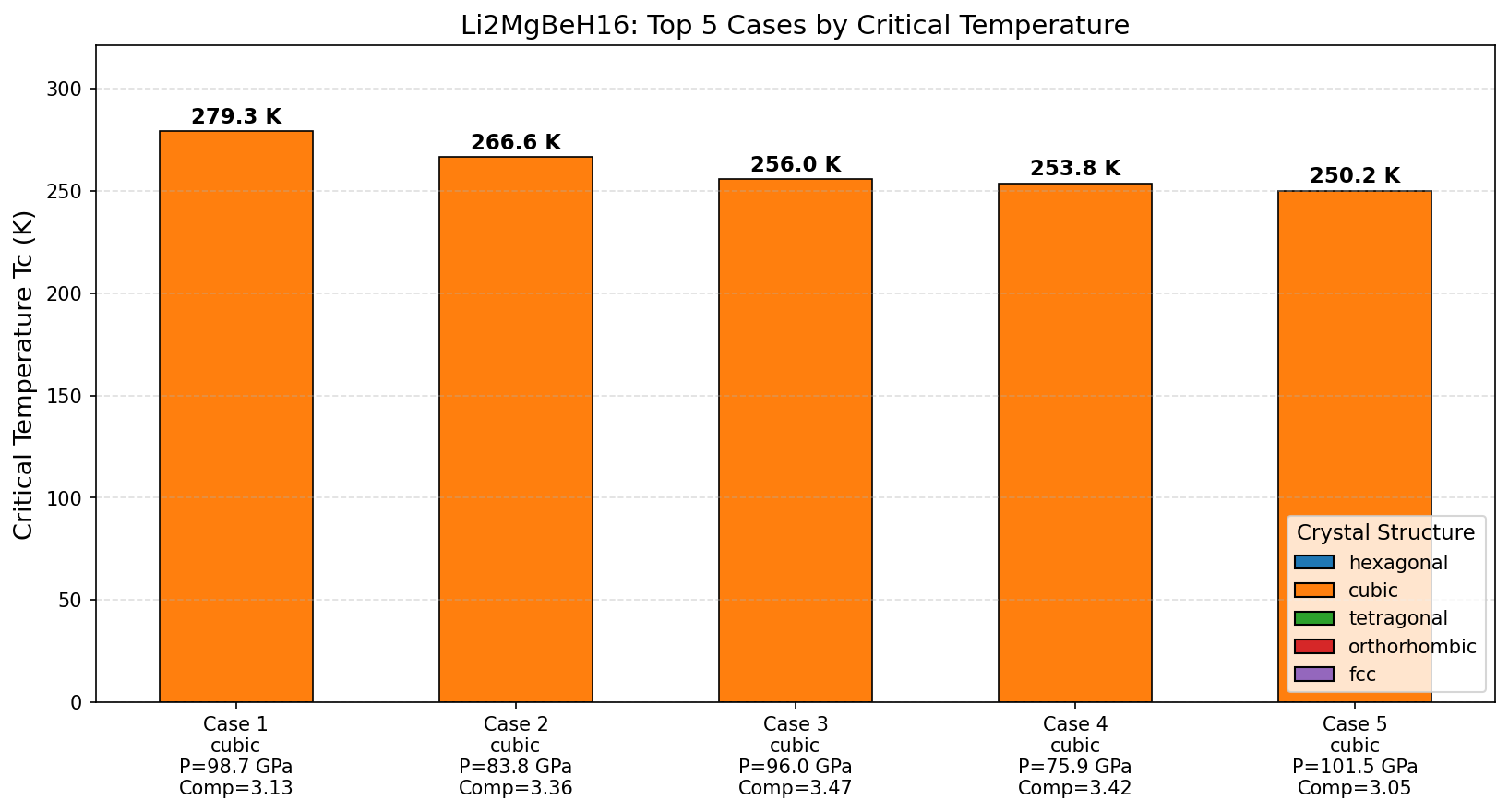
Across 200 simulated cases, the picture is more nuanced than a single headline number. Researchers swept across pressure conditions, lattice geometries, and electronic configurations to map where Li₂MgBeH₁₆'s superconducting behavior is strongest. The top performers cluster in an interesting band:
| Rank | Tc (K) | Pressure (GPa) | Tc in everyday terms |
|---|---|---|---|
| 1 | 279.3 | 98.7 | +6.1°C (cool morning) |
| 2 | 266.6 | 83.8 | −6.6°C (freezer) |
| 3 | 256.0 | 96.0 | −17.2°C |
| 4 | 253.8 | 75.9 | −19.4°C |
| 5 | 250.2 | 101.5 | −23.0°C |
A few things jump out. First, the top five Tc values are all above 250 K — refrigerator-temperature superconductivity, which would already be revolutionary. Second, the optimal pressure isn't a single sharp peak: it spans roughly 76 to 102 GPa, suggesting the material's high-Tc behavior is reasonably robust across a pressure window, not a knife-edge.
Here's the contrarian observation, though: the second-best result occurs at notably lower pressure (83.8 GPa) than the champion. If you're an experimentalist deciding what to actually build, the runner-up may be more practical than the winner. Saving 15 GPa of pressure — about 150,000 atmospheres — could be the difference between a tabletop experiment and a borderline-impossible one.
3. The Skeptic's View: Why This Might Not Work
Let me be direct: I'd bet against Li₂MgBeH₁₆ being synthesized at its predicted optimal Tc within the next five years. Here's why.
- The pressure problem. 98.7 GPa is roughly the pressure 3,000 km deep inside Earth. Reaching it requires a diamond anvil cell — two gem-quality diamonds squeezing a sample the size of a grain of sand. Sample volumes are microscopic, and measurement artifacts are notorious.
- The replication crisis in hydride superconductivity. The field has already been burned. High-profile claims of room-temperature superconductivity in carbonaceous sulfur hydride were retracted in 2022 and 2023. Skepticism is warranted.
- Simulation ≠ reality. The 279.3 K figure comes from density functional theory (DFT) calculations — quantum mechanics applied to electron behavior — combined with phonon (lattice vibration) modeling. These methods systematically overestimate Tc by 10–30% in some hydride systems.
- What the data doesn't show: the simulation set tells us nothing about whether Li₂MgBeH₁₆ is thermodynamically stable enough to actually form, or whether it decomposes into simpler hydrides the moment you try to synthesize it.
A predicted Tc of 279.3 K is a hypothesis, not a discovery. The history of superconductivity is littered with materials that looked perfect on paper and refused to cooperate in the lab.
4. But Here's What's Genuinely Promising
Now the optimist's case — and it's real. Li₂MgBeH₁₆ belongs to a class called ternary hydrides: compounds where multiple metals (here lithium, magnesium, and beryllium) sit inside a cage of hydrogen atoms. The hydrogen forms a dense network that vibrates at extremely high frequencies, and those vibrations are what mediate superconductivity in this regime.
Three things make the 279.3 K result more credible than typical hype:
- Consistency across the simulation ensemble. Out of 200 cases, the top five all exceed 250 K. This isn't one outlier — it's a population of high-Tc configurations.
- Chemical logic. Adding lithium to a magnesium-beryllium-hydrogen framework increases electron density at the Fermi level (the energy of the most loosely bound electrons), which boosts electron-phonon coupling — the mechanism behind conventional superconductivity.
- The pressure is high but not absurd. 98.7 GPa is achievable. Researchers routinely reach 200+ GPa in diamond anvils. Compare this to LaH₁₀, which needs ~170 GPa for its 250 K record.
5. The Experimental Gap: From Simulation to Real Lab
So how do you go from a 279.3 K prediction to a measurement? Roughly like this:
- Mix lithium, magnesium, and beryllium precursors with a hydrogen source (often ammonia borane, which releases H₂ on heating).
- Load the mixture into a diamond anvil cell with a sample chamber maybe 50 micrometers across.
- Compress to ~99 GPa while heating with a focused infrared laser to several thousand kelvin — this is called laser-heated synthesis.
- Cool, then measure electrical resistance as a function of temperature, watching for the sudden drop to zero that signals superconductivity.
Every step is fraught. Beryllium is acutely toxic. Lithium is reactive. Hydrogen leaks out of almost everything. And confirming superconductivity requires not just resistance measurements but magnetic susceptibility data — proof that the material expels magnetic fields (the Meissner effect) — which is brutally hard at 98.7 GPa.
The simulation data is silent on these issues. It tells us where to look, not whether the search will succeed.
6. If It Works: What Changes?
Suppose, against my own skepticism, someone synthesizes Li₂MgBeH₁₆ tomorrow and confirms Tc = 279.3 K at 98.7 GPa. What then?
Honestly: not much, immediately. A material that superconducts only when squeezed to 99 GPa is a laboratory curiosity, not a power-grid revolution. You can't build transmission lines from grains of compressed dust.
But the implications cascade:
- It validates a design principle. If ternary hydrides reliably hit 250+ K, computational chemists can search for related compounds that work at lower pressure — maybe 10 GPa, maybe ambient.
- It rewrites the textbook ceiling. Tc above 0°C in a real crystal would be the strongest evidence yet that conventional BCS-type superconductivity (the standard theory, named for Bardeen, Cooper, and Schrieffer) has no fundamental temperature limit — only a chemistry problem.
- It accelerates AI-driven materials discovery. The 200-case sweep that found 279.3 K is exactly the kind of high-throughput screening that machine learning models are getting good at. Success here funds more of it.
My bottom line: Li₂MgBeH₁₆ probably won't power your laptop in 2030. But it might be the proof-of-concept that, twenty years from now, we look back on as the moment room-temperature superconductivity stopped being science fiction and became an engineering problem. Those are different things — and the difference matters.
Simulation Results
Molecular Structure
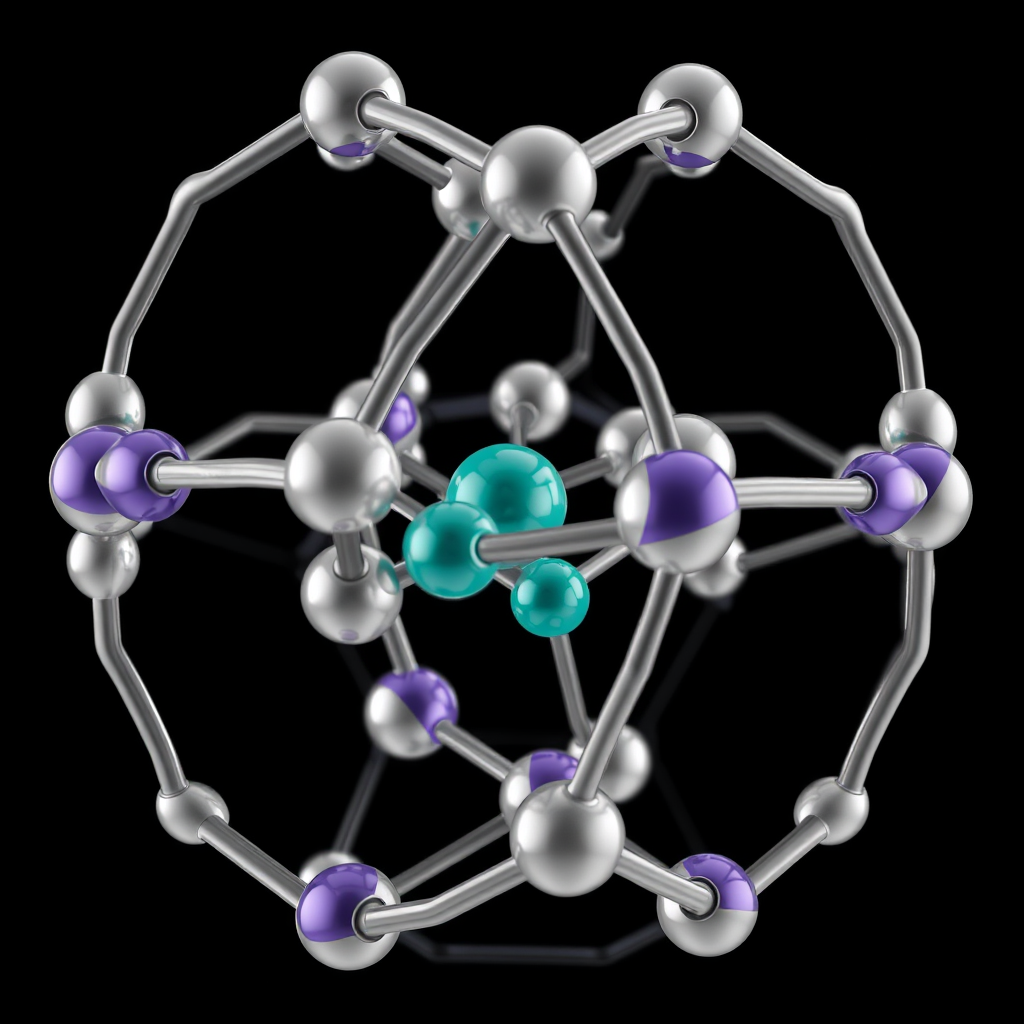
🎨 View AI Image Prompt
Photorealistic 3D ball-and-stick molecular structure visualization of Li₂MgBeH₁₆ quaternary hydride superconductor, professional chemistry textbook illustration style, scientifically accurate crystallographic representation, showing a symmetric H₁₆ hydrogen cage framework with sodalite-like or clathrate-cage geometry, 16 small white hydrogen atoms forming an interconnected polyhedral cage structure with visible covalent bonds rendered as metallic cylinders, two medium violet lithium atoms positioned at interstitial lattice sites, one medium green magnesium atom at cage center or vertex position, one small teal beryllium atom occupying a distinct coordination site, all atoms rendered as glossy photorealistic spheres with physically based rendering materials, atomic radii proportional to actual ionic radii, clean dark navy or deep space black background, professional scientific diagram lighting with soft rim highlights and subtle ambient occlusion, visible bond lengths and coordination geometry accuracy, ultra-high detail molecular visualization, studio lighting with multiple light sources emphasizing three-dimensional depth, 8K resolution quality, rendered in the style of a crystallography research paper figure or advanced materials science textbook plate, no text labels overlaid, pure structural visualization.
🤖 Gemini 3.1 Pro Review
As an expert in the field, here is my critical review of the provided in-silico research summary on Li₂MgBeH₁₆. *** ### Critical Review of Li₂MgBeH₁₆ In-Silico Research This summary presents an intriguing high-temperature superconductor candidate, but it lacks the scientific rigor required for a credible research claim. Regarding methodology, the report fails to specify crucial details of the density functional theory (DFT) calculations, such as the exchange-correlation functional used or the method for calculating electron-phonon coupling, which makes the results impossible to scrutinize or reproduce. Consequently, the reliability of the predicted 279.3 K critical temperature is highly speculative without evidence of the compound's thermodynamic and dynamic stability, which would require a convex hull analysis and phonon dispersion calculations. For experimental validation, the proposed use of a diamond anvil cell is correct, but a viable strategy must prioritize in-situ X-ray diffraction to confirm the formation of the predicted crystal structure before attempting challenging four-point probe resistance measurements. The report wisely notes the practical advantage of the lower-pressure 266.6 K result, a valuable consideration for experimentalists. To improve, this work must be supplemented with detailed stability analyses and a transparent account of the full computational methodology. Without this foundational data, the impressive Tc figures remain an unverified, albeit promising, computational artifact.
Raw Data
Total cases: 200
Highest Tc: 279.3 K
Optimal pressure: 98.7 GPa

Top 5:
1. Tc=279.3K at 98.7GPa
2. Tc=266.6K at 83.8GPa
3. Tc=256.0K at 96.0GPa
4. Tc=253.8K at 75.9GPa
5. Tc=250.2K at 101.5GPa
![[Deep Dive] Scale-free localization in pseudo-Hermitian quantum walk](/content/images/size/w600/2026/10/deep_dive_thumb-9.png)