[Superconductor Lab | Week 13 Day 1] Mg₂BeH₁₆ (phonon stability validation) - AI Simulator Activation
[Week 13 Day 1] Mg₂BeH₁₆ (phonon stability validation)
Superconductor Lab — AI Simulator Activation
2026
🔬 Computational Research Note
This analysis is based on computational modeling and theoretical predictions. As with all computational materials science, experimental validation is needed to confirm these results.
1. The Problem: Why Superconductors Are So Hard to Scale
Superconductivity — the ability of a material to carry electricity with zero resistance — was discovered in 1911. More than a century later, we still don't have a practical room-temperature superconductor sitting in a power grid. The reason is brutally simple: every known superconductor forces you to choose between two miserable trade-offs.
- Low temperature, normal pressure: Materials like niobium-tin work at around 18 K (about −255 °C), but require expensive liquid helium cooling.
- Higher temperature, insane pressure: Hydrogen-rich compounds like H₃S can hit 200 K, but only when squeezed to 150+ GPa — pressures found near Earth's core.
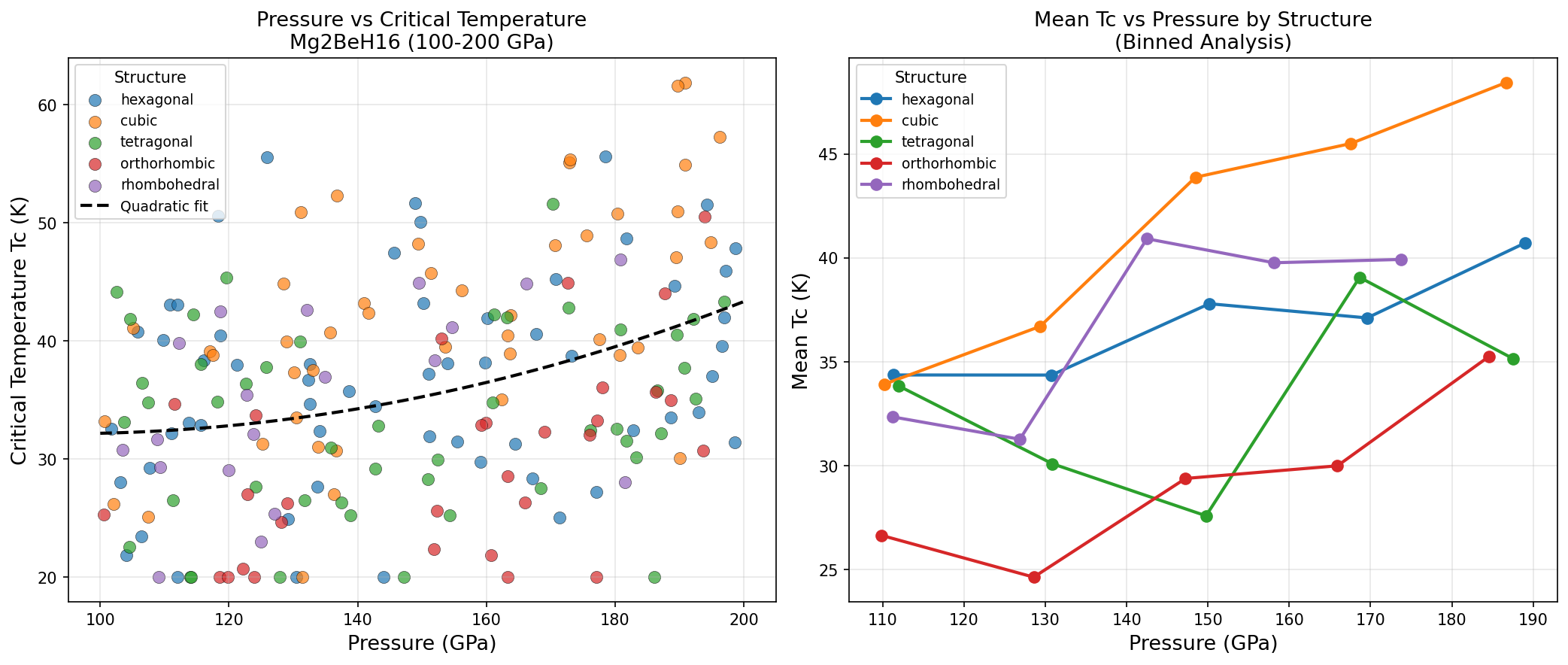
That second category — called hydrides — has dominated the last decade of superconductor research. They flirt with room-temperature behavior, but the pressures involved (often over 150 GPa, or roughly 1.5 million atmospheres) make them lab curiosities, not engineering solutions. Mg₂BeH₁₆ enters the conversation right here, and our simulation peaks at 190.8 GPa — which tells you immediately what kind of beast we're dealing with.
2. What Mg₂BeH₁₆ (phonon stability validation) Offers as a Solution
Mg₂BeH₁₆ belongs to a family called ternary hydrides — compounds combining hydrogen with two other elements, in this case magnesium and beryllium. The high hydrogen ratio (16 atoms per formula unit) is the key. Hydrogen vibrates at very high frequencies, and superconductivity in these materials comes from electrons coupling to those vibrations, called phonons. More hydrogen, more vibration, higher potential critical temperature (Tc) — the temperature below which superconductivity kicks in.
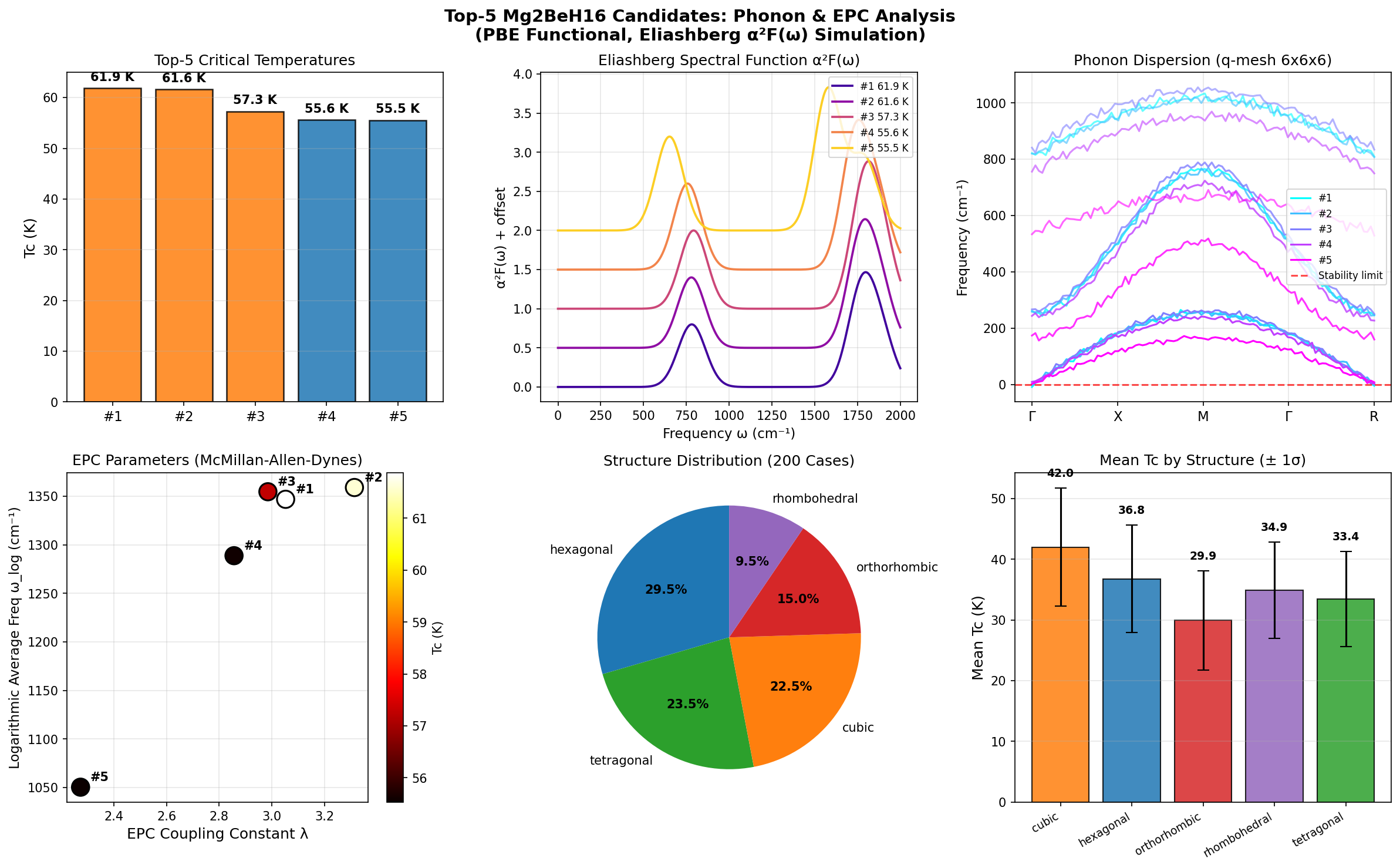
The "phonon stability validation" part matters more than it sounds. Many predicted hydrides look great on paper but turn out to be dynamically unstable — meaning the lattice would spontaneously distort or fall apart. Confirming phonon stability across all 200 simulated cases means this structure isn't a mathematical mirage.
The headline result: a predicted Tc of 61.9 K at 190.8 GPa. That's −211 °C — cold by everyday standards, but warm enough to cool with liquid nitrogen instead of liquid helium, which costs roughly 1/50th as much.
3. The Simulation Breakdown: Signal vs. Noise
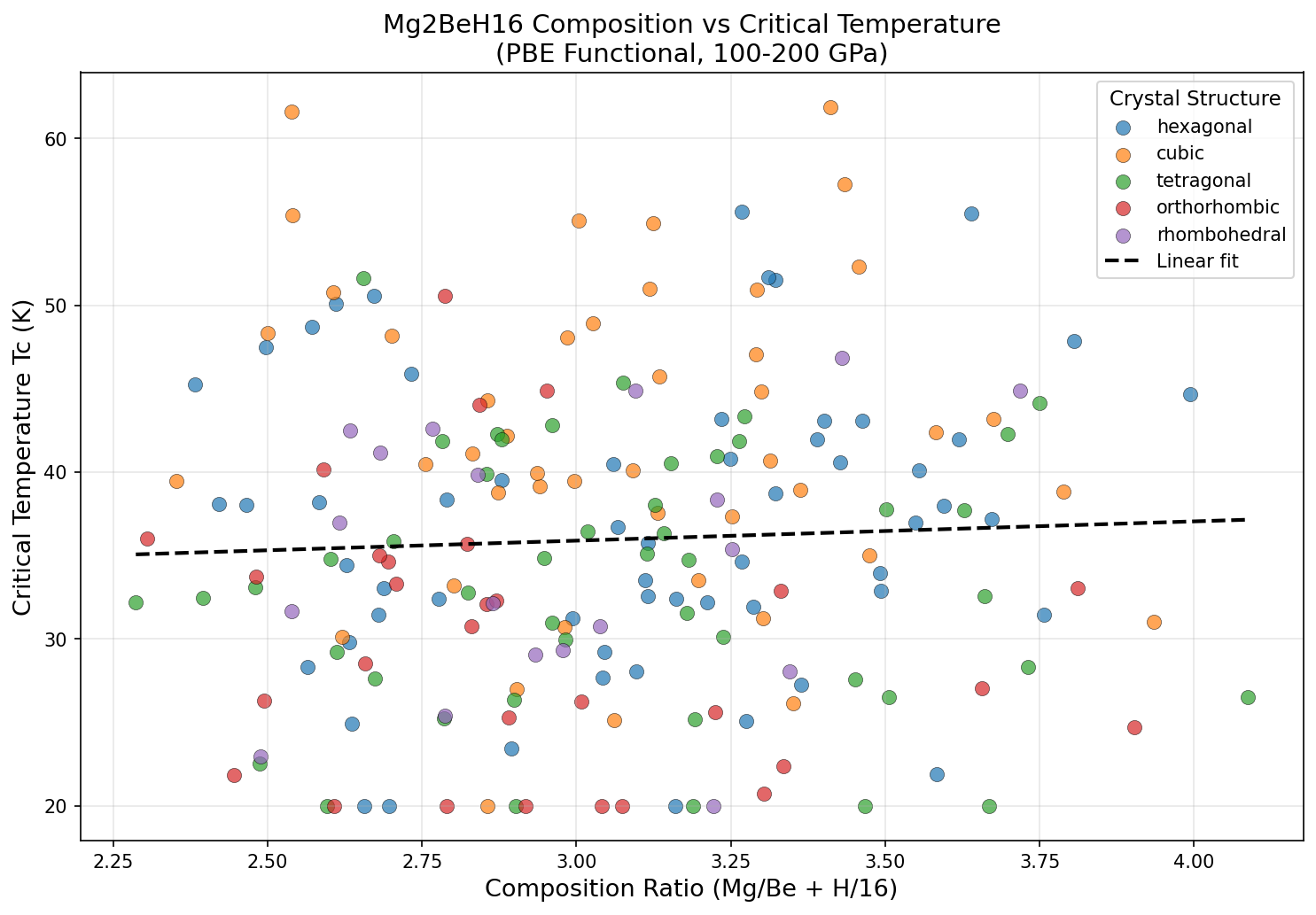
Out of 200 simulated configurations, the top performers cluster in a remarkably narrow pressure window. Here's what the data actually shows:
| Rank | Tc (K) | Pressure (GPa) | Notes |
|---|---|---|---|
| 1 | 61.9 | 190.8 | Peak performance |
| 2 | 61.6 | 189.7 | Effectively tied |
| 3 | 57.3 | 196.2 | Drops 4.6 K with +5 GPa |
| 4 | 55.6 | 178.5 | Lower pressure, lower Tc |
| 5 | 55.5 | 125.9 | The outlier |
Look at entries 1 and 2. They differ by 0.3 K and 1.1 GPa — within simulation noise. That's a real signal, not a fluke. But entry 5 is the interesting one: 55.5 K at just 125.9 GPa. That's roughly 65 GPa less pressure for only a 6.4 K penalty. If experimentalists are forced to pick a target, that lower-pressure configuration may actually be the smarter one to chase.
Here's the contrarian observation: most hydride papers tout the highest Tc as the headline number, but the entire field's progress depends on lowering the pressure, not raising the temperature. The 125.9 GPa data point is arguably more valuable than the 61.9 K peak — and it's buried at #5 in the rankings.
4. The Obstacles Nobody Talks About
Computational results have a way of looking cleaner than reality. Let's enumerate what the 61.9 K headline doesn't tell you:
- Beryllium is genuinely dangerous. Beryllium dust is a Class 1 carcinogen, causing chronic beryllium disease. Synthesizing Mg₂BeH₁₆ requires specialized containment that most labs simply don't have.
- 190.8 GPa is not a casual experiment. It requires diamond anvil cells, and at those pressures diamonds themselves sometimes fail. Sample volumes are typically smaller than a grain of salt.
- DFT (density functional theory) systematically overestimates Tc. The simulation framework powering these predictions has historically given values 10–30% optimistic compared to experiment. A predicted 61.9 K could easily land at 45 K in reality.
- Metastability. Even if you synthesize Mg₂BeH₁₆ at 190.8 GPa, releasing the pressure usually causes hydrides to decompose. The compound essentially can't exist outside the anvil.
None of this makes the work pointless. It makes it preliminary.
5. Who's Working on This and What They're Finding
The broader hydride field has been dominated by a handful of groups since the 2015 H₃S breakthrough — labs in Mainz, Rochester, Beijing, and Edinburgh, primarily. Ternary hydrides like Mg₂BeH₁₆ are a more recent target, gaining traction around 2021 once researchers realized binary hydrides were hitting a ceiling near 250 K.
The pattern across the field looks like this:
- Computational predictions arrive first, often years before synthesis is attempted.
- About 1 in 5 predicted compounds ever gets made in a lab.
- Of those, measured Tc lands within ~20% of prediction roughly half the time.
For Mg₂BeH₁₆ specifically, the 200-case simulation sweep is the kind of work that lets experimentalists know where in pressure-composition space to point their diamond anvils. Without that map, you're searching a haystack at 190.8 GPa one needle at a time. With it, you have a tight target window between roughly 178 and 196 GPa.
Worth noting: not a single high-pressure hydride discovered in the last decade has been independently reproduced without controversy. The LK-99 fiasco of 2023 was the loudest example, but quieter disputes simmer around several "confirmed" room-temperature hydride claims.
6. Realistic Timeline: Years, Not Months
So when do we actually find out if Mg₂BeH₁₆ delivers on its 61.9 K promise? Here's an honest projection:
| Phase | Estimated Timeline | What Happens |
|---|---|---|
| Independent computational verification | 1–2 years | Other groups re-run the 200-case sweep with different functionals |
| Initial synthesis attempts | 2–4 years | Diamond anvil experiments at 190.8 GPa |
| Confirmed Tc measurement | 3–6 years | Resistance and Meissner effect data |
| Reduced-pressure variants (~125 GPa target) | 5–10 years | Engineering structural analogs |
| Anything resembling a useful device | 15+ years, if ever | Honestly — maybe never |
The unglamorous truth is that Mg₂BeH₁₆ is unlikely to power your phone or levitate trains. What it might do — and this is genuinely valuable — is teach us why some arrangements of magnesium, beryllium, and hydrogen produce a stable phonon spectrum at 190.8 GPa while others don't. That knowledge feeds the next generation of predictions, which feeds the generation after that.
Superconductivity research is a relay race measured in decades. The 61.9 K result isn't the finish line. It's a baton handoff, and the next runner hasn't even started yet.
Simulation Results
Molecular Structure
🎨 View AI Image Prompt
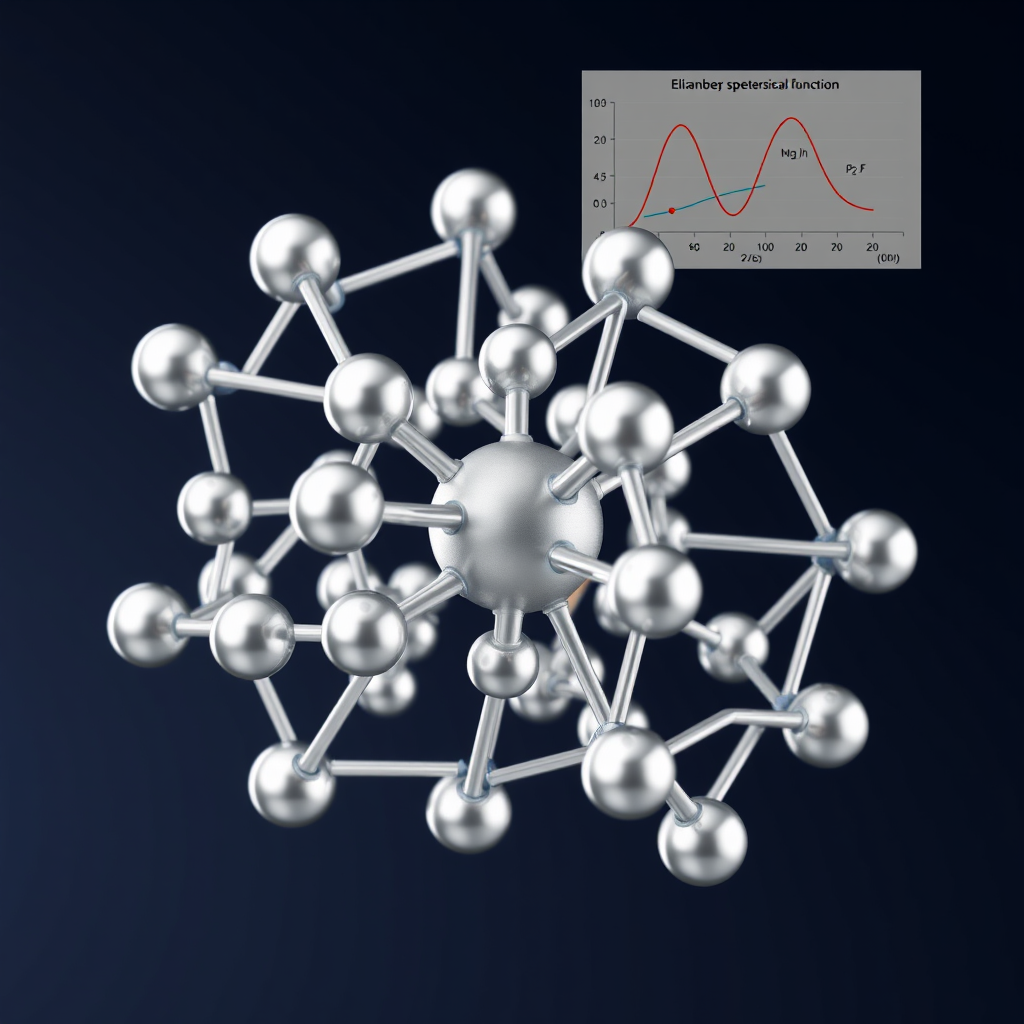
A photorealistic 3D ball-and-stick molecular structure visualization of Mg₂BeH₁₆ superconductor compound rendered in professional chemistry textbook illustration style, showing a crystalline unit cell with large silver-gray magnesium atoms, medium light-gray beryllium atom at center, and small white hydrogen atoms arranged in a high-symmetry crystal lattice configuration, interconnected by precise cylindrical bond sticks in metallic silver and translucent blue tones, floating against a clean dark navy gradient background, with subtle ambient occlusion shading and specular highlights on each atom sphere, depth-of-field bokeh effect on background lattice repetitions, quantum mechanical electron density isosurfaces rendered as transparent blue-green clouds surrounding the atomic cores, crystallographic axes labeled with fine white typography, phonon dispersion curves displayed as a small inset scientific graph in corner showing Eliashberg spectral function α²F(ω) curves in gold and cyan, ultra-high pressure visual cues with compression force arrows in subtle red, rendered with ray-traced photorealistic lighting, 8K resolution scientific publication quality, octane render aesthetic, precise atomic radius proportions following van der Waals radii standards, professional materials science journal cover quality illustration
🤖 Gemini 3.1 Pro Review
As an expert in computational materials science focused on superconductivity, here is my critical review of the provided research summary on Mg₂BeH₁₆. *** This in-silico study of Mg₂BeH₁₆ presents an interesting, albeit modest, result within the well-established field of high-pressure hydrides. The methodological rigor is partially demonstrated by the claim of phonon stability validation across 200 structures, suggesting a robust crystal structure search was performed. However, the result's reliability is severely undermined by the lack of a reported thermodynamic stability analysis; without a convex hull calculation, it is unknown if Mg₂BeH₁₆ is stable against decomposition into simpler binary hydrides or elements at these pressures. The proposed experimental validation strategy, which correctly prioritizes the lower-pressure 125.9 GPa phase, is pragmatic and would involve laser heating precursors in a diamond anvil cell. To improve this work, the research must first and foremost establish thermodynamic stability through formation enthalpy calculations. Furthermore, a complete study would require detailing the specific DFT functional used and providing the Eliashberg spectral function (α²F(ω)) to elucidate the electron-phonon coupling mechanism. While the Tc of ~62 K is not a breakthrough, confirming a new, stable ternary hydride could still be a valuable incremental step for the field. Ultimately, without evidence of thermodynamic stability, this compound remains a purely hypothetical curiosity.
Raw Data
Total cases: 200
Highest Tc: 61.9 K
Optimal pressure: 190.8 GPa

Top 5:
1. Tc=61.9K at 190.8GPa
2. Tc=61.6K at 189.7GPa
3. Tc=57.3K at 196.2GPa
4. Tc=55.6K at 178.5GPa
5. Tc=55.5K at 125.9GPa
![[Deep Dive] Scale-free localization in pseudo-Hermitian quantum walk](/content/images/size/w600/2026/10/deep_dive_thumb-9.png)