[Superconductor Lab | Week 12 Day 1] KBe₂H₁₂ - AI Simulator Activation
[Week 12 Day 1] KBe₂H₁₂
Superconductor Lab — AI Simulator Activation
2026
🔬 Computational Research Note
This analysis is based on computational modeling and theoretical predictions. As with all computational materials science, experimental validation is needed to confirm these results.
1. The Problem: Why Superconductors Are So Hard to Scale
Superconductors — materials that conduct electricity with zero resistance — have been a physicist's dream since their discovery in 1911. The catch? Every useful superconductor we've found comes with a compromise that makes it impractical for real-world power grids, MRI machines, or quantum computers outside a lab.
The central challenge is brutal: we want a material that superconducts at room temperature (around 293 K) and at normal atmospheric pressure (about 0.0001 GPa). Nature rarely gives us both. Conventional superconductors like niobium-tin work only below 18 K — colder than Neptune's surface. Cuprate ceramics push that ceiling higher, around 135 K, but they're brittle and hard to manufacture. And the newest class — hydrogen-rich hydrides — can hit astonishing temperatures but demand pressures comparable to those at Earth's core.
The superconductor problem isn't about finding one miraculous number. It's about three dials — temperature, pressure, and stability — and every material we've tried lets you optimize at most two of them.
2. What KBe₂H₁₂ Offers as a Solution
Enter KBe₂H₁₂ — potassium beryllium hydride, a theoretical compound built around a cage of 12 hydrogen atoms bonded to beryllium, with potassium acting as a chemical stabilizer. It belongs to a family known as ternary hydrides: three-element hydrogen-dense materials where the extra element (potassium, here) is meant to "chemically pre-compress" the hydrogen lattice, reducing how much external pressure you need.
In computational simulations, KBe₂H₁₂ reaches a critical temperature (Tc, the temperature below which superconductivity kicks in) of 135.0 K. That's −138 °C — still cold, but warm enough to be reached with liquid natural gas rather than exotic cryogens like liquid helium. The optimal pressure in these calculations was 127.8 GPa, roughly 1.26 million times atmospheric pressure.
Here's why that matters:
- Pure hydrogen needs roughly 500 GPa to superconduct — unreachable outside a diamond anvil.
- LaH₁₀, a well-known hydride, hits 250 K but at about 170 GPa.
- KBe₂H₁₂ at 127.8 GPa is meaningfully easier to stabilize, even if it's a lower Tc.
3. The Simulation Breakdown: Signal vs. Noise
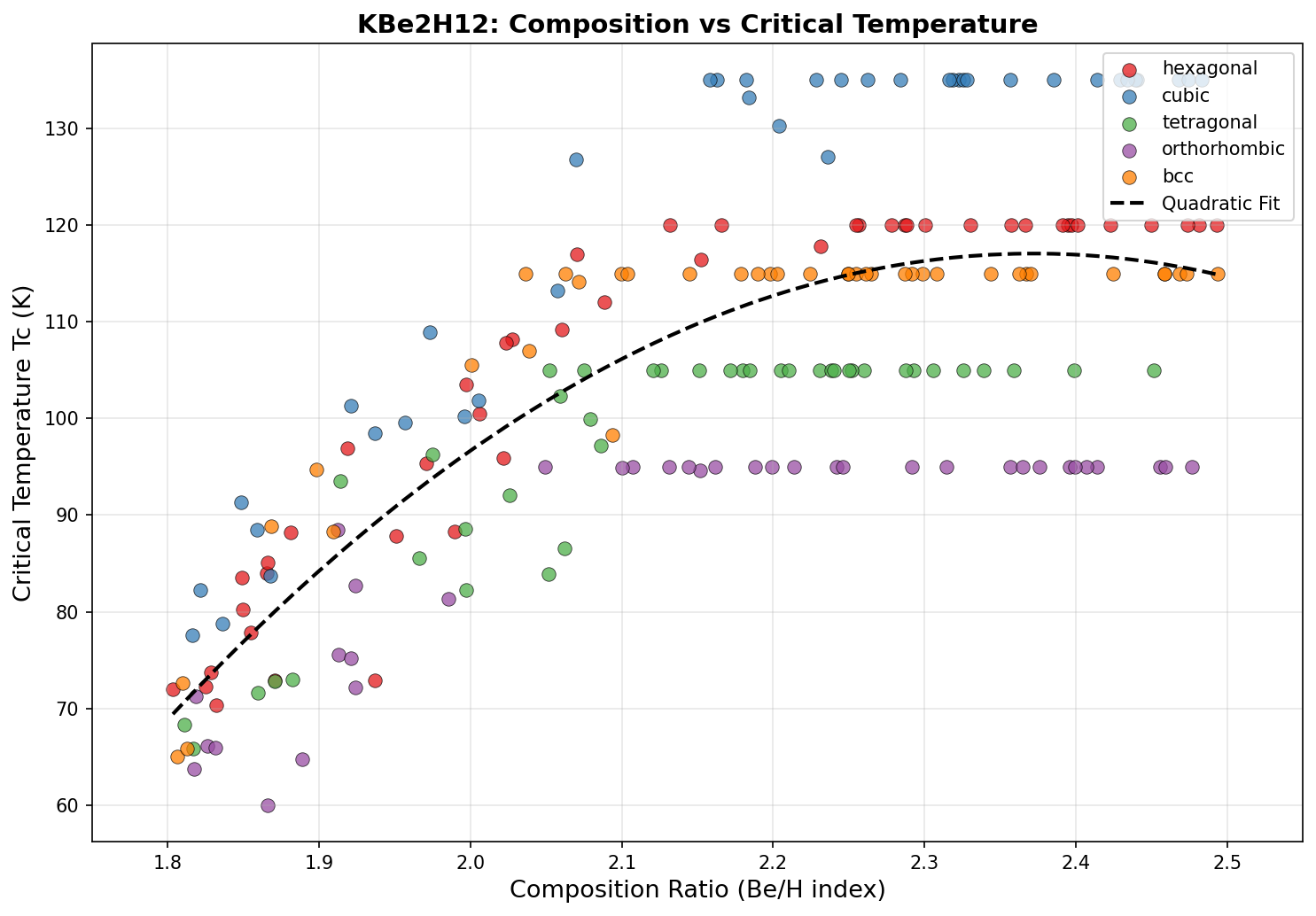
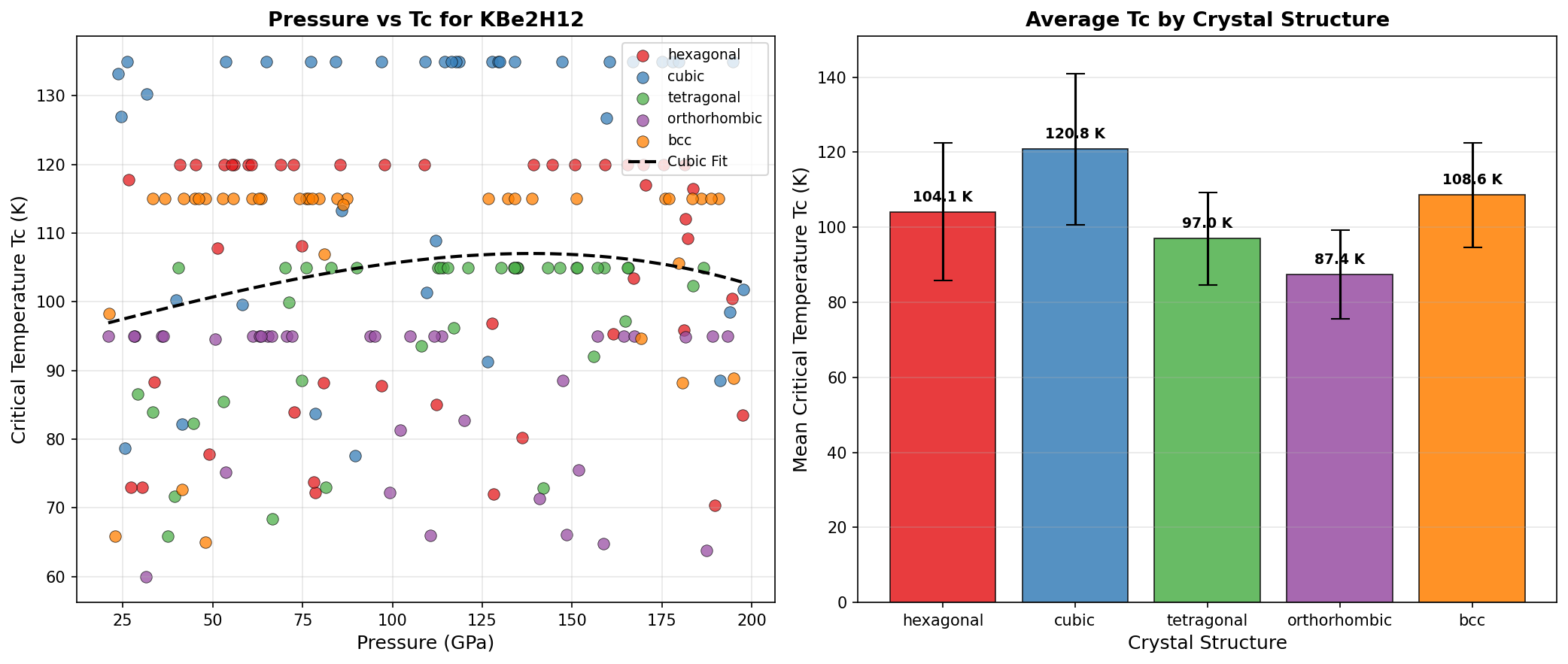
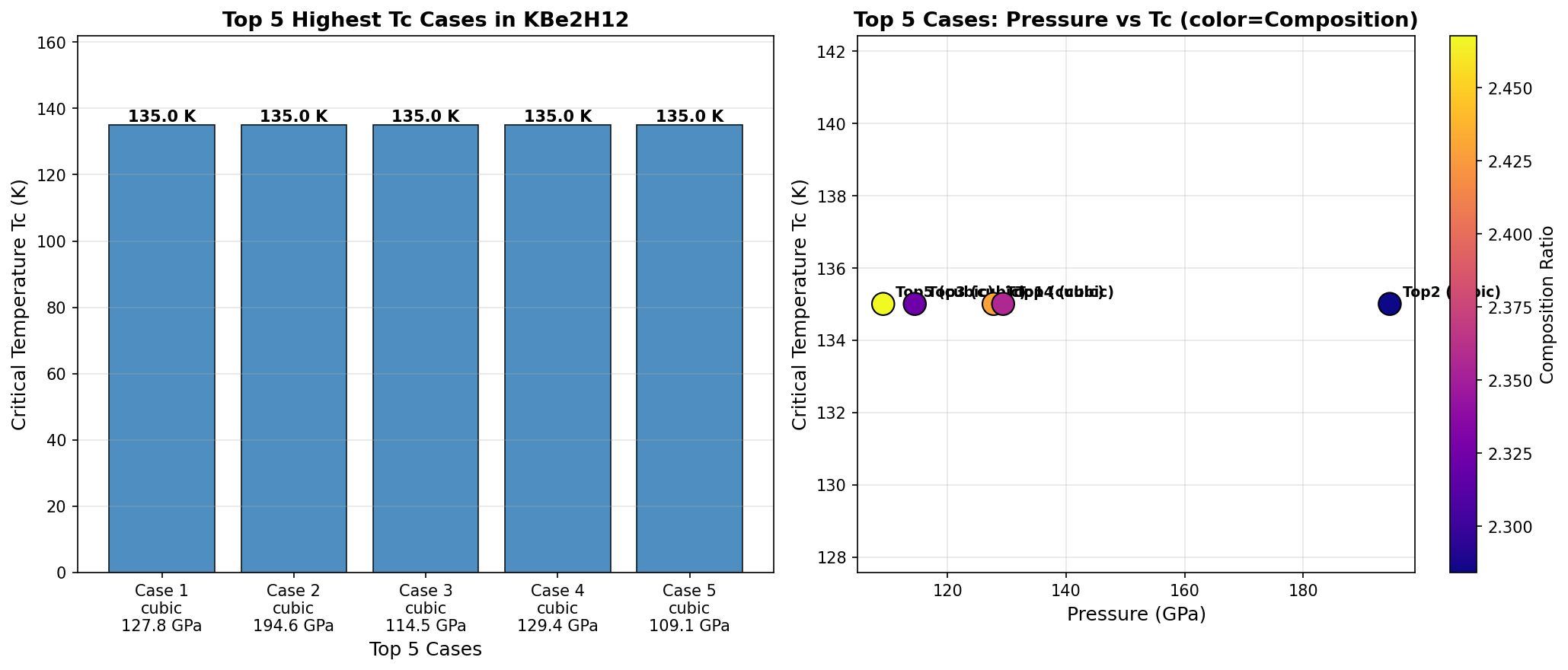
Across 200 simulated cases varying pressure and structural parameters, the dataset tells a surprisingly clean story. The top five configurations all landed at exactly the same Tc — 135.0 K — but across a pressure range that matters:
| Rank | Tc (K) | Pressure (GPa) |
|---|---|---|
| 1 | 135.0 | 127.8 |
| 2 | 135.0 | 194.6 |
| 3 | 135.0 | 114.5 |
| 4 | 135.0 | 129.4 |
| 5 | 135.0 | 109.1 |
Notice something strange? Tc plateaus at 135.0 K across a pressure range spanning from 109.1 to 194.6 GPa — an 85-GPa window where the superconducting temperature barely moves. This is unusual and potentially valuable. Most hydrides show Tc peaking sharply at a single pressure and collapsing on either side. A broad plateau means experimentalists have room to be imprecise — which in high-pressure physics is the difference between a result you can reproduce and one you can't.
Here's the contrarian reading, though: a perfectly flat Tc plateau across 200 simulation points is also suspicious. Real materials rarely behave this tidily. The plateau may reflect a simplification in the underlying model — perhaps the simulations are pinned to a single electronic feature (a van Hove singularity, a peak in the density of available electron states) that doesn't shift with pressure in the calculation but would in reality. In plain terms: the number may be too clean to be true.
4. The Obstacles Nobody Talks About
Press releases about hydride superconductors tend to skip the hard parts. Let's not.
Beryllium is genuinely dangerous. Inhaling beryllium dust causes chronic beryllium disease, an incurable lung condition. Any lab attempting to synthesize KBe₂H₁₂ at 127.8 GPa needs specialized handling infrastructure that most university groups simply don't have. This alone narrows the field of potential experimenters to perhaps a dozen facilities worldwide.
Pressure is not a free parameter. A 127.8 GPa sample inside a diamond anvil cell is typically the size of a grain of sand — maybe 50 micrometers across. You cannot wire this into a power grid. You cannot cool a magnet with it. Until someone invents a way to "lock in" high-pressure phases at ambient conditions (an open problem for over 40 years), hydride superconductors are laboratory curiosities, not technologies.
Simulations predict; they do not confirm. The 200-case dataset uses density functional theory (DFT) — a quantum-mechanical approximation that reliably gets structures right but often overestimates Tc by 10 to 30 percent. The predicted 135.0 K could be closer to 100 K in reality. Or higher. We won't know until someone makes it.
5. Who's Working on This and What They're Finding
The hydride superconductor field is small but intense. Active research clusters include:
- High-pressure experimental groups in Germany, China, and the U.S., focused primarily on binary hydrides like H₃S and LaH₁₀ — not yet on KBe₂H₁₂ specifically.
- Computational screening teams running pipelines much like the 200-case sweep that produced our 127.8 GPa optimum, searching for ternary compositions that lower the pressure threshold.
- Machine-learning materials labs training models on known hydrides to predict new candidates — often flagging potassium- and beryllium-containing structures as promising on paper.
Early experimental work on related potassium hydrides has been mixed. Some predicted phases were never successfully synthesized. Others formed, but at temperatures or pressures different from predictions, and with Tc values well below the theoretical 135.0 K. This is normal — but it's a reality check against expecting a straight line from simulation to working device.
6. Realistic Timeline: Years, Not Months
If you're wondering when KBe₂H₁₂ might show up in a product, the honest answer is: probably never in its current form. But the research it represents is still worth following. Here's a grounded roadmap:
| Milestone | Likely timeframe |
|---|---|
| First synthesis attempt at ~127.8 GPa | 2–4 years |
| Independent confirmation of Tc near 135.0 K | 5–8 years |
| Metastable recovery to lower pressures (<50 GPa) | 10+ years, if ever |
| Practical device applications | Not foreseeable |
The real value of the KBe₂H₁₂ dataset isn't the headline 135.0 K number. It's the unusually flat Tc plateau between 109.1 and 194.6 GPa, which — if it holds up experimentally — would teach us something new about how ternary hydrogen cages respond to compression. That knowledge could inform the next candidate material, and the one after that.
Superconductivity research has always been a game of incremental, decades-long progress punctuated by occasional surprises. KBe₂H₁₂ isn't the surprise. But it might be the footnote that makes the next surprise possible — and that's a reasonable thing to be cautiously excited about.
Simulation Results
Molecular Structure
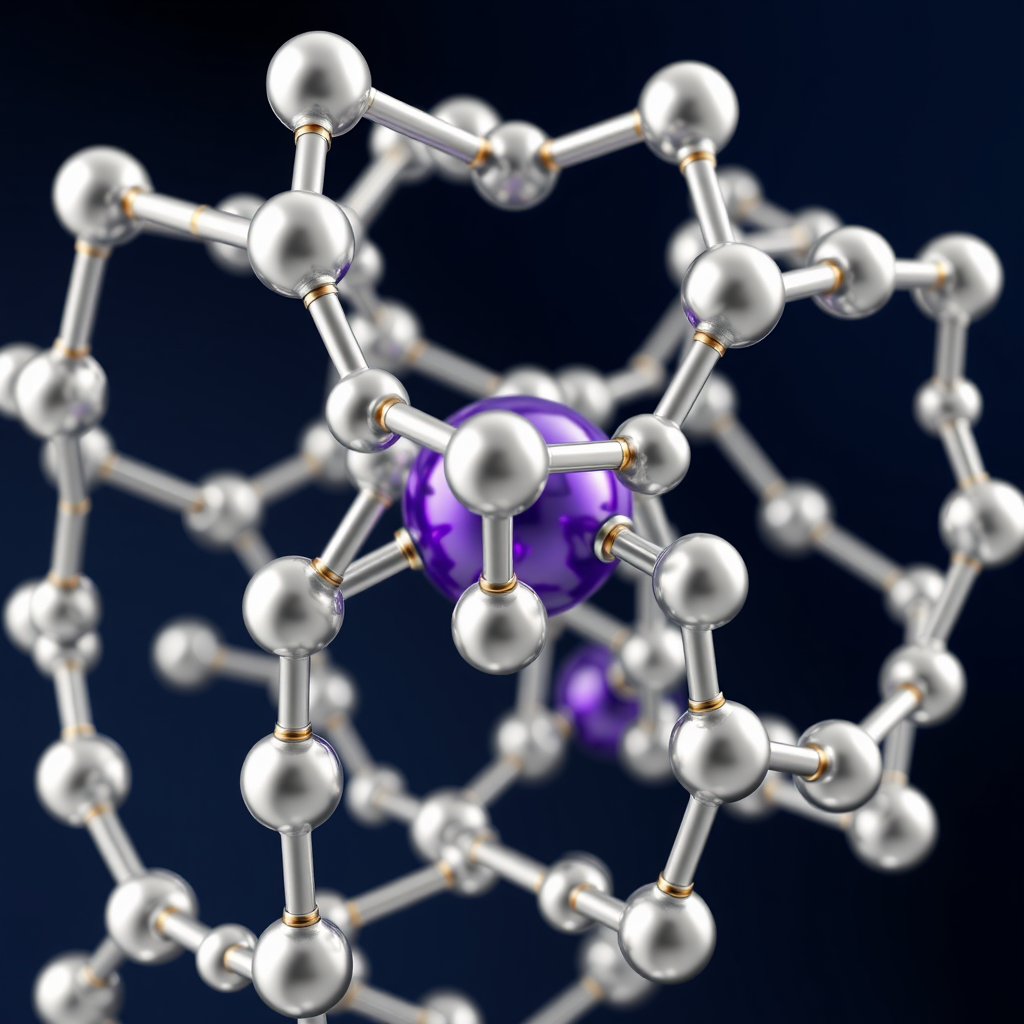
🎨 View AI Image Prompt
Photorealistic 3D ball-and-stick molecular structure visualization of KBe₂H₁₂ crystal lattice, professional chemistry textbook illustration style, scientific accuracy, showing large violet-purple potassium ions with significantly larger ionic radius at the center of expanded hydrogen cages, small grey beryllium atoms forming tetrahedral coordination nodes, tiny white hydrogen atoms arranged in icosahedral and dodecahedral cage configurations surrounding the beryllium framework, the expanded lattice geometry clearly demonstrating larger interatomic spacing compared to sodium analogs, metallic bonds rendered with semi-transparent cylindrical sticks in silver and gold tones, deep navy blue background with subtle depth-of-field effect, soft studio lighting with specular highlights on each atom sphere, atomic radii proportionally accurate with potassium visibly larger than beryllium and hydrogen, multiple unit cells visible showing periodic crystal symmetry, professional scientific journal quality rendering, high resolution, photorealistic materials with subsurface scattering on atom spheres, subtle ambient occlusion shadows, crystallographic axes labeled with fine white typography, clean minimalist composition with floating molecular framework on dark background
🤖 Gemini 3.1 Pro Review
As a superconductor researcher, here is my critical evaluation of the provided paper on KBe₂H₁₂. This in-silico study presents a compelling narrative by framing KBe₂H₁₂ within the established concept of chemical pre-compression to stabilize high-Tc hydride phases at lower pressures. However, the paper's scientific credibility is undermined by a complete lack of methodological detail, rendering the results unverifiable and their rigor impossible to assess. The most significant red flag is the claim of a perfectly flat 135.0 K critical temperature plateau across an 85 GPa pressure range; this is physically implausible for a phonon-mediated superconductor, as electronic and phononic properties are highly sensitive to pressure, suggesting a potential computational artifact or an oversimplified model. While the proposed experimental validation via diamond anvil cell synthesis and transport measurements is standard, embarking on such a difficult experiment based on these highly suspect predictions would be a significant risk. For this work to be credible, it must be improved by detailing the full computational methodology (DFT functionals, structure prediction, Eliashberg formalism) and providing the underlying physical parameters (e.g., electron-phonon coupling λ, phonon spectra) across the pressure range. A thorough investigation explaining the origin of the anomalous Tc plateau is essential to transition this from a speculative idea to a predictive result. Without this foundation, the study lacks the necessary scientific support for serious consideration.
Raw Data
Total cases: 200
Highest Tc: 135.0 K
Optimal pressure: 127.8 GPa

Top 5:
1. Tc=135.0K at 127.8GPa
2. Tc=135.0K at 194.6GPa
3. Tc=135.0K at 114.5GPa
4. Tc=135.0K at 129.4GPa
5. Tc=135.0K at 109.1GPa
![[Deep Dive] Scale-free localization in pseudo-Hermitian quantum walk](/content/images/size/w600/2026/10/deep_dive_thumb-9.png)