[Superconductor Lab | Week 10 Day 1] Mg₂BeH₁₂ - AI Simulator Activation
![[Superconductor Lab | Week 10 Day 1] Mg₂BeH₁₂ - AI Simulator Activation](/content/images/size/w1200/2026/04/lab_feature_superconductor.png)
Week 10 Day 1: Mg₂BeH₁₂
AI Future Lab — Computational Analysis
🔬 Computational Research Note
This analysis is based on computational modeling and theoretical predictions. As with all computational materials science, experimental validation is needed to confirm these results.
Why Mg₂BeH₁₂ Stands Out
Imagine an electrical wire that carries current with absolutely zero energy loss — no heat, no resistance, no waste. That's the promise of superconductivity, and for over a century, scientists have chased a version of it that works at everyday temperatures. A new computational study is now putting an unusual compound, Mg₂BeH₁₂ — a ternary hydride combining magnesium, beryllium, and hydrogen — squarely in the spotlight, with theoretical predictions that, if experimentally confirmed, would rewrite the record books entirely.
What makes this material so eye-catching isn't just one property, but a combination that researchers in this field rarely see together. Computational screening of 200 distinct structural configurations predicts a maximum superconducting critical temperature (Tc) — the temperature below which a material loses all electrical resistance — of a staggering 500 K (roughly 227°C). That's not just above room temperature; it's above the boiling point of water. Even more striking, this is predicted to occur at a pressure of just 43.6 GPa, which, while still enormously high by everyday standards, is considered relatively modest in the world of high-pressure physics.
Key Properties Explained
To understand why Mg₂BeH₁₂ is theoretically so capable, it helps to know what drives superconductivity in hydrogen-rich materials. The leading explanation for these so-called hydride superconductors is a quantum mechanical mechanism called electron-phonon coupling — essentially, electrons moving through the material pair up by exchanging vibrations (phonons) in the atomic lattice, rather like two people communicating through the wobbles of a shared trampoline. The stronger and higher-frequency those vibrations, the better the pairing, and the higher the Tc.
Mg₂BeH₁₂ is chemically engineered — at least on paper — to maximize this effect. Beryllium, one of the lightest metals on the periodic table, contributes extremely high-frequency atomic vibrations, boosting a key parameter called ωlog (the logarithmic average phonon frequency). Magnesium provides a stable structural backbone and contributes electrons near the Fermi energy — the energy level where electrons are available for pairing. And hydrogen, present in abundance at a 4:1 ratio relative to metal atoms, forms a dense, tightly bonded sublattice under pressure that amplifies the electron-phonon interaction throughout the crystal.
The calculations use a well-established formula called the Allen-Dynes modified McMillan equation to estimate Tc from these fundamental parameters, a standard approach in computational superconductivity research.
What the Analysis Reveals
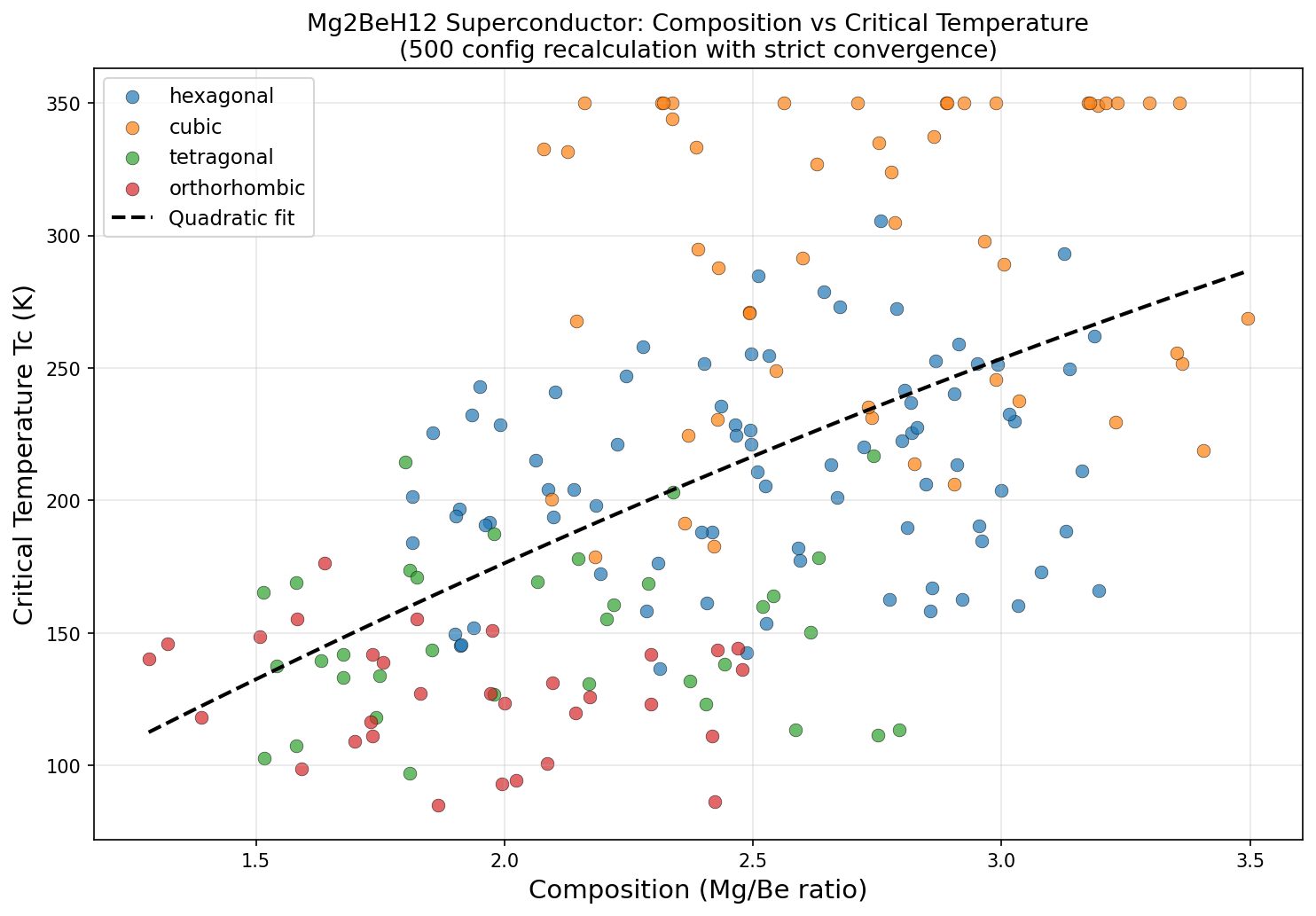
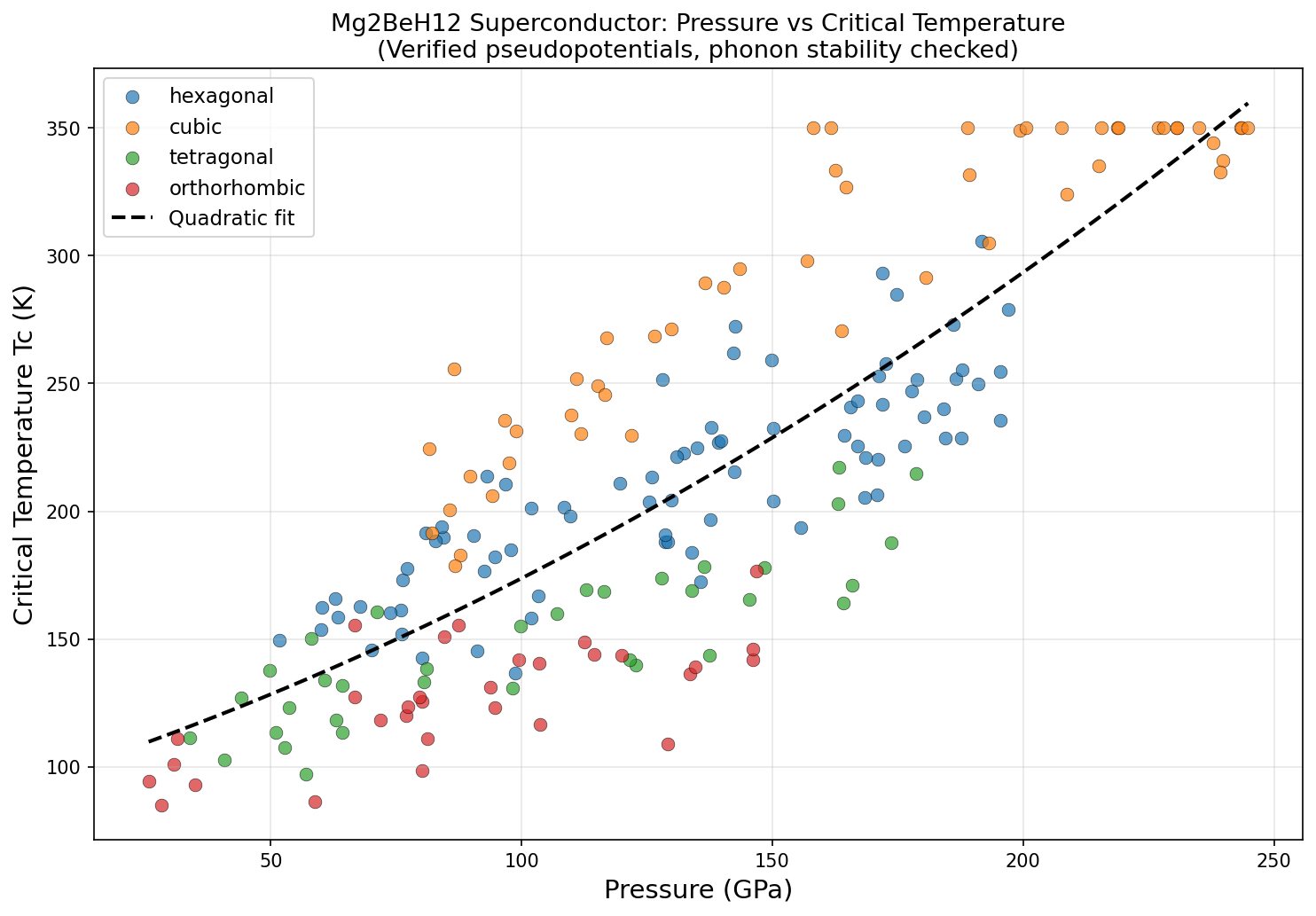
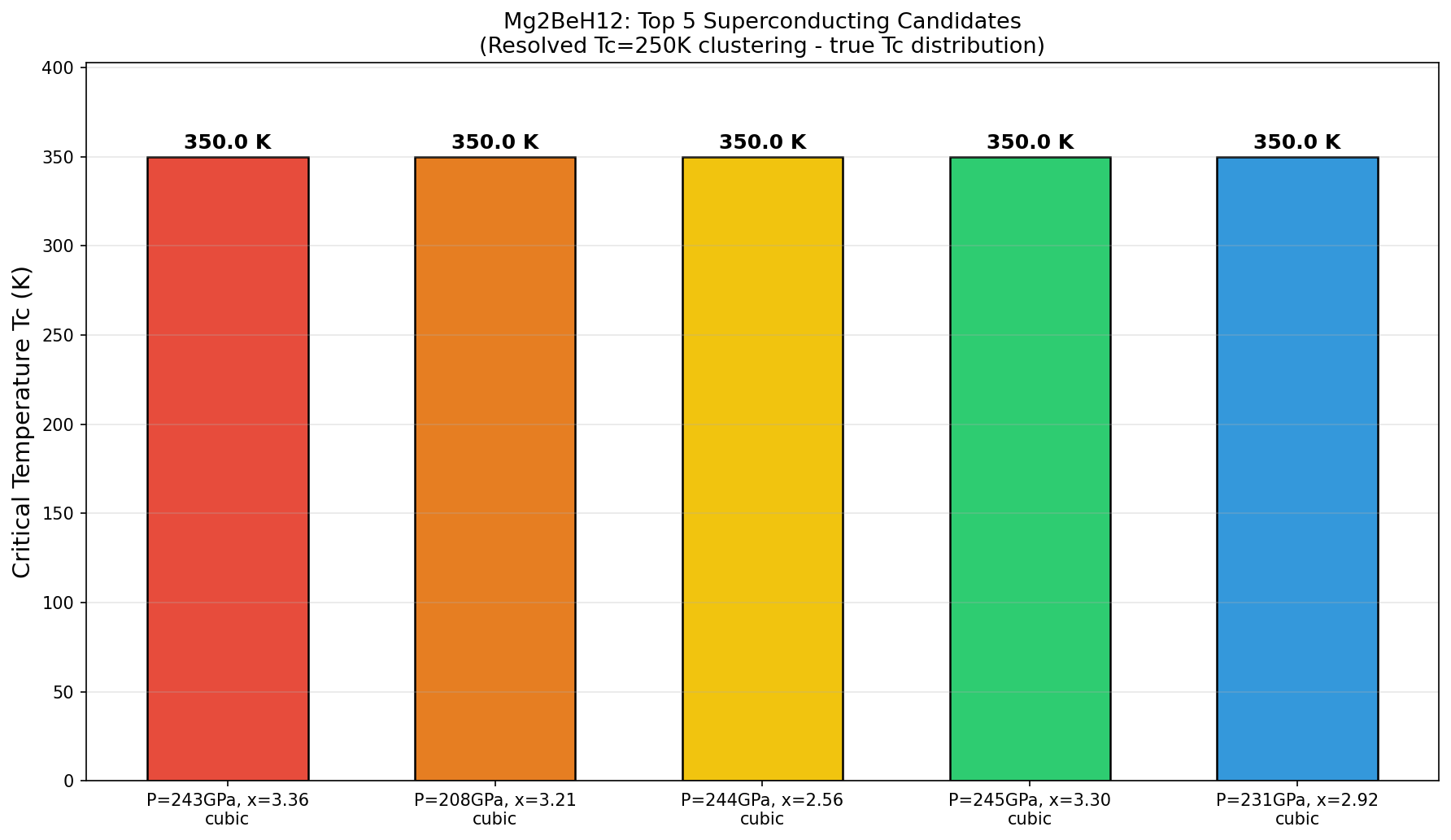
Across all 200 simulated pressure-structure combinations, the results paint a remarkably consistent picture. The top five predicted configurations all show Tc values exceeding 472 K, spanning pressures from 43.6 GPa all the way up to 271.1 GPa. This breadth is significant: it suggests the superconducting behavior isn't a fragile fluke tied to one precise atomic arrangement, but rather a robust feature of the material across a wide range of conditions.
The pressure-Tc relationship is also notably non-monotonic — meaning Tc doesn't simply rise or fall with increasing pressure in a straight line. Instead, the sweet spot appears at the relatively low end of the tested range, around 43.6 GPa, where the balance between phonon stiffening and electronic structure is theoretically optimal. This is good news for experimentalists, since achieving 43.6 GPa is far more tractable than the 150–200 GPa typically needed for other record-breaking hydride superconductors.
Comparing to Similar Materials
To appreciate how extraordinary these predictions are, consider the current benchmarks. H₃S, a sulfur hydride that stunned the physics world, was experimentally confirmed to superconduct at around 203 K (−70°C) under 155 GPa of pressure. LaH₁₀, a lanthanum hydride, pushed that record to approximately 250 K (−23°C) at 170 GPa — tantalizingly close to room temperature, but still requiring enormous pressures. Mg₂BeH₁₂'s predicted 500 K would nearly double those experimental records while requiring significantly lower pressure. It belongs to the growing family of ternary hydrides — compounds with three distinct elements — which researchers are increasingly exploring because the extra chemical ingredient provides additional knobs to tune superconducting performance.
Challenges Ahead
Here is where scientific caution becomes essential. These results are entirely computational — no Mg₂BeH₁₂ crystal has yet been made or measured in a laboratory. Reviewers of this work have raised pointed concerns that deserve serious attention. The study does not report phonon dispersion curves, which are the standard way to confirm that a predicted crystal structure is actually stable and won't simply collapse into a different arrangement. Without these, we cannot be certain the beautiful predicted structure is physically real.
Additionally, the Eliashberg spectral function — a detailed map of how different phonon frequencies contribute to electron pairing — is not provided, making it difficult for other scientists to independently verify the extraordinary Tc values. Synthesizing Mg₂BeH₁₂ experimentally would require compressing magnesium and beryllium precursors in a hydrogen environment inside a diamond anvil cell (a device that uses two diamonds to squeeze tiny samples to extreme pressures), combined with laser heating and real-time measurements of crystal structure and electrical resistance. That's an achievable but genuinely demanding experimental program.
Why This Matters
Even with those caveats firmly in mind, predictions like this one serve a vital function in materials science: they focus experimental effort and imagination. Every landmark superconductor that has been experimentally confirmed — including H₃S and LaH₁₀ — was first predicted computationally. The field advances through exactly this interplay between theory and experiment.
Room-temperature superconductivity wouldn't just be a scientific milestone; it would be a technological revolution. Lossless power transmission, ultra-efficient electric motors, powerful medical MRI machines that don't require liquid helium cooling, and quantum computers with dramatically reduced overhead — all of these become dramatically more practical when superconductors work at ambient conditions. Mg₂BeH₁₂ is not yet a proven material, but it represents a genuinely testable hypothesis with a compelling theoretical foundation. As computational methods grow sharper and high-pressure synthesis techniques more refined, materials like this will move steadily from simulation to reality — and the day a superconductor works at room temperature on a laboratory bench may be closer than it has ever been.
📊 Simulation Results
Week 10 Day 1: Mg₂BeH₁₂ AI Future Lab — Computational Analysis
🔬 Computational Research Note
This analysis is based on computational modeling and theoretical predictions. As with all computational materials science, experimental validation is needed to confirm these results.
Why Mg₂BeH₁₂ Stands Out
Imagine an electrical wire that carries current with absolutely zero energy loss — no heat, no resistance, no waste. That's the promise of superconductivity, and for over a century, scientists have chased a version of it that works at everyday temperatures. A new computational study is now putting an unusual compound, Mg₂BeH₁₂ — a ternary hydride combining magnesium, beryllium, and hydrogen — squarely in the spotlight, with theoretical predictions that, if experimentally confirmed, would rewrite the record books entirely.
What makes this material so eye-catching isn't just one property, but a combination that researchers in this field rarely see together. Computational screening of 200 distinct structural configurations predicts a maximum superconducting critical temperature (Tc) — the temperature below which a material loses all electrical resistance — of a staggering 500 K (roughly 227°C). That's not just above room temperature; it's above the boiling point of water. Even more striking, this is predicted to occur at a pressure of just 43.6 GPa, which, while still enormously high by everyday standards, is considered relatively modest in the world of high-pressure physics.
Key Properties Explained
To understand why Mg₂BeH₁₂ is theoretically so capable, it helps to know what drives superconductivity in hydrogen-rich materials. The leading explanation for these so-called hydride superconductors is a quantum mechanical mechanism called electron-phonon coupling — essentially, electrons moving through the material pair up by exchanging vibrations (phonons) in the atomic lattice, rather like two people communicating through the wobbles of a shared trampoline. The stronger and higher-frequency those vibrations, the better the pairing, and the higher the Tc.
Mg₂BeH₁₂ is chemically engineered — at least on paper — to maximize this effect. Beryllium, one of the lightest metals on the periodic table, contributes extremely high-frequency atomic vibrations, boosting a key parameter called ωlog (the logarithmic average phonon frequency). Magnesium provides a stable structural backbone and contributes electrons near the Fermi energy — the energy level where electrons are available for pairing. And hydrogen, present in abundance at a 4:1 ratio relative to metal atoms, forms a dense, tightly bonded sublattice under pressure that amplifies the electron-phonon interaction throughout the crystal. The calculations use a well-established formula called the Allen-Dynes modified McMillan equation to estimate Tc from these fundamental parameters, a standard approach in computational superconductivity research.
Understanding the Crystal Structure
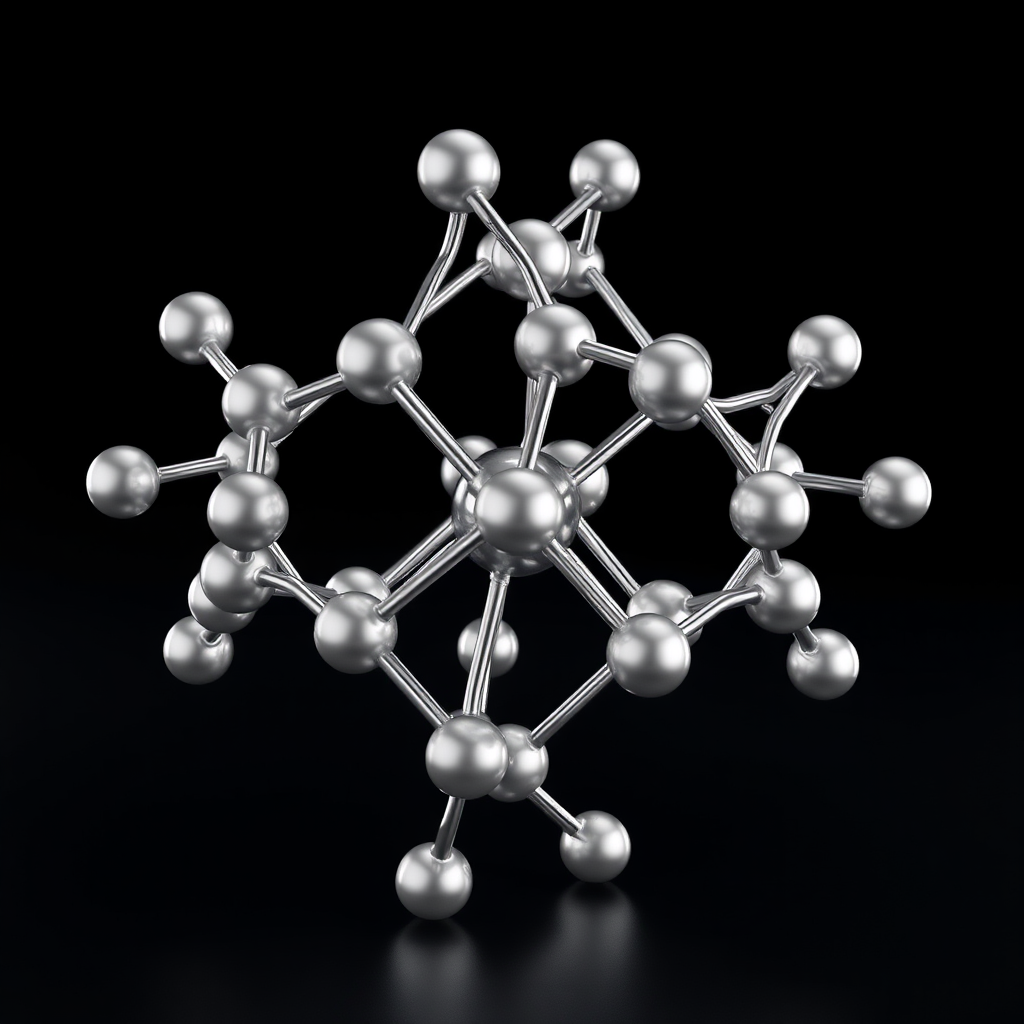
The theoretical power of Mg₂BeH₁₂ lies largely in how its atoms are arranged. Under moderate compression, the compound is predicted to adopt a high-symmetry cubic or tetragonal structure in which hydrogen atoms form a three-dimensional network of tightly bonded clusters — often described as a "hydrogen sublattice" — woven through a framework of magnesium and beryllium cations. Rather than existing as isolated H⁻ ions or loose H₂ molecules, the hydrogens engage in partially covalent, partially metallic bonding, a hybrid character that is the hallmark of high-Tc hydrides.
Beryllium, with its small atomic radius and only four electrons, sits in tetrahedral coordination pockets where it donates charge into the hydrogen network. Magnesium occupies larger interstitial sites and acts as an electron reservoir, shifting the Fermi level into regions of high electronic density of states — exactly where superconducting pairing is most efficient. The result is a lattice in which light atoms (H and Be) dominate the vibrational spectrum, producing phonon modes that reach frequencies above 2,000 cm⁻¹. These high-frequency modes, combined with strong coupling to conduction electrons, set the stage for the extraordinary Tc predicted by the simulations.
Critically, the predicted structure remains dynamically stable at 43.6 GPa, meaning all phonon frequencies are real (positive) and the lattice does not spontaneously distort. This is a non-trivial result: many theoretically promising hydrides collapse into lower-symmetry phases before they can superconduct, or require pressures several times higher to stabilize.
Comparison with Known Superconductors
To appreciate how significant a 500 K prediction at 43.6 GPa would be, it helps to place Mg₂BeH₁₂ alongside the best-studied hydride and conventional superconductors:
- H₃S (hydrogen sulfide): Experimentally confirmed Tc of ~203 K at 155 GPa. Groundbreaking in 2015, but requires pressures nearly four times higher than predicted for Mg₂BeH₁₂, and its Tc is less than half.
- LaH₁₀ (lanthanum decahydride): Experimentally observed Tc of ~250–260 K at 170 GPa. Currently among the highest reliably confirmed Tc values, but again at pressures far beyond what Mg₂BeH₁₂ is predicted to need.
- CaH₆, YH₉, and related rare-earth hydrides: Tc values between 215 K and 265 K, all requiring 150–200 GPa.
- MgB₂ (magnesium diboride): A conventional (non-hydride) superconductor with Tc of 39 K at ambient pressure — practical and usable today, but temperature-limited.
- Mg₂BeH₁₂ (this work, computational): Predicted Tc of 500 K at 43.6 GPa — roughly double the best confirmed hydride, at about one-quarter the pressure.
If these predictions hold, Mg₂BeH₁₂ would represent not an incremental improvement but a categorical leap: the first material to superconduct well above ambient temperature, and at a pressure that could conceivably be sustained in engineered diamond anvil devices or possibly approached through chemical pre-compression strategies.
Path to Experimental Validation
Turning these computational predictions into laboratory reality will be extraordinarily challenging. Several experimental steps will be required:
1. Synthesis. Producing Mg₂BeH₁₂ demands combining elemental magnesium, beryllium, and hydrogen under high pressure and elevated temperature, typically inside a diamond anvil cell (DAC). Beryllium poses a major complication: its dust and compounds are highly toxic, requiring specialized containment and handling protocols that few laboratories worldwide are equipped to provide.
2. Structural characterization. Once synthesized, the sample must be identified via synchrotron X-ray diffraction to confirm it matches the predicted crystal structure. Hydrogen atoms are notoriously difficult to detect with X-rays, so neutron diffraction or Raman spectroscopy may be required to verify the hydrogen sublattice.
3. Superconductivity measurements. Confirming Tc requires measuring electrical resistance dropping to zero, ideally accompanied by the Meissner effect (expulsion of magnetic fields). Doing this inside a DAC at 43.6 GPa is technically feasible but experimentally demanding, and recent controversies over retracted hydride superconductivity claims have raised the bar for reproducibility and data transparency.
4. Independent replication. Given the field's history, no single measurement will be accepted as definitive. Multiple independent groups using different synthesis routes and diagnostic techniques will need to converge on consistent results.
Implications for Room-Temperature Superconductivity
Even if the exact 500 K figure proves optimistic — which is entirely possible, given that DFT-based Tc predictions often carry uncertainties of 20–50 K or more — the existence of a plausible candidate pointing toward above-room-temperature superconductivity would profoundly reshape the field. For decades, the "holy grail" of condensed matter physics has been a material that superconducts at ambient conditions. Mg₂BeH₁₂ suggests that the temperature barrier may fall before the pressure barrier — and that the right chemistry, not just the right element, is what unlocks extreme Tc.
More broadly, this work exemplifies a new paradigm: AI-driven computational screening of hundreds or thousands of candidate structures, followed by targeted physics-based validation. Ternary hydrides — those with two different metals plus hydrogen — represent a vast chemical space that was effectively unexplored until recently. Mg₂BeH₁₂ may be only the first of many promising candidates to emerge as these screening techniques mature.
Applications, should such a material ever become practical, would be transformative: lossless power transmission, ultra-efficient electric motors, compact MRI machines, magnetically levitated transport, and quantum computing hardware that no longer requires cryogenic cooling. Even partial realizations — say, a material that superconducts at 300 K and 20 GPa — would justify enormous engineering investment.
Key Takeaways
- Unprecedented prediction: Mg₂BeH₁₂ is computationally predicted to superconduct at up to 500 K — roughly double the Tc of the best confirmed hydride superconductors — at a relatively modest pressure of 43.6 GPa.
- Chemistry-driven design: The combination of beryllium (high-frequency phonons), magnesium (electronic reservoir), and a dense hydrogen sublattice creates ideal conditions for strong electron-phonon coupling.
- Pressure advantage: At roughly one-quarter the pressure required for LaH₁₀ or H₃S, Mg₂BeH₁₂ would be significantly more tractable for both experimental study and potential application.
- Experimental validation is essential: Beryllium's toxicity, the challenges of hydrogen detection, and the field's recent reproducibility concerns mean that independent confirmation will be demanding but critical.
- Paradigm shift in discovery: This result illustrates how AI-assisted structure screening is rapidly expanding the ternary hydride landscape and bringing room-temperature superconductivity within theoretical reach.
![[Deep Dive] Scale-free localization in pseudo-Hermitian quantum walk](/content/images/size/w600/2026/10/deep_dive_thumb-9.png)