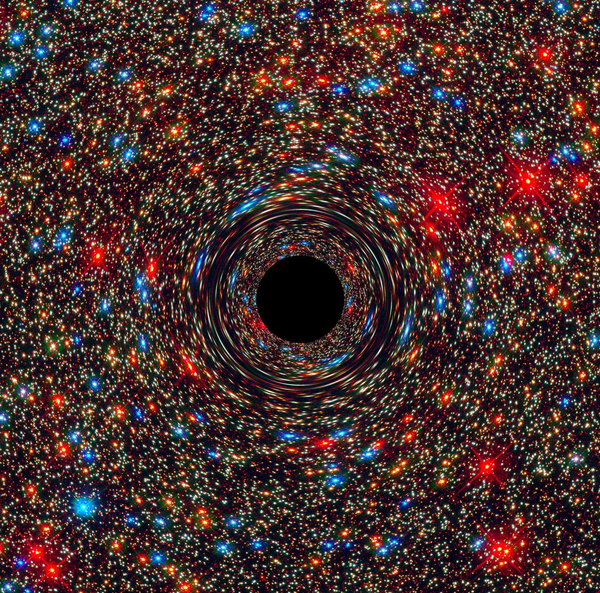
Neutrinos: A Trillion Pass Through You Every Second
Episode 0: Prologue: How Do We Know What We Cannot See?
Hold your hand up to the light. Any light — your screen, the bulb above you, the sun if you happen to be outside. Look at the back of your hand. The skin, the veins, the small mountain range of your knuckles. It looks solid. It feels solid. If you knock on it, it sounds solid.
It isn't.
Right now, as you read this sentence, something is happening to your hand that you cannot feel, cannot see, cannot detect with any sense you were born with. About a hundred trillion tiny things are passing through it. Not around it. Through it. Through your skin, through the bones, through the blood, out the other side, and onward into the chair, the floor, the ground, and eventually out the other side of the planet.
A hundred trillion. Per second.[1]
You have been doing this your entire life. You did it as a baby. You did it in the womb. Your grandmother did it, and so did the first fish that crawled onto land, and so did the dinosaurs, and so does the dog asleep at your feet. Every living thing on Earth, and every dead thing, and every rock and ocean and mountain — all of it, constantly, is being passed through.
And nothing happens. No damage. No warmth. No tickle. The things go through you the way you would go through a thought.
This is the strangest fact I know about being alive, and almost nobody talks about it.
I want you to sit with this for a second, because I think we skip past these things too quickly. We hear a number — a hundred trillion per second — and our brain files it under "science fact" and moves on. But your body is being constantly perforated, at this exact moment, by a rain of something. Something real. Something that came from a star. Something that, in most cases, was made about eight minutes ago at the center of the sun and has been traveling at nearly the speed of light ever since, just to arrive here, just to pass through your left thumb, and just to keep going.
If you stood in front of a brick wall a light-year thick — a wall of solid lead, stretching for nearly six trillion miles — about half of these things would still come out the other side.[2]
So here is the question I cannot stop turning over.
How do we know they are there?
I mean it. Really think about this. You can't see them. You can't feel them. They don't push you, heat you, dent the chair, shake a leaf. They don't show up on any instrument you own. If every one of them stopped existing tomorrow, you would not notice. Nothing in your daily life would change. Your coffee would still get cold at the same rate. The cat would still ignore you.
And yet someone, somewhere, figured out they exist. Someone wrote down a number — a hundred trillion per second — and other people checked, and the number held up. We built machines in old gold mines and under mountains in Japan and at the bottom of the sea, and somehow, in a way I want to talk about, we caught a few of them.
A handful. Out of the uncountable flood.
This is what I keep coming back to, the thing that got me writing this whole series in the first place. We have built a picture of reality that includes things we cannot see and never will. Things smaller than atoms. Things older than light. Things at the edge of the universe, on the other side of time. And the picture is not a guess. It is checkable. We can predict where a planet will be in a hundred years, what color a distant galaxy will glow, how long a particle will live before falling apart. Most of what we call "the world" is invisible to us, and yet we know it.
How? How does that work?
AI-generated image — a conceptual visualization
That's what this series is about. We're going to start here, with the things passing through your hand right now, and then we're going to walk backwards. Backwards through stars, backwards through galaxies, backwards through the slow cooling of everything, until we arrive at a moment when there was no light at all, no atoms, nothing you could call a thing. And we're going to ask, at every step: how do you know? How can anyone know?
But first, the hand. The hundred trillion. The rain that goes through everything.
Let me tell you what they are.
Here is the thing I want you to picture. Forget the hand for a second. Imagine a parking garage. One of those huge concrete ones, ten floors, ramps spiraling up, fluorescent lights buzzing. Cars everywhere. Pillars. Walls. The whole thing weighs, I don't know, a hundred thousand tons of concrete and steel.
Now imagine a ghost walks in.
Not a Halloween ghost. A serious ghost. A ghost on a mission. This ghost is going to walk in a perfectly straight line, from the east side of the garage to the west side, and it doesn't care about cars or pillars or walls. It walks through them. Concrete? Doesn't notice. The engine block of an SUV? Walks right through. A person leaning against a Honda? Through them too. The ghost doesn't even slow down. It doesn't bump anything, scratch anything, leave a draft. It just goes.
That's a neutrino *1. A neutrino is a particle so antisocial that almost nothing in the universe can stop it or even tap it on the shoulder. It has almost no mass. It has no electric charge. It interacts with normal matter through one specific force — the weak force *2 — and that force is called weak for a very honest reason. It barely does anything.
So here is where the analogy gets weird. Because a single ghost walking through your parking garage is one thing. But neutrinos don't come one at a time.
Imagine the entire eastern wall of the garage suddenly becomes a fire hose of ghosts. Not a trickle. A flood. A torrent. Billions of ghosts per second, all walking westward in straight lines, passing through every car, every pillar, every commuter fumbling for their keys. A constant, silent stampede. And nobody notices. The cars don't shake. The lights don't flicker. The keys don't jingle. The ghosts just pour through and keep going, out the western wall, into the next building, through the next building, and the next, all the way out the other side of the Earth, and then out into space.
That is what is happening to you right now. About a hundred trillion neutrinos pass through your body every second [1]. Most of them are coming from the Sun [2]. They were made in the Sun's core eight minutes ago, they crossed ninety-three million miles of vacuum, they hit the Earth, they went through the atmosphere like it wasn't there, through the roof of your house, through the ceiling, through you, through your floor, through the floors below you, through the rock and the mantle and the molten iron core of the planet, and out the other side into space again. They didn't stop for any of it. You were not a speed bump. You were not even a suggestion.
Now, you might reasonably ask: if these things ignore everything, how do we know they exist? Good question. Hold onto it. We're going to come back to it, because that's actually the whole point of this series.
But first I want to push the analogy one more step, because there's a detail that changes everything.
Once in a while — very, very rarely — the ghost bumps into something. Not on purpose. The ghost is not aiming. It's just that if you have enough ghosts and enough atoms, statistics eventually wins. About once in a blue moon, a neutrino will smack into the nucleus of an atom and leave a tiny, recordable scuff mark.
How rare is rare? If you wanted to stop, on average, half of the neutrinos coming out of the Sun, you would need a wall of solid lead about a light-year thick [3]. A light-year. That's roughly six trillion miles of lead. To stop half of them. The other half would walk through your six-trillion-mile lead wall and keep going, whistling.
This is the part that broke my brain when I first heard it. We share our bodies, constantly, with a substance so shy that planets are basically transparent to it. The Earth — the entire Earth, eight thousand miles of rock and metal — is, to a neutrino, about as solid as a thin morning mist. The Sun is a slightly thicker mist. A human being? A human being is nothing. A human being is a rumor of matter. You couldn't stop a neutrino with a human being any more than you could stop a bullet with a thought.
And yet, somehow, we know they're there. Somehow, we know exactly how many are passing through you. We know where they came from. We know what they're doing. We have giant tanks of cleaning fluid buried under mountains, watching for the rare ghost that bumps into something [4]. We have caught them. We have counted them. We have learned things about the Sun's core, the most hidden place in our solar system, by listening to the ghosts that came from it.
AI-generated image — a conceptual visualization
Which is the real story I want to tell you. Not that neutrinos exist — though that's strange enough on its own. The real story is the trick. The whole, ridiculous, beautiful trick of how a species of slightly clever apes, on a damp planet, figured out how to see things that pass through planets like the planets aren't there.
That trick is what this series is about. We're going to start here, with the things that flow through you right now, and we're going to walk backwards. Backwards through the Sun. Backwards through stars that died before our star was born. Backwards, eventually, all the way to a moment when there were no stars at all and the whole universe was a kind of fog.
We see all of it. We don't see any of it. Both of those sentences are true.
The ghost is real. Physicists call it a neutrino *1, which is a terrible name because it sounds like a small Italian pasta. It actually means "little neutral one" in Italian, which is at least honest. It's little. It's neutral. That's almost the whole story.
Almost.
Here is where I have to tell you how we know any of this, because that's the actual question, isn't it? If a particle passes through your body without touching anything, how did anyone ever figure out it existed? You can't see it. You can't weigh it. You can't put it in a jar. For a long time, nobody could prove it was there at all. It was a math problem before it was a physics problem.
The story starts in 1930 with a guy named Wolfgang Pauli, who was a brilliant Austrian physicist and, by most accounts, kind of a jerk. Pauli was looking at a process called beta decay *2, which is what happens when certain radioactive atoms spit out an electron and turn into a different kind of atom. The problem was the math didn't add up. When you measured the energy of the electron coming out, plus the energy of the atom left behind, it was less than the energy you started with. Energy was just disappearing. And energy isn't supposed to disappear. That's kind of the one rule.
Some physicists, including Niels Bohr, were ready to throw out the rule. Maybe energy isn't conserved at small scales. Maybe the universe is just sloppy down there.
Pauli had a different idea. In December 1930, he wrote a letter to a physics conference in Tübingen that he couldn't attend because he'd RSVP'd to a ball in Zürich instead. I'm not making that up. He started the letter with "Dear Radioactive Ladies and Gentlemen" [1]. In it, he proposed that there was a tiny, invisible, electrically neutral particle being emitted along with the electron, carrying away the missing energy. He called it a "neutron" at first, which got confusing later when somebody discovered an actual neutron, so the name got changed.
Pauli himself thought the idea was a little embarrassing. He reportedly told a friend, "I have done a terrible thing. I have postulated a particle that cannot be detected" [2]. He believed his ghost particle would never be observed because it interacted so weakly with everything else. He was almost right.
It took twenty-six years to prove him wrong.
In 1956, two American physicists, Clyde Cowan and Frederick Reines, set up an experiment next to a nuclear reactor at the Savannah River Plant in South Carolina [3]. Reactors, it turns out, are neutrino factories. The fission reactions inside them spit out enormous numbers of these little ghosts — something like ten trillion per square centimeter per second flying out from the reactor core. If neutrinos existed at all, this was the place to find them.
The experiment was beautiful in its desperation. Cowan and Reines built two huge tanks of water mixed with cadmium chloride, sandwiched between detectors filled with a liquid that flashes when a charged particle moves through it. The idea was that very, very rarely — maybe a few times a day, out of trillions and trillions of neutrinos passing through — one would happen to slam into a proton inside the water. When it did, it would produce a specific double flash of light with a precise time delay between the flashes. A signature. A fingerprint.
They waited. They watched. They saw the flashes.
They sent a telegram to Pauli that read: "We are happy to inform you that we have definitely detected neutrinos" [4]. Pauli, who was at CERN, reportedly interrupted a meeting to read it aloud, replied with a brief telegram of his own, and then went out and got drunk. Reines won the Nobel Prize for it in 1995. Cowan had died by then. The Nobel doesn't go to the dead.
So that's how we know they exist. But the story gets stranger.
AI-generated image — a conceptual visualization
Because there isn't just one kind of neutrino. There are three. Physicists call them flavors *3, which is the second-worst name in physics after neutrino itself. There's the electron neutrino, the muon neutrino, and the tau neutrino, each one paired with a heavier cousin particle. The muon neutrino was found in 1962 by Leon Lederman, Melvin Schwartz, and Jack Steinberger at Brookhaven [5]. The tau neutrino wasn't directly observed until 2000, by the DONUT experiment at Fermilab [6]. Forty-four years between the first one and the last one. These things do not give themselves up easily.
And then, in the late 1990s, things got really weird.
There was a problem nobody could explain, called the solar neutrino problem *4. The sun, like the reactor at Savannah River, is a neutrino factory — it makes them in the fusion reactions at its core. Physicists could calculate how many neutrinos the sun should be sending us. They could also build detectors and count how many we actually receive. The numbers didn't match. We were only seeing about a third of the neutrinos we expected [7]. For decades, this was an open wound in physics. Either our model of the sun was wrong, or our model of neutrinos was wrong, or our detectors were broken.
Turns out it was the neutrinos.
In 1998, an experiment in Japan called Super-Kamiokande — a giant tank holding 50,000 tons of ultra-pure water buried a kilometer underground in an old zinc mine — announced that neutrinos were changing flavor mid-flight [8]. An electron neutrino could turn into a muon neutrino could turn into a tau neutrino, all while traveling through space. They were oscillating between identities. The sun was making the right number of neutrinos; we were just looking for the wrong flavor when they arrived.
This was confirmed in 2001 by the Sudbury Neutrino Observatory in Canada, two kilometers down in a nickel mine, using a thousand tons of heavy water [9]. Takaaki Kajita and Arthur McDonald shared the 2015 Nobel Prize for this work.
Why does this matter? Because for a particle to change flavor mid-flight, it has to have mass. Even a tiny, ridiculous, almost-zero amount of mass. The original theory of physics — the Standard Model *5, which is the textbook everyone has been using since the 1970s — said neutrinos had to be massless, like photons. The oscillation discovery proved the Standard Model wrong. Not in a small way. In a load-bearing way.
We still don't know how much a neutrino weighs. We only know it's not zero, and it's incredibly small. The current best limit, from the KATRIN experiment in Germany, is that an electron neutrino has a mass less than 0.45 electron-volts [10]. To translate: a neutrino is at least a million times lighter than an electron, which is itself nearly two thousand times lighter than a proton. We are talking about something so close to nothing that for seventy years we thought it was nothing.
But it isn't nothing. And here is the part I keep getting stuck on.
There is a physicist named Janet Conrad at MIT who has spent her career chasing neutrinos. She once said, in an interview I can't stop thinking about, "Neutrinos are the most abundant matter particles in the universe, and we know almost nothing about them" [11]. Almost nothing. The most abundant matter particle. Both of those things at once.
How abundant? About 330 of them per cubic centimeter, everywhere, all the time, left over from the Big Bang [12]. They're called the cosmic neutrino background, and they're older than atoms. Older than light, actually — they decoupled from the rest of matter about one second after the Big Bang, while photons didn't escape until 380,000 years later. Every cubic centimeter of space you walk through contains a few hundred of these ancient ghosts. Including the cubic centimeters inside your skull.
The hundred trillion per second I mentioned at the start — those are mostly from the sun [13]. They take about eight minutes to get here from the solar core, except for the part where they don't, because they were actually made tens of thousands of years ago and have been bouncing around the dense interior of the sun before finally escaping. The light from the sun is eight minutes old. The neutrinos from the sun are basically the same age, but the energy that drove their creation is ancient.
At night, the neutrinos don't stop. The sun is on the other side of the Earth, but the Earth might as well not be there. The neutrinos pass through eight thousand miles of rock and iron and your bedroom floor and your mattress and you, on their way out into space on the far side. You are being neutrino-bombed twenty-four hours a day from every direction. From the sun, from distant supernovae, from the Earth's own radioactive core, from the nuclear reactor in the next state over, from the bananas in your kitchen [14].
Yes. Bananas emit neutrinos. Potassium-40, which is naturally present in bananas, undergoes beta decay. Pauli's original problem, happening on your kitchen counter. Every banana is a tiny ghost factory.
Here is what physicists now agree on, more or less. Neutrinos come in three flavors. They have mass, but we don't know exactly how much. They oscillate between flavors as they travel. They interact only through the weak nuclear force *6 and gravity, which is why they pass through matter so easily — the weak force has a range about a thousand times smaller than a proton, so a neutrino has to score an almost direct hit on a quark to interact at all. They're produced anywhere there's nuclear reactions: stars, supernovae, reactors, accelerators, the cores of planets, radioactive bananas.
Here is what physicists do not agree on, and this is the part that keeps the field alive. We don't know if a neutrino is its own antiparticle [15]. We don't know which flavor is the heaviest. We don't know if there's a fourth, "sterile" neutrino that interacts even less than the regular ones — there have been hints, in experiments like LSND and MiniBooNE, but nothing confirmed [16]. We don't know why neutrinos have mass at all, when the Standard Model said they shouldn't. We don't know if they're connected to the reason there's more matter than antimatter in the universe — which is to say, we don't know if neutrinos are the reason anything exists at all.
AI-generated image — a conceptual visualization
That last sentence is not me being dramatic. There's a serious idea in physics called leptogenesis *7, which proposes that a slight asymmetry in the behavior of neutrinos and their antiparticles in the early universe is what tipped the cosmic scales toward matter over antimatter [17]. If this idea is right, then the reason there are atoms — the reason there are stars and planets and oceans and you — is because of these particles you can't feel passing through your hand right now. The ghosts wrote the universe. Then they kept walking.
I want to give you a sense of the scale of effort it takes to study these things, because I think it tells you something about how strange they are. There is a detector at the South Pole called IceCube *8. It is not a detector you can hold. It is a cubic kilometer of Antarctic ice, drilled with eighty-six holes going down 2,500 meters, with strings of light sensors lowered into each hole and frozen in place [18]. The ice is the detector. When a neutrino, very rarely, slams into a nucleus in the ice, it creates a flash of blue light that the sensors pick up. To catch a few hundred high-energy neutrinos a year from outside our solar system, we had to turn a piece of Antarctica into an instrument.
In 2017, IceCube traced one of these high-energy neutrinos back to its source — a blazar *9, which is a supermassive black hole in a distant galaxy, four billion light-years away, shooting a jet of matter almost directly at us [19]. A single particle, lighter than almost anything, traveled across most of the observable universe and ended its journey by hitting one specific atom in a block of ice at the bottom of the world, where humans had spent a decade preparing to notice. That's how we know the blazar is doing what it's doing. One ghost arrived. We were ready.
Francis Halzen, the physicist who led IceCube for years, put it this way: "Neutrinos are the only particles that can escape from the dense, violent environments where the highest-energy events in the universe occur" [20]. Light gets blocked. Atoms get blocked. Everything else gets absorbed or scattered or destroyed. Neutrinos walk out. They are the only messengers that can leave certain places. If you want to know what's happening inside a collapsing star, or near a black hole, or at the heart of the sun, or in the first second of the universe — neutrinos are the only thing that can tell you. They are the only mail that gets delivered.
And we are sitting in the middle of the postal service. A hundred trillion letters a second, passing through your hand, addressed to nobody, signed by stars.
Almost all of them keep going. Out the other side of you, out the other side of the planet, out into space, until they hit something or don't, for the rest of time.
But every once in a while — once or twice in your entire life, statistically — one of them stops. One of them, out of the unthinkable number that have passed through your body since you were born, will hit a single atom inside you and interact [21]. A tiny, invisible event. You will not feel it. Nothing will change. A proton somewhere in your left elbow becomes a neutron for a fraction of a second, and an electron flies off, and that's it. That's the whole event.
Once or twice. In a lifetime. Out of the trillions per second.
The question I keep coming back to, the one I can't shake, is this: what does it mean to share a body with something you cannot detect? Not metaphorically. Literally. Right now, you are full of particles that were born in the sun, and particles that were born in stars that died before the sun existed, and particles that were born one second after the universe began. They are inside you. They are passing through you. They were here before you and they will be here after you, and the brief moment when your body is in their way is, from their perspective, nothing — a faint smudge of matter they barely noticed.
We had to build mines full of water and freeze a piece of Antarctica and write angry letters about energy conservation just to prove they were there at all.
So when I tell you that you cannot see most of what is happening to you, in this room, right now — I am not being poetic. I mean it as exactly as I can mean anything. Your senses were built to find food and avoid predators on an African savanna. They were not built to notice ghosts. The ghosts are here anyway.
And if there's this much we missed, sitting still in our own bodies — what else have we missed?
Here is what gets me. We have spent ninety years chasing this particle. We built a tank in a gold mine. We built a bigger tank in a zinc mine. We built a tank under a mountain in Japan, and another one under the ice in Antarctica — a cubic kilometer of Antarctic ice wired up with light sensors, called IceCube [1], because physicists are sometimes very literal. We have caught neutrinos from the sun, from exploding stars, from nuclear reactors, from the atmosphere, from the center of our own galaxy.
And we still don't know what a neutrino weighs.
I want you to sit with that for a second. We know how many of them are passing through your thumbnail right now. We know they come in three flavors *2 — electron, muon, tau, which sound like ice cream options but aren't. We know they switch between these flavors mid-flight, which is a thing called oscillation *3 and which won someone a Nobel Prize in 2015 [2]. We know an absurd amount about these ghosts.
But the mass? We have an upper limit. The best experiment, called KATRIN, sits in Germany and is essentially the world's most sensitive scale. It has narrowed the neutrino's mass down to less than 0.45 electron-volts [3], which in normal-person units is less than one-millionth the mass of an electron, which was already the lightweight champion of known particles. We know it's lighter than that. We don't know how much lighter. It could be a hundred times lighter. It could be a thousand. We just know the ceiling, not the floor.
AI-generated image — a conceptual visualization
And there might be a fourth kind. For decades, certain experiments have shown weird little hiccups — extra neutrino events that the three-flavor model can't explain. Some physicists think there's a fourth flavor hiding out there, called the sterile neutrino *4, which would be a ghost among ghosts: a particle that doesn't even do the small handshake the others do. A neutrino that ignores everything, including other neutrinos. The latest experiments seem to be ruling it out [4]. The previous experiments seemed to be ruling it in. Nobody is sure yet.
Here is the one that actually keeps me up at night, in the mild way that physics keeps a person up at night, which is to say not really but a little. We don't know if a neutrino is its own antiparticle.
Every other particle we know has an opposite. Electrons have positrons. Protons have antiprotons. They meet, they annihilate, end of story. But the neutrino is so strange, so barely-there, that it might be the one particle in the universe that is its own mirror. If that turns out to be true — and there are experiments running right now trying to find out [5] — it would mean the neutrino is a fundamentally different kind of thing from everything else in the standard model. It would also possibly explain why the universe contains any matter at all, instead of having annihilated itself into pure light fourteen billion years ago, which it really should have.
That's not a small loose end. That's a thread that, when you pull it, the entire question of why-we-exist might come along with it.
So when I say a hundred trillion neutrinos are passing through you every second, I am giving you a fact. When I tell you what they are, I am giving you our best guess, dated this year, subject to revision. The ghosts are real. We have caught some. But we have not really seen them. We have only seen the small bruises they leave behind in our giant underground swimming pools, and from those bruises we are trying to reconstruct a face we have never met.
And the face, so far, keeps almost smiling.
So here is the thing I keep coming back to, the reason I can't stop thinking about this.
A hundred trillion neutrinos are passing through you every second [2]. Most of them came from the sun, eight minutes ago, born in a nuclear reaction at the core where hydrogen is being crushed into helium [3]. They flew out through six hundred thousand kilometers of solar plasma like it was nothing. They crossed the vacuum to Earth. They went through the atmosphere, through the roof, through your skull, through the soft gray tissue where you are right now reading these words and thinking your private thoughts. And then they kept going. Through the floor. Through the bedrock. Through the entire planet. Out the other side. Back into space.
You did not slow them down. Your thoughts did not slow them down. Whatever you were worried about this morning did not slow them down.
And here is what I want you to sit with. Those neutrinos are messengers. Each one is carrying a little piece of information about the inside of the sun — a place we can never visit, never see directly, never photograph. The light from the sun's surface is hundreds of thousands of years old by the time it leaves *2. It bounces around in there forever. But the neutrinos? The neutrinos are honest. They come straight out. They are, in a real sense, the only direct view we have ever had of the heart of a star [4].
And they are inside you right now.
Which means something I find hard to write down without sounding silly. You are, at this moment, being looked through by the sun. Or maybe you are looking through the sun, depending on which direction you face. There is no membrane between you and the core of a star. There never was. You just couldn't tell.
This is what this whole series is going to be about. The things passing through us. The things we cannot see. The way the universe is mostly invisible, and we are mostly invisible to it, and yet somehow, with tanks of water in mines and ice at the South Pole and a lot of stubbornness, we have started to look.
So if a hundred trillion ghosts pass through you every second and leave no mark — what else is doing the same?
TERMS EXPLAINED
- *1(none in this section — technical terms introduced in the next section)
- *2Beta decay: A type of radioactive decay where an atom's nucleus spits out an electron (or its antimatter twin) and changes into a different element. It's how potassium-40 in a banana slowly becomes calcium.
- *3Flavor (of neutrino): The three "types" of neutrino — electron, muon, and tau — named after the heavier particles they pair with. A neutrino can switch flavors as it travels.
- *4Solar neutrino problem: A decades-long mystery where we kept detecting only about a third of the neutrinos the sun should have been sending us. Solved when we realized the missing ones had switched flavors mid-flight.
- *5Standard Model: The current rulebook of particle physics, written in the 1970s. It describes all known particles and forces except gravity. It said neutrinos were massless. It was wrong about that, and we still don't fully understand why.
- *6Weak nuclear force: One of the four fundamental forces, and the one neutrinos can feel. It only works at distances smaller than a proton, which is why neutrinos almost never hit anything — they have to come almost impossibly close to a particle to notice it's there.
- *7Leptogenesis: A theory that says the reason the universe has matter instead of being empty is because neutrinos and their antimatter twins behaved slightly differently in the first moments after the Big Bang. If true, you exist because of a tiny imbalance in how ghosts behave.
- *8IceCube: A neutrino detector at the South Pole made of one cubic kilometer of Antarctic ice, with strings of light sensors frozen into it. The ice itself is the detector.
- *9Blazar: A galaxy with a supermassive black hole at its center that is shooting a jet of high-energy matter and radiation almost directly at Earth. They are some of the most violent objects in the universe and, apparently, neutrino factories.
SOURCES & REFERENCES
- [1]Bahcall, J. N. (1989). "Neutrino Astrophysics." Cambridge University Press. — The figure of roughly 65–100 billion solar neutrinos per square centimeter per second at Earth, integrated over a hand-sized area, gives on the order of 10^14 per second through a human body.
- [2]Formaggio, J. A. & Zeller, G. P. (2012). "From eV to EeV: Neutrino Cross Sections Across Energy Scales." Reviews of Modern Physics, 84, 1307. — Neutrino interaction cross sections imply a mean free path of roughly a light-year in lead for typical solar neutrino energies.
- [3]Cowan, C. L., Reines, F., et al. (1956). "Detection of the Free Neutrino: A Confirmation." Science, 124(3212), 103–104. — The first detection of the neutrino at Savannah River.
- [4]Reines, F. (1996). "The Neutrino: From Poltergeist to Particle." Nobel Lecture, Reviews of Modern Physics, 68(2), 317. — Account of the telegram exchange with Pauli.
- [5]Danby, G., Gaillard, J.-M., Goulianos, K., Lederman, L. M., et al. (1962). "Observation of High-Energy Neutrino Reactions and the Existence of Two Kinds of Neutrinos." Physical Review Letters, 9(1), 36. — Discovery of the muon neutrino.
- [6]Kodama, K., et al. (DONUT Collaboration) (2001). "Observation of tau neutrino interactions." Physics Letters B, 504(3), 218–224. — First direct detection of the tau neutrino.
- [7]Bahcall, J. N. (1989). Neutrino Astrophysics. Cambridge University Press. — Documentation of the solar neutrino problem and the deficit observed by Davis's chlorine experiment.
- [8]Fukuda, Y., et al. (Super-Kamiokande Collaboration) (1998). "Evidence for Oscillation of Atmospheric Neutrinos." Physical Review Letters, 81(8), 1562. — Discovery of neutrino oscillation.
- [9]Ahmad, Q. R., et al. (SNO Collaboration) (2002). "Direct Evidence for Neutrino Flavor Transformation from Neutral-Current Interactions in the Sudbury Neutrino Observatory." Physical Review Letters, 89(1), 011301. — Confirmation of flavor change at SNO.
- [10]Aker, M., et al. (KATRIN Collaboration) (2022). "Direct neutrino-mass measurement with sub-electronvolt sensitivity." Nature Physics, 18, 160–166. — Current upper limit on the electron neutrino mass.
- [11]Conrad, J. (2018). Interview, Quanta Magazine, "The Hunt for Sterile Neutrinos Heats Up." — Quote on neutrino abundance and our ignorance.
- [12]Lesgourgues, J. & Pastor, S. (2006). "Massive neutrinos and cosmology." Physics Reports, 429(6), 307–379. — Density of cosmic neutrino background, ~336 per cm³.
- [13]Bahcall, J. N. & Meltzer, D. (2004). "How Many σ's Is the Solar Neutrino Effect?" The Astrophysical Journal, 614, 464. — Solar neutrino flux at Earth, ~6.5×10¹⁰ per cm² per second.
- [14]Health Physics Society (2013). "Radioactivity in food." HPS Position Statement. — Beta decay of K-40 in bananas, producing antineutrinos.
- [15]Dell'Oro, S., Marcocci, S., Viel, M., Vissani, F. (2016). "Neutrinoless Double Beta Decay: 2015 Review." Advances in High Energy Physics, 2016, 2162659. — Open question of whether neutrinos are Majorana particles.
- [16]Aguilar-Arevalo, A. A., et al. (MiniBooNE Collaboration) (2018). "Significant Excess of Electronlike Events in the MiniBooNE Short-Baseline Neutrino Experiment." Physical Review Letters, 121, 221801. — Hints of sterile neutrinos.
- [17]Fukugita, M. & Yanagida, T. (1986). "Baryogenesis without grand unification." Physics Letters B, 174(1), 45–47. — Original leptogenesis proposal connecting neutrinos to matter-antimatter asymmetry.
- [18]Aartsen, M. G., et al. (IceCube Collaboration) (2017). "The IceCube Neutrino Observatory: instrumentation and online systems." Journal of Instrumentation, 12, P03012. — Description of the IceCube detector design.
- [19]IceCube Collaboration et al. (2018). "Multimessenger observations of a flaring blazar coincident with high-energy neutrino IceCube-170922A." Science, 361(6398), eaat1378. — Identification of TXS 0506+056 as the source of a high-energy neutrino.
- [20]Halzen, F. (2017). Interview, University of Wisconsin–Madison News, "IceCube Detects Astrophysical Neutrinos." — Quote on neutrinos as messengers from extreme environments.
- [21]Formaggio, J. A. & Zeller, G. P. (2012). "From eV to EeV: Neutrino cross sections across energy scales." Reviews of Modern Physics, 84, 1307. — Neutrino interaction cross sections used to estimate lifetime interaction probability in a human body.
Inline citations [N] correspond to numbered references above.
A weekly journey from the present universe back to the Big Bang — and to what it means for us.
![[Deep Dive] Scale-free localization in pseudo-Hermitian quantum walk](/content/images/size/w600/2026/10/deep_dive_thumb-9.png)