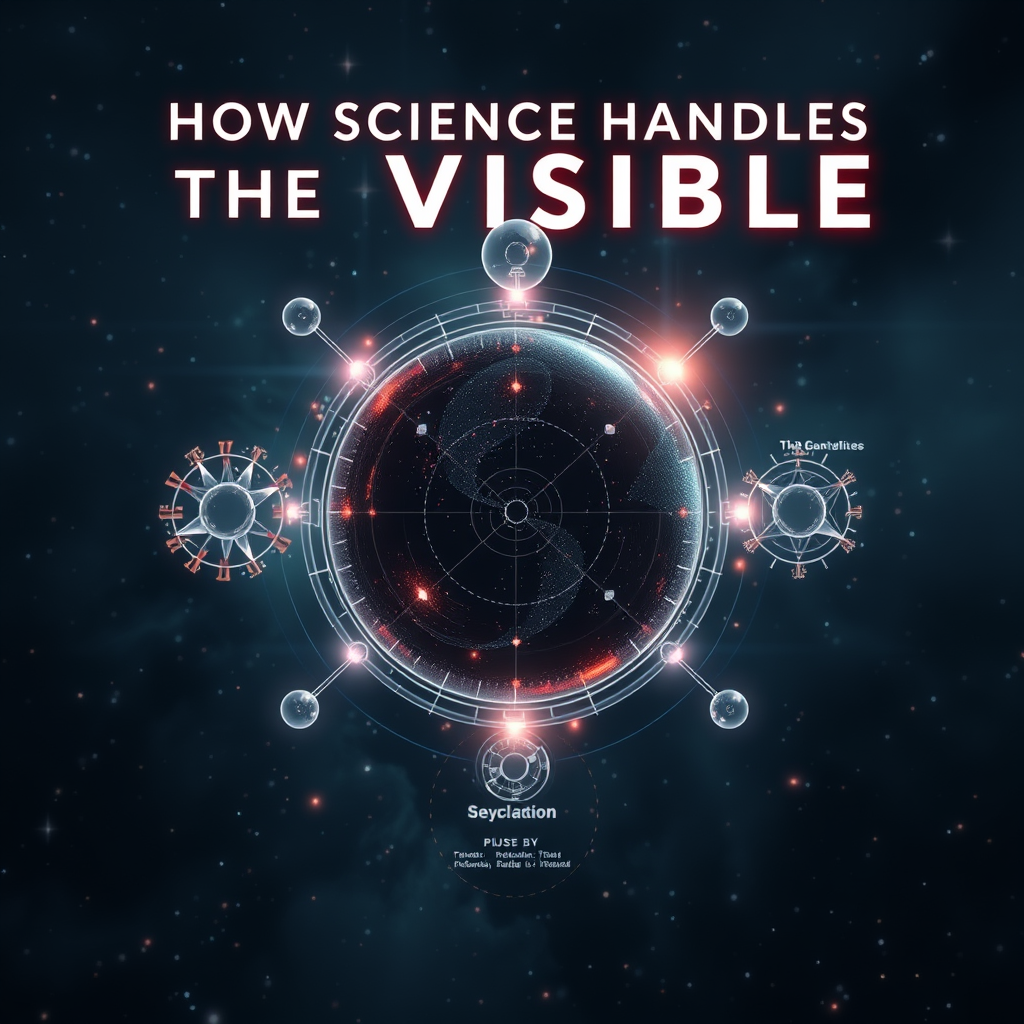
How Science Handles the Invisible
Episode 0: Prologue: How Do We Know What We Cannot See?
I like science that leaves room to imagine. When things that seemed unrelated turn out to share a hidden pattern — that moment feels like finding one of the world's secrets. Which opens a door I didn't know was there. Which leads somewhere unexpected. Which eventually leads back to me.
You're sitting on a chair right now. Probably. And the chair feels solid. That's the whole experience — your weight goes down, the chair pushes up, nothing falls through anything. Case closed.
Except the chair is mostly empty. Not poetically empty. Literally. If you scaled an atom up so its nucleus was the size of a marble, the nearest electron would be a few city blocks away [1]. Everything in between is nothing. Not air. Nothing. The chair holding you up is a sparse cloud of almost-nothing, and so are you, and somehow the two almost-nothings refuse to pass through each other.
So why don't you fall through the chair?
Hold that question. We'll come back to it.
Here's another one. Look up tonight. If you live somewhere with a dark sky, you'll see maybe two or three thousand stars [2]. That feels like a lot. It feels, honestly, like everything. But every second, while you're standing there squinting at the sky, about 100 trillion ghost particles are passing through your body [3]. They came from the sun. They went through the entire Earth on their way to you, like the Earth wasn't there. Then they went through you, like you weren't there. And then they kept going, out the other side of the planet, into space, possibly forever.
You didn't feel a thing. You never have. You never will.
These particles are called neutrinos *1 — tiny scraps of matter so shy they almost never interact with anything. They're the second most common particle in the universe, after photons of light [4]. And until 1956, we had no idea if they were real [5]. They had been predicted on paper, by someone who hated his own prediction and called it "a desperate remedy" [6]. For twenty-six years, the most abundant matter-thing in your immediate vicinity, the thing currently sleeting through your skull at the speed of almost-light, was a guess.
Think about that for a second. The universe was full of something. We were swimming in it. We had no way to know.
This is the thing nobody tells you about science. The hard part isn't doing experiments. The hard part is suspecting that something is there at all. The world is loud with the visible — chairs, stars, cats, weather — and underneath all that noise is a quieter world doing most of the actual work. Holding you up. Cooking the sun. Deciding whether the universe expands forever or eventually folds back on itself.
You can't see any of it. Your eyes evolved to spot ripe fruit and predators, not to detect the structure of reality. They catcha thin slice of the electromagnetic spectrum [7] — a single octave on a piano that has, as far as we can tell, no end. Everything else is dark to you. Radio waves passing through the room right now, carrying somebody's phone call. Infrared light pouring off your own skin. The magnetic field of the Earth, which birds apparently see [8] and you don't.
And those are just the things made of light you're missing. The neutrinos are something else entirely. They're matter. Actual stuff. They have mass — a tiny amount, we recently figured out, but more than zero [9]. They're as real as you are. They just don't bump into things.
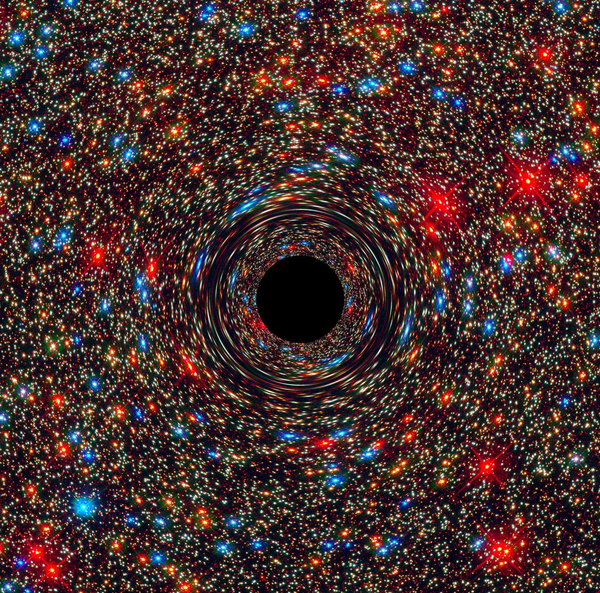
Here's where it gets strange. Most of the universe — the actual majority of what exists — is even further out of reach than that. Roughly 95% of everything is made of two things we have never directly seen and cannot currently detect: dark matter and dark energy [10]. We know they're there because galaxies spin wrong without them, and the universe expands wrong without them. That's it. That's our evidence. The math doesn't balance unless we add a huge invisible thumb to the scale.
Imagine looking at your bank account and realizing 95% of the money in it belongs to someone you've never met, doing things you can't observe, for reasons no one can explain. You'd probably want to know more.
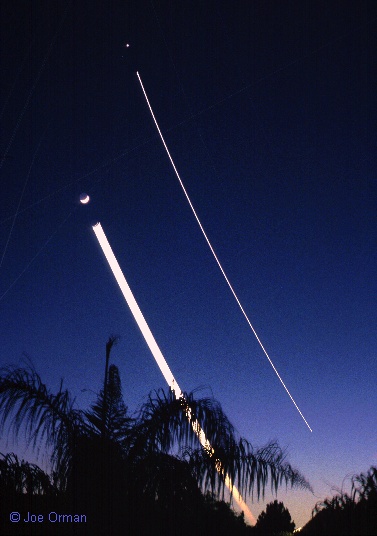
📷 Venus Falls Out of the Evening Sky — Joe Orman (NASA APOD, Public Domain)
So here's the question I keep getting stuck on, the one that started this whole series for me. If your senses only show you a sliver, and the sliver isn't even the important part — how do you know anything at all? How do you know the chair is there? How do you know the sun will rise? How do you know the ghost particles are real and not just a story physicists tell each other to feel better about their equations?
The honest answer is that we don't know in the way you know your own name. We know in a different way. A way that involves looking sideways at things, watching what they do to other things, trusting the math when it predicts something three decades before anyone sees it. It's a weirder kind of knowing than school taught you.
And I think it might be the most important kind. Because if you only believe what you can see, you'll spend your whole life missing the part that matters.
What if the world you actually live in is the one you can't look at directly?
So how do scientists know any of this? How do we know the chair is empty when it feels solid? How do we know about things we cannot, by definition, see?
Here is the analogy that broke it open for me. It involves a dark room and a bouncy ball.
Imagine you walk into a room that is completely pitch black. No light. You can't see your hand in front of your face. Somewhere in this room, there is an object. You don't know what it is. You don't know where it is. You don't even know if it's one thing or several things. You just know something is in there.
You have one tool. A bag of bouncy balls.
You stand at the door and you start throwing the balls into the darkness. Most of them sail through and hit the far wall — thud, thud, thud. But every so often, one of them comes back at you. Some bounce back hard, right into your chest. Some get deflected sideways and clatter against the walls. A few seem to just... vanish. Swallowed.
You can't see anything. But after throwing a few thousand balls, you start to notice patterns.
The balls that bounce straight back? They must be hitting something hard and roughly the size of a bouncy ball — because if it were huge, more balls would hit it, and if it were tiny, fewer would. The angle of the deflections tells you the shape. The frequency of the bounces tells you how dense the object is, how much of the room it actually occupies. The balls that vanish — maybe they hit something soft, something that absorbs. Or maybe there's a hole.
Slowly, by throwing things you can see at things you can't, the invisible object in the dark room starts to take shape in your mind. Not because you saw it. Because it left fingerprints on everything you threw at it.
This is, more or less, how we know what an atom looks like. In 1909, a man named Ernest Rutherford did exactly this. He shot tiny particles at a thin sheet of gold foil, expecting them to pass through like bullets through tissue paper. Most of them did. But a few — a tiny, ridiculous few — bounced straight back. He famously said it was as if you had fired a 15-inch shell at a piece of tissue paper and it came back and hit you [2]. That bounce told him there was something small and dense in the middle of every atom. The nucleus *1. He found it without ever seeing it. He found it by throwing bouncy balls in the dark.
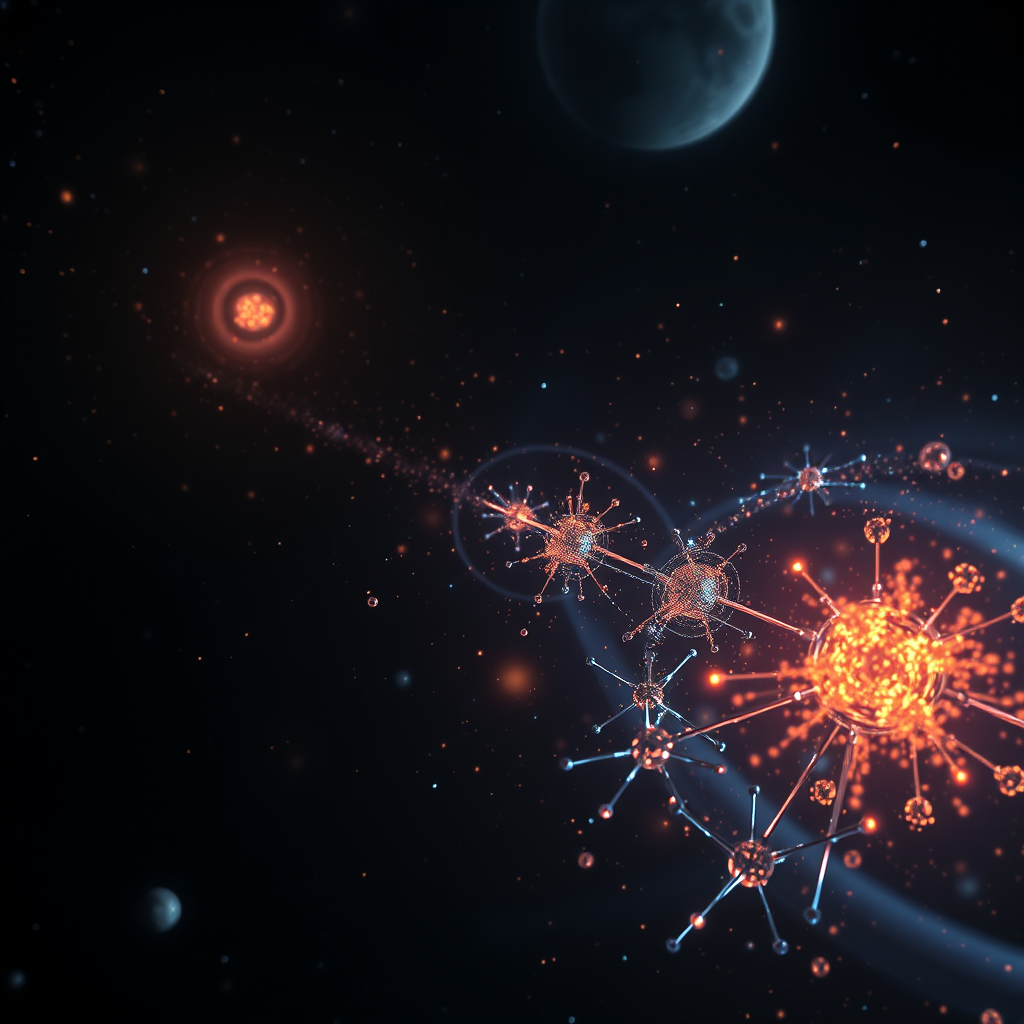
AI-generated image — a conceptual visualization
And here's the thing that hit me, the thing I can't stop thinking about: almost everything we know about the universe works this way. Almost everything.
We have neverseen an atom with our eyes. We can't. Atoms are smaller than the wavelength of visible light, which means light literally cannot bounce off them in a way your eye could register [3]. Trying to look at an atom with light is like trying to feel the shape of a grain of sand by hitting it with a beach ball. The tool is too big for the job.
So we throw other things. Electrons. Neutrons. X-rays. Particles smaller than the thing we're trying to see, or waves with shorter wavelengths than visible light [4]. We measure how they scatter, where they end up, what comes back. And from those patterns — those bounces in the dark — we build a picture.
We have never seen a black hole, not directly. A black hole *2 is a region of space where gravity is so intense that not even light can escape, which means by definition there is nothing to see. So how do we know they exist? We watch the stars near them. We watch the stars get whipped around something invisible, orbiting nothing, and we measure the nothing by how the something moves [5]. Bouncy balls again. Different room, same trick.
We have never seen the inside of the Earth. We've drilled maybe twelve kilometers down, which on the scale of the planet is less than scratching the skin of an apple [6]. Everything we know about the core — that it's iron, that it's mostly liquid with a solid center, that it's hotter than the surface of the sun — comes from listening to earthquakes. When an earthquake happens on one side of the planet, the shockwaves travel through the Earth and come out the other side. Some get bent. Some get blocked. Some arrive late. By reading those patterns, geologists reconstructed the inside of the planet without ever going there [7]. Bouncy balls. In the dark.
I want you to sit with this for a second, because it's wilder than it sounds at first.
Almost nothing important to your existence is something you can see directly. The atoms you're made of. The forces holding you together. The core of the planet under your feet. The history of the universe before there were eyes. All of it is invisible. All of it is inferred. All of it is a story we've assembled from bounces in the dark.
And it works. It works so well that you can build a computer out of the story. You can land a rover on Mars with it. You can predict, decades in advance, where a tiny moon of Jupiter will be on a Tuesday afternoon.
Which raises an uncomfortable question, the one I keep coming back to at 2 a.m. If everything real is invisible, and we onlyknow it by its bounces — what about you? What about the thing reading these words right now? You can't see your own mind either. You only know it by what it does, by what bounces back when the world throws something at it.
Maybe we're all just dark rooms, throwing balls at each other, hoping to map the shape of what's inside.
That bouncy ball trick — throwing things at the invisible and reading the bounces — isn't just an analogy. It's literally how we discovered that atoms have a structure at all.
In 1909, Ernest Rutherford had two assistants, Hans Geiger and Ernest Marsden, doing something that sounds absurd when you say it out loud. They were firing tiny radioactive bullets at a sheet of gold foil. The bullets were alpha particles *1 — chunks of matter spat out by radioactive atoms, each one about seven thousand times heavier than an electron. The gold foil was beaten so thin it was almost transparent, only a few hundred atoms thick [2].
The expectation was boring. Everyone at the time believed in the "plum pudding" model of the atom — a soft blob of positive charge with electrons sprinkled through it like raisins. If that were true, the alpha particles should sail through the foil with barely a wobble. Soft pudding doesn't deflect bullets.
AI-generated image — a conceptual visualization
Most of them did exactly that. They went straight through. But every so often — about one in eight thousand — an alpha particle would bounce almost straight back at the source [3]. Rutherford described it in a lecture years later in words that physicists still quote: "It was quite the most incredible event that has ever happened to me in my life. It was almost as incredible as if you fired a 15-inch shell at a piece of tissue paper and it came back and hit you" [4].
He had thrown bouncy balls into the dark room. And every now and then, one came back. Whatever was in there, it was small, it was dense, and it was hard. Rutherford did the math and worked out that nearly all the mass of the atom had to be packed into something less than a ten-thousandth of the atom's diameter [5]. The atomic nucleus. Discovered not by seeing it, but by listening to the bounces.
That experiment set the template for how we'd handle the invisible for the next hundred years. You don't see the thing. You see what happens around it.
Fast forward to 1930. Physicists were watching a kind of radioactive decay called beta decay *2, where an atomic nucleus spits out an electron and turns into a slightly different element. The problem was the energy didn't add up. Before the decay you had a certain amount of energy. After the decay, when you measured the electron and the new nucleus, some energy was just missing. Not a little. A lot. And different amounts each time.
Niels Bohr, who was not a man given to wild speculation, was so disturbed by this that he seriously proposed giving up on the conservation of energy [6]. Maybe energy just wasn't conserved at the subatomic level. Maybe the universe was loose with its accounting.
Wolfgang Pauli hated this idea. In December 1930, he wrote a letter to a conference of physicists in Tübingen — a letter that started "Dear Radioactive Ladies and Gentlemen" because he was too busy to attend, he was going to a ball [7]. In the letter, he proposed what he called a "desperate remedy." There was another particle. Invisible. Neutral. Almost massless. It was carrying away the missing energy, and we just couldn't see it because it barely interacted with anything.
He was, in his own words, embarrassed. "I have done a terrible thing," he reportedly said to a colleague. "I have postulated a particle that cannot be detected" [8].
He called it the neutron at first. Enrico Fermi later renamed it the neutrino *3 — "the little neutral one" in Italian — because by then the name "neutron" had been taken by something else. The neutrino is a particle so shy it can pass through a light-year of solid lead with a decent chance of not hitting anything [9]. Right now, about a hundred trillion neutrinos from the Sun are passing through your body every second [10]. None of them are interacting with you. You will live your entire life and only a handful of them will ever bump into one of your atoms.
Pauli thought his particle would never be detected. He was wrong, but only barely. It took twenty-six years. In 1956, Clyde Cowan and Frederick Reines parked a tank of water next to a nuclear reactor in South Carolina, because nuclear reactors spew neutrinos by the trillion. They waited. And they caught a few. They sent Pauli a telegram: "We are happy to inform you that we have definitely detected neutrinos" [11]. Pauli reportedly drank a case of champagne.
Notice the pattern. Notice it carefully, because it's going to come back over and over again in this series. Pauli didn't see the neutrino. He saw a hole in the accounting. Energy was missing. The shape of what was missing told him exactly what had to be there. The invisible thing was defined entirely by the gap it left behind.
This is what physicists actually mean when they say they've "found" something. Most of the time, they haven't seen it. They've found a place where the numbers don't work without it.
The same trick caught the Higgs boson *4. Peter Higgs proposed it in 1964 — a paper so short it almost didn't get published. The journal Physics Letters rejected the first version for not having enough connection to experiment [12]. Higgs added two paragraphs predicting a new particle, and the revised version went through. It then took forty-eight years and the largest machine humans have ever built to find the thing.
At CERN, the Large Hadron Collider smashes protons together at almost the speed of light. The collisions happen forty million times per second [13]. Almost all of them are boring. But once in a few billion collisions, something interesting comes out — and the Higgs, when it appears, lives for about a sextillionth of a second before falling apart into other particles [14]. Nobody saw a Higgs boson in 2012. What they saw was a tiny statistical bump in a graph — an excess of certain decay products at exactly the energy where the Higgs should have been hiding.
AI-generated image — a conceptual visualization
When CERN announced the discovery, the spokesperson Joe Incandela said something I keep thinking about: "We're reaching into the fabric of the universe at a level we've never done before" [15]. Reaching. Not seeing. The Higgs was found because trillions of collisions left a fingerprint on a graph, and the fingerprint matched the prediction Higgs and others had made half a century earlier.
This is starting to sound abstract, so let me bring it back to something you can almost touch. In 1846, the astronomer Urbain Le Verrier noticed that the planet Uranus wasn't where it was supposed to be. Its orbit was off — not by much, but by enough that Newton's laws couldn't explain it without something else tugging on it [16]. Le Verrier sat down with pencil and paper, and from the wobble of Uranus he calculated where the invisible something must be. He wrote a letter to an astronomer in Berlin named Johann Galle, telling him exactly where to point his telescope. That same night — September 23rd, 1846 — Galle looked, and there was Neptune. Within one degree of where Le Verrier said it would be [17].
Le Verrier discovered a planet without ever looking through a telescope. He discovered it by listening to how it pulled on its neighbor.
Then he tried the same trick on Mercury. Mercury's orbit was also misbehaving — a tiny shift, an extra wobble that Newton couldn't explain. Le Verrier predicted there must
So that's the trick. Throw something at the invisible, watch how it bounces, work backward to the shape. We've been doing it for over a century now, getting better at it, throwing smaller and smaller things — electrons at protons, protons at protons, neutrinos through entire planets [2]. Each bounce gives us another sliver of the picture.
But here's where I have to be honest with you. The picture is not finished. It is not even close to finished.
Start with this. Everything you have ever seen, touched, eaten, loved, or argued with — every star, every planet, every atom of every chair — adds up to about five percent of what's in the universe [3]. Five. The other ninety-five percent is two things we named because we had to call them something. Dark matter *2 and dark energy *3. The names are not modest. They're a confession. "Dark" here doesn't mean black or mysterious in some cool way. It means we cannot see it, we cannot bounce anything off it in the normal way, and we mostly know it's there because galaxies are spinning wrong [4] and the universe is expanding wrong [5].
Think about that for a second. We figured out atoms by throwing bullets at gold foil and reading the ricochets. With dark matter, the bullets mostly fly straight through. It barely interacts. We've built enormous tanks of liquid xenon buried inside mountains, waiting in silence for a single dark matter particle to nudge a single xenon atom hard enough to register [6]. We have been waiting for years. The detectors are working perfectly. Nothing nudges.
That is not failure, by the way. That is data. "We looked here and it isn't here" is a real sentence in physics. It just isn't a satisfying one.
And dark energy is worse. Dark matter at least has the decency to clump around galaxies. Dark energy is everywhere, evenly, pushing the universe apart faster and faster [5], and we have basically no idea what it is. Some of the smartest people alive have spent careers on this. The current best guess, when you ask them at a bar, is essentially: it's a number we measured, we don't know why it has that value, and the value we predict from theory is wrong by a factor of ten to the one hundred and twentieth power [7]. That is not a typo. It is the worst prediction in the history of science, and we just live with it.
Then there are the smaller honest gaps. We don't know why there is more matter than antimatter *4, even though the Big Bang should have made equal amounts [8]. We don't knowif the neutrino is its own antiparticle [9]. We don't know whether gravity is really a force or just a shape of spacetime that we haven't fully understood yet. We don't know what was happening, if "happening" even means anything, in the first tiny fraction of a second of the universe [10]. We don't know if there are other universes. We don't know if the question "are there other universes" is even a real question or just a sentence that sounds like one.
I want to be careful here. I am not telling you this to be dramatic. I am telling you because the story we are about to walk through together — backwards, from your chair to the Big Bang — is a story with holes in it. Big ones. And I think the holes are the most honest part.
Because here is the thing nobody told me when I was a kid, and I had to figure out by listening to physicists talk to each other for hours. Science is not a list of answers. Science is a very specific, very stubborn way of being wrong on purpose, in public, with math, until you are slightly less wrong than yesterday. The chair under you is the result of a hundred years of people being slightly less wrong about atoms. The ninety-five percent of the universe we can't see is what the next hundred years are for.
AI-generated image — a conceptual visualization
And you are sitting in the middle of it. Right now. On a chair that is mostly nothing, in a universe that is mostly something we cannot name, made of matter that shouldn't statistically exist, on a planet whose spin is being subtly tugged by a substance no detector has ever caught.
So when someone tells you science has it all figured out, they are selling you something. And when someone tells you science knows nothing, they are selling you something else. The truth is the middle, and the middle is where it gets interesting.
What would it feel like, do you think, to be the person who finally sees the other ninety-five percent?
Here is the thing that keeps me up.
We figured out the chair is empty by throwing stuff at it. We figured out the atom has a nucleus by throwing stuff at it. We're now throwing neutrinos *1 — particles so shy they can pass through a light-year of lead without flinching [1] — and we still only see about five percent of what's out there [2]. The other ninety-five percent is dark matter and dark energy, which are honestly just two polite names for "we have no idea" *2.
Think about that ratio for a second. You live in a universe where ninety-five out of every hundred somethings are a something you cannot name. Your best scientists, with their best machines, have mapped a thin bright layer of foam on top of an ocean they cannot touch [3]. And that foam includes you, your chair, your coffee, every star you have ever wished on.
So when I started this series, I wanted to do something specific. I wanted to walk backward. Start here, with you in the chair, and go the other way. Through the cells that built you. Through the atoms that built the cells. Through the particles inside the atoms. Through the moment those particles first existed. All the way back to the silence before the first second, where the rules we use to ask questions stop working.
And at every step, I want to ask the same thing. Not "what do we know." We've all read that article. I want to ask: what do we suspect, what do we miss, and what does any of it mean for the person reading this on a Tuesday night?
Because here is what I've come to believe, and I could be wrong. The invisible isn't a gap in the story. The invisible is the story. The visible part — the chair, the coffee, the foam — is the small bright exception. Everything interesting is happening in the dark, and we are tiny creatures with bouncy balls trying to map a house we were born inside of.
Next time we'll start the walk backward. We'll begin with something you cannot see but absolutely trust: the air pressing on your skin right now.
What if the most important thing about you is the part of you that isn't there?
TERMS EXPLAINED
- *1Neutrino: A tiny particle of matter, almost massless, that barely interacts with anything else. Trillions pass through you every second without touching a single atom. Made inside stars, nuclear reactors, and the Big Bang itself.
- *2Dark matter: Stuff that has mass and tugs on galaxies with gravity, but doesn't give off light and barely interacts with normal matter. We know it's there because galaxies spin faster than they should if only visible matter were holding them together.
- *3Dark energy: Whatever is causing the universe to expand faster over time, instead of slowing down like you'd expect. It acts like a push built into empty space itself. Nobody knows what it actually is.
- *4Antimatter: A mirror version of normal matter. Every particle has an antiparticle twin with opposite charge. When they meet, they annihilate into pure energy. The Big Bang should have made equal amounts of both, but somehow matter won.
SOURCES & REFERENCES
- [1]Emsley, J. (2011). "Nature's Building Blocks." Oxford University Press. — Scale ratio of atomic nucleus to electron orbital distance.
- [2]Bortle, J. (2001). "Introducing the Bortle Dark-Sky Scale." Sky & Telescope. — Number of stars visible to the naked eye under good conditions.
- [3]Bahcall, J. N. (1989). "Neutrino Astrophysics." Cambridge University Press. — Solar neutrino flux through the human body per second.
- [4]Particle Data Group (2022). "Review of Particle Physics." Progress of Theoretical and Experimental Physics. — Neutrinos as the second most abundant particle after photons.
- [5]Cowan, C. L., Reines, F., et al. (1956). "Detection of the Free Neutrino: A Confirmation." Science, 124(3212). — First experimental detection of the neutrino.
- [6]Pauli, W. (1930). Letter to the "radioactive ladies and gentlemen" at Tübingen. Reprinted in Pauli's collected works. — Pauli's own characterization of his neutrino hypothesis as a "desperate remedy."
- [7]Land, M. F. & Nilsson, D-E. (2012). "Animal Eyes." Oxford University Press. — Human visual range as a narrow band of the electromagnetic spectrum.
- [8]Hore, P. J. & Mouritsen, H. (2016). "The Radical-Pair Mechanism of Magnetoreception." Annual Review of Biophysics, 45. — Evidence for magnetic field perception in birds.
- [9]Super-Kamiokande Collaboration (1998). "Evidence for Oscillation of Atmospheric Neutrinos." Physical Review Letters, 81. — Discovery that neutrinos have non-zero mass.
- [10]Planck Collaboration (2020). "Planck 2018 Results. VI. Cosmological Parameters." Astronomy & Astrophysics, 641. — Dark matter and dark energy comprise roughly 95% of the universe's content.
Inline citations [N] correspond to numbered references above.
A weekly journey from the present universe back to the Big Bang — and to what it means for us.
![[Deep Dive] Scale-free localization in pseudo-Hermitian quantum walk](/content/images/size/w600/2026/10/deep_dive_thumb-9.png)