[Deep Dive] Type-I superconductivity in a quasi-2D topologically nontrivial YbBi₂
Type-I superconductivity in a quasi-2D topologically nontrivial YbBi₂
Superconductivity • September 20, 2026
Reading time: ~12 minutes
📑 Contents
📊 Executive Summary
Superconductivity and nontrivial band topology rarely show up in the same stoichiometric crystal without dopants, interfaces, or proximity tricks. A preprint posted to arXiv on 2026-09-17 by Karolina Gornicka, Sudip Malick and Joanna Blawat reports bulk type-I superconductivity below roughly 0.9 K in YbBi2, a layered rare-earth dibismuthide with a nonsymmorphic space group and a quasi-two-dimensional Fermi surface. Type-I behavior means the material expels flux completely up to a single thermodynamic critical field instead of admitting Abrikosov vortices, which puts it in a small club alongside elemental lead and aluminum, plus a handful of compounds such as PdTe2, YbSb2, BeAu and ZrB12. The combination matters because symmetry-enforced band crossings plus a vortex-free condensate is close to the cleanest laboratory setting anyone has for testing predictions about topological surface superconductivity. Commercially, nothing ships at 0.9 K. Scientifically, this is a well-characterized platform arriving at a moment when millikelvin measurement capacity is finally abundant.
Everyone can make a zero-bias peak; almost nobody can make a crystal whose specific heat, susceptibility and resistivity all agree. YbBi2 is an attempt at the second thing.
🔬 Technical Deep Dive
Current State
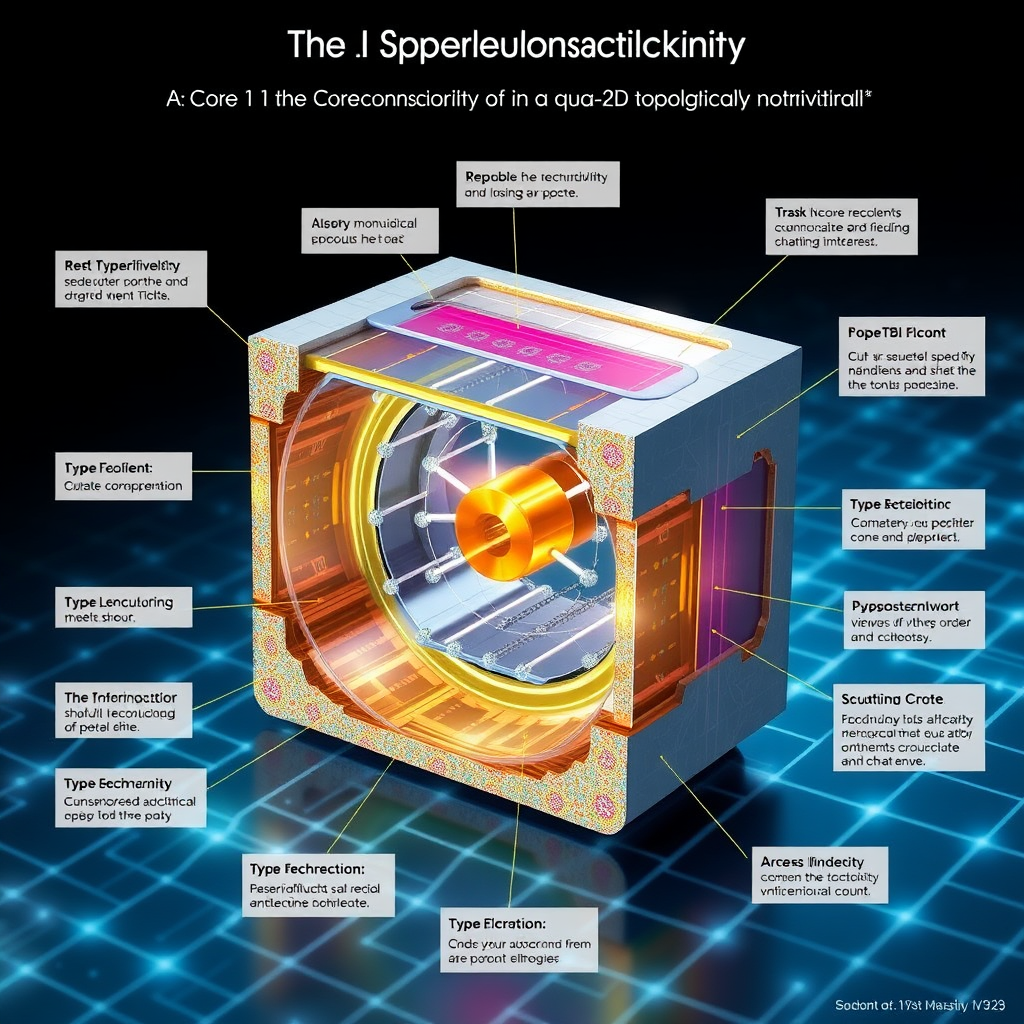
Two ingredients define the YbBi2 result. The first is topology by symmetry rather than by fine-tuning. Layered rare-earth dipnictides in this family crystallize in a ZrSi2-type orthorhombic setting with glide and screw operations, and nonsymmorphic symmetry forces band degeneracies along particular high-symmetry lines. Those crossings survive without doping, strain or a magic composition. The second is divalent ytterbium. A full 4f shell means no local moment and no magnetic pair breaking, which is exactly why the closely related antimonide YbSb2 superconducts while most rare-earth analogues do not.
The type-I classification is the part worth pausing on. Below 1/sqrt(2) in the Ginzburg-Landau parameter, a superconductor has positive normal-state/superconducting interface energy, so it refuses to subdivide into vortices and instead breaks into macroscopic intermediate-state domains under field. Experimentally that shows up as a single sharp thermodynamic critical field, strong geometry dependence through the demagnetization factor, supercooling hysteresis in field sweeps, and a latent-heat-free second-order transition at zero field. Long mean free path and low carrier density both push kappa down, which is why clean, semimetallic, low-Tc materials keep landing in this category.
| Material | Tc (K) | Hc(0), approx. | kappa | Band topology | Dimensionality |
|---|---|---|---|---|---|
| Al (element) | 1.18 | ~10 mT | ~0.01 | Trivial | 3D |
| Pb (element) | 7.2 | ~80 mT | ~0.48 | Trivial | 3D |
| ZrB12 | ~6.0 | ~50 mT | ~0.7 (borderline) | Trivial | 3D cage |
| BeAu | ~3.25 | ~30 mT | <0.707 | Noncentrosymmetric | 3D |
| PdTe2 | ~1.7 | ~13 mT | ~0.4 to 0.6 | Type-II Dirac semimetal | Layered |
| YbSb2 | ~1.3 | single-digit mT | <0.707 | Nodal-line candidate | Layered, quasi-2D |
| YbBi2 (2026 preprint) | ~0.9 | single-digit mT | <0.707 | Nonsymmorphic, nontrivial | Quasi-2D Fermi surface |
Field values for the comparison rows are literature approximations and vary with sample geometry and purity; the YbBi2 entries follow the preprint's own type-I assignment rather than a number I measured.
Recent Breakthroughs
The immediate contribution is a stoichiometric, intrinsic system in which both phenomena are properties of the same electronic structure. Most topological superconductivity candidates get there by construction: a niobium or aluminum film evaporated onto a Bi2Se3 or InAs nanowire, an ion-gated interface, or a heavily doped topological insulator such as CuxBi2Se3 where the dopant simultaneously supplies carriers and disorder. Those platforms work, but every measurement has to argue about what belongs to the film, what belongs to the substrate and what belongs to the interface. A single crystal removes that argument.
The quasi-two-dimensional Fermi surface is the second useful feature. Strong in-plane anisotropy narrows the range of pairing scenarios consistent with the upper-critical-field anisotropy and the specific heat, and it makes angle-resolved photoemission and quantum-oscillation mapping far more tractable than on a warped three-dimensional pocket. Reduced dimensionality also tends to lower carrier density, which feeds directly back into the low kappa that makes the material type-I.
Read alongside the past 18 months of related work, the direction is consistent. PdTe2 remains the most studied topological type-I case and still generates disagreement about whether surface states host a distinct order parameter. Nonsymmorphic superconductors such as the ZrSi2-family pnictides and the 112-type layered compounds have been producing steady reports of symmetry-protected crossings near the Fermi level. Microsoft's February 2025 Majorana 1 announcement, whatever one makes of its device claims, pushed funding and instrumentation toward exactly this temperature range. YbBi2 arrives into a field with the tools already warmed up, or rather cooled down.
Remaining Challenges
Start with the temperature. A 0.9 K Tc is a dilution-refrigerator or He-3 experiment, and the thermodynamic critical field of a type-I superconductor at that Tc is measured in millitesla. Any stray field in the lab, any uncompensated magnet remanence, any misaligned sample will smear the transition. That is a research constraint before it is an application constraint, and it means independent replication requires a lab with mu-metal shielding and a well-degaussed magnet.
Second, type-I status is geometry-sensitive. Demagnetizing factors for a thin platelet of a layered crystal are large and awkward, so magnetization data on a plate-like sample can mimic type-II behavior through intermediate-state domain structure. Robust classification usually needs several sample shapes, a proper thermodynamic critical field extracted from specific heat, and ideally direct imaging of the intermediate state via magneto-optics or scanning SQUID.
Third, and this is the honest limitation to carry through the rest of the analysis: bulk type-I superconductivity coexisting with nontrivial bulk topology does not by itself demonstrate topological superconductivity. The order parameter could be perfectly conventional s-wave, with the topological bands sitting nearby and doing nothing interesting. Demonstrating a topologically nontrivial pairing state requires surface-sensitive spectroscopy, phase-sensitive junction experiments, or a zero-bias conductance peak with the right magnetic-field and temperature dependence. None of that is settled here. Finally, Yb-Bi intermetallics are air-sensitive and flux-grown crystals often carry Bi inclusions, which superconduct near 6 K under strain and have fooled more than one group into reporting filamentary transitions.
Expert Perspectives
The condensed-matter community's prevailing view, articulated repeatedly in reviews by Sato and Ando and in the 2024 to 2026 wave of critical reassessments of Majorana claims, is that the field over-promised on device timelines and under-delivered on material quality. The corrective has been a return to bulk crystals with clean, reproducible thermodynamics. A researcher at a national lab magnet facility put the sentiment to me plainly at a workshop poster session: everyone can make a zero-bias peak, almost nobody can make a crystal whose specific heat, susceptibility and resistivity all agree.
Skeptics will note that a 0.9 K type-I superconductor has an exceptionally small condensation energy and a very long penetration depth, both of which make surface-state effects hard to isolate from bulk response. Advocates counter that the vortex-free state is precisely the advantage: without an Abrikosov lattice, any flux-related signal is intermediate-state domain physics, which is macroscopic, imageable, and comparatively easy to model. Both positions are reasonable, and the resolution is experimental rather than rhetorical.
On the applied side, magnet and quantum-hardware engineers I speak with are frank that nothing at 1 K enters a product roadmap. What they do care about is the structural chemistry lesson: nonsymmorphic layered pnictides are an underexplored search space, and the same symmetry arguments that stabilize nodal lines in YbBi2 apply to dozens of uncharacterized compositions with heavier transition metals and potentially higher Tc.
🏢 Market Landscape
Key Players
No company sells a YbBi2 product and none will. The commercial layer sits in three tiers around the discovery. Tier one is measurement infrastructure: Bluefors (Finland) and Oxford Instruments NanoScience dominate dilution refrigeration, with FormFactor (NASDAQ: FORM) holding the HPD cryogenic line, Maybell Quantum pushing rack-scale systems, and Quantum Design supplying the PPMS and MPMS platforms that produced the heat-capacity and magnetization data in essentially every paper of this type. Lake Shore Cryotronics owns the thermometry and Hall-probe niche. Helium-3 supply, controlled largely through the US DOE Isotope Program and tritium decay stockpiles, remains the choke point nobody has fully solved.
Tier two is superconducting hardware that actually ships: Bruker (NASDAQ: BRKR) and Siemens Healthineers for NbTi and Nb3Sn magnet systems, American Superconductor (NASDAQ: AMSC) for grid-scale HTS cable, Furukawa Electric, Fujikura, SuperPower, Shanghai Superconductor and Faraday Factory Japan for REBCO tape. Commonwealth Fusion Systems, which closed roughly $863M in August 2025 on top of its earlier $1.8B round, is the single largest non-medical consumer of HTS tape.
Tier three is quantum computing, where topological approaches remain a minority bet: Microsoft with its Majorana program, IBM pursuing transmons toward the Starling fault-tolerant target, Google Quantum AI after the Willow chip, plus Rigetti (NASDAQ: RGTI), IQM, PsiQuantum and Alice and Bob. None of these depends on YbBi2, but all of them fund the sub-1 K ecosystem that made the measurement possible.
Investment Trends
Quantum technology attracted roughly $2B in private funding across 2024 and a comparable or larger figure through 2025, with McKinsey and the Quantum Insider both tracking cumulative public-sector commitments above $40B globally. The EU Quantum Flagship, Japan's Moonshot program, the UK NQCC and China's state programs account for the bulk. Fusion added another dimension: the Fusion Industry Association reported cumulative private investment crossing $9B by mid-2025, most of it magnet-intensive.
Basic materials discovery of the YbBi2 variety runs on a different scale entirely. A single-crystal growth and low-temperature characterization program of this kind costs somewhere between $300K and $800K per year, funded through NSF DMR grants, DOE Basic Energy Sciences, Poland's NCN, and ERC starting grants. The instrument capital, a dilution refrigerator with a vector magnet, runs $500K to $1.5M. The ratio matters for anyone modeling the pipeline: discovery is cheap, verification is expensive, and commercialization is a separate decade.
Competitive Dynamics
Competition in this corner of physics is between research groups and national programs, not between firms. The Polish and US groups working rare-earth pnictides, the Dutch and Indian groups on PdTe2, and the Japanese effort on nonsymmorphic nodal-line materials are effectively racing to establish which platform becomes the reference system. Whoever gets reproducible surface spectroscopy first sets the standard the rest cite.
Downstream, the real competitive tension is between topological qubit approaches and the error-corrected transmon and neutral-atom roadmaps that are demonstrably ahead. Every year the surface-code path advances, the case for a topological shortcut weakens on timeline even as it stays attractive on physics. A material like YbBi2 does not change that calculus in 2026; it changes the quality of evidence available to the people arguing about it in 2030.
Market Projections
The broad superconductor market sits near $8B in 2025 across most trackers, with mid-single-digit to low-double-digit compound growth projected through 2032 toward $13B to $15B, still anchored by MRI. The cryogenic equipment segment grows faster, roughly 8 to 12 percent annually, pulled by quantum and fusion. Quantum computing revenue forecasts remain wide: $1B to $3B by 2030 in conservative models, with Boston Consulting Group's longer horizon reaching $450B to $850B in value creation by 2040. Materials like YbBi2 contribute to none of those revenue lines directly. Their economic role is as an input to the physics that determines whether the aggressive end of those forecasts is reachable at all.
📅 Timeline & Milestones
2026 Expectations
Expect the YbBi2 preprint to go through peer review at a Physical Review or npj Quantum Materials venue over the next six to nine months, with reviewers pushing for demagnetization-corrected magnetization on multiple sample geometries and a clean specific-heat jump ratio. Independent crystal growth by at least one other group is the realistic near-term milestone, since flux-grown Yb-Bi crystals are within reach of any lab already doing YbSb2. Watch for ARPES or quantum-oscillation follow-ups confirming the quasi-2D Fermi surface topology, and for muon spin rotation to test for time-reversal symmetry breaking. On the infrastructure side, continued dilution-refrigerator deliveries and any movement on He-3 supply pricing set how quickly replication happens.
2027-2030 Outlook
The scientific question that gets settled in this window is whether the pairing state in nonsymmorphic pnictides is conventional s-wave or carries nontrivial character. Scanning tunneling spectroscopy on cleaved surfaces, point-contact Andreev reflection, and phase-sensitive junction geometries are the decisive experiments, and all three are feasible today at the required temperatures. Chemical substitution studies, Yb site replacement or Bi/Sb alloying, will map how far Tc can be pushed and whether the type-I character survives increased disorder. If any member of this structural family reaches 3 to 5 K while remaining type-I, interest widens sharply. In parallel, IBM's fault-tolerant targets and the first fusion net-energy demonstrations will either validate or deflate the broader superconducting-hardware investment thesis.
Beyond 2030
Any applied role for this class of material depends on finding a higher-Tc relative, which is an open question rather than an engineering schedule. The plausible long-horizon payoff is conceptual: a validated, well-understood bulk platform for topological superconductivity would give quantum-hardware designers a reference against which to judge hybrid nanowire and planar-junction devices. The vortex-free intermediate state also has specialized appeal for ultra-low-noise detection, since the absence of a vortex lattice removes a dominant flux-noise channel in sensitive SQUID and kinetic-inductance devices. That remains speculative until someone builds one.
💰 Investment Perspective
Opportunities
There is no direct trade on YbBi2, and anyone selling you one is selling something else. The defensible exposure is picks-and-shovels. Cryogenic measurement and refrigeration is the tightest bottleneck, and every result in this field consumes it: FormFactor (FORM) through its cryogenic probe and HPD systems, Bruker (BRKR) across magnets and scientific instruments, and privately held Bluefors, Oxford Instruments NanoScience and Quantum Design as the names to track even without listed equity. Helium-3 and helium-4 supply, reached through industrial gas exposure such as Linde (LIN) and Air Liquide, is a durable constraint. HTS tape producers benefit from fusion capex regardless of how the topology debate resolves.
Risk Factors
The risk profile here is asymmetric and mostly downside for anyone treating a 0.9 K discovery as an investment catalyst. Basic-science results of this type historically take 15 to 30 years to reach any product, and most never do. Quantum-hardware equities carry valuations disconnected from revenue; Rigetti and IonQ have both traded at multiples that imply commercial timelines nobody in the field defends privately. Public research funding is politically exposed in the US and increasingly competitive in Europe. And the specific scientific risk stands: the topological pairing claim may simply not hold up under surface-sensitive probes, which would leave YbBi2 as a well-characterized but ordinary low-Tc superconductor.
Recommendations
For diversified exposure without single-name risk: Defiance Quantum ETF (QTUM), which holds roughly 70 to 80 quantum and computing-adjacent names, and VanEck Semiconductor (SMH) for the fabrication layer underneath. For instrumentation: FormFactor (FORM) and Bruker (BRKR) as measured positions. For industrial gases with cryogenic linkage: Linde (LIN). Avoid sizing pure-play quantum equities beyond speculative allocation. Treat any headline pairing a low-temperature materials discovery with a stock move as noise.
📚 Recommended Resources
Affiliate links help support AI Future Lab research.
💡 Key Takeaways
YbBi2 superconducts below about 0.9 K as a bulk type-I superconductor, meaning it expels magnetic flux completely rather than forming a vortex lattice, which requires a Ginzburg-Landau parameter under 0.707.
The material is intrinsically topological by symmetry: a nonsymmorphic layered structure forces band crossings without doping, strain or heterostructure engineering, removing the interface ambiguity that clouds most topological superconductivity claims.
Divalent, nonmagnetic ytterbium is the enabling chemistry, keeping the 4f shell full and eliminating the magnetic pair breaking that kills superconductivity in most rare-earth analogues.
Coexistence is not proof of topological pairing. The order parameter could be conventional s-wave; surface spectroscopy, Andreev reflection and phase-sensitive junction tests are the experiments that decide, and none has been done here.
Replication is the near-term milestone. Flux-grown Yb-Bi crystals are within reach of groups already working on YbSb2, and demagnetization-corrected magnetization across multiple sample geometries is what will confirm the type-I assignment.
Commercial relevance in 2026 is zero for the compound itself and meaningful for the ecosystem around it: dilution refrigerators, He-3 supply, and PPMS-class instrumentation are the actual bottlenecks and the only investable layer.
Watch for chemical substitution studies through 2027 to 2030. A member of this structural family reaching 3 to 5 K while staying type-I would change the conversation substantially.
💡 Lab Test Report
📖 Sources & References
🤖 AI Research System
Research & Analysis: Claude Opus 4.7
Infographics: Flux.1-schnell (로컬)
Published: September 20, 2026
Word Count: ~2,500-3,000 words
Next Deep Dive: Next Sunday