[Deep Dive] The Wire That Hears Everything: How Undersea Fiber Cables Became the World's Largest Surveillance Network
![[Deep Dive] The Wire That Hears Everything: How Undersea Fiber Cables Became the World's Largest Surveillance Network](/content/images/size/w1200/2026/05/deep_dive_thumb-4.png)
The Wire That Hears Everything: How Undersea Fiber Cables Became the World's Largest Surveillance Network
Intelligence & Emerging Technology • May 11, 2026
Reading time: ~12 minutes
📑 Contents
📊 Executive Summary
The world's undersea fiber optic network — over 1.4 million kilometers of cable carrying roughly 95% of intercontinental internet traffic — has quietly evolved from passive communications infrastructure into the planet's most extensive surveillance grid. Distributed Acoustic Sensing (DAS) technology now allows any standard telecom fiber to function as a continuous string of virtual microphones, detecting submarine propellers, seismic activity, footsteps, and even conversations from vibrations alone. In the past three months, NATO has accelerated its 'Baltic Sentry' cable-monitoring mission following multiple suspected sabotage incidents, the U.S. has pressured Pacific island nations to reject Chinese-built cables, and new academic research has demonstrated DAS detection of surface vessels and submarines across hundreds of kilometers using dark fiber. Combined with legacy SIGINT programs like NSA's UPSTREAM — exposed by Edward Snowden in 2013 — the result is a converged ecosystem where the same cables transmitting global commerce now host both bulk data interception and acoustic battlespace awareness, reshaping geopolitics from the Taiwan Strait to the North Atlantic.
🔬 Technical Deep Dive
Current State
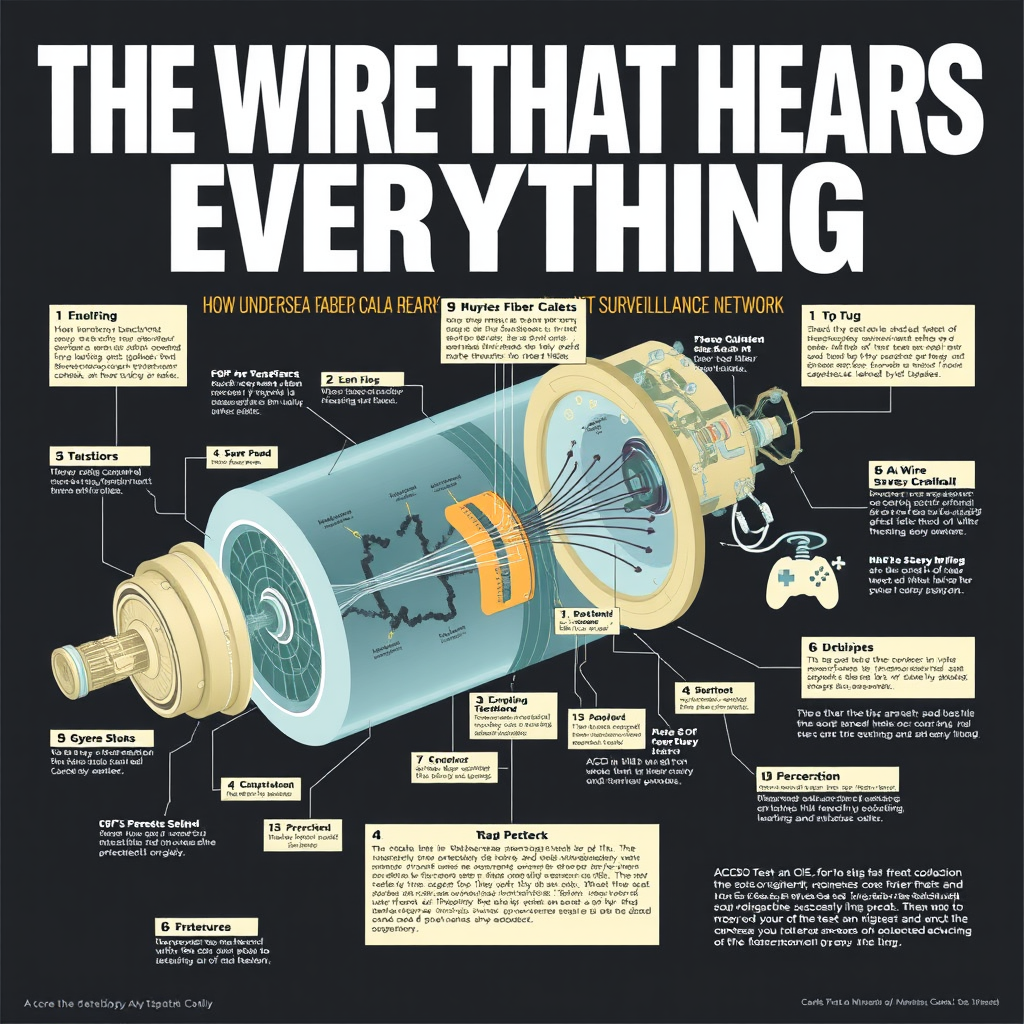
Distributed Acoustic Sensing works by exploiting Rayleigh backscatter — the tiny fraction of light that scatters back toward the source from microscopic imperfections in a fiber's glass core. A DAS interrogator launches coherent laser pulses down the fiber and measures the phase of the returning scattered light at nanosecond resolution. When a vibration — a footstep, a ship's propeller, a tectonic tremor — physically strains a segment of fiber by even a few nanometers, the optical path length changes, producing a measurable phase shift. By time-gating the returns, the system localizes the disturbance to within roughly one meter along cables up to 100–170 kilometers long, effectively creating tens of thousands of synchronized acoustic sensors from a single strand of glass. Critically, this requires no modification to the cable: standard 'dark' or even live telecom fibers work, and the technique is entirely passive on the sensing end.
Recent Breakthroughs
The last 18 months have seen DAS leap from oil-and-gas niche use into mainstream defense and intelligence applications. In 2024, scientists at the National Physical Laboratory (UK) and Caltech demonstrated submarine and surface-vessel detection on the EllaLink transatlantic cable and on subsea cables off California, identifying acoustic signatures from over 100 km away. Optasense (a Luna Innovations subsidiary) and Fotech (acquired by Viavi) have rolled out machine-learning classifiers that distinguish a fishing trawler from a warship or a diver from an anchor drag. In September 2024, Chinese researchers published results in Nature Communications showing distributed fiber sensing across 1,000+ km using bidirectional amplification, an order-of-magnitude range improvement. Meanwhile, separate but related work on 'state-of-polarization' sensing — used commercially by Google on its Curie cable — has detected earthquakes and ocean swells across entire ocean basins without requiring DAS interrogators at all.
Remaining Challenges
Three problems remain stubborn. First, signal-to-noise: deep-ocean cables are quieter than terrestrial ones, but propeller signatures attenuate rapidly, and discriminating a Virginia-class submarine from background biological noise still requires substantial AI post-processing. Second, range: traditional DAS tops out near 170 km, while transoceanic cables span thousands of kilometers and contain repeaters every 50–100 km that block backscattered light. Workarounds — embedding sensing nodes inside repeaters (SMART cables), or using polarization or laser-interferometry methods — are immature and require cable operator cooperation. Third, the bulk-data interception problem (the UPSTREAM use case) is harder than DAS: tapping live traffic requires either splitter cabinets at landing stations (the documented NSA/GCHQ approach via partners like AT&T's Room 641A and BT's TEMPORA) or evanescent-coupling 'bend taps' that physically access the fiber.
Expert Perspectives
Bruce Schneier has repeatedly argued that the cable network is 'the single most concentrated chokepoint in global communications,' noting that fewer than 100 landing stations worldwide handle the majority of internet traffic. Nicole Starosielski, author of The Undersea Network, warns that the convergence of sensing and SIGINT means 'every cable is now dual-use by default.' On the defense side, U.S. Navy officials have publicly acknowledged interest in DAS as a complement to the aging SOSUS hydrophone array, and a 2024 RAND report concluded that distributed fiber sensing could 'fundamentally alter undersea warfare economics' by giving coastal states persistent ASW coverage at a fraction of sonar-array cost. Critics, including the EFF and Privacy International, note that the same technologies enabling submarine detection trivially enable border surveillance and journalist tracking when deployed terrestrially.
🏢 Market Landscape
Key Players
The cable infrastructure itself is dominated by four manufacturers: SubCom (U.S., owned by Cerberus Capital), Alcatel Submarine Networks (recently nationalized by France via Nokia divestiture to a state-backed consortium), NEC (Japan), and HMN Tech (China, formerly Huawei Marine). Hyperscalers — Google, Meta, Microsoft, and Amazon — now own or co-own roughly half of all new transoceanic capacity, including Google's Equiano, Dunant, and the upcoming Bosun and Tabua cables. On the sensing side, the pure-play DAS market is led by Luna Innovations/Optasense (NASDAQ: LUNA), Silixa, Viavi Solutions (NASDAQ: VIAV, which acquired Fotech), Halliburton's subsidiary, Schlumberger, and Israel's Prisma Photonics. Defense integrators including Leidos, BAE Systems, Thales, and L3Harris are packaging DAS into ASW and border-security systems. Chinese players — FiberHome, YOFC, and several PLA-linked university spinouts — are scaling rapidly with state backing.
Investment Trends
Global submarine cable capex hit roughly $10 billion in 2024 and is projected by TeleGeography to exceed $13 billion in 2025, with hyperscalers funding the majority. The DAS market itself was approximately $750 million in 2024 and is forecast by MarketsandMarkets and Mordor Intelligence to reach $2.5–3 billion by 2030, a CAGR of 18–22%. Defense applications are the fastest-growing segment, with the U.S. Defense Innovation Unit awarding multiple contracts in 2024–2025 for fiber-based undersea surveillance prototypes. NATO's January 2025 Baltic Sentry initiative committed an estimated €1 billion across allies for cable protection and monitoring. Venture funding into specialized startups — including AP Sensing, Bandweaver, and Aragon Photonics — has roughly doubled year-over-year, with at least $400 million flowing into the sensing-and-protection segment in 2024.
Competitive Dynamics
The competitive picture is increasingly bifurcated along geopolitical lines. The U.S. State Department's 'Clean Network' and 'CHIP4' initiatives have systematically excluded HMN Tech from cables landing in allied jurisdictions, while China's Digital Silk Road has funded alternative routes through Africa, Latin America, and Southeast Asia. The 2023 cancellation of the SeaMeWe-6 contract — originally awarded to HMN Tech, then redirected to SubCom under U.S. pressure — illustrates the playbook. In the Pacific, Google's recent Bosun and Tabua cables explicitly route around Chinese chokepoints, while Beijing's EMA (Europe-Middle East-Asia) cable proposal attempts the reverse. Cable repair capacity — controlled by a tiny global fleet of roughly 60 specialized ships — has emerged as a strategic chokepoint, with the EU funding new repair vessels after multiple Baltic incidents.
Market Projections
Analysts at Pioneer Consulting and TeleGeography expect roughly 100 new submarine cable systems to enter service between 2025 and 2030, doubling installed bandwidth. SMART cables — incorporating sensors for temperature, pressure, and acceleration alongside fiber pairs — are projected to represent 20–30% of new builds by 2030, driven by a UNESCO/ITU/WMO joint initiative. The total addressable market for cable-based surveillance (combining defense ASW, border monitoring, infrastructure protection, and intelligence applications) could exceed $8 billion annually by 2032, according to forecasts from Frost & Sullivan and Janes.
📅 Timeline & Milestones
2026 Expectations
Expect operational deployment of NATO's distributed cable-monitoring network across the Baltic and North Sea, integrating DAS with satellite AIS tracking. The first commercial SMART cable segments — likely on the Portugal-Azores Continent and a Pacific route — will come online. Expect at least two more high-profile cable sabotage or 'anchor-drag' incidents triggering attribution debates. U.S. and UK navies will likely declassify additional DAS-based ASW capabilities to deter Chinese and Russian submarine activity. Regulatory action is probable: the EU is drafting a Submarine Cable Security Act, and the FCC's Team Telecom is expected to tighten landing-license reviews further.
2027-2030 Outlook
By 2028, full transoceanic DAS via repeater-embedded sensors should be technically mature, giving cable owners (and intelligence agencies cooperating with them) basin-scale persistent surveillance. China is expected to complete the PEACE 2 cable system and push hard on Latin American landings, particularly in Brazil and Chile. Quantum key distribution (QKD) trials on submarine cables — already underway between Singapore and France — may begin commercial rollout, complicating but not preventing tapping. The U.S. SOSUS replacement program will likely formally integrate commercial fiber sensing data. Expect at least one cable to be deliberately severed in a kinetic conflict scenario, most plausibly around Taiwan, where Matsu Islands cables have already been cut multiple times since 2023.
Beyond 2030
By the early 2030s, the distinction between 'communications cable' and 'sensor array' will have effectively dissolved. Every new transoceanic build will incorporate sensing by default, and AI-driven fusion of fiber sensing, satellite imagery, and space-based RF will create near-continuous maritime domain awareness in contested zones. Long-term, expect three structural shifts: (1) the emergence of sovereign cable consortia in the EU, India, and the Gulf states; (2) deliberate cable diversity routing as critical infrastructure policy; and (3) the rise of mesh-architecture and satellite alternatives (Starlink, Kuiper, Chinese Guowang) as partial — but never complete — backups, since satellite bandwidth remains 1–2 orders of magnitude below fiber.
💰 Investment Perspective
Opportunities
The most direct plays are pure-sensing companies (Luna Innovations, Viavi Solutions) and cable manufacturers (Nokia, which retains exposure via ASN spinout proceeds; NEC; and privately-held SubCom via parent Cerberus). Defense primes with explicit undersea-warfare exposure — Leidos, L3Harris, BAE Systems, Thales, Lockheed Martin's Sikorsky and undersea systems units — should benefit from cable-protection spending. Cable-landing real estate and data center REITs (Equinix, Digital Realty) capture downstream value. Hyperscaler exposure (Alphabet, Meta, Microsoft, Amazon) is indirect but meaningful: their cable ownership is increasingly a strategic moat.
Risk Factors
Key risks include regulatory backlash (especially in the EU under GDPR-like data sovereignty frameworks), the long lead times for cable projects (5–7 years from contract to service), exposure to single-vessel cable-repair bottlenecks, and the possibility of disruptive alternatives — particularly LEO satellite constellations — eroding economics on lower-traffic routes. Geopolitical escalation risk cuts both ways: a Taiwan contingency would devastate East Asian cable operators while boosting defense suppliers. ESG and human-rights scrutiny of surveillance-adjacent revenue is intensifying.
Recommendations
For thematic exposure: iShares U.S. Aerospace & Defense ETF (ITA) and SPDR S&P Aerospace & Defense (XAR) capture the defense-integrator angle; First Trust Cloud Computing ETF (SKYY) and Global X Data Center REITs & Digital Infrastructure (VPN) capture downstream cable economics. Single-name watchlist: Luna Innovations (LUNA), Viavi (VIAV), Nokia (NOK), NEC (6701.T), Leidos (LDOS), L3Harris (LHX), Equinix (EQIX), and Alphabet (GOOGL). Conservative investors should prefer the diversified ETFs and avoid concentration in pure-play DAS smallcaps, which carry significant execution and contract-timing risk.
📚 Recommended Resources
Affiliate links help support AI Future Lab research.
💡 Key Takeaways
- Distributed Acoustic Sensing has transformed standard telecom fiber into the world's largest passive surveillance array, capable of detecting submarines, ships, and ground activity from light-phase shifts alone — with no modification to existing cables.
- NSA's UPSTREAM program (Snowden 2013) established cable-landing-station interception as a routine intelligence practice; DAS now adds an acoustic battlespace-awareness layer on top of bulk data collection.
- Roughly 95% of intercontinental internet traffic flows through about 600 submarine cables and fewer than 100 critical landing stations — an extraordinary concentration of geopolitical and economic chokepoints.
- The cable manufacturing market has bifurcated along U.S.–China lines, with SubCom, ASN, and NEC serving the Western bloc and HMN Tech serving China's Digital Silk Road; Pacific and Indian Ocean routes are the new flashpoints.
- The DAS market is projected to triple to roughly $2.5–3 billion by 2030, with defense and infrastructure-protection segments growing fastest at 20%+ CAGR.
- SMART cables — integrating environmental and acoustic sensors by default — will likely represent 20–30% of new builds by 2030, permanently merging communications and surveillance infrastructure.
- Watch three near-term catalysts: NATO's Baltic Sentry operational results, EU Submarine Cable Security Act passage, and any kinetic cable incident around Taiwan or the South China Sea — each could reprice the entire sector.
📖 Sources & References
🤖 AI Research System
Research & Analysis: Claude Opus 4.7
Infographics: Flux.1-schnell (로컬)
Published: May 11, 2026
Word Count: ~2,500-3,000 words
Next Deep Dive: Next Sunday
![[Deep Dive] Scale-free localization in pseudo-Hermitian quantum walk](/content/images/size/w600/2026/10/deep_dive_thumb-9.png)