[Deep Dive] Engineering electrically-switchable quantum anomalous Hall states by spin-orbit coupling
![[Deep Dive] Engineering electrically-switchable quantum anomalous Hall states by spin-orbit coupling](/content/images/size/w1200/2026/06/deep_dive_thumb-5.png)
Engineering electrically-switchable quantum anomalous Hall states by spin-orbit coupling
Nanoscience • June 14, 2026
Reading time: ~12 minutes
📑 Contents
📊 Executive Summary
Quantum anomalous Hall (QAH) states represent a frontier in condensed matter physics where dissipationless chiral edge currents flow without external magnetic fields. The June 2026 preprint by Qin, Wang, and Kim (arXiv:2606.13651) advances a critical capability: engineering the magnetic energy landscape of graphene moiré systems through proximity-induced spin-orbit coupling rather than relying on intrinsic device properties. This matters because nonvolatile, gate-driven switching of topological states could enable a new class of low-power electronics built on chiral edge channels. Over the past three months, the field has seen converging work on twisted bilayer and pentalayer graphene, moiré engineering, and proximity heterostructures. The central implication is that QAH switching can become deliberate and controllable rather than incidental. Commercial application remains years away, gated by cryogenic operating temperatures and fabrication reproducibility, but the work narrows the gap between exotic physics demonstrations and engineered topological devices.
Engineering the magnetic landscape through proximity spin-orbit coupling converts quantum anomalous Hall switching from an intrinsic accident into a designable function, even as cryogenic operation keeps real applications years over the horizon.
🔬 Technical Deep Dive
Current State
The quantum anomalous Hall effect produces quantized Hall conductance in the absence of an applied magnetic field, arising from intrinsic magnetization combined with band topology. First observed in magnetically doped topological insulators in 2013, the effect has since migrated to graphene moiré platforms, where stacking two or more graphene sheets at small relative twist angles generates flat electronic bands. In these flat bands, electron-electron interactions dominate, producing correlated insulating states and, under the right conditions, spontaneous orbital magnetism that supports QAH order. Twisted bilayer graphene near the 1.1 degree magic angle and rhombohedral pentalayer graphene aligned to hexagonal boron nitride have both shown QAH signatures. The appeal of these systems is electrical tunability: gate voltages adjust carrier density and displacement fields, allowing a single device to access multiple topological phases.
Recent Breakthroughs
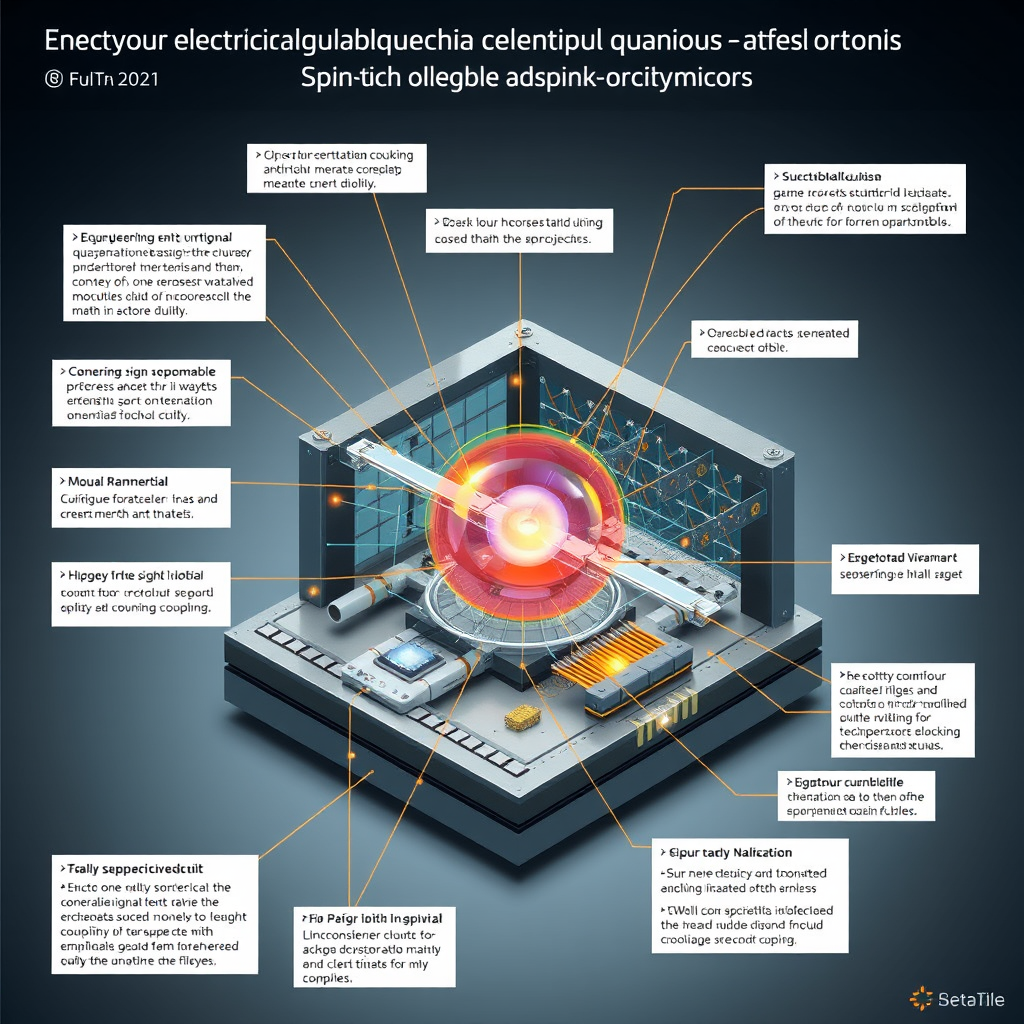
The Qin, Wang, and Kim work targets a specific limitation. Earlier demonstrations of gate-driven QAH switching exploited the device's intrinsic magnetic energy landscape, which left both the magnetic anisotropy and the metastability of the switched states largely outside experimental control. Their contribution is to engineer that landscape through proximity coupling, placing the moiré graphene adjacent to a material that imparts spin-orbit coupling without chemical doping. Proximity-induced spin-orbit coupling modifies band structure and magnetic anisotropy at the interface, giving designers a knob to set the energy barriers separating distinct QAH configurations. Nonvolatile switching means the chosen topological state persists after the gate pulse is removed, behaving like a memory element. Combining nonvolatility with deliberate control over metastability moves these devices closer to functioning as reconfigurable topological circuit components rather than laboratory curiosities.
Remaining Challenges
Several obstacles persist. Operating temperatures remain deep in the cryogenic regime, typically below 2 kelvin, because the energy scales protecting the correlated topological states are small. Device fabrication demands atomic-scale control of twist angle and layer alignment, and reproducibility across devices is poor relative to silicon manufacturing. Proximity heterostructures add interface quality as a new variable: the strength and uniformity of induced spin-orbit coupling depend sensitively on stacking and cleanliness. Scaling from single demonstration devices to arrays introduces variability that current assembly techniques, often manual tear-and-stack methods, cannot yet address at volume.
Expert Perspectives
Researchers in the moiré community generally frame proximity engineering as the logical next step after intrinsic effects were mapped. The broader topological electronics field views chiral edge states as attractive for interconnects and dissipationless logic, though most acknowledge that the temperature ceiling must rise substantially before applications materialize. There is genuine disagreement over whether moiré platforms or magnetic topological insulators will reach practical QAH operation first, and skeptics note that two decades of QAH research have not yet produced a commercial product.
🏢 Market Landscape
Key Players
No company currently commercializes QAH devices, so the landscape is defined by research institutions and the broader quantum hardware ecosystem. Academic leaders include groups at MIT, Stanford, Princeton, the University of Washington, and several institutions in China and Korea, where much of the graphene moiré and proximity coupling work originates. On the commercial periphery, firms invested in topological and quantum hardware include Microsoft, which has pursued topological qubits, and IBM and Google in adjacent quantum computing efforts. Materials and instrumentation suppliers such as Oxford Instruments and Bruker provide the cryogenic and measurement infrastructure these experiments require. Graphene producers and 2D materials startups form a supporting tier, though none has a direct QAH product line.
Investment Trends
Direct venture funding for QAH-specific ventures is effectively zero, reflecting the early-stage science. Capital flows instead through the broader quantum technology channel, which attracted several billion dollars globally in recent years across hardware, software, and components. Government programs remain the dominant funding source for the underlying physics, including national quantum initiatives in the United States, the European Union, China, and South Korea. The proximity engineering approach is funded primarily through academic grants rather than commercial investment.
Competitive Dynamics
Competition operates at the level of scientific priority rather than market share. Research groups race to demonstrate higher operating temperatures, cleaner switching, and reproducible device arrays. Geographically, the United States, China, and Korea form the leading clusters, with the author list of the focal preprint reflecting that international character. The competitive question for the next several years is which material platform, moiré graphene or magnetic topological insulator, achieves robust, higher-temperature QAH operation, since that platform will likely attract the first wave of applied investment.
Market Projections
There is no standalone QAH market today, and credible near-term revenue projections do not exist. The relevant proxy is the quantum hardware and topological electronics adjacency, where industry estimates place the quantum computing market in the range of several billion dollars by the end of the decade. QAH devices, if they reach application, would more plausibly appear first as cryogenic interconnects or memory elements within quantum computing systems than as standalone consumer products. That positioning makes the technology a long-dated option on the quantum hardware buildout rather than an independent market.
📅 Timeline & Milestones
2026 Expectations
Expect continued preprints refining proximity-engineered switching, with replication attempts of the Qin, Wang, and Kim results and parallel work on pentalayer graphene QAH states. Improvements in switching reliability and characterization of metastability barriers are the likely near-term deliverables. Operating temperatures will stay below a few kelvin.
2027-2030 Outlook
The medium-term goal across the field is raising QAH operating temperatures and demonstrating reproducible multi-device arrays. Progress on interface engineering could yield prototype reconfigurable topological memory or interconnect elements in laboratory settings. Integration with existing quantum computing test platforms is plausible by the end of this window, though still confined to research environments. Critical path dependencies include advances in scalable moiré device assembly and materials offering stronger proximity spin-orbit coupling.
Beyond 2030
A practical QAH technology depends on either substantially higher operating temperatures or a clear advantage that justifies cryogenic deployment within quantum systems. If those conditions are met, chiral edge state interconnects and nonvolatile topological memory could enter specialized quantum hardware. Mainstream electronics application remains speculative and contingent on physics breakthroughs not yet in sight.
💰 Investment Perspective
Opportunities
Direct investment in QAH technology is not available to public market participants and will not be for years. The actionable opportunity lies in the supporting ecosystem: cryogenic instrumentation, 2D materials supply, and the broader quantum hardware sector that would absorb any eventual QAH application. Companies providing dilution refrigerators, precision measurement tools, and quantum hardware infrastructure carry indirect exposure to progress in topological device research.
Risk Factors
The dominant risk is timeline. QAH research has run for over a decade without a commercial product, and the cryogenic temperature constraint may prove durable. Fabrication reproducibility is unsolved, and proximity heterostructures add new failure modes. Investors should treat any QAH-linked thesis as a long-dated, low-probability option rather than a near-term catalyst. The honest limitation: nothing in the current literature, including the focal preprint, demonstrates a path to room-temperature or even liquid-nitrogen-temperature operation.
Recommendations
For exposure to the adjacency, watch Oxford Instruments and Bruker for cryogenic and measurement infrastructure, and IBM, Microsoft, and Alphabet for quantum hardware optionality. Quantum-themed ETFs such as Defiance Quantum (QTUM) provide diversified, indirect exposure. None of these is a pure QAH play, and position sizing should reflect that the science is pre-commercial.
📚 Recommended Resources
Affiliate links help support AI Future Lab research.
💡 Key Takeaways
The Qin, Wang, and Kim preprint engineers the magnetic energy landscape of moiré graphene through proximity spin-orbit coupling, making QAH switching deliberate rather than incidental.
Nonvolatile gate-driven switching lets a topological state persist after the gate pulse, enabling memory-like behavior in chiral edge state devices.
Operating temperatures below 2 kelvin remain the single largest barrier to any practical application.
Moiré graphene and magnetic topological insulators compete to reach robust, higher-temperature QAH operation, with no clear winner yet.
There is no standalone QAH market; value would emerge inside the broader cryogenic quantum hardware stack.
Investors should treat QAH as a long-dated option, gaining exposure through cryogenic instrumentation and quantum hardware adjacencies rather than direct plays.
Watch for replication of the proximity-engineering results and any demonstration of higher operating temperatures or reproducible device arrays.
📖 Sources & References
🤖 AI Research System
Research & Analysis: Claude Opus 4.7
Infographics: Flux.1-schnell (로컬)
Published: June 14, 2026
Word Count: ~2,500-3,000 words
Next Deep Dive: Next Sunday
![[Deep Dive] Scale-free localization in pseudo-Hermitian quantum walk](/content/images/size/w600/2026/10/deep_dive_thumb-9.png)