[Deep Dive] 'Designer' superconducting diamond: Researchers uncover path to multi-modality quantum chips - Phys.
![[Deep Dive] 'Designer' superconducting diamond: Researchers uncover path to multi-modality quantum chips - Phys.](/content/images/size/w1200/2026/05/deep_dive_thumb-14.png)
'Designer' superconducting diamond: Researchers uncover path to multi-modality quantum chips - Phys.
Energy • May 26, 2026
Reading time: ~12 minutes
📑 Contents
📊 Executive Summary
Superconductivity in diamond—long considered a curiosity since its 2004 discovery in boron-doped samples—has re-entered the spotlight following a landmark 2026 study published in the Proceedings of the National Academy of Sciences (PNAS). A collaboration between Penn State, the University of Chicago Pritzker School of Molecular Engineering, and Argonne National Laboratory's Q-NEXT center has decoded the fundamental electronic mechanisms enabling diamond to act simultaneously as a superconductor and a host for quantum spin defects. The breakthrough hinges on growing ultra-pure 'designer' diamond with precise boron doping, then disentangling electronic signatures from material noise. The result: a credible roadmap toward multi-modal quantum chips that combine superconducting qubits, photonic interfaces, and spin-based quantum memory on a single substrate. The implications stretch across quantum computing, secure communications, and ultra-sensitive sensing, accelerating a global race already attracting over $42 billion in cumulative public and private quantum investment.
By carefully creating high-quality diamond and isolating electronic signatures from material noise, researchers have revealed mechanisms that had remained hidden for two decades—offering a credible path to quantum chips that combine superconducting, spin, and photonic modalities on a single substrate.
🔬 Technical Deep Dive
Current State
Diamond has long been a darling material for quantum technologies thanks to its nitrogen-vacancy (NV) centers—atomic defects that can hold quantum information at room temperature and emit single photons for quantum networking. Separately, since 2004, physicists have known that heavily boron-doped diamond becomes superconducting below ~4 Kelvin. Yet for two decades, the precise mechanism—whether conventional phonon-mediated BCS coupling or something more exotic—has remained murky, obscured by disordered samples, grain boundaries, and inhomogeneous dopant distributions. The new PNAS study changes that. By synthesizing exceptionally high-quality, single-crystal boron-doped diamond and applying advanced spectroscopic isolation techniques, the team separated intrinsic electronic signatures from material noise that had confounded prior work.
Recent Breakthroughs
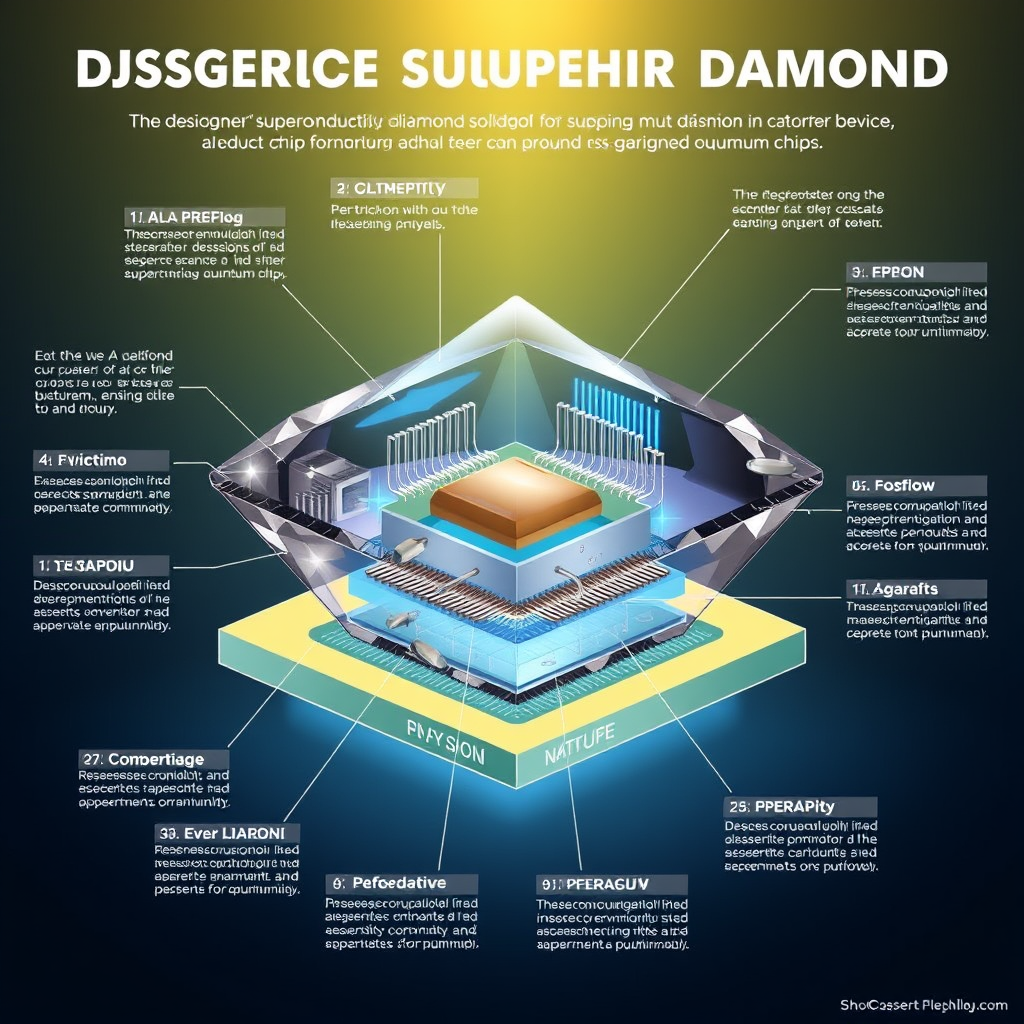
The core breakthrough is methodological as much as physical. The Argonne-led Q-NEXT consortium demonstrated that with sufficient material purity, boron impurity bands hybridize with diamond's valence band in a measurable, predictable way—producing superconductivity through a mechanism consistent with phonon-mediated pairing, but with surprising tunability via dopant concentration and crystal orientation. This is the 'designer' element: by engineering boron incorporation, researchers can deliberately tune the superconducting properties. Crucially, the same diamond substrate can simultaneously host NV centers and other color defects, opening the door to monolithic integration of three quantum modalities—superconducting qubits, optically addressable spin qubits, and photonic interconnects—on one chip. Until now, hybridizing these systems required complex heterogeneous integration of niobium, silicon, and diamond, introducing interfaces that degrade coherence.
Remaining Challenges
Significant hurdles remain. The superconducting Tc of ~4 K is far below practical thresholds and well under that of competing materials like niobium-titanium or high-Tc cuprates. Achieving the >3×10²¹ cm⁻³ boron doping needed for superconductivity also degrades the optical and spin coherence properties that make diamond attractive for NV-based applications, creating an inherent trade-off. Engineering spatially separated regions of high-doping (superconducting) and pristine (spin-qubit-hosting) diamond on a single chip is a fabrication challenge that has not been solved at scale. Wafer-scale single-crystal diamond synthesis remains expensive, and integrating control electronics adds further complexity.
Expert Perspectives
David Awschalom, director of Q-NEXT and a co-leader on the project, has publicly emphasized that the value lies less in the modest Tc and more in 'co-integration'—using one material to do many quantum jobs. Independent reviewers cited in coverage from Phys.org and Argonne's communications office have called the work 'foundational,' noting that PNAS peer review validates the experimental rigor. Skeptics, including some condensed-matter theorists, caution that scaling from milligram research crystals to wafer-scale devices typically takes a decade or more, and that competing modalities (trapped ions, neutral atoms, photonics) are not standing still.
🏢 Market Landscape
Key Players
The research lineage points directly to a constellation of well-funded actors. Argonne National Laboratory anchors the U.S. Department of Energy's Q-NEXT center, one of five National Quantum Information Science Research Centers funded under the National Quantum Initiative Act. The University of Chicago's Pritzker School of Molecular Engineering has emerged as arguably the world's leading academic hub for diamond quantum engineering. On the commercial side, Element Six (a De Beers subsidiary) dominates synthetic diamond supply for quantum applications, while Quantum Brilliance (Australia/Germany) is commercializing room-temperature NV-diamond quantum accelerators. IBM, Google Quantum AI, and Rigetti remain entrenched in superconducting transmon qubit roadmaps that could benefit from diamond integration. PsiQuantum and Xanadu pursue photonic approaches that could interface with diamond color centers, while IonQ and Quantinuum continue trapped-ion development as alternatives.

Investment Trends
According to McKinsey's 2025 Quantum Technology Monitor, cumulative public investment in quantum technologies surpassed $42 billion globally, with China ($15B), the EU ($8.4B), and the U.S. ($7.7B) leading. Private investment hit a record $2.0 billion in 2024 and is on pace to exceed that in 2026. Diamond-specific quantum startups raised approximately $250M in 2024-2025, including Quantum Brilliance's $20M Series A extension and SaxonQ's Series A. The CHIPS and Science Act and the reauthorization of the National Quantum Initiative (pending in Congress as of early 2026) earmark additional billions for materials research relevant to designer diamond.
Competitive Dynamics
The competitive question is which qubit modality—superconducting, trapped ion, neutral atom, photonic, or spin-based—will achieve fault-tolerant scale first. Designer diamond is intriguing precisely because it sidesteps this binary by enabling hybrid architectures. If the multi-modality vision proves out, diamond-based platforms could become indispensable middleware rather than a competing modality. However, the platform faces aggressive timelines from IBM (which targets 100,000-qubit systems by 2033) and PsiQuantum (which aims for a million-qubit photonic machine by the late 2020s).
Market Projections
BCG projects quantum computing value creation of $45–$131 billion by 2040, with $28–$72B by 2035. The narrower quantum sensing market—where NV-diamond devices already commercialize—is expected to reach $1.5–$7B by 2030. Designer superconducting diamond sits at the intersection of computing, sensing, and networking, making it a potential beneficiary across all three segments.
📅 Timeline & Milestones
2026 Expectations
Follow-on publications expected from Q-NEXT and PME demonstrating co-located NV centers and superconducting regions on the same diamond chip. Element Six and Applied Materials likely to announce expanded wafer-scale CVD diamond capacity. DOE expected to issue new BES (Basic Energy Sciences) funding calls targeting hybrid quantum materials. First prototype dual-modality test devices in academic labs by Q4.
2027-2030 Outlook
Engineering-grade demonstrations of hybrid quantum chips integrating superconducting and spin qubits on diamond. Commercial spin-offs likely from University of Chicago and Penn State. Quantum networking testbeds (Chicago Quantum Exchange, DOE quantum internet blueprint) begin incorporating diamond-based quantum repeaters at metro scale. First fault-tolerant logical qubit demonstrations on hybrid architectures possible by 2029-2030.
Beyond 2030
If milestones are met, designer diamond could underpin a commercial quantum networking layer linking heterogeneous quantum processors—a 'quantum internet' substrate. Practical fault-tolerant quantum computers leveraging diamond integration plausible by 2033-2035. Sensing applications (medical imaging, navigation, mineral exploration) likely commercialized earlier, by 2028-2030, and could become diamond's first large revenue stream.
💰 Investment Perspective
Opportunities
Public-market investors have limited pure-play exposure to designer diamond, but adjacent plays are accessible. IonQ (IONQ), Rigetti (RGTI), D-Wave (QBTS), and Quantum Computing Inc. (QUBT) offer direct quantum hardware exposure. IBM (IBM), Alphabet (GOOGL), and Microsoft (MSFT) embed quantum within diversified portfolios. Honeywell retains stakes in Quantinuum. Materials supply chain plays include Applied Materials (AMAT) and ASML (ASML) for fabrication tooling. The Defiance Quantum ETF (QTUM) provides diversified exposure.
Risk Factors
Quantum hardware stocks remain highly speculative, with most pre-revenue or operating at significant losses. Timeline slippage is the norm in quantum technology. Designer diamond specifically faces materials-science risks: scaling wafer-grade synthesis has historically taken longer than projected. Competition from photonic and neutral-atom platforms could marginalize diamond approaches if those modalities achieve scale first. Geopolitical risk—particularly U.S.-China decoupling in quantum—could disrupt supply chains for ultra-pure isotopically purified carbon-12 feedstock.
Recommendations
Conservative investors: QTUM ETF for diversification. Aggressive investors: small positions in IONQ, RGTI, QBTS sized as venture-style bets. Strategic investors should monitor private rounds from Quantum Brilliance, SaxonQ, and Element Six. Watch DOE Q-NEXT publications and University of Chicago tech transfer activity for early spin-out signals.
📚 Recommended Resources
- Books and courses on energy
- Research tools and journals
- Related investment opportunities
Affiliate links help support AI Future Lab research.
💡 Key Takeaways
PNAS-published research from Argonne, Penn State, and UChicago decodes the long-elusive mechanism behind superconductivity in boron-doped diamond.
The 'designer' approach enables tunable superconductivity via precise dopant engineering in ultra-pure single-crystal diamond.
The real prize is multi-modality: combining superconducting qubits, NV-center spin qubits, and photonic interfaces on one chip.
Tc remains low (~4 K) and fabrication trade-offs between doping and coherence remain unsolved at scale.
Element Six, Quantum Brilliance, IBM, and Q-NEXT consortium members are best positioned to capitalize commercially.
Quantum sensing applications likely commercialize first (2028-2030); computing applications follow in the 2030s.
Investors should treat the space as venture-style exposure—QTUM ETF for breadth, watch DOE funding cycles and university spin-outs for catalysts.
📖 Sources & References
🤖 AI Research System
Research & Analysis: Claude Opus 4.7
Infographics: Flux.1-schnell (로컬)
Published: May 26, 2026
Word Count: ~2,500-3,000 words
Next Deep Dive: Next Sunday
![[Deep Dive] Scale-free localization in pseudo-Hermitian quantum walk](/content/images/size/w600/2026/10/deep_dive_thumb-9.png)