[Deep Dive] AMOC Collapse and the Coming Global Food Crisis: When the Ocean Stops, Harvests Fail
AMOC Collapse and the Coming Global Food Crisis: When the Ocean Stops, Harvests Fail
Climate Science / Food Security • June 29, 2026
Reading time: ~12 minutes
📑 Contents
📊 Executive Summary
The Atlantic Meridional Overturning Circulation (AMOC) operates as a planetary heat conveyor, and its current state has scientists worried. According to IPCC AR6 (2021), the system is at its weakest in roughly 1,000 years, and a cluster of recent papers has pushed potential tipping-point estimates earlier than the previous consensus of post-2100. A 2023 Nature Communications study by Ditlevsen and Ditlevsen placed a possible collapse window between 2025 and 2095, with a central estimate around mid-century. The implications reach far beyond oceanography. A weakened or collapsed AMOC would cool northwest Europe, dry the Amazon, and disrupt West African and South Asian monsoons that feed billions. Quantified crop modeling suggests global grain output could fall by double digits in severe scenarios, igniting a chain that runs from food inflation through social unrest to geopolitical fracture. For investors, the same risk vector creates demand for resilient food systems, climate insurance, and agricultural technology.
The scientific debate has shifted from whether an AMOC tipping point exists to how soon it might arrive, with one central estimate placing the window near 2050.
🔬 Technical Deep Dive
Current State
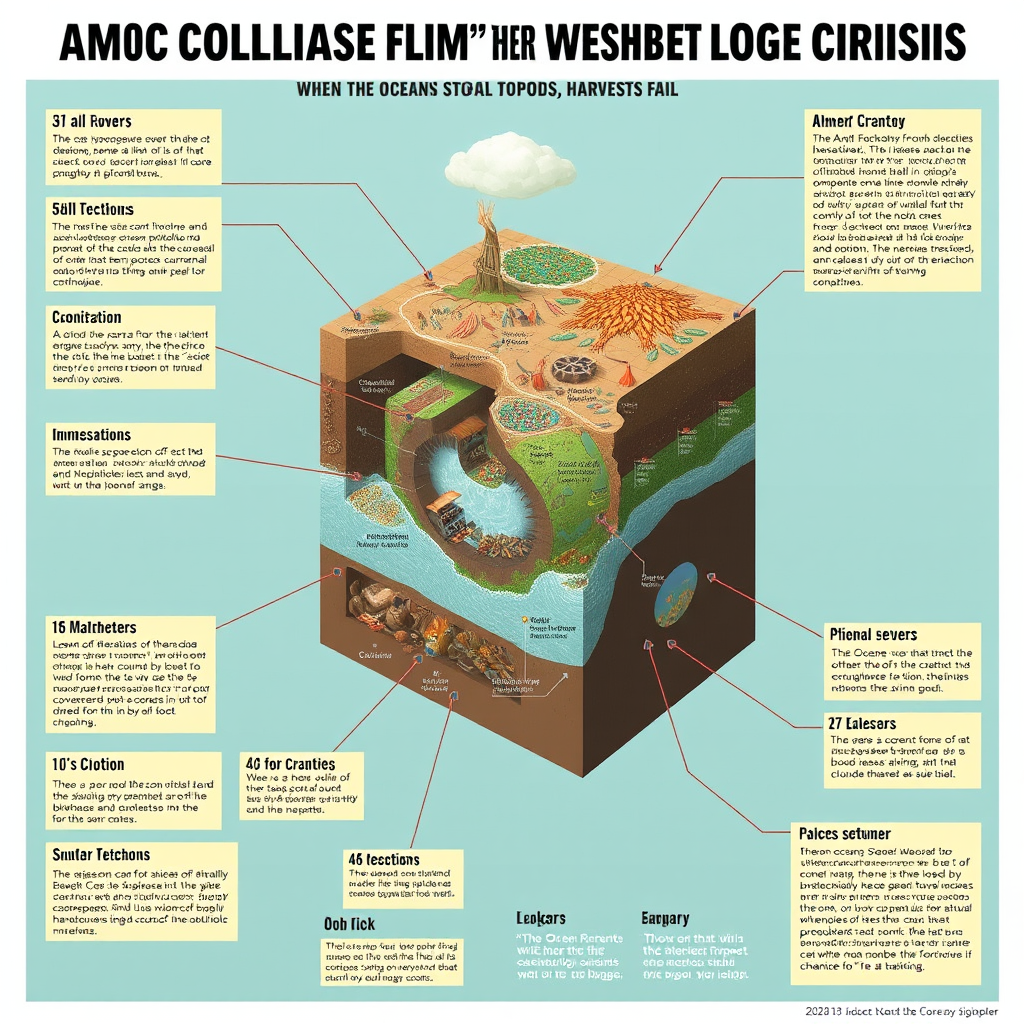
AMOC functions as the Atlantic limb of the global thermohaline circulation. Warm, salty surface water flows northward from the tropics toward the subpolar North Atlantic, where it cools, becomes denser, and sinks in regions near Greenland and the Labrador Sea. This sinking drives a deep return flow southward, completing a loop that transports roughly 17 million cubic meters of water per second and moves heat equivalent to about a petawatt toward the Northern Hemisphere. The mechanism that keeps it running depends on a delicate density balance. As Greenland ice melt and increased precipitation freshen surface waters, the water becomes less dense, sinking slows, and the entire conveyor decelerates. Direct continuous measurement only began in 2004 with the RAPID array at 26 degrees North, which means long-term trends rely heavily on proxy reconstructions of sea surface temperature patterns and sediment records.
Recent Breakthroughs
The most consequential recent work has been the modeling of nonlinearity. Earlier assessments treated AMOC weakening as gradual and reversible, but recent studies emphasize bistability, meaning the system can flip from an 'on' to an 'off' state once a threshold is crossed. A 2024 study in Science Advances led by van Westen used a high-resolution model to identify an early-warning signal in freshwater transport at the southern edge of the Atlantic, providing a physically grounded indicator rather than a statistical one. Separately, the Ditlevsen 2023 analysis applied statistical early-warning signals to sea surface temperature data and produced the headline mid-century estimate that reframed public discussion. These methods converge on the same uncomfortable conclusion: the margin of safety is thinner than the cautious AR6 language implied.
Remaining Challenges
Considerable uncertainty remains, and honesty requires stating it plainly. Climate models disagree on AMOC sensitivity by wide margins, and the short 20-year RAPID record cannot yet distinguish a forced long-term decline from natural decadal variability. Proxy reconstructions carry their own error bars, and the statistical early-warning methods that produced the alarming 2050 figure have been criticized for assumptions about the stationarity of the underlying data. The CMIP6 model ensemble generally projects weakening through 2100 but not full collapse, creating a genuine scientific tension between observational analysis and process models.
Expert Perspectives
Stefan Rahmstorf of the Potsdam Institute has argued that the risk of crossing a tipping point this century is higher than commonly assumed and warrants treating AMOC as a low-probability, high-impact threat. The Ditlevsen authors have been candid that their estimate carries large uncertainty while insisting the direction of risk is clear. More cautious voices, including some IPCC contributors, maintain that a complete collapse before 2100 remains unlikely even as substantial weakening is probable. The disagreement is less about whether AMOC is slowing than about how close the threshold sits.
🏢 Market Landscape
Key Players
The investment landscape spans several sectors positioned to benefit from agricultural disruption. In controlled-environment agriculture, Plenty and Bowery have pursued indoor vertical farming, though both have faced harsh economics and restructuring. AeroFarms emerged from bankruptcy proceedings, illustrating the sector's difficulty. In alternative protein, Beyond Meat (BYND) and the ingredient supplier Corbion serve the plant-based segment, while privately held firms pursue precision fermentation. Agricultural technology majors include Deere (DE) for precision equipment, Corteva (CTVA) and Bayer for seeds and crop science, and Nutrien (NTR) and CF Industries (CF) in fertilizer. In climate and crop insurance, Swiss Re, Munich Re, and parametric specialists offer products that pay out on measured weather triggers rather than assessed losses.
Investment Trends
Funding patterns reflect a sober recalibration. Vertical farming venture investment cooled sharply after the 2021-2022 peak as energy costs exposed unit-economics flaws, with several high-profile failures in 2023 and 2024. Alternative protein funding similarly contracted from its pandemic-era highs. By contrast, ag-tech focused on resilience, precision irrigation, drought-tolerant seeds, and parametric insurance has held interest better because the value proposition tracks real climate stress rather than consumer fashion. Climate-adaptation finance broadly has drawn institutional attention as physical risk reprices.
Competitive Dynamics
The competitive picture divides along a cost line. Capital-intensive indoor farming competes against extremely cheap field agriculture and loses on commodity crops, surviving mainly in high-value leafy greens near urban demand. Seed and crop-science incumbents hold structural advantages through patents and distribution. Fertilizer producers benefit from input scarcity during supply shocks. Reinsurers occupy a defensible position because pricing climate risk is a specialized actuarial skill that scales with volatility.
Market Projections
The global agricultural technology market is broadly projected to grow at high single-digit to low-teen annual rates through 2030, with precision agriculture and controlled-environment segments cited as faster-growing subcategories in various industry reports. Alternative protein forecasts vary enormously depending on adoption assumptions. Climate insurance and parametric products are widely expected to expand as physical climate risk becomes a standard underwriting consideration.
📅 Timeline & Milestones
2026 Expectations
Expect continued RAPID array data releases refining the observed trend, additional modeling studies probing early-warning signals, and likely intensifying scientific debate ahead of the next IPCC cycle. Commodity markets will remain sensitive to any single bad harvest year, with grain prices reacting to regional weather extremes that may or may not be AMOC-linked. Parametric insurance products should see continued product launches.
2027-2030 Outlook
Over this window, monsoon and Atlantic monitoring should produce a clearer signal on whether weakening is accelerating. Crop modeling under AMOC scenarios will likely become more granular by region and crop type. If observational trends continue downward, expect policy attention to food security and strategic grain reserves to rise. Ag-tech consolidation is probable as weaker vertical-farming players exit and stronger precision-agriculture firms absorb the field.
Beyond 2030
The central scientific question, whether the system crosses a threshold before mid-century, may begin to resolve. Even absent a full collapse, continued weakening would progressively stress European agriculture, the Amazon basin, and monsoon-dependent regions. The compounding risk is that food shocks rarely arrive alone; they interact with energy prices, currency stress, and migration pressure, producing geopolitical effects disproportionate to the harvest shortfall itself.
💰 Investment Perspective
Opportunities
The cleanest exposure to agricultural disruption lies in input and equipment providers that benefit regardless of which region suffers, since global supply tightening lifts prices broadly. Fertilizer producers, seed and crop-science firms, and farm-equipment makers fit this profile. Reinsurers and parametric-insurance specialists gain pricing power as physical risk rises. Drought-tolerant seed technology and precision-irrigation companies address adaptation directly.
Risk Factors
The timing risk is severe. AMOC collapse may not occur for decades or this century at all, making any thesis built on imminent catastrophe vulnerable to being early and wrong for years. Vertical farming carries genuine bankruptcy risk given proven poor unit economics. Alternative-protein demand has disappointed. Commodity-linked equities are cyclical and volatile. Policy intervention, including export bans and price controls during food crises, can disrupt the very profits a thesis assumes.
Recommendations
For diversified exposure, consider the VanEck Agribusiness ETF (MOO) and the Invesco Global Agriculture portfolio. Individual names worth monitoring include Deere (DE), Corteva (CTVA), Nutrien (NTR), and CF Industries (CF). For climate-risk pricing, Swiss Re and Munich Re offer indirect exposure. Treat vertical-farming and pure-play alternative-protein names as high-risk, speculative positions only.
📚 Recommended Resources
- {'type': 'book', 'description': 'Books on climate risk and food security'}
- {'type': 'etf', 'description': 'Agriculture and climate tech ETFs (MOO, KRBN)'}
Affiliate links help support AI Future Lab research.
💡 Key Takeaways
AMOC is at its weakest in roughly 1,000 years and has slowed an estimated 15% since the mid-20th century.
Recent studies have pushed possible tipping-point estimates earlier, with one central estimate near 2050, though uncertainty remains large.
A collapse would cool northwest Europe, dry the Amazon, and disrupt monsoons feeding over a billion people.
Severe scenarios model up to a 20% reduction in global grain output, with cascading effects on inflation and stability.
Investment durability favors agricultural inputs, equipment, and climate-risk pricing over capital-intensive vertical farming.
The biggest investment risk is timing, since collapse may be decades away or avoidable entirely.
Watch the RAPID array data, the next IPCC cycle, and freshwater-transport early-warning indicators for trend confirmation.
📖 Sources & References
🤖 AI Research System
Research & Analysis: Claude Opus 4.7
Infographics: Flux.1-schnell (로컬)
Published: June 29, 2026
Word Count: ~2,500-3,000 words
Next Deep Dive: Next Sunday