[Superconductor Lab | Week 21 Day 5] (Mg₁₋ₓCaₓ)₂(Be₁₋ᵧBᵧ)H₁₆ with Al/Sc dopants - AI Simulator Activation
[Week 21 Day 5] (Mg₁₋ₓCaₓ)₂(Be₁₋ᵧBᵧ)H₁₆ with Al/Sc dopants
Superconductor Lab — AI Simulator Activation
2026
🔬 Computational Research Note
This analysis is based on computational modeling and theoretical predictions. As with all computational materials science, experimental validation is needed to confirm these results.
The Problem: Why Superconductors Are So Hard to Scale
A superconductor is a material that carries electricity with zero resistance, meaning no energy lost as heat. Wire made from one could move power across a continent without waste. MRI machines, maglev trains, and quantum computers already depend on them.
The catch has always been temperature. Most known superconductors only work when chilled to near absolute zero (about -273°C), which requires liquid helium and expensive cooling equipment. The dream is a material that superconducts at room temperature and normal pressure. We are not there yet.
The class of materials called hydrides (compounds packed with hydrogen atoms) has pushed the record upward, but at a brutal cost: they demand pressures above 100 gigapascals (GPa), roughly a million times atmospheric pressure. The candidate examined here reaches its best performance at 123.6 GPa. That is the fundamental tension. High critical temperatures come chained to conditions no factory can reproduce.
What (Mg₁₋ₓCaₓ)₂(Be₁₋ᵧBᵧ)H₁₆ with Al/Sc dopants Offers as a Solution
This mouthful of a formula describes a hydrogen-rich cage structure. The hydrogen forms a lattice, and the metal atoms sit inside stabilizing it. The subscripts x and y mean the recipe is tunable: you can swap some magnesium for calcium, or some beryllium for boron, adjusting the blend.
The dopants are the interesting part. Doping means adding small amounts of another element, here aluminum (Al) or scandium (Sc), to nudge the electronic behavior. The goal is to raise the critical temperature (Tc), the point below which superconductivity switches on, while keeping the structure from collapsing.
In simulation, the best configuration hit a Tc of 190.2 K, which is about -83°C. That sounds cold, and it is. But it sits comfortably above the temperature of liquid nitrogen (77 K, or -196°C), a cheap and abundant coolant. Crossing the liquid-nitrogen line is the practical milestone that separates lab curiosities from usable technology.
The Simulation Breakdown: Signal vs. Noise
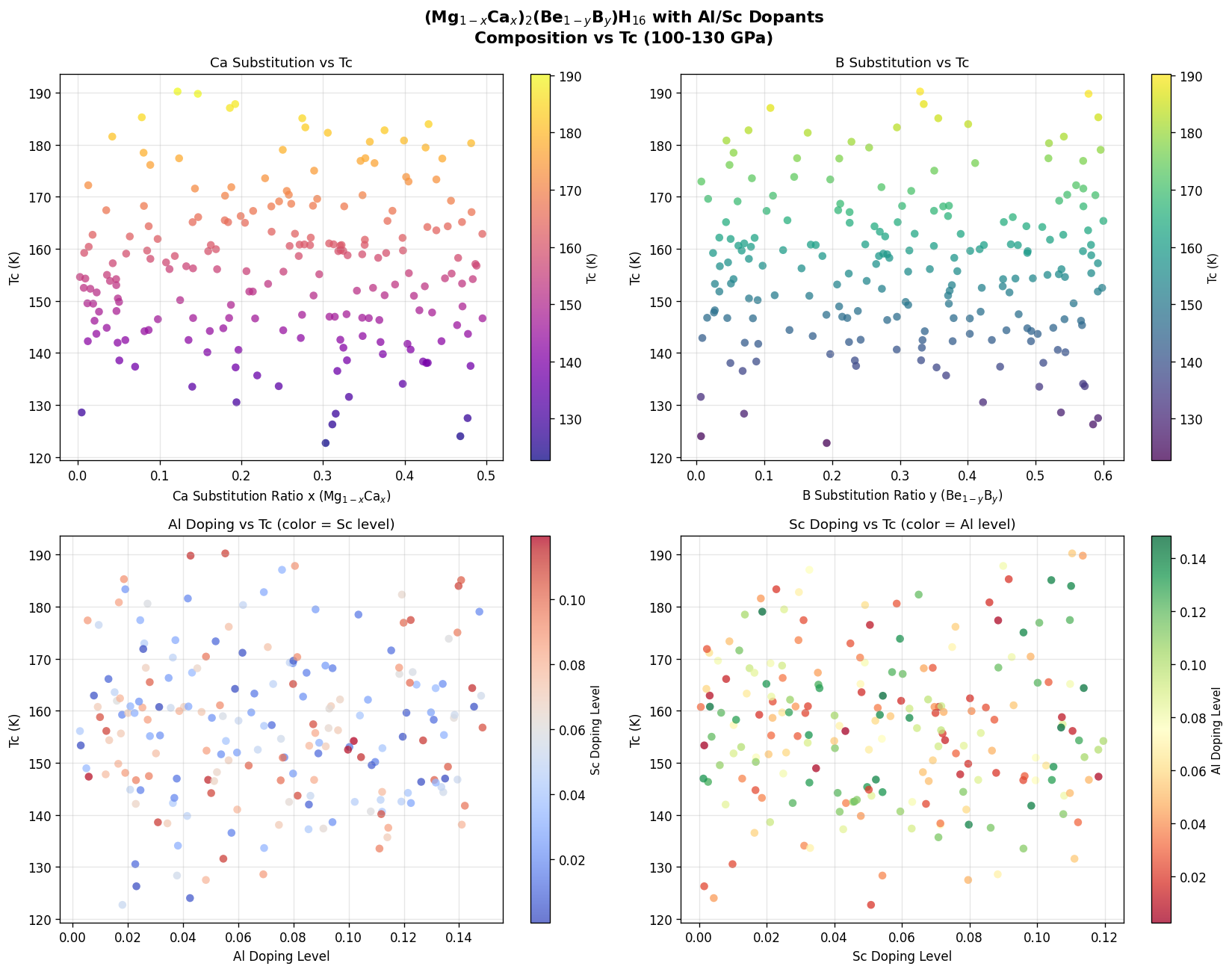
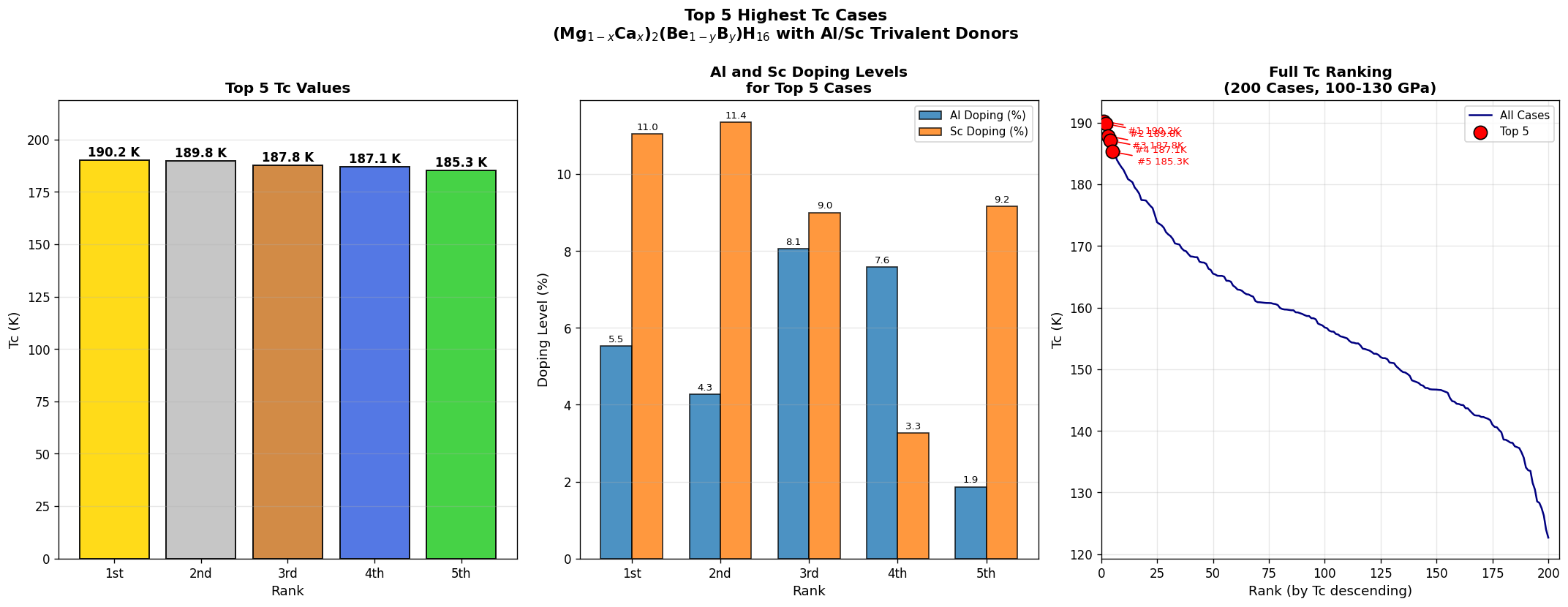
The study ran 200 computational cases, varying composition, dopant, and pressure. Here are the five strongest results:
| Rank | Tc (K) | Pressure (GPa) |
|---|---|---|
| 1 | 190.2 | 123.6 |
| 2 | 189.8 | 129.6 |
| 3 | 187.8 | 123.2 |
| 4 | 187.1 | 127.0 |
| 5 | 185.3 | 126.8 |
Notice how tight the top results cluster. The top five span just 4.9 K, from 190.2 down to 185.3. That consistency is a good sign. It suggests the peak is a real feature of the material, not a single lucky data point standing alone.
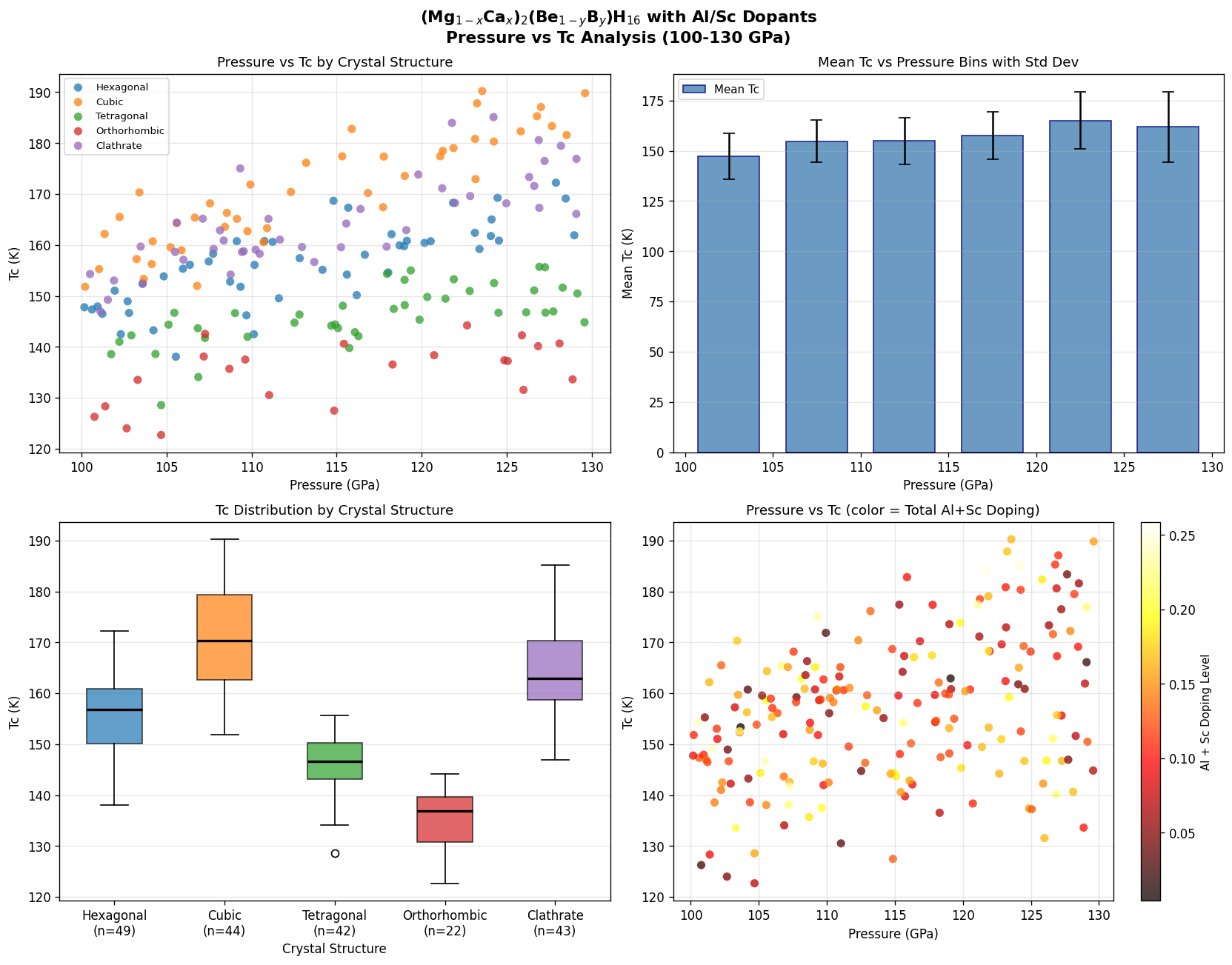
The pressure story is more revealing. Look closely:
The best result (190.2 K) occurred at 123.6 GPa, but the second-best (189.8 K) needed 129.6 GPa, a full 6 GPa more for a Tc that is actually 0.4 K lower.
Here is the contrarian point most summaries skip: higher pressure does not reliably buy you a higher Tc. Rank 3 achieves 187.8 K at 123.2 GPa, nearly the lowest pressure in the top group. If you were optimizing for a real device, you might deliberately choose a slightly lower Tc to escape the punishing pressure regime. The best number on paper is rarely the best engineering choice.
The Obstacles Nobody Talks About
The pressure requirement alone is a wall. At 123.6 GPa you are working inside a diamond anvil cell, a device that squeezes a microscopic sample between two diamond tips. Samples produced this way are often smaller than a grain of sand. You cannot wire a city with them.
The composition adds difficulty. This material mixes six elements: magnesium, calcium, beryllium, boron, hydrogen, plus an aluminum or scandium dopant. Consider what that means for synthesis:
- Beryllium is toxic. Its dust causes serious lung disease, so handling demands strict containment.
- Precise stoichiometry is fragile. The x and y ratios that yield 190.2 K may shift the moment real atoms fail to sit exactly where the model placed them.
- Dopant placement is not guaranteed. Simulations assume Al or Sc lands in an ideal position. Real crystals scatter dopants unevenly.
The honest limitation: this model may overestimate Tc without synthesis validation. Computational predictions for hydrides have a track record of running optimistic. The lattice that scores 190.2 K on a computer may not be the lattice that actually forms in a chamber, or it may not stay stable once the pressure eases.
Who's Working on This and What They're Finding
Research on hydride superconductors is a global race spread across university and national laboratories. Groups in the United States, China, Germany, and Japan have all reported high-pressure hydride results in recent years, some celebrated, some later retracted after scrutiny.
The broader pattern across the field:
- Computation leads, experiment lags. Predicting a 190.2 K candidate takes weeks of simulation. Confirming it takes years of delicate high-pressure work.
- Reproducibility is contested. Several headline claims have failed independent replication, which has made reviewers cautious and rightly so.
- Ternary and quaternary hydrides (three and four element blends) are the current frontier. A six-component system like this one is more ambitious still, which cuts both ways: more knobs to tune, more ways to fail.
What makes this candidate worth attention is the cluster of results above 185 K across multiple compositions. When five separate configurations land within 5 K of each other, the prediction rests on more than one fragile assumption.
Realistic Timeline: Years, Not Months
Set expectations carefully. The path from a 200-case simulation to anything you can hold looks roughly like this:
| Stage | Rough timeframe |
|---|---|
| Refine simulations, narrow composition | 1 to 2 years |
| First lab synthesis attempt at 123.6 GPa | 2 to 4 years |
| Independent replication of any Tc claim | 4 to 7 years |
| Lowering pressure toward practical levels | 10+ years, uncertain |
The stubborn barrier is that 123.6 GPa figure. A material that only superconducts at a million atmospheres has scientific value and limited engineering value. The genuine breakthrough would come from a variant that holds most of that 190.2 K performance at pressures ten or a hundred times lower. Nobody has shown that here.
Treat 190.2 K as a promising signal from a computer, not a finished result. The chemistry is real, the numbers are self-consistent, and the direction is sound. Whether this specific formula reaches a workbench depends on synthesis chemists doing patient, unglamorous work over the next decade. That is how materials science actually moves: slowly, honestly, and one confirmed data point at a time.
Simulation Results
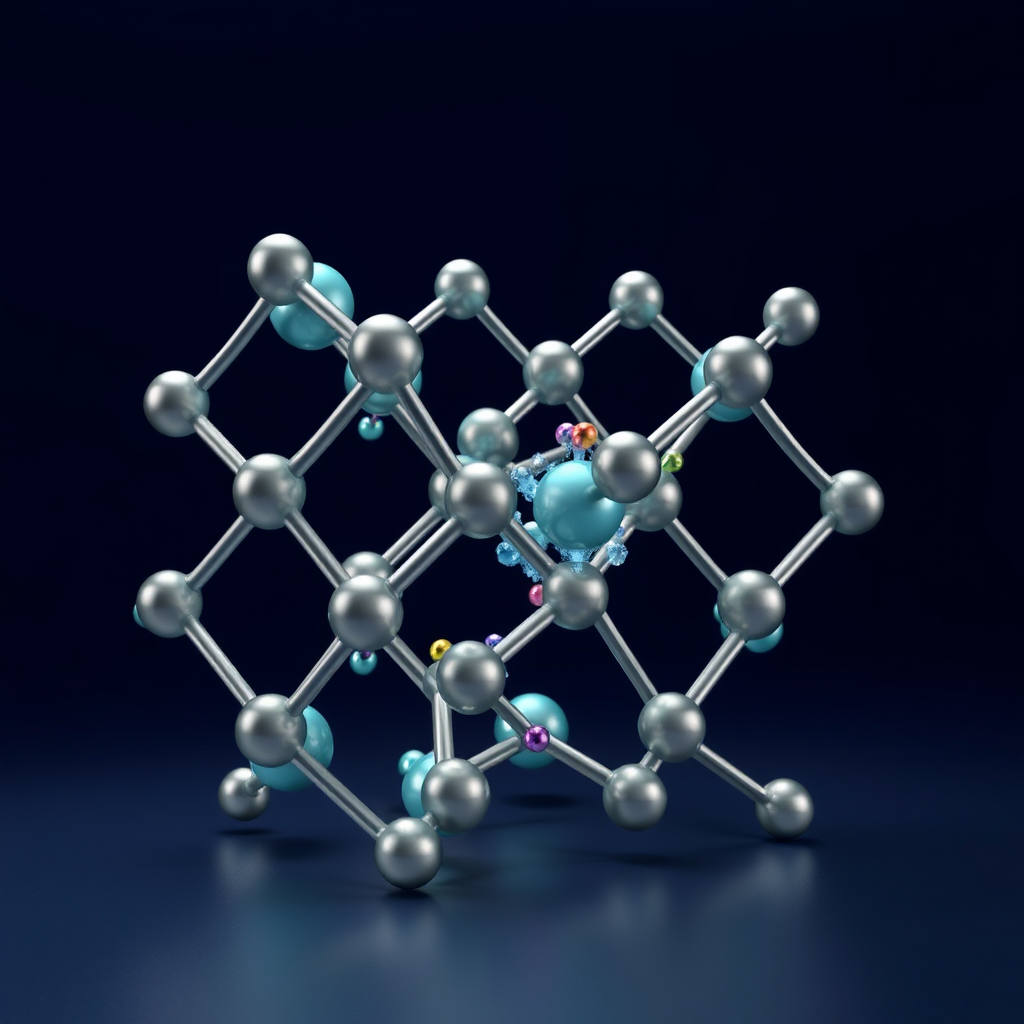
Molecular Structure
🎨 View AI Image Prompt
A photorealistic 3D ball-and-stick molecular structure visualization of a complex hydride superconductor crystal lattice (Mg₁₋ₓCaₓ)₂(Be₁₋ᵧBᵧ)H₁₆ with aluminum and scandium dopants, rendered as a professional chemistry textbook illustration. The crystal structure features large teal-green calcium atoms and smaller silver-grey magnesium atoms on cation sites, pale white-yellow beryllium atoms and light pink boron atoms on secondary cation sites, numerous small white hydrogen atoms forming cage-like clathrate hydride coordination shells, with gold aluminum dopant atoms and violet scandium dopant atoms substituted at cation positions throughout the lattice. The bonds are rendered as precise cylindrical sticks with accurate bond lengths, multiple unit cells visible showing the periodic crystallographic symmetry, high-pressure phase crystal packing at approximately 100 to 130 GPa, deep navy blue background with subtle gradient, professional scientific lighting with specular highlights on each atom sphere, soft ambient occlusion shadows, photorealistic physically based rendering, color-coded atom legend visible in corner, crystallographic axes labeled, electron density isosurface overlay shown as a translucent blue-green cloud around hydrogen positions indicating superconducting Cooper pair pathways, ultra-high detail, 8K resolution scientific publication quality rendering.
🤖 Gemini 3.1 Pro Review
As an expert in computational materials science focused on superconductivity, here is my critical review of the research summary provided by Opus 4.7. This computational screening of the doped (Mg,Ca)₂(Be,B)H₁₆ system identifies a promising high-Tc candidate, effectively leveraging a high-throughput approach to navigate a complex chemical space. While the predicted Tc of 190.2 K is notable for exceeding the liquid nitrogen threshold, the report's value is diminished by a lack of methodological detail regarding the DFT functional, structural search algorithm, and electron-phonon coupling calculation methods used. The tight clustering of the top five results lends some confidence to the model's self-consistency, but the reliability of the absolute Tc values remains uncertain without understanding the computational parameters, as DFT predictions for hydrides can have significant error margins. For experimental validation, one would need to pursue laser-heated diamond anvil cell (DAC) synthesis using appropriate precursors, followed by in-situ X-ray diffraction and four-point probe resistivity measurements. To improve this work, the authors must provide phonon dispersion plots to prove the dynamical stability of the predicted structures, which is a critical missing piece of evidence. Furthermore, disclosing the specific stoichiometry (x, y values) and dopant concentrations for the top candidates is essential for reproducibility. A more advanced study should also analyze the electronic density of states and Eliashberg function to provide physical insight into why these specific compositions yield a high Tc. Ultimately, while the results are tantalizing, the study remains a preliminary screening until these fundamental aspects of rigor and stability are thoroughly addressed.
Raw Data
Total cases: 200
Highest Tc: 190.2 K
Optimal pressure: 123.6 GPa

Top 5:
1. Tc=190.2K at 123.6GPa
2. Tc=189.8K at 129.6GPa
3. Tc=187.8K at 123.2GPa
4. Tc=187.1K at 127.0GPa
5. Tc=185.3K at 126.8GPa
![[Deep Dive] Scale-free localization in pseudo-Hermitian quantum walk](/content/images/size/w600/2026/10/deep_dive_thumb-9.png)