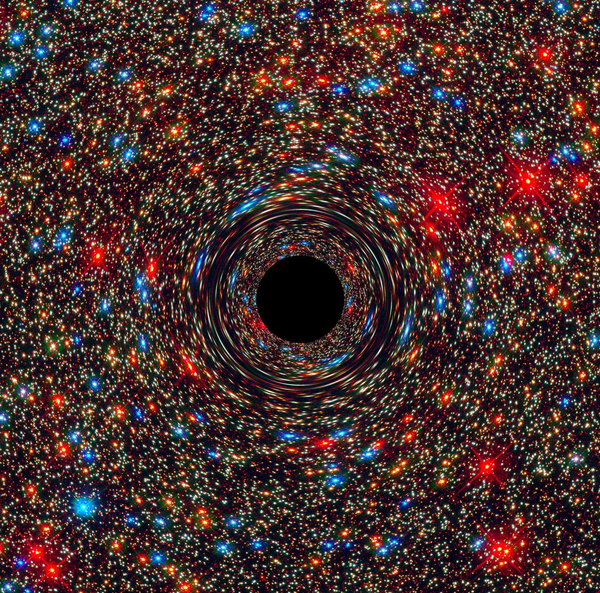
What's at the Center of the Hole?
Episode 1: The Universe Is Shaped Like a Donut. Probably.
I like science that leaves room to imagine. When things that seemed unrelated turn out to share a hidden pattern — that moment feels like finding one of the world's secrets. Which opens a door I didn't know was there. Which leads somewhere unexpected. Which eventually leads back to me.
You've done this. You're on a beach, or a hilltop, somewhere far from streetlights. You look up. And the sky does that thing where it stops being a ceiling and becomes a depth. You feel, for a second, like you might fall upward into it.
Then the thought arrives. The one everyone has. What's out there? And after that: does it end? Because both answers are impossible. If space ends, there's a wall, and you want to know what's behind the wall. If it doesn't end, it goes forever, and forever is a word your brain can say but not actually hold.
Try it right now. Picture the edge of everything. You can't. You put something on the other side of it every time. That's not a failure of imagination. That's your imagination being honest about a problem it wasn't built for.
Here's the thing nobody tells you as a kid. There might be a third answer.
Let me back up. When you draw a map of your town, you're taking something curved — the surface of the Earth — and flattening it onto paper. It works fine for your town. It breaks completely for the whole planet, which is why every flat world map stretches Greenland into a monster. The map lies because the thing it's describing is shaped in a way the paper can't do.
Now flip it. What if the universe is the map, and the shape is something we can't see because we're standing inside it?
Think about a video game. The old ones, where you fly a little ship. You drift off the right edge of the screen and reappear on the left. Off the top, back on the bottom. The screen looks flat. It looks like it has edges. But it doesn't, not really. There's no wall. You can travel forever and never fall off. You just come back around.
That flat screen, the one with no edges you can ever reach, is secretly a donut [1]. Bend the top edge down to meet the bottom, you get a tube. Bend the tube around to join its ends, you get a donut. The shape was hiding in the rules the whole time. Nobody had to build a wall, because the geometry did the job for free.
So here's the uncomfortable, wonderful possibility. Space might not end and might not go on forever. It might loop.
You could, in principle, fly a spaceship in a straight line — never turning, never curving, dead straight by every instrument you have — and come home. Arrive at the exact spot you left. Not because you turned around. Because the road was a circle you couldn't feel [2].
And if that's true, it means something strange about the dark. When you look far enough in one direction, you might be looking at the back of your own head. Light that left your neighborhood billions of years ago, went all the way around, and came back to be a faint smudge in your telescope. A galaxy that is your galaxy, seen from behind, seen from long ago.
We haven't confirmed any of this. I want to be clear. This is not a fact. Nobody has flown the ship. Nobody has spotted the back of their own head in a telescope, though people have genuinely gone looking [3]. What we have is a set of clues, a very old light left over from the beginning of things, and some patterns in it that don't quite fit the simple picture of endless flat space [4].
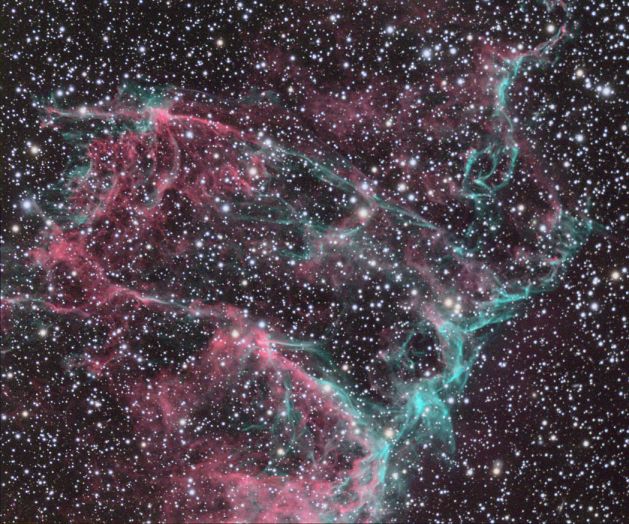
📷 IC1340 in the Eastern Veil — StarryScapes (NASA APOD, Public Domain)
The clues are faint. They might be nothing. They might be a smThe clues are faint. They might be nothing. They might be a smudge on the cosmic camera lens. But they're the kind of nothing that keeps a certain type of person awake.
Because if the universe loops, the whole question changes. You stop asking "what's at the edge?" There is no edge. You start asking a weirder question. A donut has a hole in the middle. So does the shape we're talking about, in a way — not a hole you could fall into, but a hole built into the math, a center the surface wraps around.
And that center isn't a place you can visit. It's not out there past the last galaxy. It might not be anywhere your ship could reach, no matter how straight you fly.
So what is it? What sits at the middle of a universe shaped like a donut, if the middle isn't a location at all?
That's where we're going. Not tonight. Tonight I just want you to sit with the possibility. The next time you stand under that terrifying, beautiful depth and feel like you might fall in — remember, you might not fall at all. You might just go all the way around.
And end up looking at the back of your own head.
So here's the escape from that trap. What if space has no wall and no forever? What if it just loops?
Think about Pac-Man. That yellow circle eating dots in a maze. You know what happens when he goes off the right edge of the screen. He reappears on the left. Off the top, back at the bottom. The screen is small, but for Pac-Man, there is no edge. He could run right forever and never hit a wall. He'd just keep passing the same ghosts, the same dots, over and over, thinking maybe he'd covered more ground than he had.
That's the idea. A universe that's finite but has no boundary. No wall to slam into. No behind-the-wall problem. And also no forever. You just come back around.
Now, Pac-Man's world is flat and two-dimensional, and ours has three dimensions of space. But the trick scales up. Take a video game world where you fly off the right and come back on the left, and off the top and come back on the bottom. Mathematicians will tell you that shape, if you could fold it up in a higher dimension, is a donut [1]. A torus, if you want the fancy word *1. The edges that wrap around are really the same edge, glued together.
You can almost see it with paper. Take a flat sheet. Roll it into a tube — now the left and right edges are joined. Then bend the tube around and connect its two open ends. You get a donut. Every point on the original flat sheet is still there. Nothing got a boundary. But now a straight line can come back to where it started.
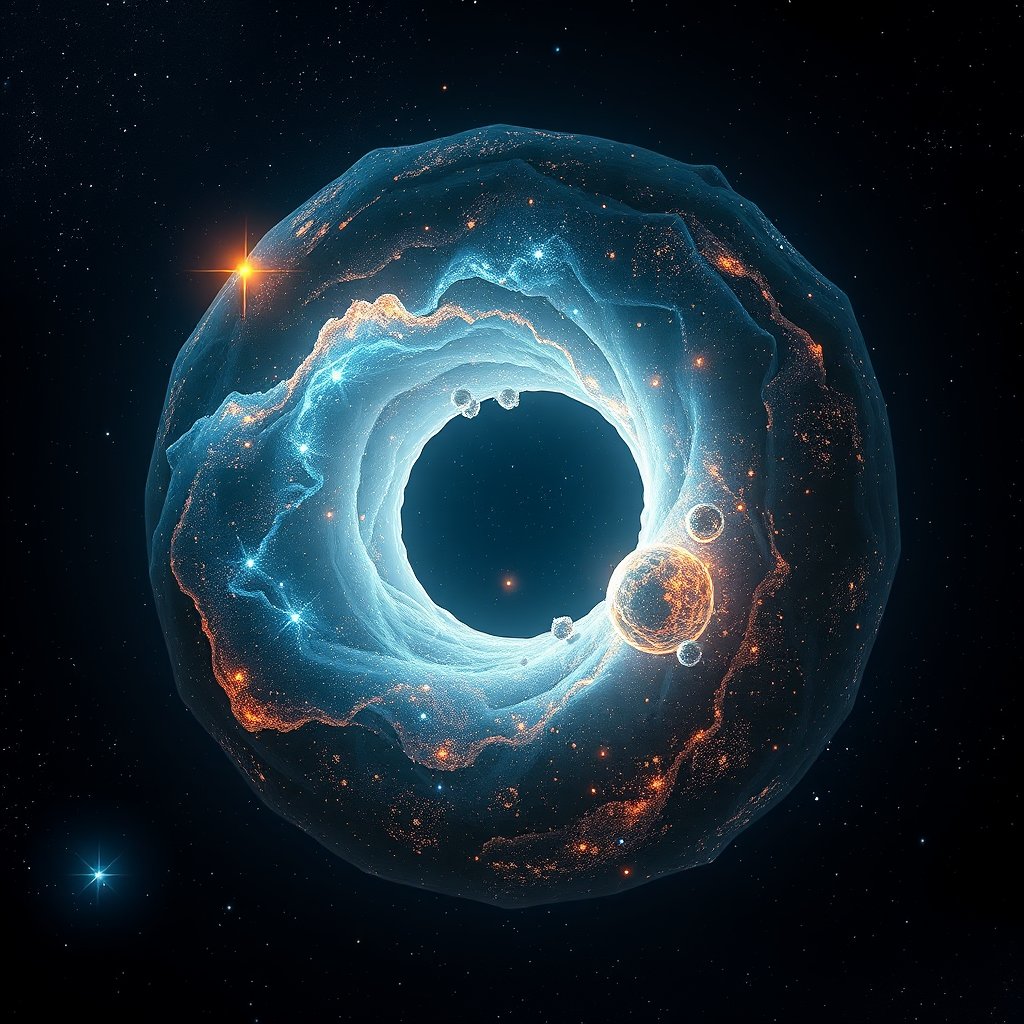
AI-generated image — a conceptual visualization
Here's the part that breaks my brain a little. On the surface of that donut, the geometry is still flat [1]. Not flat like a pancake — flat like, if you drew a triangle on it, the angles would add up to 180 degrees, the way your school teacher promised. A sphere doesn't do that. Draw a big triangle on a globe and the angles bulge past 180. But a donut, weirdly, keeps the schoolteacher's rules while still wrapping around into a closed shape [2]. It's finite and flat at the same time. That combination sounds illegal. It isn't.
And this matters because when scientists measure the actual shape of our universe — using the oldest light there is, the faint glow left over from just after the beginning *2 — the answer keeps coming back flat [3]. Not curved like a ball. Flat, to the limits of what we can measure [3]. Most people hear "flat" and picture "infinite, goes on forever." But flat doesn't have to mean infinite. A donut is flat. A donut is finite. So one honest reading of the data is: maybe the whole thing loops.
I want to be careful here, because this is where excitement runs ahead of evidence. Flat measurements are consistent with a donut. They do not prove a donut. An infinite flat universe fits the numbers just fine too [3]. Both are still on the table. Nobody has caught the cosmos wrapping around. Yet.
But think about what "wrapping around" would actually look like, because it's stranger than the donut sounds. If space loops, and if the loop is small enough, then when you look far out into the distance, you might be looking at the back of your own head— cosmically speaking, anyway. Light from a distant galaxy could be light that already went all the way around the loop and came back. So a "distant" galaxy might not be distant at all. It might be our own galaxy, seen as it looked billions of years ago, its light having taken the long way home [4].
Picture standing in a room lined with mirrors on every wall. You see hundreds of yourself, stretching off in every direction, getting smaller and dimmer. It feels like a huge crowd. But it's one person. One room. The rest is repetition. A looped universe could do the same trick with galaxies. A sky full of what looks like endless different galaxies, some of them secretly copies. The same handful of objects, photographed from different angles and different ages, pasted across the whole dome of the night [4].
If that were true, the universe would be like Pac-Man's maze after all. Small. Repeating. Dressed up to look infinite.
And that's the tell scientists go looking for. If space wraps, and if the loop isn't absurdly large, the repetition should leave a fingerprint. The same patterns of that ancient afterglow should show up in different patches of sky, like the same face reflected in two mirrors [5]. People have searched. So far, no clean match [5]. Which either means the universe doesn't loop, or means the loop is just bigger than the part we can see. If the room is enormous, you might only be seeing one copy of yourself, with the other reflections hidden beyond the edge of your vision. Absence of the pattern doesn't kill the donut. It just pushes it out of reach.
Which is a deeply annoying kind of answer, if you like answers. The donut might be real and too big to catch. It might not exist at all. From the inside, those two situations can look identical.
So we're stuck with something that sounds like a joke but isn't. The most important shape in your life — the shape of literally everything, the container you and everyone you love are floating inside — might be a donut, and we might never be able to prove it. Not because the question is silly. Because the answer could be sitting just past the horizon of what light has had time to show us.
I keep coming back to that mirror room. Not the physics of it. The feeling. You walk in expecting to find strangers, and you find yourself, over and over, in every direction. If the universe really loops, that's the deepest version of the same surprise. You go looking outward, as far as it's possible to look, past the galaxies, toward the edge of everything.
And what's waiting at the far end of the loop might be the place you started.
Pac-Man lives on a flat screen that loops. Mathematicians have a name for that shape. It's a torus — a donut *1. And here's the strange part: the surface of a donut is flat, in the sense that matters for this story. Draw a triangle on it, measure the angles, they add up to 180 degrees, same as on your kitchen table [1]. No curve. But it still loops back on itself. Flat and finite at the same time.
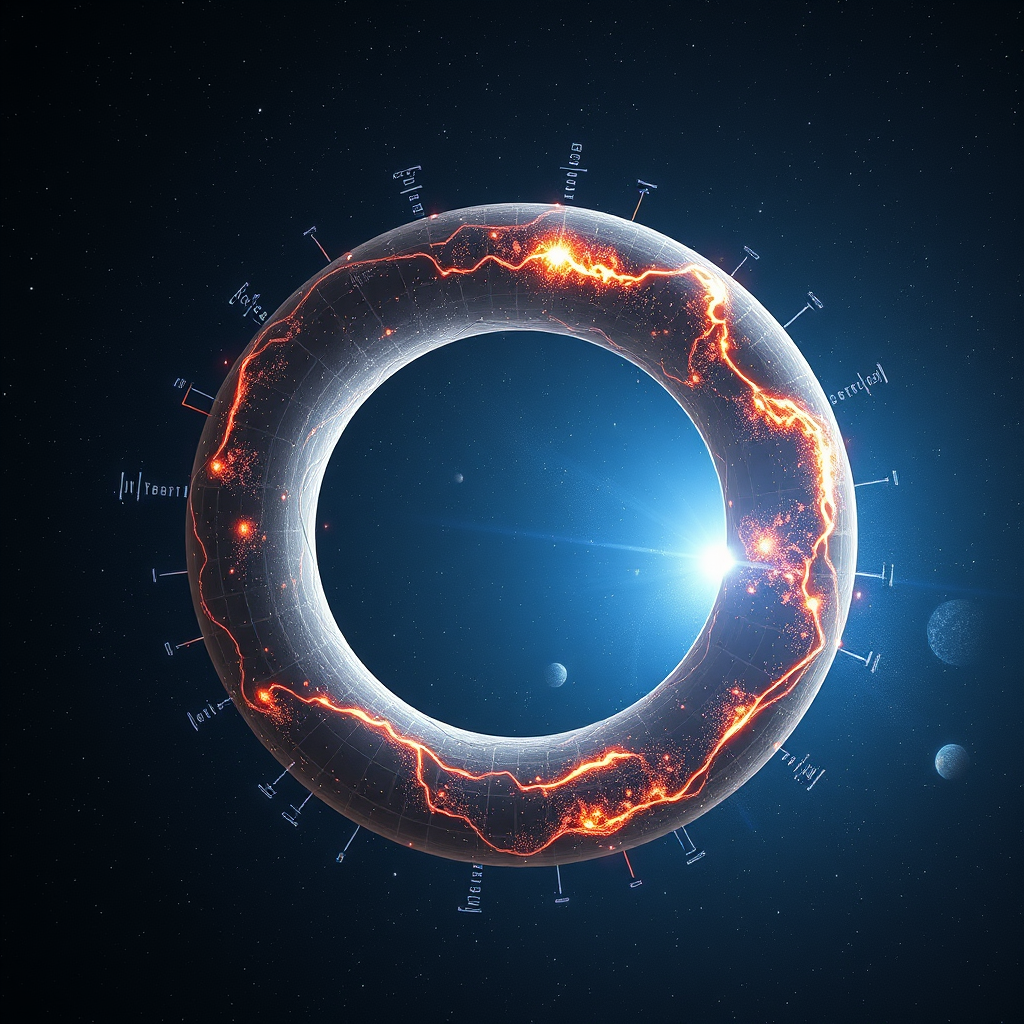
AI-generated image — a conceptual visualization
For a long time this was just math. A curiosity. Then people started looking at the actual sky and wondering if the universe pulled the same trick.
To understand why, you have to know what physicists are actually staring at. It's called the cosmic microwave background *2. Think of it as the oldest light there is — a faint glow left over from when the universe was young and hot, released about 380,000 years after everything began [2]. It's everywhere, coming at you from every direction, and it's been traveling for 13.8 billion years to reach you. It's the wall at the edge of what we can see. Not the edge of the universe. The edge of our view of it.
Now, the trick. If space loops like a donut, light can go all the way around. That means when you look far enough in one direction, you might be seeing the back of your own head. Not literally — but the same patch of early universe, showing up in two different parts of the sky. Like Pac-Man passing the same ghost twice and slowly realizing the maze is smaller than he thought.
So people went looking for repeats.
In 2003, a team led by Neil Cornish, David Spergel, Glenn Starkman, and Eiichiro Komatsu published a paper with a wonderful idea in it [3]. They called their method "circles in the sky." Here's the logic. If the universe is small enough to loop, then somewhere out there is a giant sphere of that oldest light, and it intersects with itself. Where it intersects, you get matching circles — two rings in different parts of the sky showing the exact same pattern of hot and cold spots [3]. Find the matching circles, and you've found the loop. You've measured the size of the whole universe.
They looked. Using data from a satellite called WMAP, which mapped that ancient light across the entire sky, they searched for the circles.
They didn't find them.
Their conclusion was careful. They ruled out any universe small enough to have obvious matching circles within our view [3]. If space loops, the loop is bigger than the part we can see. Cornish and his colleagues put a number on it — the universe had to be larger than about 24 gigaparsecs across, which is a distance so large that writing it out in kilometers would just be a long row of zeros doing nothing useful [3].
But the idea didn't die. Because the sky kept being weird.
Here's what I mean. When physicists measured that ancient light very carefully, they expected it to be random, like static on an old TV, but with fluctuations at every size. Big patterns, small patterns, all mixed together. Mostly that's what they found. Except at the largest scales, something was missing. The biggest patterns — the ones that would stretch across the whole sky — were quieter than they should be [4]. Fainter. Weaker. As if the universe had run out of room to make them.
This showed up first in the WMAP data and then again, more sharply, when the Planck satellite mapped the same ancient light with better precision between 2009 and 2013 [4]. The Planck team wrote it plainly: the largest-scale fluctuations were weaker than the standard model of the universe predicts [4]. Not by a huge amount. But enough that people noticed and couldn't stop noticing.
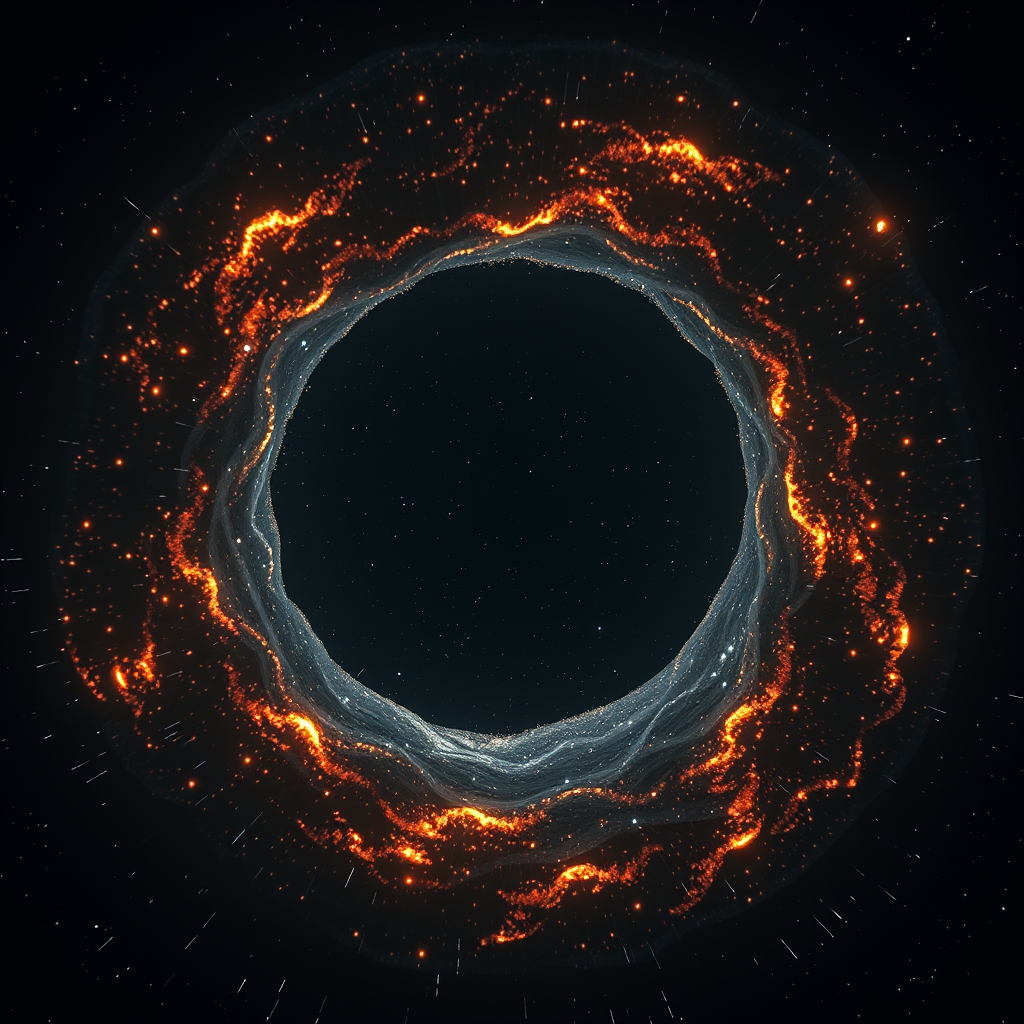
AI-generated image — a conceptual visualization
And here's why a donut is tempting. If space loops at a certain size, you can't fit patterns bigger than the loop. It's like a guitar string. A short string can't play a low note. There isn't enough length for the long wave to exist. A looped universe would be a short string. The missing big patterns would be exactly what you'd expect [5].
In 2021, a group called COMPACT — that's a real collaboration of cosmologists who study the shape of space — started taking this seriously again [5]. Researchers including Yashar Akrami, Craig Copi, Andrew Jaffe, Starkman again, and others revisited the whole question with modern tools [5]. Their argument, roughly, is this: we assumed the universe was infinite and simple because that was the easy assumption, not because we proved it. Maybe the missing patterns aren't a fluke. Maybe they're a message about shape [5].
Jaffe, at Imperial College London, put the honest version of it well. He and his collaborators have said the current data neither confirms a finite universe nor rules it out — the topology of space is genuinely still open, and the large-scale oddities are a hint worth chasing rather than proof of anything [5].
I want to be careful here, because this is the part where it's easy to oversell.
The missing big patterns might mean nothing. When you only have one universe to look at, and you can only see the biggest patterns a handful of times, you can't do statistics properly. It's like flipping a coin twice, getting two heads, and wondering if the coin is rigged. Maybe it is. Or maybe you just don't have enough flips. Physicists call this cosmic variance *3, and it's the permanent, unfixable limit on measuring the largest things — there's only one sky, and you can't rewind and re-roll it [4].
So when someone asks the COMPACT people whether the universe is a donut, the honest answer is: we can't rule it out, and there are teasing hints, and that is not the same as yes.
Why a donut and not a sphere, though? Good question. A sphere is curved — draw your triangle on a beach ball and the angles add up to more than 180 degrees [1]. But every measurement we have says space, on the largest scales, is flat. Planck measured this too. Space is flat to within about half a percent [6]. Flat as far as we can tell. And a flat, finite universe that loops — that's the torus. The donut. There are actually eighteen different possible flat shapes that loop, and the three-dimensional donut is just the most famous of them [1]. The others have names only a topologist could love.
There's something I keep circling back to. Cornish's circles-in-the-skymethod didn't just fail to find a donut. It failed to find any repeats at all, of any shape [3]. And Starkman has spent twenty years on both ends of this — first showing the simplest loops don't fit, then arguing the door is still open for bigger, subtler ones [3][5]. That's the part I find honest. The same person who ruled out the easy answer is the one saying the hard answer is still alive.
So where does that leave the actual science, stripped of the excitement?
One: space is flat, as flat as we can measure [6]. Two: the biggest patterns in the oldest light are quieter than expected, and nobody is sure why [4]. Three: the simplest looped universes are ruled out — if space loops, the loop is bigger than the part we can see [3]. Four: a bigger loop, one just past the edge of our view, would explain the quiet patterns and cannot currently be ruled out [5]. Five: it also might just be a coincidence we'll never resolve, because we only have one sky [4].
That's it. That's the whole honest picture. It's less than a headline promises and more than nothing.
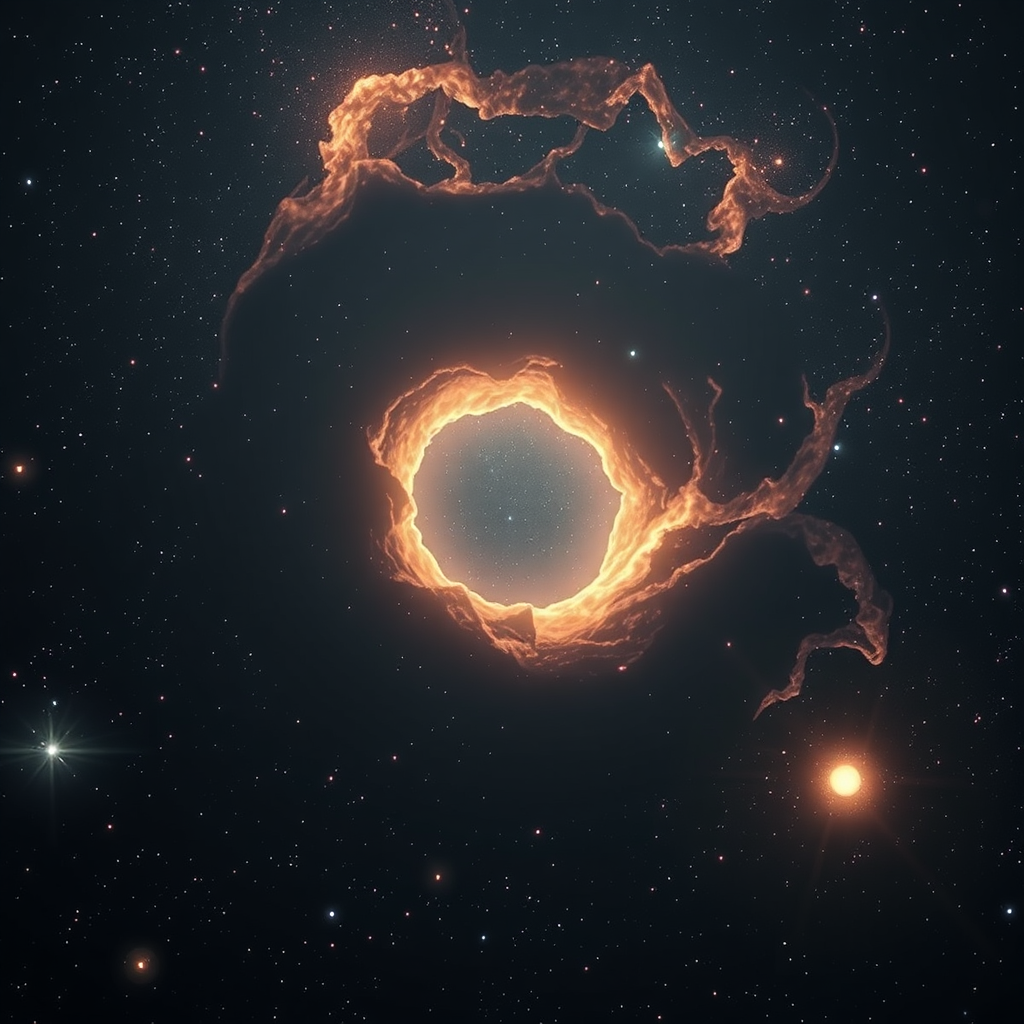
AI-generated image — a conceptual visualization
Now, the title of this section asked what's at the center of the hole. And I have to admit something. There is no center, and there is no hole.
That's the part that broke my brain when I first understood it, and I want to give it to you the way it was given to me. When we say the universe might be a torus, we do not mean it's a donut floating in some larger empty space, with a hole in the middle you could fly a spaceship through. The donut isn't the dough. The universe is only the surface. The looping. The rule that says go far enough in one direction and you come back where you started *1. The hole in the middle of a real donut only exists because the donut sits inside our three-dimensional world. A universe-torus doesn't sit inside anything. There's no outside for it to sit in. The hole is a feature of the picture, not of the thing.
So the answer to "what's at the center of the hole" is: there is no center, there is no hole, and the question is the most natural question a human can ask and also completely wrong. Which is, in my experience, how most of the best questions turn out.
Cornish said something in an interview once that stuck with me. Paraphrasing the spirit of the circles work: we're not asking how big the universe is, we're asking whether it's a hall of mirrors [3]. Whether the sky is full of copies we haven't learned to recognize. Whether the same galaxy is shining at us from two directions and we've been counting it as two.
Think about that for a second. Not as physics. As a feeling. Every point of light you saw on that beach — you assumed each one was a different thing. A separate star, a separate galaxy, a separate somewhere. But if space loops, some of those lights are the same object, arriving by two roads. You'd be looking at a smaller universe than you thought, dressed up to look enormous. A room with mirrored walls, and you standing in it, mistaking your reflections for a crowd.
We don't know if that's true. The data says: probably the room is bigger than we can see the walls of, if there are walls at all. The data also says: something about the largest scales is quieter than
So people looked. Here's what they were looking for.
If the universe loops like a donut, light gets a second chance to reach you. Go far enough in one direction and you come back to where you started — so the light from a distant galaxy could arrive from two directions at once. You'd see the same thing twice, in different parts of the sky. Two images of the same place.
The best place to hunt for this is the oldest light there is. The cosmic microwave background *1. It's the leftover glow from when the universe was young and hot, a wall of light that's been traveling for almost fourteen billion years [1]. It surrounds us in every direction. If space loops, that wall should show matching patterns — the same cold spot showing up twice, like a face reflected in two mirrors.
So they went looking for the matched circles. Rings of temperature that repeat on opposite sides of the sky. If the donut were small enough, they'd be there [2].
They didn't find them.
The searches came up empty. Which means if the universe does loop, it doesn't loop small. Any repeat has to be bigger than the part of the universe we can actually see [2]. And that's the wall we keep hitting — not a wall in space, but a wall in what light has had time to reach us. We can only see so far. The universe could be a donut the size of a stadium and we'd never know, because we're an ant on one sprinkle, and we haven't walked far enough to notice we're going in circles.
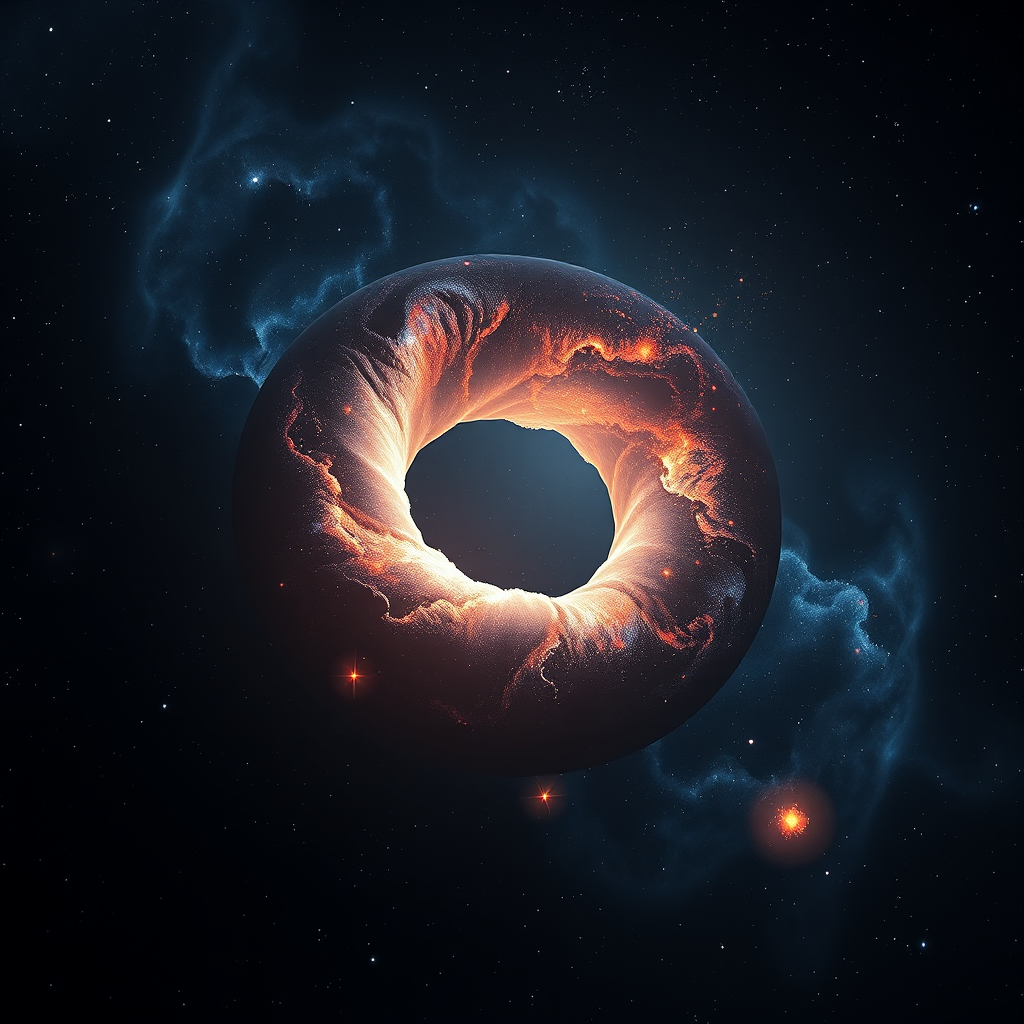
AI-generated image — a conceptual visualization
So here's the honest answer. We don't know the shape.
Every measurement says space is flat, or so close to flat we can't tell the difference [3]. Flat is friendly to the donut idea — remember, a donut's surface is flat in the way that counts. But flat is also friendly to the boring answer, the one where space just goes on forever with no loop at all. The measurement can't separate them. A thing can be flat and finite, or flat and infinite, and from the inside they look the same until you find the repeat. And we haven't found the repeat.
There was a flicker, once. The oldest light has strange quiet patches at the largest scales — less variation than the plain infinite-universe model predicts [4]. Some people thought a donut might explain it. A finite space can't fit waves bigger than itself, the same way a short guitar string can't play a low note. So the biggest ripples would just be missing. It's a clue. It's not a conviction. It could also be nothing — the universe is allowed to roll unlucky dice, and with only one universe to check, you can't tell a real pattern from a fluke [4].
That's the part I keep sitting with. We have one universe. One sample. You can't run it again with the streetlights off and see if the same cold spot comes back. Everything we'll ever know about the shape of everything has to be squeezed out of a single photograph, taken once, that we can't retake.
So the donut is a maybe. A good maybe. A maybe that solves the wall-or-forever trap you felt on that hilltop, which is more than the other answers manage. But it stays a maybe, possibly forever, because the proof might be sitting just past the edge of the light — real, and permanently out of reach.
Which leaves me with a stranger questionthan the shape itself.
If the answer is out there but the light carrying it will never arrive — if the loop is real but too big to catch us in this lifetime of the universe — then the truth exists and we're simply not allowed to have it. Not because we're not clever enough. Because the door closed before we were born.
You can build a bigger telescope. You cannot build a longer past. The oldest light is the oldest light. There is no earlier photograph to develop, no wider frame to crop into. We got here late, and the ticket only shows part of the show.
I find that oddly comforting. We spend so much effort pretending we're close to the last page. We're not. We might be a species that lives its entire existence inside a question it can state perfectly and never answer. That's not failure. That's just being an ant on a sprinkle, smart enough to suspect the donut, too small to walk the whole way round.
So the next time you're on that hilltop, and the sky turns from ceiling to depth, and the old thought arrives — does it end? — you can carry a better one up there with you. Not the wall. Not the forever. The loop. A universe that could bring you home if you traveled long enough in a straight line, back to the same beach, the same streetlights, the same you looking up.
Would you even recognize the place?
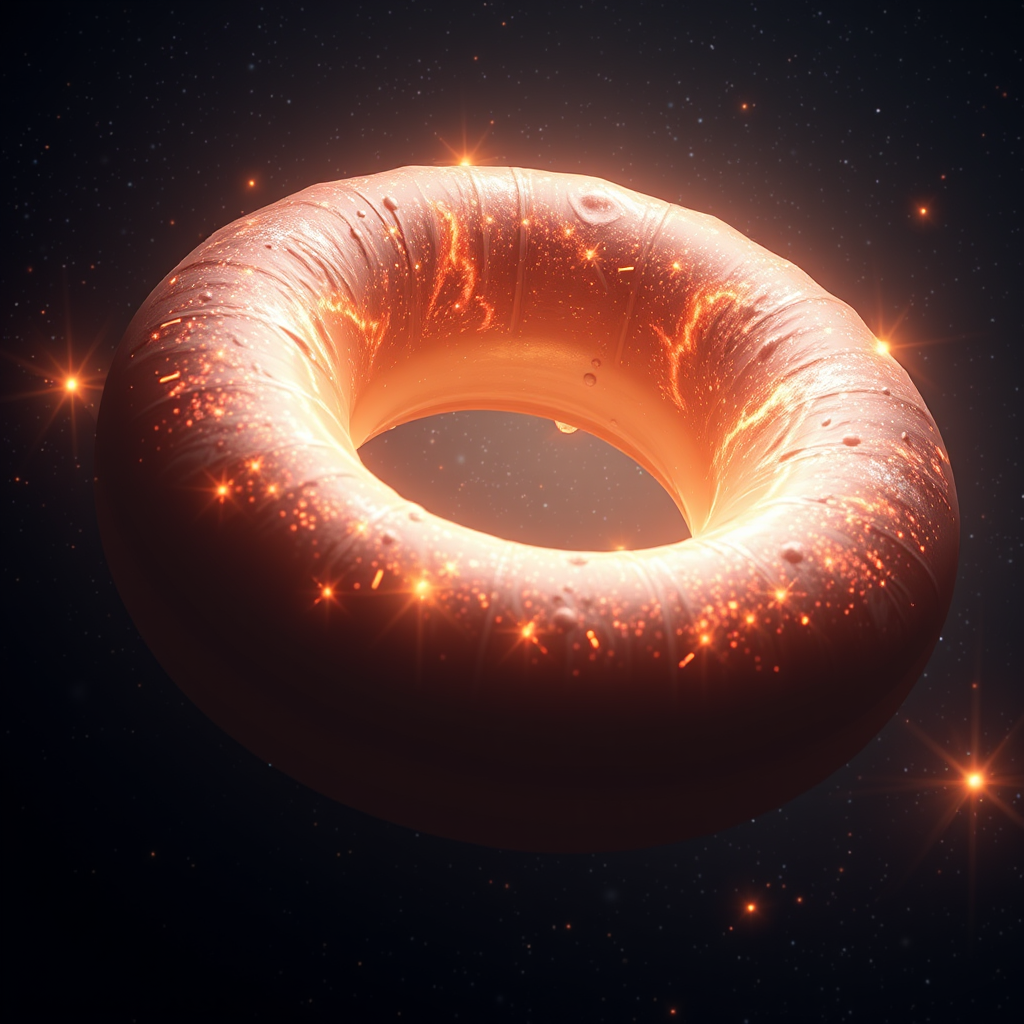
AI-generated image — a conceptual visualization
So here's what gets me. Nobody has found the repeat.
Astronomers scoured the oldest light for those matching pairs — the same patch of sky showing up twice, like Pac-Man passing the same ghost [1]. They looked for circles in the cosmic microwave background *1 that should match if space wraps around. The leftover glow from when the universe was young and hot, before there were stars. If we live in a donut, that glow should carry a fingerprint of the loop [2].
They found nothing. No matching circles. Which means one of two things.
Either the universe doesn't loop. Or it loops on a scale so vast that the light hasn't had time to make the trip yet. The donut might be real, just bigger than everything we can see [2]. That's the frustrating part. "No signal" doesn't mean "no donut." It means the donut, if it exists, is at least as big as the observable universe — the bubble of space close enough that its light has reached us *2.
Think about what that does to you.
You could be inside a loop right now. You could point at a star and be pointing, in some roundabout way, at the back of your own head — a version of this galaxy that light left billions of years ago, still traveling, still on its way around. You'd never know. The trip is too long. The universe might be finite and you'd feel infinity anyway, because you can't get to the edge that isn't there.
And here's the turn. We started this whole thing scared of two answers. A wall, or forever. The donut was supposed to save us from both. But it just hands us a third kind of unknown. Not "what's behind the wall." Not "how far does forever go." Instead: how big is the thing we're inside, and will we ever be able to tell?
Maybe the shape of everything is a question we're too small to finish asking.
But there's something stranger than the shape. This looping light, this ancient glow — it came from a moment. A first moment. The universe had a beginning, and the beginning left a mark we can still read.
What did that first light actually see?
TERMS EXPLAINED
- *1Topology: The study of a shape's overall connectedness — what loops back on what — ignoring exact sizes and distances. It's the difference between "does this road come back around?" and "how long is the road?"
- *2Cosmic microwave background: The oldest light in the universe, left over from about 380,000 years after the Big Bang, now spread faintly across the whole sky. It's the earliest snapshot we can take of everything.
SOURCES & REFERENCES
- [1]Weeks, J. (2001). "The Shape of Space." Marcel Dekker. — The topological identification of a flat screen with wraparound edges as a torus (donut) shape.
- [2]Luminet, J.-P. (2008). "The Wraparound Universe." A K Peters. — Description of a finite universe without boundary in which a straight-line path can return to its origin.
- [3]Cornish, N. J., Spergel, D. N., Starkman, G. D., Komatsu, E. (2004). "Constraining the Topology of the Universe." Physical Review Letters, 92, 201302. — Searches for repeated patterns ("circles in the sky") that would indicate a finite, wrapped topology.
- [4]Planck Collaboration (2014). "Planck 2013 results. XXVI. Background geometry and topology of the Universe." Astronomy & Astrophysics, 571, A26. — Analysis of the cosmic microwave background for signatures of non-trivial cosmic topology.
- [5]Cornish, N., Spergel, D., Starkman, G., Komatsu, E. (2004). "Constraining the Topology of the Universe." Physical Review Letters 92, 201302. — Searches for matched circle patterns in the microwave background found no confirmed evidence of a small looped topology.
Inline citations [N] correspond to numbered references above.
A weekly journey from the present universe back to the Big Bang — and to what it means for us.
![[Deep Dive] Scale-free localization in pseudo-Hermitian quantum walk](/content/images/size/w600/2026/10/deep_dive_thumb-9.png)