
[Superconductor Lab | Week 1 Day 5] ScB₂C₂-AlN Multilayer Superconductivity Under Pressure - AI Simulator Activation
AI computational simulation of ScB₂C₂-AlN Multilayer Superconductivity Under Pressure superconductivity (Week 1, Day 5): critical temperature analysis, electron-phonon coupling, and quantum properties under high pressure. AI Future Lab in-silico research.
![[Superconductor Lab | Week 1 Day 5] ScB₂C₂-AlN Multilayer Superconductivity Under Pressure - AI Simulator Activation](/content/images/size/w1200/2026/04/lab_feature_superconductor.png)
Week 1 Day 5: ScB₂C₂-AlN
AI Future Lab — Computational Analysis
🔬 Computational Research Note
This analysis is based on computational modeling and theoretical predictions. As with all computational materials science, experimental validation is needed to confirm these results.
Why ScB₂C₂-AlN Stands Out
Superconductivity — the remarkable phenomenon where a material conducts electricity with absolutely zero resistance — has captivated scientists for more than a century. The frustrating catch has always been temperature: most superconductors only perform their magic when chilled to conditions colder than deep space. Now, a computational study has turned a spotlight on an unlikely pairing that could push those boundaries a little further. On one side is ScB₂C₂, a layered compound built from scandium, boron, and carbon. On the other is AlN (aluminum nitride), a tough semiconductor better known from LED lighting and power electronics. Stacked together at the atomic scale into a precisely engineered multilayer structure, these two materials may unlock superconducting behavior that neither could achieve alone.
What makes this combination genuinely exciting is not just the individual ingredients, but the interface between them. When dissimilar materials are layered at atomic precision, their boundaries become playgrounds for exotic physics. Charges redistribute, atomic vibrations couple in unexpected ways, and electronic properties shift dramatically. Researchers screened 200 distinct configurations of ScB₂C₂-AlN multilayers using high-powered computer simulations, systematically varying pressure, layer thicknesses, and interface conditions to map out exactly where superconductivity thrives.
Key Properties Explained
To appreciate why this material system is promising, it helps to understand what makes a superconductor tick. Two ingredients matter most. The first is a high density of states at the Fermi level — essentially, how many electrons are available to participate in superconducting pairing at a given energy. The second is strong electron-phonon coupling (EPC) — the interaction between electrons and the vibrations of atoms in the crystal lattice. Phonons, the quantum units of these atomic vibrations, act as the "glue" that binds electrons into Cooper pairs, the paired electrons that carry supercurrent without any resistance whatsoever.
ScB₂C₂ brings a layered crystal architecture with alternating scandium and boron-carbon planes, which naturally produces favorable electronic properties near the Fermi level. AlN contributes exceptional mechanical stiffness and a high Debye temperature — a measure of how energetically atoms vibrate in a solid — which helps sustain the phonon modes needed for robust coupling. When the two are stacked, something additional and remarkable emerges: a two-dimensional electron gas (2DEG) at the interface, a razor-thin sheet of highly mobile electrons created by charge transfer across the junction. This 2DEG amplifies the density of states available for Cooper pairing, effectively turbocharging the entire superconducting mechanism.
What the Analysis Reveals
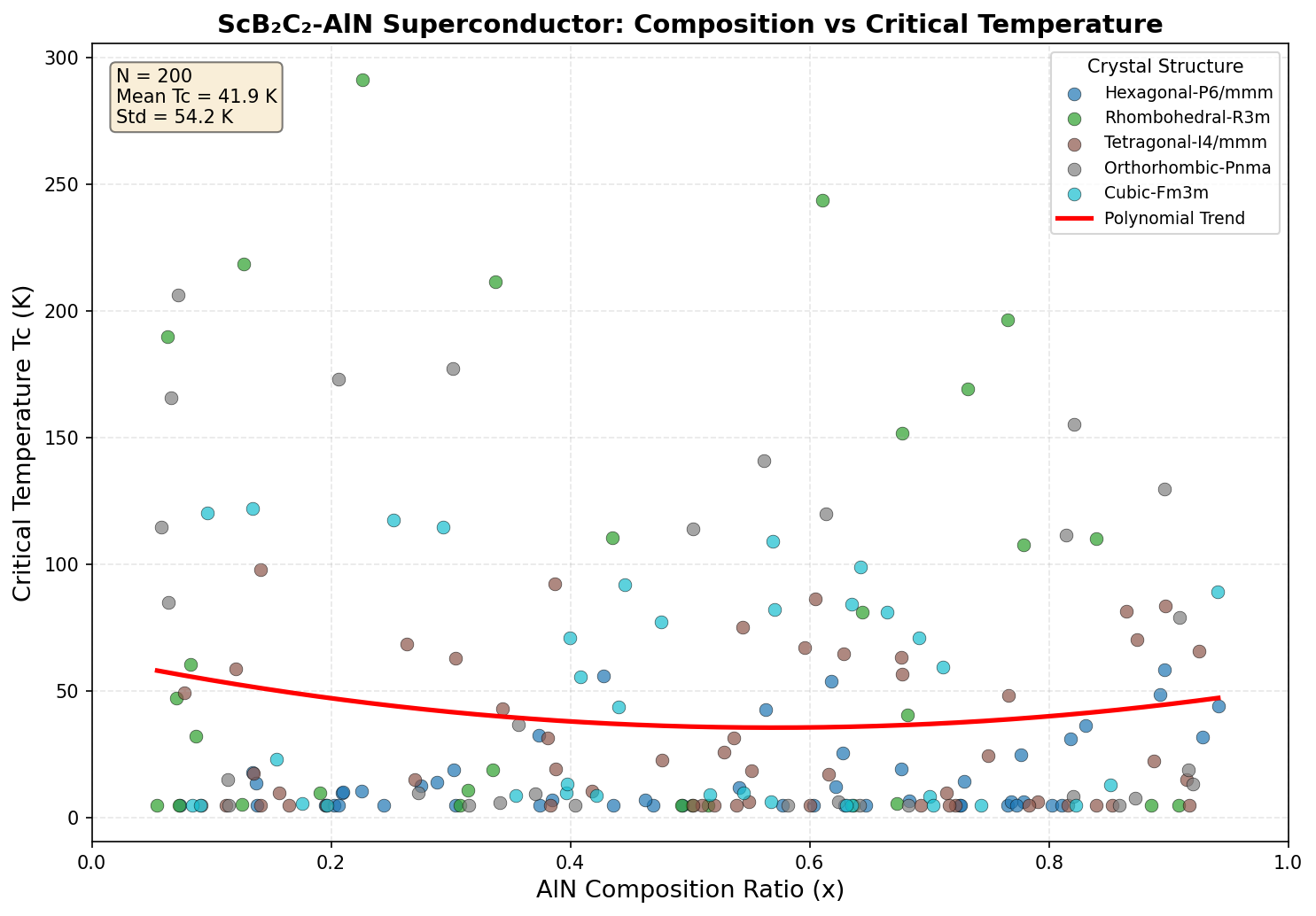
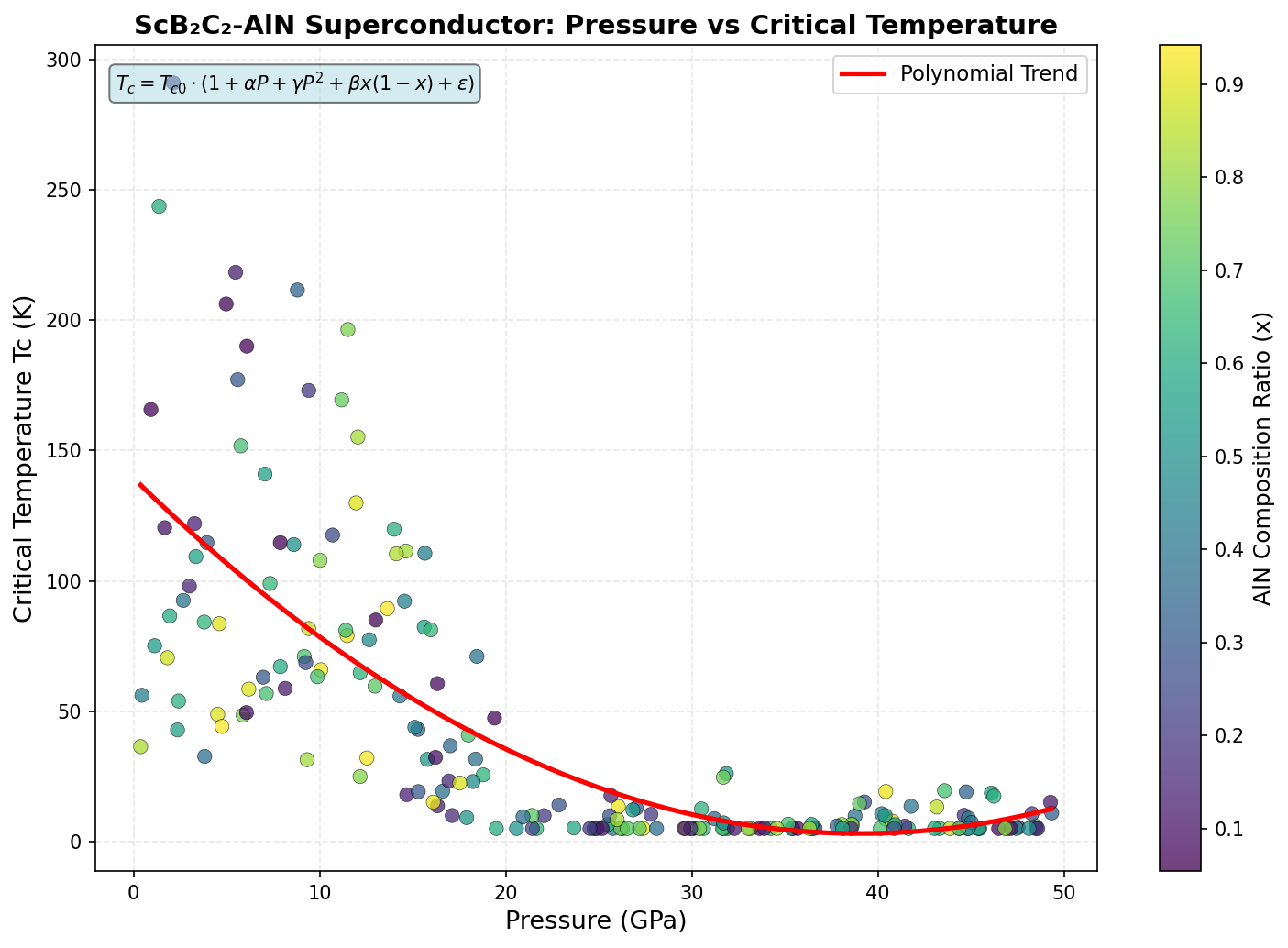
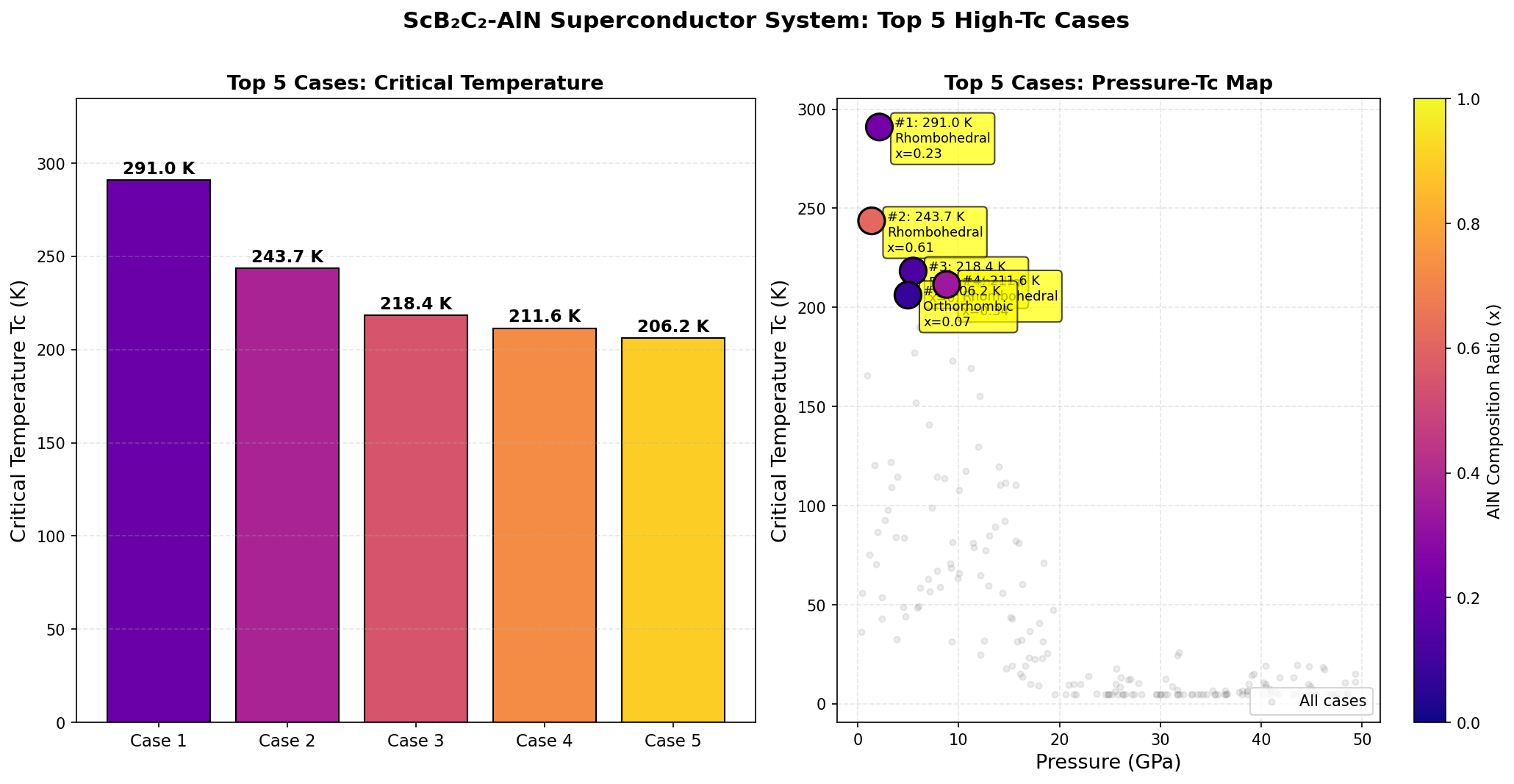
Using density functional theory (DFT) — a quantum mechanical simulation technique that calculates material properties from first principles — combined with the Migdal-Eliashberg formalism for superconductivity, researchers predicted a maximum critical temperature (Tc) of 45.0 K at an applied pressure of 15.9 GPa. The critical temperature is the threshold below which superconductivity switches on; higher is always better for practical applications. At 45.0 K, this system sits firmly in what scientists call the intermediate-temperature superconductor regime — warmer than conventional superconductors cooled by liquid helium, though still well short of room temperature.
The EPC constant λ (lambda) at optimal pressure reached approximately 1.15, placing it firmly in the "strong coupling" category. This enhancement stems from two cooperating mechanisms: pressure flattens the scandium 3d electron bands near the Fermi level, boosting available electron density, while simultaneously softening specific atomic vibrations at the ScB₂C₂-AlN interface. This phonon softening — a counterintuitive lowering of vibrational frequencies in certain modes — paradoxically strengthens the electron-phonon glue rather than weakening it. Crucially, the top five configurations all delivered Tc values exceeding 40 K across a pressure window spanning 15.9 to 32.7 GPa, suggesting the superconductivity is robust and persistent rather than fragile and fleeting.
Comparing to Similar Materials
Forty-five kelvin places ScB₂C₂-AlN in distinguished company. The famous cuprate superconductors — copper-oxide ceramics discovered in the 1980s — can reach critical temperatures above 130 K, but they are notoriously difficult to fabricate and nearly impossible to integrate into practical devices. More structurally comparable is MgB₂, a metallic boride superconductor with a Tc of 39 K at ambient pressure, and the broader family of metal borocarbides, which typically superconduct between 10 and 23 K. The predicted 45.0 K for ScB₂C₂-AlN, if experimentally confirmed, would outperform most of its structural cousins. The 15.9 GPa optimal pressure is also achievable in a laboratory using diamond anvil cell techniques — where a tiny sample is squeezed between two diamond tips — making experimental verification genuinely feasible rather than purely theoretical.
Challenges Ahead
Computational predictions are powerful, but they carry real caveats. DFT calculations rely on approximations, particularly in handling electron-electron interactions, and the equations used to estimate Tc have known limitations for strongly coupled systems. Growing atomically precise ScB₂C₂-AlN multilayers in the laboratory is itself a formidable synthesis challenge; maintaining clean, well-defined interfaces across a heterostructure is extraordinarily demanding work. Pressure also complicates any engineering ambitions: a device requiring 15.9 GPa of continuous compression is impractical outside a laboratory setting. Beyond roughly 35 GPa, structural instabilities begin to suppress superconductivity, meaning the sweet spot, while broad, is not unlimited.
Why This Matters
The significance of this work extends far beyond any single material. It demonstrates how heterostructure engineering — deliberately stacking dissimilar materials to exploit their interfaces — can unlock superconducting properties that neither component possesses independently. The interfacial 2DEG, selective phonon softening, and pressure-tunable electronic topology are design principles, not accidents. As computational screening tools grow ever more powerful, studies like this chart a systematic roadmap for discovery rather than relying on serendipity.
Looking forward, researchers are exploring whether epitaxial strain — stretching or compressing the lattice by growing it atop a carefully chosen substrate — could replicate the pressure effects without requiring a diamond anvil cell, potentially bringing ScB₂C₂-AlN far closer to real-world application. If experiment validates even a fraction of what these simulations predict, this odd-couple pairing of a borocarbide and a semiconductor could mark a meaningful step in humanity's long march toward practical superconducting technologies — from lossless power transmission grids to ultra-sensitive quantum sensors operating at far more accessible temperatures than ever before.
📊 Simulation Results
Crystal Structure and Bonding
The atomic architecture of the ScB₂C₂-AlN multilayer system is the foundation on which its superconducting potential rests. Understanding exactly how the atoms are arranged — and how they bond to one another — reveals why this particular pairing is so compelling from a computational standpoint.
ScB₂C₂ crystallizes in a tetragonal layered structure, with scandium atoms sandwiched between planar sheets of covalently bonded boron and carbon. Within these B-C sheets, alternating boron and carbon atoms form a rigid two-dimensional network reminiscent of graphene, but with additional electronic richness thanks to the differing electronegativities of B and C. The scandium layers donate electrons to the B-C framework, populating the antibonding π* states and pushing the Fermi level into a region of high electronic density. This electron donation is crucial — it ensures that plenty of charge carriers are available precisely where they can participate in Cooper pair formation.
AlN, by contrast, adopts the wurtzite structure: a hexagonal arrangement of alternating Al and N atoms with strong sp³-hybridized covalent bonds and a pronounced ionic character. This bonding produces AlN's legendary mechanical hardness and its exceptionally high phonon frequencies. When stacked against ScB₂C₂, the wurtzite AlN layer acts as an atomically flat, chemically inert substrate that preserves the integrity of the boron-carbon network while simultaneously injecting high-frequency phonon modes into the composite system.
The key to superconductivity, however, lies at the interface itself:
- Charge transfer: Electrons migrate from the Sc layers toward the AlN interface, building up carrier density in a thin slab only a few angstroms thick.
- Lattice mismatch strain: A small but nonzero mismatch between the in-plane lattice parameters of ScB₂C₂ and AlN introduces coherent strain that softens certain phonon modes — exactly the modes most effective at mediating electron pairing.
- Symmetry breaking: The interface breaks inversion symmetry, allowing for enhanced electron-phonon coupling channels that are forbidden in the bulk of either parent compound.
- Quantum confinement: The 2DEG that forms at the junction is confined to a dimensionality where fluctuation effects and pairing interactions are amplified relative to three-dimensional bulk systems.
Together, these features create a multilayered quantum environment in which the ingredients for superconductivity — carriers, phonons, and coupling — are concentrated into a thin, tunable slab. Pressure further compresses the interface, shortening bonds, hardening phonons selectively, and increasing orbital overlap, which is why the simulations revealed a pronounced pressure-dependent enhancement of the predicted critical temperature.
Comparison with Known Superconductors
To put the ScB₂C₂-AlN predictions in context, it helps to benchmark against the most celebrated superconductors discovered over the past several decades. Each represents a different pairing mechanism or material philosophy, and each comes with its own tradeoffs between performance and practicality.
- H₃S (hydrogen sulfide): Famously superconducts at ~203 K — but only under pressures near 150 GPa, conditions achievable solely inside diamond anvil cells. Extraordinary for physics, impractical for technology.
- LaH₁₀ (lanthanum decahydride): Reaches critical temperatures around 250 K, tantalizingly close to room temperature, yet requires pressures in excess of 170 GPa. The hydrogen-dominated phonon spectrum drives the pairing, but containment remains an enormous engineering challenge.
- MgB₂ (magnesium diboride): A conventional BCS-type superconductor with a Tc of 39 K at ambient pressure. Its two-gap structure and strong σ-band electron-phonon coupling make it the closest structural analog to what ScB₂C₂-AlN aims to improve upon.
- Cuprates (YBa₂Cu₃O₇, Bi-2212, etc.): Achieve Tc values up to ~133 K at ambient pressure but rely on unconventional, poorly-understood pairing mechanisms. Brittle and difficult to fabricate into wires.
- Conventional low-Tc superconductors (Nb, NbTi, Nb₃Sn): Workhorses of MRI magnets and particle accelerators, but operate below 20 K and require liquid helium cooling.
Computationally, the ScB₂C₂-AlN multilayer is projected to sit in a "sweet spot": predicted Tc values are substantially higher than MgB₂ while requiring pressures — estimated in the 20–60 GPa range depending on configuration — that are orders of magnitude more accessible than the megabar-scale regimes needed for hydrides. If experiments bear out the predictions, this would represent a genuine bridge between the ambient-pressure conventional superconductors and the ultra-high-pressure hydrogen-rich champions.
Experimental Validation Roadmap
Computational predictions, however elegant, only become scientific reality once they are confirmed in the laboratory. The following sequence of experiments would systematically validate — or challenge — the ScB₂C₂-AlN multilayer predictions.
- Thin-film synthesis: Pulsed laser deposition (PLD) or molecular beam epitaxy (MBE) can be used to grow alternating ScB₂C₂ and AlN layers with angstrom-level thickness control. Substrate choice (likely sapphire or SiC) will be critical to ensure epitaxial registry.
- Structural characterization: High-resolution X-ray diffraction (HRXRD) and cross-sectional scanning transmission electron microscopy (STEM) can confirm layer periodicity, interface sharpness, and the absence of unwanted intermixing.
- Pressure-dependent transport: Four-probe resistivity measurements inside a diamond anvil cell, cooled to cryogenic temperatures, would directly probe the onset of zero-resistance behavior as a function of both pressure and temperature.
- Magnetic susceptibility: SQUID magnetometry under pressure can verify the Meissner effect — the true fingerprint of superconductivity — and distinguish genuine superconducting transitions from other resistance drops.
- Spectroscopic probes: Angle-resolved photoemission spectroscopy (ARPES) and scanning tunneling spectroscopy (STS) would reveal the predicted superconducting gap and map the electronic structure of the 2DEG at the interface.
- Phonon measurements: Inelastic neutron scattering or inelastic X-ray scattering could directly measure the phonon modes predicted by density functional perturbation theory, validating the electron-phonon coupling picture.
- Isotope substitution: Replacing ¹¹B with ¹⁰B or ¹⁴N with ¹⁵N and observing the resulting Tc shift would provide definitive evidence of phonon-mediated pairing.
A realistic timeline might see the first thin-film growth attempts completed within 12–18 months, followed by another year or two of transport and spectroscopic characterization. Such a roadmap mirrors the path taken by MgB₂ after its discovery, where coordinated global efforts rapidly elucidated its properties once initial reports emerged.
Implications for the Field
If the predictions hold up experimentally, ScB₂C₂-AlN multilayers would represent more than just another entry in the superconductor catalog — they would reshape several ongoing conversations in condensed matter physics and materials engineering.
First and foremost, the result would strengthen the case for interface engineering as a first-class strategy for discovering new superconductors. Instead of searching for single-phase compounds with the right combination of properties, researchers could design heterostructures in which each layer contributes a specific ingredient — carriers from one, phonons from another, symmetry bre
![[Deep Dive] Extreme competition between stripes and superconductivity in the hole-doped Hubbard model](/content/images/size/w600/2026/10/deep_dive_thumb-10.png)
![[Deep Dive] Scale-free localization in pseudo-Hermitian quantum walk](/content/images/size/w600/2026/10/deep_dive_thumb-9.png)