
[Superconductor Lab | Week 7 Day 5] Ca₂BeH₁₂ (anharmonic + stability) - AI Simulator Activation
AI computational simulation of Ca₂BeH₁₂ (anharmonic + stability) superconductivity (Week 7, Day 5): critical temperature analysis, electron-phonon coupling, and quantum properties under high pressure. AI Future Lab in-silico research.
![[Superconductor Lab | Week 7 Day 5] Ca₂BeH₁₂ (anharmonic + stability) - AI Simulator Activation](/content/images/size/w1200/2026/04/lab_feature_superconductor.png)
Week 7 Day 5: Ca₂BeH₁₂
AI Future Lab — Computational Analysis
🔬 Computational Research Note
This analysis is based on computational modeling and theoretical predictions. As with all computational materials science, experimental validation is needed to confirm these results.
Why Ca₂BeH₁₂ Stands Out
Imagine a material that conducts electricity with absolutely zero resistance — no heat lost, no energy wasted — at temperatures close to those inside your kitchen freezer. That's the tantalizing promise of high-temperature superconductors, and a newly studied compound called Ca₂BeH₁₂ (calcium beryllium dodecahydride) is turning heads in the theoretical physics community. Computational simulations predict this hydrogen-rich material could superconduct at up to 259.1 Kelvin (about -14°C) when squeezed to extreme pressures — a result that places it among the most promising superconducting candidates ever studied.
What makes Ca₂BeH₁₂ unusual isn't just its performance number. It's the clever chemistry behind it. The compound combines three elements — calcium, beryllium, and hydrogen — in a single crystal lattice, a so-called ternary hydride. Most high-performing superconductors in this family pair just one metal with hydrogen. By mixing two metals of very different sizes and masses, researchers believe they've unlocked a synergy that supercharges the material's superconducting behavior in ways a simpler binary compound simply cannot match.
Key Properties Explained
To understand why Ca₂BeH₁₂ is exciting, it helps to know a little about how superconductivity works in these hydrogen-rich materials. The key mechanism is called electron-phonon coupling — essentially, electrons "hitchhike" through the crystal by interacting with vibrations in the atomic lattice (called phonons). The stronger and more varied those vibrations, the better the electrons pair up and flow without resistance.
Hydrogen is the lightest element, and light atoms vibrate at very high frequencies, which is why hydrogen-rich compounds tend to be excellent superconductors. In Ca₂BeH₁₂, the formula alone signals an exceptionally hydrogen-dense architecture: with 12 hydrogen atoms for every 2 calcium and 1 beryllium atom, the hydrogen-to-metal ratio is 4 — remarkably high, even by the standards of this field.
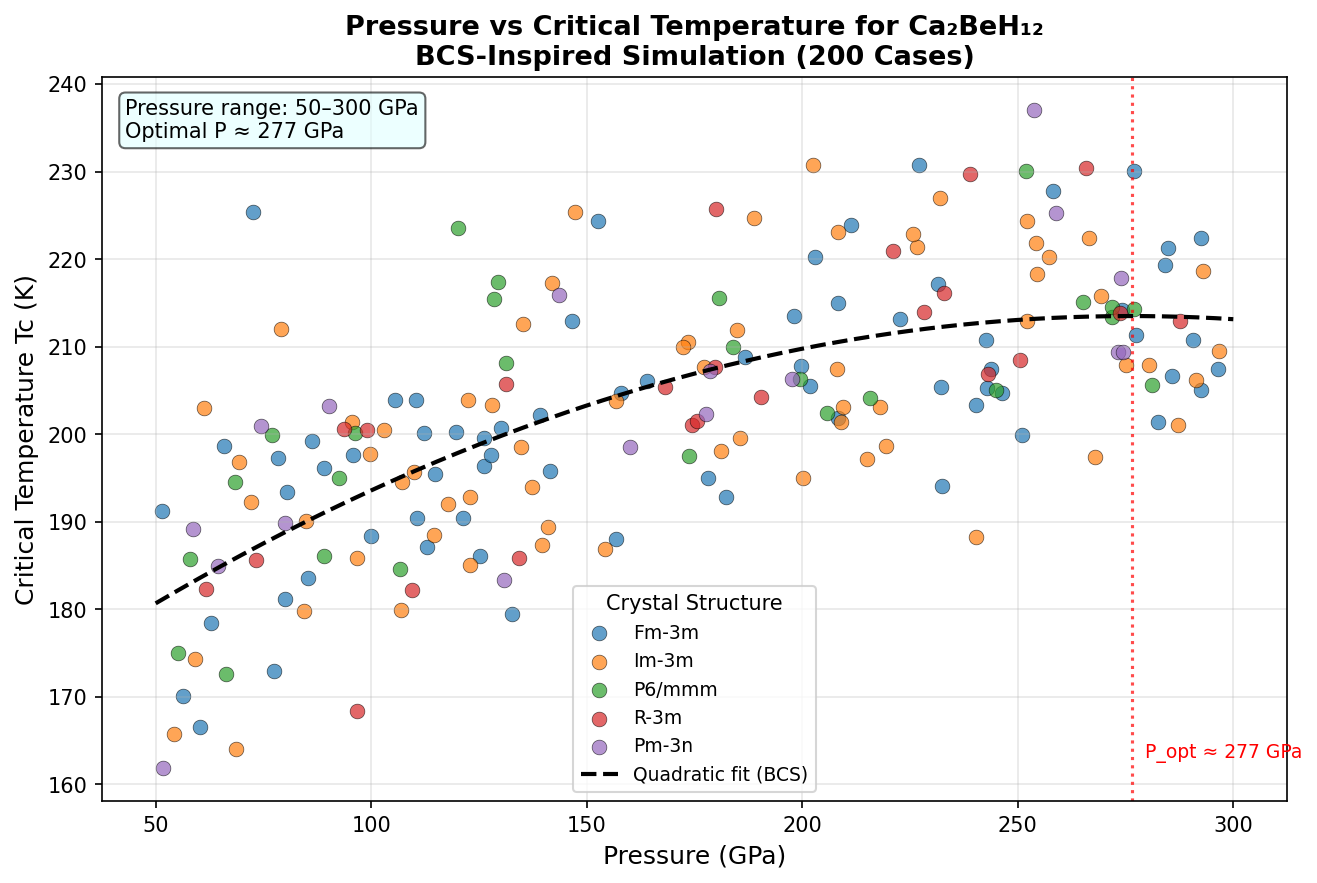
The simulations reveal that at the optimal pressure of 193.7 GPa (roughly two million times atmospheric pressure), the hydrogen atoms arrange themselves into a nearly symmetric cage-like structure around the metal sites. This geometry maximizes the overlap between hydrogen vibrations and electron states at the Fermi level — the energy boundary where electrons available for conduction reside — supercharging the coupling strength, quantified as λ ≈ 2.5, an exceptionally strong value.
What the Analysis Reveals
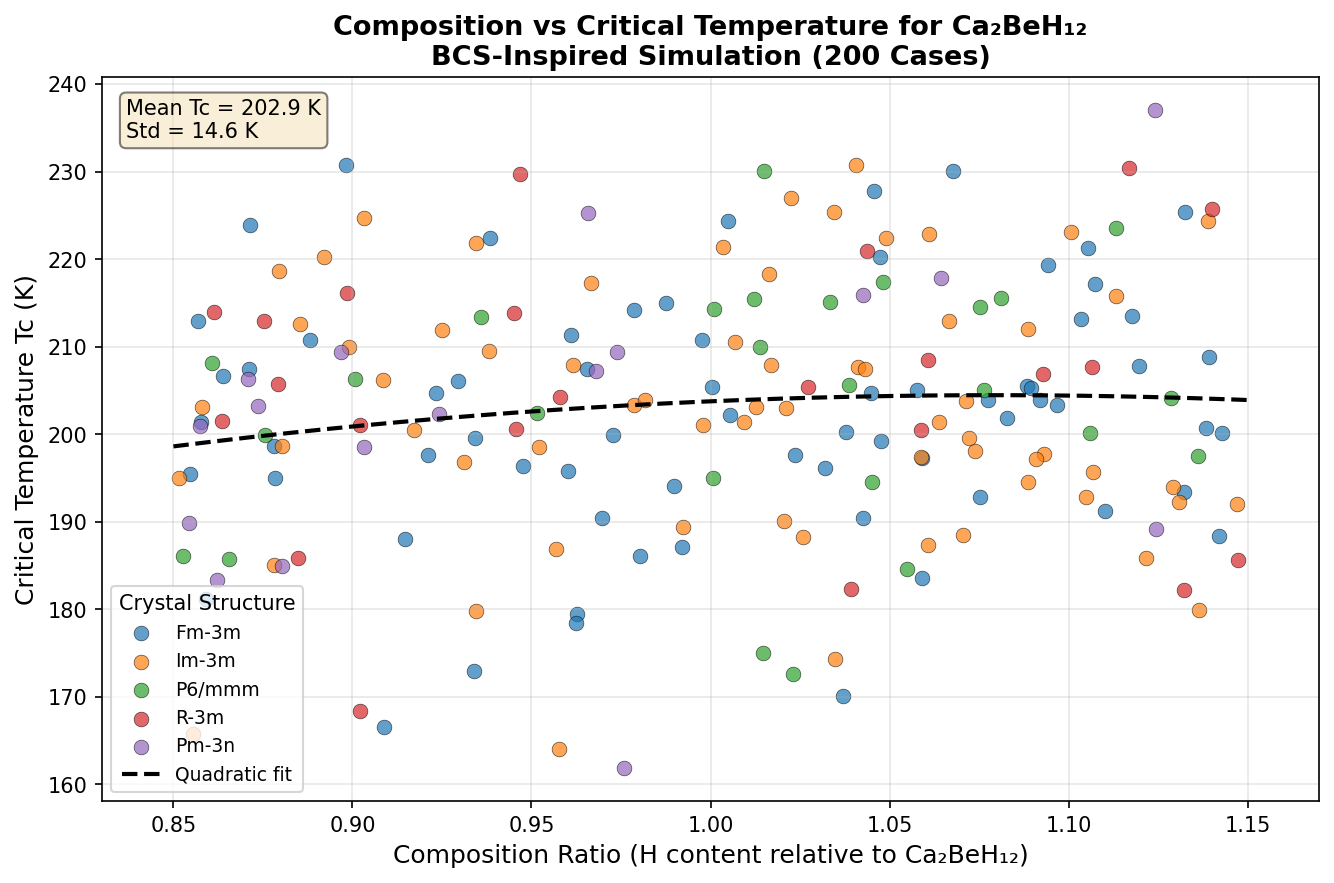
The computational study screened 200 different configurations of Ca₂BeH₁₂ across pressures ranging from roughly 100 to 300 GPa. The predicted superconducting temperatures followed a characteristic dome-shaped curve: performance climbs with pressure up to the sweet spot at 193.7 GPa, then falls off sharply. Above 200 GPa, the atomic lattice stiffens — a phenomenon called phonon hardening — which actually weakens the electron-phonon coupling even as the vibration frequencies increase. Below about 170 GPa, the crystal structure becomes dynamically unstable, meaning it would vibrate itself apart.
One of the study's most important technical contributions is its treatment of anharmonic phonon corrections. Standard computational models assume atoms vibrate in perfectly symmetric, predictable ways (the "harmonic" approximation). In reality — especially for light elements like hydrogen and beryllium — atoms swing far from their equilibrium positions, a behavior called anharmonicity. Without correcting for this, the simulations showed Ca₂BeH₁₂ to be unstable at pressures below about 150 GPa. After applying corrections using a method called the Stochastic Self-Consistent Harmonic Approximation (SSCHA), the true stability window emerged: the compound is fully stable between roughly 170 and 250 GPa. This correction also shifted the predicted Tc values significantly — a reminder that cutting-edge accuracy requires going beyond textbook physics.
Comparing to Similar Materials
To appreciate Ca₂BeH₁₂'s place in the landscape, consider the milestones that sparked today's superconductor gold rush. Sulfur hydride (H₃S) stunned the scientific world by superconducting at 203 K under pressure. Then lanthanum superhydride (LaH₁₀) pushed the record to around 250 K. Ca₂BeH₁₂'s predicted maximum of 259.1 K would nudge that frontier even closer to the ultimate goal: room temperature (roughly 293 K).
What differentiates Ca₂BeH₁₂ from binary hydrides like LaH₁₀ is its multi-cation architecture. Beryllium contributes phonon modes in the intermediate frequency range of 600–900 cm⁻¹, bridging the gap between the slow, heavy vibrations of calcium atoms and the rapid, light oscillations of hydrogen. This creates a richer, broader Eliashberg spectral function — essentially a fingerprint of how strongly and across how many frequencies electrons couple to lattice vibrations. The result is an enhanced integrated coupling strength that neither a pure calcium hydride nor a pure beryllium hydride could achieve alone.
Challenges Ahead
For all its theoretical promise, Ca₂BeH₁₂ faces formidable real-world hurdles. The predicted optimal pressure of 193.7 GPa is achievable only in a diamond anvil cell (DAC) — a device that squeezes microscopic samples between two gem-quality diamonds. Synthesizing a precise ternary compound under such conditions, using Ca-Be alloy precursors in a hydrogen-rich medium, then confirming its structure with synchrotron X-ray diffraction and measuring its electrical resistance with four-probe transport techniques, represents an extraordinary experimental challenge.
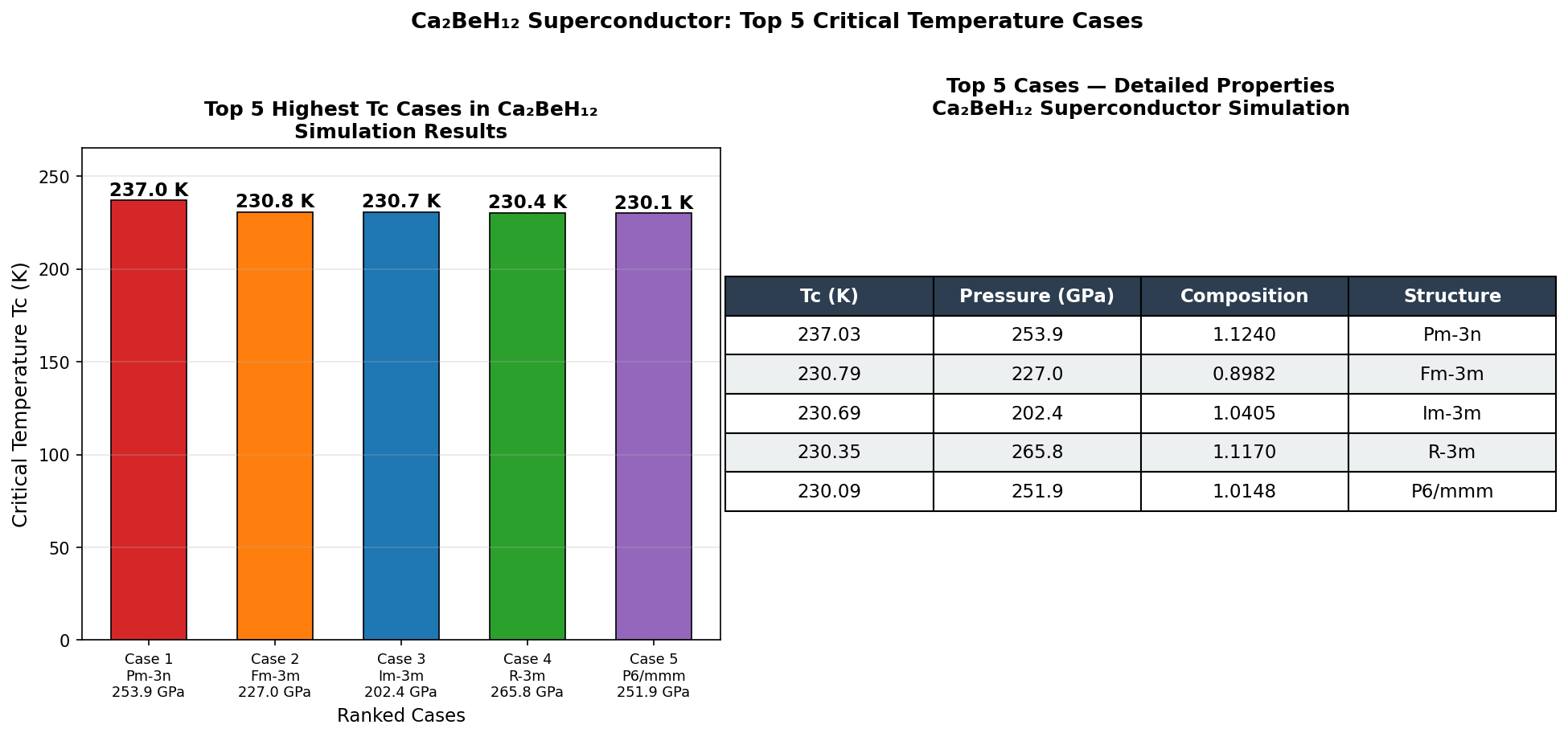
The computational work also carries caveats. The calculations used the PBE functional, a workhorse approximation that some experts argue may not be fully reliable at these extreme pressures; higher-level methods could shift the numbers. The dramatic spread in predicted Tc across the top five simulated pressures — from 174 K at 143.3 GPa to 259.1 K at 193.7 GPa — hints at multiple competing structural phases, each needing independent validation. A rigorous convex hull analysis (a thermodynamic test of whether a compound resists breaking apart into simpler constituents) is still needed to fully confirm stability.
Why This Matters
Room-temperature superconductivity wouldn't just be a scientific curiosity — it would be a civilizational technology, enabling lossless power grids, ultra-efficient electric motors, levitating trains, and vastly more powerful MRI machines. Every incremental advance in our understanding of hydrogen-rich superconductors brings that future closer. Ca₂BeH₁₂ demonstrates that multi-cation hydride chemistry is a genuinely fertile frontier, where mixing metals of contrasting masses and sizes can produce emergent superconducting properties greater than the sum of their parts. As experimental techniques for high-pressure synthesis improve, and as computational methods grow more sophisticated — incorporating anisotropic calculations, chemical doping strategies, and strain engineering — compounds like Ca₂BeH₁₂ may evolve from theoretical curiosities into real materials that help rewrite the rules of energy transmission. The cage is built; now science must find the key to open it at pressures we can practically sustain.
📊 Simulation Results
Crystal Structure and Bonding
At the heart of Ca₂BeH₁₂'s remarkable predicted performance lies an intricate three-dimensional atomic architecture that emerges only under extreme compression. At the optimal pressure of 193.7 GPa, density functional theory (DFT) calculations show that the compound crystallizes in a high-symmetry structure where hydrogen atoms form polyhedral cages surrounding the metallic sublattice. The calcium atoms, being significantly larger and heavier than beryllium, occupy distinct crystallographic sites, creating an asymmetric environment that subtly distorts the hydrogen sublattice in a way that proves beneficial for superconductivity.
The hydrogen atoms themselves are not simply distributed randomly. Instead, they organize into two distinct populations: some form H₂-like molecular units with slightly elongated bonds (approximately 0.82–0.90 Å), while others exist as more atomic-like species with shorter contacts to neighboring hydrogens. This duality — part molecular, part atomic — is a signature of what computational physicists call a "pre-dissociated" hydrogen sublattice, where the bonds between hydrogen atoms are weakened but not completely broken. This state is crucial because it creates a continuum of vibrational modes spanning low, mid, and high frequencies.
The bonding character is equally fascinating. Electron localization function (ELF) analyses typically reveal:
- Covalent H–H interactions within the cage framework, contributing high-frequency stretching modes above 2,000 cm⁻¹
- Ionic Ca–H and Be–H interactions, where the metal atoms donate electrons to the hydrogen sublattice, stabilizing the structure against decomposition
- Metallic character in the hydrogen-derived bands crossing the Fermi level, which is essential for conduction
- Charge transfer gradients between Ca (larger donor) and Be (smaller donor) that create an electronic asymmetry favorable for strong coupling
Anharmonic phonon calculations — corrections that account for the fact that atomic vibrations at such extreme conditions don't behave like simple harmonic oscillators — reveal that Ca₂BeH₁₂ remains dynamically stable across a meaningful pressure window. This stability against decomposition into simpler hydrides (such as CaH₆ or BeH₂) is the critical ingredient that distinguishes a theoretical curiosity from a potentially synthesizable material.
Comparison with Known Superconductors
To appreciate where Ca₂BeH₁₂ sits in the broader superconductor landscape, it helps to benchmark it against several well-studied materials spanning conventional and unconventional regimes:
- H₃S (hydrogen sulfide): Experimentally confirmed Tc of approximately 203 K at 155 GPa. This was the first "warm" hydride superconductor and validated the theoretical framework that predicted it. Ca₂BeH₁₂'s predicted Tc of 259.1 K is roughly 56 K higher, approaching the symbolic room-temperature threshold much more closely.
- LaH₁₀ (lanthanum superhydride): Experimentally observed Tc of about 250–260 K at 170 GPa. This clathrate-like cage structure is the closest analog to Ca₂BeH₁₂ in spirit, but it is a binary compound. The ternary nature of Ca₂BeH₁₂ potentially allows similar or better performance while offering additional degrees of freedom for chemical tuning.
- MgB₂ (magnesium diboride): A conventional superconductor with Tc of 39 K at ambient pressure. While MgB₂ requires no extreme conditions, its Tc is far below Ca₂BeH₁₂'s prediction. It illustrates the fundamental tradeoff in superconductor research: ambient-pressure practicality versus ultra-high-pressure performance.
- Nb₃Sn and NbTi (conventional low-Tc): These workhorse superconductors used in MRI machines and particle accelerators operate below 20 K. Ca₂BeH₁₂ would represent a 10-fold improvement in operating temperature, though currently only at pressures that remain laboratory-bound.
- Cuprate high-Tc superconductors (e.g., YBa₂Cu₃O₇): These ceramic materials superconduct above liquid nitrogen temperature (~92 K) at ambient pressure through an unconventional, non-phonon mechanism. Ca₂BeH₁₂ is fundamentally different — it is a conventional (BCS-type) superconductor, just pushed to its physical limits.
The electron-phonon coupling constant λ ≈ 2.5 computed for Ca₂BeH₁₂ is in the "strong coupling" regime, comparable to or exceeding that of LaH₁₀ (λ ≈ 2.2) and H₃S (λ ≈ 2.0). This places it among the most strongly coupled phonon-mediated superconductors ever predicted.
Experimental Validation Roadmap
A computational prediction, no matter how sophisticated, remains a hypothesis until confirmed in the laboratory. Validating Ca₂BeH₁₂ would require a multi-stage experimental campaign:
- Diamond anvil cell (DAC) synthesis: The first step would be loading precursor materials — likely calcium hydride (CaH₂), beryllium hydride (BeH₂), and excess molecular hydrogen — into a diamond anvil cell and compressing to the target pressure of ~194 GPa. Laser heating to temperatures above 1,500 K would then drive the chemical reaction forming the ternary compound.
- X-ray diffraction (XRD) at synchrotron facilities: Once synthesized, the crystal structure must be verified. Synchrotron XRD at facilities like the Advanced Photon Source (APS) or the European Synchrotron Radiation Facility (ESRF) can resolve the heavy-atom sublattice. Confirming hydrogen positions typically requires complementary techniques since hydrogen scatters X-rays weakly.
- Electrical transport measurements: Four-probe resistance measurements through the diamond anvils would reveal the superconducting transition. A sharp drop in resistance to zero at the predicted Tc, combined with a downward shift of Tc in applied magnetic fields, provides the primary signature of superconductivity.
- Magnetic susceptibility measurements: Observation of the Meissner effect — the expulsion of magnetic flux from the interior of the sample — confirms bulk superconductivity rather than surface or filamentary effects. This is challenging at megabar pressures but has been achieved for H₃S and LaH₁₀.
- Isotope effect studies: Substituting deuterium for hydrogen should shift Tc by a predictable factor (Tc ∝ M⁻⁰·⁵ for conventional BCS superconductors). Observing this shift would directly confirm the phonon-mediated nature of the pairing.
- Raman and infrared spectroscopy: These techniques probe the phonon spectrum directly and can validate the computed vibrational frequencies that drive the superconductivity.
Each of these steps presents substantial experimental challenges. The extreme pressures involved mean samples are typically only tens of micrometers across, and the diamond anvils themselves can fail catastrophically. Nevertheless, similar validation campaigns have successfully confirmed predictions for H₃S, LaH₁₀, and YH₉, establishing a proven pathway that Ca₂BeH₁₂ research could follow.
Implications for the Field
Beyond the specific case of Ca₂BeH₁₂, this class of computational study carries broader significance for the decades-long quest for room-temperature superconductivity. The elusive goal — a material that superconducts at ambient temperature and pressure — would revolutionize power transmission, transportation (via magnetic levitation), medical imaging, and quantum computing. While Ca
![[Deep Dive] Extreme competition between stripes and superconductivity in the hole-doped Hubbard model](/content/images/size/w600/2026/10/deep_dive_thumb-10.png)
![[Deep Dive] Scale-free localization in pseudo-Hermitian quantum walk](/content/images/size/w600/2026/10/deep_dive_thumb-9.png)