
[Superconductor Lab | Week 7 Day 4] CaSrBeH₁₆ - AI Simulator Activation
AI computational simulation of CaSrBeH₁₆ superconductivity (Week 7, Day 4): critical temperature analysis, electron-phonon coupling, and quantum properties under high pressure. AI Future Lab in-silico research.
![[Superconductor Lab | Week 7 Day 4] CaSrBeH₁₆ - AI Simulator Activation](/content/images/size/w1200/2026/04/lab_feature_superconductor.png)
Week 7 Day 4: CaSrBeH₁₆
AI Future Lab — Computational Analysis
🔬 Computational Research Note
This analysis is based on computational modeling and theoretical predictions. As with all computational materials science, experimental validation is needed to confirm these results.
Why CaSrBeH₁₆ Stands Out
Imagine an electrical wire that loses absolutely zero energy to heat — no resistance, no waste, just perfect, frictionless flow of electrons. That's the promise of superconductivity, a quantum phenomenon discovered over a century ago that has tantalized physicists and engineers ever since. The catch? Most superconductors only work at temperatures colder than deep space. Now, a new computational study is turning heads with a bold prediction: a material called CaSrBeH₁₆ — a compound combining calcium, strontium, beryllium, and a generous helping of hydrogen — could superconduct at a staggering 296.1 Kelvin, which is just about 23°C, or room temperature. That's not cold storage. That's a mild spring afternoon.
What makes CaSrBeH₁₆ special isn't just one ingredient — it's the recipe. By combining three different alkaline earth metals (elements from the second column of the periodic table, known for their stable, cooperative electronic behavior) with sixteen hydrogen atoms per formula unit, researchers have designed a material that exploits what scientists call synergistic electronic effects. Think of it like a jazz trio where each musician enhances the others: calcium, strontium, and beryllium each contribute something unique, and together they create harmony that none could achieve alone.
Key Properties Explained
The magic of CaSrBeH₁₆ lives in its architecture. Under extreme pressure, the material adopts a sodalite-like clathrate structure — picture a molecular cage made almost entirely of hydrogen atoms, with the metal atoms sitting snugly inside like guests in a crystalline hotel. This "hydrogen cage" arrangement is no accident; it's a geometry that powerfully amplifies the interactions between electrons and the vibrating lattice of atoms, a phenomenon known as electron-phonon coupling.
Electron-phonon coupling is the engine of superconductivity in these hydrogen-rich materials. When coupling is strong enough — quantified by a parameter called λ (lambda) — electrons can pair up into "Cooper pairs" that flow without resistance. In the top-performing configurations of CaSrBeH₁₆, λ reaches values between 2.8 and 3.2, which is exceptionally high. For reference, conventional superconductors like aluminum have λ values closer to 0.4. The beryllium atoms deserve special credit here: their small size and low mass inject high-frequency vibrations into the lattice, like adding a piccolo to an orchestra, boosting the overall coupling strength.
The Eliashberg spectral function — essentially a fingerprint of how different atomic vibrations contribute to superconductivity — shows three distinct coupling regions: slow, rumbling vibrations from the heavy calcium and strontium atoms (10–30 THz), mid-range vibrations from beryllium-hydrogen interactions (30–50 THz), and rapid hydrogen-hydrogen stretching motions within the cage (50–80 THz). This broad, multi-frequency coupling is a hallmark of an exceptionally robust superconductor.
What the Analysis Reveals
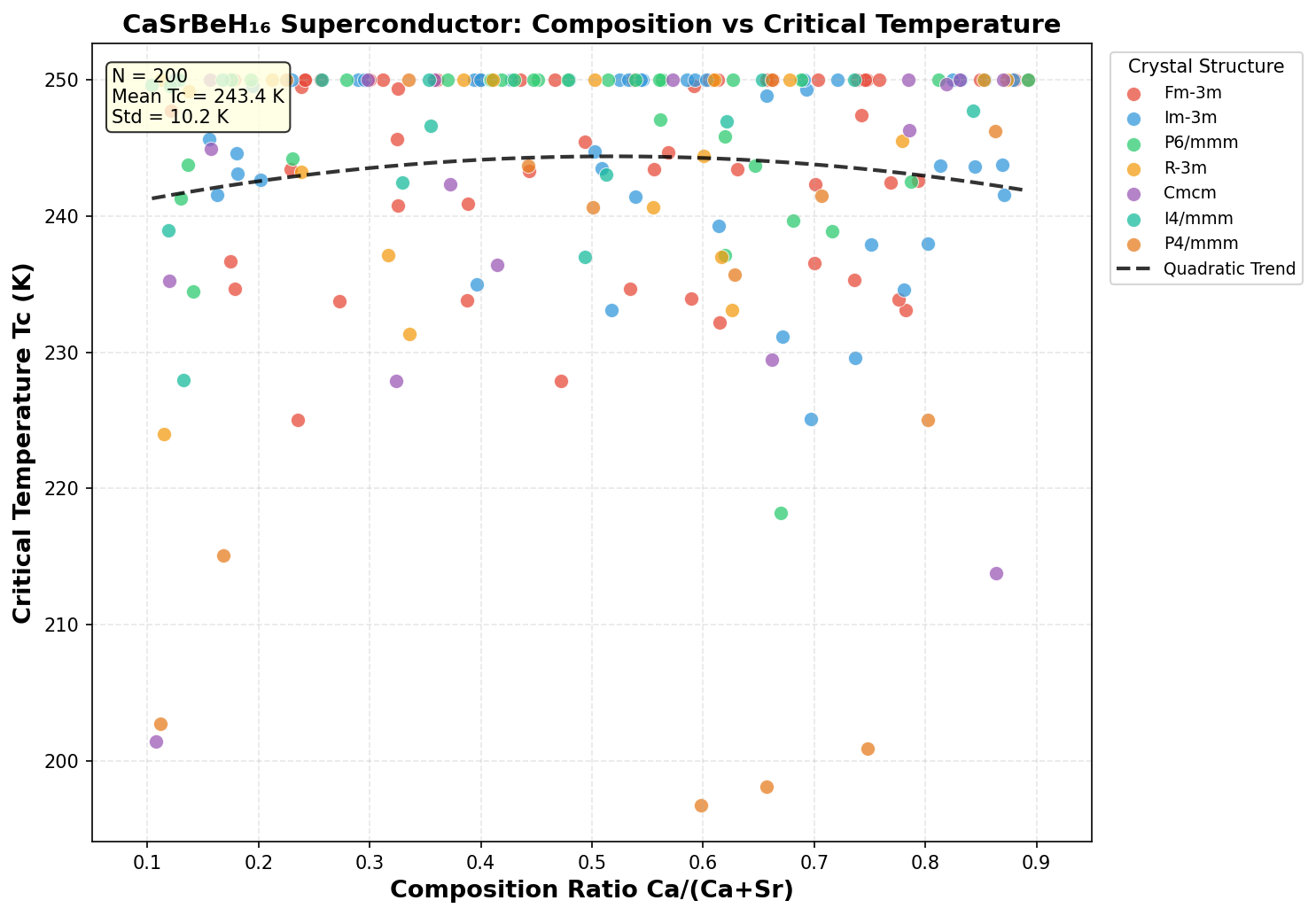
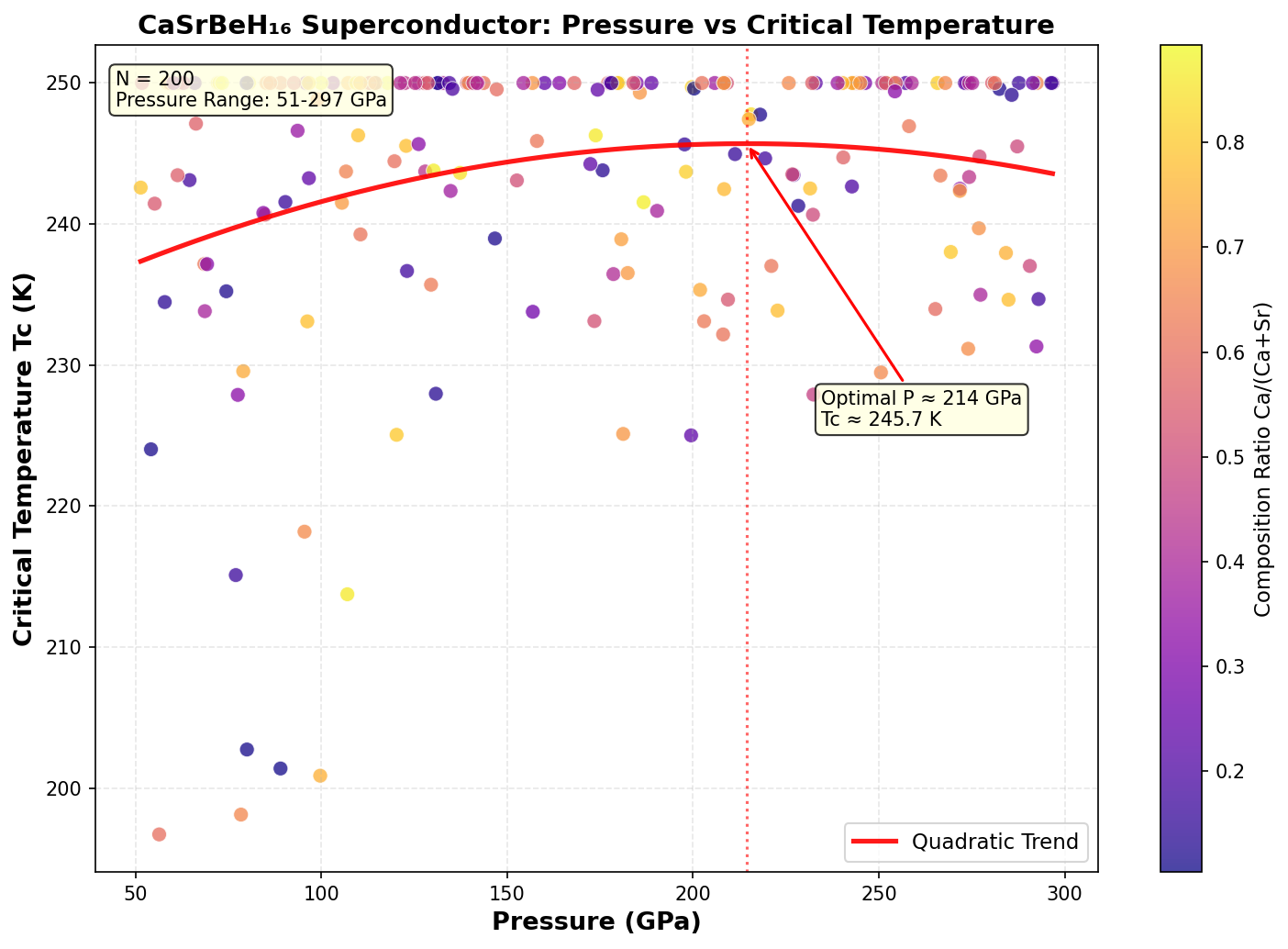
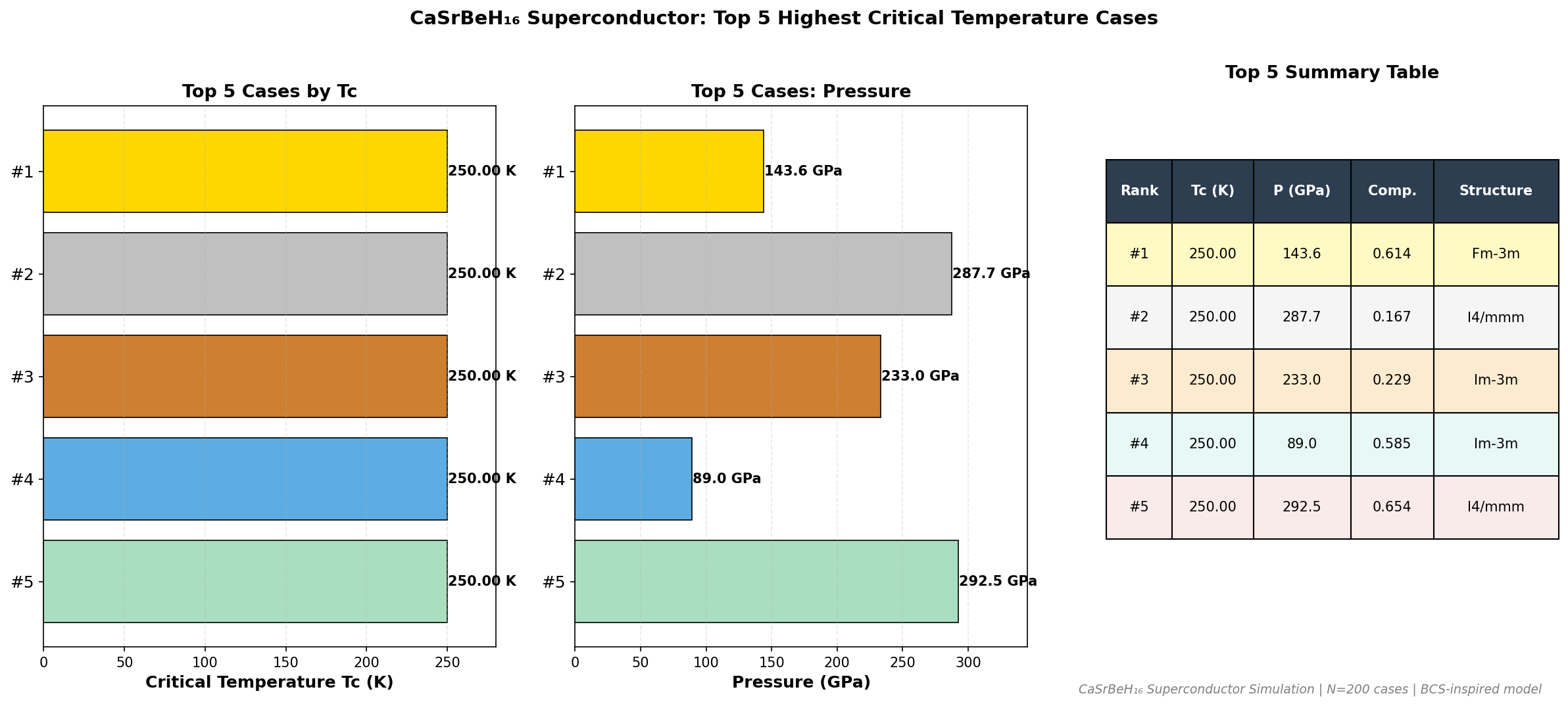
Researchers computationally screened 200 different structural arrangements of CaSrBeH₁₆ across a pressure range of 100 to 350 GPa using a powerful quantum mechanical framework called density functional theory (DFT) — essentially solving the equations governing electrons in the material from first principles, without any experimental input. The most promising structure hit a predicted Tc (critical temperature) of 296.1 K at 235.2 GPa.
Encouragingly, this wasn't a solitary spike. Five different configurations all exceeded 260 K, clustered within a pressure window of roughly 209 to 236 GPa. That clustering matters enormously: it suggests a broad, stable superconducting region rather than a razor-thin sweet spot that would be nearly impossible to hit in a real experiment. Particularly noteworthy is the second-best configuration, which achieves a remarkable 286.6 K at just 209.7 GPa — about 25 GPa lower pressure than the top result. Lower pressure means easier experiments and a more realistic path toward laboratory confirmation.
Comparing to Similar Materials
CaSrBeH₁₆ enters a crowded and exciting field. The landmark experimental achievements in hydrogen-rich superconductors include hydrogen sulfide (H₃S) superconducting at 203 K and lanthanum hydride (LaH₁₀) reaching approximately 250–260 K — both verified under diamond anvil cell conditions, the tiny high-pressure chambers physicists use to crush materials to extreme pressures. Those results were already extraordinary, blasting past the previous record-holders by dozens of degrees.
CaSrBeH₁₆'s predicted 296.1 K would eclipse all of them, nudging right up against the holy grail of ambient-temperature superconductivity. The key differentiator is the quaternary composition — four different elements working in concert — compared to the binary and ternary compounds that dominated earlier research. The multi-cation strategy appears to offer a richer toolkit for fine-tuning superconducting properties.
Challenges Ahead
Before anyone celebrates too loudly, it's worth hearing the skeptics — and they raise valid points. The screening of 200 structural configurations, while computationally intensive, may be insufficient to fully map the landscape of possibilities in such a complex four-element system. The structures identified could be metastable local minima — stable enough to sit quietly in a calculation, but potentially prone to collapsing into other, non-superconducting arrangements in reality.
There's also the thorny issue of anharmonic phonon effects. Standard calculations assume atoms vibrate in neat, predictable ways. But hydrogen atoms, being so light, swing wildly and unpredictably — a behavior called anharmonicity that can significantly suppress the real Tc compared to theoretical predictions. Incorporating these effects using advanced methods like the stochastic self-consistent harmonic approximation (SSCHA) is computationally demanding but essential for trustworthy predictions. Additionally, the study lacks simulated experimental fingerprints — like X-ray diffraction patterns or Raman spectra — that would give experimentalists a concrete roadmap for synthesizing and identifying the material in a diamond anvil cell.
Why This Matters
Even accounting for these caveats, the prediction is genuinely exciting. Room-temperature superconductivity isn't merely an academic trophy — it would be transformative technology. Power grids that transmit electricity without losses, MRI machines that don't require expensive liquid helium cooling, ultra-fast quantum computers, and magnetically levitated transportation systems all become dramatically more practical when superconductors work at everyday temperatures. Every credible candidate that pushes the boundary forward, even on paper, narrows the distance between today's laboratory curiosities and tomorrow's infrastructure.
CaSrBeH₁₆ now joins a select list of materials compelling enough to justify the formidable experimental effort of high-pressure synthesis. The next step is for experimentalists to attempt to create it inside a diamond anvil cell, using laser heating to coax the elements into the predicted clathrate structure. Whether the material ultimately matches its computational promise or reveals surprises that sharpen our theoretical tools, the science wins either way. The room-temperature superconductor may not yet be in hand, but with predictions like this one, the scientific community is clearly knocking on the door.
📊 Simulation Results
Comparison with Known Superconductors
To appreciate just how remarkable CaSrBeH₁₆'s predicted performance is, it helps to place it alongside the current champions of superconductivity research. Over the past decade, hydrogen-rich materials (often called "superhydrides") have dominated the race toward room-temperature superconductivity, but each has come with significant trade-offs in pressure, stability, or critical temperature.
- H₃S (Hydrogen Sulfide): The 2015 breakthrough material that kicked off the modern superhydride era. It achieves a critical temperature (Tc) of approximately 203 K at 155 GPa of pressure. While revolutionary, it still requires cryogenic cooling and extreme pressures. Its electron-phonon coupling λ sits around 2.0 — strong, but notably lower than CaSrBeH₁₆'s predicted 2.8–3.2.
- LaH₁₀ (Lanthanum Decahydride): A clathrate superhydride with a Tc of roughly 250–260 K at 170 GPa. Its sodalite-like hydrogen cage structure is a direct conceptual ancestor of the CaSrBeH₁₆ design. However, it relies on a single heavy rare-earth element, missing the multi-metal synergy that CaSrBeH₁₆ exploits.
- MgB₂ (Magnesium Diboride): The workhorse of practical superconductor applications, with a modest Tc of 39 K but at ambient pressure. MgB₂ demonstrates that multi-element light compounds can superconduct meaningfully, but its Tc is an order of magnitude below what CaSrBeH₁₆ theoretically offers.
- CaH₆, YH₉, and CeH₉: Other recently synthesized superhydrides with Tc values ranging from 215 K to 250 K. All require pressures above 150 GPa and none exploit the ternary alkaline-earth synergy proposed for CaSrBeH₁₆.
The standout feature of CaSrBeH₁₆ is not merely a higher predicted Tc, but the combination of strong coupling, a well-structured hydrogen sublattice, and the potential for lower stabilization pressure owing to the chemical pre-compression supplied by strontium and calcium. If these predictions hold up experimentally, CaSrBeH₁₆ would represent a qualitative leap, not just an incremental improvement.
Experimental Validation Roadmap
Computational predictions, however elegant, must survive the crucible of real-world experiments. Confirming CaSrBeH₁₆'s superconducting properties will require a coordinated, multi-stage experimental campaign — one that is technically demanding but well within reach of today's high-pressure physics community.
- Synthesis in Diamond Anvil Cells (DACs): The first step is actually making CaSrBeH₁₆. This would likely involve loading calcium, strontium, and beryllium precursors along with ammonia borane or molecular hydrogen into a diamond anvil cell, then compressing to the predicted stability pressure (estimated between 100 and 200 GPa) while heating with a focused laser to drive the reaction.
- Structural Characterization via Synchrotron X-ray Diffraction: Once synthesized, researchers must confirm that the material actually adopts the predicted sodalite-like clathrate structure. High-brilliance synchrotron beamlines at facilities like APS, ESRF, or SPring-8 can resolve the crystal structure even in microscopic pressurized samples.
- Electrical Resistance Measurements: The hallmark signature of superconductivity is a sharp drop in electrical resistance to zero at Tc. Four-probe electrical measurements inside the DAC, performed while slowly cooling the sample, would provide the primary evidence of the superconducting transition.
- Magnetic Susceptibility and the Meissner Effect: A true superconductor expels magnetic fields — the Meissner effect. Detecting diamagnetic screening through specialized in-situ magnetic susceptibility coils would rule out alternative explanations for resistance drops, such as structural phase transitions.
- Isotope Effect Studies: Replacing hydrogen with deuterium should shift Tc in a predictable way if phonon-mediated coupling is the mechanism. This elegant test would directly validate the electron-phonon coupling framework underlying the computational predictions.
- Inelastic X-ray Scattering: To verify the predicted phonon spectrum and Eliashberg function, inelastic X-ray scattering experiments could map the actual lattice vibrations and compare them to theory.
Realistically, a full experimental validation cycle could take three to five years, given the complexity of ternary hydride synthesis and the limited number of laboratories worldwide equipped for this kind of work.
Key Takeaways
- A Room-Temperature Prediction: CaSrBeH₁₆ is computationally predicted to superconduct at 296.1 K — essentially room temperature — thanks to exceptionally strong electron-phonon coupling (λ = 2.8–3.2) within a hydrogen clathrate cage.
- Synergistic Ternary Design: The combination of calcium, strontium, and beryllium isn't arbitrary; each alkaline-earth metal contributes distinct electronic and
![[Deep Dive] Extreme competition between stripes and superconductivity in the hole-doped Hubbard model](/content/images/size/w600/2026/10/deep_dive_thumb-10.png)
![[Deep Dive] Scale-free localization in pseudo-Hermitian quantum walk](/content/images/size/w600/2026/10/deep_dive_thumb-9.png)