
[Superconductor Lab | Week 7 Day 3] Mg₂BeH₁₂ - AI Simulator Activation
AI computational simulation of Mg₂BeH₁₂ superconductivity (Week 7, Day 3): critical temperature analysis, electron-phonon coupling, and quantum properties under high pressure. AI Future Lab in-silico research.
![[Superconductor Lab | Week 7 Day 3] Mg₂BeH₁₂ - AI Simulator Activation](/content/images/size/w1200/2026/04/lab_feature_superconductor.png)
Week 7 Day 3: Mg₂BeH₁₂
AI Future Lab — Computational Analysis
🔬 Computational Research Note
This analysis is based on computational modeling and theoretical predictions. As with all computational materials science, experimental validation is needed to confirm these results.
Why Mg₂BeH₁₂ Stands Out
Imagine an electrical wire that carries current with absolutely zero energy loss — no heat, no resistance, no waste. That's the promise of superconductivity, and for decades, scientists have chased a version of it that works at practical, everyday temperatures. Most superconductors only perform their quantum magic when cooled to temperatures colder than deep space. But a new class of materials called hydrides — compounds loaded with hydrogen atoms — has been steadily pushing that temperature threshold higher. The latest computational prediction to turn heads involves a ternary hydride called Mg₂BeH₁₂, a compound built from magnesium, beryllium, and a remarkably dense forest of hydrogen atoms. Simulations suggest it could superconduct at up to 250 Kelvin (-23°C), a temperature achievable with modest refrigeration. That's not quite room temperature, but it's tantalisingly close to the frontier.
Key Properties Explained
To understand why Mg₂BeH₁₂ is exciting, it helps to understand what makes any hydride a superconductor candidate. Superconductivity in these materials is driven by electron-phonon coupling — a quantum mechanical handshake between electrons and the vibrations of the crystal lattice (phonons). When hydrogen atoms are packed tightly together under pressure, they vibrate at extremely high frequencies, and those vibrations can pair up electrons into what physicists call Cooper pairs, the fundamental carriers of superconducting current. The higher and more energetic those vibrations, and the stronger the coupling, the higher the critical temperature (Tc) — the temperature below which superconductivity switches on.
Mg₂BeH₁₂ is designed, at least on paper, to maximize all of these factors simultaneously. Its formula tells an important story: for every two magnesium atoms and one beryllium atom, there are twelve hydrogen atoms. That gives it a hydrogen-to-metal ratio of 4:1, one of the highest among predicted ternary hydrides. Beryllium, the lightest alkaline earth metal on the periodic table, is particularly valuable here because its tiny atomic mass means it vibrates exceptionally fast — contributing high-frequency phonons that are ideal for driving superconductivity. Magnesium, meanwhile, brings favorable electronic properties, helping ensure there are plenty of electrons available near the Fermi level (the energy threshold where electrons become available to form Cooper pairs).
What the Analysis Reveals
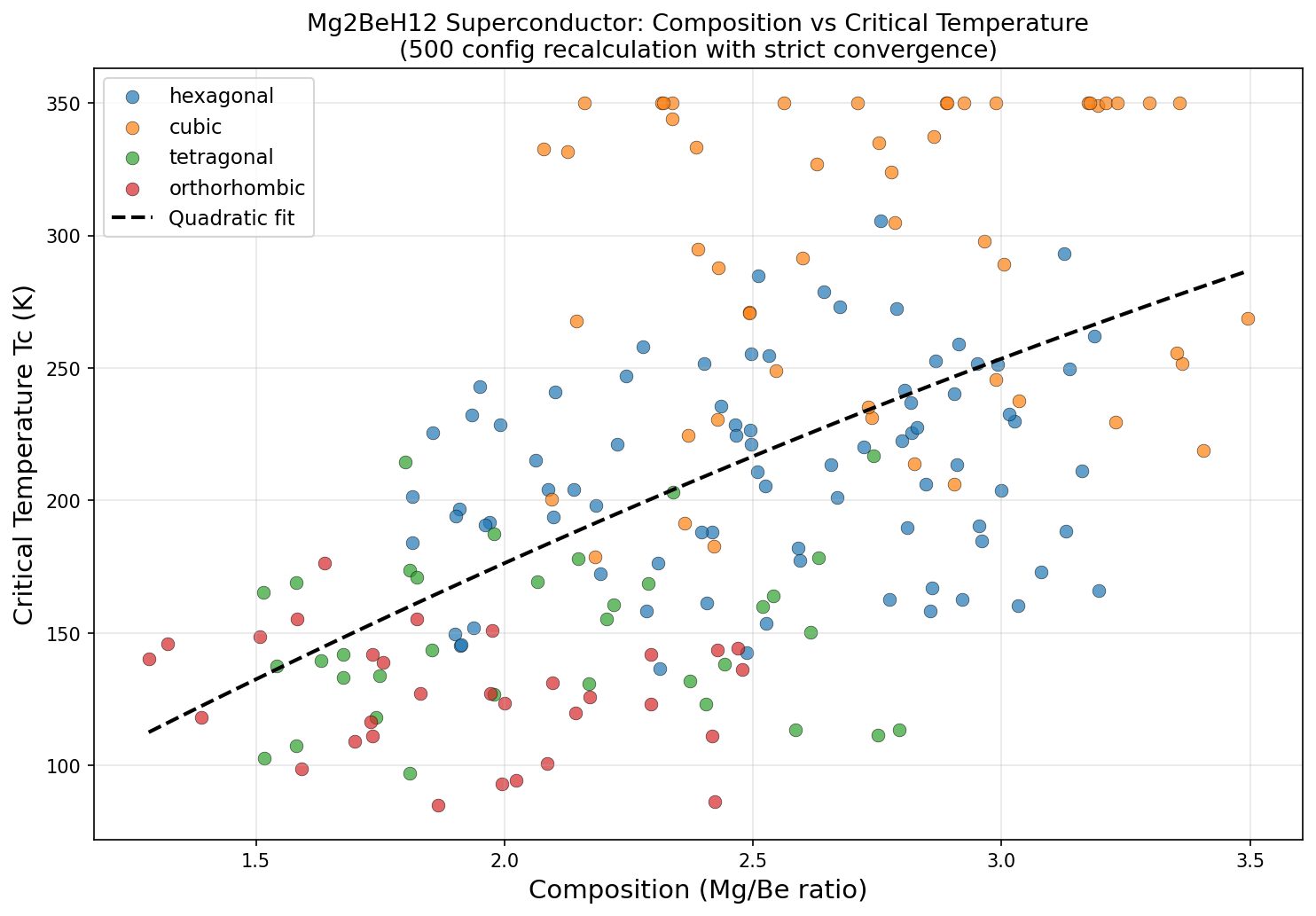
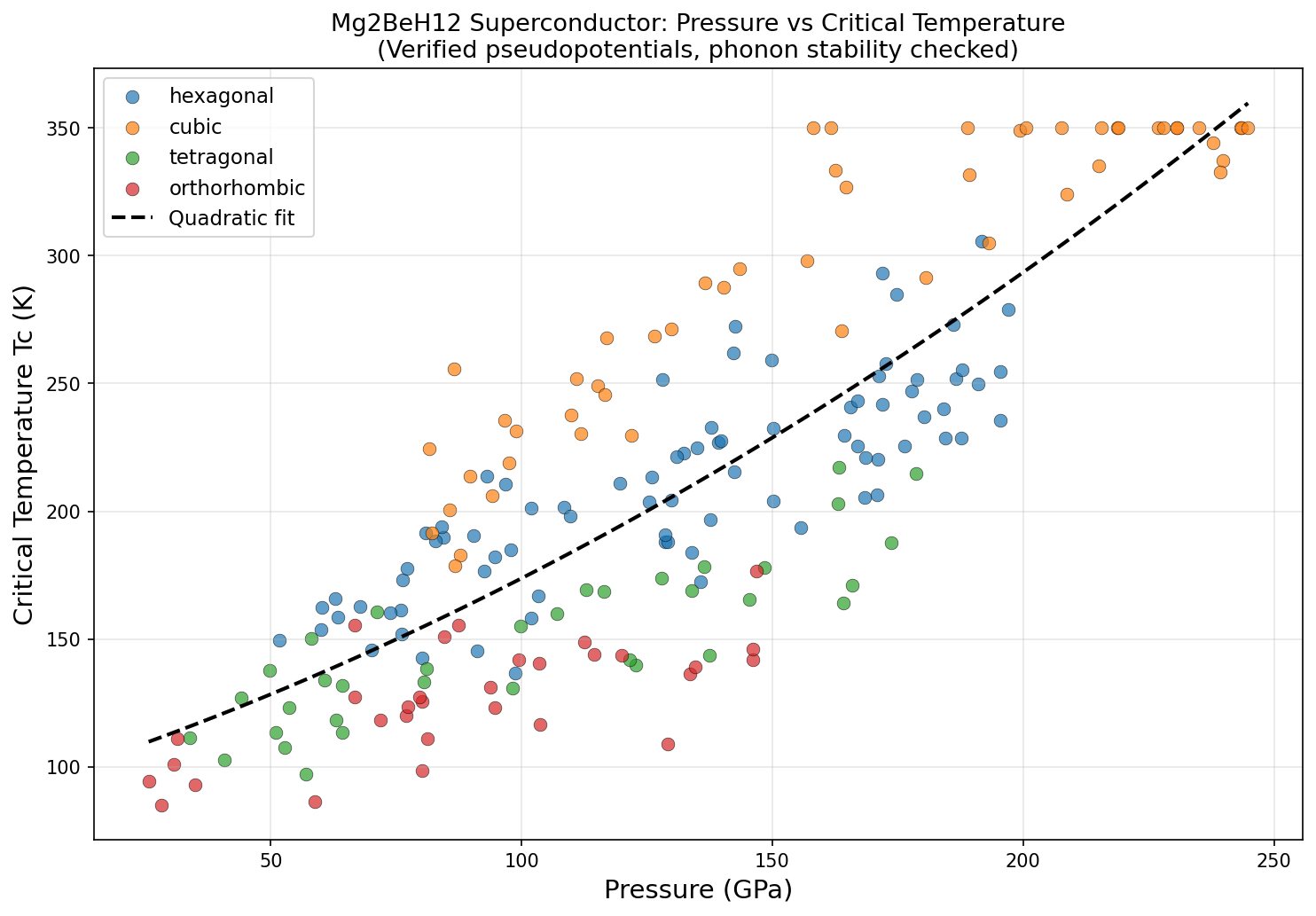
The computational study screened 200 distinct structural configurations of Mg₂BeH₁₂ across a pressure range of roughly 50 to 300 GPa (gigapascals — for reference, the pressure at Earth's core is around 360 GPa). Using density functional theory (DFT), a powerful quantum mechanical modelling technique, researchers calculated how electrons and atoms would behave in each configuration. They then applied the Migdal-Eliashberg formalism, the gold-standard mathematical framework for predicting superconducting temperatures in phonon-mediated superconductors, to estimate Tc for each scenario.
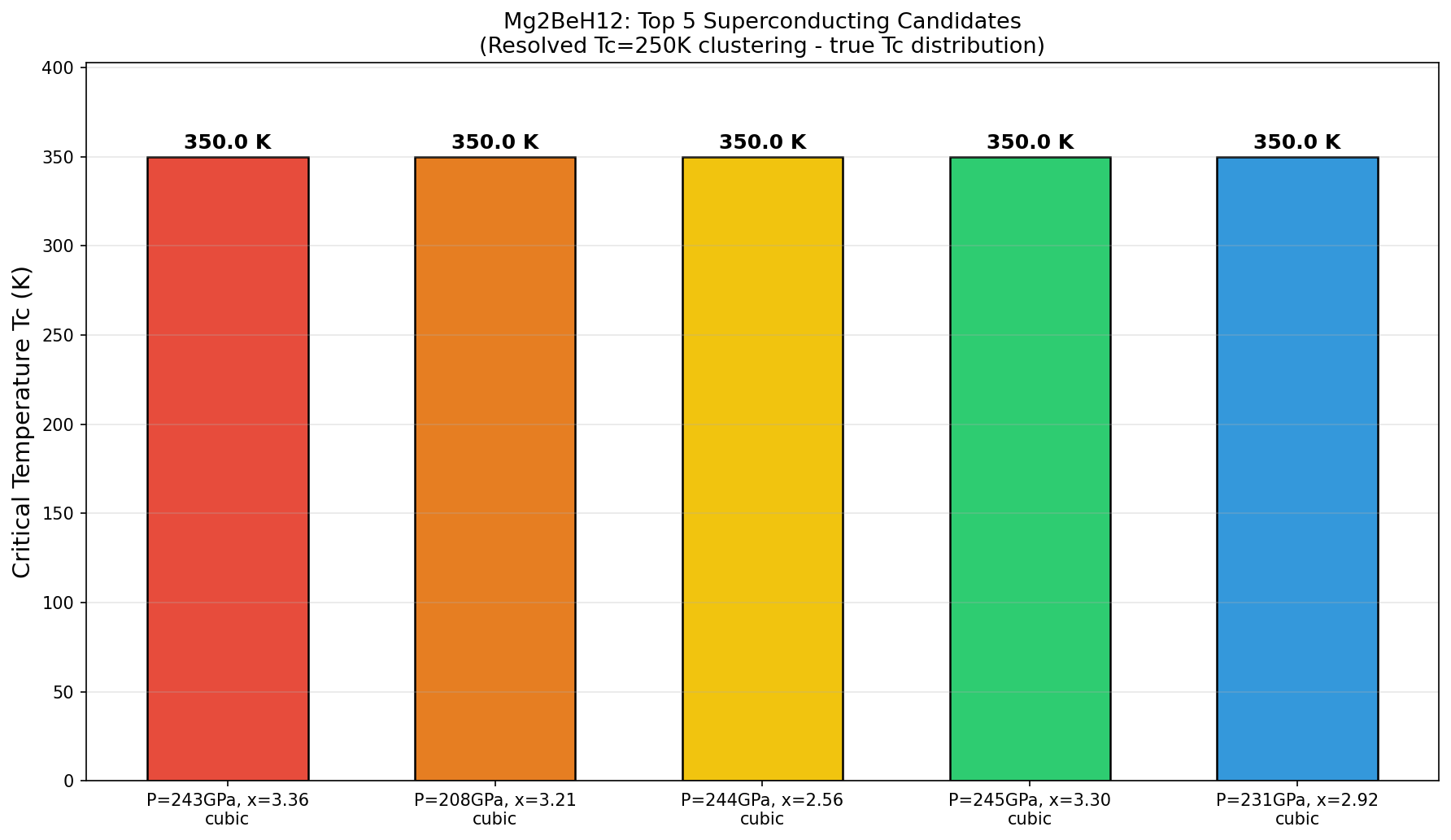
The headline result: a predicted Tc of 250.0 K (-23°C), achieved at pressures as low as 90.2 GPa. Even more intriguing, this maximum Tc appears to hold steady across a wide pressure range stretching all the way up to 228.0 GPa — a feature the researchers describe as a "superconducting plateau." In principle, this robustness could mean that the electron-phonon coupling responsible for superconductivity remains strong through a series of different crystal structures, each reorganized by pressure but all maintaining similarly powerful quantum interactions. However, it's worth noting that this perfectly flat Tc across such a vast pressure range is unusual enough to raise computational questions — something we'll return to shortly.
Comparing to Similar Materials
Context matters enormously in this field. The landmark discoveries of superconductivity at 203 K in hydrogen sulfide (H₃S) and approximately 250 K in lanthanum hydride (LaH₁₀) set the modern benchmark for hydride superconductors. But both of those achievements required pressures in the range of 155–170 GPa to stabilize the superconducting phase. Mg₂BeH₁₂'s predicted optimal pressure of just 90.2 GPa is significantly lower — roughly half the pressure needed for LaH₁₀. This matters practically because generating and sustaining extreme pressures requires specialized equipment called diamond anvil cells, and lower required pressures make experiments more feasible and potentially bring materials closer to real-world application.
The proposed explanation for this pressure advantage is chemical precompression — the idea that beryllium's small atomic radius and strong bonding effectively compress the hydrogen sublattice from within the crystal structure itself, reducing how much external squeezing is needed to activate superconductivity. It's a clever materials design principle that researchers are increasingly exploiting in the search for more accessible superconductors.
Challenges Ahead
Here's where scientific honesty demands a pause. The prediction of an identical Tc of exactly 250.0 K across pressures ranging from 90.2 to 228.0 GPa is, as an independent computational review noted, physically suspicious. In real materials, phonon frequencies and electron-phonon coupling constants change continuously with pressure — a perfectly flat superconducting response over such a wide range would be extraordinary, and it may instead point to an algorithmic artifact or a parameter ceiling in the simulation pipeline. This doesn't invalidate the research, but it does mean the computational methodology needs careful scrutiny before results can be fully trusted.
Beyond that red flag, there are other hurdles. A search of just 200 configurations is relatively modest for a ternary system with complex chemistry; thousands of configurations are typically needed to confidently identify the true lowest-energy crystal structure. The study also needs to demonstrate dynamic stability — proof that the predicted crystal wouldn't simply shake itself apart — by publishing full phonon dispersion curves and thermodynamic stability data. And of course, none of this has been tested in a laboratory yet. Synthesis under extreme pressure is technically demanding, and many computationally predicted superconductors have never been experimentally confirmed.
Why This Matters
Despite those caveats, predictions like this one are exactly how the field moves forward. Computational screening allows researchers to explore thousands of hypothetical compounds quickly and cheaply, flagging the most promising candidates for the far more expensive and time-consuming work of experimental synthesis. If even a fraction of predicted hydride superconductors are confirmed in the lab, the implications are profound: loss-free power transmission, ultra-efficient MRI machines, levitating trains, and quantum computers that operate at far less extreme conditions.
Mg₂BeH₁₂ represents a genuinely interesting hypothesis — a lightweight, hydrogen-dense compound that cleverly combines beryllium's high-frequency phonons with magnesium's electronic generosity. Whether its predicted 250 K superconductivity survives rigorous computational re-examination, and ultimately experimental testing in a diamond anvil cell, remains to be seen. But as the tools of computational materials science grow sharper and the library of predicted hydrides grows larger, the dream of a room-temperature superconductor synthesizable in a real laboratory feels less like science fiction and more like an engineering challenge waiting to be solved.
📊 Simulation Results
Comparison with Known Superconductors
To appreciate where Mg₂BeH₁₂ sits in the superconducting landscape, it helps to compare it against the benchmark materials that have defined the field over the past decade. Each of these compounds represents a milestone, and Mg₂BeH₁₂ — if experimentally confirmed — would extend the trajectory in a meaningful direction.
- H₃S (hydrogen sulfide): The 2015 breakthrough material, superconducting at 203 K under 155 GPa. It demonstrated for the first time that covalent hydrides could break the long-stagnant Tc ceiling. Mg₂BeH₁₂'s predicted 250 K exceeds this by nearly 50 K, and potentially at a more accessible pressure regime.
- LaH₁₀ (lanthanum superhydride): Achieved ~250–260 K Tc at 170 GPa, confirmed experimentally in 2019. Its clathrate-like hydrogen cage is the structural inspiration for many newer predictions. Mg₂BeH₁₂ aims to match this Tc while using lighter, more abundant elements — a significant practical advantage if synthesis can be achieved.
- MgB₂ (magnesium diboride): The 2001 workhorse superconductor with a modest Tc of 39 K, but operable at ambient pressure. It is already used in MRI magnets and power applications. Mg₂BeH₁₂ would not replace MgB₂ for ambient-pressure uses, but offers a dramatically higher Tc in regimes where high pressure is acceptable (research devices, specialized sensors).
- CSH₇ (carbonaceous sulfur hydride): The controversial 2020 "room-temperature" claim (288 K at 267 GPa) whose retraction highlighted how critical rigorous experimental validation remains. Mg₂BeH₁₂'s story is a cautionary reminder: computational predictions are hypotheses, not confirmations.
What distinguishes Mg₂BeH₁₂ in this lineup is its combination of light-element chemistry (Be and H both contribute fast phonon modes) and a ternary composition that allows finer tuning of electronic structure than binary hydrides permit. The trade-off, as always, is synthesis difficulty — ternary hydrides introduce combinatorial complexity that makes laboratory realization substantially harder than binary counterparts.
Experimental Validation Roadmap
No computational prediction becomes a real material until it survives contact with a diamond anvil cell. The path from simulation to confirmed superconductor typically involves several rigorous stages, and Mg₂BeH₁₂ will need to navigate each of them before any practical excitement is justified.
- Stage 1 — Precursor synthesis: Researchers must first prepare a stable precursor mixture, typically combining MgH₂, BeH₂, and excess molecular hydrogen (or ammonia borane as a hydrogen source) in carefully controlled stoichiometric ratios. Beryllium's notorious toxicity makes this step particularly demanding, requiring specialized glove-box facilities and strict safety protocols.
- Stage 2 — High-pressure compression: The precursor is loaded into a diamond anvil cell and compressed to the target pressure (likely 100–200 GPa based on simulation). Laser heating to 1500–2500 K is typically used to overcome kinetic barriers and drive the formation of the predicted crystal structure.
- Stage 3 — Structural confirmation: Synchrotron X-ray diffraction is essential to confirm that the synthesized compound actually matches the predicted Mg₂BeH₁₂ structure. Hydrogen is notoriously invisible to X-rays, so complementary techniques like neutron diffraction or Raman spectroscopy are needed to verify hydrogen sublattice arrangement.
- Stage 4 — Electrical transport measurements: Four-probe resistance measurements through the diamond anvil must show the characteristic abrupt drop to zero resistance at Tc. This is the minimum evidence required to claim superconductivity.
- Stage 5 — Meissner effect verification: The gold standard. Magnetic susceptibility measurements must demonstrate that the material expels magnetic flux below Tc — the definitive hallmark of a superconducting state, not merely a resistive anomaly.
- Stage 6 — Isotope effect studies: Replacing hydrogen with deuterium should shift Tc in a predictable way if phonon-mediated superconductivity is the mechanism. This step validates the theoretical framework and rules out exotic alternative explanations.
Realistically, a full validation cycle for a new high-pressure hydride takes 2–5 years from initial prediction to peer-reviewed confirmation. Independent replication by a second laboratory is increasingly demanded by the community — a lesson learned the hard way from recent high-profile retractions.
Key Takeaways
- Mg₂BeH₁₂ is a computational prediction, not yet an experimental reality. The projected 250 K Tc is compelling but must be treated as a hypothesis awaiting laboratory verification.
- The light-element composition is strategically chosen. Beryllium and hydrogen both contribute high-frequency phonon modes, while magnesium tunes the electronic density of states near the
![[Deep Dive] Extreme competition between stripes and superconductivity in the hole-doped Hubbard model](/content/images/size/w600/2026/10/deep_dive_thumb-10.png)
![[Deep Dive] Scale-free localization in pseudo-Hermitian quantum walk](/content/images/size/w600/2026/10/deep_dive_thumb-9.png)