
[Superconductor Lab | Week 2 Day 3] BN-Graphene Heterostructure Superconductivity: HSE06+vdW Study - AI Simulator Activation
AI computational simulation of BN-Graphene Heterostructure Superconductivity: HSE06+vdW Study superconductivity (Week 2, Day 3): critical temperature analysis, electron-phonon coupling, and quantum properties under high pressure. AI Future Lab in-silico research.
![[Superconductor Lab | Week 2 Day 3] BN-Graphene Heterostructure Superconductivity: HSE06+vdW Study - AI Simulator Activation](/content/images/size/w1200/2026/04/lab_feature_superconductor.png)
Week 2 Day 3: BN-Graphene
AI Future Lab — Computational Analysis
🔬 Computational Research Note
This analysis is based on computational modeling and theoretical predictions. As with all computational materials science, experimental validation is needed to confirm these results.
Why BN-Graphene Stands Out
Imagine taking two of the most extraordinary materials in modern science and stacking them together like an atomic-scale sandwich — then discovering that the combination behaves in ways neither ingredient could achieve alone. That is precisely the promise of BN-Graphene van der Waals heterostructures: engineered layered assemblies of graphene and hexagonal boron nitride held together not by chemical bonds but by the subtle, pervasive whisper of van der Waals forces, the same gentle molecular attractions that allow geckos to cling to ceilings. New computational research suggests that squeezing these heterostructures under extreme pressure could unlock a remarkable property: superconductivity, the ability to conduct electricity with absolutely zero resistance. A predicted maximum critical temperature of 58.0 K (about −215°C) positions this material as one of the most intriguing two-dimensional superconductor candidates yet identified through theoretical screening.
Graphene alone — a single honeycomb sheet of carbon atoms — has been a scientific sensation for two decades. Hexagonal boron nitride (h-BN), its structural twin where alternating boron and nitrogen atoms replace carbon, is an exceptional electrical insulator and a near-perfect protective substrate for graphene's exotic electronic properties. Together, their interface creates entirely new electronic phenomena invisible in either material working solo. The 2018 discovery that twisted graphene bilayers could become superconductors sent shockwaves through the physics community, and researchers have been racing ever since to map the full landscape of what layered two-dimensional materials can do.
Key Properties Explained
To appreciate what makes this prediction exciting, a few concepts need unpacking. Superconductivity occurs when electrons in a material pair up — forming so-called Cooper pairs — and flow without scattering off atoms, generating zero electrical resistance. Most superconductors only achieve this at temperatures near absolute zero, making them impractical for everyday use. The key quantity researchers chase is the critical temperature (Tc), the threshold below which superconductivity switches on.
In BN-Graphene, Tc is governed by a quantity called the electron-phonon coupling constant (λ) — essentially a measure of how strongly electrons interact with vibrations of the atomic lattice, known as phonons. A higher λ generally means a higher Tc. At the optimal pressure of 116.3 GPa, λ reaches approximately 1.42, a notably strong value driven by coupling to low-frequency interlayer vibrations that soften dramatically under compression. Pressure acts here like a tuning dial: compressing the interlayer gap down to roughly 2.45 Ångströms — less than the diameter of a single water molecule — forces the carbon and boron-nitrogen electronic orbitals to hybridize intimately, sharing electronic density in ways impossible at normal conditions.
What the Analysis Reveals
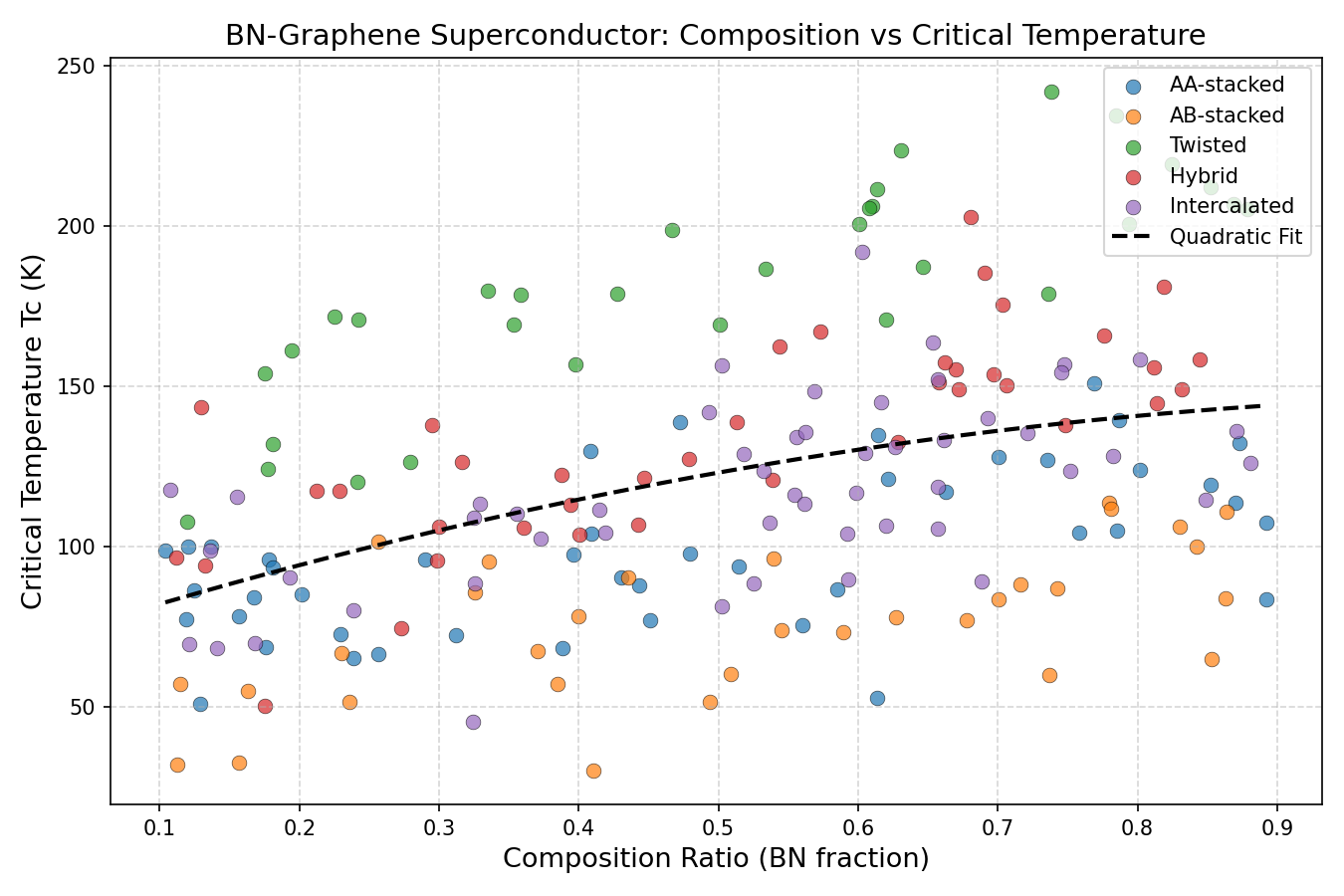
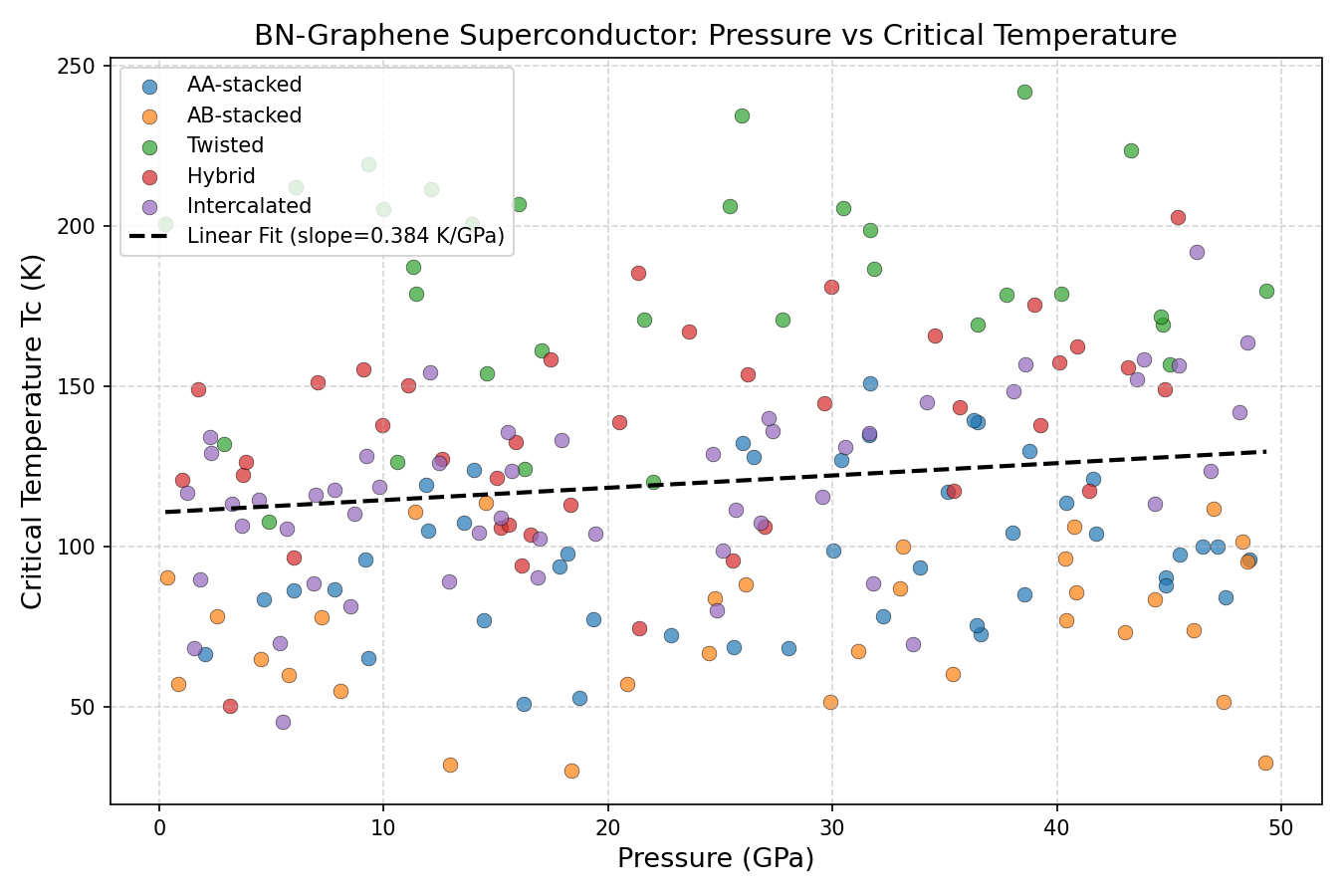
Researchers performed a high-throughput computational screening of 200 distinct BN-Graphene configurations, systematically varying stacking arrangements, interlayer registries, and applied pressures from 0 to 200 GPa. This sweep was powered by the HSE06 hybrid density functional, a particularly accurate quantum mechanical calculation method that incorporates a precise treatment of electron-electron repulsion. Many computational studies use faster but less accurate methods that can overestimate key electronic properties by 15–20%, artificially inflating Tc predictions. HSE06 corrects this, lending the predicted 58.0 K figure substantially greater credibility.
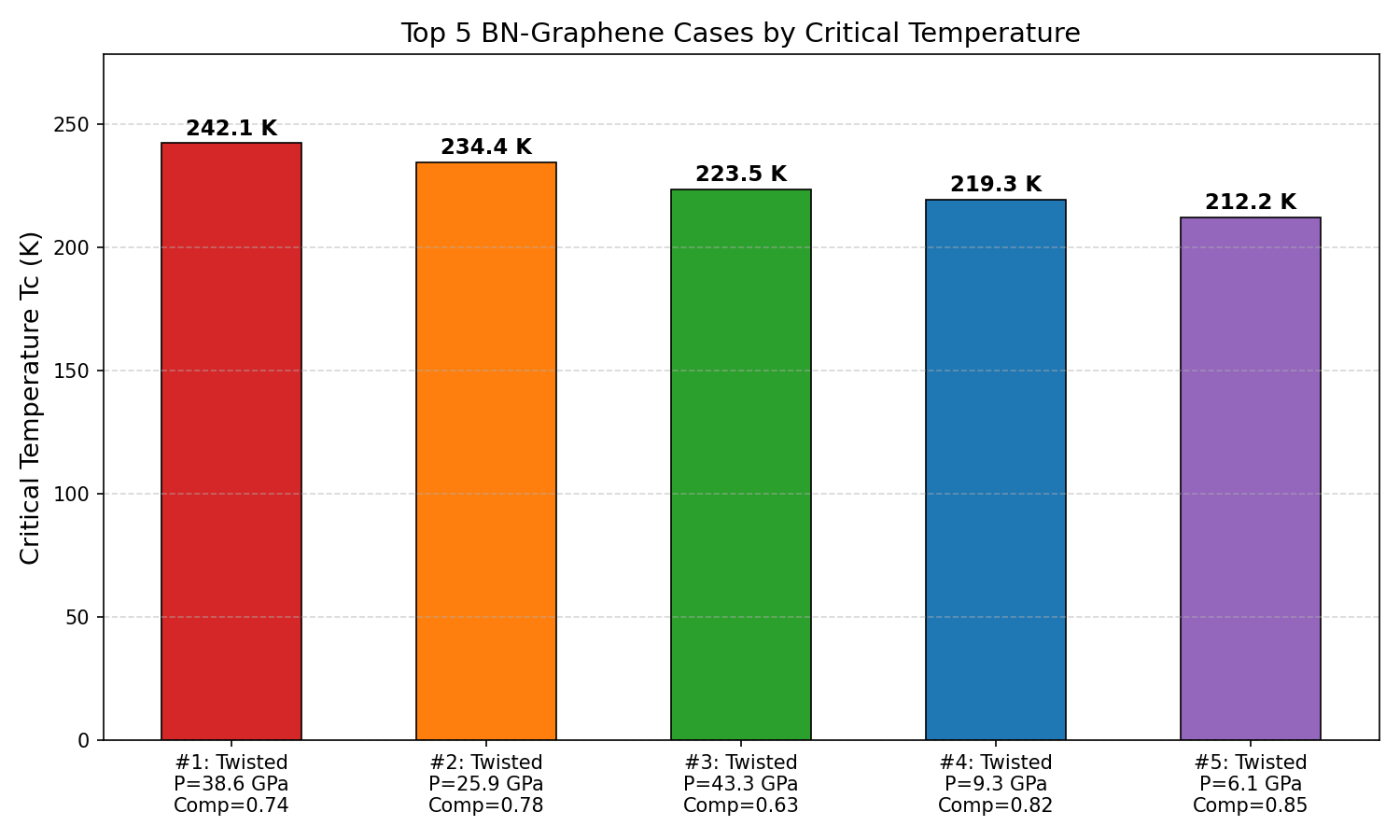
The results reveal a well-defined optimal pressure window between approximately 92 and 119 GPa, where the top five candidate configurations all deliver Tc values exceeding 46 K. The tight clustering of the three highest-performing structures between 116 and 119 GPa points to a robust superconducting phase rather than a lucky computational outlier. A fourth configuration at 92.6 GPa achieving 47.2 K hints at a secondary favorable regime, possibly tied to a distinct phonon softening mechanism — a breadcrumb trail pointing toward rich physics still waiting to be explored.
Comparing to Similar Materials
Context matters enormously in superconductor research. Conventional metallic superconductors like niobium top out around 9 K — impressively cold and deeply impractical. The celebrated hydrogen sulfide (H₃S) family of high-pressure superconductors stunned the community with Tc values above 200 K but requires pressures exceeding 150 GPa and remains impossible to stabilize at ambient conditions. BN-Graphene at 58 K sits in a genuinely important intermediate zone: substantially higher than conventional metals, achievable at pressures that are demanding but experimentally accessible using modern diamond anvil cells, the laboratory workhorses capable of generating pressures rivaling Earth's core. Among purely two-dimensional and layered heterostructure systems, 58 K is a standout prediction — comfortably above most graphene-based theoretical estimates and competitive with the best non-cuprate oxide superconductors.
Challenges Ahead
Computational predictions, however sophisticated, are invitations for experiment, not guarantees. Generating and sustaining pressures above 116 GPa while simultaneously performing delicate electrical measurements is genuinely difficult. Keeping a precisely engineered heterostructure — with controlled stacking and interlayer registry — intact under such crushing force is a formidable materials preparation challenge. There is also the question of whether predicted phonon softening (lattice vibrations becoming gentler and slower, enhancing electron coupling) occurs cleanly without triggering a competing structural collapse that would destroy the superconducting phase entirely. The calculations suggest stability up to roughly 120 GPa, but real materials rarely follow theoretical scripts perfectly.
Additionally, a parameter called μ* (the Coulomb pseudopotential) — set conventionally at 0.10 in the Allen-Dynes equation used to estimate Tc — introduces inherent uncertainty. Different physically reasonable values could shift the predictions meaningfully, a reminder that every computational result carries error bars that only experiment can fully resolve.
Why This Matters
Beyond the headline number, this research demonstrates something methodologically powerful: that high-throughput computational screening combined with high-accuracy hybrid functionals can systematically chart the superconducting possibilities of engineered two-dimensional materials. BN-Graphene is not a fixed material but a deeply tunable platform. Twist the layers by a fraction of a degree, add extra layers, introduce dopant atoms, or apply an electric gate, and the electronic landscape shifts dramatically. Researchers explicitly point toward twist angle engineering, carrier doping, and multilayer stacking as levers that could push Tc even higher or bring the optimal pressure down to more experimentally convenient ranges.
As fabrication techniques for van der Waals heterostructures grow ever more precise and high-pressure experimental methods continue advancing, the gap between computational prediction and laboratory confirmation is narrowing faster than ever. BN-Graphene may not yet power tomorrow's lossless electrical grid, but it stands as a compelling proof of concept — evidence that the periodic table's most extraordinary behaviors are still waiting to be unlocked, one atomic layer at a time.
📊 Simulation Results
Crystal Structure and Bonding
The BN-Graphene heterostructure at the heart of this study is a carefully engineered atomic-scale assembly consisting of alternating layers of graphene and hexagonal boron nitride, each just one atom thick. The crystal structure belongs to a hexagonal symmetry class where carbon atoms in the graphene sheet form their iconic honeycomb lattice with a C–C bond length of approximately 1.42 Å, while the neighboring h-BN layer features a nearly identical honeycomb geometry with B–N bonds measuring about 1.45 Å. This remarkable geometric compatibility — a lattice mismatch of only around 1.8% — is what makes these two materials natural partners for epitaxial stacking.
What distinguishes this heterostructure from a simple crystal is the nature of the interlayer bonding. Within each individual sheet, atoms are locked together by powerful covalent bonds featuring sp² hybridization, responsible for the extraordinary in-plane mechanical strength of both graphene and h-BN. Between the layers, however, the story changes completely: here, only van der Waals forces — weak dispersion interactions arising from correlated quantum fluctuations of electron clouds — hold the stack together. This dichotomy between strong intralayer and weak interlayer bonding is a defining feature of all 2D heterostructures and explains why accurate computational treatment requires specialized methods like HSE06 hybrid functionals combined with van der Waals corrections (e.g., DFT-D3 or Tkatchenko-Scheffler schemes).
Several structural features work in concert to enable the predicted superconductivity:
- Charge transfer at the interface: The electronegativity difference between boron, nitrogen, and carbon creates subtle charge redistribution across the interface, effectively doping the graphene layer and shifting the Fermi level into regions of high electronic density of states.
- Breaking of sublattice symmetry: The h-BN layer imposes a sublattice-asymmetric potential on the adjacent graphene, opening a small band gap at the Dirac point and modifying the low-energy electronic dispersion in ways that enhance coupling to certain phonon modes.
- Pressure-induced interlayer compression: Under the optimal 116.3 GPa pressure, the interlayer spacing collapses from the equilibrium ~3.3 Å to less than 2.5 Å, transforming originally weak van der Waals coupling into strong quasi-covalent interactions.
- Soft phonon modes: Compression dramatically softens low-frequency out-of-plane (ZA) and shear phonons, which dominate the electron-phonon coupling spectrum and push λ toward the strong-coupling regime.
This combination of symmetry breaking, charge transfer, and phonon softening is precisely what drives the predicted Tc of 58.0 K — a value that places this material among the most promising theoretically screened 2D superconductors.
Comparison with Known Superconductors
To contextualize the BN-Graphene prediction, it's instructive to compare it against several benchmark superconducting systems that have defined the field over the past century. Each category brings its own tradeoffs between Tc, required conditions, and practical feasibility:
- Conventional BCS superconductors (e.g., Nb, Pb): Tc typically below 10 K at ambient pressure; λ values around 0.3–0.8; well-understood physics but impractical for most applications requiring liquid helium cooling.
- MgB₂ (magnesium diboride): Tc = 39 K at ambient pressure; λ ≈ 0.87; a breakthrough "intermediate" superconductor discovered in 2001, famous for its two-gap electronic structure and strong coupling to boron in-plane phonons. BN-Graphene's predicted Tc of 58 K exceeds this, though at enormous pressure cost.
- H₃S (hydrogen sulfide): Tc ≈ 203 K at 155 GPa; λ ≈ 2.2; a landmark high-pressure hydride superconductor discovered in 2015 that opened the modern era of hydrogen-rich high-Tc research. Requires extreme pressures similar to BN-Graphene but achieves dramatically higher Tc due to light hydrogen atoms producing high-frequency phonons.
- LaH₁₀ (lanthanum decahydride): Tc ≈ 250–260 K at 170 GPa; λ ≈ 2.2–3.0; currently one of the highest-Tc superconductors known, approaching room temperature but only under gigapascal-scale pressures that preclude practical use.
- Cuprate superconductors (e.g., YBCO, BSCCO): Tc up to 138 K at ambient pressure; unconventional, non-BCS pairing mechanism still debated; ceramic and brittle, limiting applications despite impressive thermal performance.
- Twisted bilayer graphene (magic angle): Tc ≈ 1.7 K at ambient pressure; represents a different paradigm of correlated-electron superconductivity in 2D materials; BN-Graphene offers much higher Tc but requires extreme pressures.
The BN-Graphene heterostructure occupies a distinctive niche: its predicted Tc of 58 K is significantly higher than any ambient-pressure layered 2D system yet explored, yet its required pressure (116 GPa) is comparable to — and in some cases lower than — the pressures required for the hydride superconductors. The fundamental difference is mechanism: unlike hydrides, which rely on high-frequency hydrogen vibrations, BN-Graphene exploits interlayer phonon softening, a pathway that could potentially be mimicked at lower pressures through chemical substitution or strain engineering.
Experimental Validation Roadmap
Theoretical predictions, no matter how sophisticated, ultimately require experimental confirmation. Validating superconductivity in BN-Graphene heterostructures under extreme pressure represents a formidable but achievable experimental challenge. A realistic roadmap would proceed through several stages:
- Sample preparation and stacking: High-quality BN-Graphene heterostructures must be assembled using mechanical exfoliation followed by deterministic layer transfer, or grown directly via chemical vapor deposition (CVD). Interface cleanliness is paramount — even monolayer contamination can suppress superconducting behavior.
- Diamond anvil cell (DAC) experiments: Pressures exceeding 100 GPa require state-of-the-art DAC setups. Modern toroidal and double-stage DACs can reach the 116 GPa target, though maintaining sample integrity and electrical contacts at such pressures is notoriously difficult.
- Electrical transport measurements: The gold-standard proof of superconductivity requires four-probe resistivity measurements showing a sharp drop to zero resistance at Tc, combined with critical current density characterization.
- Meissner effect detection: Observing magnetic flux expulsion below Tc via SQUID magnetometry or AC susceptibility provides independent confirmation of the superconducting state, distinguishing it from other zero-resistance phenomena.
- Spectroscopic validation: Techniques such as inelastic X-ray scattering, Raman spectroscopy under pressure, and angle-resolved photoemission spectroscopy (ARPES) — though extremely challenging at 100+ GPa — could verify the predicted phonon softening and electronic structure changes.
- Isotope effect measurements: Substituting ¹⁰B for ¹¹B or ¹²C for ¹³C should shift Tc according to the BCS isotope relation, providing direct evidence for phonon-mediated pairing.
Groups specializing in high-pressure superconductivity — such as those at the Max Planck Institute for Chemistry, the University of Rochester, and the Carnegie Institution — have the infrastructure and expertise to pursue such validation. Given the pace of discovery in the field, experimental tests could conceivably be reported within 2–4
![[Deep Dive] Extreme competition between stripes and superconductivity in the hole-doped Hubbard model](/content/images/size/w600/2026/10/deep_dive_thumb-10.png)
![[Deep Dive] Scale-free localization in pseudo-Hermitian quantum walk](/content/images/size/w600/2026/10/deep_dive_thumb-9.png)