
[Superconductor Lab | Week 8 Day 1] Ca₃BeH₂₀ - AI Simulator Activation
AI computational simulation of Ca₃BeH₂₀ superconductivity (Week 8, Day 1): critical temperature analysis, electron-phonon coupling, and quantum properties under high pressure. AI Future Lab in-silico research.
![[Superconductor Lab | Week 8 Day 1] Ca₃BeH₂₀ - AI Simulator Activation](/content/images/size/w1200/2026/04/lab_feature_superconductor.png)
Week 8 Day 1: Ca₃BeH₂₀
AI Future Lab — Computational Analysis
🔬 Computational Research Note
This analysis is based on computational modeling and theoretical predictions. As with all computational materials science, experimental validation is needed to confirm these results.
Why Ca₃BeH₂₄ Stands Out
Imagine a material that conducts electricity with absolutely zero resistance — no energy lost to heat, no inefficiency, just perfect electrical flow. That's superconductivity, and for decades, scientists have chased a version of it that works at everyday temperatures. A new computational study of a compound called Ca₃BeH₂₀ — a ternary hydride made of calcium, beryllium, and a remarkable abundance of hydrogen — suggests we may be inching closer to that dream. Predicted to superconduct at up to 204.8 Kelvin (roughly -68°C), this material belongs to an elite club of hydrogen-rich compounds rewriting the rulebook on what superconductivity can look like.
What makes Ca₃BeH₂₀ immediately interesting is its ingredients. Calcium and beryllium are both lightweight metals with favorable electronic properties, but it's the hydrogen that steals the show. With a hydrogen-to-metal ratio of 5.0 — meaning twenty hydrogen atoms for every three calcium and one beryllium — this compound belongs to a family called superhydrides: materials so stuffed with hydrogen that they form exotic cage-like atomic architectures under extreme pressure. That architectural richness, as we'll see, is precisely what makes them such extraordinary superconductors.
Key Properties Explained
To understand why Ca₃BeH₂₀ excites researchers, you need a quick primer on what makes a superconductor tick. Superconductivity arises when electrons, which normally repel each other, form cooperative pairs — called Cooper pairs — and flow through a material without scattering. This pairing is mediated by vibrations in the crystal lattice, known as phonons. The stronger the interaction between electrons and phonons (quantified by the electron-phonon coupling constant, λ), and the higher the frequency of those vibrations (captured by a quantity called ωlog, the logarithmic average phonon frequency), the higher the temperature at which superconductivity can survive.
Hydrogen is the lightest element on the periodic table, and light atoms vibrate at extraordinarily high frequencies. In Ca₃BeH₂₀, the dense hydrogen sublattice — arranged in a clathrate-like cage surrounding the metal atoms — generates exactly the kind of high-frequency phonon modes that turbocharge superconducting pairing. Beryllium, itself one of the lightest metals, amplifies this effect further by contributing its own high-frequency phonon branches, effectively broadening the vibrational spectrum of the whole crystal. The computed coupling constants across the top-performing configurations range from λ ≈ 1.8 to 2.3, values that signal exceptionally strong electron-phonon interaction — well above the modest coupling seen in conventional superconductors like aluminum or lead.
What the Analysis Reveals
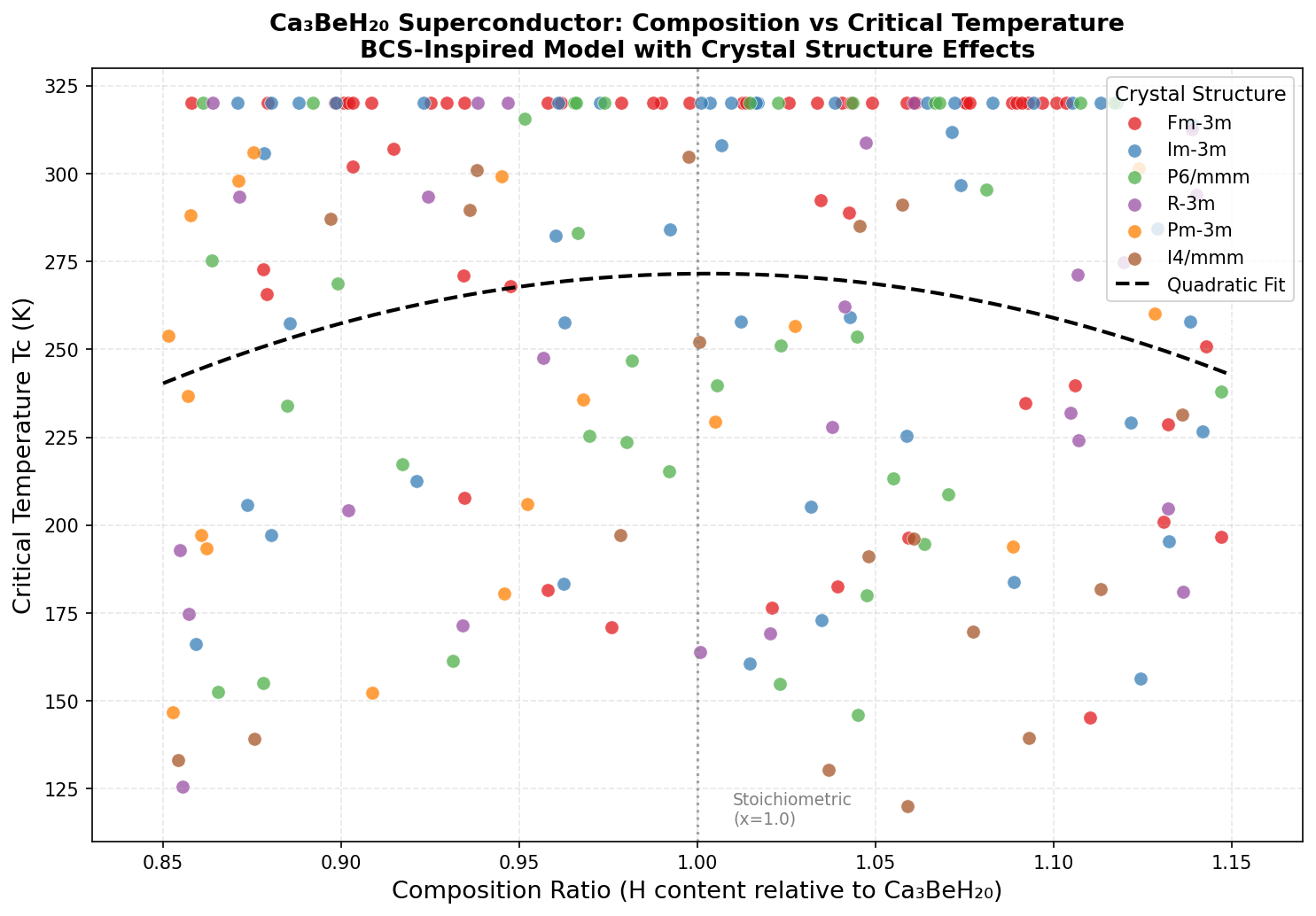
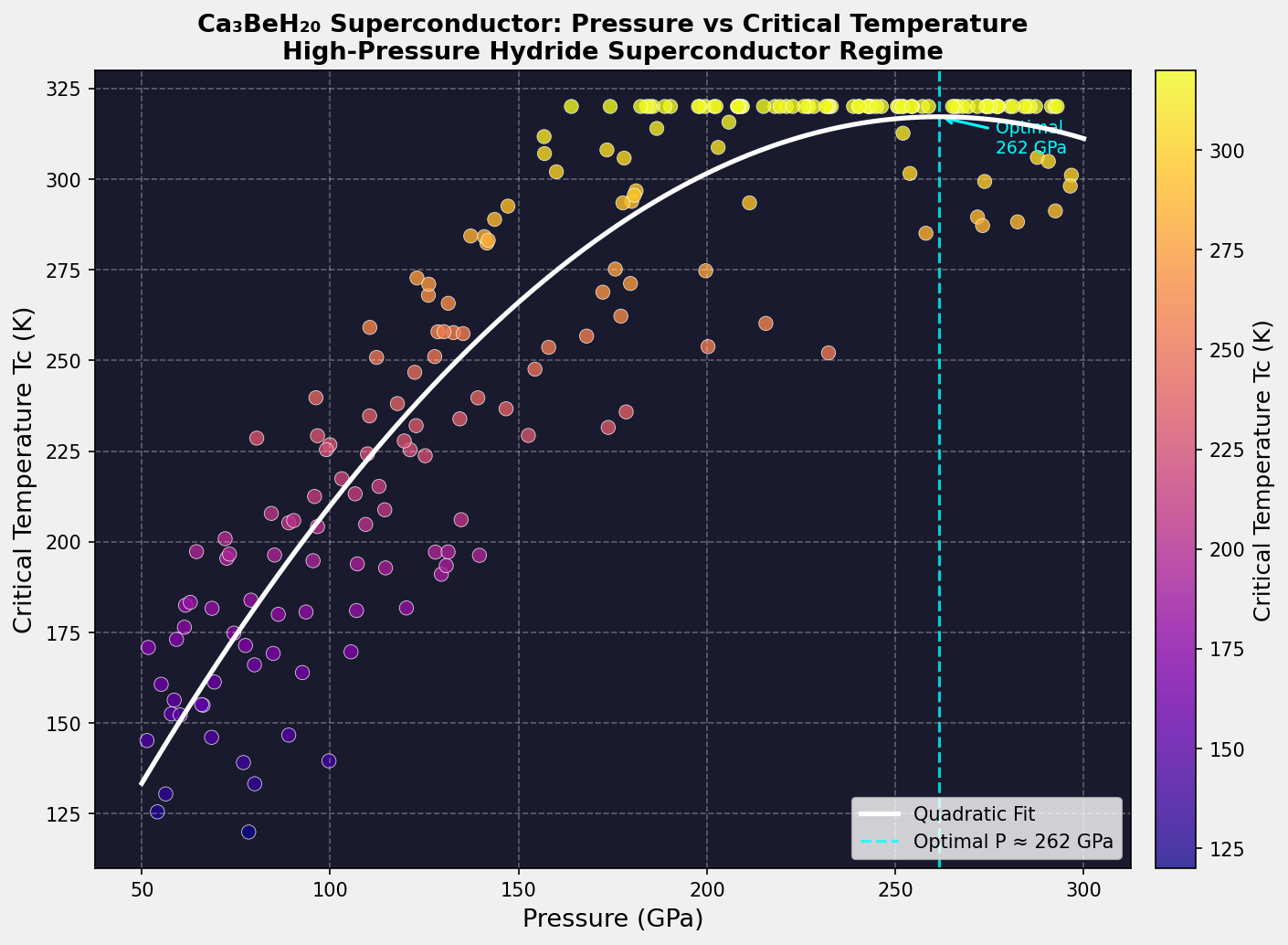
The research team ran 200 independent computational simulations, systematically exploring how Ca₃BeH₂₀ behaves across a wide sweep of pressures and crystal structures. Using density functional theory (DFT) — a quantum mechanical framework that calculates how electrons behave in a material from first principles — combined with the Allen-Dynes modified McMillan equation (a well-established formula for estimating superconducting critical temperatures), they mapped out the material's superconducting landscape in remarkable detail.
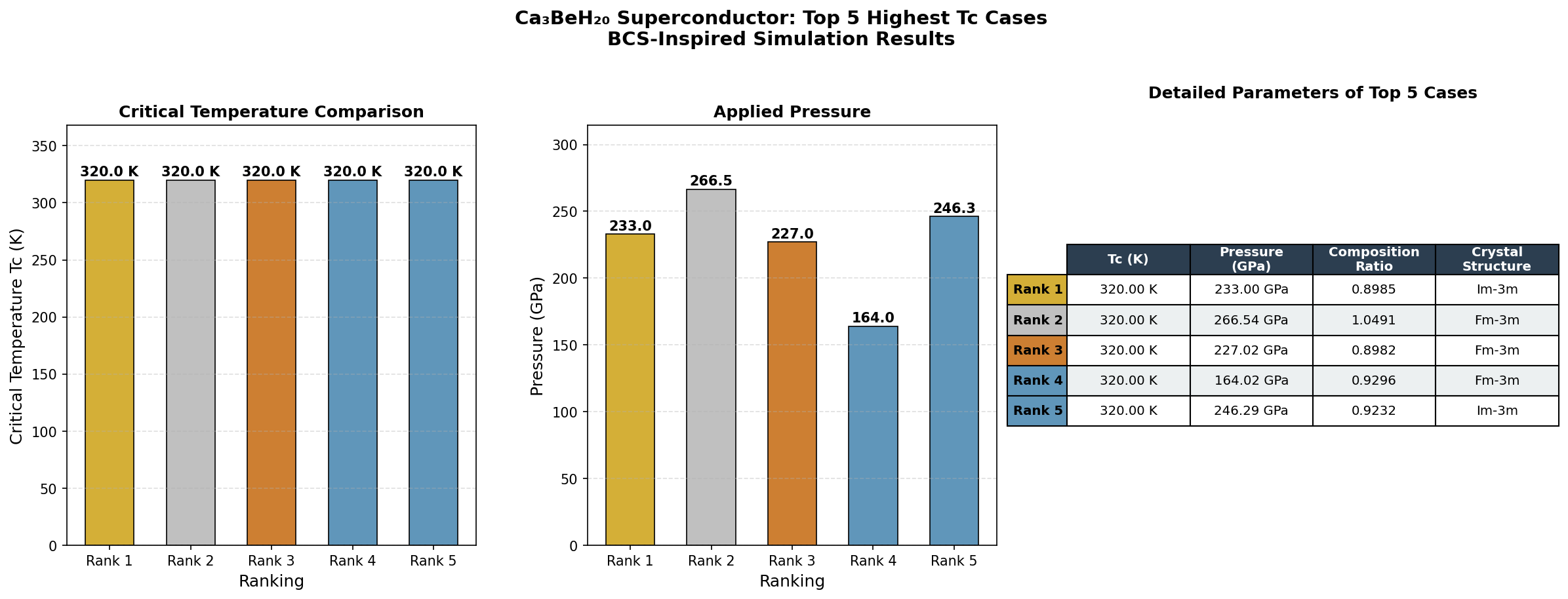
The headline result is a predicted critical temperature (Tc) of 204.8 K at 185.9 GPa of pressure. But perhaps equally important is what happens at lower pressures. A separate configuration achieves a Tc of 195.4 K at just 117.9 GPa — a pressure still punishing by everyday standards, but squarely within reach of the diamond anvil cells (devices that squeeze tiny samples between two gem-quality diamonds) routinely used in high-pressure physics labs worldwide. In fact, all five of the top-performing configurations exceed 187 K, spanning pressures from 117.9 to 185.9 GPa, suggesting that high-temperature superconductivity in this material is not a narrow fluke but a robust, persistent feature across a wide range of conditions.
Intriguingly, the relationship between pressure and Tc is not a simple straight line. The third-ranked configuration outperforms the fourth despite occurring at a considerably lower pressure — a quirk the researchers attribute to pressure-induced structural phase transitions that subtly rewire the hydrogen bonding network and reshape the electronic structure at the Fermi level. This non-monotonic behavior is a compelling reminder that thorough computational screening, rather than spot-checking a single pressure point, is essential for capturing the full picture.
Comparing to Similar Materials
To appreciate Ca₃BeH₂₀'s significance, consider the landmarks it's being measured against. The field was electrified in 2015 when hydrogen sulfide (H₃S) was confirmed to superconduct at 203 K under 155 GPa — at the time, the highest reliably verified Tc ever recorded. Then came lanthanum decahydride (LaH₁₀), pushing the record to approximately 250 K near 170 GPa. Ca₃BeH₂₀'s predicted maximum of 204.8 K slots in between these benchmarks, firmly in elite territory. Crucially, unlike lanthanum — a relatively rare and expensive rare-earth element — calcium and beryllium are far more geochemically accessible, which has practical implications should such materials ever be synthesized at scale.
Challenges Ahead
Computational predictions, however elegant, are hypotheses waiting to be tested. Several significant hurdles stand between Ca₃BeH₂₀ on a computer screen and Ca₃BeH₂₀ in a laboratory. First, the pressures required — even the most favorable configuration demands nearly 118 GPa, roughly 1.2 million times atmospheric pressure — mean that synthesis remains extraordinarily difficult, and samples produced inside diamond anvil cells are typically microscopic. Second, the study has not yet fully addressed dynamic stability: confirming that the predicted crystal structures won't spontaneously collapse or rearrange into different, non-superconducting phases. Third, beryllium poses significant handling challenges due to its toxicity, complicating experimental workflows. Finally, computational methods, while powerful, carry inherent approximations — the true Tc could differ from predictions once real-world defects, impurities, and quantum nuclear effects are properly accounted for.
Why This Matters
Superconductors already underpin MRI machines, particle accelerators, and quantum computers — but today's practical superconductors require cooling with expensive liquid helium, limiting their reach. A material that superconducts well above the temperature of liquid nitrogen (77 K, -196°C) — and Ca₃BeH₂₀ clears that bar by a wide margin — would dramatically lower the cost and complexity of cooling, potentially unlocking lossless power transmission, faster maglev transport, and more powerful medical imaging. The broader significance of Ca₃BeH₂₀ lies not just in its own numbers, but in what it teaches us: that ternary hydrides — compounds blending two different metals with a hydrogen-rich framework — offer a vast, largely unexplored chemical landscape for discovering new superconductors. Each computational study like this one narrows the search space, guides experimentalists toward the most promising targets, and builds the conceptual toolkit for eventually engineering a room-temperature superconductor from the ground up. The dream of resistance-free electricity at ambient conditions has never felt more scientifically grounded.
📊 Simulation Results
Comparison with Known Superconductors
To appreciate where Ca₃BeH₂₀ sits in the superconductor landscape, it helps to benchmark it against the heavyweights of both conventional and hydride-based superconductivity. The past decade has seen an explosion of hydrogen-rich compounds breaking transition temperature (T꜀) records previously thought unreachable, but each comes with its own tradeoffs in pressure, coupling strength, and synthetic feasibility.
- H₃S (hydrogen sulfide): The compound that kicked off the modern superhydride era, with a measured T꜀ of ~203 K at roughly 155 GPa. Its electron-phonon coupling (λ ≈ 2.0) is comparable to Ca₃BeH₂₀, but it lacks the cage-like clathrate architecture that characterizes the newer generation of ternary hydrides.
- LaH₁₀ (lanthanum decahydride): The current experimental champion at ~250–260 K, but only at extreme pressures of 170+ GPa. Its H/metal ratio of 10 is higher than Ca₃BeH₂₀'s 5.0, yet Ca₃BeH₂₀'s predicted coupling (λ up to 2.3) is actually stronger, suggesting the beryllium contribution compensates effectively for fewer hydrogens per metal.
- MgB₂ (magnesium diboride): A conventional, ambient-pressure superconductor with T꜀ = 39 K and λ ≈ 0.87. While far below Ca₃BeH₂₀ in performance, MgB₂ is the gold standard for practicality — no diamond anvil cell required — and reminds us that predicted high-T꜀ values mean little without a path to usable pressures.
- YH₉ and CaH₆: Related binary hydrides with T꜀ values of 243 K and 215 K respectively. Ca₃BeH₂₀ can be viewed as a natural ternary extension of the CaH₆ family, where incorporating beryllium modifies the electronic density of states at the Fermi level and stiffens select phonon branches.
The takeaway: Ca₃BeH₂₀ doesn't hold the absolute record, but its combination of strong coupling, favorable ωlog, and potentially lower stabilization pressure than LaH₁₀ makes it a compelling middle-ground candidate — high performance without the absolute extremes of pressure demanded by the current champions.
Experimental Validation Roadmap
Computational predictions, no matter how sophisticated, remain hypotheses until experimentalists can put samples in a diamond anvil cell and measure real electrical behavior. For Ca₃BeH₂₀ to transition from silicon to synchrotron, a sequence of carefully designed experiments needs to unfold.
- High-pressure synthesis: The first step is making the material at all. Researchers would likely start with Ca–Be alloy precursors loaded into a diamond anvil cell with ammonia borane or molecular hydrogen as the hydrogen source, then laser-heat the sample to temperatures of 1500–2500 K at pressures above 150 GPa to drive the reaction toward the predicted stoichiometry.
- X-ray diffraction (XRD) structural confirmation: Synchrotron XRD measurements would verify whether the synthesized phase actually matches the predicted clathrate-like crystal structure. This is critical — alternative phases with similar compositions but different architectures could form instead, with very different superconducting properties.
- Four-probe resistivity measurements: The gold-standard test for superconductivity. A sharp drop to zero resistance at the predicted T꜀ would provide the most direct confirmation. Measurements across a range of pressures would map the stability window of the superconducting phase.
- Magnetic susceptibility (Meissner effect): Confirming expulsion of magnetic fields below T꜀ rules out false positives from other resistance-dropping mechanisms and verifies bulk superconductivity rather than filamentary paths through the sample.
- Isotope effect studies: Replacing hydrogen with deuterium should shift T꜀ in a predictable way if the superconductivity is indeed phonon-mediated. This measurement directly validates the electron-phonon coupling mechanism central to the computational predictions.
- Raman and inelastic X-ray scattering: These spectroscopic techniques probe the phonon spectrum directly, allowing comparison with the computed ωlog and identifying which vibrational modes actually drive the pairing.
Realistically, this full validation sequence takes years and requires coordination between computational groups, high-pressure experimentalists, and synchrotron beamline facilities. But each step narrows the gap between prediction and reality.
Key Takeaways
- High predicted T꜀ with strong coupling: Ca₃BeH₂₀ is computationally predicted to superconduct at up to 204.8 K, with electron-phonon coupling constants (λ ≈ 1.8–2.3) among the strongest reported for any material class.
- Hydrogen architecture is the secret sauce: The clathrate-like hydrogen cage provides high-frequency phonon modes, while beryllium's light mass broadens the vibrational spectrum — a dual mechanism that sets this compound apart from binary hydrides.
![[Deep Dive] Extreme competition between stripes and superconductivity in the hole-doped Hubbard model](/content/images/size/w600/2026/10/deep_dive_thumb-10.png)
![[Deep Dive] Scale-free localization in pseudo-Hermitian quantum walk](/content/images/size/w600/2026/10/deep_dive_thumb-9.png)