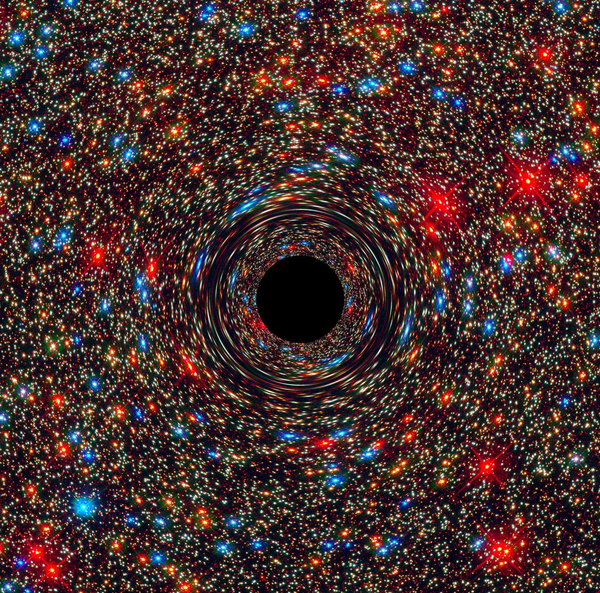
Dark Matter: We're Certain It Exists, We Have No Idea What It Is
Episode 0: Prologue: How Do We Know What We Cannot See?
I like science that leaves room to imagine. When things that seemed unrelated turn out to share a hidden pattern — that moment feels like finding one of the world's secrets. Which opens a door I didn't know was there. Which leads somewhere unexpected. Which eventually leads back to me.
You've done this before. You're walking through your apartment in the dark, no lights, and you don't bump into the couch. You know it's there. You feel it without seeing it. Your hand goes out at the right moment and finds the edge of the doorway. You move through a room full of invisible furniture by memory, by the soft pressure of air, by something you can't quite name.
Now imagine you wake up in someone else's apartment.
You walk forward in the dark and something stops you. You can't see it. You reach out — nothing. You wave your hand through the space in front of you and your hand passes through air. But you can't move forward. There's a force, gentle but absolute, pressing you back. You walk sideways. Same thing. You crouch. You jump. Whatever it is, it's everywhere, and it has shape, and it has weight, and it's holding you in place like a fly in honey you can't see.
You would, reasonably, lose your mind.
This is roughly the situation astronomers found themselves in about ninety years ago. They were looking at galaxies — those enormous spirals of stars, hundreds of billions of suns held together by gravity — and the galaxies were spinning. Fine. Everything spins. But they were spinning wrong. The stars at the edges were moving so fast that, by every law of physics anyone trusted, the galaxies should have been flying apart. Like a merry-go-round spinning at a thousand miles an hour. You'd expect children to be launched into the next county.
Instead, the galaxies were holding together. Calmly. As if something invisible was wrapped around them, holding all those fast-moving stars in place. [1]
The astronomer who noticed this first, Fritz Zwicky, was famously prickly and called his colleagues "spherical bastards" — bastards from every angle you looked at them. [2] He suggested, in 1933, that there had to be some kind of missing matter out there. Stuff we couldn't see. Nobody really took him seriously for about forty years.
Then Vera Rubin came along in the 1970s and measured the spinning more carefully, galaxy after galaxy, and found the same impossible pattern everywhere. [3] Galaxies don't just have stars in them. They sit inside something. Something huge, something invisible, something with mass.
And here's the part that got me, the part I keep coming back to when I can't sleep: this invisible something isn't a small correction. It isn't a rounding error. The stuff you can see — every star, every planet, every cloud of glowing gas, every person, every cat, every book, every ocean — adds up to about fifteen percent of the matter in the universe. [4]
The other eighty-five percent is the thing in the dark apartment. The thing you can't see but keeps stopping you from walking forward.
Take a breath with that for a second. Five-sixths of the matter around you, around the Earth, around the sun, around the galaxy, is something nobody has ever directly seen. Not with a telescope. Not with a microscope. Not with any instrument ever built. We know it's there because of how it pushes things around. We know roughly how much of it there is. We know where it tends to clump.
We do not know what it is.
This is not a fringe idea or a theory some physicist is pushing to get tenure. This is the mainstream consensus. The standard model of cosmology — the one taught in every university, the one that predicts the cosmic microwave background and the way galaxies cluster and the way the universe expands — only works if most of the matter in it is invisible to us. [5]
Which means, and I want you to really sit in this for a moment: when you walk through a room, you are walking through more of this stuff than you are walking through air. It just doesn't push back on you the way the doorway in the dark apartment did. It barely interacts with you at all. It passes through your body right now, billions of particles probably, and you feel nothing. The dark apartment isn't somewhere else. You're standing in it.
So how do you study something you cannot touch, cannot see, cannot trap in a jar? How do you know it exists at all, instead of just admitting your math is wrong?
AI-generated image — a conceptual visualization
Here is the game astronomers have been playing for almost a hundred years, except they didn't know they were playing it.
Imagine you're watching a hockey game from very high up. So high you can't actually see the puck. You can see the players. You can see them skating, turning, slamming into each other, falling down, getting back up. And from their movements alone, you have to figure out what they're chasing.
This is doable. You watch a player suddenly accelerate toward the corner. Something is there. You watch two players converge on the same empty patch of ice. Something is there too. After a while, you can trace the path of an object you have never seen, just by watching what bends around it.
Now imagine you do this for an entire game. You map every movement. You calculate where the puck must be at every second. And at the end, you add up all the puck-locations and realize: there isn't one puck. There are six. There are sixty. The players are reacting to a swarm of invisible objects, and your tidy little theory about one puck collapses.
That's roughly where we are.
In the 1930s, an astronomer named Fritz Zwicky was looking at a cluster of galaxies called Coma.[1] A cluster is just what it sounds like — a bunch of galaxies hanging out near each other, held together by gravity. Zwicky measured how fast the galaxies were moving inside the cluster. And the galaxies were moving way too fast.[1]
Think of it like this. You're swinging a tennis ball on a string above your head. The faster you swing it, the stronger the string has to be, or it snaps and the ball flies off. Zwicky's galaxies were swinging so fast that the "string" — the gravity of everything he could see — should have snapped a long time ago. The cluster should have flown apart. But it hadn't. It was still there, perfectly intact, billions of years later.
So either gravity works differently than we think, or there was a much, much stronger string than anyone could see. Zwicky called the invisible stuff dunkle Materie*1. Dark matter. And then, because science is sometimes about ideas being too weird for their own time, everyone basically ignored him for forty years.
Forty years later, an astronomer named Vera Rubin started measuring something different but related.[2] She looked at single galaxies — beautiful spiral ones, like ours — and measured how fast the stars at the edges were spinning around the center.
Here's what should happen. Think of the solar system. Mercury whips around the Sun fast. Pluto crawls. The farther you are from the center of gravity, the slower you should move. This is just how gravity works. It thins out with distance.
Rubin looked at the stars at the outer edges of galaxies, expecting them to be the Plutos — slow, lazy, almost forgotten. They weren't. They were sprinting.[2] The outer stars were moving just as fast as the inner ones. Which, according to the physics we trust for everything from baseball to spacecraft, should be impossible.
Unless. Unless there was a huge, invisible halo of something around each galaxy, holding those outer stars in place. Something we couldn't see, in quantities much larger than all the stars and gas and dust we could see.[2]
Back to the hockey rink. Rubin had just discovered that the players weren't reacting to one puck. They were reacting to a swarm. An ocean. A whole invisible ice rink of pucks, vastly outnumbering the visible ones.
And here's the part that gets me. Here's the part I keep turning over in my head.
AI-generated image — a conceptual visualization
If you add up all the matter in the universe — every star, every planet, every black hole, every cloud of gas, every neutrino*2, every speck of dust on every moon — that adds up to about fifteen percent of the matter that exists.[3] The other eighty-five percent is dark matter. Stuff we have never directly detected. Stuff that doesn't shine, doesn't reflect, doesn't absorb, doesn't seem to do anything except pull.[3]
We are the minority. Everything you have ever seen, everything every telescope has ever pointed at, every atom in your body and every atom in every body of every person who has ever lived — that's the small slice. The hockey players. The dark matter is the rink.
And we figured this out the same way you found the doorway in your dark apartment. Not by seeing. By bumping into things. By watching what moves and asking why. By trusting that if a galaxy is spinning too fast to hold itself together, and it's still holding itself together, then something is holding it. Something has to be.
We don't know what. We have guesses. We have particles with names that sound like rejected superhero teams — WIMPs, axions, sterile neutrinos.[4] We've built detectors deep underground, in old mines, surrounded by the purest materials we can manufacture, waiting for one of these invisible somethings to bump into a single atom and leave a tiny flash of evidence. We've been waiting for decades. We are still waiting.[4]
This is, I think, the most honest moment in modern science. We are completely certain that most of the matter in the universe exists. We have no idea what it is. Both of these things are true at the same time, and somehow we just live with it.
It's like knowing your apartment has a roommate you've never met. You see the dishes move. You hear the floor creak. The rent gets paid. But you've never once seen them, and when you ask around, nobody can describe their face.
The first person to walk into a dark apartment that wasn't hers was Vera Rubin. Though she would have hated me saying it like that, because she was very specific that she didn't discover dark matter. She just noticed something was wrong.
In the 1970s, Rubin and her colleague Kent Ford were doing something that sounds almost boring. They were measuring how fast galaxies spin [1]. Not the galaxies themselves rotating like a record — the stars inside them, orbiting the center, the way planets orbit the sun.
Here's what they expected to see. In our solar system, Mercury orbits the sun at about 47 kilometers per second. Neptune, way out at the edge, crawls along at about 5 [2]. The pattern is simple. The farther you are from the center of mass, the slower you go. This is just gravity doing its job. It's the same reason a figure skater spins faster when she pulls her arms in.
So Rubin pointed her spectrograph *1 at the Andromeda galaxy and started measuring the speeds of stars at different distances from the center. She expected the stars near the edge to be moving slowly. Sluggish. Drifting. The Neptunes of Andromeda.
They weren't.
The stars at the edge were moving just as fast as the stars near the middle [3]. All of them. The whole galaxy was spinning like a solid disk, like a vinyl record, which is not how gravity is supposed to work. If gravity was the only thing in play, those outer stars should have been flung off into space long ago. The galaxy should have come apart.
But it hadn't. Andromeda has been there for billions of years, spinning wrong, holding together for reasons no one could explain.
Rubin and Ford measured galaxy after galaxy. Same thing. Same wrong spinning. By 1980 they had data from dozens of spiral galaxies and the conclusion was hard to avoid: there is something else inside these galaxies. Something with mass. Something whose gravity is holding the outer stars in place. Something we cannot see [4].
AI-generated image — a conceptual visualization
Now here's the part I love. Rubin wasn't the first to suggest this. Forty years earlier, in 1933, a Swiss astronomer named Fritz Zwicky was looking at something completely different — a cluster of galaxies called the Coma Cluster. He measured how fast the galaxies in the cluster were moving relative to each other and found they were moving way too fast. The cluster should have been flying apart. To hold it together, he calculated, there had to be about 400 times more mass present than what was visible [5]. He called this missing stuff "dunkle Materie" — dark matter [6].
Nobody listened. Zwicky was famously difficult — he called his colleagues "spherical bastards," because, he said, they were bastards no matter which angle you looked at them from. His ideas were ignored for forty years. It took a woman patiently measuring star speeds in the 1970s to drag dark matter into the mainstream.
So that's two clues. Galaxies spin wrong. Galaxy clusters move wrong. Both pointing at the same invisible furniture.
But here's where it gets stranger, because the evidence kept piling up from completely unrelated directions.
In 1979, a team led by Dennis Walsh observed something that looked like twin quasars — two bright points of light, identical, sitting close together in the sky [7]. They turned out to be the same quasar. A galaxy sitting between us and that distant quasar was bending its light, splitting one image into two. This is gravitational lensing *2, predicted by Einstein, and it works exactly the way a glass lens bends light, except the lens is made of gravity.
Once astronomers learned to look for this, they could measure the mass of any galaxy or cluster by watching how it bent the light of things behind it. And every time they did this — every single time — they found the same answer. The mass needed to bend the light that much was way more than the mass of the visible stars and gas [8].
Same answer. Different method. Different physics. Same invisible stuff.
Then in 2006, a team led by Douglas Clowe published something they called "a direct empirical proof of the existence of dark matter" [9]. They were looking at the Bullet Cluster — two galaxy clusters that had recently collided and were passing through each other. Here's what's beautiful about a collision like this. The hot gas in the two clusters smashes into itself and slows down, like two clouds of smoke colliding. But the stars, which are tiny and far apart, sail right through each other without touching. And dark matter, if it exists, should also sail through, because it doesn't interact with normal matter much at all.
So if dark matter is real, you should be able to see the gas in the middle, where the crash happened, and the dark matter out on the wings, where the two clusters have continued past each other. Clowe's team used gravitational lensing to map where the mass actually was. And the mass was on the wings. The visible matter — the X-ray-glowing gas — was stuck in the middle. The gravity was somewhere else entirely [10].
You could literally see the dark matter sitting apart from the normal matter. Not as light. As a gravitational shadow, mapped from how it warped the light of more distant galaxies. Clowe said, in a press conference I keep thinking about, "This is the most direct proof that dark matter exists" [11]. After decades of arguments, here was a picture. The invisible furniture, photographed.
And there's one more piece, maybe the strangest of all.
When you look at the oldest light in the universe — the cosmic microwave background *3, the faint afterglow of the Big Bang itself — it isn't perfectly smooth. It has tiny ripples in it, hotter and colder spots, fluctuations of about one part in 100,000 [12]. The pattern of those ripples encodes the entire recipe of the universe. How much normal matter. How much dark matter. How much of whatever else is in there.
The Planck satellite measured this pattern with absurd precision between 2009 and 2013. And when you fit the equations to the data, you get a number. The universe is about 5% normal matter — the stuff you and I and stars and planets are made of. About 27% dark matter. And about 68% something else called dark energy, which is a whole other nightmare we'll get to later [13].
Take a moment with this. Everything you have ever seen, touched, eaten, loved, photographed, broken, fixed, lost — every atom of it — is 5% of what's out there. We are the rounding error. The universe is mostly made of two things we cannot see and do not understand, and we are floating in a thin film of visible matter on top of it.
AI-generated image — a conceptual visualization
So that's where the consensus sits. Five completely different lines of evidence — galaxy rotation, cluster dynamics, gravitational lensing, the Bullet Cluster, the cosmic microwave background — all pointing at the same thing. There is roughly five times more invisible matter than visible matter in the universe, and it is everywhere.
Now you would think, given all this certainty, that physicists must at least know what dark matter is made of.
They don't.
For about thirty years the leading guess was something called a WIMP *4 — a Weakly Interacting Massive Particle. The idea was elegant. You posit a heavy particle that barely interacts with normal matter, and it falls out of the equations of particle physics almost for free. Multiple experiments were built deep underground — in old mines, under mountains
Here is what's strange. We've been looking for dark matter for fifty years. We have built detectors a kilometer underground, shielded from every stray particle, cooled to almost absolute zero, waiting in the dark for a single whisper of a collision. We have built them in Italy, in South Dakota, in China. We have made them bigger and bigger and quieter and quieter.
And we have found nothing.
Not "nothing interesting." Nothing. The leading candidate for decades was something called a WIMP *1 — a weakly interacting massive particle, which is physics-speak for "a heavy thing that almost never touches anything." We thought we'd see them by now. We don't [1]. Each new experiment rules out more places the WIMP could be hiding, and the hiding places are getting small.
So maybe it's not a WIMP. Maybe it's an axion *2, which is a particle so light and so shy it would pass through the entire Earth without noticing. There are experiments looking for those too. They also haven't found anything [2].
Maybe it's something heavier. Primordial black holes — small ones, made in the first second after the Big Bang, drifting through the galaxy like invisible cannonballs. We've looked. The numbers don't quite work [3].
Maybe — and this is the one that keeps some physicists up at night — maybe there is no dark matter at all. Maybe gravity itself works differently at very large scales, and we've been chasing a ghost made of our own bad math. This idea is called MOND *3, and most physicists don't believe it, but "most physicists don't believe it" is not the same as "it's wrong." It explains some things dark matter struggles with. It fails at others [4]. Nobody has a clean answer.
Here is what we actually know, stripped of every guess. Something is bending light that shouldn't be bent. Something is holding galaxies together that should be flying apart. Something makes up about 27% of the universe [5], and whatever it is, it doesn't shine, doesn't absorb, doesn't bounce, doesn't seem to talk to ordinary matter in any way we've figured out how to listen for.
It might be a particle. It might be a thousand kinds of particle, an entire dark periodic table we can't see [6]. There could be dark atoms. Dark chemistry. Dark stars. There's no reason to assume the invisible world is simpler than the visible one — we just hope it is, because we have to start somewhere.
The honest summary is this: we are certain something is there, and we have no idea what it is. Those two sentences sit next to each other and refuse to resolve. Most of physics is a story of mystery becoming explanation. This one has been mystery becoming more mystery for half a century.
And it gets worse, in a way that's almost funny. Dark matter is only 27% of the universe. About 68% is something else — dark energy *4 — which we understand even less [5]. The stuff you and I and the stars and the planets are made of? Five percent. We are the rounding error. The entire history of human science, every experiment ever performed, every chemical ever isolated, every cell ever stained — all of it is the study of the 5% that happens to glow.
AI-generated image — a conceptual visualization
The other 95% is doing something. We don't know what.
There's a temptation, when you sit with this for a while, to feel small. To feel like the universe is mostly a stranger's apartment and we are stumbling through it bumping into furniture we can't name. But I don't think that's the right feeling. The right feeling, I think, is the one you get when you're a kid and you realize there's a door in your house you've never opened.
What would it mean if you could see it?
So here's where we actually are, you and me, on a Tuesday afternoon.
Most of the universe is something. We know it's something because we can see it bending light [1] and holding galaxies together [2]. We have measured how much of it there is with absurd precision — about 27% of everything, while the stuff you're made of, the stuff your coffee cup is made of, the stuff the sun is made of, adds up to less than 5% [3].
We are the minority. We are the weird stuff. We are the rounding error.
And the majority — the thing that actually fills the room — we cannot find. Not for lack of trying. We've been looking with the patience of monks for half a century. The dark apartment is real. The couch we keep bumping into is real. But every time we reach out to touch it, our hand passes through.
This should bother you more than it does. It bothers me at strange hours. Because what it means is that the universe you grew up imagining — stars and planets and gas and dust and the warm glow of everything — that universe is the thin foam on top of the wave. The wave itself is something else. Something you have never seen and probably never will.
And here's the part I keep getting stuck on. We figured this out. A handful of humans, on a small wet rock, looking up at lights, did math and noticed the lights were moving wrong, and from that alone deduced that 95% of reality is hidden from them. That's either the most impressive thing our species has ever done or the most arrogant, and I genuinely cannot tell which.
Maybe both. Probably both.
Next time, we're going further back. Because dark matter is just the beginning of what we cannot see. There is something stranger waiting — something that isn't just invisible but is actively pushing the universe apart, faster and faster, for reasons no one can explain [4]. We call it dark energy, which is physics-speak for we have no idea.
But before we get there, I want you to sit with this one thing.
If most of the universe is hiding from you, what else is?
TERMS EXPLAINED
- *1Rotation curve: A graph of how fast stars move depending on how far they are from the center of their galaxy. If galaxies were only made of the stuff we see, stars at the edges should move slowly, like outer planets in our solar system. They don't. They move just as fast as the inner ones, which only makes sense if there's a huge invisible halo of mass holding everything together.
- *2Cosmic microwave background: The faint afterglow of heat left over from when the universe was young and hot, about 380,000 years after the Big Bang. It's everywhere, in every direction, and its tiny variations are a kind of baby picture of the universe.
- *3Standard model of cosmology: The current best story scientists have about how the universe works on the largest scales — what it's made of, how it expands, how galaxies formed. Most of this story only makes sense if dark matter is real.
- *4Dark energy: The even more mysterious thing pushing the universe to expand faster over time. Not the same as dark matter. We named it "dark" because we don't understand it, which is becoming a pattern.
SOURCES & REFERENCES
- [1]Rubin, V. C., & Ford, W. K. (1970). "Rotation of the Andromeda Nebula from a Spectroscopic Survey of Emission Regions." Astrophysical Journal, 159, 379. — Measurements of galactic rotation curves showing stars at galactic edges move faster than visible mass predicts.
- [2]Zwicky, F. (1933). "Die Rotverschiebung von extragalaktischen Nebeln." Helvetica Physica Acta, 6, 110-127. — First proposal of "dunkle Materie" (dark matter) based on Coma Cluster observations. Zwicky's "spherical bastards" remark is widely cited in biographical accounts.
- [3]Rubin, V. C., Ford, W. K., & Thonnard, N. (1980). "Rotational Properties of 21 ScGalaxies." Astrophysical Journal, 238, 471. — Systematic confirmation of flat rotation curves across many galaxies, establishing dark matter as a widespread phenomenon.
- [4]Planck Collaboration (2020). "Planck 2018 results. VI. Cosmological parameters." Astronomy & Astrophysics, 641, A6. — Measurements give ordinary matter at roughly 5% of the universe's energy content and dark matter at roughly 27%, meaning dark matter is about 85% of all matter.
- [5]Bertone, G., & Hooper, D. (2018). "History of dark matter." Reviews of Modern Physics, 90, 045002. — Review establishing dark matter as a foundational component of the standard cosmological model (ΛCDM).
- [6]Buckley, M. & Fox, P. (2010). "Dark Matter Self-Interactions and Light Force Carriers." Physical Review D. — Theoretical basis for complex "dark sector" with multiple particle types.
Inline citations [N] correspond to numbered references above.
A weekly journey from the present universe back to the Big Bang — and to what it means for us.
![[Deep Dive] Scale-free localization in pseudo-Hermitian quantum walk](/content/images/size/w600/2026/10/deep_dive_thumb-9.png)