What If the Donut's Dough Is a Black Hole?
Episode 5: Black Holes Are Also Donuts
I like science that leaves room to imagine. When things that seemed unrelated turn out to share a hidden pattern — that moment feels like finding one of the world's secrets. Which opens a door I didn't know was there. Which leads somewhere unexpected. Which eventually leads back to me.
You are holding a donut. Your thumb rests in the hole. Think about that hole for a second. It is nothing. Literally nothing. And yet, without it, you are holding a bun. You paid for the absence. The nothing is the whole point.
Mathematicians take this more seriously than bakers do. They have a name for the shape: a torus *1. And in topology *2, the branch of math that cares about holes but not about size or angles, a donut and a coffee mug are the same object [1]. Each has exactly one hole. Squish one slowly enough, without tearing, and you get the other. This explains why topologists keep dunking the wrong thing into their coffee.
Here is what gets me. The math does not care about the dough. Stretch it, flatten it, glaze it pink. None of that matters. What makes a donut a donut is the empty space in the middle. The part you cannot eat.
You already know this feeling, even if you have never thought about math. A friend moves away and the room changes shape. A chair at the dinner table stays empty and everyone keeps glancing at it. Sometimes the thing that defines a space is the thing that is missing from it.
Now hold that thought and look up. In April 2019, a team of astronomers showed the world a blurry orange ring [2]. It was a picture of something 55 million light-years *3 away [2]. The light in that image left its source when your ancestors were small mammals hiding from whatever survived the dinosaurs. Everyone stared at the glowing ring. But the ring was just the dough. The real subject was the dark circle in the middle, the part that sent no light at all [2]. Thousands of people spent years building a planet-sized camera to photograph a hole [2].
So here you are, a person who has eaten donuts your whole life without once wondering about the center. And somewhere out there, the universe seems to have made the same shape on a scale that swallows stars. Maybe that is a coincidence. Maybe shapes are just shapes.
But what if the hole was never empty to begin with?
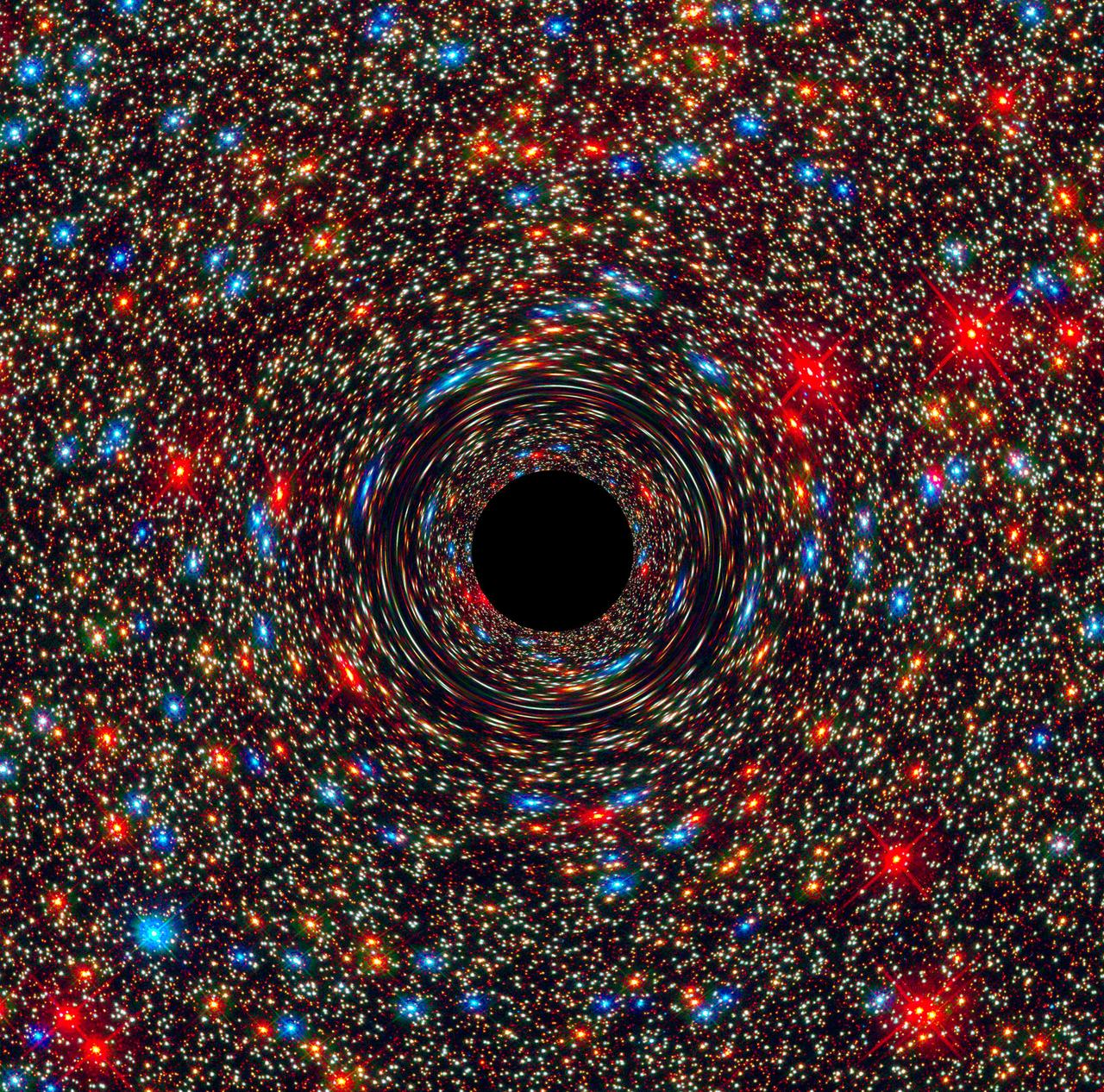
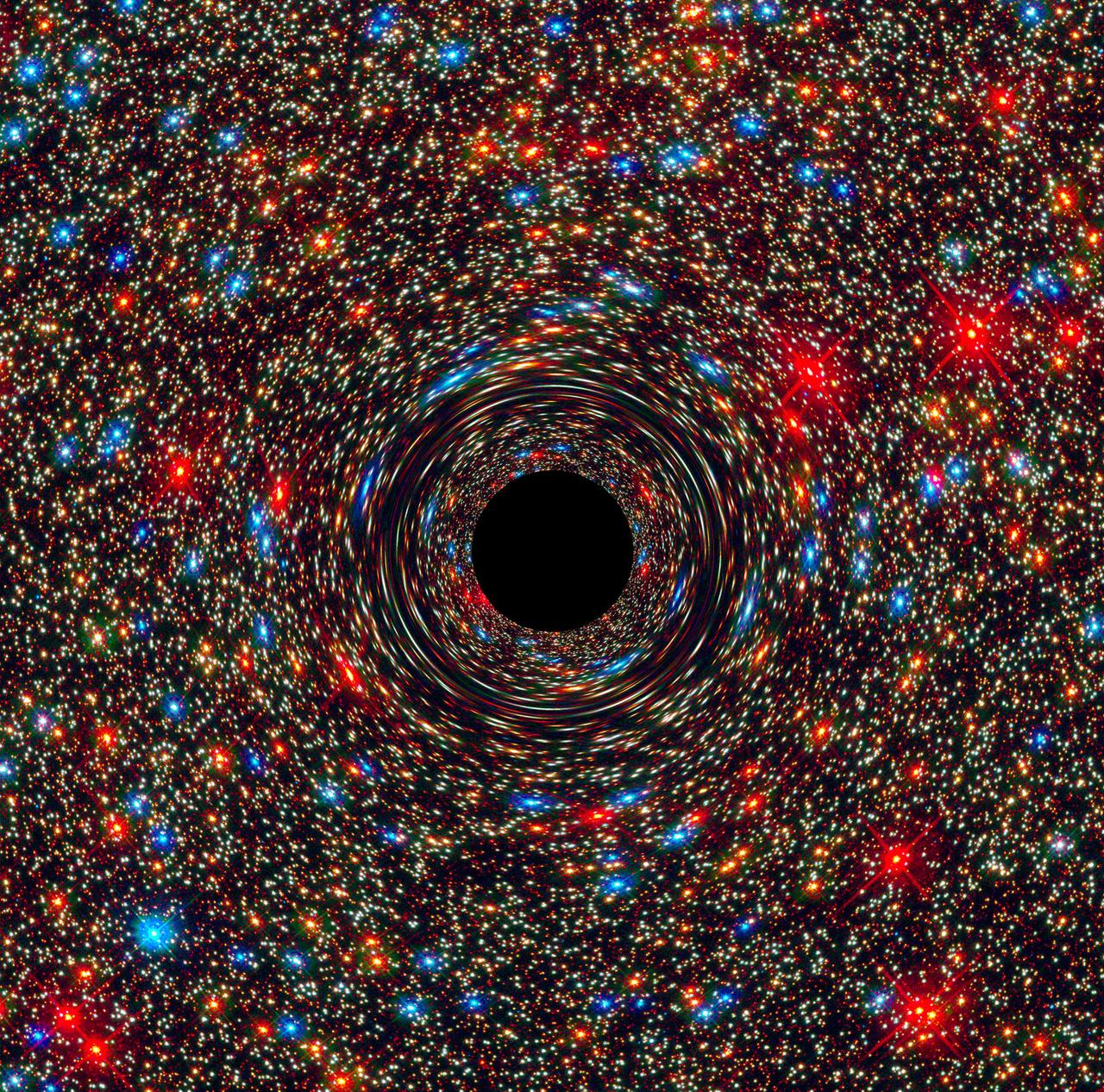
📷 Behemoth Black Hole Found in an Unlikely Place — GSFC (NASA Image and Video Library, Public Domain)
Asteroids, Rings, and Forbidden Donuts
Remember Asteroids? The little triangle ship, the drifting rocks. Fly off the right edge of the screen and you pop back in on the left. Fly off the top and you come back at the bottom. It feels like a flat rectangle. It isn't.
Glue the left edge to the right and you get a tube. Glue the top of the tube to the bottom and you get a donut. That ship was never flying across a flat screen. It was crawling over the surface of a torus, while you steered it in an arcade that smelled like old carpet [2]. Mathematicians love this example because it shows the trick. The shape a space really has and the shape you see can be completely different things.
Hold that thought and pick up a black hole. Real ones spin. When a star collapses, it keeps its spin and speeds up, like a skater pulling in her arms. In 1963, Roy Kerr found the equations for a spinning black hole [3]. Buried in his math is something strange. The singularity *3 is no longer a point. It's the place where the math says density goes to infinity, and spin stretches it into a ring [3].
A ring. Infinitely thin, infinitely dense. Dough with no thickness, wrapped around a hole.
Here's where it gets uncomfortable. According to the equations, you could fly straight through the middle of that ring without touching it. On the other side, the math describes a region where gravity pushes instead of pulls, and where paths through time can loop back on themselves [4]. A donut hole that opens into somewhere else.
Do physicists believe it? Mostly, no. Calculations from 1990 suggest the inside of a spinning black hole is violently unstable. Anything falling in piles up energy until the tidy geometry tears itself apart [5]. The ring might be real. The doorway is probably a mathematical ghost. We don't know, and nobody is volunteering to check.
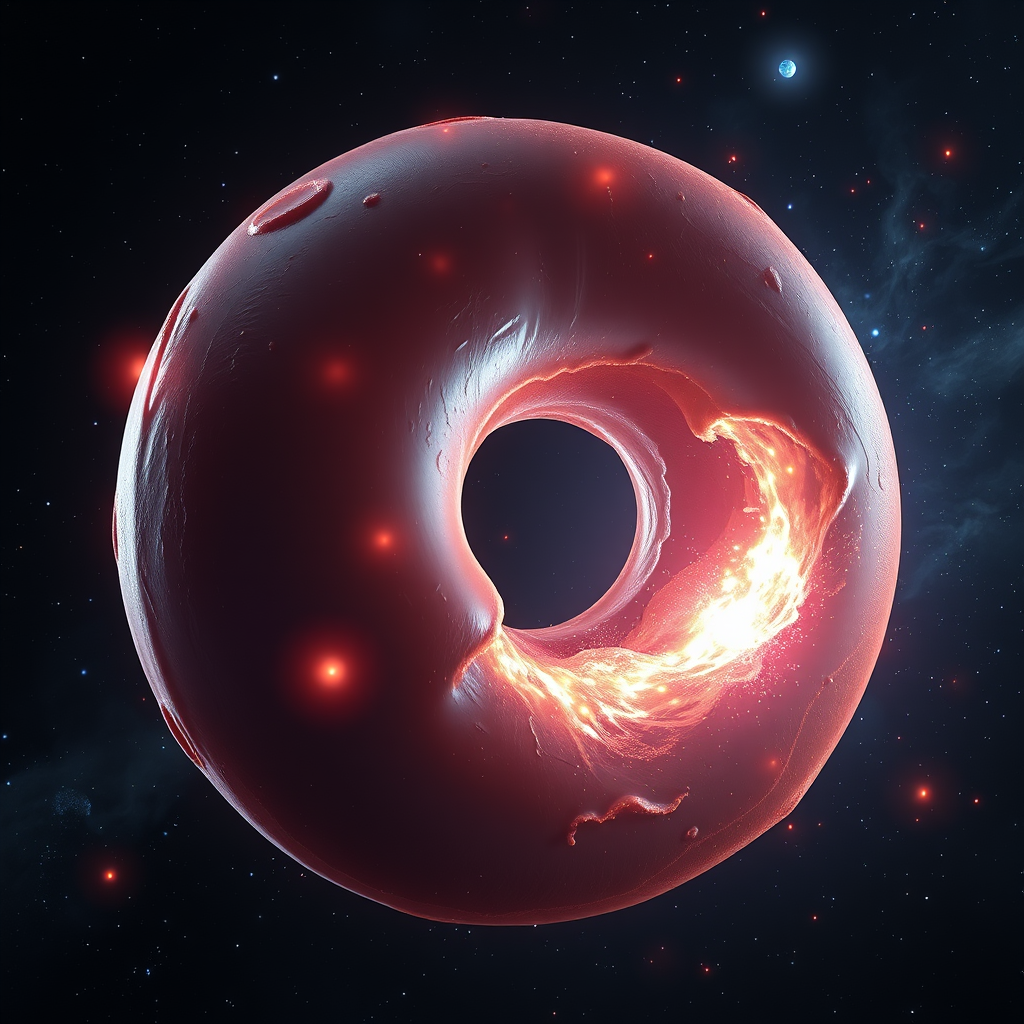
AI-generated image — a conceptual visualization
There's a second twist. The outer surface of a black hole, the event horizon *4, is not allowed to be a donut. In 1972, Stephen Hawking showed that in a universe with three dimensions of space, like ours, a horizon has to be shaped like a sphere [6]. No holes. The universe, it turns out, has rules about pastry.
Add one more dimension of space, though, and the rule breaks. In 2002, Roberto Emparan and Harvey Reall found a black hole whose horizon is a ring. It's a true black donut, spinning fast enough to avoid collapsing into a ball [7]. It's the same theory of gravity, with one extra direction to move in.
So the shape a black hole is allowed to take depends on how many directions exist. Which brings us back to the little ship. It had no idea it lived on a donut. From the inside, the screen looked flat and ordinary.
You live in a space too. It looks ordinary from here. How would you know if it wasn't?
The Black Hole That Wanted a Hole
Close your eyes and picture a black hole. You probably see a ball. A dark sphere, maybe with a glowing ring of gas around it. Nobody told you it had to be round. You just assumed.
Physicists assumed too. Then they tried to prove it, and the proof turned out stranger than the assumption.
Start with the edge. A black hole has an event horizon *3. That is the point of no return, the invisible surface where gravity gets so steep that even light, moving as fast as anything can, isn't fast enough to climb back out. The horizon isn't a wall. You could fall through it and feel nothing special. You just could never send a postcard home.
So what shape is that surface? In 1972, Stephen Hawking used Einstein's general relativity *4 to answer it. In a universe like ours, with three dimensions of space, a black hole that has settled down must have a horizon shaped like a sphere [3]. Squashed, maybe. Spinning, maybe. But topologically a ball. No holes. No handles.
Physics, in other words, has a strict no-donut policy. Physics also has a long history of reading its own rules very carefully.
The loophole is the word "settled." Hawking's theorem describes black holes that have stopped changing. It says nothing about the violent moment of birth. In 1995, Stuart Shapiro, Saul Teukolsky and Jeffrey Winicour ran a computer simulation *5 of a cloud of matter arranged in a ring, collapsing under its own weight [4]. For a brief stretch, the horizon that formed was a torus. A genuine black donut, with a genuine hole in the middle.
Then the hole closed. Fast. And this is where it gets interesting.
The hole closed faster than light could cross it. Ted Jacobson and Shankar Venkataramani showed this isn't luck [5]. Any temporarily toroidal horizon has to seal itself before a light ray could slip through the middle and come out the other side. Two years earlier, John Friedman, Kristin Schleich and Donald Witt had proved a broader version, which they called topological censorship *6 [6]. Roughly: the universe can have complicated shapes tucked away in its geometry, but no traveler from the outside can ever fly a loop through them and come home to report.
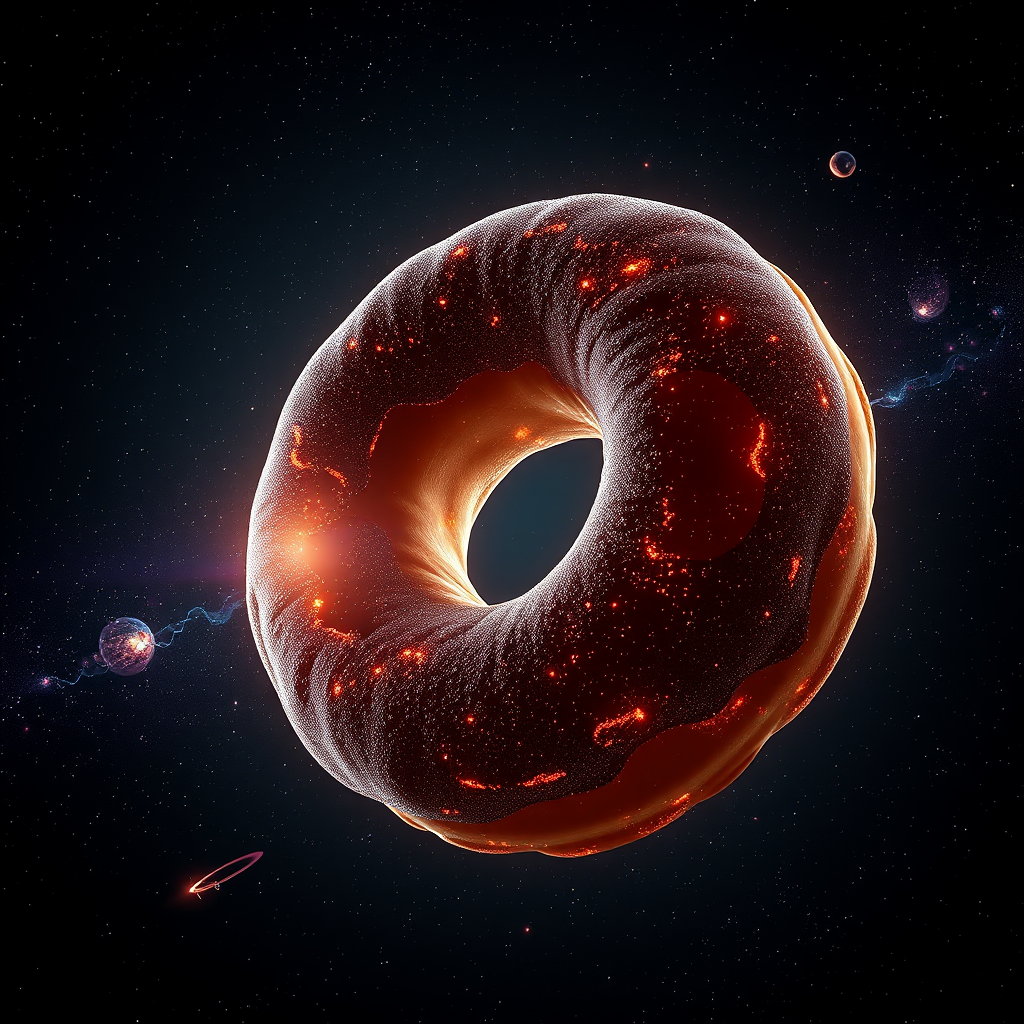
AI-generated image — a conceptual visualization
Now go back to the Asteroids screen. The only reason you knew you were on a torus was that your ship could fly off one edge and reappear on the other. The loop is how you discover the hole. Topological censorship says the universe lets the donut exist on exactly one condition. You never get to fly the ship through it.
The hole is allowed. Knowing about it is not.
But what if space had more room to move? In 2002, Roberto Emparan and Harvey Reall published a short paper with a title that sounds like a dare: "A rotating black ring in five dimensions" [7]. Add one extra dimension of space *7, and Einstein's equations permit a black hole shaped like a ring. A doughnut of darkness. Spin keeps it open, the way a spinning hula hoop holds its shape instead of collapsing.
This broke something physicists had relied on for decades. In our three dimensions, a settled black hole is completely described by its mass, its spin and its electric charge. Nothing else. Emparan and Reall found that in five dimensions, a round black hole and a black ring can carry the same mass and the same spin [7]. Same numbers, different shapes. The universe's tidiest objects turned out to be less tidy than advertised.
Do these rings survive? Mostly no. In 2016, Pau Figueras, Markus Kunesch and Saran Tunyasuvunakool simulated thin black rings and watched them wobble, pinch and break apart into a chain of smaller black holes, like a stream of water from a tap breaking into droplets [8]. Worse, at the pinch points, the simulation hinted at a naked singularity *8, a place where the math stops working and no horizon hides it. That is exactly the kind of thing physicists hope the universe forbids. The donut might not just fall apart. It might break the rules on its way out.
There is one more place donut-shaped black holes live comfortably. José Lemos showed in 1995 that in a universe with a negative cosmological constant *9, black holes can be permanently toroidal [9]. They are stable. They are happy. They live in a universe that isn't ours. Our cosmos has a positive cosmological constant, the push behind its accelerating expansion. Close, but no donut.
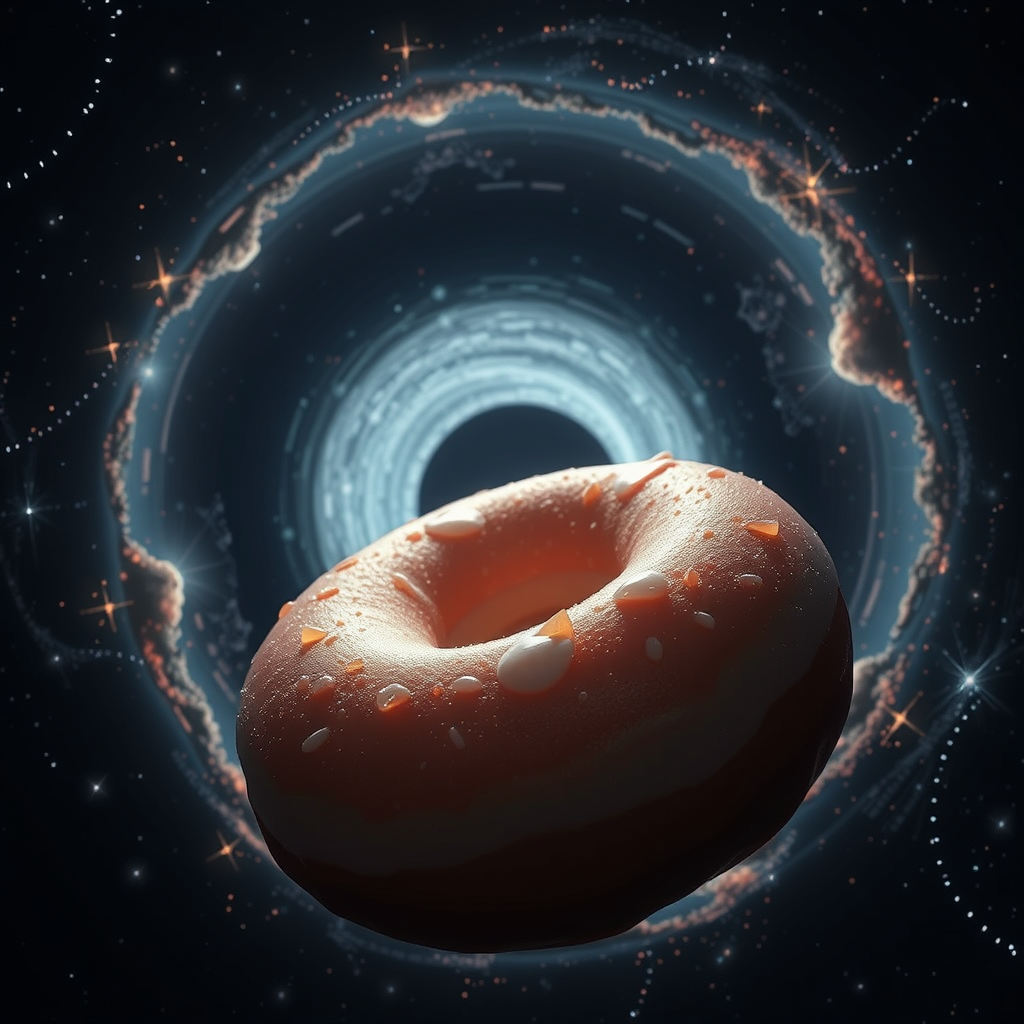
AI-generated image — a conceptual visualization
And yet. Even the ordinary black holes we actually observe hide a ring. When Roy Kerr found the math for a spinning black hole in 1963, it took a few more years for Brandon Carter to map what was inside [10]. The singularity at the center of a spinning black hole is not a point. It is a ring. On paper, you could thread yourself through the middle of it and come out somewhere very strange. Most physicists suspect the real interior is far too violent for sightseeing. Infalling light piles up near the inner horizon and the geometry there may tear itself apart before anyone gets close to the ring [11]. The doorway exists in the equations. Whether it exists in the sky, we don't know.
So here is the honest score. Donut black holes can be born, but only for a moment, and only if nobody can look through them. They can live forever, but only in five dimensions or in a universe curved the wrong way. And the spinning black holes we photograph might have a ring buried at their core, sealed behind two horizons, where no report will ever come back from.
Every time, the hole is there. Every time, it is hidden.
Think about what that means for you. Your whole picture of the universe comes from loops you can actually fly. Light that leaves something and reaches your eye. Signals that go out and come back. Topological censorship says some of the shape of reality might never complete that loop. Not because you aren't clever enough. Because the geometry itself won't allow the trip.
You paid for the hole in your donut because you could see it. If the universe is full of holes you are forbidden to see, how would you ever know what you're holding?
The Donut That Only Lives Elsewhere
Here is the honest part. In our universe, with three dimensions of space, a settled black hole cannot be a donut. Hawking showed that a calm, unchanging horizon has to be a sphere in the topological sense [5]. Lumpy is fine. Squashed is fine. A hole is not.
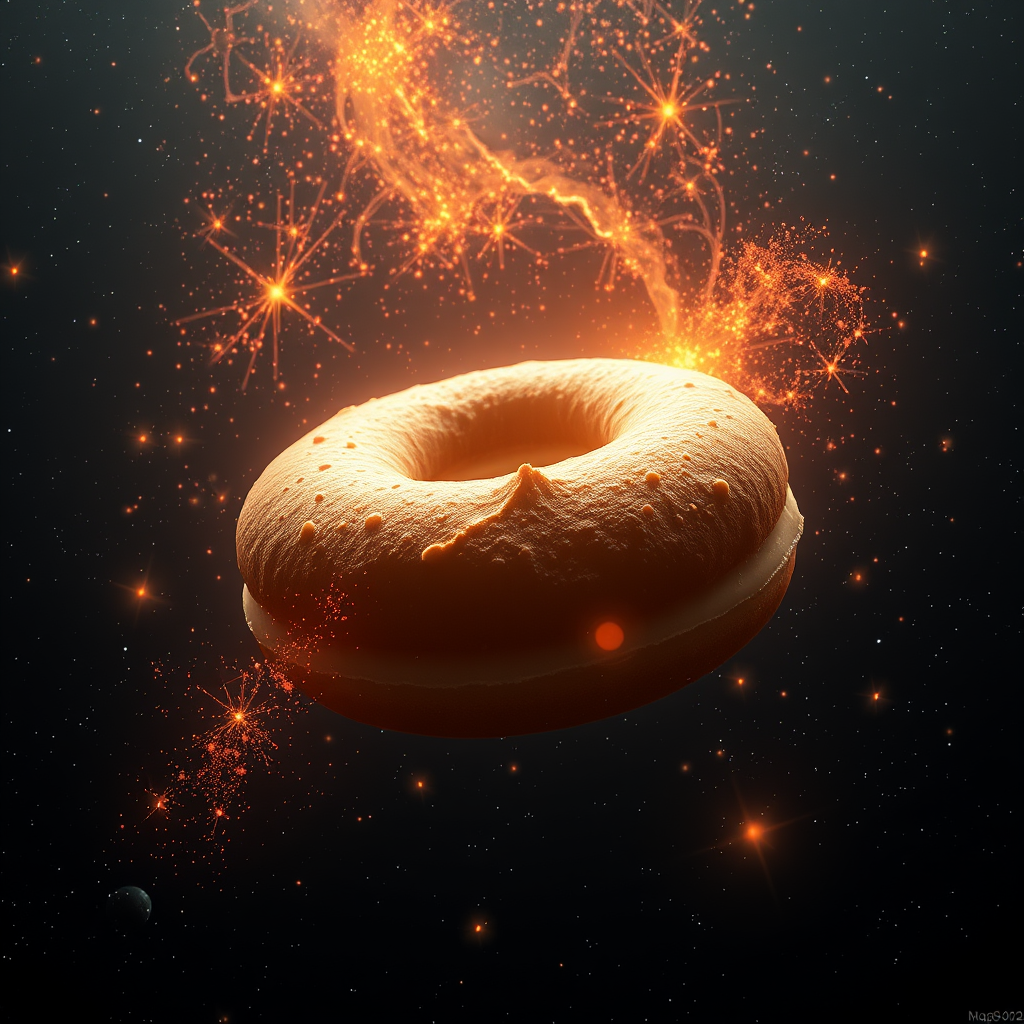
AI-generated image — a conceptual visualization
Notice the word settled. During the violent moment of collapse, things get messier. In 1995, physicists simulated a ring of matter falling in on itself. The horizon that formed was briefly a torus [6]. It was a donut that existed for an instant before it closed its own hole. Nothing could slip through that hole to the outside world, and it sealed fast. The universe, apparently, lets you have the donut as long as you eat it immediately.
Has this happened in a real collapsing star? We don't know. We have no way to watch. If the donut phase exists, it hides behind the horizon's own rules.
Then it gets stranger. Add one extra dimension of space *4, and the ban lifts. In 2002, Roberto Emparan and Harvey Reall found an exact solution for a black ring *5 in five dimensions. It is a black hole shaped like a spinning hoop [7]. Later simulations suggested that thin rings wobble and break into smaller black holes. In the process they might briefly expose a naked singularity, the thing physicists most hope nature forbids [8]. The hope that nature always hides its singularities is called cosmic censorship *6. Nobody has proven it.
So the open questions stack up. Do extra dimensions exist? Nobody knows. Are black holes round only because we live with this particular number of dimensions? Possibly. Does nature censor its own breakdowns, or have we just not looked hard enough? Unknown.
Here is what stays with me. The shape of a black hole is not only about the black hole. It is a fingerprint of the space you live in. Count the dimensions, and you know which shapes are allowed. Youare living inside the answer to a geometry problem. You can't step outside the room to check the working.
So I keep turning one thing over. If the number of dimensions decides which shapes can exist, what else is quietly forbidden to you, simply because you were born into three?
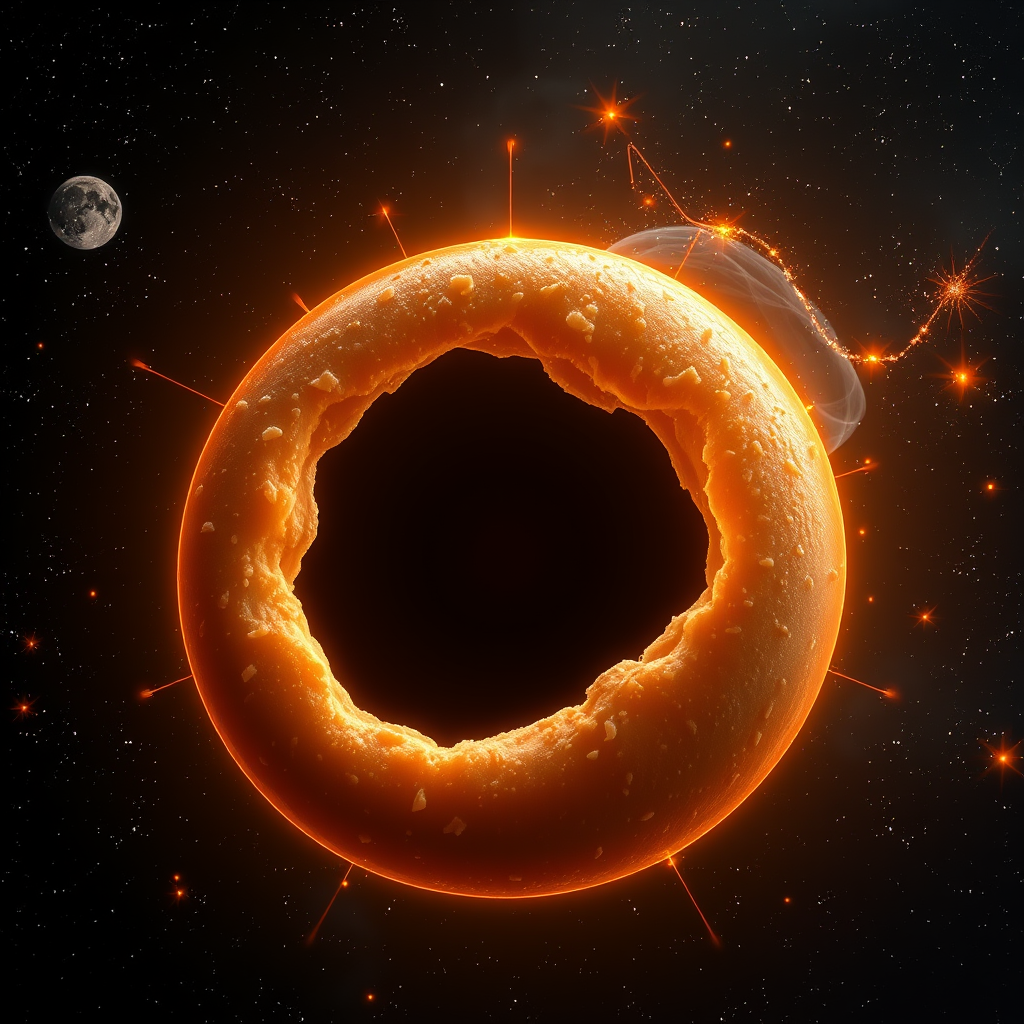
AI-generated image — a conceptual visualization
The Donut You Are Living Inside
So the dough cannot be a black hole. Not here, not in three dimensions. But give the universe one extra direction to move in, and the rule breaks. In 2002, two physicists found an exact solution for a black ring *4 in five dimensions. It was a spinning horizon shaped like a donut, perfectly legal on paper [7]. The math has no objection. Our universe simply never ordered it.
Hypothesis, not an established model: the outer skin of a thickened ring stands in for our universe, the cut-open dough for a black hole's interior. Conceptual visualization.
Now go back to the Asteroids ship. It thought it lived on a flat screen. It lived on a torus. Cosmologists have asked the same question about us. If space itself loops back on itself, light from a distant galaxy could circle around and reach you from two directions. The Planck satellite searched the oldest light in the sky, the cosmic microwave background *5, for repeated patterns like that. It found none, at least on the scales it could check [8]. That rules out a small donut. Not a big one.
Here is what keeps me up. You cannot see the shape of the thing you live inside. The ship couldn't. You can't. Hawking proved the horizon must be round bystanding outside it, on paper. Nobody gets to stand outside the universe. We only get clues from inside.
So which one are you crawling across right now? A flat screen that goes on forever, or a donut so big you will never feel the curve?
Next time, we follow the oldest light back home.
TERMS EXPLAINED
- *1Torus: The shape of a donut or an inner tube. A surface that loops around a hole in the middle.
- *2Topology: A kind of math that only cares about how things are connected, like how many holes something has. It doesn't care about length, size, or exact shape.
- *3Light-year: The distance light travels in one year, about 9.5 trillion kilometers. It measures distance, not time.
- *4Event horizon: The invisible boundary around a black hole. Once you cross it, nothing, not even light, can get back out.
- *5Computer simulation: Solving the equations of gravity step by step on a computer to watch what happens, because they're too hard to solve by hand.
- *6Topological censorship: The rule that any holes or handles in the shape of space stay hidden. No outside traveler can loop through them and return.
- *7Extra dimension of space: A direction beyond up-down, left-right and forward-back. We can't picture it, but the math works fine with it.
- *8Naked singularity: A point where the equations break down and no horizon hides it from the rest of the universe.
- *9Negative cosmological constant: A property of empty space that pulls the universe inward. Ours has the opposite, a push outward.
SOURCES & REFERENCES
- [1]Weeks, J. (2002). "The Shape of Space." Marcel Dekker / CRC Press. — Topology treats a donut and a coffee mug as equivalent because each has one hole; it ignores size and angles.
- [2]Event Horizon Telescope Collaboration (2019). "First M87 Event Horizon Telescope Results. I. The Shadow of the Supermassive Black Hole." The Astrophysical Journal Letters 875, L1. — April 2019 release of a ring-shaped image with a dark center, from about 55 million light-years away, made using a network of telescopes acting as an Earth-sized instrument.
- [3]Hawking, S. W. (1972). "Black holes in general relativity." Communications in Mathematical Physics. — Settled black holes in three spatial dimensions have spherical horizons.
- [4]Carter, B. (1968). "Global Structure of the Kerr Family of Gravitational Fields." Physical Review. — In the Kerr math, a path can pass through the ring into a region where gravity repels and paths through time can loop back on themselves.
- [5]Poisson, E. & Israel, W. (1990). "Internal Structure of Black Holes." Physical Review D. — Infalling energy piles up inside spinning and charged black holes ("mass inflation"), making the tidy interior geometry unstable.
- [6]Hawking, S. W. (1972). "Black Holes in General Relativity." Communications in Mathematical Physics. — In a universe with three dimensions of space, a black hole's horizon must be shaped like a sphere.
- [7]Emparan, R. & Reall, H. S. (2002). "A Rotating Black Ring in Five Dimensions." Physical Review Letters. — With one extra dimension of space, a black hole's horizon can be a ring, held open by its spin.
- [8]Figueras, P., Kunesch, M., & Tunyasuvunakool, S. (2016). "End point of black ring instabilities and the weak cosmic censorship conjecture." Physical Review Letters. — Thin black rings fragment into smaller black holes, possibly exposing naked singularities.
- [9]Lemos, J. P. S. (1995). "Cylindrical black hole in general relativity." Physics Letters B. — Stable toroidal black holes exist with a negative cosmological constant.
- [10]Carter, B. (1968). "Global structure of the Kerr family of gravitational fields." Physical Review. — The singularity inside a spinning (Kerr) black hole is ring-shaped.
- [11]Poisson, E., & Israel, W. (1990). "Internal structure of black holes." Physical Review D. — Infalling radiation makes the inner horizon of a realistic black hole violently unstable.
Inline citations [N] correspond to numbered references above.
A weekly journey from the present universe back to the Big Bang — and to what it means for us.