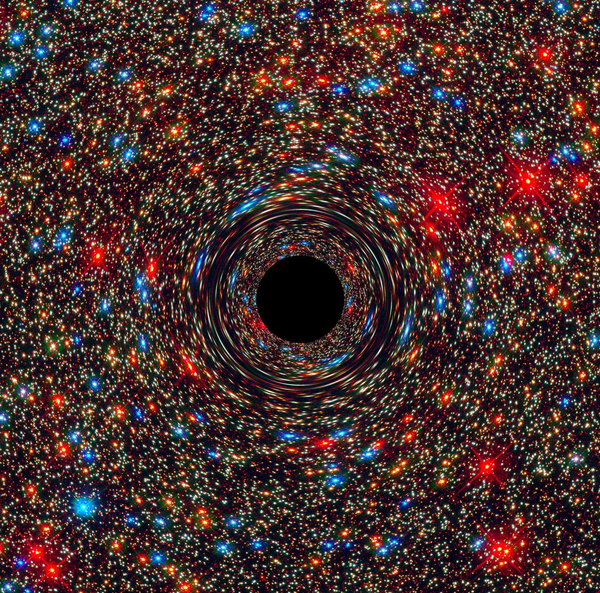
What If Dark Matter Doesn't Exist?
Episode 3: Why Do Galaxies Form a Cosmic Web?
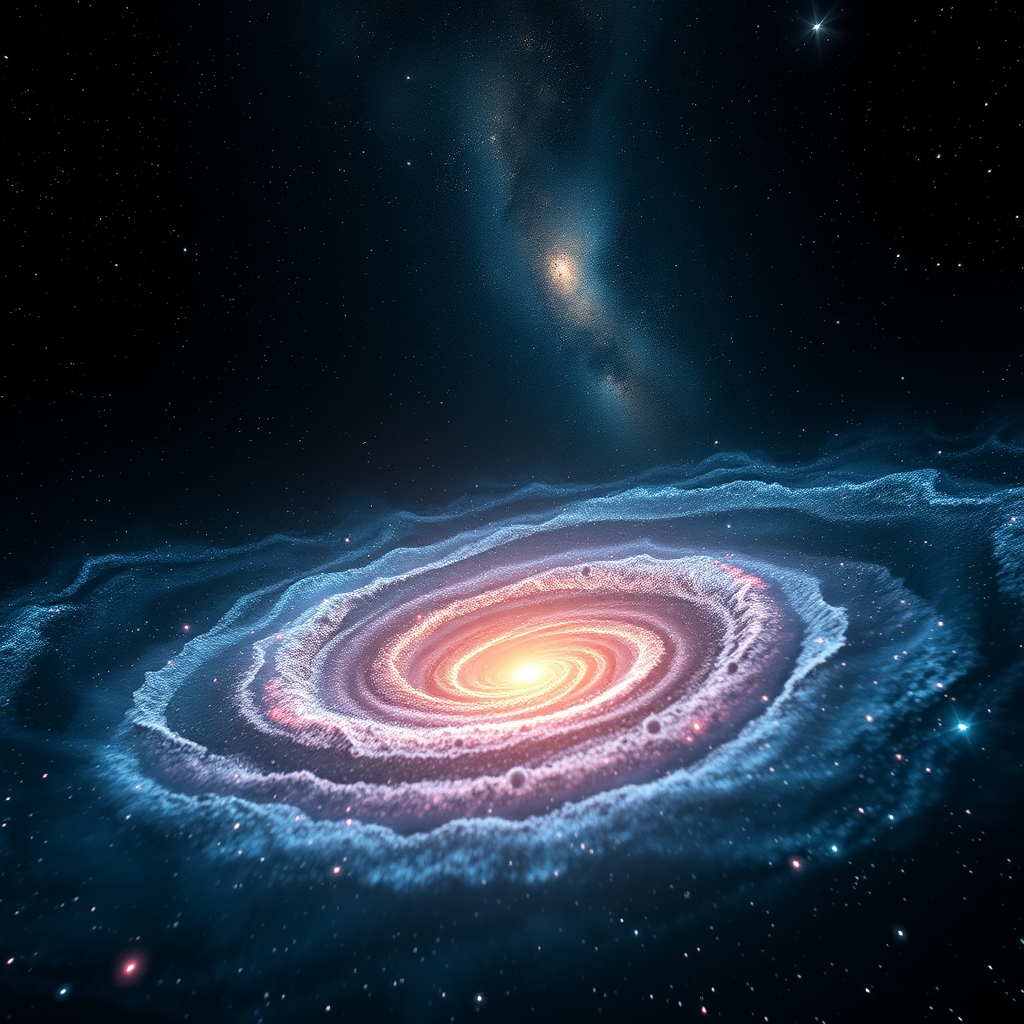
I like science that leaves room to imagine. When things that seemed unrelated turn out to share a hidden pattern — that moment feels like finding one of the world's secrets. Which opens a door I didn't know was there. Which leads somewhere unexpected. Which eventually leads back to me.
You know the feeling. You're eight years old, on the playground roundabout, and someone bigger has decided to spin it faster than is strictly reasonable. Your body wants to leave. There's a line pulling you outward, straight out, and the only thing keeping you on is your hands on the bar and the fact that you are stubborn.
Let go, and you're gone. That's the deal. Spin fast enough, and whatever isn't held on tight enough goes flying.
Everyone has felt this. In a car taking a corner too quickly, when the groceries slide across the back seat. On a bike leaning into a turn, when the world tilts and your stomach tilts with it. It is one of the first physical laws you learn, and nobody has to teach it to you. Spin holds you out. Grip holds you in. If the grip loses, the spin wins.
Now hold that feeling and go outside tonight.
Everything you can see up there is spinning. Not fast in a way you can feel, but fast in a way that should matter. Our sun is on a roundabout too. It's moving around the center of our galaxy at roughly 220 kilometers per second [1]. That's about half a million miles an hour. You are, right now, sitting in a chair, moving faster than any object humans have ever built.
And you're not being flung off. So something is gripping.
The grip is gravity — the mass at the center, the crowded bright bulge of stars, pulling everything inward while the spin tries to throw it out. Fine. That's the same deal as the roundabout, just bigger. This is a solved problem. We had the math for it in 1687.
Here's how the math is supposed to work. In our own solar system, the planets closest to the sun move fastest. Mercury sprints. Neptune crawls. The further out you go, the weaker the pull, and the slower you have to travel to stay in a stable circle. Draw it on a graph and you get a line that starts high on the left and slumps down to the right, like someone losing interest halfway through a sentence. This is not a theory anyone is nervous about. It works for spacecraft. We aim things at Mars using it and the things arrive.
So a galaxy should do the same. Most of its visible mass is packed near the middle. Stars out at the ragged edge should be dawdling, barely held, moving slowly, the way Neptune dawdles.
In the 1960s and 70s, an astronomer named Vera Rubin decided to actually check. She measured how fast stars and gas were moving at different distances from the center of the Andromeda galaxy, our big neighbor. Not the whole thing at once — point by point, working outward [2].
The stars at the edge were not dawdling.
They were moving just as fast as the ones much closer in. The line on the graph didn't slump. It went out flat, and stayed flat, and kept going flat as far as she could measure [2]. Then people checked other galaxies, and other galaxies, and it kept happening. Flat, flat, flat [3].
Think about what that means with your hands on the bar. Those outer stars are on the very rim of the roundabout, the part that whips around hardest, and they're going at full speed. With only the visible stuff pulling on them, they should have been thrown off long ago. Scattered. Galaxies should be coming apart like a wet paper bag.
They aren't. They've been holding together for billions of years.
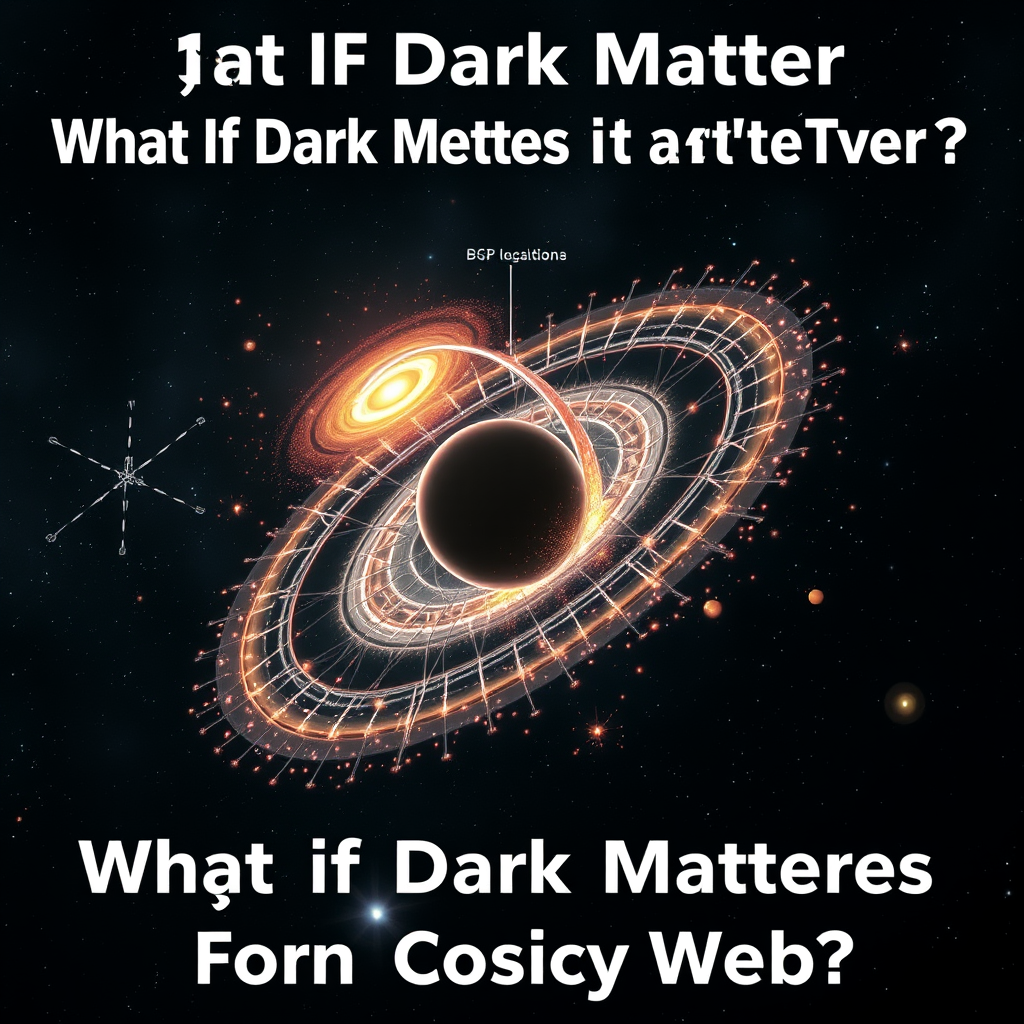
The same cosmic web from another angle. Can gravity alone explain this structure? A conceptual visualization.
So either the rule you learned on the playground is wrong, or somebody is holding on to those stars, and we can't see who.
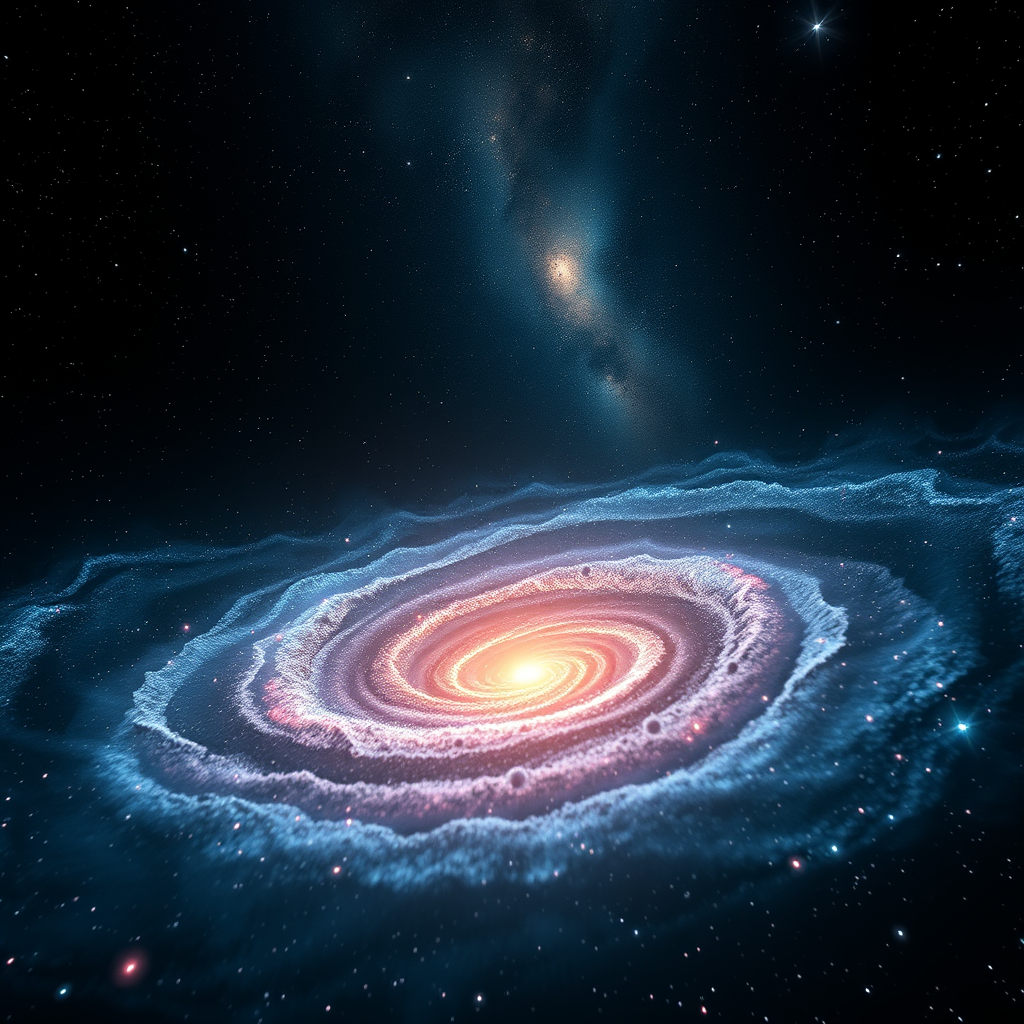
AI-generated image — a conceptual visualization
I want to be honest about how strange this is, because it's easy to hear this story and file it as a puzzle for specialists. It isn't. It's a hole in the middle of the floor. We look at a galaxy, we count every star, every cloud of gas, everyglowing smudge of dust, add it all up honestly — and we come up short. Not by a rounding error. By a factor of five or six [4]. The stuff we can see is the minority. It looks like the whole show because it's the part that lights up, the way a lit window looks like the whole house on a dark street.
There are two ways out of a hole like that.
One: there's more stuff. Something out there with mass, doing its gravitational job perfectly well, that simply doesn't glow, doesn't block light, doesn't announce itself in any way we've learned to listen for. A silent majority.
Two: gravity itself doesn't work the way we think it does once you get far enough from anything. That the rule we tested inside our own tiny solar system — a neighborhood roughly one light-day across, in a galaxy a hundred thousand light-years wide — doesn't scale. We'd be like someone who measured their kitchen and drew a map of the continent.
Most physicists take door one. Some very serious people take door two, and they are not cranks, and they have some uncomfortably good arguments [5].
I don't know which door is right. Nobody does yet.
But here's what I keep circling back to, lying awake: what would it take to convince you that the floor you're standing on isn't there?
Here's the thing about the roundabout. The physics doesn't care about you personally. It cares about two numbers: how fast you're going, and how hard something is holding you in. Grip strength versus speed. That's the whole contest.
Now scale it up.
Picture a running track. A proper stadium one, eight lanes, the kind where the starting blocks are staggered because the outer lanes are longer. Everyone knows the rule: run in lane eight and you cover more ground per lap.
Our solar system is a running track where the outer lanes are also slower. Not because the planets are lazy, but because the Sun's grip weakens with distance. Earth moves around 30 kilometres per second. Neptune, thirty times further out, ambles along at about 5.4 [1]. Neptune is not in a hurry. It doesn't have to be — the Sun is barely tugging on it, and a gentle tug can only hold a gentle orbit. Speed up Neptune, and it leaves. Roundabout rules.
This isn't a guess. It's Kepler's law, worked out four hundred years ago, and it describes the solar system with almost insulting precision [1].
So in the 1970s, when astronomers pointed their instruments at other galaxies to watch the stars go round, they knew what they'd see. A bright crowded centre where the stars whip along fast, and then, further out, a graceful slowing. Lane eight, taking it easy.
That's not what happened.
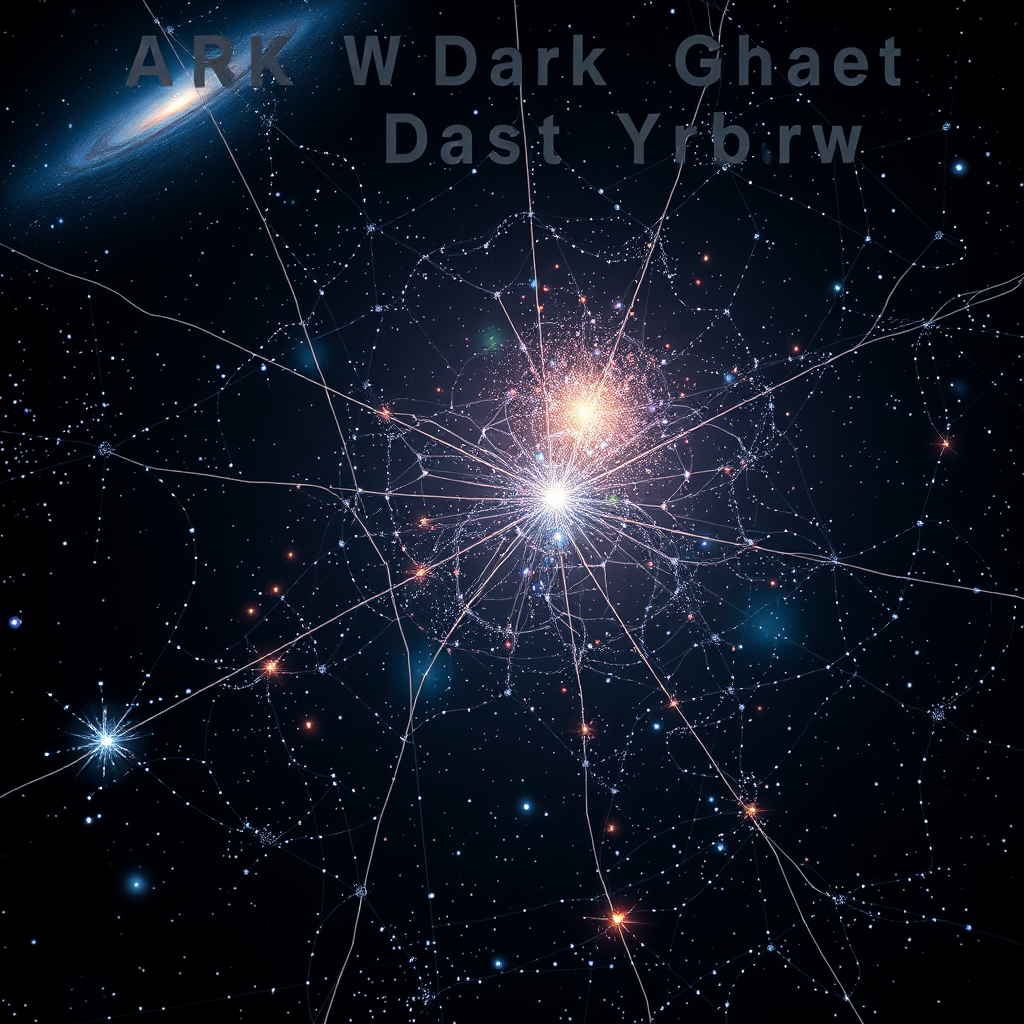
AI-generated image — a conceptual visualization
Vera Rubin and Kent Ford measured the speeds of stars in dozens of spiral galaxies, working outward from the core to the faint edges [2]. The speeds went up. Then they flattened. Then they just... stayed there. Star after star, further and further out, all moving at roughly the same speed as the ones near the middle [2][3]. In our own galaxy, the number is around 220 kilometres per second, and it holds steady out past where the visible stars give up entirely [3].
Imagine watching that stadium race and every runner, lane one to lane eight, crosses the line at the same pace. The outer ones are taking much longer per lap, sure — bigger circle. But their actual pace? Identical.
Something is wrong with the track.
Go back to the roundabout for a second. You're holding on. If someone spins it faster, you need a better grip. If your grip is fixed and the spin keeps increasing, there is a moment — a specific, calculable moment — where you leave. This is not a matter of willpower.
The stars at the edges of galaxies are spinning way too fast for the grip. We can count the stars. We can weigh the gas. We can add up everything that glows, everything that blocks light, everything we can see by any means we have. And the total gravity of all that visible stuff is nowhere near enough to hold those outer stars in orbit [2][4]. They should have flung off into the dark billions of years ago. Whole galaxies should have unravelled like a badly thrown frisbee.
They didn't. They're still here. We're sitting inside one.
So there are exactly two ways out of this, and they are both uncomfortable.
The first: there's more grip than we can see. Something is out there, spread through and around every galaxy, with mass and therefore gravity, but which emits no light, absorbs no light, reflects nothing. A hand on the bar that isn't attached to a visible arm. We call this dark matter *1, and if it exists it outweighs everything we can see by roughly five to one [5]. Which means the universe you've been looking at your whole life is the minority component. The stuff we've written poems about is the froth.
The second way out is stranger, and it's the one that doesn't get the documentaries. Maybe there's no extra stuff. Maybe our rule for grip is simply wrong.
Because here's an uncomfortable detail about Kepler and Newton. We tested those laws in the solar system, where gravity is relatively strong. Then we assumed they hold everywhere, forever, at every strength. That's a big assumption dressed up as common sense. At the ragged edge of a galaxy, gravitational pull drops to something absurdly feeble — around a hundred billionth of what you feel standing on Earth [6]. We have never tested Newton's law down there. Not once. Not in a lab, not anywhere.
In 1983, Mordehai Milgrom proposed that below that specific tiny threshold, gravity stops fading the way we expect and instead holds on harder [6]. Change the rule, and the flat rotation curves *2 fall out of the maths automatically. No invisible matter required.
One idea says the roundabout has a passenger you can't see. The other says the bar you're gripping isn't made of what you think it's made of.
They can't both be right.
Start with a man nobody listened to.
AI-generated image — a conceptual visualization
In 1933, Fritz Zwicky was looking at the Coma Cluster — a swarm of about a thousand galaxies, all orbiting each other in a loose gravitational crowd. He measured how fast they were moving. Then he weighed the cluster by counting the light coming out of it. The numbers didn't just disagree. They disagreed by a factor of hundreds. The galaxies were moving so fast the cluster should have flown apart long ago, like a roundabout spinning off its children [1].
Zwicky's conclusion was blunt. There must be something there we can't see. He called it dunkle Materie. Dark matter *1.
Almost nobody cared for forty years.
Then Vera Rubin picked up a spectrograph and pointed it at Andromeda.
What Rubin and her colleague Kent Ford were doing, in the late 1960s, was measuring the running track. They looked at glowing clouds of gas at different distances from Andromeda's centre and measured how fast each one was circling [2]. Inner lanes, outer lanes. The expectation was the stadium rule: the further out you go, the slower you should travel, because there's less mass pulling on you from inside your orbit. That's how the solar system behaves. Neptune crawls. Mercury sprints.
Andromeda did not do this. The outer gas moved just as fast as the inner gas. The rotation curve *2 went out flat, like a ruler laid across the graph, and stayed flat as far as they could see.
By 1980, Rubin, Ford and Norbert Thonnard had done this for twenty-one spiral galaxies. Same answer every time. Flat, flat, flat [3]. Rubin later wrote that they had "peered into a new world, and have seen that it is more mysterious and more complex than we had imagined" [4].
Here's the fork in the road, and it's still the fork we're standing at.
Option one: there's extra stuff. Invisible mass, spread out in a huge halo around each galaxy, gripping the outer stars and holding them on the roundabout. You need about five times more of it than ordinary matter [5]. It doesn't glow. It doesn't absorb light. It just pulls.
Option two: there is no extra stuff. Our rule for how gravity works is wrong.
Option two has a name, and a father. In 1983, an Israeli physicist named Mordehai Milgrom published three papers proposing what he called Modified Newtonian Dynamics *3 — MOND [6]. His idea was almost insultingly simple. Newton's law of gravity has been tested to death in the solar system, where accelerations are strong. But out at the edge of a galaxy, gravity is unbelievably feeble. What if, below some tiny threshold acceleration, the rule quietly changes?
Milgrom picked a number for that threshold. About 1.2 × 10⁻¹⁰ metres per second squared. It's called a₀. To feel how small that is: at that acceleration, starting from rest, you would take roughly a year to reach walking speed.
And here's the thing that keeps MOND alive, forty years on. It works.
Not vaguely. Precisely. Give Milgrom's formula the visible matter in a galaxy — the stars, the gas, nothing else — and it predicts the rotation curve. Not fits it afterwards. Predicts it. In 2016, Stacy McGaugh, Federico Lelli and Jim Schombert took 153 galaxies of wildly different types, 2,693 individual measurements, and plotted the acceleration you observe against the acceleration the visible matter alone should produce [7]. Giant spirals, dwarf galaxies, gas-rich, gas-poor, chaotic, tidy. They all fell on one line.
One line. With scatter so small it's close to what you'd expect from measurement error alone.
AI-generated image — a conceptual visualization
McGaugh has been fairly direct about what this means: the visible matter tells you the total gravity, everywhere, in every galaxy. If invisible halos are running the show, why do they take their orders so exactly from the stars? He and his co-authors called it a relation that "plays a tantalizing role" no current dark matter model naturally explains [7].
There's a second oddity. Take the speed of light, divide it by the age of the universe, and you get a number suspiciously close to a₀. That's either a profound clue about how local gravity is tied to the whole cosmos, or a coincidence. Nobody knows which. Milgrom himself has always argued for the first reading.
So why isn't everyone a MONDian?
Because of a bullet.
In 2006, Douglas Clowe and colleagues published a paper with a title that doesn't leave much room for negotiation: "A Direct Empirical Proof of the Existence of Dark Matter" [8]. They'd been studying the Bullet Cluster — two galaxy clusters that had smashed straight through each other. The hot gas, which is most of the ordinary matter by mass, collided and got stuck in the middle, glowing in X-rays. The galaxies themselves, being mostly empty space, sailed on past.
Then they mapped where the gravity actually was, using gravitational lensing *4 — the way mass bends the path of light from things behind it, warping distant galaxies into arcs and smears.
The gravity wasn't with the gas. It was out ahead, with the galaxies. Mass and visible matter had come apart, physically, in space. If gravity is just a modified response to visible matter, that shouldn't be possible.
MOND advocates argue back — that the Bullet Cluster is one system, that clusters have always been MOND's weak spot, that some unseen ordinary matter or heavy neutrinos could sit where the lensing does. A neutrino, by the way, is a particle so unwilling to interact with anything that trillions are passing through your thumbnail every second and none of them notice you're there. They have a tiny mass. They are the one form of dark matter we know for certain exists. There just aren't nearly enough of them.
But the deepest problem for "no dark matter" isn't the Bullet Cluster. It's the thing this whole episode is about. It's the web.
Here's the sequence. For the first 380,000 years, the universe was too hot for atoms to hold together. Light couldn't travel — it just bounced off loose electrons, over and over, the way headlights bounce in fog. Then it cooled, the electrons got captured, the fog cleared, and that ancient light has been flying ever since. We see it today as the cosmic microwave background *5, a faint glow coming from every direction at once, the oldest thing you can look at.
It is almost perfectly smooth. Almost. There are ripples in it, temperature differences of about one part in a hundred thousand — the seeds of everything [9]. Every galaxy, every cluster, every strand of the cosmic web grew out of those bumps.
Now, why does this matter for dark matter?
Because ordinary matter, in that early universe, could not clump. It was electrically charged and tangled up with light, and light pushes back. Every time gravity tried to pull ordinary matter into a lump, radiation pressure shoved it out again. The stuff sloshed — in and out, in and out — sound waves in a plasma the size of the visible universe. Those are called baryon acoustic oscillations, and we can see their fingerprints in the ripple pattern [10].
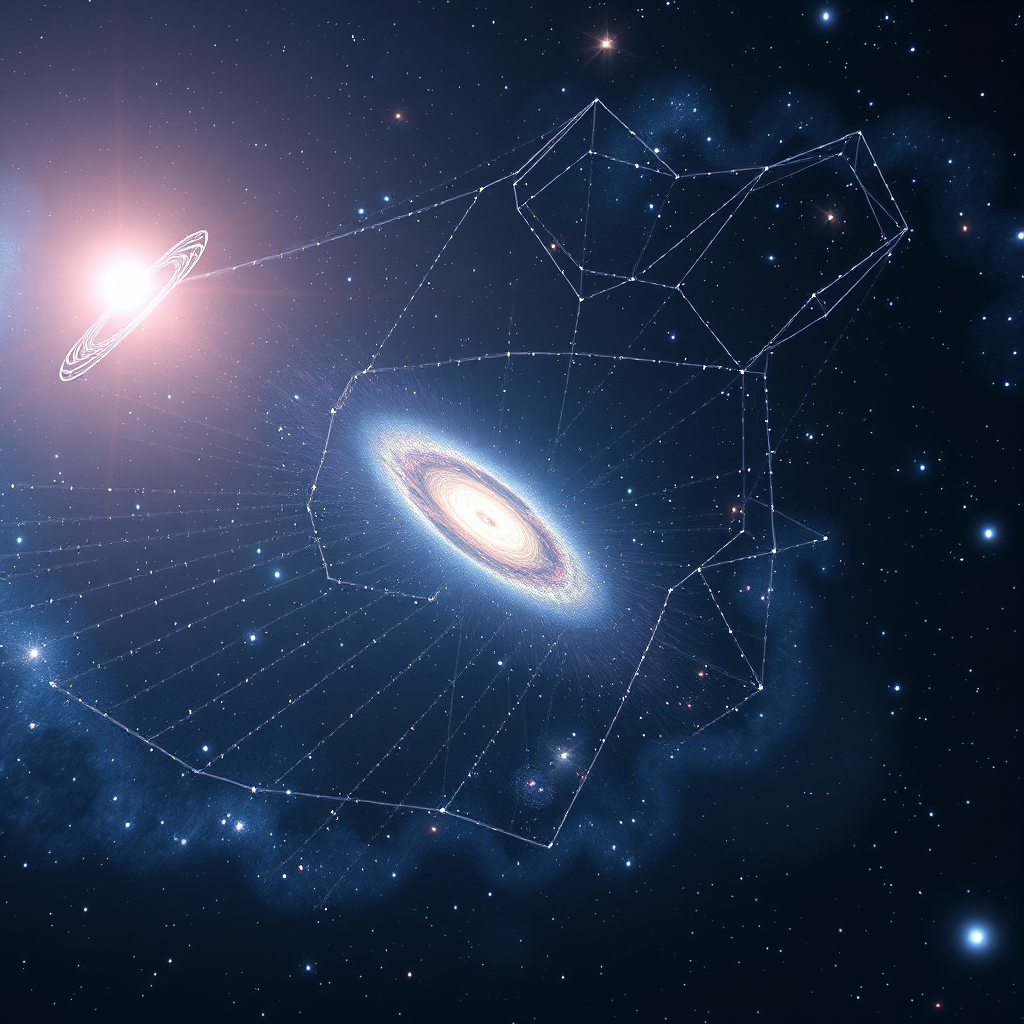
Dark matter feels none of this. No charge, no interaction with light. It could start collapsing immediately, while ordinary matter was still stuck in the sloshing. So by the time the fog cleared, dark matter had already dug the valleys. Ordinary matter simply rolled into holes that were waiting for it.
AI-generated image — a conceptual visualization
Take that head start away, and there isn't enough time. You get thirteen billion years of gravity trying to build structure from a standing start, and what you'd see today wouldn't look like the universe we live in.
The Planck satellite measured those ripples with brutal precision. The pattern of them — the relative heights of the peaks in what's called the power spectrum — is a fingerprint of what the early universe was made of. The 2018 results give the recipe: about 5% ordinary matter, about 26% dark matter, the rest dark energy [11]. The dark matter isn't fudged in to make things work. It's read straight off the sky, and the same number then correctly predicts things it wasn't tuned for.
Then there are the simulations. In 2005, Volker Springel and the Virgo Consortium ran the Millennium Simulation — ten billion particles of dark matter, evolved from just after the Big Bang to now, on a supercomputer for over a month [12]. What came out was filaments, sheets, empty voids, dense knots where clusters sit. The cosmic web, grown from nothing but gravity and cold dark matter.
Then the galaxy surveys came back with their maps. And the maps looked like the simulation.
That is a genuinely uncomfortable thing for MOND. Milgrom's formula was built to describe rotating galaxies, and at that job it is startlingly good. Scaling it up to the whole universe — making a version that's compatible with Einstein's relativity, that can grow the web, that can reproduce the Planck peaks — has proved brutally hard. Jacob Bekenstein produced the most serious attempt, TeVeS, in 2004 [13]. It was a real theory, and it was later shown to have trouble with the observed speed of gravitational waves [14]. Work continues. Constantinos Skordis and Tom Złośnik published a relativistic MOND-like model in 2021 that does reproduce the microwave background pattern [15] — a genuine achievement, and one that most people, including its authors, would call a work in progress rather than a victory.
So where does that leave you?
With something honest and a bit unsatisfying. Dark matter wins at the largest scales — the web, the ancient light, the Bullet Cluster. MOND wins at the smallest — the flat rotation curves, that single tight line McGaugh found across 153 galaxies, the fact that you can predict a galaxy's spin from its stars alone. Each theory is strongest exactly where the other is weakest.
And after ninety years of looking, nobody has caught a dark matter particle. The favourite candidate for decades was the WIMP *6 — a heavy, sluggish particle that ignores light and almost ignores everything else. Detectors went underground, into old mines, shielded from cosmic rays, waiting for one to nudge a single atom. LUX-ZEPLIN, currently the most sensitive of them, has run for years and found nothing [16]. The search space keeps shrinking. The particle keeps not showing up.
Which doesn't mean it isn't there. It means it's shy, or it's lighter than we thought, or it's something else entirely — axions, primordial black holes, or a whole hidden family of particles that talk only to each other.
Or it means Milgrom was right about something, and we haven't yet worked out what.
Twenty-six percent of everything. That's the honest headline. A quarter of the universe is a thing we have named, mapped, weighed, and never once held.
If we can be this wrong about the most common kind of matter there is — what else is standing right next to us, doing nothing but pulling?
Here's the part that should bother you.
We have never seen it. Not once. Dark matter is the majority of the matter in the universe — about five times more of it than everything made of atoms [1] — and in ninety years of looking, nobody has caught a single particle of it in a laboratory.
AI-generated image — a conceptual visualization
Not for lack of trying. There are detectors buried under mountains, in old gold mines, tanks of liquid xenon chilled and shielded and watched around the clock, waiting for one atom to twitch. The LZ experiment in South Dakota ran for 280 days and found nothing [2]. Every generation of detector gets more sensitive. Every generation finds the same thing, which is nothing. We have named this stuff, funded it, built underground cathedrals for it, and it has not returned a single call.
So there's an obvious question. What if we're wrong about the whole thing?
In 1983, Mordehai Milgrom suggested the problem isn't missing matter. It's gravity. His idea, MOND *1, says that when gravitational pull gets extremely weak — weaker than anything you'd feel in the solar system — it stops fading the way Newton said it should [3]. Tweak the law, and galaxy rotation curves fall out naturally. No invisible stuff required.
And here's the uncomfortable thing: it works embarrassingly well. Give MOND the visible matter in a spiral galaxy, and it predicts the rotation speed. Not fits — predicts. Across galaxies spanning a factor of a hundred in mass [4]. Dark matter, meanwhile, has to be poured into each galaxy in exactly the right amount, like a recipe you adjust after tasting.
But MOND has a problem, and the problem is scale.
Go bigger than a galaxy and it starts to fail. In galaxy clusters — Zwicky's territory — MOND still leaves a gap. You have to add some unseen mass anyway [5]. And then there's the Bullet Cluster: two clusters that smashed through each other, where the hot gas piled up in the middle from the collision while the gravity, mapped by how the light of background galaxies bends around it, stayed out with the galaxies on either side [6]. Something passed straight through. Something that doesn't collide with anything, including itself. That's hard to explain by rewriting gravity. That looks like stuff.
And the cosmic web — the reason we're here — is the strongest argument of all. Run the early universe forward on a computer with only ordinary matter and you don't get filaments and voids in the time available. You get soup. Dark matter, which ignores light and starts clumping earlier, builds the scaffolding first. Ordinary matter falls in afterwards [1].
So where does that leave you?
With two ideas, each of which is excellent at exactly the thing the other one is bad at. MOND owns individual galaxies. Dark matter owns clusters, the web, the whole large-scale shape of everything. Neither one has swallowed the other. Some people are now trying hybrids, and other people find hybrids inelegant, and "inelegant" is doing a lot of load-bearing work in that sentence.
I want to be honest about the state of this. Most cosmologists think dark matter is real, and they have very good reasons. But "most experts think" is not the same as "we found it." Those are different sentences and we should stop letting them blur together.
What we actually know is this. Something is holding galaxies together that we cannot see. Something built the filaments. Whatever it is, it either has no interest in light whatsoever, or it isn't a thing at all and our equations have a soft spot we haven't found yet. Both of those are extraordinary. One of them is going to be true.
And here's what gets me at two in the morning. Every atom you're made of — the iron in your blood, the calcium in your teeth, the oxygen you just breathed — belongs to the minority. The unusual fraction. The exception. You're not the main ingredient in the universe. You're the trim.
The cosmic web is the shape of a substance we've never touched. Your galaxy sits in one of its strands like a bead on a wire we can't see the wire of. And you, reading this, are made from the leftovers, sitting on a rock, doing arithmetic about the stuff you're
So here's the other option, the one that doesn't get invited to as many conferences.
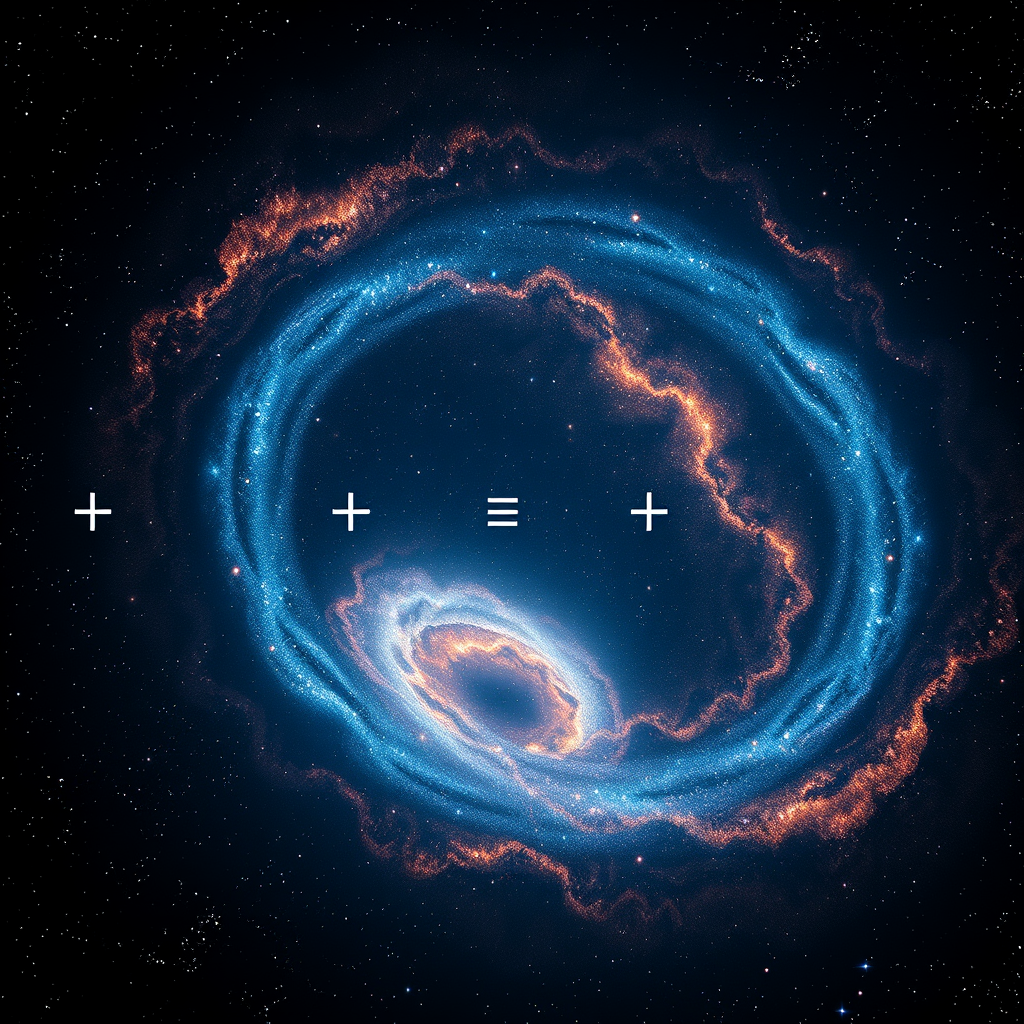
AI-generated image — a conceptual visualization
Maybe there's no invisible stuff. Maybe gravity itself is different out there.
In 1983, Mordehai Milgrom suggested that when gravitational pull gets very weak — weaker than about one ten-billionth of what you feel standing on Earth — it stops fading the way Newton said it should. Tweak the law, and galaxies spin exactly right, no ghost particles required [2]. This idea is called MOND *1, and the embarrassing thing is how well it works. It predicted the rotation of galaxies we hadn't discovered yet [3]. A theory that predicts things it wasn't built to explain is a theory you have to take seriously.
And then it hits a wall.
In 2006, astronomers watched two galaxy clusters that had smashed through each other. The hot gas — most of the ordinary matter, the stuff you could in principle touch — piled up in the middle, slowed by the collision. But the gravity didn't. Most of the mass had sailed straight through, untouched, and sat out on the wings [4]. Modified gravity struggles with that. It's hard to separate gravity from matter if gravity is only ever a property of matter.
So we're stuck with two uncomfortable options. Either the universe is mostly made of something we cannot see, cannot catch, and cannot name. Or one of the most tested laws in the history of science is quietly wrong in the places we can't run experiments.
Pick your discomfort.
But here's what pushed me over. Dark matter isn't just a fix for spinning galaxies. It's the reason there are galaxies at all. In the early universe, ordinary matter was locked in a hot glowing fog, toohot to clump. Push it together and it pushed right back, radiation shoving it apart faster than gravity could pull it in. Nothing could grow. Nothing could collapse into anything.
Dark matter had no such problem. Light passes straight through it. So while ordinary matter was still churning in the fog, the dark stuff was already collapsing quietly in the dark, building deep wells of gravity [5]. When the fog finally cleared, the ordinary matter — the hydrogen that would become stars, planets, the calcium in your teeth — rolled downhill into structures that were already waiting for it.
The scaffolding came first. We arrived later and moved in.
That's the strands. That's the web. Every filament of galaxies stretching across the sky is ordinary matter draped over something we cannot see, like frost picking out a window screen at dawn [6]. You're not looking at the structure of the universe. You're looking at where the structure of the universe got dusty.
And that's what keeps me up. Not that dark matter might not exist. That if it doesn't, we don't just lose a particle — we lose the reason anything is here in a shape at all. Every galaxy, every star, every arrangement of atoms complicated enough to wonder about itself, sitting on a foundation we've never touched and can't describe.
Next time, we go further back. Before the galaxies. Before the fog cleared. To the moment the universe first decided that some places would have slightly more stuff in them than others — because everything after that, including you, is just a consequence of that first faint unevenness.
What were you built on, and how would you ever know?
TERMS EXPLAINED
- *1Rotation curve: A graph of how fast things orbit a galaxy at different distances from its center. Expected to fall off with distance; observed to stay flat.
- *2Light-year: The distance light travels in a year — about 9.5 trillion kilometers. A unit of distance, not time, despite the name.
- *3MOND: The idea that gravity itself behaves differently when it gets extremely weak, so no invisible matter is needed.
- *4Gravitational lensing: Mass bends light. Look through a heavy object and the galaxies behind it appear stretched into arcs — and from the stretching you can weigh what's in the way.
- *5Cosmic microwave background: The leftover glow from when the universe first became transparent, 380,000 years after the Big Bang. It fills the whole sky.
- *6WIMP: Weakly Interacting Massive Particle. A hypothetical heavy particle that passes through ordinary matter almost undisturbed — the long-running favourite candidate for dark matter, still not found.
SOURCES & REFERENCES
- [1]Reid, M. J., et al. (2014). "Trigonometric Parallaxes of High Mass Star Forming Regions: The Structure and Kinematics of the Milky Way." The Astrophysical Journal. — The sun's orbital speed around the galactic center, approximately 220–240 km/s.
- [2]Rubin, V. C., & Ford, W. K. (1970). "Rotation of the Andromeda Nebula from a Spectroscopic Survey of Emission Regions." The Astrophysical Journal. — Measurement of Andromeda's flat rotation curve.
- [3]Rubin, V. C., Ford, W. K., & Thonnard, N. (1980). "Rotational Properties of 21 Sc Galaxies with a Large Range of Luminosities and Radii." The Astrophysical Journal. — Flat rotation curves confirmed across many spiral galaxies.
- [4]Planck Collaboration (2020). "Planck 2018 Results VI: Cosmological Parameters." Astronomy & Astrophysics. — Ratio of dark matter to ordinary matter in the universe, roughly 5 to 1.
- [5]Famaey, B., & McGaugh, S. (2012). "Modified Newtonian Dynamics (MOND): Observational Phenomenology and Relativistic Extensions." Living Reviews in Relativity. — Serious modified-gravity alternatives to dark matter and their observational successes.
- [6]Milgrom, M. (1983). "A modification of the Newtonian dynamics as a possible alternative to the hidden mass hypothesis." The Astrophysical Journal, 270, 365. — Proposal that gravity deviates from Newtonian behaviour below an acceleration of about 1.2 × 10⁻¹⁰ m/s², and that this reproduces flat rotation curves without invisible matter.
- [7]McGaugh, S., Lelli, F. & Schombert, J. (2016). "Radial Acceleration Relation in Rotationally Supported Galaxies." Physical Review Letters. — 153 galaxies, 2,693 points, single tight relation.
- [8]Clowe, D. et al. (2006). "A Direct Empirical Proof of the Existence of Dark Matter." Astrophysical Journal Letters. — Bullet Cluster lensing offset from the gas.
- [9]Smoot, G. et al. (1992). "Structure in the COBE Differential Microwave Radiometer First-Year Maps." Astrophysical Journal Letters. — Discovery of CMB temperature ripples at one part in ~100,000.
- [10]Eisenstein, D. et al. (2005). "Detection of the Baryon Acoustic Peak in the Large-Scale Correlation Function of SDSS Luminous Red Galaxies." Astrophysical Journal. — Acoustic oscillations imprinted on matter distribution.
- [11]Planck Collaboration (2020). "Planck 2018 results. VI." Astronomy & Astrophysics. — Cosmic budget: ~5% ordinary matter, ~26% dark matter.
- [12]Springel, V. et al. (2005). "Simulations of the formation, evolution and clustering of galaxies and quasars." Nature. — Millennium Simulation producing the cosmic web.
- [13]Bekenstein, J. (2004). "Relativistic gravitation theory for the modified Newtonian dynamics paradigm." Physical Review D. — TeVeS.
- [14]Boran, S. et al. (2018). "GW170817 Falsifies Dark Matter Emulators." Physical Review D. — Gravitational wave speed constraints on TeVeS-type theories.
- [15]Skordis, C. & Złośnik, T. (2021). "New Relativistic Theory for Modified Newtonian Dynamics." Physical Review Letters. — Relativistic MOND model reproducing CMB structure.
- [16]LZ Collaboration (2023). "First Dark Matter Search Results from the LUX-ZEPLIN Experiment." Physical Review Letters. — Null result, tightest WIMP limits to date.
Inline citations [N] correspond to numbered references above.
A weekly journey from the present universe back to the Big Bang — and to what it means for us.
![[Deep Dive] Scale-free localization in pseudo-Hermitian quantum walk](/content/images/size/w600/2026/10/deep_dive_thumb-9.png)