The Ring Singularity: A Rotating Black Hole Is a Torus
Episode 5: Black Holes Are Also Donuts
I like science that leaves room to imagine. When things that seemed unrelated turn out to share a hidden pattern — that moment feels like finding one of the world's secrets. Which opens a door I didn't know was there. Which leads somewhere unexpected. Which eventually leads back to me.
Have you ever stood over a bathtub and watched the water leave? At first it just sinks. Then it starts to turn. And right above the drain, something odd happens. A hollow opens in the middle [1]. A thin tunnel of air, wrapped in a spinning wall of water. The center isn't a point anymore. It's an empty ring.
You've seen this a hundred times. You probably didn't think about it, because you were standing there wet and slightly cold, which is not when most people do their best physics.
Here's another one. A figure skater spins with her arms out. Then she pulls them in, and suddenly she's a blur. Nobody pushed her. She didn't kick off anything. The universe simply won't let spin disappear. When spinning stuff moves closer to the center, it has to turn faster to keep the same total amount of spin [2]. Physicists call that amount angular momentum *1. You can think of it as a spin budget. It can be moved around, but you can't spend it.
Now look up. Nothing out there sits still. The ground under you is moving east at about 1,670 kilometers per hour if you live near the equator [3]. The Sun turns once every 25 days or so at its middle [4]. And the Sun itself is swinging around the center of our galaxy, one lap every couple of hundred million years [5]. When a cloud of gas collapses to form a new star, it spins up as it shrinks, exactly like the skater [6]. Spin isn't a special feature of a few things. It's the default setting of everything.
So here's the thought I can't put down. What happens when you squeeze a spinning thing as far as it can possibly go? Further than a skater's arms. Further than a star. Down past anything we can see, past anything we can measure. The spin budget doesn't vanish. It has to go somewhere.
In the bathtub, spin refused to let the center stay a point. It pulled the middle open. Is that just a quirk of water and drains? Or is it something deeper, a rule that holds all the way down?
When nature is forced to choose between a point and a ring, which one does it pick?
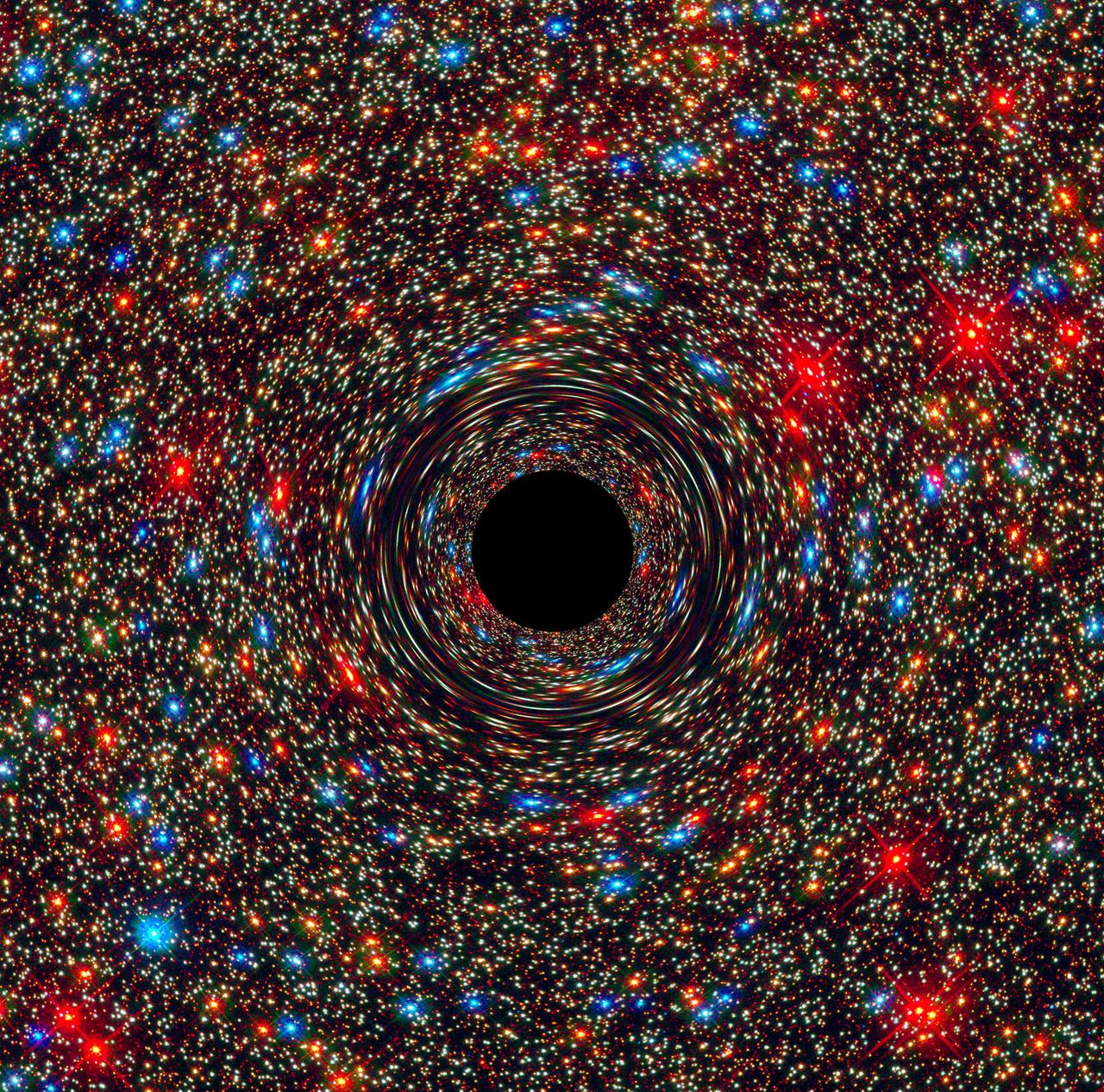
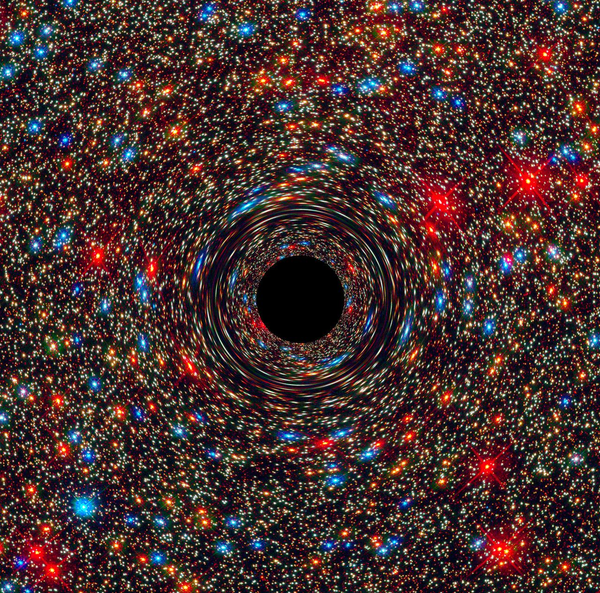
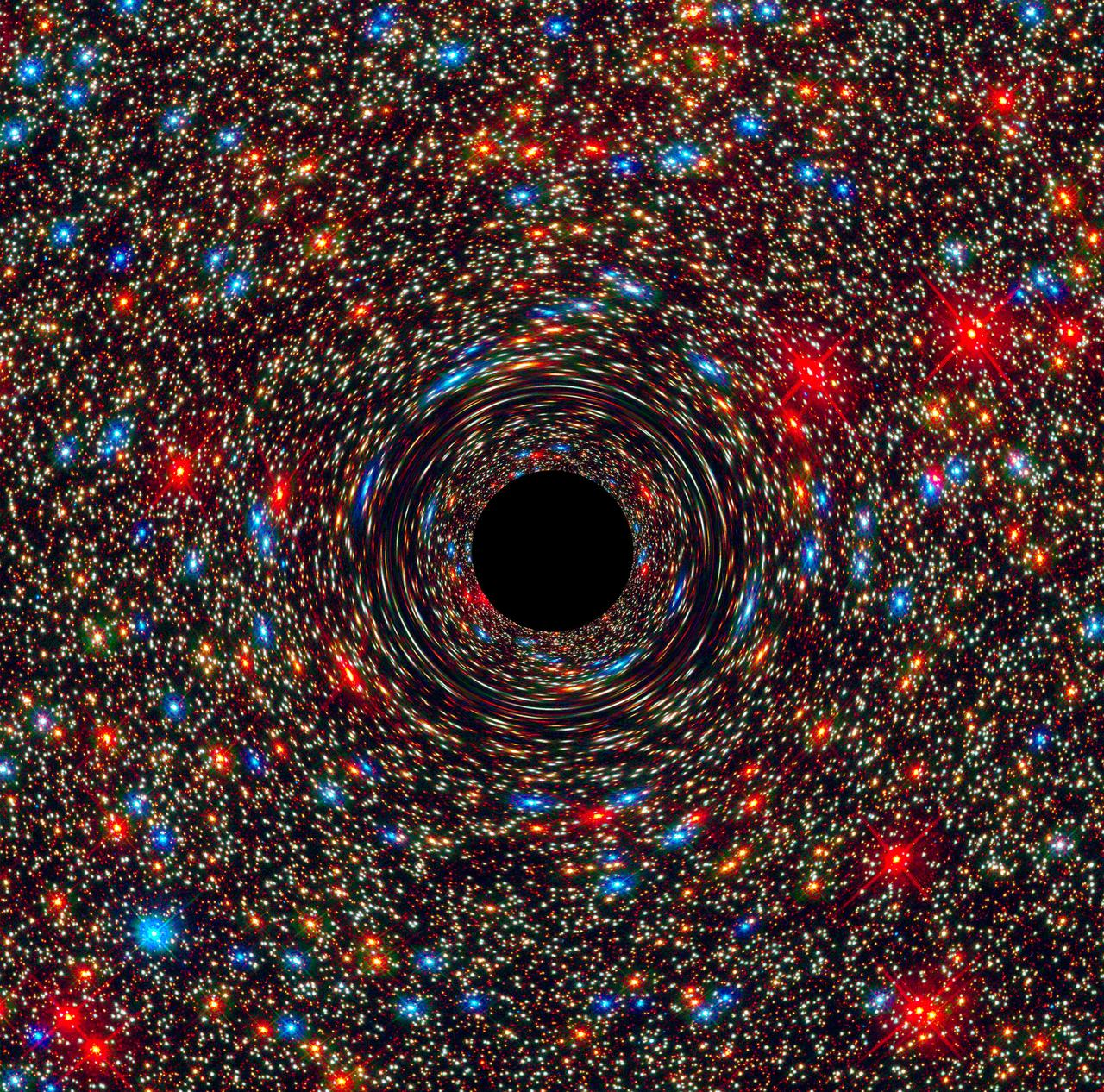
📷 Behemoth Black Hole Found in an Unlikely Place — GSFC (NASA Image and Video Library, Public Domain)
The Pizza Chef Who Can't Hit Zero
Picture a pizza chef in a small kitchen. He takes a ball of dough, flattens it, and tosses it into the air with a flick of the wrist. It spins. And as it spins, something happens to the middle. It gets thinner. The dough runs away from the center and piles up at the edge. Spin it too hard and the middle tears open. Now he's holding a ring. A very sad, very expensive bagel.
That chef is doing what a dying star does. Just with more flour.
When a giant star collapses, gravity pulls everything inward. If the star weren't turning at all, the math says the matter would crush down to a single point [1]. Zero size. No edges. That point is the singularity *1, the place where our equations stop making sense.
But nothing in the universe is perfectly still. Stars rotate. And rotation carries something called angular momentum *2, which is a fancy way of saying spin refuses to disappear [2]. A figure skater pulls her arms in and spins faster. She can't pull them in all the way to nothing, because the spin has to go somewhere. A collapsing star has the same problem. The closer the matter gets to the center, the faster it whirls, and the harder it resists meeting in the middle.
So it doesn't meet in the middle. In 1963, a New Zealand mathematician named Roy Kerr found the exact solution to Einstein's equations for a spinning black hole [3]. The singularity in his answer isn't a point. It's a ring [3][4]. A loop with nothing in the center, lying flat along the black hole's equator, hidden inside the event horizon *3. The faster the black hole spins, the wider that ring becomes [4].
Here is the strange part. In Kerr's math, the hole in the donut is a real hole. You could, on paper, fly through the middle of the ring without touching it [5]. And on the other side? The equations describe a region where gravity seems to push instead of pull, and where paths loop back in time [5]. That sounds like science fiction. Honestly, it might be. Most physicists suspect the inside of a real black hole is far messier than Kerr's clean solution, and that this tidy tunnel would collapse long before anyone could use it [6]. We don't know. Nobody has been inside to check, and nobody who goes will send a postcard.
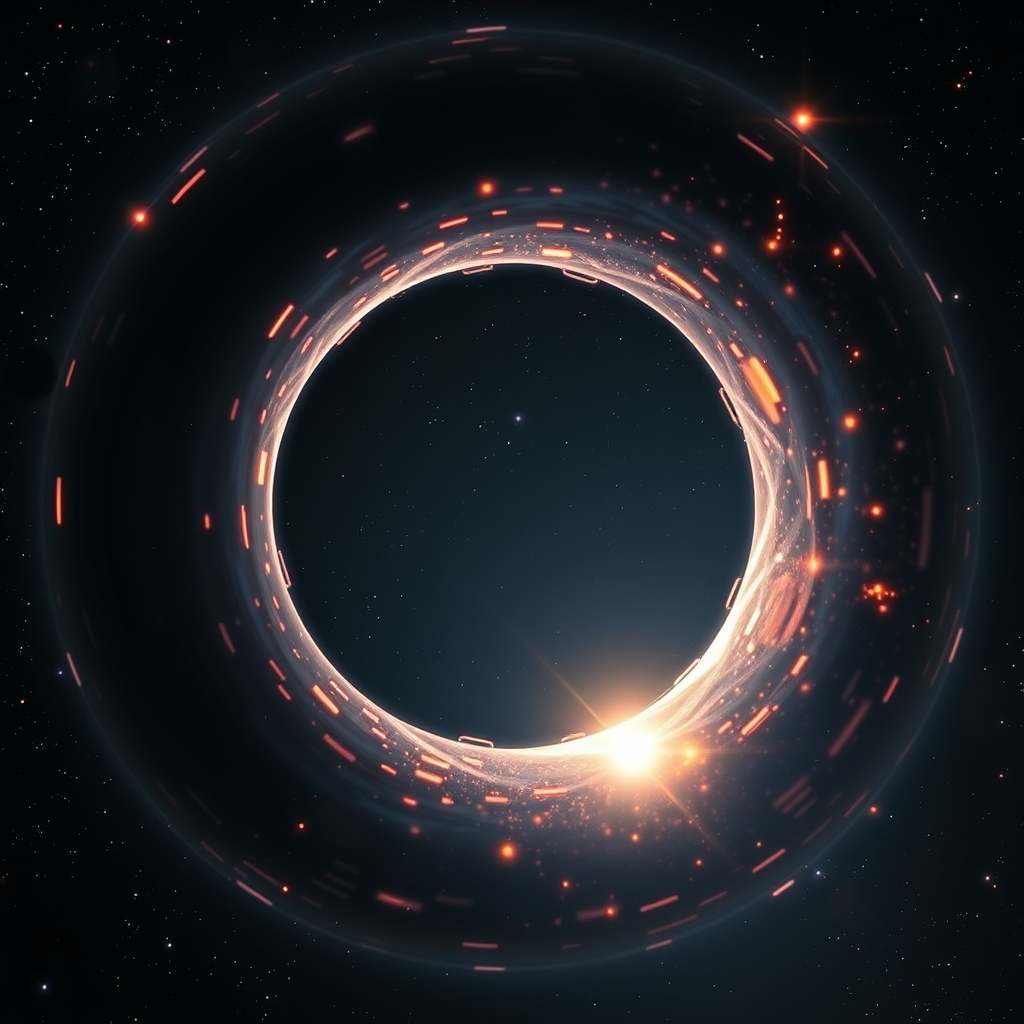
AI-generated image — a conceptual visualization
What we do know is that real black holes spin. When telescopes photographed the black hole in the galaxy M87, the image matched what a spinning Kerr black hole should look like [7]. So the donut isn't just a mathematical curiosity. It's probably sitting at the heart of most galaxies, including ours.
Go back to the chef. Go back to your bathtub. Same story both times. Spin keeps the center empty. The universe, it turns out, doesn't like to let spinning things collapse into nothing. It keeps a hollow open, right where you'd expect the crush to be worst.
The Ring Roy Kerr Found
In 1915, Einstein wrote down the equations of general relativity [1]*1. They describe how mass bends space and time. They look tidy on paper. They are not tidy. Solving them exactly, for anything real, is brutally hard.
A few weeks later, Karl Schwarzschild managed it for one case [2]. He was a German astronomer serving on the Russian front in the First World War. He took the simplest object he could imagine, a ball of mass that doesn't move or spin, and found what Einstein's equations say about the space around it. Hidden in his answer was a point where the math breaks. All the mass crushed into zero size. Infinite density. Physicists now call that a singularity *2.
For almost fifty years, that was the picture. A black hole was a point wrapped in darkness.
There was one problem. Nothing in the universe sits still. Stars spin. Planets spin. You are spinning right now, at hundreds of kilometers per hour, just by standing on Earth. A star that collapses doesn't stop turning. It turns faster, like a skater pulling in her arms. So Schwarzschild's black hole was a beautiful answer to a question nature never asks.
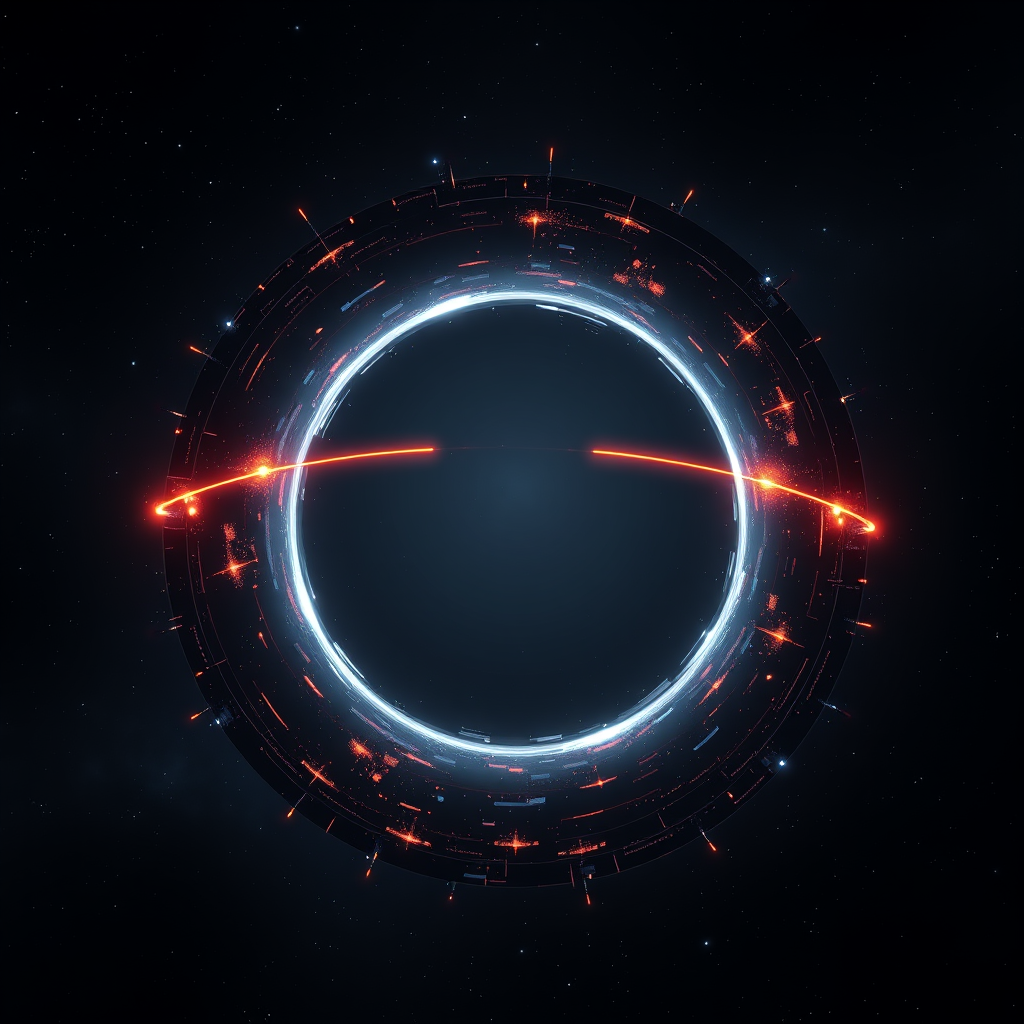
AI-generated image — a conceptual visualization
Then, in 1963, a young mathematician from New Zealand named Roy Kerr published a two-page paper [3]. Its title was "Gravitational Field of a Spinning Mass as an Example of Algebraically Special Metrics." Not the kind of title that makes headlines. But inside was the thing nobody had found: an exact solution for a spinning black hole.
The story goes that when Kerr presented it at a big astrophysics conference in Dallas that year, much of the audience ignored him [4]. People talked among themselves. Some left. One of the most important results in the history of gravity was received roughly like a fire safety announcement.
It took a few more years for people to understand what Kerr had written down. Robert Boyer and Richard Lindquist found a cleaner way to describe it in 1967 [5]. Then Brandon Carter, a physicist at Cambridge, mapped the whole structure in 1968 [6]. And that's where the donut appears.
In Kerr's black hole, the singularity is not a point. It's a ring [6]. It lies flat, in the plane where the black hole spins, like the edge of the pizza dough after the middle has torn open. Its size depends on how fast the black hole turns *3. No spin, and the ring shrinks to Schwarzschild's point. More spin, and it opens wider.
Coordinate sketch of an idealised Kerr black hole (M = 1, spin a = 0.9): the ring singularity of radius 0.9, both horizons and the ergosurface. Brightness and transparency are for illustration only.
And here is the part that made me put down whatever I was holding. The middle of the ring is empty. Carter showed that, in the math, you could fall toward a spinning black hole, slip through the hole in the donut without touching the singularity, and come out somewhere else entirely [6]. A region the equations describe but nobody can picture. Near the ring, the math gets stranger still. It allows paths through time that loop back on themselves [6]*4. Loops where you could, in principle, arrive before you left.
That's what the bathtub was trying to tell you. Spin hollows out the center. In water, the hollow is filled with air. In a Kerr black hole, it may be filled with a door.
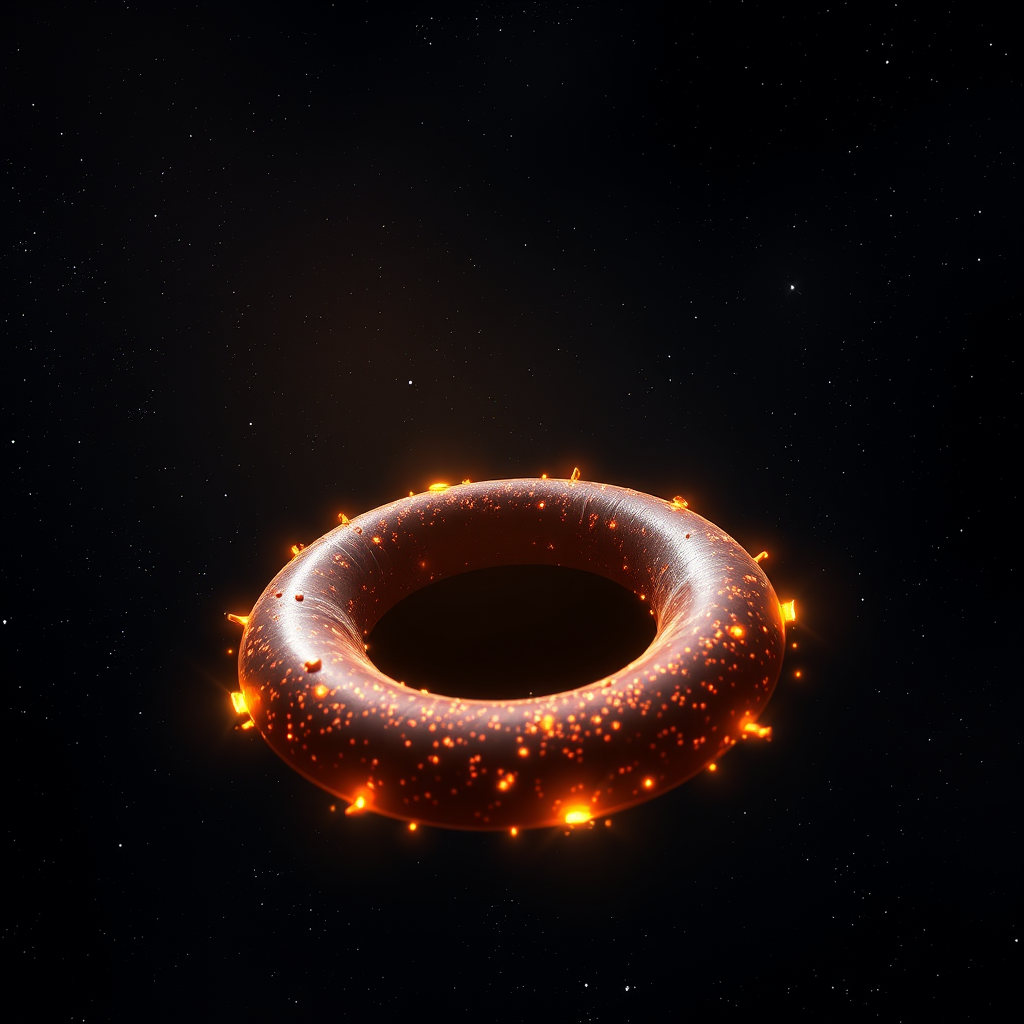
AI-generated image — a conceptual visualization
Before you pack a bag, there's a catch. Actually, several.
A spinning black hole has two horizons, not one. The outer one is the event horizon *5, the edge past which nothing returns. Deeper in, there's an inner horizon *6. Roger Penrose suggested back in 1968 that this inner boundary might be unstable [7]. In 1990, Eric Poisson and Werner Israel worked out why [8]. Light and matter falling in get piled up and squeezed at the inner horizon. Their energy grows without limit. They called it "mass inflation." It's a wall of energy building up exactly where the tunnel is supposed to start.
So the elegant ring, and the doorway through it, may never form in a real black hole. The perfect Kerr solution might be like the perfect pizza toss in a textbook. True on paper. Messier in the kitchen.
But here's the strange twist. Outside the horizon, Kerr's math seems to be exactly right. Physicists believe that a settled black hole is described by just a few numbers: mass, spin, and electric charge, which in practice is close to zero. Everything else about the star that made it is erased. And if that's true, every real black hole in the universe is a Kerr black hole on the outside.
The Indian-American astrophysicist Subrahmanyan Chandrasekhar, who won a Nobel Prize for his work on dying stars, couldn't get over this. He wrote: "In my entire scientific life, extending over forty-five years, the most shattering experience has been the realization that an exact solution of Einstein's equations of general relativity, discovered by the New Zealand mathematician, Roy Kerr, provides the absolutely exact representation of untold numbers of massive black holes that populate the universe" [9].
Shattering. From a man who did math for fun.
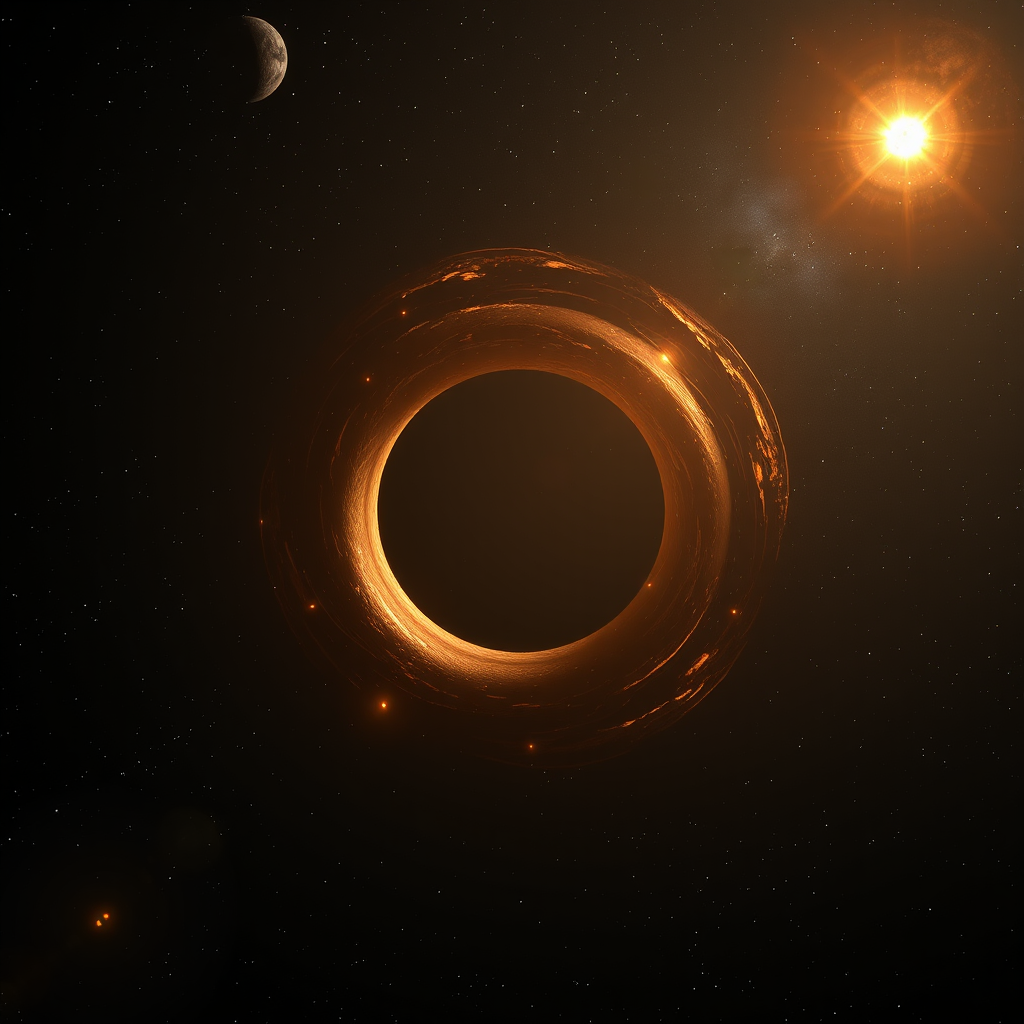
AI-generated image — a conceptual visualization
And we now have evidence these things really spin. In 2015, the LIGO detectors caught the ripples in space from two black holes colliding [10]. The black hole left behind was spinning, with about two-thirds of the maximum spin the theory allows [10]. In 2019, the Event Horizon Telescope took the first image of a black hole, at the center of the galaxy M87 [11]. The glowing ring in that photo fits the predictions for a spinning black hole [11]. That's not the singularity itself, which we'll never see. It's light circling just outside. Still, a donut, photographed from 55 million light-years away.
Now the honest part. Nobody knows what's really at the center. Penrose proved in 1965 that, under general relativity, collapse leads to something going badly wrong inside [12]. That work earned him a Nobel Prize. But "something going wrong" is not the same as "a ring of infinite density." Most physicists suspect that, at those scales, Einstein's equations stop being the right tool. Quantum effects take over, and we don't have a working theory for that yet.
Even Kerr isn't sure his ring exists. In 2023, at almost ninety, he posted a paper with the blunt title "Do Black Holes have Singularities?" [13]. He argued that the proofs everyone leans on don't actually show that singularities must form. The man who found the donut is now asking whether there's anything in the middle of it.
I find that oddly comforting. Sixty years after his discovery, the person who knows this object best is still saying: I'm not sure.
So think about where that leaves you. Every black hole out there is spinning. Each one, according to the best math we have, is shaped by that spin into something with a hole in its heart. Maybe a ring. Maybe a door. Maybe a wall of fire where the door should be. And maybe something we don't have a word for yet.
If the center of a spinning black hole is a doorway, where does it open?
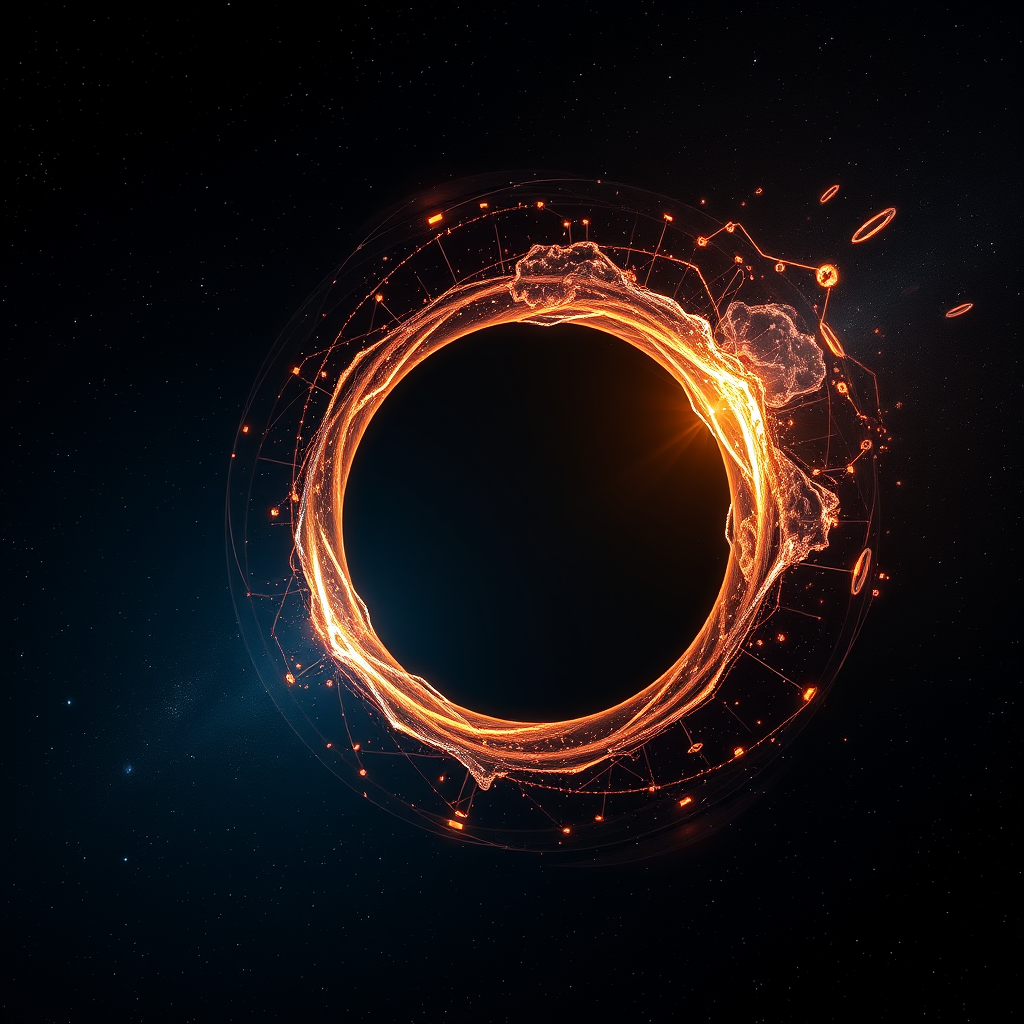
AI-generated image — a conceptual visualization
Nobody Has Seen the Donut
Here's the uncomfortable part. The ring is a prediction. Nobody has seen it. Nobody ever will, at least not and lived to file a report.
Roy Kerr found the spinning solution in 1963 [1]. It describes a black hole that has always existed, perfectly calm, alone in an empty universe. Real black holes aren't like that. They're born from collapsing stars. They eat gas. They get hit by things. And the deep interior of Kerr's solution is fragile. Before you reach the ring, you'd cross a second, inner horizon *1. In 1990, Eric Poisson and Werner Israel showed that energy falling in piles up there, without limit [2]. The calm interior may not survive contact with reality.
So does the ring even form? We don't know. Recent mathematical work suggests the inner horizon holds together in a weakened, crumpled way [3]. What lies beyond it is still open. The donut might be a feature of a perfect equation, not of the universe.
It gets stranger. Take Kerr's math seriously and you can pass through the ring. On the other side, gravity pushes instead of pulls, and paths exist that loop back in time [4]*2. Most physicists read this as a warning light, not a travel brochure. A singularity *3 is where the equations stop making sense. It usually means the theory has been pushed past where it works. To know what really happens there, we need a theory of quantum gravity *4. We don't have one. People have been trying for nearly a century.
Meanwhile, in 2019, the Event Horizon Telescope photographed the shadow of the black hole in the galaxy M87 [5]. It fits a spinning Kerr black hole well. From the outside. The horizon hides everything else. Roger Penrose suspected nature always hides its singularities like this [6].
So you live in a universe that draws a curtain around its own broken places. At the center of every spinning black hole sits something you cannot see, describe, or reach. Maybe that curtain is only where our math runs out. Maybe it's something deeper, a rule we haven't found yet. The next time you watch the water spin down the drain, you're looking at a shape the universe may use too. Is that curtain protecting the universe from the broken place, or protecting us from learning how little we understand?
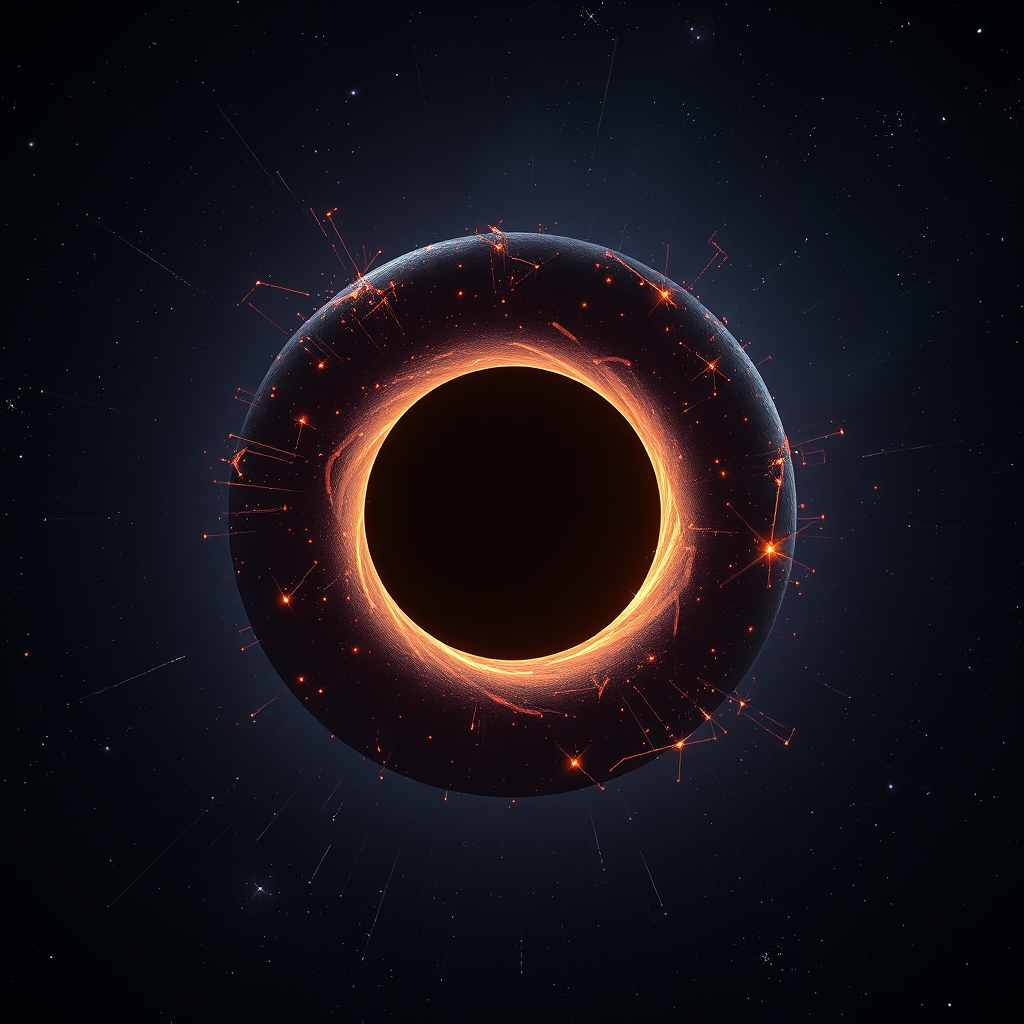
AI-generated image — a conceptual visualization
Everything You Love Is Spinning
So here's where I've landed. Nature doesn't seem to like points. Give anything a little spin, and the center opens. Bathtub water. Pizza dough. A dying star, crushed past the point of return. Kerr's math says the same rule may hold even there, where the rules supposedly end [1]*1.
And almost nothing in the universe stands still. Astronomers have measured a black hole spinning at more than ninety-eight percent of the fastest spin a black hole can have [2]*2. Our solar system takes about 230 million years to circle the galaxy once [3]. The ground under your chair is turning right now, about 1,670 kilometers per hour at the equator, and you didn't feel a thing [4]. You are, technically, riding a merry-go-round with no exit.
That makes me rethink the word "center." We use it for the heart of things. The center of a city. The center of your life. We assume there's a point in there, something solid you could put your finger on. But maybe anything that moves long enough hollows out in the middle. Maybe the center of a spinning thing isn't a place at all.
That spin had to come from somewhere. Stars got it from clouds. Clouds got it from galaxies. Galaxies got it from something earlier, and next time we follow that thread backwards.
And if you stopped circling for one moment, what would you find in the middle of your own life?
TERMS EXPLAINED
- *1Angular momentum: The total "amount of spin" something has, which depends on how fast it turns and how far its mass sits from the center. Pull the mass inward and it has to spin faster to keep the total the same.
- *2Angular momentum: The amount of spin something has. It can be passed around but never simply vanishes, so shrinking objects spin faster to keep the total the same.
- *3Event horizon: The invisible boundary around a black hole. Cross it and nothing, not even light, can come back out.
- *4Closed loops in time: Paths through space and time that circle back to their own starting moment. If you could follow one, you would return to where you began before you set out. The math allows them near the Kerr ring. No one knows if nature does.
- *5Event horizon: The outer edge of a black hole. Cross it, and no direction leads back out, not even for light.
- *6Inner horizon: A second boundary deeper inside a spinning black hole. In the ideal math, it marks the edge of the region near the ring. In reality, it may be where infalling energy piles up into a destructive wall.
SOURCES & REFERENCES
- [1]Andersen, A., Bohr, T., Stenum, B., Rasmussen, J.J., Lautrup, B. (2003). "Anatomy of a Bathtub Vortex." Physical Review Letters. — Draining vortices form a hollow air core at the center.
- [2]Feynman, R., Leighton, R., Sands, M. (1963). "The Feynman Lectures on Physics, Vol. I, Ch. 18–20." Addison-Wesley. — Conservation of angular momentum; a spinning body speeds up as mass moves inward.
- [3]Williams, D.R. (2024). "Earth Fact Sheet." NASA Goddard Space Flight Center. — Earth's equatorial rotation speed of about 1,670 km/h.
- [4]Williams, D.R. (2024). "Sun Fact Sheet." NASA Goddard Space Flight Center. — The Sun rotates roughly once every 25 days at its equator.
- [5]Bland-Hawthorn, J., Gerhard, O. (2016). "The Galaxy in Context: Structural, Kinematic, and Integrated Properties." Annual Review of Astronomy and Astrophysics. — The Sun's orbital speed and distance around the galactic center, implying a period of roughly 200+ million years.
- [6]Bodenheimer, P. (1995). "Angular Momentum Evolution of Young Stars and Disks." Annual Review of Astronomy and Astrophysics. — Collapsing gas clouds spin up as they contract to form stars.
- [7]Event Horizon Telescope Collaboration (2019). "First M87 Event Horizon Telescope Results. I. The Shadow of the Supermassive Black Hole." Astrophysical Journal Letters. — M87 image consistent with a spinning Kerr black hole.
- [8]Poisson, E. & Israel, W. (1990). "Internal Structure of Black Holes." Physical Review D 41, 1796. — Mass inflation at the inner horizon of rotating and charged black holes.
- [9]Chandrasekhar, S. (1987). "Truth and Beauty: Aesthetics and Motivations in Science." University of Chicago Press. — Quotation on the Kerr solution as the exact description of real black holes.
- [10]Abbott, B. P. et al. (LIGO and Virgo Collaborations) (2016). "Observation of Gravitational Waves from a Binary Black Hole Merger." Physical Review Letters 116, 061102. — Detection of GW150914; final black hole spin about 0.67.
- [11]Event Horizon Telescope Collaboration (2019). "First M87 Event Horizon Telescope Results. I. The Shadow of the Supermassive Black Hole." Astrophysical Journal Letters 875, L1. — First black hole image, about 55 million light-years away, consistent with a Kerr black hole.
- [12]Penrose, R. (1965). "Gravitational Collapse and Space-Time Singularities." Physical Review Letters 14, 57. — Singularity theorem showing collapse breaks general relativity's description of spacetime.
- [13]Kerr, R. P. (2023). "Do Black Holes have Singularities?" arXiv:2312.00841. — Kerr's argument that the standard singularity proofs do not show that singularities must form inside black holes.
Inline citations [N] correspond to numbered references above.
A weekly journey from the present universe back to the Big Bang — and to what it means for us.