The Quantum Fingerprint in the Sky
Episode 4: The Universe's First Photograph
I like science that leaves room to imagine. When things that seemed unrelated turn out to share a hidden pattern — that moment feels like finding one of the world's secrets. Which opens a door I didn't know was there. Which leads somewhere unexpected. Which eventually leads back to me.
Somewhere in your house there is probably a photograph of you as a baby. You have no memory of the moment. You were there, you were the whole subject of the picture, and yet the person in it is a stranger to you. Someone else had to tell you what was happening that day.
Now hold that feeling, because there is another photograph like that. It is a picture of everything, taken before there were eyes, before there were stars, and you are in it. Not you specifically. But every atom that would eventually be assembled into your hands is somewhere in that frame, smeared out, waiting.
Here is the strange part. For most of the twentieth century, you could see a piece of that photograph on your television.
If you are old enough to remember analog TV *1, you remember the snow. The channel that wasn't a channel. That gray, hissing chaos between stations, which somehow felt lonelier than silence. Most of that noise came from the electronics of the set and from human broadcasts bouncing around. But a small slice of it — a percent or so — was not from Earth at all [1]. It was ancient light, arriving from every direction at once, stopping in your living room after a journey of roughly 13.8 billion years [2].
The people who found it did not want to find it. In 1964, two radio astronomers in New Jersey had a horn-shaped antenna and a hiss they could not get rid of [3]. They checked the wiring. They pointed it at different parts of the sky and the hiss stayed exactly the same, which is the astronomical equivalent of hearing a sound in your car that follows you home. They eventually evicted a pair of pigeons nesting inside the antenna and scrubbed out what one of them politely described as a white dielectric material. The hiss remained. It turned out to be the oldest thing anyone had ever detected [3].
And when we finally built instruments good enough to look at it closely, the picture was not smooth. It had texture. Faint hot spots and cold spots, differences of about one part in a hundred thousand [4] — the ripples that would eventually collapse into galaxies, into stars, into the carbon in your blood.
Those ripples had to come from somewhere. And the best explanation we have is that they were, originally, something almost too small to say out loud.
So what were you looking at, all those nights, when nothing good was on?
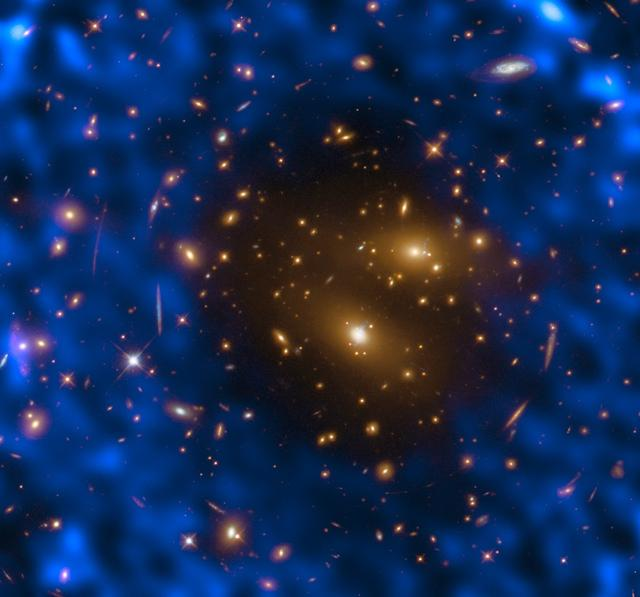
📷 The Big Bang left a permanent scar in the cosmic background, 5 billion light-years from Earth — GSFC (NASA Image and Video Library, Public Domain)
Film Grain the Size of Galaxies
Try this tonight. Take your phone into a dark room and photograph the wall. Not a dramatic wall. Just a wall.
What you get back is not black. It's speckle. A fine sandy noise crawling across the image, because a camera sensor can never sit perfectly still — there's always a faint jitter in the electronics, and with nothing else to photograph, the camera photographs its own restlessness.
Now imagine you could blow that speckle up. Not a little. Take one grain of that noise, one pixel's worth of random twitch, and enlarge it until it's the width of a continent. The blurry edge of the grain becomes a coastline. Its faint bright center becomes a mountain range.
That is, more or less, what happened to the universe.
Empty space has the same problem as your camera. It can't hold perfectly still. At very small scales, the amount of energy in a patch of nothing is always flickering slightly up and slightly down — quantum fluctuations *1, the built-in fidget of reality. Physicists have known about this jitter for a century. It's not a flaw in our instruments. It's a feature of the floor.
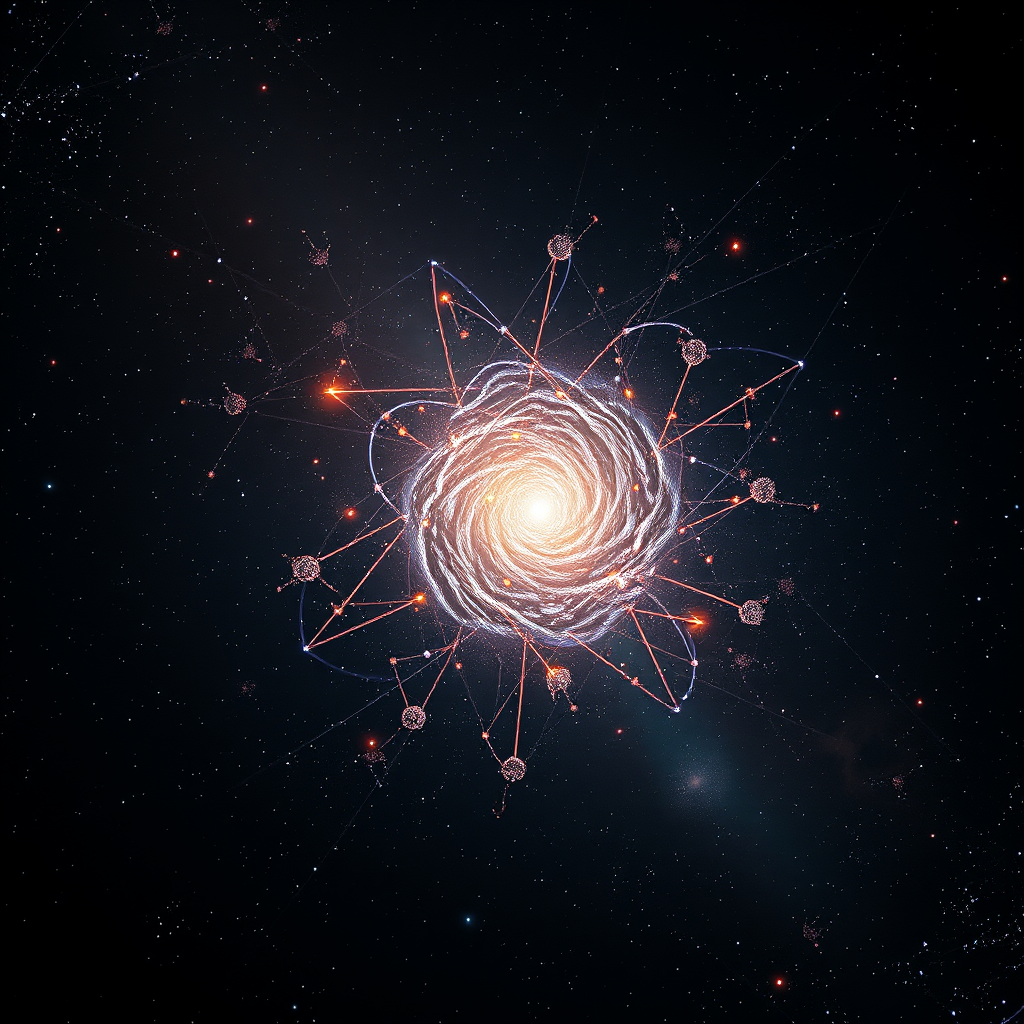
Here's the part that still knocks me sideways. In the first sliver of a second, the universe went through a period called inflation *2 — a burst of expansion so violent that a region smaller than a proton was stretched to something like the size of a grapefruit or larger, in roughly a trillionth of a trillionth of a trillionth of a second [1]. Space itself blew up the negative.
And the jitter got blown up with it [2].
The random twitches in that tiny patch — quantum noise, the kind of thing that normally only matters to individual particles — were suddenly frozen at enormous scale. Too big to jiggle away. They became real, permanent lumps in the density of the early universe: some places a hair denser, some a hair thinner.
AI-generated image — a conceptual visualization
We can see the lumps. In the light from that first photograph, the temperature varies from place to place by about one part in a hundred thousand [3]. Which is nothing. If your bath water varied that much you'd need laboratory equipment to notice. But that nothing is everything. The denser spots pulled in a little more gas by gravity, and the gas collected, and the collecting made more gravity, and after a few hundred million years those hairline differences had become the first stars [4].
Every galaxy you can point at is a magnified glitch.
I find this hard to hold in my head, so I keep going back to the camera. The sensor noise in your phone photo is meaningless. Nobody builds anything out of it. But run the same noise through an expansion of that scale and the speckle stops being an error and starts being an address — this is where a galaxy goes, this is where a void goes, this is where, eventually, someone stands in a dark room photographing a wall.
The universe took a picture of its own restlessness. Then it moved in.
The Wrinkles Nobody Expected to Find
Start with the number, because the number is the strange part.
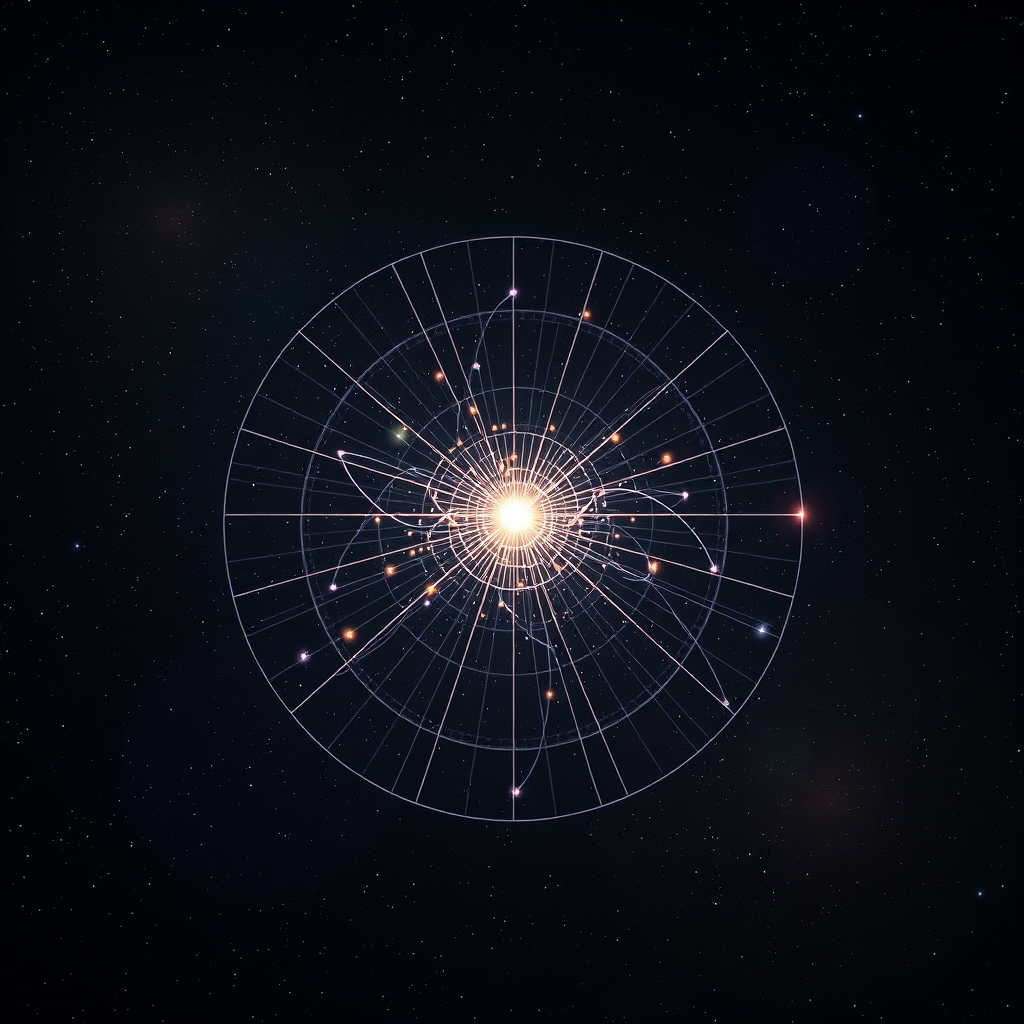
The sky, in microwaves, has a temperature. It is 2.7255 kelvin — about 455 degrees below zero Fahrenheit, cold enough that "cold" stops being a useful word [1]. Point a sensitive antenna anywhere and you get that same reading. Up, down, toward the constellations you know, toward the ones you don't. Same.
Same to about one part in one hundred thousand [2].
AI-generated image — a conceptual visualization
That kind of sameness is not comforting. It's suspicious. Nothing in nature is that uniform by accident.
The signal was found by accident, though. In 1964, Arno Penzias and Robert Wilson were working with a horn antenna in New Jersey and could not get rid of a hiss [3]. They checked the electronics. They pointed it at different parts of the sky. They evicted a pair of pigeons from the horn and cleaned out what they described in print as "white dielectric material," which is the most dignified phrase anyone has ever used for bird droppings. The hiss stayed. It was the leftover heat of the universe, and it won them a Nobel Prize.
For the next twenty-eight years, the problem was the opposite. The glow was too smooth. If the early universe had been perfectly even, nothing would ever have clumped. No galaxies. No stars. No planet with pigeons on it. There had to be lumps in the early soup, and nobody could find them.
Then COBE *1. In April 1992, George Smoot's team announced that the satellite had seen the variations — temperature differences of roughly thirty millionths of a degree between one patch of sky and another [2]. Smoot told the press conference that if you're religious, it's like looking at God [4]. He got some grief for that. But understand the scale of what had just happened: the map of those wrinkles is the map of where everything would eventually be.
Here is what the pattern is not. It is not a picture of objects. There's no galaxy in it, no shape you'd recognize. It's a field of hot and cold blotches, and the only thing physicists can say about any individual blotch is: that one's random. The information lives in the statistics — how much contrast there is at large scales versus small scales. A pattern of noise with a very specific personality.
The CMB temperature pattern, dominated by features about one degree across: the imprint of acoustic waves grown from early quantum fluctuations. Conceptual visualization. Background map: ESA / Planck Collaboration.
And the claim on the table, the one that makes this whole episode worth your evening, is that the personality of that noise was set by quantum mechanics *2 when the universe was unimaginably younger than one second old.
Here's the plain version of why empty space can't stay quiet. The uncertainty principle says you cannot pin down certain pairs of quantities at the same time. For a field filling space, that means you can't have it sitting at exactly zero and also not changing at all. Nature won't allow that much precision. So even a perfect vacuum ripples — tiny, fleeting, everywhere, all the time. Not a flaw in the theory. A requirement of it.
Those ripples are microscopic. Absurdly microscopic. They should have nothing to do with the arrangement of galaxies across billions of light years.
AI-generated image — a conceptual visualization
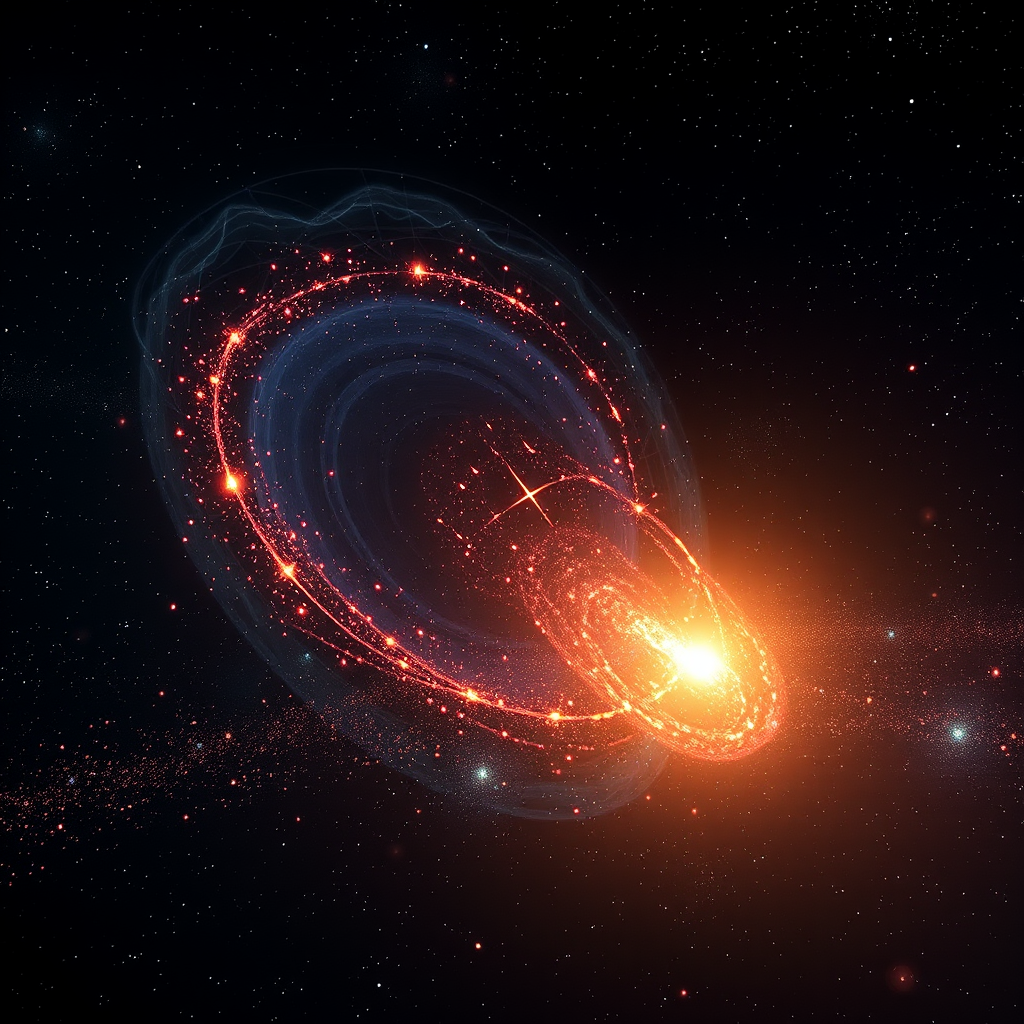
Unless something took them and stretched them.
That something is inflation *3 — the proposal that the infant universe went through a brief episode of ferociously accelerating expansion. Alan Guth published the version that caught on in 1981 [5]; Alexei Starobinsky had worked out a related model just before [6]; Andrei Linde, Andreas Albrecht and Paul Steinhardt fixed its early problems shortly after [7]. The stretch factor is at least e to the sixtieth power. You do not need to picture that. Just know it takes something smaller than a proton and makes it bigger than the observable sky.
And the ripples get stretched with it. What was a quantum jitter becomes a region of space very slightly denser than its neighbors. Then gravity has something to work with, and it works on it for thirteen billion years.
The first person to actually do the calculation was Viatcheslav Mukhanov, with Gennady Chibisov, in 1981 [8]. They showed that quantum fluctuations in an inflating universe would come out the other side with a nearly scale-invariant *4 spectrum — roughly the same amount of wrinkle at every size. That prediction of near-scale-invariance had been guessed at in the early seventies by Edward Harrison and Yakov Zel'dovich on purely aesthetic grounds [9]. Mukhanov and Chibisov derived it from quantum mechanics. In 1982, at a workshop in Cambridge, Stephen Hawking, Guth and So-Young Pi, Starobinsky, and James Bardeen with Steinhardt and Michael Turner all converged on essentially the same result [10].
But here's the part that turns it from a story into science. The spectrum shouldn't be exactly scale-invariant. Inflation has to end, so conditions drift slightly while the fluctuations are being laid down, and that drift tilts the pattern — a little more contrast at large scales than small ones. The tilt is measured by a number called the spectral index *5, written n-sub-s. Perfectly even would be exactly 1. Inflation says slightly less.
The Planck satellite measured it: 0.9649, plus or minus 0.0042 [11].
Less than one. Not by much. But by far more than the error bars allow you to shrug off. Somebody wrote down a small deviation from a round number in 1981 based on the uncertainty principle, and thirty-seven years later a spacecraft found it.
There's a second fingerprint. Quantum fluctuations should be random in a particular mathematical way — Gaussian *6, the bell-curve kind of random, with no strange skew. Planck looked hard for a skew and found none, to tight precision [12]. Consistent with the simplest quantum origin.
AI-generated image — a conceptual visualization
Guth has a line about all this that I can't improve on. He calls the universe "the ultimate free lunch" [13].
Now the honesty. Nobody knows what actually drove inflation. There's a field in the equations, the inflaton, and we have no independent evidence it exists and no idea what it is. There are hundreds of candidate models. And the cleanest possible confirmation — primordial gravitational waves, which would leave a twist in the polarization of the microwave light — has not been found. The BICEP/Keck collaborationhas been hunting that twist for years. In 2014 they thought they had it; the signal turned out to be dust in our own galaxy [14]. Their current result is not a detection but a ceiling: whatever those primordial waves are, they're smaller than a certain size [15].
There are also people who think the whole framework is wrong. Steinhardt — one of the physicists who built inflation — has spent years arguing it predicts too much, that it generates every possible outcome somewhere and therefore predicts nothing you can test [16]. That argument is not settled. It may not be settled in your lifetime.
So hold two things at once. The pattern in that sky is real, mapped to extraordinary precision, and its statistical shape matches what you'd get if quantum noise had been inflated to cosmic size. And we still cannot tell you what did the inflating.
Which leaves you with this. The blotches in that map are the reason there is structure anywhere — the reason matter pooled here instead of spreading evenly into nothing. Your galaxy sits in one of the denser patches. Which means the specific location of the Milky Way, the specific fact that there was material here for a sun to form out of, traces back to a fluctuation that was, at the moment it happened, not required to happen.
The camera in the dark room photographs its own restlessness. The universe did the same thing, once, and then blew the picture up until we could live inside it.
If everything you can see grew from a random wobble in nothing — what were the wobbles that didn't get stretched?
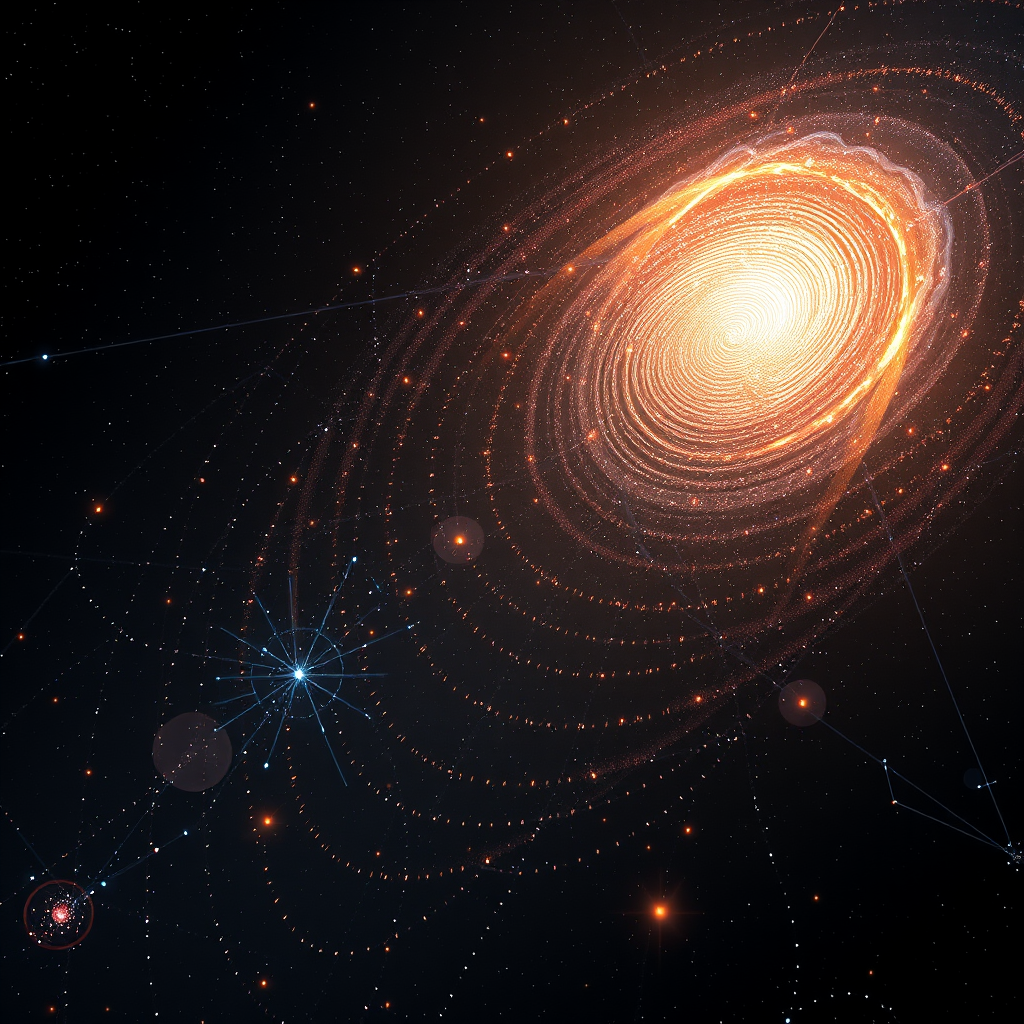
AI-generated image — a conceptual visualization
The Smoking Gun We Haven't Found
Here is the part that doesn't make the poster.
The story I just told you — a quantum jitter, stretched until it was bigger than a galaxy — is the best story we have. It is not a fact. It's a fit. Inflation*1 predicts a specific kind of speckle, slightly more power at large scales than small, and the sky delivers exactly that tilt [1]. Beautiful. Also circumstantial. A suspect matching the description is not a confession.
The confession would be gravitational waves*2. If space really tore itself outward that violently, it should have rung like a struck bell, and those ripples should have twisted the polarization of the oldestlight in a particular pinwheel pattern — B-modes*3, a faint curl in the direction the light waves prefer to vibrate. We have looked. Hard. In 2014 a team announced they'd found it, and then it turned out to be dust in our own galaxy, which is a very human way to discover the beginning of the universe [2]. Since then: nothing. Just tighter and tighter limits on how loud that ringing could have been [3].
So we don't know if inflation happened. We don't know what did the inflating — the field that supposedly drove it has never been detected in anything, anywhere [4]. We don't know why the speckle came out at one part in one hundred thousand instead of one in ten, which would have made a universe of black holes, or one in a billion, which would have made a universe of nothing but thin gas and regret.
And there's a harder limit underneath all of that. The photograph has an edge. Before the moment that light escaped, the universe was opaque, and no telescope will ever see through it. We are reading a fogged window and inferring the room [5]. Neutrinos*4 might help someday — ghost particles so unwilling to interact that they streamed free long before light did, carrying an even older image — but we cannot yet build a camera that catches them [6].
Which leaves you where you actually are. You have a baby picture, and the earliest part of the story is not in the picture. It's testimony. Someone worked it out from the edges.
I find that oddly steadying. The most important thing about your own origin is something you have to take partly on inference — and you still get up and live as though you know who you are.
What would it change, for you, if the beginning turned out to be something else entirely?
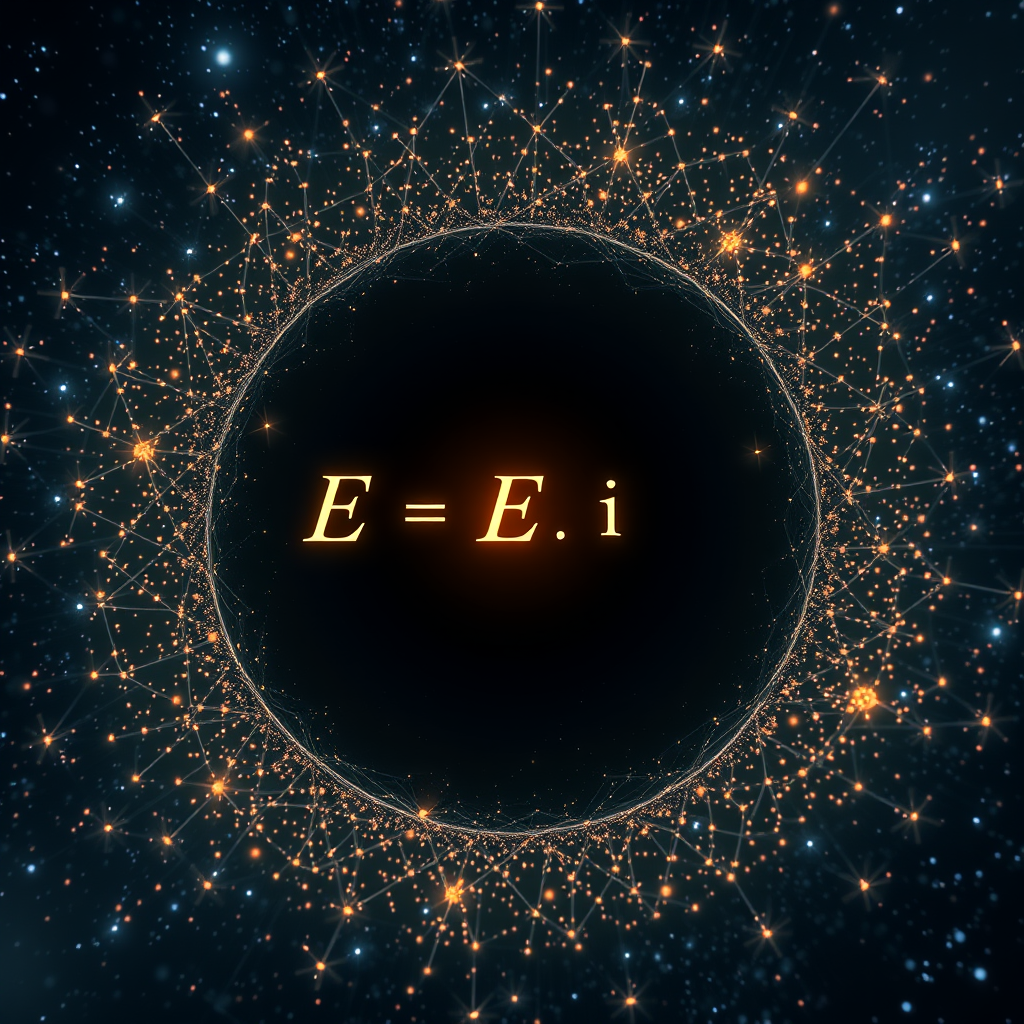
AI-generated image — a conceptual visualization
You Are a Blown-Up Piece of Noise
Here is the thing I can't put down.
Every structure you have ever cared about sits on top of that speckle. The tiny hot spots in that photograph are just slightly denser patches of the early universe, and denser patches pull harder, and pulling harder makes them denser still [1]. Run that forward fourteen billion years and the dense patches are galaxies. The empty bits stay empty. Your galaxy, your star, the iron in your blood — all of it is downstream of a fluctuation*1 that was, at the beginning, smaller than a proton.
Which means the reason there is something here rather than smooth nothing is that the early universe was bad at being uniform. It couldn't hold still. Quantum mechanics won't let anything hold perfectly still [2] — and that failure is the only reason you exist. Every attempt at cosmic perfection would have produced a universe with no you in it.
So the photograph isn't just old. It's a family portrait where the blur is the subject.
But a photograph has an edge. That light left when the universe was about 380,000 years old [3], and before that, everything was opaque — a fog no telescope will ever see through. We are standing outside a closed door, describing the room from the sound of it.
What do you do when the evidence stops but the story obviously doesn't?
TERMS EXPLAINED
- *1Analog TV: The old way of broadcasting television, where a picture was sent as a continuously varying radio wave rather than as digital data. If the signal was weak or absent, the set displayed whatever random radio noise it could pick up — the familiar black-and-white "snow."
- *2Inflation: A proposed burst of enormous expansion in the universe's first fraction of a second, which stretched a subatomic speck into everything we can see.
- *3Inflation: The idea that in its first fraction of a second the universe expanded at a wildly accelerating rate, blowing microscopic features up to enormous size.
- *4Scale-invariant: Looking statistically the same whether you zoom in or out — the same amount of bumpiness at every size you check.
- *5Spectral index: A single number describing whether the early universe's wrinkles were slightly stronger at large scales or small ones. Exactly 1 means perfectly balanced.
- *6Gaussian: The plain kind of randomness — values scattered in a bell curve, with no lopsidedness or hidden pattern.
SOURCES & REFERENCES
- [1]Smoot, G. & Davidson, K. (1993). "Wrinkles in Time." William Morrow. — The claim that a small percentage of analog television static originates from the ancient background radiation of space.
- [2]Planck Collaboration (2020). "Planck 2018 results. VI. Cosmological parameters." Astronomy & Astrophysics, 641, A6. — Age of the universe at approximately 13.8 billion years.
- [3]Penzias, A. A. & Wilson, R. W. (1965). "A Measurement of Excess Antenna Temperature at 4080 Mc/s." The Astrophysical Journal, 142, 419–421. — The accidental detection of an isotropic excess noise in a horn antenna in Holmdel, New Jersey, including the elimination of pigeons and their residue as a possible cause.
- [4]Bennett, C. L. et al. (2003). "First-Year Wilkinson Microwave Anisotropy Probe (WMAP) Observations: Preliminary Maps and Basic Results." The Astrophysical Journal Supplement Series, 148, 1–27. — Temperature variations across the sky of roughly one part in one hundred thousand, and their role as the seeds of later cosmic structure.
- [5]Guth, A. H. (1981). "Inflationary universe: A possible solution to the horizon and flatness problems." Physical Review D, 23, 347. — The original inflation proposal.
- [6]Starobinsky, A. A. (1980). "A new type of isotropic cosmological models without singularity." Physics Letters B, 91, 99. — Earlier model with accelerated early expansion.
- [7]Linde, A. D. (1982). "A new inflationary universe scenario." Physics Letters B, 108, 389; Albrecht, A. & Steinhardt, P. J. (1982). "Cosmology for Grand Unified Theories with Radiatively Induced Symmetry Breaking." Physical Review Letters, 48, 1220. — Repair of the graceful-exit problem in the original model.
- [8]Mukhanov, V. F. & Chibisov, G. V. (1981). "Quantum fluctuations and a nonsingular universe." JETP Letters, 33, 532. — First calculation showing quantum vacuum fluctuations seed a nearly scale-invariant spectrum of density perturbations.
- [9]Harrison, E. R. (1970). Physical Review D, 1, 2726; Zel'dovich, Y. B. (1972). MNRAS, 160, 1P. — The scale-invariant spectrum proposed on general grounds before inflation.
- [10]Guth, A. H. & Pi, S.-Y. (1982). Physical Review Letters, 49, 1110; Hawking, S. W. (1982). Physics Letters B, 115, 295; Starobinsky, A. A. (1982). Physics Letters B, 117, 175; Bardeen, J. M., Steinhardt, P. J. & Turner, M. S. (1983). Physical Review D, 28, 679. — Independent derivations converging after the 1982 Nuffield Workshop, Cambridge.
- [11]Planck Collaboration (2020). "Planck 2018 results. VI. Cosmological parameters." Astronomy & Astrophysics, 641, A6. — Measured spectral index n_s = 0.9649 ± 0.0042.
- [12]Planck Collaboration (2020). "Planck 2018 results. IX. Constraints on primordial non-Gaussianity." Astronomy & Astrophysics, 641, A9. — No detected departure from Gaussian statistics.
- [13]Guth, A. H. (1997). "The Inflationary Universe." Addison-Wesley. — The "ultimate free lunch" description of cosmic origins.
- [14]BICEP2/Keck and Planck Collaborations (2015). "A Joint Analysis of BICEP2/Keck Array and Planck Data." Physical Review Letters, 114, 101301. — The 2014 B-mode claim attributed largely to galactic dust.
- [15]BICEP/Keck Collaboration (2021). "Improved Constraints on Primordial Gravitational Waves using Planck, WMAP, and BICEP/Keck Observations through the 2018 Observing Season." Physical Review Letters, 127, 151301. — Upper limit on primordial gravitational waves, r < 0.036 (95% confidence).
- [16]Ijjas, A., Steinhardt, P. J. & Loeb, A. (2013). "Inflationary paradigm in trouble after Planck2013." Physics Letters B, 723, 261. — The argument that inflation is unpredictive and hence hard to falsify.
Inline citations [N] correspond to numbered references above.
A weekly journey from the present universe back to the Big Bang — and to what it means for us.