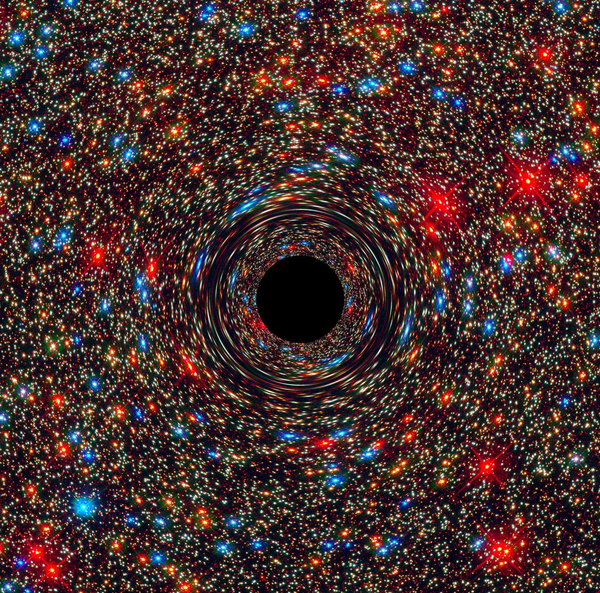
The Hubble Tension: Two Measurements, One Problem
Episode 2: The Universe Is Still Expanding — And Speeding Up
I like science that leaves room to imagine. When things that seemed unrelated turn out to share a hidden pattern — that moment feels like finding one of the world's secrets. Which opens a door I didn't know was there. Which leads somewhere unexpected. Which eventually leads back to me.
You step on the scale in your bathroom. Seventy-four kilograms. Fine.
Two weeks later you're at the doctor's office, shoes off, and the nurse writes down seventy-seven. You feel a small flicker of something. Not alarm. Just a tiny itch. One of these scales is lying to you.
But here's what you do next, and everyone does it: you decide it doesn't matter. Cheap scale, thick socks, big lunch, who cares. You let it go. Three kilograms is not a crisis. Three kilograms is life.
Now imagine you couldn't let it go.
Imagine you bought a better scale. Then a laboratory-grade one. You calibrated it against a certified reference mass. You weighed yourself at dawn, fasting, naked, on a concrete floor. You did this for ten years, and so did four hundred other people using different equipment on different continents, and every single time the bathroom said seventy-four and the doctor said seventy-seven, and the more careful everyone got, the more the two numbers refused to meet in the middle. The error bars shrank. The gap didn't.
At some point that stops being a measurement problem. At some point it becomes a message.
That's roughly where we are right now with the universe, and almost nobody outside a few thousand people has been told.
Here's the situation, stripped of jargon.
There are two ways to measure how fast the universe is flying apart. One is to look at nearby things — stars whose brightness we understand well enough to use as distance markers, exploding stars in galaxies close enough to see clearly [1]. You measure how far away they are, you measure how fast they're receding, you divide. That's the bathroom scale. Local, direct, hands-on.
The other way is to look at the oldest light there is. A faint glow left over from when the universe was about 380,000 years old, still filling all of space, still arriving at our detectors from every direction at once [2]. You measure the tiny ripples in that glow, you feed them into our best model of how everything works, and the model tells you how fast space should be stretching today [3]. That's the doctor's office. Indirect, theoretical, enormously precise.
The first method says the universe is expanding at about 73 kilometers per second for every megaparsec*1 of distance [1]. The second says about 67 [3].
Six units. Roughly eight percent. Three kilograms.
And for about twenty years, everyone assumed somebody had made a mistake. That's the reasonable assumption. Measuring the universe is hard, and the history of astronomy is basically a long parade of people confidently measuring the wrong thing. Edwin Hubble's original number was off by a factor of seven [4]. Humility is warranted.
So people got better. They rebuilt the distance ladder rung by rung. They used a different satellite. They used gravitational lensing*2. They used the wobble of dying stars. They used water masers in a galaxy fifty million light-years away, which is a real technique and not something I made up to sound impressive [5]. And every improvement made both numbers sharper, and the two sharp numbers sat there, refusing to touch, like guests at a wedding who used to date.
The statistical odds that this is a fluke are now somewhere around one in three and a half million [1].
That's the part that keeps me up. Not the numbers themselves — I couldn't feel a megaparsec if it hit me. It's what the stubbornness implies. Because if nobody is making a mistake, then the two measurements aren't disagreeing about the universe. They're disagreeing about *us*. About the story we tell connecting the first light to this morning.
One of them is asking the universe how fast it's expanding right now. The other is asking what it *should* be, given everything we think we know about the fourteen billion years in between [3]. When those two answers split, the crack isn't in the telescope. The crack is in the middle. In the part of the story nobody was watching.
And there's something almost unbearably human about that. You know where you started. You know where you are. And the arithmetic connecting the two doesn't work out, which means something happened along the way that you didn't account for.
We don't know what it is. That's not a cop-out — that's the honest state of things, and it's the most interesting sentence in cosmology right now. It might be a new kind of particle. It might be that the invisible energy pulling space apart isn't constant after all. It might be something nobody has thought of yet, sitting in a graduate student's notebook in a city I'll never visit.
Or it might still be a mistake. Somebody's socks.
But hold onto that itch you felt in the bathroom. The tiny flicker when two numbers that should agree, don't. Scientists are trained to chase that flicker instead of shrugging it off, and every so often, chasing it breaks the world open.
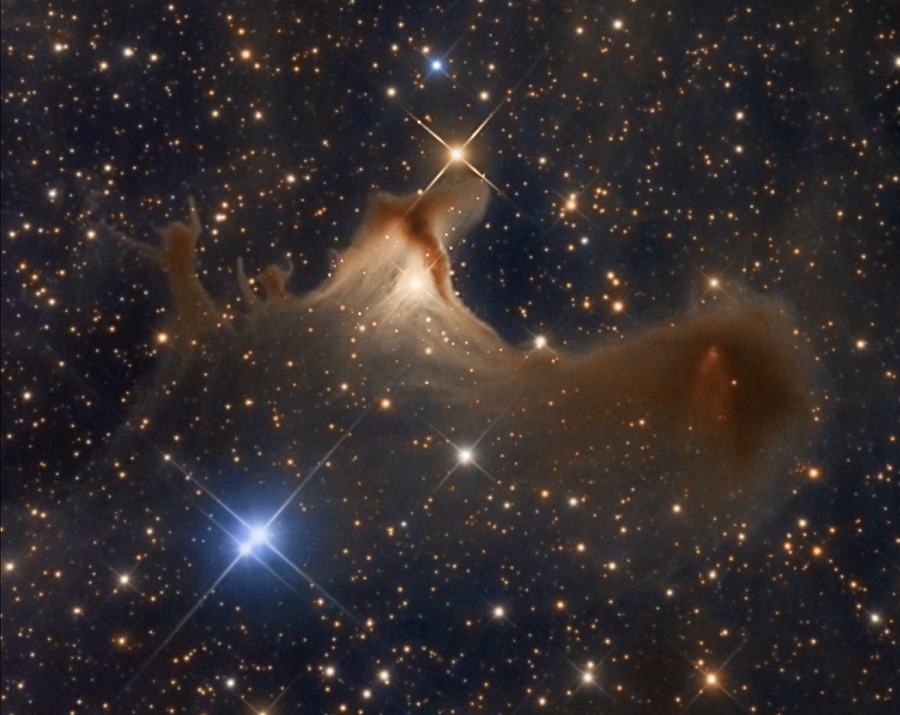
📷 Ghost of the Cepheus Flare — Stephen Leshin (NASA APOD, Public Domain)
What if the discrepancy isn't an error at all — what if it's the universe telling you that the last fourteen billion years contained something you've never met?
Go find a doorframe with pencil marks on it.
Somebody's kitchen, somebody's grandmother's hallway. A stack of little lines with dates next to them. That's how you measure a child growing, and it works, and it also depends entirely on something nobody thinks about: every mark trusts the one below it. If the first line was drawn while the kid was standing on a rug, every line above it inherits that rug. Forever. Nobody ever finds out.
This is exactly how we measure the expansion of the universe from where we stand.
The bottom mark is parallax. You look at a nearby star in June, then again in December, from opposite sides of Earth's orbit, and you watch it shift against the background. Simple geometry gives you its distance. That's the rug-free line, the one we trust most.
Then you climb. You find a certain kind of star inside that distance — a Cepheid *1, a star that pulses, brightening and dimming on a clock, and the slower the pulse the brighter the star. Now you know how bright Cepheids really are. So when you spot one in a faraway galaxy and it looks faint, you know how far away it is. New mark on the doorframe, drawn using the old one.
Then you climb again. In galaxies with Cepheids, you wait for a Type Ia supernova *2 — a dying star that detonates at almost exactly the same brightness every single time, like a lightbulb the universe manufactures to spec. Now you know how bright those are. And you can see them across billions of light years. Highest mark on the frame.
Measure how fast those distant galaxies are rushing away, divide by how far they are, and you get a number: about 73 [1]. Seventy-three kilometers per second faster, for every 3.26 million light years farther out you look *3. The error bars are around one percent [1]. That's a very confident pencil mark.
Now, the other method. This one is stranger.
There's a baby photo of the universe. Actually a baby photo — light that has been traveling since the cosmos was 380,000 years old [2]. Before that, everything was hot fog, and light couldn't get anywhere. Then it cooled, the fog cleared, and that first free flash of light has been flying ever since. It's still arriving. It's the cosmic microwave background *4, and it's the oldest thing anyone will ever see.
In that photo there are ripples. Slightly hotter patches, slightly cooler ones, and the sizes of those patches tell you what the infant universe was made of and how densely it was packed.
So you do what a pediatrician does. You take the baby's measurements, you apply the growth chart, and you predict how big the kid should be today. The cosmologist's growth chart is a set of equations describing how a universe with this much matter and this much dark energy expands over 13.8 billion years *5. Run it forward. Out comes today's expansion rate.
It says 67.4 [2]. Error bars under one percent.
Seventy-three. Sixty-seven. And unlike your pediatrician's chart, this one has no footnote for "some kids are just tall."
Here's why this is not a rounding argument. The two numbers don't merely differ — their uncertainty ranges don't touch. Don't even come close to touching. The gap is around five sigma *6, which is roughly a one-in-a-million chance of being a fluke [1]. In physics, five sigma is the line where you stop saying "interesting" and start saying "discovery."
So the obvious move is to go check the pencil marks. Somebody's rug is in the wrong place. For years the leading suspect was the Cepheids — those pulsing stars sit in crowded regions, and maybe our telescopes were blurring neighboring stars into them and making them look too bright. Reasonable. Boring. Fixable.
Then the James Webb Space Telescope looked, with sharper eyes, and the Cepheid distances held [3]. The rug wasn't there.
Meanwhile, other groups climb the ladder using entirely different rungs — a method based on the reddest, oldest giant stars instead of Cepheids — and land somewhere in the middle, around 70 [4]. Which is either a clue or a mess, depending on the day and who you ask. We genuinely don't know yet.
But notice what the disagreement actually is. It isn't two teams measuring the same thing and getting different answers. It's a measurement versus a prediction. One side reads the universe's height today with a ruler. The other side reads the baby photo and calculates what the height ought to be. Both could be done perfectly and still disagree — if the growth chart is wrong.
That's the part that should make the back of your neck prickle. The growth chart is our model of everything: how much matter, how much dark matter, how dark energy behaves, what happened in the first fraction of a second. If the pencil marks are honest and the photo is honest, then the thing standing between them — our story of the last 13.8 billion years — has a gap in it somewhere. Something happened between the baby picture and now that we haven't accounted for.
AI-generated image — a conceptual visualization
People have proposed candidates. A burst of some extra energy in the early universe that faded away [5]. Dark energy that isn't constant but drifting. An extra species of lightweight particle in the hot fog. Every one of these is a guess, and every one of them, if true, rewrites a chapter.
Or someone finds a rug. It happens. Most anomalies in physics die quietly of a calibration error, and this one still might.
But it's been more than a decade. Better telescopes, more supernovae, independent ladders, and the gap won't close. It's the most stubborn crack in modern cosmology, and it appeared not because something exotic showed up, but because we got good enough at measuring to notice that two careful answers don't match.
Which raises a question worth chewing on: how many other things do you believe because you've only ever measured them one way?
Here's the number everybody is fighting about.
The Hubble constant *1. It tells you how fast the universe is stretching. Take a galaxy sitting one megaparsec *2 away — call it three and a quarter million light years, a distance so large that the word "away" starts to lose its grip — and the Hubble constant tells you how quickly that galaxy is receding from you, purely because the space in between is getting bigger.
The unit is kilometers per second per megaparsec. It is a mouthful invented by people who do not get out much.
Now, the two answers.
The first comes from the cosmic microwave background *3, the faint heat left over from when the universe was 380,000 years old and finally cooled enough to become transparent. The Planck satellite mapped that light across the whole sky. From those maps, the Planck Collaboration got a Hubble constant of 67.4, give or take 0.5 [1].
The second comes from looking at nearby galaxies with telescopes and measuring how far away they are, one rung at a time. That's the SH0ES team, led by Adam Riess — who, incidentally, already has a Nobel Prize for discovering that the expansion is accelerating in the first place. Their 2022 result: 73.04, give or take 1.04 [2].
67.4 and 73.04.
Two scales in two bathrooms, and neither of them is cheap.
Here's what makes this different from your three kilograms. The error bars. Riess and his colleagues calculated that the gap between these two numbers is a five-sigma *4 disagreement [2]. Five sigma is the threshold particle physicists use to announce that they've discovered something. It means: if both measurements are correct and the universe is behaving the way we think, the odds of a fluke this large are roughly one in three and a half million.
So one of three things is true. The early-universe measurement is wrong. The late-universe measurement is wrong. Or the universe is doing something we have not written down yet.
Let me show you why this is harder to dismiss than it sounds.
Start with the Planck number, because people misunderstand what it is. Planck did not measure the expansion rate of the universe today. Planck measured the pattern of hot and cold splotches in ancient light — the sizes of the ripples, how they cluster, how they repeat. From that pattern you can extract the ingredients of the early universe: how much ordinary matter, how much dark matter, how much radiation. Then you take our standard model of cosmology, the one with dark matter and dark energy, and you press play. You let it run for 13.8 billion years. And out the other end comes a prediction for how fast space should be stretching right now [1].
67.4.
It's not a reading. It's a forecast. Extremely precise, built on a model that fits the microwave background almost embarrassingly well, but still a forecast. If the model is missing an ingredient — anything that changes the physics between then and now — the forecast comes out wrong even if every measurement feeding into it is perfect.
The forecast depends especially on one thing: the sound horizon *5. Before the universe went transparent, it was a plasma, and pressure waves rang through it like sound through a bell. When the plasma cooled and turned into gas, those waves froze in place, leaving a characteristic scale imprinted on the distribution of matter — roughly 150 megaparsecs, about 480 million light years [1]. That frozen scale is a ruler. Cosmologists use it everywhere. And here's the catch: its length is set by physics in the first few hundred thousand years.
Change that early physics, and the ruler changes length, and every distance measured with it changes, and the Hubble constant you infer shifts. Lloyd Knox and Marius Millea walked through this systematically in a paper they called, with admirable honesty, "The Hubble Hunter's Guide" [3]. Their conclusion was blunt: if you want to raise the early-universe number without wrecking everything else that fits, you almost certainly have to shrink the sound horizon. Late-time fixes — messing with dark energy in the recent universe — tend to break other data.
AI-generated image — a conceptual visualization
That's the doorframe problem from before. The bottom pencil mark. If it was drawn while the kid stood on a rug, every mark above it inherits the rug, and nobody ever finds out by staring harder at the top of the frame.
Now the other side.
The SH0ES measurement is the distance ladder, and it is exactly as precarious as it sounds. Three rungs.
Bottom rung: geometry. You measure the distance to nearby stars by parallax *6 — watch a star from opposite sides of Earth's orbit and see how much it appears to shift against the background, the same way your thumb jumps when you switch eyes. The Gaia satellite did this for over a billion stars, and its parallaxes are the calibration floor of the whole ladder [4]. There's a second geometric anchor too, a galaxy called NGC 4258, where water masers — clouds of water vapor beaming microwaves — orbit a supermassive black hole in a disk we happen to see edge-on. You watch them move, you do trigonometry, you get a distance that owes nothing to any other rung [5].
Middle rung: Cepheids *7. These are stars that pulse, brightening and dimming on a regular cycle, and the length of the cycle tells you how luminous the star truly is. Compare true brightness to apparent brightness and you get distance. Henrietta Swan Leavitt found this relationship in 1912, and it is still the load-bearing wall of extragalactic astronomy.
Top rung: Type Ia supernovae *8. White dwarf stars that detonate at a fairly consistent brightness. They are visible across billions of light years. Calibrate them against Cepheids in nearby galaxies, then use them to reach far enough that the expansion of space dominates over the random drift of galaxies.
Three rungs, and any error in the bottom rung climbs to the top and never announces itself.
So people attacked the rungs.
The most popular objection for years was crowding. Cepheids live in busy star-forming regions of other galaxies, and from Earth, through Hubble's eyes, a Cepheid can be blended with its neighbors — you think you're measuring one star and you're measuring a small crowd. A crowd looks brighter. Brighter looks closer. Closer means a bigger Hubble constant. It was a clean, plausible way for the whole tension to be a mistake.
Then JWST arrived, with sharper infrared vision, and Riess's group went back and re-measured more than a thousand of the same Cepheids. The blending was real and measurable. It also wasn't big enough to matter. The JWST distances agreed with the Hubble Space Telescope distances to within about one percent, and the Hubble constant barely moved [6].
Riess has been direct about what he thinks that means. Writing about the 2022 result, he and his team argued that the discrepancy "is not caused by an error in any single measurement or method" and pointed instead toward "a feature of the cosmological model" [2]. In plainer terms: stop looking for the typo. Look at the theory.
But — and this is the part I find genuinely thrilling, in the way an unresolved argument between two very careful people is thrilling — not everyone agrees.
Wendy Freedman has spent her career on the distance scale. She led the original Hubble Key Project in the 1990s, the one that first pinned the Hubble constant down to roughly ten percent. And she does not trust Cepheids as the only middle rung. So she built a different ladder using something called the tip of the red giant branch *9 — an old, dying star reaches a very specific brightness at the moment helium ignites in its core, and that brightness is nearly universal. These stars live in the quiet outskirts of galaxies, away from the dust and the crowds.
Her group's answer keeps landing lower. Around 69 to 70 [7]. With JWST data and a third independent method — carbon-rich stars called JAGB stars — the Chicago-Carnegie group reported values that sit uncomfortably in the middle, close enough to Planck that Freedman's team wrote that they find "no strong evidence for a discrepancy" with the standard model [8].
So now we have a tension inside the tension. Two teams, both excellent, both using JWST, both measuring the local universe, and they don't quite agree with each other either.
I want to be honest with you about how that feels from the outside. It looks like a mess. It is a mess. But it's a productive mess, because the disagreement is now about specific, checkable things — which stars, which corrections, which calibration — rather than about vibes.
And here's what keeps the tension alive: the ladder isn't the only route.
There are ways to measure cosmic distance that skip Cepheids entirely. Water masers again — the Megamaser Cosmology Project measured six galaxies with pure geometry, no ladder, no calibration to anything, and got 73.9 plus or minus 3.0 [9]. Then there's gravitational lensing. When a distant quasar sits behind a massive galaxy, its light takes several paths around that galaxy and arrives at different times. The quasar flickers; you see the same flicker replayed weeks or months apart. The delays depend on the geometry of the universe, and therefore on the Hubble constant. The H0LiCOW collaboration got 73.3 from six lensed quasars [10]. That number later drifted and its error bars grew when the team allowed more freedom in modeling the lens galaxies' mass, which is a lovely example of a result becoming more honest and less useful at the same time.
And then the strangest one. In 2017, LIGO and Virgo detected two neutron stars colliding, and telescopes saw the flash. Gravitational waves tell you directly how far away the source was — the physics of the waveform encodes the distance, no ladder required, which is why people call these standard sirens *10. Combined with the redshift of the host galaxy, that single event gave a Hubble constant of about 70, with error bars big enough to swallow both camps whole [11].
That last one matters more than its precision suggests. Because eventually there will be dozens of these events, then hundreds, and standard sirens will deliver a completely independent verdict built on gravity rather than on starlight. If sirens land on 73, the ladder is vindicated. If they land on 67, something in stellar astrophysics has been fooling us for a century.
AI-generated image — a conceptual visualization
Now, suppose the measurements are all fine. Suppose the universe really is telling us two different things. What would have to be true?
The most-studied answer is early dark energy *11. Vivian Poulin and colleagues proposed a burst of something dark-energy-like that switched on before the cosmic microwave background formed and then faded away quickly [12]. That extra push makes the early universe expand slightly faster, which means the sound waves have less time to travel, which shrinks the sound horizon, which shortens the ruler, which raises the Hubble constant you infer from Planck. It works. Sort of. It relieves the tension without fully curing it, and it makes other predictions about how galaxies clump that the data doesn't love.
Other proposals: extra species of relativistic particles in the early universe, altering how fast it cooled. A brief change in the strength of gravity. A shift in the electron's effective mass at recombination. Dark matter that decays. Dark energy that isn't constant — and in 2024, the DESI survey did report hints that dark energy might be weakening over time, which would be a much bigger deal than the Hubble tension and a topic for another day [13].
None of these has won. Every fix that solves one problem tends to scrape against another dataset. The standard model of cosmology has six free parameters and fits an absurd range of observations, and it is very hard to improve without breaking.
Which is why Knox and Millea called their paper a hunter's guide. Nobody has the animal yet.
Here's where I'd like to leave you before we go further back in time.
We are living through a moment where two extremely careful ways of asking the same question return two different answers, and the gap has survived twenty years of people trying to make it disappear. Every year, the measurements get better. Every year, the gap holds. That is the opposite of what usually happens to disagreements in science. Usually precision kills them.
This one it feeds.
And the thing I can't get out of my head: whatever is causing this — if it's real — is happening right now, to the space in this room, at the same time it's happening between galaxies. There's no boundary. The universe doesn't have a section where the physics is interesting and a section where you live.
So if the two numbers never converge, what exactly did we get wrong — the universe's childhood, or its present tense?
Somebody made a mistake. That was the boring answer, and for about ten years it was everyone's favorite. It's a good answer. Measuring distances across the universe is fiddly work, and the local method leans on Cepheid variable stars *3 — stars that pulse, brighten and dim on a clock, and the slower the pulse the brighter the star, which means if you time one you know how much light it truly gives off, and if you know that you can work out how far away it is. Cepheids sit in crowded galaxies. Other stars blur into them. Maybe the whole ladder was standing on a rug.
So they checked. The James Webb Space Telescope has sharper infrared eyes than anything before it, and it went back to the same stars, in the same galaxies, and resolved the crowding [1]. The Cepheids held. The local number stayed high, around 73 [1].
Meanwhile the early-universe number stayed low, around 67 [2]. And it's not just one method on each side anymore. Time delays in gravitationally lensed quasars — light from a single distant object taking several different routes around a foreground galaxy and arriving on different days — land high [3]. Water masers *4 orbiting a black hole in NGC 4258, which need no ladder at all, agree with the high side [4].
But not everything does. Measure distances using the tip of the red giant branch *5 instead of Cepheids — a different kind of star, at a different stage of dying, used as a different kind of yardstick — and you get something in between, low enough that some astronomers think there's no crisis at all [5]. The community is split on this. Not politely split. Split.
Which means the honest state of things is: two very good measurements disagree by about eight percent, the disagreement has roughly a one-in-a-few-million chance of being luck [1], and nobody has found the mistake.
So people started asking the other question. What if there is no mistake?
The early-universe number isn't really a measurement of expansion. It's a prediction. You look at the oldest light in the sky, you assume you know what the universe is made of, and you run the physics forward thirteen point eight billion years to see how fast things should be flying apart today [2]. If the prediction misses, maybe the recipe is wrong. Maybe there's an ingredient nobody wrote down.
The candidates are strange. Early dark energy *6 — some pressure that existed briefly in the young universe, pushed for a moment, and vanished before anything could notice. Extra kinds of neutrino *7. A neutrino is a particle so unwilling to interact with matter that trillions are passing through your eyeballs right now and none of them will touch anything on the way out. We know three types exist. Some models want a fourth, one that doesn't feel any force at all except gravity, purely to make the numbers work [6].
Or dark energy itself might not be constant. Recent survey data hints, weakly, that it may have been stronger in the past and is fading [7]. That would be a genuinely large deal, and it might not survive the next round of data.
Here's what I keep circling back to. Every one of these fixes is a person saying: I would rather add a new ingredient to reality than admit I measured wrong. Which sounds arrogant until you realize they've spent thirty years trying to find the measurement error and can't.
AI-generated image — a conceptual visualization
And here's the limit of my honesty. I don't know which side is right. I've read enough to have a feeling, and my feeling is worth nothing, because the people who actually do this for a living are also split and they have the data.
What I can tell you is what's at stake for you, sitting there. The two numbers imply different ages for the universe — the high number makes it younger, by something like a billion years [1]. A billion years is not a rounding error. It's longer than complex life has existed on Earth. So the question of how old everything is, including the shelf of time your species sits on at the very end, currently has two answers, and we are waiting.
There's something almost comic about it. We can describe the first fraction of a second after the Big Bang with real confidence. We cannot agree on how fast the thing is expanding today, in the room you're in.
The near stuff is harder than the far stuff. That keeps surprising me.
Maybe that's the actual lesson. We built a picture of the universe that works spectacularly well and then found one thread hanging off the edge of it, and we've been pulling for a decade, and either the thread comes loose or the whole sweater does.
If it's the sweater — if dark energy changes, if there's a fourth kind of neutrino, if the recipe is wrong — then everything after this section of the series, everything about the beginning, shifts underneath us.
What would you do with a world where the experts openly disagreed about something this basic and nobody was hiding it?
So here's where we actually are.
The early-universe number, read off the leftover glow of the Big Bang *4, is 67.4 [1]. The local number, read off stars and exploding stars in our neighborhood, is 73.0 [2]. The gap between them is about five sigma *5, which is physics-speak for: this is not a fluke, stop hoping [2]. And the James Webb Space Telescope went and looked at those crowded Cepheid fields again with sharper eyes, specifically to catch the error everybody assumed was hiding there, and found nothing wrong [3].
Both scales are right. You are seventy-four and seventy-seven kilograms at the same time.
Which means the problem isn't the measuring. The problem is the thing being measured, or rather the story we tell about what happened between the two measurements. Because that's what the early number really is. It isn't a direct reading of today's expansion. It's a prediction — you take the baby photo of the universe, you feed it into your best theory of everything in between, and out comes what the expansion should be right now [1]. Then you look out the window and it isn't.
Stay with that for a second. The disagreement isn't between two telescopes. It's between the universe as we see it and the universe as we can explain it. Something happened in the 13.8 billion years separating those two numbers that we have not accounted for [1]. Some ingredient, some episode, some force that showed up, did its work, and left no note.
People have guesses. Maybe dark energy *6 isn't a constant and has been changing strength over cosmic time — and the DESI survey has started seeing hints, genuinely tentative ones, that it might be weakening [4]. Maybe there was an extra push in the first hundred thousand years, an "early dark energy" that flared and vanished [5]. Maybe there's a species of particle we haven't met. Every one of these solutions is, in plain terms, an admission that we're missing a piece of the universe's history.
And here's the part I keep chewing on. You will never feel this. The expansion doesn't stretch you. Your atoms hold on to each other, the Earth holds on to the Sun, the galaxy holds itself together against all of it [6]. The disagreement is happening in the space between galaxies, in a quantity you will never touch, and it changes nothing about your Tuesday.
Except that it does. Because five sigma means we are wrong about something structural. Not a detail — structural. The same physics that gets a spacecraft to Saturn on the first try cannot tell us how fast the sky is moving apart, and the error isn't in the instruments, it's in us.
We're used to science closing gaps. This one has been widening for a decade [3]. The more carefully we look, the worse it gets.
Which brings up something I can't stop turning over. To know how fast the universe is expanding today, you have to reconstruct everything that came before. Every era. Every ingredient. The whole chain of pencil marks back to the very first line on the doorframe.
So what if the mistake is down there, at the bottom, in the very beginning?
TERMS EXPLAINED
- *1Megaparsec: A distance of about 3.26 million light-years. Galaxies are typically a few megaparsecs apart, so it's the natural yardstick when you're measuring the whole universe instead of your living room.
- *2Gravitational lensing: Heavy objects bend the path of light passing near them. A galaxy sitting between you and something farther away acts like a warped lens, splitting one distant object into several images. Timing how those images flicker gives you an independent way to measure cosmic distances — no ladder required.
- *3Kilometers per second per megaparsec: The unit for how fast space is stretching. A megaparsec is 3.26 million light years. So "73" means: for every megaparsec farther away a galaxy sits, it recedes 73 km/s faster.
- *4Cosmic microwave background: The oldest light there is. Released when the universe cooled enough to become transparent, it now fills all of space as a faint microwave glow — a snapshot of the infant cosmos.
- *5Dark energy: Whatever is making the expansion of the universe speed up instead of slow down. We can measure its effect precisely. We have no idea what it is.
- *6Five sigma: A measure of how unlikely a result is to be random noise — roughly one chance in 3.5 million. Physics treats it as the threshold for calling something real.
- *7Cepheid: A star that swells and shrinks on a clock-like cycle. The slower the pulse, the brighter the star truly is — so timing the pulse tells you the real brightness, and comparing that to how bright it looks tells you how far away it is.
- *8Type Ia supernova: A dead star that steals matter until it detonates, and it detonates at close to the same brightness every time. Because they're so bright, you can see them across billions of light years and use them as distance markers.
- *9Tip of the red giant branch: Old stars puff up as they die, and at one precise moment helium ignites in the core. That moment always happens at nearly the same brightness, which makes it a reliable distance marker — and these stars sit in the calm outer parts of galaxies, away from dust and crowding.
- *10Standard siren: A collision of dead stars that shakes spacetime. The shape of the gravitational wave itself encodes how far away the event was — no ladder of assumptions, just the physics of the wave.
- *11Early dark energy: A hypothetical push that briefly sped up the infant universe and then vanished. If it existed, it would have shortened the cosmic measuring stick, which would change what the ancient light is telling us about today's expansion rate.
SOURCES & REFERENCES
- [1]Riess, A. G., et al. (2022). "A Comprehensive Measurement of the Local Value of the Hubble Constant with 1 km/s/Mpc Uncertaintyfrom the Hubble Space Telescope and the SH0ES Team." The Astrophysical Journal Letters, 934, L7. — Local distance-ladder measurement of ~73 km/s/Mpc using Cepheid variables and Type Ia supernovae; the ~5-sigma (roughly one in 3.5 million) statistical significance of the disagreement.
- [2]Penzias, A. A., & Wilson, R. W. (1965). "A Measurement of Excess Antenna Temperature at 4080 Mc/s." The Astrophysical Journal, 142, 419–421. — Discovery of the leftover glow filling all of space, arriving from every direction.
- [3]Planck Collaboration (2020). "Planck 2018 Results. VI. Cosmological Parameters." Astronomy & Astrophysics, 641, A6. — Early-universe inference of ~67 km/s/Mpc from ripples in the oldest light, derived through the standard cosmological model; the universe becoming transparent around 380,000 years after the beginning.
- [4]Hubble, E. (1929). "A Relation Between Distance and Radial Velocity Among Extra-Galactic Nebulae." Proceedings of the National Academy of Sciences, 15(3), 168–173. — Hubble's original expansion rate of ~500 km/s/Mpc, roughly seven times the modern value.
- [5]Reid, M. J., Pesce, D. W., & Riess, A. G. (2019). "An Improved Distance to NGC 4258 and Its Implications for the Hubble Constant." The Astrophysical Journal Letters, 886, L27. — Water maser measurement of the distance to a galaxy used as an independent calibration of the distance ladder.
- [6]Riess, A. G., et al. (2024). "JWST Observations Reject Unrecognized Crowding of Cepheid Photometry as an Explanation for the Hubble Tension at 8σ Confidence." Astrophysical Journal 962, 26. — JWST re-measurement of over a thousand Cepheids agreeing with HST to about one percent.
- [7]Freedman, W. L., et al. (2019). "The Carnegie-Chicago Hubble Program. VIII. An Independent Determination of the Hubble Constant Based on the Tip of the Red Giant Branch." Astrophysical Journal 882, 34. — TRGB-based Hubble constant near 69–70.
- [8]Freedman, W. L., Madore, B. F., et al. (2025). "Status Report on the Chicago-Carnegie Hubble Program (CCHP): Measurement of the Hubble Constant Using the Hubble and James Webb Space Telescopes." Astrophysical Journal. — JWST TRGB and JAGB results; statement of no strong evidence for a discrepancy with the standard model.
- [9]Pesce, D. W., et al. (2020). "The Megamaser Cosmology Project. XIII. Combined Hubble Constant Constraints." Astrophysical Journal Letters 891, L1. — Ladder-free geometric value of 73.9 ± 3.0.
- [10]Wong, K. C., et al. (2020). "H0LiCOW XIII. A 2.4% measurement of H0 from lensed quasars." Monthly Notices of the Royal Astronomical Society 498, 1420. — Time-delay cosmography value of 73.3.
- [11]LIGO Scientific Collaboration & Virgo Collaboration, et al. (2017). "A gravitational-wave standard siren measurement of the Hubble constant." Nature 551, 85. — Standard siren value of about 70 from GW170817.
- [12]Poulin, V., Smith, T. L., Karwal, T. & Kamionkowski, M. (2019). "Early Dark Energy Can Resolve The Hubble Tension." Physical Review Letters 122, 221301. — Proposal of a transient early dark energy component that shrinks the sound horizon.
- [13]DESI Collaboration (2024). "DESI 2024 VI: Cosmological Constraints from the Measurements of Baryon Acoustic Oscillations." arXiv:2404.03002. — Hints that dark energy may be weakening over time.
Inline citations [N] correspond to numbered references above.
A weekly journey from the present universe back to the Big Bang — and to what it means for us.
![[Deep Dive] Scale-free localization in pseudo-Hermitian quantum walk](/content/images/size/w600/2026/10/deep_dive_thumb-9.png)