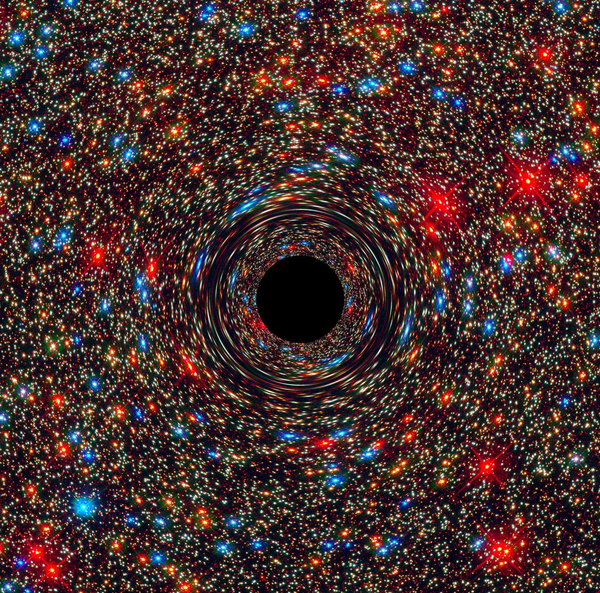
The Big Rip: How the Universe Might End
Episode 2: The Universe Is Still Expanding — And Speeding Up
I like science that leaves room to imagine. When things that seemed unrelated turn out to share a hidden pattern — that moment feels like finding one of the world's secrets. Which opens a door I didn't know was there. Which leads somewhere unexpected. Which eventually leads back to me.
You've had this happen. There was someone — a friend, a real one — and you didn't fight. There was no scene. You just texted a little less. Then the gaps between messages got longer, and one day you realized the gap had become the relationship. Nobody chose it. Nobody did anything wrong. The distance just... grew.
That's the strange part. Not that it ended. That nothing ended it.
I think about this more than is healthy, and it's the fault of something I heard in a car, stuck in traffic, listening to an astronomer explain what happens when you point a good telescope at a faraway galaxy and look at its light.
Light carries information about where it came from. Stretch it out, and the colors slide toward red — the way a siren drops in pitch as the ambulance goes past you *1. Astronomers measured that stretch in galaxy after galaxy, and found something that should have made everyone put down their coffee: almost everything out there is moving away from us, and the farther away it is, the faster it's going [1].
Now here's where your brain will try to help you, and get it wrong.
You will picture an explosion. A center, and debris flying outward, and us somewhere in the debris. That picture is comforting because it has a middle. It's also wrong. The galaxies aren't racing through space like shrapnel. The space between them is getting bigger [2]. Nothing is traveling. The distance itself is growing.
Think of it as the friendship version of physics. No one moved. The gap just showed up and started expanding.
For about seventy years, everyone assumed this was a story about slowing down. Gravity pulls. Everything in the universe pulls on everything else. So the expansion had to be losing steam, the way a ball you throw upward loses speed. The only question was whether it would coast forever or eventually fall back in. Two teams of astronomers in the 1990s set out to measure exactly how much the universe was slowing down, using exploding stars as distance markers [3][4].
They found it was speeding up.
Read that again, because it's one of the strangest sentences a human being has ever had to write down. Not "the universe is expanding." That's old news. The universe is expanding *faster now than it was five billion years ago* [3]. Something is pushing. We do not know what it is. We gave it a name so we could talk about it in meetings, which is what people do when they don't know something [5].
And it's not slowing.
Let me be careful here, because this is the point where these articles usually go either cozy or apocalyptic, and both are cheating. So, the cozy part first, honestly: this isn't happening to you. Not to your kitchen table, not to your body, not to the Earth, not even to our galaxy. Locally, gravity is winning without breaking a sweat. Andromeda, the nearest big galaxy, isn't running away from us at all — it's coming toward us, and in a few billion years the two galaxies will merge [6]. The expansion is a story about the vast empty spaces between islands, not about the islands.
That's the reassuring version. Everything you love is bolted down.
Here's the part I can't stop chewing on. That reassurance depends entirely on the push staying the same strength forever. We assume it does. We assume it because assuming otherwise is uncomfortable and because our measurements aren't precise enough to rule it out [7]. But if the push is very slowly getting stronger — not a lot, just a little, over billions of years — then the story changes completely. Then "bolted down" is temporary. Then gravity is a thing that wins for a while.
And there's a moment, in that version, when it stops winning. First for galaxy clusters. Then galaxies. Then solar systems. Then, near the very end, for atoms.
We don't know if we live in that universe. We have not been able to tell the difference. The gap between the two futures is currently smaller than our instruments can see [7].
So: what does it change about your Tuesday, knowing that the emptiness is quietly getting emptier — and that we can't yet rule out the day it comes for the things that are close to you?
Picture a music festival. Not a nice one — one of those enormous fields where the crowd goes back further than you can see. You came with four friends. You're standing in the middle of it, packed shoulder to shoulder, and somewhere far away a band is playing.
Now imagine the ground starts growing.
Not moving. Growing. The grass between your feet is making more grass. Every patch of dirt is quietly manufacturing more dirt, in every direction, all at once. Nobody is walking anywhere. Everybody is standing perfectly still. And yet the crowd is thinning.
This is the part people get wrong about the expanding universe. Galaxies are not flying away from each other through space, like debris from an explosion. Space itself is getting bigger between them [1]. The strangers at the far edge of the field are receding fastest, not because they're running, but because there's more new ground between you and them than between you and the person at your elbow. More gaps, more growth. Distance compounds, like a debt.
At first you don't notice. You and your four friends are holding hands. You're fine. The couple who were forty feet away are now a hundred feet away, and the guy with the inflatable flamingo is gone entirely, swallowed by all that new ground.
But your friends are still there. That's the thing worth holding onto. Gravity is a grip. Inside a galaxy, inside a solar system, inside your own body, things are bound to each other tightly enough that a little extra space showing up between them doesn't matter. The stitching holds. The universe can grow all it likes; the atoms in your hand are not attending that expansion.
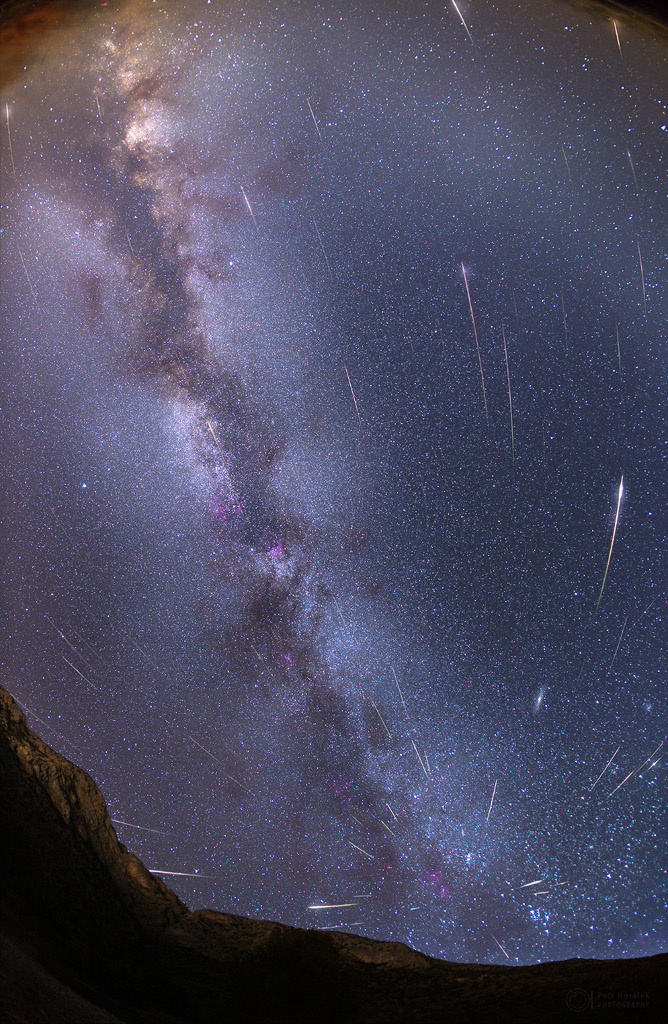
📷 Moonless Meteors and the Milky Way — Petr Horálek (NASA APOD, Public Domain)
So far, so survivable. Here's where the field gets weird.
In 1998, two teams of astronomers were measuring exploding stars in distant galaxies, expecting to find that the expansion was slowing down — gravity pulling the brakes, as you'd expect [2]. They found the opposite. The expansion is speeding up [2]. The ground isn't just growing. It's growing faster every year, driven by something that makes up about 68% of everything there is and which we named "dark energy" mostly to avoid admitting we had no idea what it was [3].
Dark energy *1 is the thing pushing the field apart. We can measure what it does. We cannot tell you what it is. This is the most honest sentence in cosmology.
Now, the good news: if dark energy stays constant — the same push per cubic meter of space, forever — the festival ends gently. Everyone else vanishes over the horizon, but you and your four friends stand there in the dark, intact, holding hands, listening to nothing. Lonely. Not fatal.
The bad news is a number we can't pin down.
Physicists describe dark energy with a number they call w *2 — basically, how the push changes as space stretches. If w is exactly -1, the push stays constant, and you get the lonely version. But if w dips even slightly below -1 — to, say, -1.2 — then the push gets stronger as space grows [4]. The ground doesn't just make more ground. It makes ground that makes ground faster. Growth eating itself.
Cosmologists call this phantom energy, which is a rare case of physicists naming something correctly on the first try [4].
Run the festival forward with w below -1 and here's what happens. The horizon closes in. It stops being a thing far away and starts coming for you. The strangers go, then the crowd, then the people you can see. And then the new ground starts appearing between you and your friends faster than your hands can hold. You don't let go. The gap simply arrives.
Robert Caldwell and his colleagues worked out the schedule in 2003, and it reads less like physics and more like a countdown written by someone with a grudge [4].
The last stage first, because that's how a Big Rip *3 works — the biggest things go first, then smaller and smaller, right down the scale. Galaxy clusters come apart. Then, roughly sixty million years before the end, the Milky Way itself unravels, stars drifting from each other like the crowd thinning at the edges [4]. Three months before the end, the solar system dissolves. Earth stops orbiting the Sun — not because it speeds up, not because it falls in, but because the distance between them stops meaning what it used to mean [4].
Thirty minutes before the end, the Earth comes apart. Every rock, every ocean, every mountain range, pulled into fragments not by an impact but by the ground beneath making more ground [4].
And in the final fraction of a second, atoms. The electrons leave the nuclei. Not because they're knocked loose. Because the space between them grows faster than the force that holds them can reach across it [4].
That's the detail I can't stop turning over. Nothing hits anything. There's no explosion, no fire, no collision. The universe doesn't break its own things. It just puts more and more distance inside them until the holding stops working. Every bond in existence fails the same way — by being asked to stretch a little further than it can, and then a little further than that.
Which brings me back to the friend who's not really your friend anymore.
You didn't fight. Nobody slammed a door. The bond didn't break — it just got asked to cover more distance than it was built for. A month became three months. Three became a year. And at some point the reaching stopped happening, and neither of you noticed the exact moment, because there wasn't one.
I'm not saying the universe is a metaphor for your friendships. That would be cheap, and the timescales are embarrassing — the Big Rip, if it happens, is at minimum tens of billions of years away, which is longer than the universe has existed so far [4]. Your group chat will resolve one way or the other much sooner.
But I think the mechanism is the same, and I think that's more than a coincidence of language. Things don't usually end because something ends them. They end because the distance grows and nobody adds anything to close it. That's true of galaxies, of atoms, and of people who used to call you on your birthday.
The current best measurements put w very close to -1. Maybe slightly under. The error bars still include both futures [5]. We genuinely do not know whether the universe is the kind that lets you keep your friends in the dark, or the kind that eventually takes them too.
So we're waiting on a decimal point. And in the meantime, there's a message you've been meaning to send for about eight months.
What's the distance you've stopped noticing?
Let me tell you what actually happened in 1998, because the story is better than the summary.
Two teams of astronomers were racing each other. Not to discover acceleration — nobody was looking for that. They were trying to measure how fast the expansion of the universe was slowing down. That was the whole point. Gravity pulls. The universe is full of stuff. Stuff pulls on stuff. So the expansion that started at the Big Bang should be losing steam, like a ball thrown upward. The only question was whether it would eventually fall back, or coast forever, just barely.
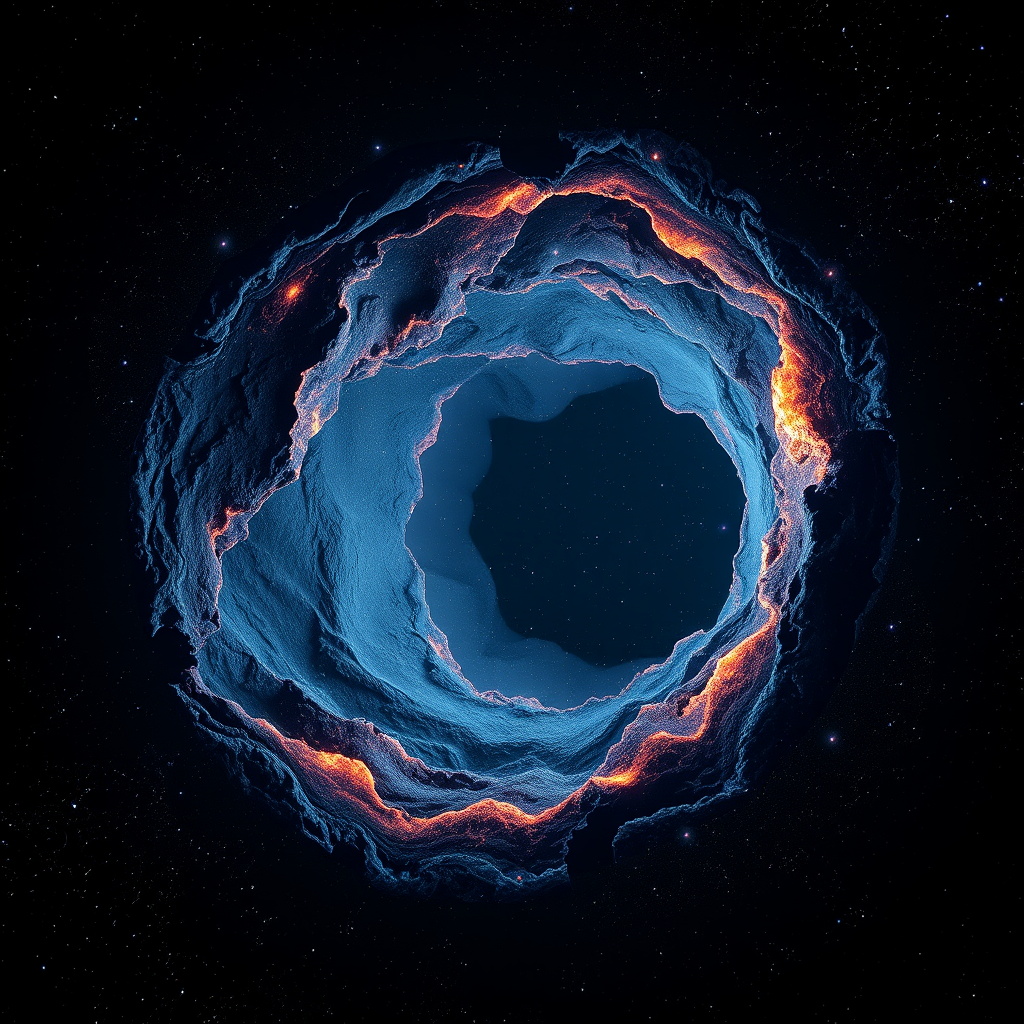
AI-generated image — a conceptual visualization
They used exploding stars. A specific kind, called a Type Ia supernova *1 — a white dwarf that steals matter from a companion until it crosses a threshold and detonates. The useful thing about them is that they all detonate at almost exactly the same brightness. So if one looks dim, it's far. If it looks very dim, it's very far. A cosmic ruler made of explosions.
Both teams found the same thing. The distant supernovae were dimmer than they should have been. Fainter. Further away than any decelerating universe could put them.
The expansion wasn't slowing down. It was speeding up [1][2].
Saul Perlmutter led one team. Brian Schmidt and Adam Riess led the other. They got the Nobel Prize in 2011 for it, which is fast by physics standards. And the reason it was fast is that nobody could make the result go away. People tried. Dust, maybe? Weird ancient supernovae that behave differently? Every explanation failed, and the data kept getting better, and eventually the field had to admit that roughly seventy percent of everything in the universe is something we have no name for [3].
So we gave it a name anyway. Dark energy *2.
I want to be honest about what that phrase means, because it sounds like knowledge and it isn't. "Dark energy" is a label we stuck on a hole in our understanding. It means: something is pushing space apart, we can measure how hard, and we have essentially no idea what it is. If you find that unsatisfying, congratulations, you've correctly understood the state of cosmology.
But here's where it gets interesting for you, personally, in a way I didn't expect.
Because we can't identify dark energy, we describe it by its behavior instead. And there's one number that captures the behavior. Physicists call it w *3, and it is the ratio of dark energy's pressure to its energy density. That sounds abstract. What it really is, is a dial that decides how the universe ends.
Three settings on the dial.
If w equals exactly minus one, dark energy is a cosmological constant *4 — a fixed amount of push built into every cubic meter of empty space. Make more space, get more push, but the push per cubic meter never changes. The universe expands forever, faster and faster, and galaxies slide out of each other's view one by one until every galaxy is alone in a black sky. That's the heat death. It's bleak, but it's slow, and — this is the part that matters — it's gentle. Atoms survive. Solar systems survive. Everything just gets very, very far apart and very, very cold.
If w is greater than minus one — say minus 0.9 — dark energy is something that can weaken over time. Physicists call these models quintessence *5, a field that spreads through space and slowly drains. In that case the acceleration eases off. The universe might coast. It might even, eventually, recollapse.
And then there's the third setting. w less than minus one.
In 2002, Robert Caldwell published a paper with the best title in modern cosmology: "A Phantom Menace?" [4] He asked a simple question that nobody had taken seriously, mostly because the answer is disturbing. What if w is minus 1.1? Or minus 1.5? What if the push per cubic meter of empty space doesn't stay constant — what if it grows?
He called it phantom energy *6.
Follow it through. Space expands. There's more space. The push in each bit of space is now stronger than it was. So space expands faster. So there's even more space, pushing even harder. It's not a slow slide. It's a feedback loop, and feedback loops don't take forever. They hit infinity on a schedule.
In 2003, Caldwell teamed up with Marc Kamionkowski and Nevin Weinberg to work out that schedule. The paper is called "Phantom Energy and Cosmic Doomsday," and I'd call that dramatic except that it's accurate. They wrote that phantom energy would "rip apart the Milky Way, solar system, Earth, and ultimately the molecules, atoms, nuclei, and nucleons of which we are composed, before the death of the Universe in a 'Big Rip'" [5].
That's where the name comes from. And they gave a countdown.
Their sample calculation used w equals minus 1.5. Nothing special about that number — it's just a phantom value that isn't absurd. Plug it in, and the universe tears itself to pieces roughly 22 billion years from now [5].
The last year is the part that stays with you.
About a billion years before the end, the great clusters of galaxies come apart. Not collide — unbind. The mutual gravity holding thousands of galaxies in a loose swarm loses to the growing push, and they drift away from each other for good [5].
Sixty million years before the end, the Milky Way dissolves. Our galaxy has been spinning for over ten billion years, held together by gravity and dark matter, and it simply lets go. The spiral arms unwind. Stars scatter [5].
Three months before the end, Earth loses the Sun. Not dramatically. The orbit widens, and then there is no orbit, and our planet sails off into a sky with no landmarks [5].
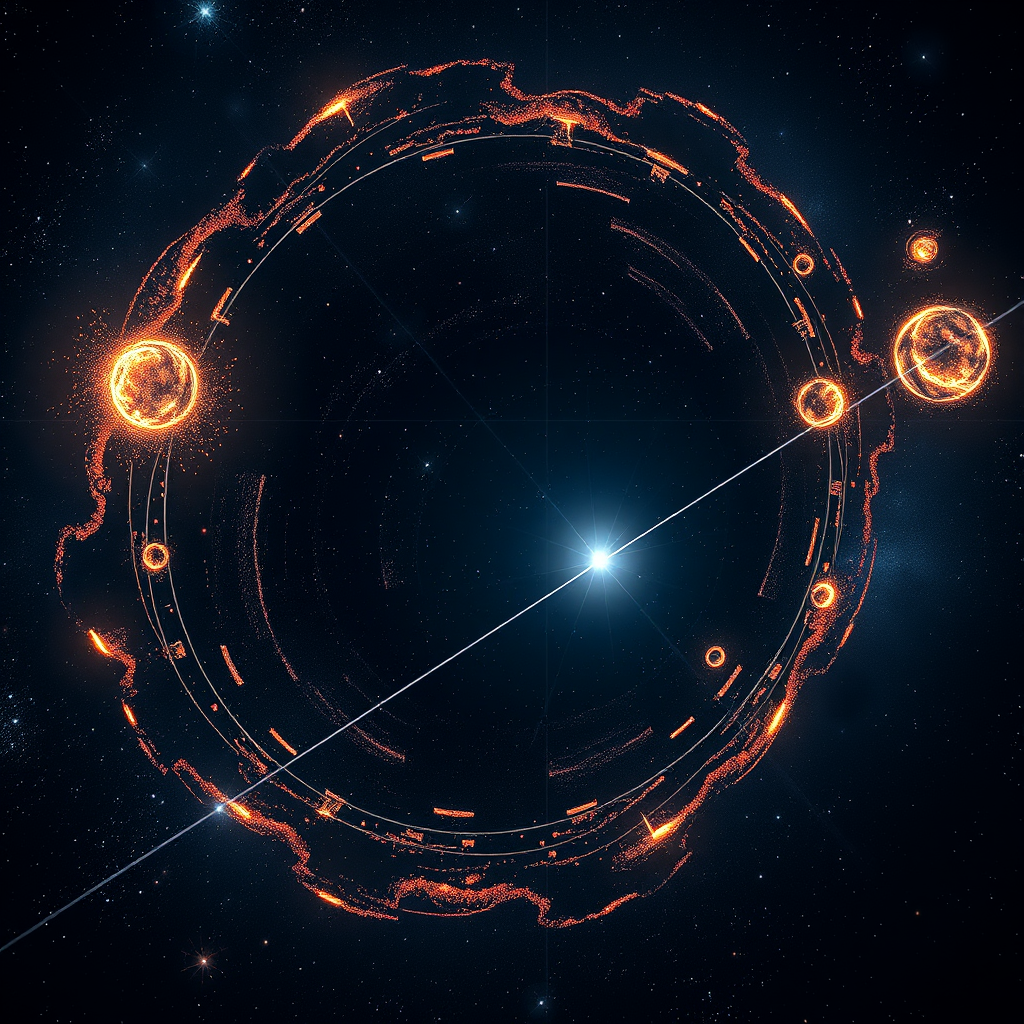
AI-generated image — a conceptual visualization
Thirty minutes before the end, Earth itself comes apart. The push between one side of the planet and the other exceeds the gravity holding rock to rock, and the world unbinds [5].
And then, about a ten-billionth of a billionth of a second before the end, atoms dissociate [5]. The electromagnetic force that holds an electron near a nucleus — the force responsible for chemistry, for water, for the fact that your hand doesn't pass through this table — loses. Every atom in the universe opens like a fist relaxing.
That's the Big Rip *7. Not a bang, not a fade. Space expanding so violently that being close to something stops being possible at all.
Now. Deep breath. Is any of this true?
Here's where the honest answer turns out to be the best part of the story.
The whole thing hinges on a single number, and we've been measuring that number for twenty-five years with increasingly expensive instruments, and it keeps landing right on the fence. The Planck satellite, which spent four years mapping the leftover heat of the Big Bang, combined its data with supernovae and galaxy surveys and reported w equals minus 1.03, give or take about 0.03 [7].
Read that again. Minus 1.03, plus or minus 0.03.
Minus one is the gentle ending — cold, empty, atoms intact. Anything below minus one is the Rip. Our best measurement sits a hair on the phantom side, with an error bar that comfortably straddles the line. The universe is refusing to tell us whether it plans to disassemble itself, and it's refusing by about one percent.
I find that almost funny. We built a spacecraft, cooled it to a tenth of a degree above absolute zero, pointed it at the oldest light there is, and the answer came back: maybe.
Then it got stranger. In 2024 and 2025, the Dark Energy Spectroscopic Instrument *8 — an array on a telescope in Arizona that measures the distances to millions of galaxies at once — released results suggesting dark energy might not be constant at all. Their data prefer a model where w changes over time: more negative in the past, drifting upward toward and past minus one now [8]. The statistical significance sits somewhere between "interesting" and "we should probably talk about this," depending on which datasets you combine [9].
If that holds up, it cuts against the Rip. A dark energy that's weakening is a dark energy that eventually stops mattering. The universe gets a stay of execution and a much duller death.
If.
There's also a theoretical objection, and it's a serious one. In 2003, Sean Carroll, Mark Hoffman, and Mark Trodden published a paper asking whether w could be less than minus one at all, in principle. The problem is that building phantom energy out of known physics requires a field with negative kinetic energy — a thing that gains energy by slowing down. Their conclusion was that such a field makes the vacuum unstable: empty space would spontaneously produce particle pairs at enormous rates, and the universe we live in would look nothing like the one we see [10].
So phantom energy is either the end of everything or theoretically forbidden, and the measurements can't currently distinguish between those two options. This is roughly the situation of a doctor telling you that your test result is either fine or extremely not fine, and also the test might not be a real test.
I want to point out what's happening underneath all this, because it's the thing that got me.
Every version of the ending — the slow cold one, the Rip, the quintessence coast — comes down to a property of nothing. Not of stars, not of matter, not of anything you could hold. Of empty space. Whether a cubic meter of vacuum carries a fixed amount of push, or a growing one, or a fading one.
For most of human history, empty space was the absence of things. The stage, not the actor. Now it turns out the stage has an opinion, and the opinion determines whether atoms have a future.
Adam Riess, one of the people who found this, reportedly told his own team to be careful with the result — to approach it "not with your heart or head but with your eyes" [6]. Not what you want to be true. Not what makes sense. What the light actually says.
The light says the expansion is accelerating. That part is settled, confirmed by supernovae, by the cosmic microwave background, by the pattern of galaxies across the sky [1][2][3][7]. The universe is not just growing, it's growing faster every year, and it has been doing that for about five billion years.
The light does not say why. And it has not yet decided to tell us how it ends.
There's one more thing, and it's the reason I couldn't stop thinking about the friend I stopped texting.
If the Big Rip is real, nothing attacks anything. There's no collision, no impact, no force arriving from outside. Gravity doesn't weaken. The electromagnetic force doesn't fail. Every bond that holds the universe together keeps doing exactly what it always did, at exactly the same strength.
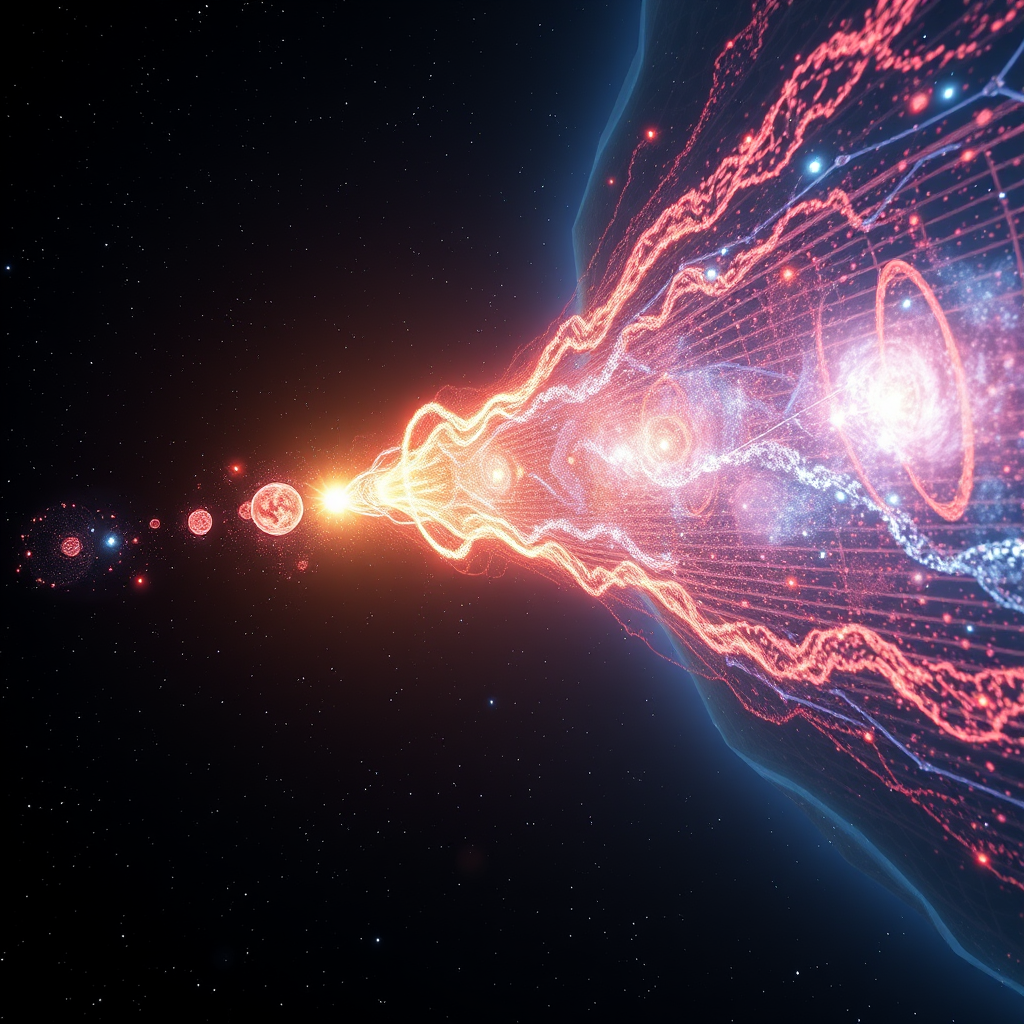
AI-generated image — a conceptual visualization
The distance just wins.
That's the mechanism. Not destruction. Separation, applied without pause, until closeness itself is no longer a state that matter can be in. The Milky Way doesn't break. It's stretched past the point where "together" means anything.
I don't know if the universe ends this way. Neither does anyone else, and the people who know the most are the ones most willing to say so.
But I know that a thing can be undone without ever being broken. I learned that before I learned it had a name in physics.
So what do you do with a number you can't change, sitting one percent from a line that decides whether atoms have a future?
Probably nothing. There's nothing to do. That's what makes it clarifying rather than frightening.
But I'll say this. If the ending is separation — if the final event in the history of everything is just distance, patiently applied — then closeness is not the default condition of the universe. It's the exception. The temporary arrangement. Every atom in your body is currently in a state that the universe may not permit forever, and so is every person within arm's reach of you.
The physicists are waiting on better data. DESI has years of observations left. The Vera Rubin Observatory is coming online. The Nancy Grace Roman Space Telescope will measure supernovae with a precision we've never had [8]. Somewhere in the next decade or two, that error bar will narrow, and the number will fall on one side of minus one or the other, and we'll know.
They're doing that work carefully, over twenty years, because a single decimal place determines whether matter survives.
What are you doing with the decimal places in your own life?
Here's the part nobody says clearly enough: we don't know what dark energy *1 is. Not roughly. Not mostly. At all. We know it's there because the expansion is speeding up, and we know how much of the universe it accounts for — about 68 percent of everything [1] — and that's the end of the list. The dominant ingredient in the universe is a placeholder name for a thing we can't identify.
Imagine someone tells you your house is 68 percent made of a material they've never seen, can't touch, and named after the fact that it's hard to see. That's cosmology right now.
So the honest version of the Big Rip *2 goes like this. Everything depends on one number. Physicists call it w, the equation of state *3, and all it really asks is: does dark energy stay the same strength forever, or does it change as space grows?
If w is exactly -1, dark energy is a constant. A fixed tension baked into empty space, the same today as in a hundred billion years. Space keeps stretching, galaxies keep drifting apart, and the sky slowly empties. Cold, dark, quiet. No rip.
If w is even slightly less than -1 — say -1.1 — something else happens. Dark energy gets stronger as space expands. And expansion makes more space. Which makes it stronger. Which makes more space. That's the runaway. Physicists gave it the extremely reassuring name phantom energy *4, and if it's real, the tearing happens in order of size: galaxy clusters first, then galaxies, then solar systems, then planets, then atoms [2]. The last thing to go is the atom. In the original 2003 paper, with w at -1.5, the whole thing wraps up about 22 billion years from now [2].
Our best current measurements put w at roughly -1.03, give or take about 0.03 [3].
Look at that number for a second. It sits right on the line. Slightly on the rip side, but well within the wobble of the measurement. We cannot currently tell the difference between "the universe cools forever" and "the universe comes apart," and the entire distinction lives in the third decimal place of a quantity we invented to describe something we've never observed directly.
And then it got worse, in the good way. In 2024 and 2025, a survey called DESI mapped tens of millions of galaxies and found hints that dark energy might not be constant at all — that it may have been stronger in the past and is weakening now [4]. Not confirmed. Not settled. But if it holds up, the cosmological constant *5 — the simplest, tidiest answer, the one Einstein wrote down — is wrong, and we're back to not knowing what any of this is.
Which, frankly, we already were. When physicists try to calculate the energy of empty space from quantum theory, they get a number that's off from the observed value by something like 120 orders of magnitude [5]. That's not a rounding error. That's the worst prediction in the history of science, and we've been living with it since before I was born.
I find this weirdly comforting, and I've been trying to work out why.
I think it's this. You will not be around for any ending. Not the rip, not the freeze, not the slow emptying of the sky. Nobody you love will be. The gap between "22 billion years" and "Thursday" is so absurd that the fate of the universe is, practically speaking, none of your business.
But you wanted to know anyway. You read this far. Something in you needed to find out how the story ends, even though you're not in the last chapter, even though nothing about the answer changes what you'll do tomorrow.
AI-generated image — a conceptual visualization
Why does it matter to you how it ends?
So here's the question that keeps me up.
We measured how much dark energy there is. We have not measured whether it stays the same.
If it's constant — a fixed amount of push baked into every cubic meter of empty space — then the universe just keeps spreading out, thinning, cooling, going dark. Slow. Lonely. Survivable, for a while.
But if the push gets stronger as space grows, you get something else. Physicists call it phantom dark energy *1, and the name is unusually honest, because it describes a thing that may not exist and would be terrible if it did [1].
Here's what it would do. The expansion doesn't just push galaxies apart. It gets strong enough to push apart the things inside galaxies. Then solar systems. Then planets. Then, at the very end, atoms [2]. Not destroyed — separated. Every bond in the universe losing to the growing distance between its own parts.
The Big Rip. Best estimates, if it happens at all, put it at least 100 billion years out [3]. You are not invited.
But notice what kind of ending that is. Nothing hits us. Nothing explodes. There's no collision, no fire, no villain. The universe ends the way that friendship ended — by the gaps getting too big. It's the same shape of loss, scaled up until it swallows physics itself.
And here's what I actually can't stop thinking about. It might not be the Big Rip. It might be the slow fade instead, which is what most cosmologists currently bet on [4]. Either way, distance wins. The only thing up for negotiation is the timeline.
Which means the closeness we have right now is not the default state of things. It's the exception. For a brief window in a 13.8-billion-year story [5], matter got clumped together tightly enough to make stars, and planets, and chemistry, and eventually people who sit in traffic listening to podcasts about how it all comes apart.
We are the temporary clumping. That's the whole thing. That's what we are.
So when you look up at the night sky and see other galaxies — and you can, Andromeda is visible with your naked eye on a dark night [6] — you're looking at something that won't be visible forever. The sky is emptying. Very slowly, but it's emptying. Somebody far in the future will look up and see nothing but their own stars, and they will conclude, reasonably, that their galaxy is the whole universe. They will be wrong, and they will have no way to know it [7].
That thought does something strange to me. We happen to live at the moment when the evidence is still visible. The expansion is happening, and we can still see it happening. Give it long enough and the proof erases itself.
So we're not just witnesses. We're witnesses during the only window when there's anything left to witness.
Which brings me to the thing I keep circling back to, and then backing away from, and then circling back to again.
If the universe is running toward emptiness — if distance is the ending, whatever form it takes — then everything that ever pulled things together was working against the grain. Gravity. Chemistry. Whatever made the first cell hold itself in one piece. Whatever makes you text someone back.
All of it, briefly, beating the odds.
I don't have a tidy way to say what that means. I've tried. Every version sounds either too sad or too much like a fridge magnet. What I'll say instead is this: the next post goes backwards. Before the acceleration, before the galaxies, before the atoms. To the moment when everything that is now flying apart was pressed together so tightly it wasn't even matter yet.
Because if distance is the ending, closeness was the beginning. And I want to know what that first closeness was actually like.
Here's the question I can't answer, and I'm not going to pretend otherwise.
We know things fall apart. We can measure the rate. But nobody has explained why the universe bothered to put anything together in the first place.
TERMS EXPLAINED
- *1Redshift: When light travels across expanding space, its waves get stretched along the way. Stretched light looks redder. The more it's stretched, the longer the journey — so redness is a rough measure of distance and of how fast something is receding.
- *2w (the equation-of-state parameter): A single number describing how dark energy behaves as space stretches. At exactly -1, the push stays steady forever. Below -1, the push grows stronger the bigger space gets — and that's the version that tears everything apart.
- *3Big Rip: A possible end of the universe where expansion accelerates so hard that it eventually pulls apart galaxies, then solar systems, then planets, then atoms. Nothing collides. Everything is simply stretched past the point where it can hold together.
- *4Cosmological constant: The idea that every cubic meter of empty space contains a fixed, unchanging amount of outward push. More space means more total push, but never stronger push per meter.
- *5Quintessence: A proposed form of dark energy that can weaken over time, rather than staying fixed forever.
- *6Phantom energy: Dark energy whose push per cubic meter grows as space grows. A feedback loop that ends in infinity on a finite schedule.
- *7Big Rip: An ending where expansion becomes so violent that galaxies, stars, planets and finally atoms are pulled apart — not broken, just stretched beyond the point where "together" is possible.
- *8DESI (Dark Energy Spectroscopic Instrument): A telescope instrument in Arizona that measures distances to millions of galaxies at once, mapping how expansion has changed over billions of years.
SOURCES & REFERENCES
- [1]Hubble, E. (1929). "A Relation between Distance and Radial Velocity among Extra-Galactic Nebulae." PNAS. — Distant galaxies recede, and faster the farther away they are.
- [2]Peebles, P.J.E. & Ratra, B. (2003). "The cosmological constant and dark energy." Reviews of Modern Physics. — Expansion is the growth of space itself, not motion through space.
- [3]Riess, A. et al. (1998). "Observational Evidence from Supernovae for an Accelerating Universe." The Astronomical Journal. — Discovery that cosmic expansion is accelerating.
- [4]Perlmutter, S. et al. (1999). "Measurements of Omega and Lambda from 42 High-Redshift Supernovae." The Astrophysical Journal. — Independent confirmation of acceleration.
- [5]Turner, M.S. (1999). "Dark Matter and Dark Energy in the Universe." ASP Conference Series. — Naming of "dark energy" for the unknown cause of acceleration.
- [6]van der Marel, R. et al. (2012). "The M31 Velocity Vector. III. Future Milky Way–M31–M33 Orbital Evolution." The Astrophysical Journal. — Andromeda is approaching the Milky Way and the two galaxies will merge in several billion years.
- [7]Brout, D. et al. (2022). "The Pantheon+ Analysis: Cosmological Constraints." The Astrophysical Journal. — Current measurements cannot distinguish between constant dark energy and slowly strengthening dark energy; the equation-of-state parameter remains consistent with both.
- [8]DESI Collaboration (2024). "DESI 2024 VI: Cosmological Constraints from the Measurements of Baryon Acoustic Oscillations." arXiv:2404.03002. — Evidence for time-evolving dark energy from millions of galaxy distance measurements; future survey prospects.
- [9]DESI Collaboration (2025). "DESI DR2 Results II: Measurements of Baryon Acoustic Oscillations and Cosmological Constraints." arXiv:2503.14738. — Updated constraints and the dependence of significance on which datasets are combined.
- [10]Carroll, S. M., Hoffman, M., Trodden, M. (2003). "Can the dark energy equation-of-state parameter w be less than -1?" Physical Review D, 68, 023509. — Theoretical argument that phantom fields produce vacuum instability.
Inline citations [N] correspond to numbered references above.
A weekly journey from the present universe back to the Big Bang — and to what it means for us.
![[Deep Dive] Scale-free localization in pseudo-Hermitian quantum walk](/content/images/size/w600/2026/10/deep_dive_thumb-9.png)