The Axis of Evil: Why the CMB Anomalies Matter
Episode 4: The Universe's First Photograph
I like science that leaves room to imagine. When things that seemed unrelated turn out to share a hidden pattern — that moment feels like finding one of the world's secrets. Which opens a door I didn't know was there. Which leads somewhere unexpected. Which eventually leads back to me.
You're lying on your back in a field. A cloud drifts over, and for a second it's clearly a dog. Then it's a shoe. Then it's just a cloud again.
You knew the dog wasn't real. Your brain built it anyway. We are pattern machines. People see faces in electrical outlets, in car grilles, in burnt toast *1. In one experiment, volunteers stared at pure random static, nothing hidden in it at all, and reported seeing a face about a third of the time [1]. That's not a flaw. It's how your ancestors spotted the leopard in the grass before it spotted them. The price is false alarms. Lots of them.
Now hold that thought, because astronomy has spent five centuries teaching us the opposite lesson. Copernicus moved Earth out of the center [2]. Then the Sun turned out to be an ordinary star. Then our galaxy turned out to be one among billions [3]. Every time humans thought we were special, the universe quietly corrected us. There's a name for this humility: the Copernican principle *2. You are not at the center. Nobody is. There may not even be a center to be at.
So here's the problem. Imagine the oldest photograph in existence. Not of a person or a planet. Of everything. It's made of light that set out nearly fourteen billion years ago, before there were any stars [4]. It should be the most impartial picture ever taken. It has no reason to care about us.
And yet, when astronomers looked closely, a few of its largest features seemed to line up. Not with some distant galaxy. With us. With the flat plane our planet traces around the Sun [5]. As if the baby picture of the cosmos had been posed to face a small rock that wouldn't exist for another nine billion years.
That's a bit like finding your own name in your great-great-grandmother's wallpaper. Flattering. Also deeply suspicious.
Maybe something is wrong with the camera. Maybe something is wrong with us. Maybe something is wrong with the universe. Or maybe you're back in the field, and the dog is just a cloud. Nobody knows yet. That's not a failure. It's the most honest place science can stand.
So when the universe seems to look back at you, how do you tell a real signal from a cloud shaped like a dog?
The Tea Leaves That Knew Where You Sat
Picture your grandmother's kitchen. She finishes her tea, swirls the cup three times, and flips it onto the saucer. The wet leaves slide and settle into clumps. Big clumps, small clumps, scattered specks. She squints and tells you your future.
You don't believe her. Leaves land where they land. That's the whole point of swirling.
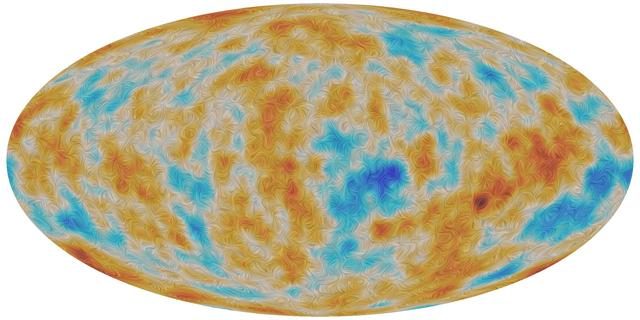
The cosmic microwave background*2 is that cup. It's the oldest light there is, released about 380,000 years after the Big Bang, when the universe first cooled enough for light to travel freely [6]. It fills the entire sky, and it isn't perfectly smooth. It has tiny hot and cold patches, like leaves stuck to porcelain. Our best theory says those patches should be random. Swirled. No preferred direction, no message.
Now imagine you look closer at the cup. The two biggest clumps of leaves both line up with the handle. Not roughly. Neatly. And the handle is the part of the cup nearest to you.
That's roughly what happened in 2003. Researchers studying data from the WMAP satellite noticed that the largest patterns in the ancient light seemed to point along the same line [3]. Stranger still, that line sat close to the plane of our own solar system*3 [4]. Light from the edge of the observable universe, older than every star, appeared to be lined up with the orbit of Earth. Two physicists named it the Axis of Evil [2]. Cosmologists are not usually this dramatic. They had clearly been waiting years for the chance.
Here's why this bothers people. The leaves shouldn't know where the handle is. The early universe shouldn't know where we'd be sitting 13.8 billion years later. So there are really only three options.
One, it's coincidence. Swirl enough cups and eventually the leaves will line up with something. Two, the cup is lying to us. Maybe dust in our own galaxy, or a quirk in how we process the data, is painting a pattern that isn't really there. Three, the leaves actually know something. Maybe the universe has a shape, or a direction, that our theory missed.
The Planck satellite looked again, with sharper eyes, and the oddities didn't go away [4][5]. But they didn't get much stronger either. They hover at a level scientists call "interesting but not convincing" [5].
And there's a catch that sits right on top of your grandmother's trick. We only get one cup. There is one sky, one universe, one pour. You can't brew another and check. The biggest patterns are also the rarest, so there are only a handful of them to compare. That built-in fuzziness has a name, cosmic variance*4. On top of that, if you search for any pattern at all, you'll usually find one. Statisticians call this the look-elsewhere effect*5 [5]. It's the math version of seeing a dog in a cloud.
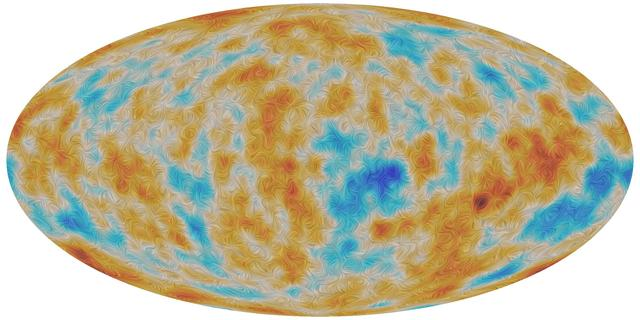
📷 Polarization of the Cosmic Microwave Background — ESA/Planck Collaboration (NASA Image and Video Library, Public Domain)
So you're left staring into the cup. Either you're reading your own face into random leaves, or the oldest light in existence is quietly pointing at the kitchen table you're sitting at.
The Pattern That Points at Us
Here's the part that kept me up at night. Your grandmother's tea leaves are supposed to be random. So is the cosmic microwave background. Our best theory of the early universe says the hot and cold spots should be scattered with no preferred direction. Across most of the sky, that holds. But when you step back and look at the very biggest splotches, the ones that stretch across the entire sky, something strange shows up.
They line up. And the line they make points, roughly, at us.
Conceptual sketch of aligned large-scale patterns and a pair of matched circles. The matched circles illustrate the donut-universe hypothesis; no such circles have been found in the data. Background map: ESA / Planck Collaboration.
The first people to notice were Max Tegmark, Angélica de Oliveira-Costa, and Andrew Hamilton, in 2003 [2]. They were cleaning up the first map from WMAP*3, a NASA satellite that had spent a year staring at the oldest light in the universe. To see what they found, you need one idea.
Think of the sky as a bell. Strike a bell and it rings with one deep note plus a stack of higher overtones. Cosmologists break the microwave map into similar notes, called multipoles*4. The deepest useful ones are the quadrupole, which is basically two hot patches and two cold ones, and the octopole, which is a slightly busier version. They're the biggest shapes on the sky.
These two notes should have nothing to do with each other. Like two leaves in the cup, each should point wherever chance sends it. Instead, the quadrupole and octopole shared almost the same axis. The team put the odds of that happening by accident at roughly one in sixty [2][3].
There was a second oddity. The quadrupole was too quiet. The deepest note barely rang at all. An earlier satellite, COBE, had hinted at this, and WMAP confirmed it [4].
In 2005, Kate Land and João Magueijo at Imperial College London pushed further. They found the alignment didn't stop at the two lowest notes. Several higher ones seemed to lean along the same direction [5]. They gave it a name that borrowed from a George W. Bush speech: "the axis of evil." Physicists do not usually get to name things. This is why.
Then it got weirder. Craig Copi, Dragan Huterer, Dominik Schwarz, and Glenn Starkman checked where the axis actually pointed. It lined up with the ecliptic*5, the flat plane our planets orbit in. It also lined up with the direction our solar system is moving through space, and with the equinoxes [6].
Sit with that. This light left its source about 13.8 billion years ago. Earth didn't exist. The Sun didn't exist. There is no reason the pattern should care where our planets go around. It's as if the tea leaves settled into an arrow pointing at your grandmother's front door.
The axis isn't alone. There's the Cold Spot, a patch in the southern sky that is unusually large and unusually cold, first flagged by Patricio Vielva and colleagues in 2004 [7]. And there's a lopsidedness: one half of the sky has slightly stronger fluctuations than the other, found by Hans Kristian Eriksen's team the same year [8]. Collectively these are called the CMB anomalies.
The obvious suspect was WMAP itself. Maybe a glitch in the instrument, or a mistake in the software. So the next test was simple. Look again with a different machine.
The European Space Agency's Planck satellite did exactly that. Different spacecraft, different detectors, different team. In 2013, Planck released its results. The anomalies were still there [9]. Paolo Natoli of the University of Ferrara put it bluntly in the ESA announcement: "It can no longer be said that they are artefacts of the measurements. They are real and we have to look for a credible explanation" [10].
Case closed? Not quite. And this is where the story loops back to that face in the static.
In 2011, the WMAP team itself, led by Charles Bennett, published a paper with a pointed title: "Are There Cosmic Microwave Background Anomalies?" [11]. Their argument was about how you calculate odds. If you look at a map first, spot something odd, and only then ask how unlikely that exact oddity is, you'll always get a small number. Anything specific is unlikely. To make the point, they showed that Stephen Hawking's initials, a clear S and H, appear in the microwave sky [11]. Hawking, as far as anyone knows, did not sign it.
Statisticians call this the look-elsewhere effect*6. Search enough places for a surprise and you'll find one. Your brain does it with clouds. Cosmologists, it turns out, have the same brains. They just have better software.
There's another problem, called cosmic variance*7. We have one sky. We can't rerun the Big Bang and check whether this universe drew a strange hand. And the biggest patterns are the worst off. There are only a handful of huge splotches on the whole sky, so you're working with very few samples. It's like judging a die by rolling it four times.
AI-generated image — a conceptual visualization
So why does anyone still care? Because of what's at stake. Modern cosmology rests on the cosmological principle*8, the assumption that on large enough scales the universe looks the same in every direction. Inflation*9, the leading theory of the first instant, predicts random fluctuations with no favorite axis. If the alignment is real,something in that picture is missing. Maybe the universe is shaped oddly on the largest scales. Maybe something happened before inflation that left a fingerprint. Or maybe something much closer, a cloud of dust in our own solar neighborhood, is quietly smudging the lens. Nobody knows.
Planck's final data, released in 2018, left things exactly there. The anomalies persist, but at a level most physicists read as "odd, not damning" [12]. In a 2016 review, Schwarz, Copi, Huterer, and Starkman argued that the large-angle oddities still deserve an explanation, and that future measurements of polarization*10 could settle whether they are real physics or chance [13].
So here's where it leaves you. The most careful people alive, with the best instruments ever built, are staring at the same sky and arguing about whether they're seeing a dog or a cloud. The data won't decide. It can't, not yet. What decides is how much you trust your own eyes.
Which raises the question I can't shake. If a pattern points straight at you, how would you ever know it wasn't you doing the pointing?
One Sky and No Second Opinion
Here's the problem nobody can get around. We have one universe. One sky. One cup of tea leaves.
If you wanted to know whether a coin was rigged, you'd flip it a thousand times. You can't flip the universe. Those giant splotches are so big that only a handful fit across the whole sky. Astronomers call this cosmic variance*5. With so few samples, the universe is allowed to look a little lopsided purely by luck [5]. It's like judging a restaurant by one bite. Of the bread.
Then there's a sneakier issue. Nobody predicted the alignment. It was found after people looked at the map. Stare at any sky long enough and something will look odd. This is the look-elsewhere effect*6. The WMAP team argued exactly this: pick a weird pattern after the fact, and of course it looks unlikely [6]. Your brain did the same thing with the dog cloud.
But it didn't go away. The Planck satellite, with sharper instruments, saw the same features. It found the alignment, a big cold spot, and one half of the sky slightly more splotchy than the other [7]. Each one alone is only mildly surprising, roughly a one-in-a-hundred to one-in-a-thousand fluke [7]. Together? Nobody agrees how to add them up [8]. And the strangest part: some of these directions line up with the plane of our own solar system, the ecliptic*7 [8]. The earlyuniverse had no idea where Earth would one day orbit. So either that's a coincidence, or something close to home is sneaking into the map. Dust, perhaps, or a quirk in how the data gets cleaned. Years of checking haven't found a culprit [8].
So we're stuck. We can't get a second sky. We can't forget we already looked. Some physicists think better maps of polarized light*8 might settle it, since that's a fresh set of clues about the same splotches [8]. Until then, the honest answer is a shrug with good error bars.
And this is where it gets personal. The same brain that saw the dog in the cloud is the one reading the cosmic map. Sometimes the pattern is real. Sometimes it's toast. When you can't run the test twice, how do you ever know which one you're looking at?
The Arrow That Might Point Home
So where does that leave you, lying in that field? Two physicists named this alignment in 2005. They called it the axis of evil [6]. Partly as a joke. Partly as a warning. If it's real, it breaks something older than modern physics: the idea that we are nowhere special. Copernicus pushed Earth out of the center. Nearly every discovery since has pushed us further toward the edge. The Copernican principle*6 isn't a law. It's a habit of humility.
Then came Planck, the most detailed map of that ancient light ever made. It still sees the anomalies [7]. Better data didn't erase them. It didn't make them stronger either. They just sit there, stubborn, like a stain on the table you've quietly learned to set your mug on.
Here's what I keep coming back to. You see faces in toast. Astronomers might be seeing an arrow in thestatic. Or the universe might actually be pointing at us. We can't tell which yet, and that's the uncomfortable part. The same brain that builds a dog out of a cloud is the one reading the map.
Next time, we go further back, past the moment this light was set free, into a darkness no telescope can reach. But first, here's the question I can't shake.
If the sky really were pointing at you, would you trust yourself enough to believe it?
TERMS EXPLAINED
- *1Pareidolia: Your brain's habit of seeing meaningful shapes, especially faces, in random things like clouds, toast, or static.
- *2Copernican principle: The working assumption that we don't occupy a special or privileged spot in the universe.
- *3Plane of our solar system: The flat disk that Earth and the other planets travel around the Sun in. Astronomers call it the ecliptic.
- *4Cosmic variance: The unavoidable uncertainty that comes from having only one universe to measure. You can't repeat the experiment.
- *5Look-elsewhere effect: If you check enough places for a pattern, you'll find one by pure chance. That makes a "surprising" result less surprising than it first looks.
- *6Look-elsewhere effect: If you search many places for something unusual, you'll find something by pure luck, so a surprise is less surprising than it looks.
- *7Cosmic variance: We only have one universe to observe, so there's a limit to how sure we can be that what we see isn't just a fluke of this one draw.
- *8Cosmological principle: The assumption that the universe, viewed at very large scales, looks basically the same everywhere and in every direction.
- *9Inflation: The idea that the universe expanded incredibly fast in a tiny fraction of its first second, stretching small random ripples into the seeds of galaxies.
- *10Polarization: The direction light's waves vibrate in. Measuring it in the oldest light gives a second, independent map to check the first against.
SOURCES & REFERENCES
- [1]Liu, J., Li, J., Feng, L., Li, L., Tian, J., & Lee, K. (2014). "Seeing Jesus in toast: Neural and behavioral correlates of face pareidolia." Cortex. — Participants viewing pure noise images reported seeing faces roughly a third of the time.
- [2]Copernicus, N. (1543). "De revolutionibus orbium coelestium." Johannes Petreius, Nuremberg. — Proposed a Sun-centered model, removing Earth from the center.
- [3]Hubble, E. P. (1925). "Cepheids in spiral nebulae." The Observatory / Publications of the American Astronomical Society. — Showed that spiral nebulae are separate galaxies far beyond the Milky Way.
- [4]Planck Collaboration (2020). "Planck 2018 results. VI. Cosmological parameters." Astronomy & Astrophysics. — The universe's age is about 13.8 billion years; this oldest light dates from its first few hundred thousand years.
- [5]Land, K. & Magueijo, J. (2005). "Examination of evidence for a preferred axis in the cosmic radiation anisotropy." Physical Review Letters. — Reported that the largest-scale patterns in the oldest light appear aligned with each other and with the plane of the solar system.
- [6]Planck Collaboration (2020). "Planck 2018 results. VI. Cosmological parameters." Astronomy & Astrophysics 641, A6. — The CMB was released about 380,000 years after the Big Bang, and the universe's age is about 13.8 billion years.
- [7]Vielva, P., Martínez-González, E., Barreiro, R. B., Sanz, J. L., & Cayón, L. (2004). "Detection of non-Gaussianity in the WMAP first-year data using spherical wavelets." Astrophysical Journal, 609, 22. — Discovery of the CMB Cold Spot.
- [8]Eriksen, H. K., Hansen, F. K., Banday, A. J., Górski, K. M., & Lilje, P. B. (2004). "Asymmetries in the cosmic microwave background anisotropy field." Astrophysical Journal, 605, 14. — Discovery of the hemispherical power asymmetry.
- [9]Planck Collaboration (2014). "Planck 2013 results. XXIII. Isotropy and statistics of the CMB." Astronomy & Astrophysics, 571, A23. — Independent confirmation of the anomalies by Planck.
- [10]European Space Agency (2013). "Planck reveals an almost perfect Universe." ESA press release, 21 March 2013. — Paolo Natoli quote on the anomalies being real.
- [11]Bennett, C. L., et al. (2011). "Seven-Year Wilkinson Microwave Anisotropy Probe (WMAP) Observations: Are There Cosmic Microwave Background Anomalies?" Astrophysical Journal Supplement, 192, 17. — Argument about after-the-fact statistics and the Hawking initials example.
- [12]Planck Collaboration (2020). "Planck 2018 results. VII. Isotropy and statistics of the CMB." Astronomy & Astrophysics, 641, A7. — Persistence of the anomalies at modest statistical significance in final Planck data.
- [13]Schwarz, D. J., Copi, C. J., Huterer, D., & Starkman, G. D. (2016). "CMB anomalies after Planck." Classical and Quantum Gravity, 33, 184001. — Review arguing the anomalies merit explanation and that polarization data can test them.
Inline citations [N] correspond to numbered references above.
A weekly journey from the present universe back to the Big Bang — and to what it means for us.