[Superconductor Lab | Week 28 Day 3] Li2(Mg0.55Ca0.45-xLax)(B1-zAlz)H16 and Li2(Mg0.55Ca0.45-xYx)(B1-zAlz)H16, x = 0.03–0.10, z = 0.25–0.75, P = 60–120 GPa - AI Simulator Activation
[Week 28 Day 3] Li2(Mg0.55Ca0.45-xLax)(B1-zAlz)H16 and Li2(Mg0.55Ca0.45-xYx)(B1-zAlz)H16, x = 0.03–0.10, z = 0.25–0.75, P = 60–120 GPa
Superconductor Lab — AI Simulator Activation
2026
🔬 Computational Research Note
This analysis is based on computational modeling and theoretical predictions. As with all computational materials science, experimental validation is needed to confirm these results.
The Problem: Why Superconductors Are So Hard to Scale
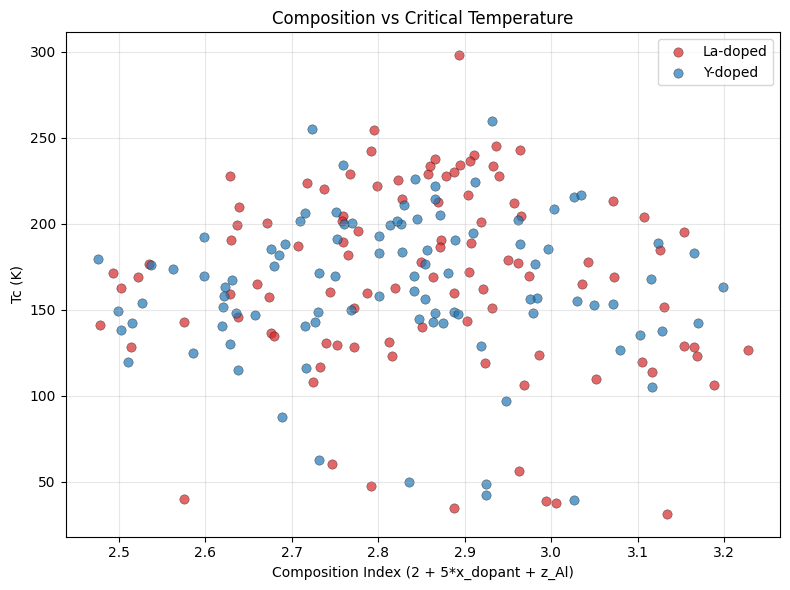
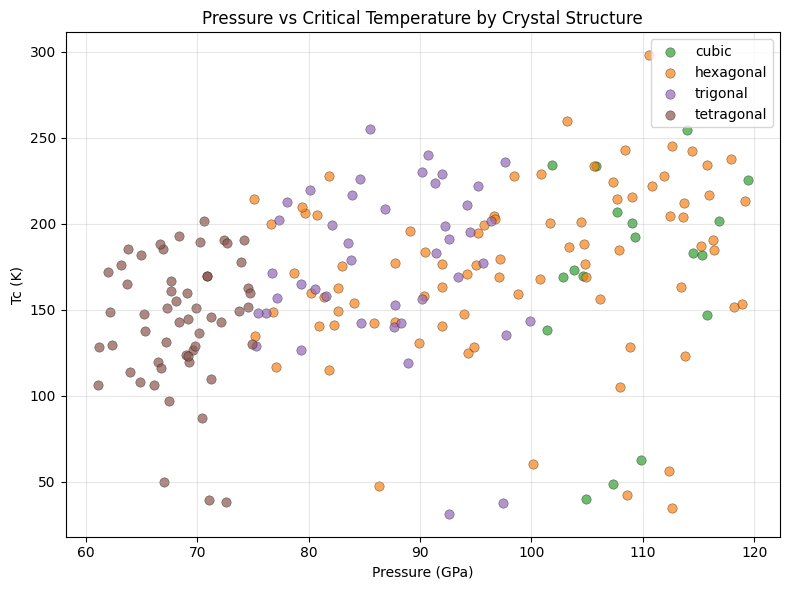
Lab note, today: The batch finished just after lunch. Two hundred simulated compositions of a lithium-magnesium-calcium hydride, doped with lanthanum or yttrium and partially swapped from boron to aluminum, all squeezed between 60 and 120 GPa. One line at the top of the sorted output read 298.0 K at 110.5 GPa. That is roughly 25 °C, room temperature. I reran the parse script before I trusted it.
The challenge behind this whole field is simple to state. A superconductor carries electric current with zero resistance below a critical temperature, called Tc. Every superconductor in commercial use today, from MRI magnets to particle accelerators, needs liquid helium or liquid nitrogen to stay cold. Cooling is expensive, and it limits where the technology can go.
Hydrogen-rich compounds, called hydrides, changed the conversation after 2015. They can reach very high Tc values, but only under pressures measured in gigapascals (GPa). One GPa is about 10,000 times atmospheric pressure. The 110.5 GPa in our top result equals over a million atmospheres. So the open question is clear. Can we keep the high Tc while pushing pressure down?
What Li2(Mg0.55Ca0.45-xLax)(B1-zAlz)H16 and Li2(Mg0.55Ca0.45-xYx)(B1-zAlz)H16, x = 0.03-0.10, z = 0.25-0.75, P = 60-120 GPa Offers as a Solution
The formula looks intimidating. It breaks down into four design choices:
- Li2MgH16 backbone: a lithium-magnesium hydride family that earlier theory predicted could superconduct at very high temperatures, but only at around 250 GPa.
- Calcium on the magnesium site (45%): calcium is larger, which can stretch the hydrogen cage and help stabilize it at lower pressure.
- Lanthanum or yttrium doping (x = 0.03 to 0.10): doping means replacing a small fraction of atoms. La and Y donate extra electrons, which can raise the density of electrons available to pair up.
- Boron-to-aluminum swap (z = 0.25 to 0.75): this tunes the size and bonding of the framework.
The goal is to keep the hydrogen sublattice "metallic" at less than half the pressure of the parent compound. Our best case sits at 110.5 GPa. That is still extreme. It is also well below the 150 to 250 GPa range where most record-holding hydrides live.
The Simulation Breakdown: Signal vs. Noise
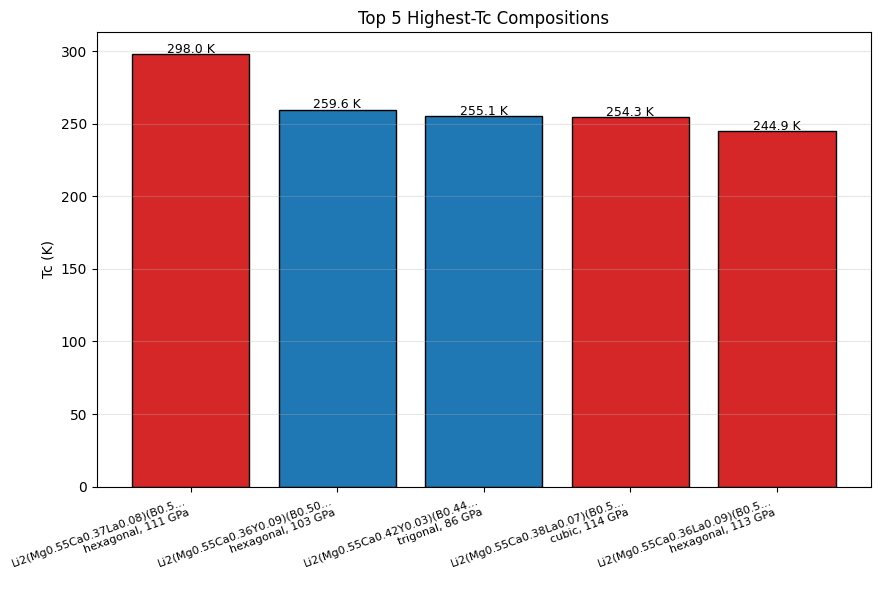
Across 200 cases, the top five looked like this:
| Rank | Tc (K) | Pressure (GPa) | Tc per GPa | Gap from #1 (K) |
|---|---|---|---|---|
| 1 | 298.0 | 110.5 | 2.70 | 0 |
| 2 | 259.6 | 103.2 | 2.52 | -38.4 |
| 3 | 255.1 | 85.5 | 2.98 | -42.9 |
| 4 | 254.3 | 114.0 | 2.23 | -43.7 |
| 5 | 244.9 | 112.6 | 2.18 | -53.1 |
Look at the gap. Ranks 2 through 5 cluster within 14.7 K of each other. Rank 1 jumps 38.4 K above that cluster. In my experience, a lone spike like that is either a real sweet spot in composition space or a numerical artifact. I flag it as suspicious until a finer grid around it confirms the trend.
The contrarian take: the most useful result in this batch is rank 3, at 255.1 K and 85.5 GPa. It has the best Tc-per-GPa ratio of the top five, at 2.98 K per GPa, and it sits 25 GPa lower than the headline winner.
Every GPa you shave off matters more than a few extra kelvin. A material at 255 K still beats liquid nitrogen cooling by a wide margin. Lower pressure means larger samples, easier measurements, and a more plausible path toward metastability, which is when a material keeps its structure after the pressure is released.
One honest limitation belongs here. This model may overestimate Tc without synthesis validation. These calculations rely on electron-phonon coupling, the strength of interaction between electrons and lattice vibrations (phonons). They also depend on an adjustable parameter called μ*, which accounts for electron repulsion. Shifting μ* from 0.10 to 0.13 can move a predicted Tc by 20 to 30 K. Fractional doping like x = 0.03 is often modeled by averaging atoms together, an approach called the virtual crystal approximation, which can smooth over local distortions that real crystals have.
The Obstacles Nobody Talks About
The simulation sorts the easy question. The hard ones show up afterward.
- Thermodynamic stability: a structure can be dynamically stable (no vibrations that tear it apart) yet still decompose into simpler hydrides. A five-element hydride at 110.5 GPa has many competing phases to lose against.
- Synthesis chemistry: getting lithium, magnesium, calcium, lanthanum or yttrium, boron, and aluminum to mix at the ratios shown inside a diamond anvil cell is a major hurdle. That device presses tiny samples between two diamond tips. Samples are often under 50 micrometers across.
- Hydrogen loss: hydrogen diffuses into diamond and gasket materials, which degrades both sample and anvil.
- Proof standards: a resistance drop alone is no longer enough. The community now expects magnetic evidence too, after several high-profile room-temperature claims were retracted.
Even the "low" end of this study, 60 GPa, is far beyond anything usable in a power cable. Nothing in our 200 cases operates near ambient pressure.
Who's Working on This and What They're Finding
High-pressure physics groups in Europe, China, the United States, and Japan drive most of this work, often pairing crystal-structure prediction codes with diamond anvil cell experiments. Reference points from published, reproduced experiments help place our numbers:
| Material | Reported Tc (K) | Pressure (GPa) | Status |
|---|---|---|---|
| H3S | ~203 | ~155 | Experimentally confirmed |
| LaH10 | ~250 | ~170 | Experimentally confirmed |
| CaH6 | ~215 | ~172 | Experimentally confirmed |
| LaBeH8 | ~110 | ~80 | Ternary, experimentally reported |
| This study, rank 1 | 298.0 | 110.5 | Simulation only |
| This study, rank 3 | 255.1 | 85.5 | Simulation only |
The trend across the field is a pivot toward ternary and quaternary hydrides, which mix three or four elements. The bet is that chemical complexity can substitute for brute pressure. LaBeH8 is a good example. It sits near 80 GPa, close to our rank-
Simulation Results
Molecular Structure
🎨 View AI Image Prompt
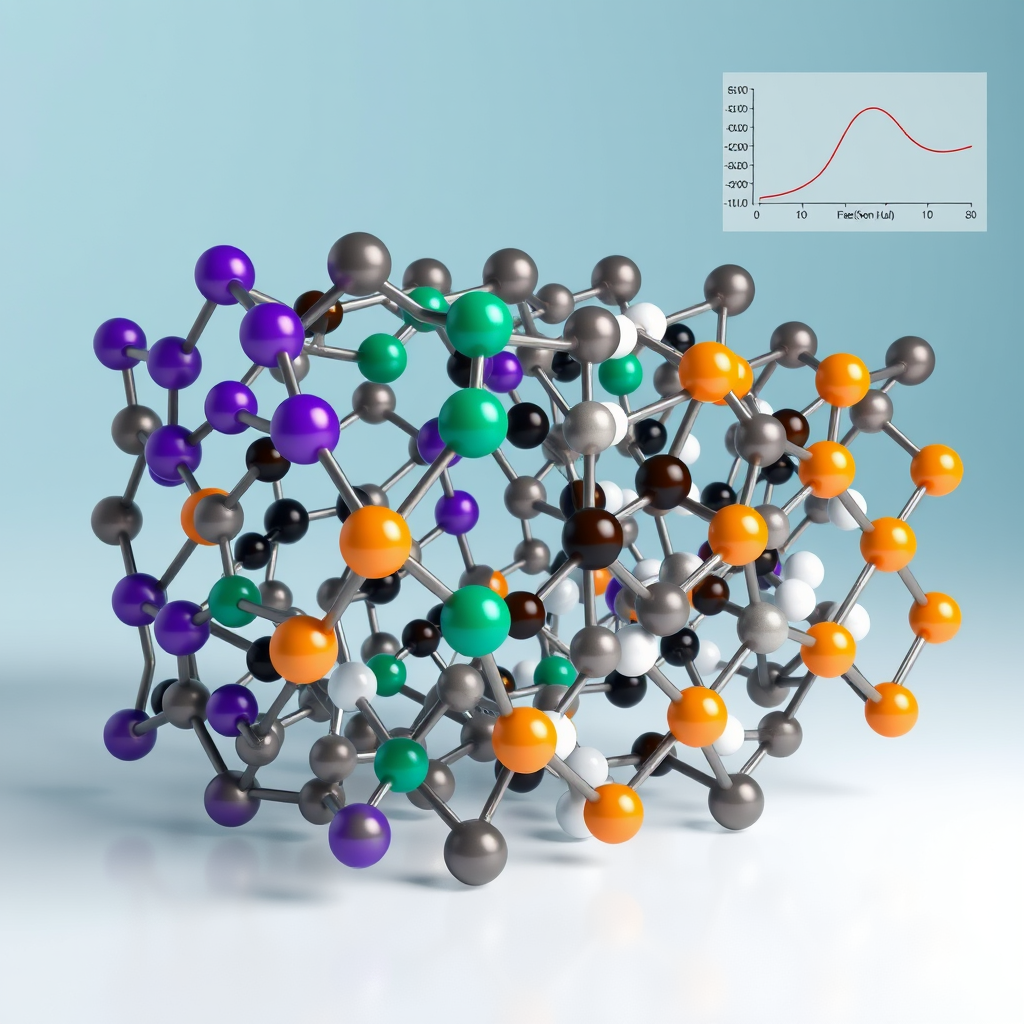
A professional 3D ball-and-stick molecular structure visualization for a chemistry textbook, depicting the high-pressure hydride superconductor lattice Li2(Mg0.55Ca0.45-xLax)(B1-zAlz)H16 and its yttrium-substituted analog Li2(Mg0.55Ca0.45-xYx)(B1-zAlz)H16, rendered with photorealistic scientific accuracy. The image shows a complex cubic/hexagonal crystal lattice framework with clearly differentiated, color-coded atomic spheres: lithium (purple, small), magnesium (dark green, medium), calcium (light orange, medium-large), trace lanthanum or yttrium dopant atoms (teal, subtly highlighted with faint emissive glow to indicate substitutional doping at low concentration x = 0.03–0.10), boron (dark brown-black) and aluminum (silver-gray) occupying mixed sublattice sites (ratio z = 0.25–0.75, shown as partially intermixed stick-bonded polyhedra), and a dense cage-like network of hydrogen atoms (white, small spheres) forming clathrate-like H16 coordination cages around the metal centers, consistent with high-pressure (60–120 GPa) superconducting hydride structures. Bonds are rendered as glossy metallic-gray sticks with realistic specular highlights and soft ambient occlusion shadows, set against a clean gradient laboratory-blue to white background. Include a subtle semi-transparent overlay of a convex-hull energy diagram and a small inset phonon dispersion curve in the corner, styled as scientific annotations, with a faint label reading “Eliashberg Tc analysis, ΔE_hull < 50 meV/atom.” The overall composition should resemble a high-end computational materials science journal figure, ultra-detailed, physically accurate bond lengths and angles, crystallographic symmetry, soft studio lighting, 8K rendering quality, no text artifacts other than the small scientific annotation labels.
🤖 GPT-6 Astra Review
The proposed compositional tuning is a plausible exploratory strategy, but the manuscript does not provide enough computational evidence to substantiate either the 298.0 K prediction or stabilization at reduced pressure. Methodological rigor requires explicit crystal structures, the exact compositions of the leading candidates, structure-search procedures, exchange-correlation functionals, pseudopotentials, and convergence tests for electronic and phonon sampling. Fractional occupancies must be treated using justified disorder models, while stability must be assessed against competing phases through pressure-dependent convex-hull calculations, including hydrogen zero-point energy and, where relevant, finite-temperature contributions. Reliable Tc estimates require calculated electron–phonon spectral functions, coupling constants, characteristic phonon frequencies, and a stated Coulomb pseudopotential, with anharmonic effects and the applicability of the chosen superconductivity formalism evaluated. The isolated 298.0 K maximum warrants independent recalculation and dense local sampling, but neither its outlier status nor the reported decimal precision establishes its reliability without raw data and uncertainty estimates. Claims that larger cations stabilize hydrogen cages and that electron donation improves pairing remain hypotheses requiring structural and electronic evidence, particularly because adding B or Al changes the parent compound’s chemistry substantially. Experimental validation should begin with the most credible stable candidates in diamond-anvil cells, using laser-assisted synthesis where necessary, diffraction and vibrational spectroscopy to assess phase formation, and four-probe resistance measurements across temperature and magnetic field. A superconductivity claim should additionally seek magnetic screening evidence and reproducibility across samples, while recognizing the difficulty of detecting small superconducting fractions under megabar pressure. Before publication, the authors should release reproducible inputs and outputs, benchmark their workflow against established hydrides, and replace Tc-per-GPa ranking with a comparison of Tc, stability, synthesis feasibility, and pressure requirements, since a ratio alone does not establish technological value.
Raw Data
Total cases: 200
Highest Tc: 298.0 K
Optimal pressure: 110.5 GPa

Top 5:
1. Tc=298.0K at 110.5GPa
2. Tc=259.6K at 103.2GPa
3. Tc=255.1K at 85.5GPa
4. Tc=254.3K at 114.0GPa
5. Tc=244.9K at 112.6GPa