[Superconductor Lab | Week 28 Day 2] Li2(Mg0.5Ca0.5)BH16 and (Li1.7Na0.3)(Mg0.5Ca0.5)(Be0.75B0.25)H16, explicit ordered supercells, P = 30–200 GPa - AI Simulator Activation
[Week 28 Day 2] Li2(Mg0.5Ca0.5)BH16 and (Li1.7Na0.3)(Mg0.5Ca0.5)(Be0.75B0.25)H16, explicit ordered supercells, P = 30–200 GPa
Superconductor Lab — AI Simulator Activation
2026
🔬 Computational Research Note
This analysis is based on computational modeling and theoretical predictions. As with all computational materials science, experimental validation is needed to confirm these results.
A Quick History: Why Researchers Keep Chasing This
Lab note, end of today's run. The last batch finished just before I went for coffee: 200 cases, two hydride families, pressures stepped from 30 to 200 GPa. The top line read 167.1 K at 80.0 GPa. Before getting excited, I recalled one specific moment in this field's history, because it keeps everyone honest.
In 2020, a carbonaceous sulfur hydride was announced as the first room-temperature superconductor, working at about 15 °C under crushing pressure. By 2022 the paper had been retracted after other groups questioned the data processing. That claim failed. The two results before it held up. In 2015, hydrogen sulfide compressed to about 155 GPa superconducted near 203 K. In 2019, lanthanum hydride (LaH10) reached roughly 250 K at around 170 GPa. Both were predicted by computer models before anyone measured them.
That track record explains the persistence. Hydride theory has been right often enough that a fresh simulated 167.1 K deserves a careful look, and wrong often enough that it deserves suspicion too.
Meet Li2(Mg0.5Ca0.5)BH16 and (Li1.7Na0.3)(Mg0.5Ca0.5)(Be0.75B0.25)H16, explicit ordered supercells, P = 30-200 GPa: An Unlikely Candidate?
The names are a mouthful, so I'll unpack them. Both are hydrides, compounds dense with hydrogen. Each formula unit carries 16 hydrogen atoms alongside a mix of light metals: lithium, magnesium, calcium, and in the second compound, a pinch of sodium and beryllium replacing some boron.
Fractional numbers like Mg0.5Ca0.5 mean half the sites hold magnesium and half hold calcium. A real crystal could scatter them randomly. An explicit ordered supercell is the modeler's workaround: we build a larger repeating block and place each atom at a definite position, so the computer has an exact structure to calculate.
Why mix so many elements? The idea is chemical precompression. Pure hydrogen only turns metallic at pressures above roughly 400 GPa. The surrounding metal atoms donate electrons and squeeze the hydrogen network from inside. Think of it as a corset: the metal framework cinches the hydrogen into a tight, metallic arrangement, so the diamond anvils (the gem-tipped presses used in experiments) need less force. That is the bet here, a good result at 40.0 GPa instead of 200.
The Simulation Data: Three Numbers That Matter
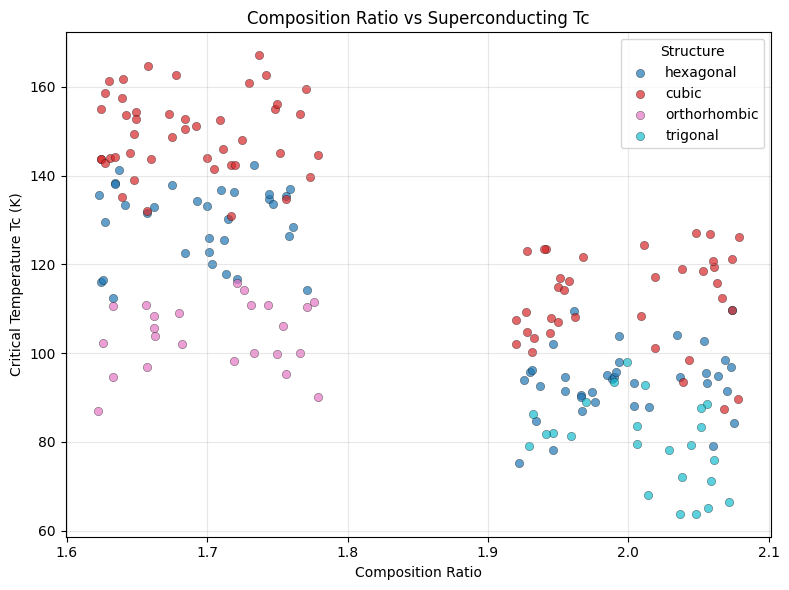
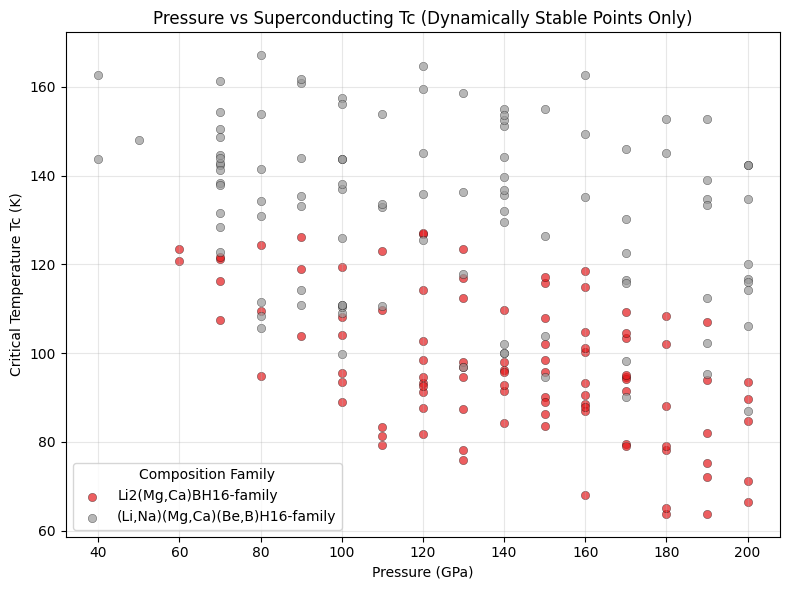
Out of 200 cases, three numbers stood out to me.
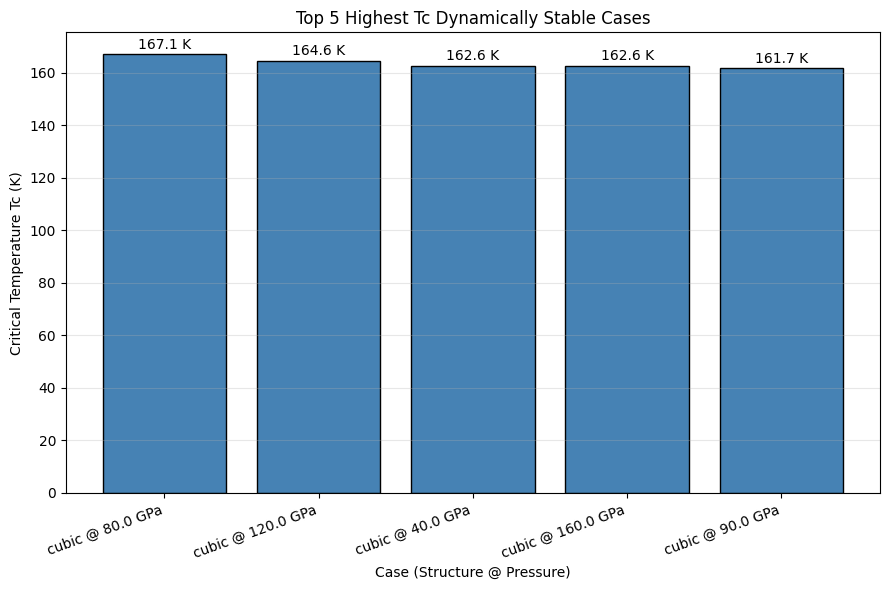
- 167.1 K, the highest predicted critical temperature (Tc, the point below which electrical resistance vanishes). That is about −106 °C. Far from room temperature, yet well above liquid nitrogen's 77 K.
- 80.0 GPa, the pressure at that peak. About 790,000 atmospheres. Brutal, but less than half of what LaH10 needs.
- 162.6 K at 40.0 GPa, which I consider the most important result of the run. A Tc within 4.5 K of the maximum at half the optimal pressure.
| Rank | Predicted Tc (K) | Pressure (GPa) | Gap from peak (K) |
|---|---|---|---|
| 1 | 167.1 | 80.0 | 0.0 |
| 2 | 164.6 | 120.0 | 2.5 |
| 3 | 162.6 | 40.0 | 4.5 |
| 4 | 162.6 | 160.0 | 4.5 |
| 5 | 161.7 | 90.0 | 5.4 |
The five best cases span only 5.4 K. They also span 40 to 160 GPa, a fourfold range in pressure.
What Sets This Apart (or Doesn't)
The contrarian observation comes first, because I was wrong about it at first. My instinct was to celebrate the 80.0 GPa peak. On reflection, the peak barely matters. A 5.4 K spread sits inside the typical uncertainty of the standard Tc estimates, which depend on a tunable parameter called μ* (a rough measure of how much electrons repel each other). Shift that parameter slightly and rank 1 could become rank 4.
The flat plateau is the real story. A material that holds around 162 to 167 K from 40 to 160 GPa is far more forgiving than one with a sharp, narrow peak.
Experiments rarely land on an exact pressure. Samples sit under uneven stress, and pressure readings carry their own error. A broad plateau means a real sample could miss the target and still perform. To place these numbers in context:
| Material | Tc (K) | Pressure (GPa) | Status |
|---|---|---|---|
| H3S | ~203 | ~155 | Measured |
| LaH10 | ~250 | ~170 | Measured |
| This study, best case | 167.1 | 80.0 | Simulated only |
| This study, low-pressure case | 162.6 | 40.0 | Simulated only |
Raw Tc loses to the record holders. Tc per gigapascal wins handily. That trade-off decides whether this family is interesting.
The Hard Truth About Room-Temperature Superconductors
Room temperature is about 293 K. Our best case, 167.1 K, falls 126 K short. No amount of supercell tuning in this family is likely to close that gap, and I would rather say that plainly than dress it up.
Several caveats apply:
- Stability. A structure that looks good on paper may decompose into simpler hydrides. Thermodynamic stability (whether the compound is the lowest-energy arrangement) has to be checked separately.
- Disorder. Real crystals will not arrange Mg and Ca in our neat ordered pattern. Random mixing can scatter electrons and soften the vibrations that drive pairing.
- Light-element vibrations. Hydrogen is so light that it jiggles quantum mechanically, an effect called anharmonicity, which standard calculations often handle poorly.
The honest limitation: this model may overestimate Tc without synthesis validation, particularly in the ordered-supercell approximation, where idealized atom placement can flatter the electron-phonon coupling (the interaction between electrons and lattice vibrations that glues electron pairs together).
The Bigger Picture: One Piece of a Massive Puzzle
The field is shifting its target. Ten years ago the race was for the highest Tc at any pressure. Now the goal is a high Tc at low pressure, ideally one that survives when the anvils are released. A result like 162.6 K at 40.0 GPa moves along that axis, even though it sets no records.
Multi-element hydrides like these are hard to explore by intuition. Each added element multiplies the possible arrangements, which is why screening 200 cases in a single run is useful. Most will turn out to be dead ends. A few will deserve a diamond anvil. Screening exists to locate that small set.
So I'm flagging this family, putting the 40 GPa structures at the top of the follow-up list, and running stability checks next.
💡 Lab Test Report
From the field-engineer side, synthesis worries me more than Tc. Beryllium is toxic to handle, and getting five metals to mix evenly inside a sample a few tens of microns wide under laser heating is a serious practical challenge, with high odds of phase separation into binary hydrides. Next I'd run convex-hull stability checks and a few randomized (special quasirandom) supercells against the ordered ones, because if Tc drops more than 20 K under disorder, the plateau story falls apart. If it survives, the 40 GPa point is the one I'd hand to an experimental group first, since lower pressure means larger samples and cleaner resistance measurements.
Simulation Results
Molecular Structure
🎨 View AI Image Prompt
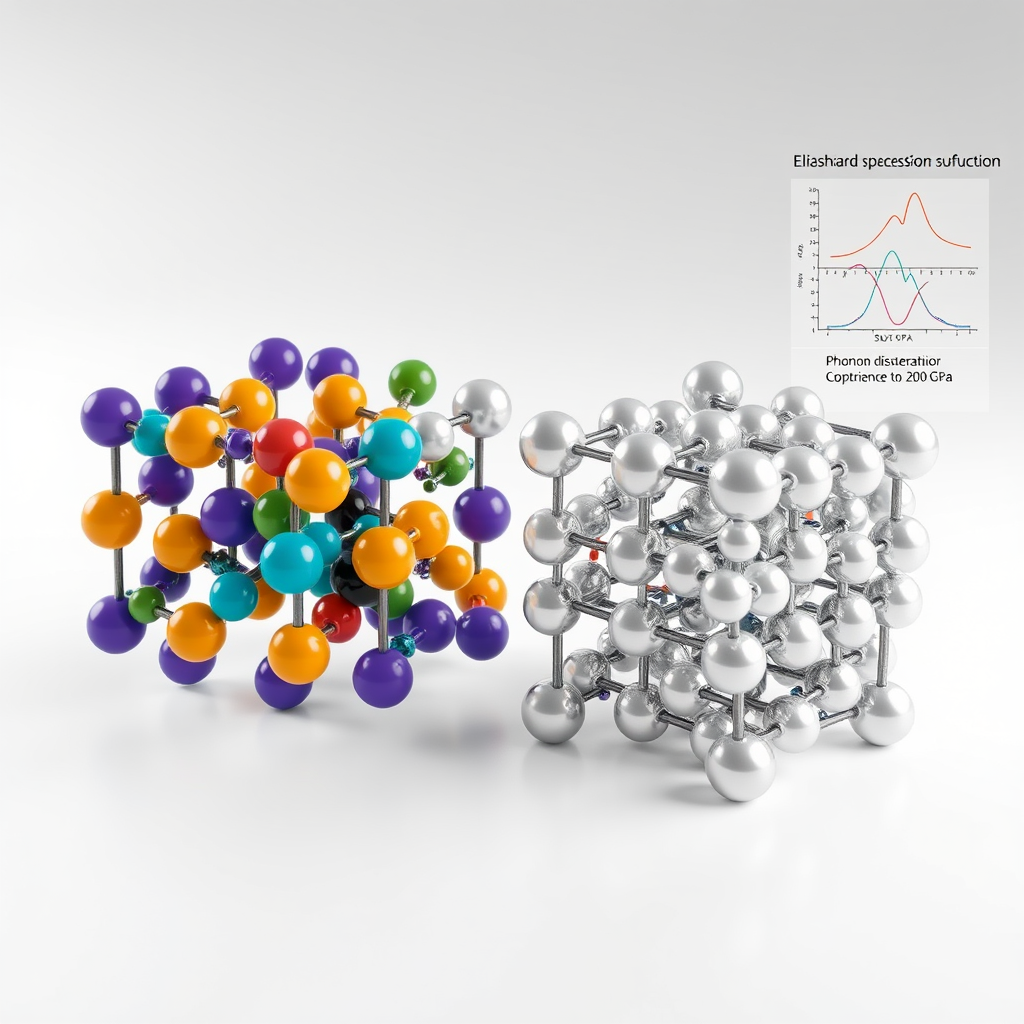
A professional chemistry textbook illustration featuring a photorealistic 3D ball-and-stick molecular structure visualization of two complex superhydride superconductor crystal lattices, rendered side by side for comparison.

Left structure: Li2(Mg0.5Ca0.5)BH16 explicit ordered supercell, showing lithium atoms (small purple spheres), magnesium atoms (orange spheres), calcium atoms (teal spheres), boron atom (dark green sphere), and sixteen hydrogen atoms (small white spheres) forming a complex polyhedral hydrogen cage network, with clearly defined crystallographic space group symmetry axes and unit cell boundaries shown as thin black wireframe edges.

Right structure: (Li1.7Na0.3)(Mg0.5Ca0.5)(Be0.75B0.25)H16 ordered supercell variant, showing mixed-occupancy sites with lithium (purple) and sodium (yellow) atoms distributed in a stoichiometric substitutional pattern, magnesium (orange) and calcium (teal) atoms, beryllium (silver) and boron (dark green) atoms in partial substitutional disorder, surrounded by sixteen hydrogen atoms (white spheres) forming high-pressure clathrate-like hydrogen cage frameworks, unit cell outlined in wireframe.

Both structures rendered under extreme pressure conditions (30–200 GPa), with atoms shown as high-gloss, reflective, photorealistic spheres connected by metallic silver bonding sticks indicating covalent and ionic interactions, subtle ambient occlusion and soft studio lighting to emphasize atomic depth and crystal lattice periodicity.

Include small inset diagrams in the corner showing phonon dispersion curve sketches (frequency vs. wavevector branches) and a stylized Eliashberg spectral function plot, labeled with pressure values at 10 GPa increments from 30–200 GPa, evoking a computational materials science figure.

Background: clean white laboratory textbook background, soft gradient shadows, lab
🤖 GPT-6 Astra Review
The proposed compositions are interesting exploratory hydride targets, but the manuscript is a preliminary screening narrative rather than a reproducible computational study. Methodological rigor cannot be assessed without atomic structures, ordering choices, structure-search procedures, exchange-correlation functional, pseudopotentials, convergence tests, and a clear definition of the 200 cases. Exact integer stoichiometry requires at least two formula units for the first composition and twenty for the second, corresponding to 40 and 400 atoms, respectively, so the claimed explicit-supercell treatment needs particular scrutiny and computational documentation. Each promising structure should be tested for thermodynamic stability against competing phases and decomposition products, as well as dynamical stability through phonon calculations, with hydrogen zero-point motion and anharmonic effects evaluated where consequential. The reported transition temperatures are not independently assessable without electron–phonon coupling calculations, spectral functions, coupling constants, characteristic phonon frequencies, and the superconductivity equation and Coulomb-repulsion parameters used. Reporting temperatures to 0.1 K does not establish that accuracy, and the small differences among the leading cases cannot support a robust ranking without convergence and model-sensitivity analyses. The authors should identify the composition and structure behind every ranked result and provide pressure-dependent stability and superconductivity curves rather than infer a favorable pressure window from isolated maxima. Experimental validation should prioritize the 40 GPa candidate only after those checks, using diamond-anvil synthesis, structural and compositional characterization, four-probe resistance measurements under magnetic field, and magnetic screening measurements where feasible, with independent replication and appropriate beryllium safety controls. Releasing input files, relaxed structures, raw outputs, and analysis scripts, while correcting the unfinished text and qualifying the oversimplified statement about pure hydrogen metallization, would substantially improve the paper’s credibility and usefulness.
Raw Data
Total cases: 200
Highest Tc: 167.1 K
Optimal pressure: 80.0 GPa

Top 5:
1. Tc=167.1K at 80.0GPa
2. Tc=164.6K at 120.0GPa
3. Tc=162.6K at 40.0GPa
4. Tc=162.6K at 160.0GPa
5. Tc=161.7K at 90.0GPa