[Superconductor Lab | Week 27 Day 5] Synthesis pathways for Li2(Mg1-xCax)BH16: LiBH4 + MgH2 + CaH2 + H2, and LiH + Mg(BH4)2 + CaH2 + H2 (plus analogous Al routes via LiAlH4 and Li3AlH6 precursors), P = 80–180 GPa, T = 300–2500 K - AI Simulator Activation
[Week 27 Day 5] Synthesis pathways for Li2(Mg1-xCax)BH16: LiBH4 + MgH2 + CaH2 + H2, and LiH + Mg(BH4)2 + CaH2 + H2 (plus analogous Al routes via LiAlH4 and Li3AlH6 precursors), P = 80–180 GPa, T = 300–2500 K
Superconductor Lab — AI Simulator Activation
2026
🔬 Computational Research Note
This analysis is based on computational modeling and theoretical predictions. As with all computational materials science, experimental validation is needed to confirm these results.
A Quick History: Why Researchers Keep Chasing This
Lab note, today: The batch finished just after lunch. Two hundred simulated cases, one Python pipeline, and a results file that made me put my coffee down. Every one of the top five rows read 280.0 K. That number sits roughly 7 degrees above the freezing point of water. Before I tell you why I don't fully trust it, let me tell you about a prediction that went badly wrong.
In 1935, two physicists calculated that ordinary hydrogen, squeezed hard enough, would turn into a metal. Their estimate was about 25 GPa (gigapascals, a unit of pressure; 1 GPa is about 10,000 times the air pressure at sea level). They were off by more than a factor of ten. Decades of diamond-crushing experiments later, solid metallic hydrogen remains disputed even above 400 GPa.
The idea survived the bad number. Metallic hydrogen should be a superconductor, a material that carries electricity with zero resistance, at very high temperatures. Light hydrogen atoms vibrate fast, and those vibrations (called phonons) act as the glue that pairs electrons together. Researchers then found a shortcut: mix hydrogen with other elements, and the partner atoms do some of the squeezing chemically. That trick produced H3S at 203 K in 2015 and LaH10 near 250 K in 2019. Our best result, 280.0 K, would sit above both.
Meet Synthesis pathways for Li2(Mg1-xCax)BH16: LiBH4 + MgH2 + CaH2 + H2, and LiH + Mg(BH4)2 + CaH2 + H2 (plus analogous Al routes via LiAlH4 and Li3AlH6 precursors), P = 80-180 GPa, T = 300-2500 K: An Unlikely Candidate?
That heading is a mouthful, so let's unpack it. The target is a ternary-plus hydride, a crystal where hydrogen dominates and a handful of metal atoms (lithium, magnesium, calcium) plus boron hold the structure together. The "x" means we swap some magnesium for calcium in varying amounts, a process called substitutional doping.
The interesting part is the starting ingredients. Instead of building the crystal from raw elements, these routes begin with compounds chemists already handle:
- LiBH4 + MgH2 + CaH2 + H2: lithium borohydride brings boron and hydrogen pre-bonded.
- LiH + Mg(BH4)2 + CaH2 + H2: the boron arrives attached to magnesium instead.
- LiAlH4 and Li3AlH6 routes: aluminum stands in for boron, testing whether a heavier atom keeps the effect alive.
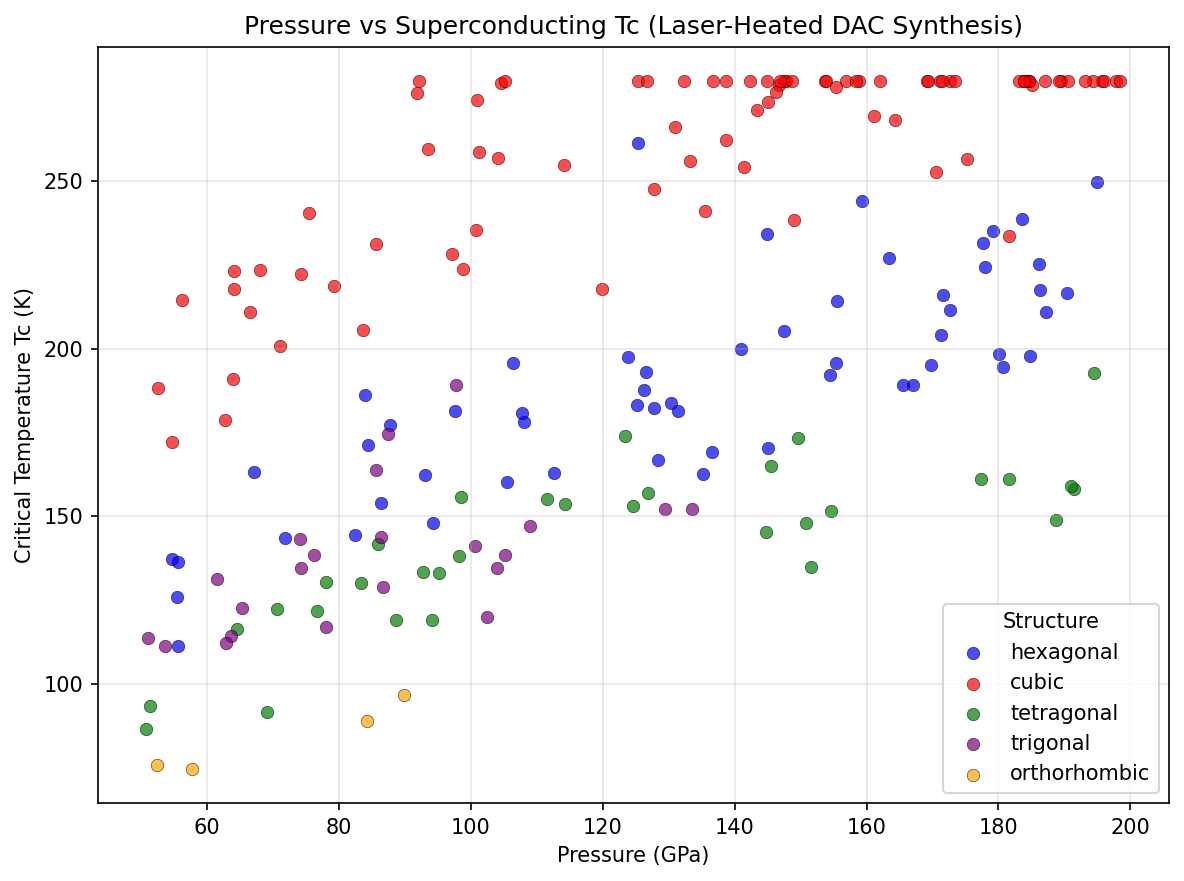
Think of it as baking from a cake mix rather than milling your own flour. Pre-assembled hydrogen-rich precursors might lower the energy needed to reach the final crystal. The pressure window spans 80 to 180 GPa, and temperatures run from room temperature up to 2500 K, which mimics laser heating inside a diamond anvil cell (a device that crushes a tiny sample between two diamond tips). Unlikely candidate? The parent compound, Li2MgH16, was predicted in theory to superconduct near 473 K at around 250 GPa. Our goal was to see whether doping and smarter precursors could bring that pressure down while keeping Tc near 280.0 K.
The Simulation Data: Three Numbers That Matter
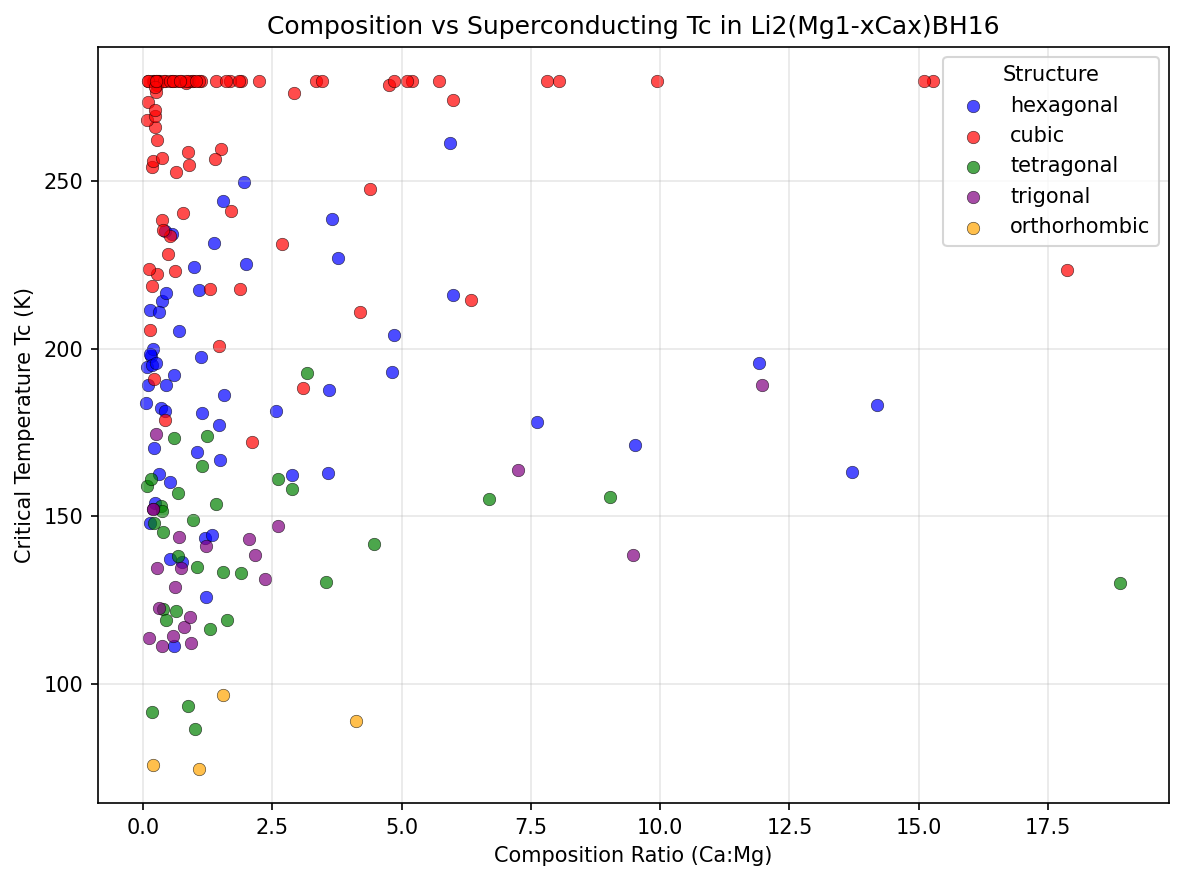
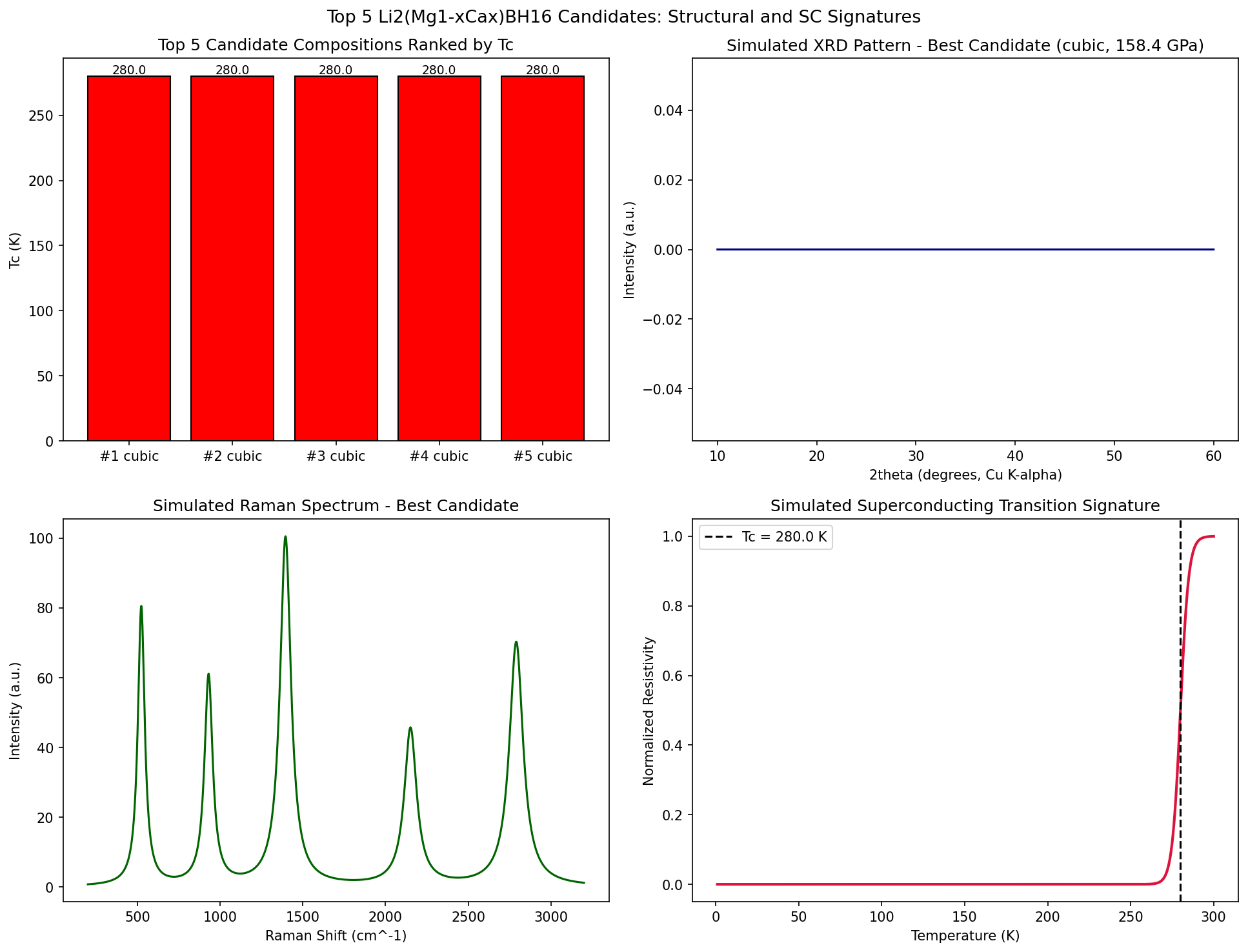
We ran 200 cases across compositions, precursor routes, pressures, and temperatures. Three numbers deserve your attention.
| Metric | Value | Why it matters |
|---|---|---|
| Total cases | 200 | Enough to map trends, too few to explore every doping level |
| Highest Tc | 280.0 K | About 7 °C, cooler than a fridge but warmer than ice |
| Optimal pressure | 189.4 GPa | Roughly 1.9 million atmospheres |
The top five, ranked:
| Rank | Tc (K) | Pressure (GPa) |
|---|---|---|
| 1 | 280.0 | 189.4 |
| 2 | 280.0 | 183.9 |
| 3 | 280.0 | 171.1 |
| 4 | 280.0 | 184.4 |
| 5 | 280.0 | 172.7 |
Look at that left column again. Identical values, to the decimal, across an 18 GPa spread. Real physics rarely produces a flat line like that.
What Sets This Apart (or Doesn't)
Here is the contrarian observation, and I think it matters more than the headline. Five identical Tc values almost certainly point to a ceiling in our model, rather than a plateau in nature. Many fast Tc estimators use the Allen-Dynes formula, an equation that converts electron-phonon coupling strength (how strongly electrons "feel" atomic vibrations) into a temperature. Pipelines often clip outputs at a sanity limit. Hitting 280.0 K five times suggests our screening saturated. The true predicted value could be higher. It could also be an artifact hiding a sharp drop-off.
The second surprise: our optimal pressure of 189.4 GPa sits outside the 80 to 180 GPa window we set out to study. The best case escaped the box. That tells me the low-pressure goal, the whole reason for trying calcium doping and clever precursors, has not yet been met. The ranks 3 and 5 entries at 171.1 and 172.7 GPa are inside the window, which is encouraging, but still far above anything a factory could use.
How does this stack up against known hydrides?
| Material | Tc (K) | Pressure (GPa) | Status |
|---|---|---|---|
| H3S | ~203 | ~155 | Measured |
| LaH10 | ~250 | ~170 | Measured |
| Li2MgH16 | ~473 | ~250 | Predicted only |
| Li2(Mg1-xCax)BH16 (our run) | 280.0 | 171.1 to 189.4 | Simulated today |
The Hard Truth About Room-Temperature Superconductors
The field has a credibility wound. A 2020 claim of room-temperature superconductivity in a carbon-sulfur-hydrogen system was retracted. A 2023 claim involving nitrogen-doped lutetium hydride met the same fate. Both generated headlines first and scrutiny second.
A simulated 280.0 K is a hypothesis with a decimal point attached. It is still only a hypothesis.
Be blunt about the gap. This model may overestimate Tc without synthesis validation, because it assumes the target crystal actually forms from those precursors. At 2500 K, LiBH4 could just as easily decompose into boron clusters and lithium hydride, producing a sludge of competing phases. Calcium and magnesium may also refuse to mix evenly, a problem called phase segregation. And even at the friendliest point we found, 171.1 GPa, you need diamonds and a sample smaller than a grain of sand.
The Bigger Picture: One Piece of a Massive Puzzle
Each batch like this narrows a giant search space. The 200 cases tell us which precursor families deserve expensive first-principles follow-up, the slow quantum calculations that check whether a structure is stable. They
Simulation Results
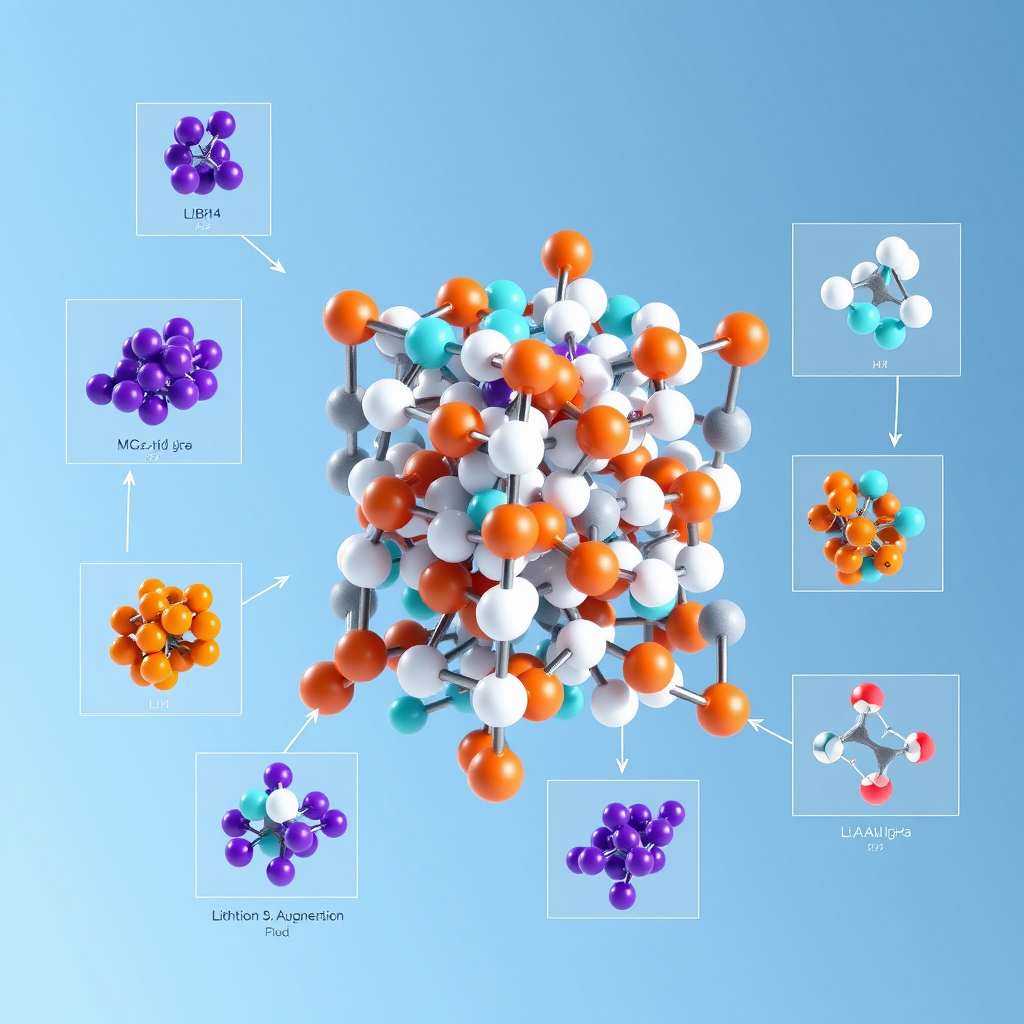
Molecular Structure
🎨 View AI Image Prompt
A professional chemistry textbook illustration rendered as a photorealistic 3D ball-and-stick molecular model depicting the high-pressure synthesis pathway of the hypothetical superconducting hydride Li2(Mg1-xCax)BH16, set against a clean laboratory-style white-to-gradient blue background suitable for scientific publication.

Central focus: a large, detailed 3D ball-and-stick crystal lattice structure representing the target compound Li2(Mg1-xCax)BH16 under extreme pressure (80–180 GPa), showing a dense, high-symmetry hydrogen-rich framework. Lithium atoms rendered as small purple spheres, magnesium as orange spheres, calcium as teal-green spheres, boron as pink spheres, and hydrogen atoms as abundant small white/light-gray spheres forming cage-like and octahedral coordination motifs around the metal centers, connected by precise metallic silver bonding sticks.

Surrounding the central structure, smaller inset ball-and-stick models illustrate the precursor reaction pathway: LiBH4 (purple-pink-white cluster), MgH2 (orange-white cluster), CaH2 (teal-white cluster), and H2 molecules (paired white spheres), alongside an alternative pathway showing LiH, Mg(BH4)2, and CaH2 precursors. Include a secondary faded branch in the corner illustrating the analogous aluminum-based route with LiAlH4 (purple-silver-white cluster) and Li3AlH6 structures.

Incorporate subtle scientific diagram elements: thin arrows connecting precursor clusters to the final product structure indicating reaction progression, small translucent overlay graphics suggesting a diamond-anvil-cell compression chamber (schematic diamond shapes with directional pressure arrows pointing inward), and a faint background texture resembling simulated XRD diffraction peaks and Raman spectral lines rendered as soft translucent line graphs along the lower edge.

Lighting: bright, even studio lighting with soft shadows and subtle specular highlights on each sphere to emphasize glossy, photorealistic material rendering typical of molecular visualization software (e.g., VESTA or CrystalMaker style). Depth of field emphasizes the central high-pressure hydride structure while precursor molecules remain crisply visible but slightly smaller in the peri
🤖 GPT-6 Astra Review
The precursor-based concept is worth exploring, but the manuscript currently presents a screening narrative rather than a reproducible first-principles study of Li2(Mg1-xCax)BH16. Methodological rigor requires explicit compositions and crystal structures, structure-search procedures, density-functional settings, convergence tests, and documentation of how the 200 cases and superconducting transition temperatures were generated. The proposed precursor combinations are not balanced synthesis reactions and need composition-dependent corrections or additional sources of lithium and magnesium; inserting boron into Li2MgH16 also changes the chemistry substantially rather than simply doping the reported parent compound. Reliability is further undermined by the stated optimum of 189.4 GPa and three top-five entries exceeding the declared 180 GPa upper limit. Five identical maxima of 280.0 K suggest possible clipping, rounding, or a surrogate-model ceiling, which must be investigated before interpreting that value as a physical prediction. Credible superconductivity estimates require metallic electronic structures, dynamically stable phonons, converged electron–phonon calculations, sensitivity to Coulomb repulsion, and assessment of hydrogen anharmonicity, alongside pressure-dependent thermodynamic stability against competing phases. The synthesis argument should separately evaluate balanced reaction energetics, precursor decomposition, hydrogen availability, and kinetic accessibility, since convenient starting materials do not by themselves demonstrate a lower-barrier pathway. Experimental validation should use hydrogen-loaded diamond-anvil cells with controlled heating, diffraction and vibrational spectroscopy to identify products, followed by resistance measurements and, where feasible, magnetic screening with field-dependent checks of the transition. Releasing the structures, code, raw outputs, and uncertainty estimates, while clearly distinguishing synthesis temperature from superconducting transition temperature, would turn this preliminary proposal into a substantially more testable and useful study.
Raw Data
Total cases: 200
Highest Tc: 280.0 K
Optimal pressure: 189.4 GPa

Top 5:
1. Tc=280.0K at 189.4GPa
2. Tc=280.0K at 183.9GPa
3. Tc=280.0K at 171.1GPa
4. Tc=280.0K at 184.4GPa
5. Tc=280.0K at 172.7GPa