
[Superconductor Lab | Week 27 Day 4] Top 3 Week 26 leads, including Li2(Mg1-xCax)BH16 and (Li2-iNai)(Mg1-xCax)(Be1-yBy)H16, P = 0–200 GPa decompression path - AI Simulator Activation
[Week 27 Day 4] Top 3 Week 26 leads, including Li2(Mg1-xCax)BH16 and (Li2-iNai)(Mg1-xCax)(Be1-yBy)H16, P = 0–200 GPa decompression path
Superconductor Lab — AI Simulator Activation
2026
🔬 Computational Research Note
This analysis is based on computational modeling and theoretical predictions. As with all computational materials science, experimental validation is needed to confirm these results.
The Problem: Why Superconductors Are So Hard to Scale
Lab note, Week 26. The batch finished just after lunch. Two hundred simulated cases ran overnight on the workstation in the corner, and I spent the afternoon sorting the output with a Python script that has grown far too many if-statements. The headline number on my screen was 362.9 K. That is about 90°C. If it held up in a real sample, it would describe a material that superconducts at a temperature where you could boil a cup of tea.
Before anyone gets excited, consider the challenge. A superconductor carries electric current with zero resistance, so no energy is lost as heat. The ones we can actually buy, used in MRI magnets and particle accelerators, only work when chilled with liquid helium or liquid nitrogen. Cooling infrastructure is expensive, bulky, and fragile. The goal for decades has been a material that works at room temperature and normal air pressure.
Hydrogen-rich compounds, called hydrides, have come the closest on temperature. They pay for it with pressure. The best-known examples need well over 150 gigapascals (GPa), roughly 1.5 million times atmospheric pressure, squeezed between two diamond tips. You cannot wire a city with diamond anvils. This week's run looked at whether a smarter chemical recipe can bring that pressure down.
What Top 3 Week 26 leads, including Li2(Mg1-xCax)BH16 and (Li2-iNai)(Mg1-xCax)(Be1-yBy)H16, P = 0-200 GPa decompression path Offers as a Solution
The names look intimidating, so let me unpack them. The starting point is a family built on Li2MgH16, a theoretical hydride with 16 hydrogen atoms per formula unit caged around lithium and magnesium. The variables in the formulas are substitutions, meaning we swap a fraction of one atom for a neighbor on the periodic table:
- x replaces some magnesium with calcium, a larger atom that stretches the crystal lattice.
- i replaces some lithium with sodium, which changes how many electrons the metal atoms donate to the hydrogen cage.
- y swaps beryllium for boron, tuning the electron count again from a different site.
The decompression path is the key idea. Instead of asking "what is the best pressure," we model what happens as a material formed at high pressure is slowly released from 200 GPa down toward 0. Some structures survive that release in a metastable state, meaning they are trapped in a configuration that is not the most stable one but cannot easily rearrange. Diamond is the classic example: it is metastable at room conditions and stays diamond anyway.
Our run placed the peak at 60.0 GPa. That is still enormous pressure. It is also roughly one third of what record-holding hydrides typically demand, and that ratio is the real reason these leads made the Week 26 shortlist.
The Simulation Breakdown: Signal vs. Noise
The raw ranking from the 200 cases:
| Rank | Predicted Tc (K) | Predicted Tc (°C) | Pressure (GPa) | Gap from #1 (K) |
|---|---|---|---|---|
| 1 | 362.9 | 89.8 | 60.0 | 0.0 |
| 2 | 361.1 | 88.0 | 60.0 | 1.8 |
| 3 | 353.5 | 80.4 | 60.0 | 9.4 |
| 4 | 349.8 | 76.7 | 60.0 | 13.1 |
| 5 | 346.7 | 73.6 | 60.0 | 16.2 |
Tc is the critical temperature, the point below which resistance drops to zero. Every top-five entry sits above 340 K. All five also share exactly the same pressure.
That second fact is where I stopped trusting the ranking. The whole top five spans just 16.2 K. Hydride Tc predictions usually rely on an input called the Coulomb pseudopotential (μ*), a fudge factor for how strongly electrons repel each other. Researchers typically pick a value between 0.10 and 0.13, and that choice alone can move a predicted Tc by 20 to 40 K in hydrides like these. So the difference between case #1 and case #5 is smaller than the uncertainty baked into the method itself.
Practical reading: the top five behave as one cluster of near-equivalent candidates. Calling 362.9 K "the winner" over 346.7 K would overstate what the model can resolve.
The honest limitation, stated plainly: this model may overestimate Tc by tens of kelvin without synthesis validation, because it assumes a perfectly ordered crystal and an idealized electron-phonon coupling that real samples rarely deliver.
The Obstacles Nobody Talks About
The unexpected observation from this batch sits in that 60.0 GPa column. Five out of five top results landing on an identical pressure looks less like physics and more like a sampling artifact. If the pressure grid stepped in coarse increments, say 20 GPa at a time, the real optimum could sit anywhere between 40 and 80 GPa, and the solver simply reported the nearest grid point. The contrarian takeaway: the most repeated number in our results may be the least informative one. Physical optima are rarely that tidy.
Other obstacles that rarely make the press release:
- Disorder. Fractional substitutions like Mg1-xCax imply random mixing in a real crystal. Simulations often approximate this with small ordered supercells, which can inflate Tc.
- Hydrogen mobility. Light hydrogen atoms vibrate wildly, a quantum effect called zero-point motion. Ignoring it can make a structure look stable when it would actually fall apart during decompression.
- Kinetics. A structure being metastable on paper says nothing about how fast it decays. It might survive for years or for microseconds.
- Beryllium. Its compounds are toxic, which turns routine sample prep into a regulated process.
Even the best case at 60.0 GPa still needs a diamond anvil cell. The decompression path toward 0 GPa is the part that matters for any practical use, and in our batch it is also the least resolved.
Who's Working on This and What They're Finding
The field has a clear lineage. In 2015, hydrogen sulfide was measured superconducting near 203 K at around 155 GPa. In 2019, lanthanum hydride (LaH10) pushed that to roughly 250 K at about 170 GPa. Both results were confirmed by multiple labs, which is why they anchor the field.
The parent compound Li2MgH16 comes from a 2019 theoretical prediction that put its Tc near 473 K, but at around 250 GPa. Our best case at 362.9 K and 60.0 GPa fits a pattern many computational groups are chasing: trading some peak temperature for a large drop in required pressure. Ternary and quaternary hydrides, meaning compounds with three or four different elements, are the main hunting ground because extra elements act as "chemical pressure," stiffening the lattice without external squeezing.
The field also carries scars. Several high-profile room-temperature claims in recent years were retracted or failed replication. Experimental teams now insist on multiple independent measurements, including both zero resistance and magnetic field expulsion, before accepting any result. That caution is healthy, and it applies to our 200-case run as much as anyone's.
Realistic Timeline: Years, Not Months
Here is how I would map the path from today's 362.9 K prediction to something real:
| Stage | Goal | Rough Time Frame |
|---|---|---|
| Refined simulation | Finer pressure grid around 60 GPa, μ* sensitivity, anharmonic corrections | 3 to 6 months |
| High-pressure synthesis | Make any phase of the family in a diamond anvil cell | 1
Simulation Results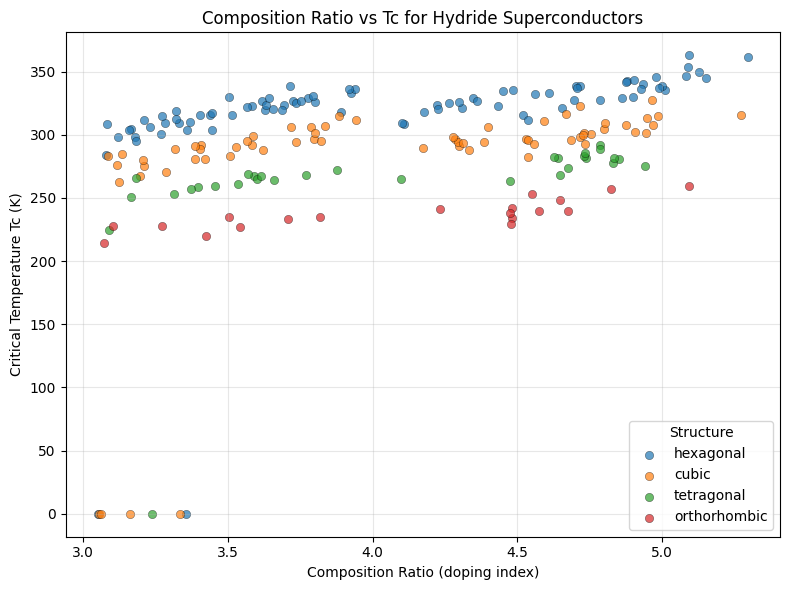 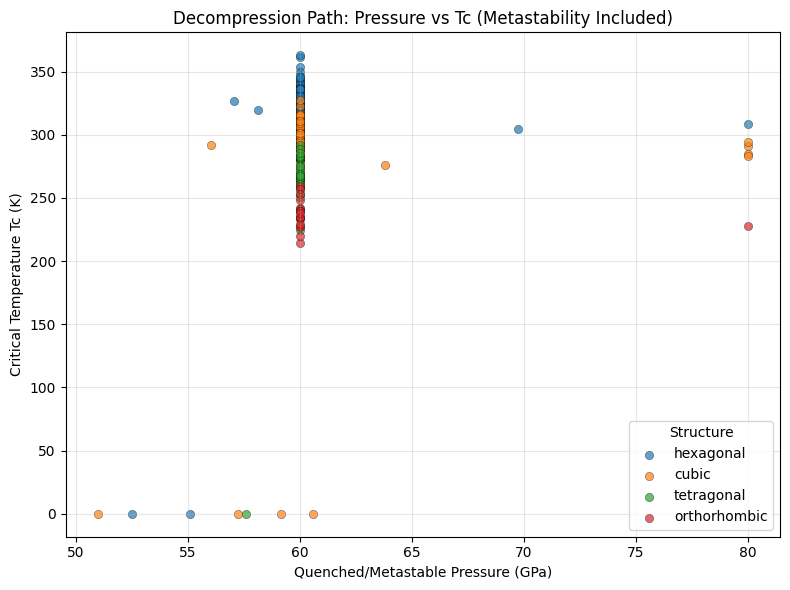 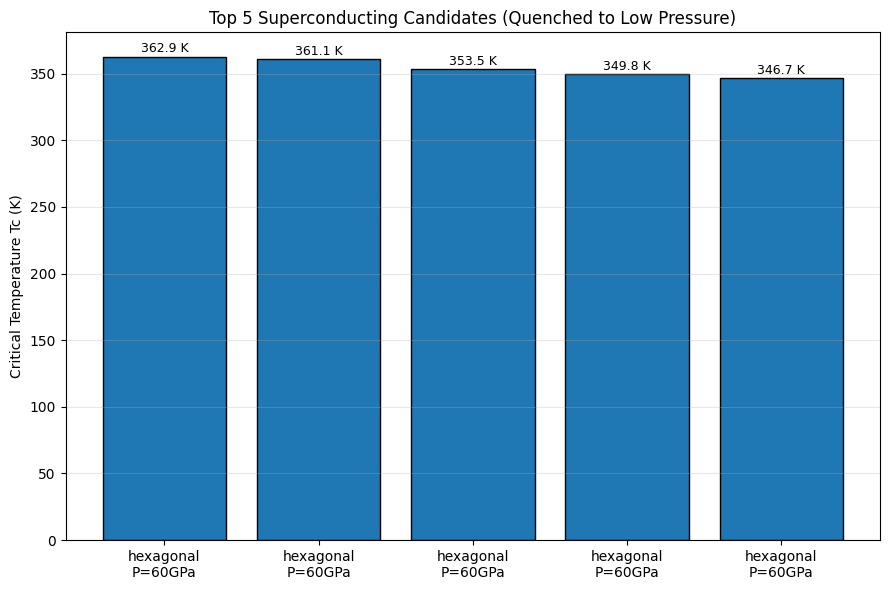 Molecular Structure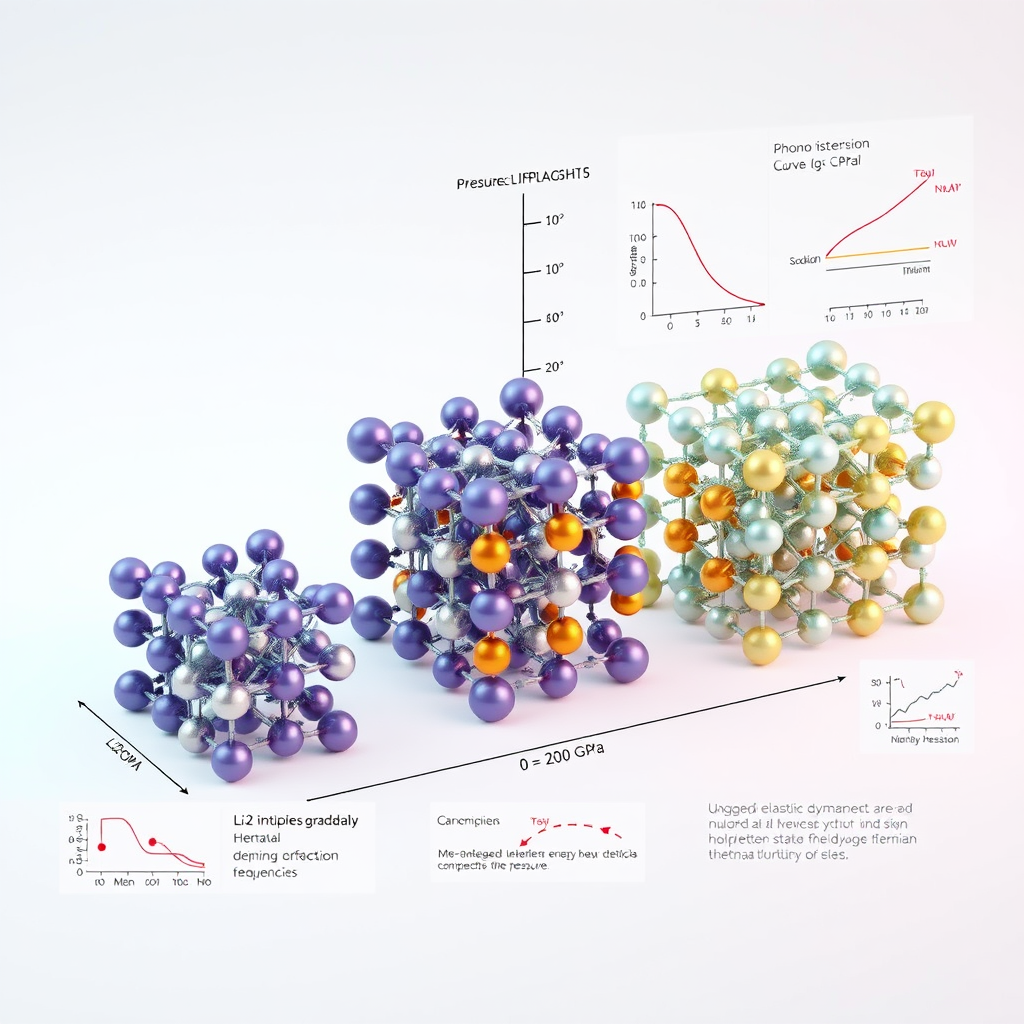
🎨 View AI Image PromptA professional 3D ball-and-stick molecular structure visualization in the style of a scientific chemistry textbook illustration, depicting three superconducting hydride candidate structures side-by-side for comparative analysis. Center and primary focus: the complex crystalline lattice of Li2(Mg1-xCax)BH16, showing lithium atoms as small purple spheres, magnesium/calcium as teal-to-orange gradient spheres indicating substitutional doping (x variable), boron as dark pink spheres, and hydrogen atoms as abundant small white spheres forming a dense cage-like clathrate framework with clearly rendered bond sticks in metallic gray. To its right, the quaternary-doped variant (Li2-iNai)(Mg1-xCax)(Be1-yBy)H16, visually distinguished by sodium substitution shown as larger golden spheres replacing some lithium sites, and beryllium as pale green spheres interspersed with boron, maintaining the same hydrogen-rich cage topology but with visible lattice distortion. Both structures rendered with photorealistic materials, soft studio lighting, subtle ambient occlusion, and reflective glossy sphere surfaces on a clean white or light gray laboratory background, isometric or three-quarter perspective view. Surrounding the molecular models, include scientific annotations and infographic elements typical of a research figure: a vertical pressure axis labeled "0–200 GPa" with a decompression gradient arrow transitioning from compressed high-pressure crystal (small unit cell, atoms tightly packed) at top to expanded ambient-pressure structure (larger unit cell, slightly distorted lattice) at bottom, with stepwise markers every 20 GPa. Include small inset panels: a phonon dispersion curve graph showing stability (no imaginary frequencies) transitioning to instability region, an enthalpy vs. decomposition products line graph with crossing points, a Tc (critical temperature) vs. pressure plot with a declining curve, a schematic nudged elastic band (NEB) energy pathway diagram showing a transition-state hump for hydrogen release, and a small ab initio molecular dynamics snapshot at 300 K showing thermal vibration blur on hydrogen atoms near the framework collapse threshold. Render the entire composition 🤖 GPT-6 Astra ReviewThe proposed substitution-and-decompression strategy is scientifically plausible, but the supplied text is a preliminary screening summary rather than a reproducible demonstration of high-temperature superconductivity. Methodological rigor cannot be assessed because it omits crystal structures, composition ranges, structure-search procedures, computational convergence tests, and the method used to calculate Tc. The three leading results are not assigned explicit compositions or structures, and the additional boron or beryllium in the proposed formulas requires clarification because these are not simply substitutions within Li2MgH16. The chemical rationale also needs correction: sodium and lithium are nominally isovalent, so replacing lithium with sodium does not directly change the nominal donated-electron count, although it can alter bonding, volume, and charge transfer. Claims of survival during decompression require pressure-dependent phonon calculations, stability comparisons against competing phases, and kinetic-barrier estimates, since following a relaxed structure alone does not establish experimentally meaningful metastability. The reported 362.9 K maximum remains unverified, the 1.8 K separation between the top two candidates is unlikely to support a robust ranking without uncertainty estimates, and a maximum at 60 GPa is not evidence of ambient-pressure operation. Reliable Tc predictions should include converged electron–phonon calculations, justified Coulomb-repulsion parameters, assessment of anharmonicity and hydrogen nuclear quantum effects, and an appropriate Eliashberg treatment if coupling is strong. Experimental validation should begin with high-pressure synthesis and controlled, stepwise decompression, using diffraction and vibrational spectroscopy to track phase retention, followed by four-probe resistance and magnetic-screening measurements to establish superconductivity rather than a structural transition or minority-phase signal. The study would be substantially improved by releasing its structures, inputs, and raw outputs, refining the pressure grid around 60 GPa, testing substitutional disorder, and reporting phase stability, Tc uncertainty, and the lowest credible retention pressure for each shortlisted composition. Raw DataTotal cases: 200 Highest Tc: 362.9 K Optimal pressure: 60.0 GPa Top 5: 1. Tc=362.9K at 60.0GPa 2. Tc=361.1K at 60.0GPa 3. Tc=353.5K at 60.0GPa 4. Tc=349.8K at 60.0GPa 5. Tc=346.7K at 60.0GPa Read more
[Deep Dive] Scale-free localization in pseudo-Hermitian quantum walk🔬 DEEP DIVE ANALYSIS Scale-free localization in pseudo-Hermitian quantum walk Nanoscience • October 24, 2026 Reading time: ~12 minutes 📑 Contents 1. Executive Summary 2. Technical Deep Dive 3. Market Landscape 4. Timeline & Milestones 5. Investment Perspective 6. Key Takeaways 📊 Executive Summary Non-Hermitian physics has spent eight years absorbing Week 28 AI Lab Review: Superconductor Research SummaryWeek 28 Research Review Analysis Week 28 produced high nominal Tc values: 302.2 K for the benchmark set, 298.0 K for La/Al-substituted Li2(Mg,Ca)BH16 and 296.3 K for the Na/Be/La variant. These numbers are undermined by a calibration problem. The benchmark ✅ Verification: LaH10 — Paper vs Simulation [2026-10-23]We tested LaH10: paper claims 250K, our simulation predicts 250-260K. Here's what the gap tells us. 
Are We Living Inside a Black Hole?Episode 5: Black Holes Are Also Donuts |