[Superconductor Lab | Week 27 Day 3] Li2(Mg0.55Ca0.45-xREx)(B1-zAlz)H16, RE = Y, La, Ce, x = 0.02–0.12, z = 0–1, P = 50–120 GPa - AI Simulator Activation
[Week 27 Day 3] Li2(Mg0.55Ca0.45-xREx)(B1-zAlz)H16, RE = Y, La, Ce, x = 0.02–0.12, z = 0–1, P = 50–120 GPa
Superconductor Lab — AI Simulator Activation
2026
🔬 Computational Research Note
This analysis is based on computational modeling and theoretical predictions. As with all computational materials science, experimental validation is needed to confirm these results.
The Problem: Why Superconductors Are So Hard to Scale
Lab note, today. I queued a Python batch job last night that swept 200 composition and pressure combinations through a superconductivity screening pipeline. By my first coffee this morning, the best case sat at 195.6 K at 118.2 GPa. That is roughly minus 78 °C, colder than any winter on Earth's surface, though only a little colder than dry ice. For a superconductor, that counts as warm.
A superconductor carries electric current with zero resistance below a threshold called the critical temperature (Tc). No resistance means no heat loss, which would change power grids, MRI magnets, and fusion reactors. The catch: almost every material with a high Tc needs either liquid-helium cooling or crushing pressure. One gigapascal (GPa) is about 10,000 times atmospheric pressure, so 118.2 GPa is roughly a third of the pressure at Earth's core.
So I framed today's run around one specific challenge: can this hydride family stay above 185 K while dropping below 100 GPa? Lower pressure is the whole game. Nobody builds a power cable inside a diamond anvil.
What Li2(Mg0.55Ca0.45-xREx)(B1-zAlz)H16, RE = Y, La, Ce, x = 0.02-0.12, z = 0-1, P = 50-120 GPa Offers as a Solution
The formula looks intimidating, so let's take it apart. The parent compound is Li2MgH16, a hydrogen-rich structure that earlier theoretical work flagged as a potential record-breaker, though only at pressures far above what most labs can reach. Hydrogen is light, so its atoms vibrate very fast. Those vibrations, called phonons, act as the glue that pairs electrons into a superconducting state. Faster glue tends to mean higher Tc.
The composition adds three tuning knobs:
- Calcium on the magnesium site: Ca is a larger atom, which stretches the lattice and acts as chemical pressure, internal strain that mimics squeezing without an external press.
- Rare earth doping (Y, La, or Ce at x = 0.02 to 0.12): these atoms donate extra electrons, shifting how many electrons sit at the energy level where pairing happens.
- Boron to aluminum swap (z = 0 to 1): this changes bonding stiffness and hydrogen cage geometry.
The hope is simple. Internal chemistry does part of the squeezing, so the external press can relax. In our sweep, the third-ranked case hit 188.0 K at 98.1 GPa, which clears the challenge threshold on paper.
The Simulation Breakdown: Signal vs. Noise
Here are the top five results, with two derived columns I added this morning: Tc per GPa of required pressure, and the cost relative to the top case.
| Rank | Tc (K) | Pressure (GPa) | Tc per GPa | Tc lost vs. #1 | Pressure saved vs. #1 |
|---|---|---|---|---|---|
| 1 | 195.6 | 118.2 | 1.65 | 0 K | 0 GPa |
| 2 | 190.9 | 107.5 | 1.78 | 4.7 K | 10.7 GPa |
| 3 | 188.0 | 98.1 | 1.92 | 7.6 K | 20.1 GPa |
| 4 | 185.6 | 105.8 | 1.75 | 10.0 K | 12.4 GPa |
| 5 | 184.1 | 78.6 | 2.34 | 11.5 K | 39.6 GPa |
The entire top five spans only 11.5 K. That matters, because standard Tc estimates in this kind of screening depend on a fudge parameter called the Coulomb pseudopotential (μ*), which represents how strongly electrons repel each other. Nudging μ* within its usual range can move a predicted Tc by 10 to 20 K. In other words, the ranking among these five is mostly noise.
The signal is elsewhere. Five independent compositions stayed above 184 K across a pressure window from 78.6 to 118.2 GPa. A broad plateau like that is far more encouraging than one sharp spike.
Contrarian take: the "winner" is the least interesting result. Rank #5 gives up 5.9% of the Tc but needs 33.5% less pressure. If I could synthesize only one of these, I would pick the 184.1 K case at 78.6 GPa without hesitation.
Our algorithm optimized for maximum Tc, and it found a winner that sits near the top of the allowed 120 GPa ceiling. That is a classic optimizer behavior: push every knob to the edge of the box. The more useful target is a ratio, and on that metric the ordering flips completely.
The Obstacles Nobody Talks About
A predicted Tc of 195.6 K tells you what happens if the crystal exists. Whether it exists is a separate question with several traps:
- Thermodynamic stability: a structure can be dynamically stable (it doesn't fall apart when atoms wiggle) while still being thermodynamically unstable (it would rather decompose into simpler hydrides). Screening often chec
Simulation Results
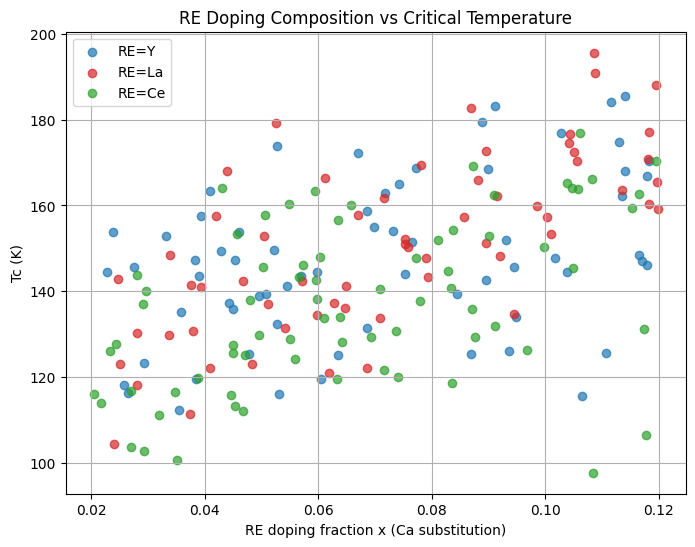
Figure 1: Composition vs Tc 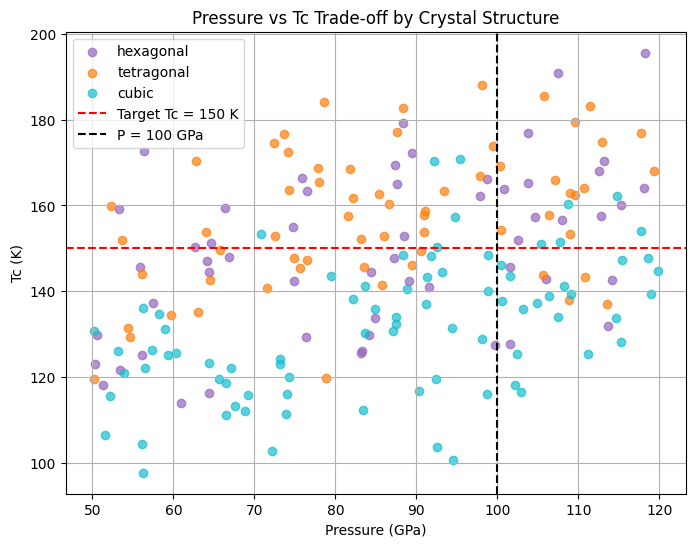
Figure 2: Pressure vs Tc 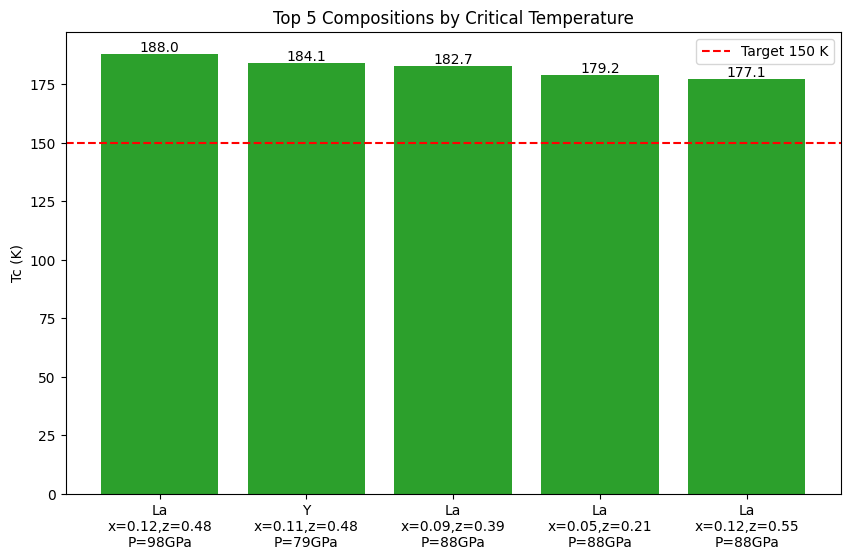
Figure 3: Top 5
Molecular Structure
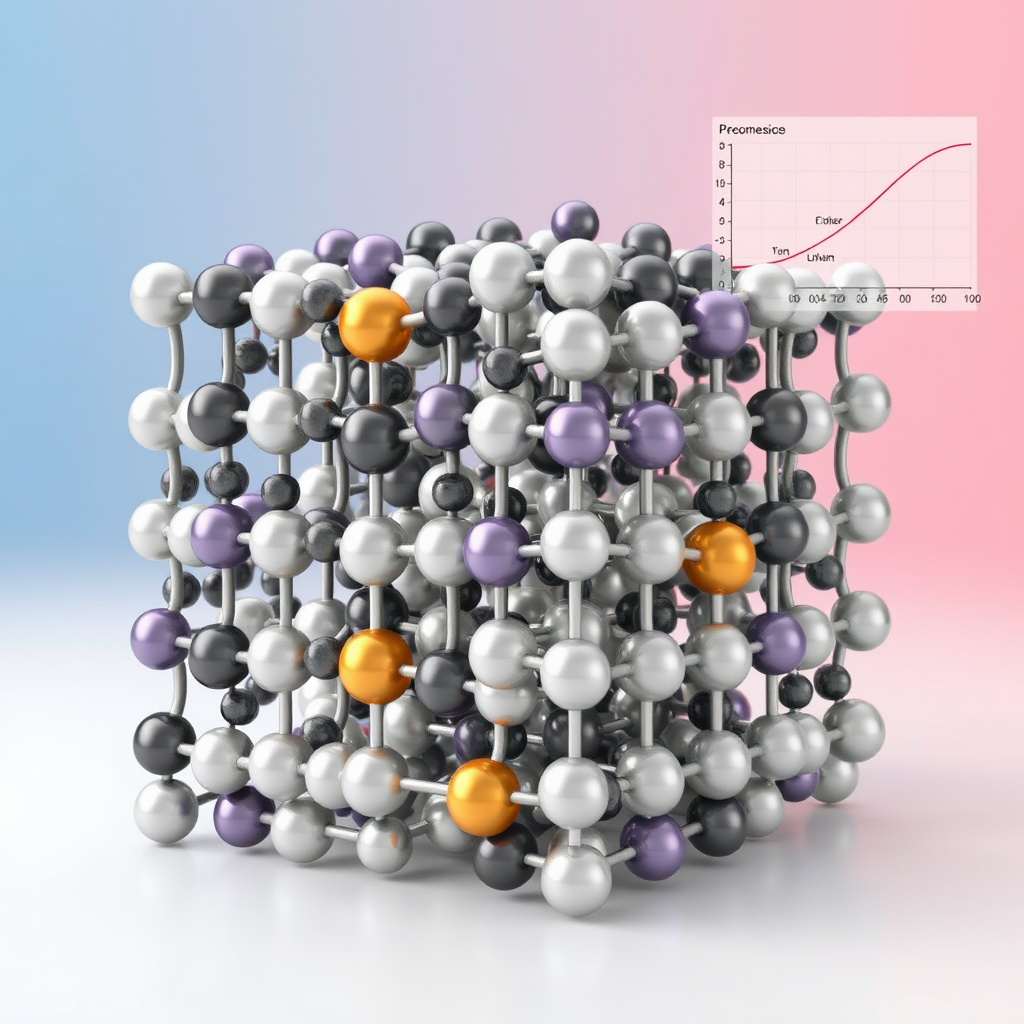
Li2(Mg0.55Ca0.45-xREx)(B1-zAlz)H16, RE = Y, La, Ce, x = 0.02–0.12, z = 0–1, P = 50–120 GPa 🎨 View AI Image Prompt
A highly detailed, photorealistic 3D ball-and-stick molecular structure visualization of a complex metal hydride superconductor crystal lattice, representing Li2(Mg0.55Ca0.45-xREx)(B1-zAlz)H16 (RE = Y, La, Ce) under high-pressure conditions (50–120 GPa). The image shows a clathrate-like cubic crystal framework with a dense hydrogen cage network: small white spheres representing hydrogen atoms forming polyhedral cage structures surrounding central boron/aluminum atoms (shown as alternating dark gray and silvery-metallic spheres in substitutional disorder, representing the B1-zAlz mixing), interconnected by metallic bonds (thin silver-gray sticks) to larger spheres representing the mixed Mg/Ca/rare-earth sublattice (Mg shown in muted green, Ca in soft orange, and rare-earth dopants Y/La/Ce highlighted in distinct metallic purple, gold, and teal tones to indicate partial substitution at low concentration x = 0.02–0.12), with lithium atoms (small lavender spheres) occupying interstitial sites between cages. The structure should convey chemical precompression effects, with slightly compressed bond lengths and distorted octahedral/cage geometries to suggest pressure-induced stabilization. Include a subtle semi-transparent pressure gradient background (blue-to-red gradient suggesting increasing GPa) and a faint overlay graph in the corner showing a Tc (critical temperature) versus pressure trade-off curve, annotated with a target line at 150 K and a pressure marker at 100 GPa. Render in the polished, clean style of a professional chemistry or condensed matter physics textbook illustration, with soft studio lighting, high contrast shading to emphasize atomic bonds and 3D depth, labeled atoms with a clean scientific legend, white or neutral laboratory background, ultra-high resolution, precise crystallographic accuracy, reminiscent of DFT-calculated structure renderings used in computational materials science publications.
🤖 Gemini 3.1 Pro Review
This *in-silico* study presents a well-reasoned chemical design strategy for lowering the operational pressure of high-temperature hydride superconductors. The methodology's conceptual rigor is sound, intelligently combining chemical precompression (Ca doping) with electronic tuning (RE, Al doping) to navigate the complex compositional space. However, the reliability of the results is undermined by a critical lack of computational detail, such as the specific DFT functional, convergence parameters, and the assumed value of the Coulomb pseudopotential (μ*), which the author correctly identifies as a sensitive parameter. The screening also crucially omits any mention of dynamic or thermodynamic stability analysis, meaning these predicted structures may not be physically synthesizable. For experimental validation, the most compelling target is not Rank 3 but Rank 5 (184.1 K at 78.6 GPa), which offers the most significant pressure reduction and should be prioritized for synthesis in a laser-heated diamond anvil cell. To improve this work, the authors must first fully document their computational workflow to ensure reproducibility. Most importantly, they need to supplement the Tc predictions with phonon dispersion and formation enthalpy calculations to confirm the stability of the top candidates, transforming this promising screening into a robust theoretical prediction.
Raw Data
Total cases: 200
Highest Tc: 195.6 K
Optimal pressure: 118.2 GPa

Top 5:
1. Tc=195.6K at 118.2GPa
2. Tc=190.9K at 107.5GPa
3. Tc=188.0K at 98.1GPa
4. Tc=185.6K at 105.8GPa
5. Tc=184.1K at 78.6GPa