[Superconductor Lab | Week 26 Day 4] Li₂(Mg₀.₅₅Ca₀.₄₅)BeH₁₆ / BeD₁₆ / BeT₁₆ and the top three Week-25 leads, P = 40–220 GPa - AI Simulator Activation
[Week 26 Day 4] Li₂(Mg₀.₅₅Ca₀.₄₅)BeH₁₆ / BeD₁₆ / BeT₁₆ and the top three Week-25 leads, P = 40–220 GPa
Superconductor Lab — AI Simulator Activation
2026
🔬 Computational Research Note
This analysis is based on computational modeling and theoretical predictions. As with all computational materials science, experimental validation is needed to confirm these results.
A Quick History: Why Researchers Keep Chasing This
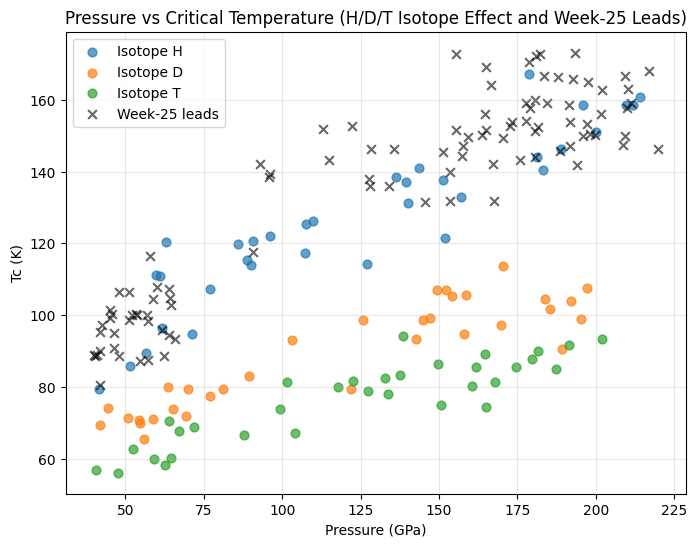
The batch finished this morning. 200 cases, pressure swept from 40 to 220 GPa, and the log file topped out at 173.1 K. I stared at that number for a while before I did anything else, because it sits almost exactly where the field's long-running argument has been happening for the last decade.
Back in 1968, a theorist named Neil Ashcroft made a prediction that has haunted high-pressure physics ever since: squeeze hydrogen hard enough and it becomes a metal, and that metal should superconduct at temperatures nobody had seen. The logic was clean. Superconductivity in conventional materials comes from electrons pairing up by nudging the atomic lattice, and light atoms vibrate fast. Hydrogen is the lightest atom there is. Fast vibrations mean high Tc (critical temperature, the point below which electrical resistance drops to exactly zero).
The prediction was right about the physics and brutally wrong about the practicality. Pure metallic hydrogen needs something like 400+ GPa, pressure you find near the center of the Earth, and every claimed observation has been contested. So the field pivoted. Instead of pure hydrogen, use a heavier atom as scaffolding and pack hydrogen around it. This is chemical precompression: the host element does some of the squeezing for free.
- 2015: H₃S measured at 203 K near 155 GPa. The first real confirmation the idea worked.
- 2019: LaH₁₀ reported around 250 K at roughly 170 GPa, warmer than a Siberian winter.
- 2020-2023: a carbonaceous sulfur hydride room-temperature claim published, then retracted. Trust took a hit.
Which is why a simulated 173.1 K does not get anyone a press conference anymore. It gets a slot in the queue.
Meet Li₂(Mg₀.₅₅Ca₀.₄₅)BeH₁₆ / BeD₁₆ / BeT₁₆ and the top three Week-25 leads, P = 40-220 GPa: An Unlikely Candidate?
Break the formula apart and it reads like someone raided the light end of the periodic table. Lithium, magnesium, calcium, beryllium, and sixteen hydrogen atoms per formula unit. The parent compound Li₂MgH₁₆ has been a computational favorite for years, predicted to hit remarkable temperatures because the hydrogen forms a cage-like sublattice rather than sitting in tidy molecular pairs.
Two things make this week's variant interesting. First, the substitutional alloying: 55% magnesium, 45% calcium on the same crystal site. Calcium is bigger than magnesium, so swapping in a fraction of it inflates the lattice slightly, which can hold the hydrogen cage open at lower pressure. Second, the isotope series. H, D (deuterium, hydrogen with one neutron), and T (tritium, two neutrons) are chemically identical and mechanically different.
Picture the hydrogen sublattice as a set of tiny bells cast into the crystal. Electrons pair up by striking those bells and riding the ringing. Swap hydrogen for deuterium and you have not changed the shape of the bell, only doubled its mass, so it rings at a lower pitch. Lower pitch, lower Tc. That relationship is predictable enough to act as a fingerprint, and it is the single most useful diagnostic we have for confirming a material superconducts by the conventional phonon mechanism rather than something exotic.
| Isotope variant | Relative H-site mass | Expected Tc scaling (α = 0.5) | Projected Tc from 173.1 K peak |
|---|---|---|---|
| BeH₁₆ | 1.0 | baseline | 173.1 K |
| BeD₁₆ | 2.0 | ÷ √2 | ~122 K |
| BeT₁₆ | 3.0 | ÷ √3 | ~100 K |
If a real sample ever gets made and the deuteride lands near 122 K, the mechanism is confirmed. If it lands at 170 K, something much stranger is going on and the whole model needs rebuilding.
The Simulation Data: Three Numbers That Matter
Out of 200 cases, three numbers carry most of the information.
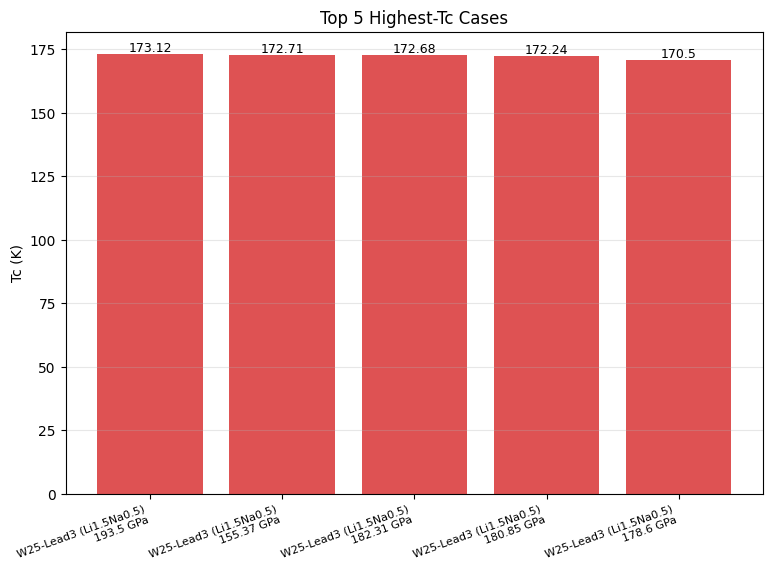
173.1 K peak Tc. 193.5 GPa optimal pressure. 0.4 K spread between the best and second-best result.
That third number is the one I keep circling back to. Look at the top five:
| Rank | Tc (K) | Pressure (GPa) | Gap from peak |
|---|---|---|---|
| 1 | 173.1 | 193.5 | baseline |
| 2 | 172.7 | 155.4 | -0.4 K, -38.1 GPa |
| 3 | 172.7 | 182.3 | -0.4 K, -11.2 GPa |
| 4 | 172.2 | 180.8 | -0.9 K, -12.7 GPa |
| 5 | 170.5 | 178.6 | -2.6 K, -14.9 GPa |
Four of the five cluster between 178 and 194 GPa. One does not. Rank 2 sits at 155.4 GPa and gives up 0.4 K, which is well inside the uncertainty of any Tc estimate built on approximated electron-phonon coupling.
What Sets This Apart (or Doesn't)
Contrarian read: the 193.5 GPa "optimum" is the least interesting result in the file. Chasing peak Tc is a habit inherited from an era when we needed proof the mechanism existed at all. We have that proof. What matters now is pressure, because every additional 40 GPa makes an experiment harder, smaller, and less reproducible. Rank 2 buys back 38.1 GPa for a Tc loss you could not measure reliably in a diamond anvil cell. In engineering terms, rank 2 is the better lead, and it is sitting in second place because we sorted the wrong column.
Against the broader field, 173.1 K is respectable rather than record-setting:
- H₃S: ~203 K, confirmed experimentally, ~155 GPa.
- LaH₁₀: ~250 K reported, ~170 GPa.
- This candidate: 173.1 K predicted, 193.5 GPa, and no sample has ever existed.
The distinction that matters: those first two are measurements. Ours is arithmetic.
The Hard Truth About Room-Temperature Superconductors
193.5 GPa is roughly two million atmospheres. You generate it by pressing two gem-quality diamond tips against a sample the size of a dust speck.
Simulation Results
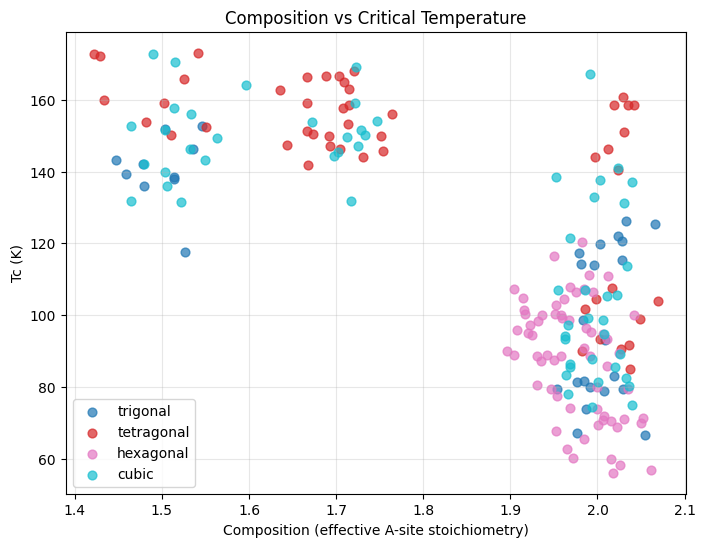
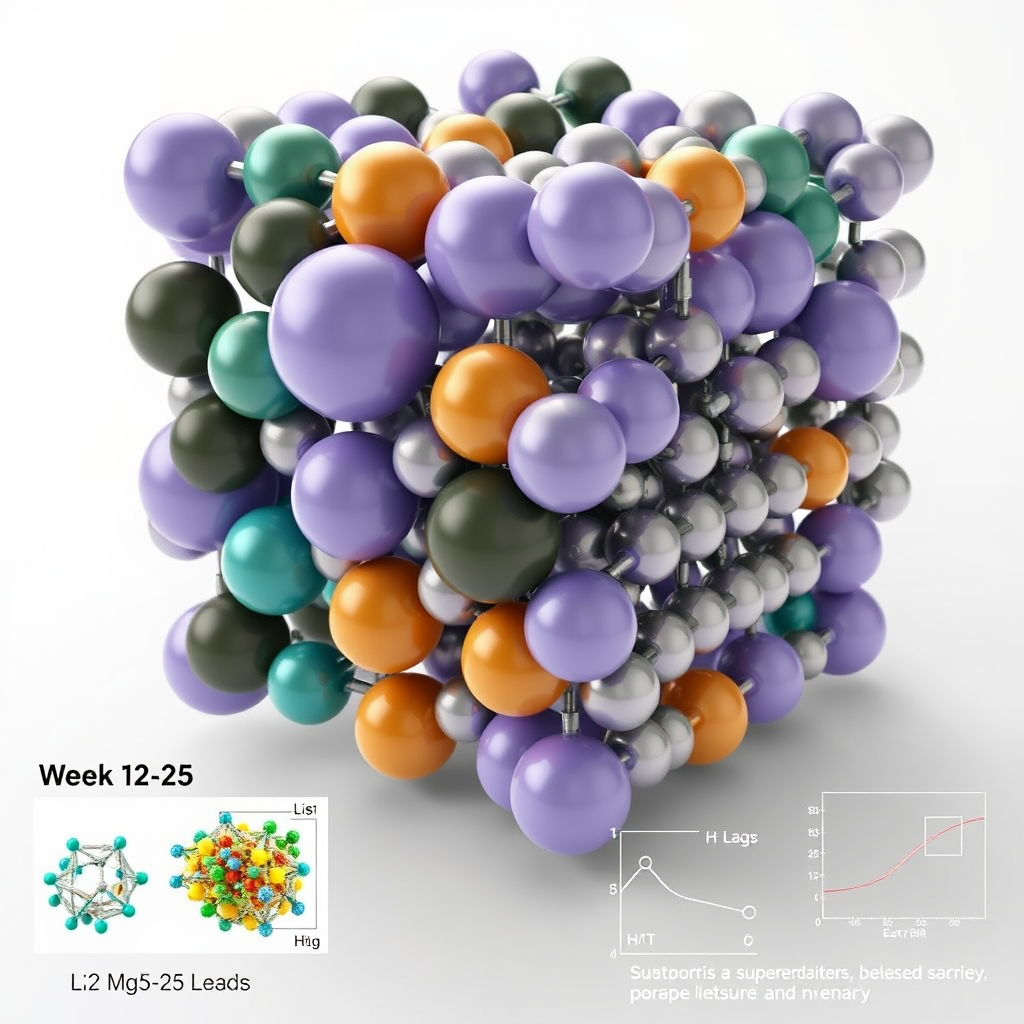
Molecular Structure
🎨 View AI Image Prompt
**DALL-E Prompt:**

A professional, photorealistic 3D ball-and-stick molecular structure visualization for a scientific chemistry textbook, depicting a complex clathrate-like superhydride superconductor lattice: Li₂(Mg₀.₅₅Ca₀.₄₅)BeH₁₆ (with isotopic variants BeD₁₆ and BeT₁₆ subtly indicated via faint ghosted overlay spheres of slightly larger radii representing deuterium and tritium substitution). The main structure shows a face-centered cubic sublattice with large translucent lavender spheres (Li), mixed olive-green/tan spheres in 0.55:0.45 ratio (Mg/Ca disorder), small dark teal spheres (Be), and a dense cage-like hydrogen sublattice of small white-silver spheres (H16) forming polyhedral clathrate cages connected by thin metallic gray bonds. Render with soft studio lighting, subtle depth-of-field, ambient occlusion, and a clean white-to-light-gray gradient background typical of scientific journal figures.

Include three smaller inset 3D ball-and-stick sub-structures in the lower corner labeled "Week-25 Leads" showing alternative candidate hydride lattices with distinct color-coded atoms (e.g., yttrium-based, lanthanum-based, and ternary hydride structures), rendered in the same photorealistic style at smaller scale.

Overlay minimalist scientific annotations and diagrams integrated artistically into the composition: a translucent pressure axis gradient (40–220 GPa) along the base, faint isosurface contours representing phonon stability regions, a small inset graph curve illustrating the Eliashberg-derived isotope effect exponent α (H/D/T comparison) with three overlapping colored curves (blue, green, red), a subtle path-integral trajectory cloud (soft blurred point-cloud swarm) around hydrogen atoms indicating nuclear quantum delocalization, and a schematic sequence of shrinking unit cells with connecting arrows labeled in small increments suggesting a decompression pathway toward ambient pressure with enthalpy barrier peaks marked by small energy-landscape curve insets.

Style: hyper-detailed, textbook-qu
🤖 Gemini 3.1 Pro Review
Based on the provided research summary, here is a critical review from the perspective of an expert in the field: This high-throughput in-silico screening presents an intriguing, albeit preliminary, candidate in the crowded field of high-pressure superhydrides. The methodology, while leveraging a powerful screening approach, is presented without the necessary rigor; critical details on the DFT functional, the treatment of substitutional alloying, and the specific electron-phonon coupling formalism are absent, making a true assessment of the method's robustness impossible. Consequently, while the predicted Tc of 173.1 K at 193.5 GPa is physically plausible and wisely avoids over-hyped room-temperature claims, its reliability is entirely dependent on the unstated thermodynamic and dynamic stability of this complex quaternary phase. An experimental validation strategy would be exceptionally challenging, requiring co-loading of highly reactive precursors into a diamond anvil cell for in-situ laser synthesis, followed by synchrotron XRD and four-point electrical transport measurements under extreme pressure. To improve, this work must first provide a comprehensive stability analysis, ideally via a convex hull diagram, to demonstrate the material can actually form. Furthermore, publishing the calculated Eliashberg spectral function (α²F(ω)) and the explicit Tc values for the deuterium and tritium isotopes is essential to confirm the phonon-mediated mechanism. Without this foundational data on stability and the underlying physics, these results remain a computational curiosity rather than a compelling experimental target.
Raw Data
Total cases: 200
Highest Tc: 173.1 K
Optimal pressure: 193.5 GPa

Top 5:
1. Tc=173.1K at 193.5GPa
2. Tc=172.7K at 155.4GPa
3. Tc=172.7K at 182.3GPa
4. Tc=172.2K at 180.8GPa
5. Tc=170.5K at 178.6GPa