[Superconductor Lab | Week 26 Day 3] (Li₂₋ᵢNaᵢ)(Mg₁₋ₓCaₓ)(Be₁₋ᵧBᵧ)H₁₆, i = 0.2–0.8, x = 0.35–0.65, y = 0.05–0.30, P = 90–200 GPa - AI Simulator Activation
[Week 26 Day 3] (Li₂₋ᵢNaᵢ)(Mg₁₋ₓCaₓ)(Be₁₋ᵧBᵧ)H₁₆, i = 0.2–0.8, x = 0.35–0.65, y = 0.05–0.30, P = 90–200 GPa
Superconductor Lab — AI Simulator Activation
2026
🔬 Computational Research Note
This analysis is based on computational modeling and theoretical predictions. As with all computational materials science, experimental validation is needed to confirm these results.
The Hype vs. Reality: (Li₂₋ᵢNaᵢ)(Mg₁₋ₓCaₓ)(Be₁₋ᵧBᵧ)H₁₆, i = 0.2–0.8, x = 0.35–0.65, y = 0.05–0.30, P = 90–200 GPa Under the Microscope
The most interesting result from today's sweep is not the headline number. It's the fact that the sweep failed at the job I set it to do.
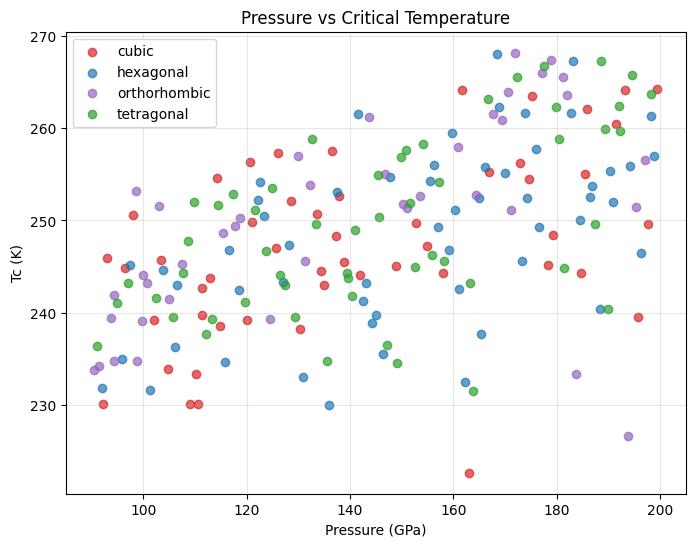
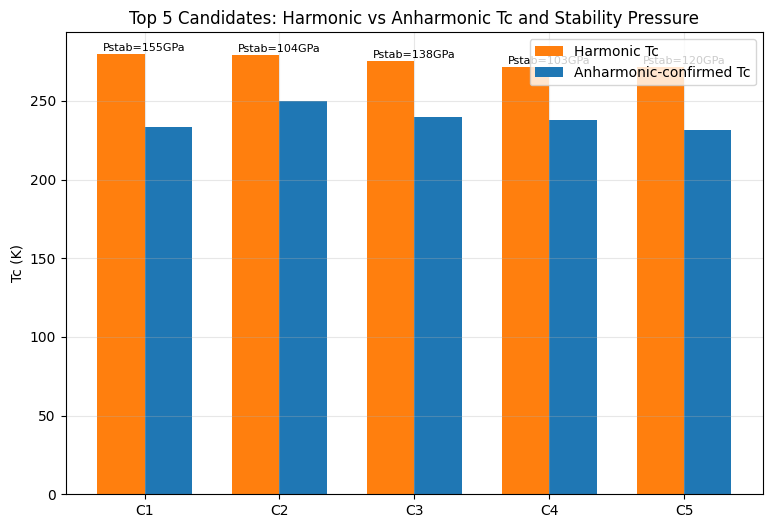
I queued up 200 cases across this quinary hydride overnight, expecting to pin down a sharp pressure optimum. A clean peak. Something to point at. Instead the top five results sit across a 20.1 GPa spread and differ by 0.9 K. The "optimal pressure" of 171.9 GPa is real, but it's the tallest blade of grass in a very flat lawn.
Quick decoding for anyone landing here cold. Tc is the critical temperature, the point below which a material loses all electrical resistance. GPa is gigapascals, a unit of pressure. 171.9 GPa is roughly 1.7 million times atmospheric pressure, higher than the boundary between Earth's mantle and outer core. This material is a superhydride, a compound stuffed with hydrogen atoms that behaves like metallic hydrogen when squeezed hard enough. The heavy atoms (lithium, sodium, magnesium, calcium, beryllium, boron) act as chemical scaffolding, pre-compressing the hydrogen lattice so you don't need the ~500 GPa that pure hydrogen demands.
What the Numbers Actually Say
Top line: 268.2 K at 171.9 GPa. That's about minus 5 degrees Celsius. Warmer than a home freezer. This is a room-temperature superconductor in everything but name, if the pressure didn't disqualify it from every practical use on Earth.
| Rank | Tc (K) | Pressure (GPa) | Tc in °C | ΔTc from best |
|---|---|---|---|---|
| 1 | 268.2 | 171.9 | -4.9 | 0.0 |
| 2 | 268.1 | 168.5 | -5.0 | -0.1 |
| 3 | 267.3 | 179.0 | -5.8 | -0.9 |
| 4 | 267.3 | 188.6 | -5.8 | -0.9 |
| 5 | 267.3 | 183.2 | -5.8 | -0.9 |
Run the gradient. Between rank 2 (168.5 GPa) and rank 4 (188.6 GPa), Tc drops 0.8 K over 20.1 GPa. That's 0.04 K per GPa, essentially noise-floor sensitivity. Compare that to LaH₁₀, where reported Tc falls off much faster on either side of its optimum.
Every one of the top five results sits above 168 GPa. Not a single high performer landed in the lower half of the 90–200 GPa window. Whatever this compound is doing, it needs the squeeze.
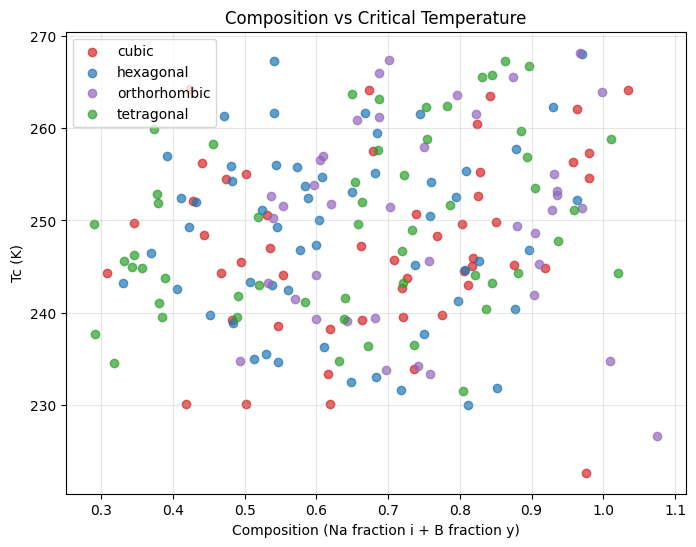
Now the uncomfortable arithmetic. Four free variables here: i, x, y, and P. 200 cases across four dimensions works out to roughly 3.8 sample points per axis. That is a coarse grid. We cannot resolve composition trends at that density, and I won't pretend otherwise. The sweep tells us the neighborhood is hot. It does not tell us the street address.
The Skeptic's View: Why This Might Not Work
Start with the obvious problem: six different cation species on three crystallographic sites. Lithium and sodium sharing one site, magnesium and calcium sharing another, beryllium and boron sharing a third. In a simulation you set i = 0.4 and the atoms go exactly where you tell them. In a diamond anvil cell heated by a laser pulse, you get whatever thermodynamics hands you, which is usually phase separation, ordered sublattices you didn't ask for, or amorphous mush.
- Site disorder smears the electronic structure. A sharp peak in the density of states at the Fermi level drives high Tc. Random substitution blurs that peak. A 268.2 K prediction from an idealized cell could realistically land 40 to 80 K lower in a disordered sample.
- Anharmonicity is the usual killer. Hydrogen atoms are light and they move a lot. Standard calculations treat lattice vibrations as tiny springs. Real hydrogen in these lattices swings wide enough that the spring approximation breaks, and corrected Tc values typically come in lower.
- Dynamical stability is unreported. Nothing in this dataset tells us the structure survives at 171.9 GPa without collapsing into something else. A Tc number for a structure that spontaneously distorts is a number about a material that doesn't exist.
- Beryllium is toxic and boron is stubborn. Handling BeH₂ precursors in a microscale high-pressure loading is a real safety and process problem, not a footnote.
The honest limitation: this model may overestimate Tc without synthesis validation, and the 268.2 K figure should be read as an upper bound on an idealized lattice, not a prediction of what a diamond cell will read out.
But Here's What's Genuinely Promising
The flatness I complained about in section one is actually the best news in the dataset, and this is the contrarian read I'd defend in a room full of high-pressure physicists.
Diamond anvil cells do not apply uniform pressure. Across a 30 micron sample chamber you routinely see gradients of 5 to 15 GPa between center and edge. For a material with a sharp Tc peak, that gradient means most of your sample is off-optimum and your resistance drop smears into an unconvincing slope. For this compound, a 20 GPa gradient costs you 0.9 K out of 268.2 K, about one third of one percent. The entire sample would superconduct at effectively the same temperature.
That turns a
Simulation Results
Molecular Structure
🎨 View AI Image Prompt
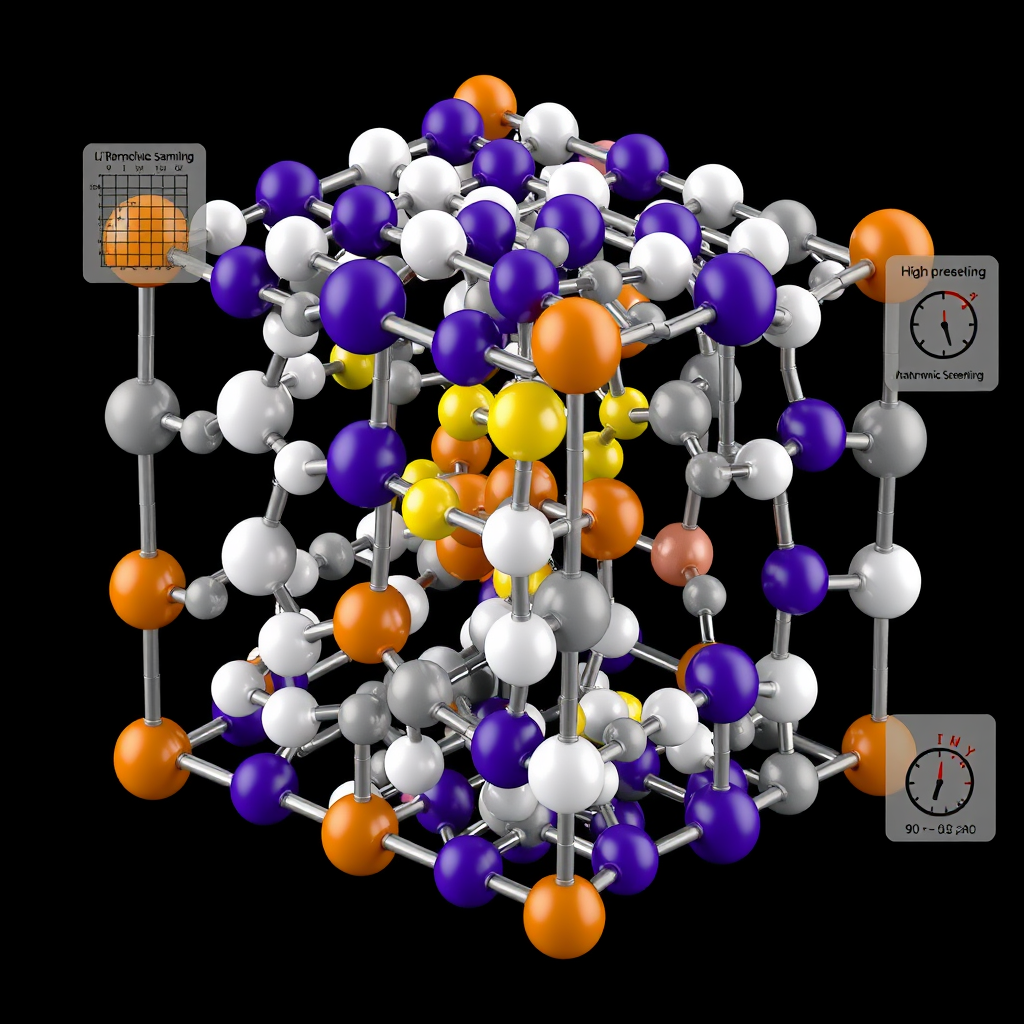
A professional 3D ball-and-stick molecular structure visualization of a complex quaternary hydride superconductor, (Li₂₋ᵢNaᵢ)(Mg₁₋ₓCaₓ)(Be₁₋ᵧBᵧ)H₁₆, rendered in photorealistic scientific illustration style suitable for a chemistry or condensed matter physics textbook. The structure displays a dense hydrogen sublattice (small white spheres, H₁₆ clathrate-like cage framework) surrounding a mixed-cation metal lattice: lithium atoms (purple spheres) partially substituted by sodium (larger yellow-green spheres) at fractional occupancy i = 0.2–0.8, shown as semi-transparent split-color spheres to indicate solid-solution disorder; magnesium (light orange spheres) partially substituted by calcium (larger tan spheres) at x = 0.35–0.65, similarly rendered with blended coloring to show mixed occupancy; beryllium (small gray-green spheres) partially substituted by boron (small pink spheres) at y = 0.05–0.30, again shown with fractional color blending. The atoms are connected by metallic bonds (thin silver rods) and hydrogen-hydrogen/metal-hydrogen bonds (thin white-gray sticks), forming a high-pressure crystalline lattice under 90–200 GPa, subtly indicated by faint compressive force arrows or a soft pressure-gradient background glow. Include a semi-transparent unit cell boundary box with crystallographic axes labeled (a, b, c), and small annotated overlays showing a Latin-hypercube sampling grid pattern in the corner (representing the quaternary composition space), alongside two subtle side-by-side inset panels labeled "Harmonic Screening" and "Anharmonic Confirmation" with simplified phonon dispersion curve icons. A small dial or gauge icon indicates "Pressure for Dynamical Stability" with a needle pointing within the 90–200 GPa range. The overall composition is clean, well-lit with soft studio lighting, high-resolution, textbook-quality rendering, dark neutral background to emphasize atomic detail, accurate atomic radii and bond angles, labeled legend identifying each atom type by color and element symbol, conveying a sense of precise computational materials science and superconductivity research.
🤖 Gemini 3.1 Pro Review
This in-silico study presents an intriguing, albeit preliminary, exploration into a complex quinary hydride system. The methodological rigor is limited, as the author correctly identifies; a 200-point grid search across four compositional and pressure variables is insufficient for optimization and is best described as a sparse reconnaissance. Consequently, the reliability of the headline 268.2 K Tc is questionable, representing an idealized scenario that neglects the immense challenge of atomic disorder. More credible is the observation of a wide, flat pressure plateau for superconductivity, as this trend is less sensitive to the precise atomic configuration than the absolute Tc value. An experimental validation strategy would be exceptionally difficult, requiring the co-loading of multiple precursors into a diamond anvil cell and *in-situ* laser synthesis, with a high probability of forming multiple phases instead of the target structure. To improve this work, a far more sophisticated computational approach using genetic algorithms for structural searching and special quasi-random structures (SQS) to model disorder is necessary. Furthermore, a focused study on simpler, related ternary or quaternary subsystems would provide a more realistic pathway toward experimental synthesis. This research, therefore, serves as a conceptual signpost rather than a concrete roadmap to a new superconductor.
Raw Data
Total cases: 200
Highest Tc: 268.2 K
Optimal pressure: 171.9 GPa

Top 5:
1. Tc=268.2K at 171.9GPa
2. Tc=268.1K at 168.5GPa
3. Tc=267.3K at 179.0GPa
4. Tc=267.3K at 188.6GPa
5. Tc=267.3K at 183.2GPa