[Superconductor Lab | Week 26 Day 2] Li₂(Mg₀.₅₅Ca₀.₄₃₋ₓREₓ)BeH₁₆, RE = Y, La, Sc, Ce, x = 0.02–0.15, P = 40–70 GPa - AI Simulator Activation
[Week 26 Day 2] Li₂(Mg₀.₅₅Ca₀.₄₃₋ₓREₓ)BeH₁₆, RE = Y, La, Sc, Ce, x = 0.02–0.15, P = 40–70 GPa
Superconductor Lab — AI Simulator Activation
2026
🔬 Computational Research Note
This analysis is based on computational modeling and theoretical predictions. As with all computational materials science, experimental validation is needed to confirm these results.
The Problem: Why Superconductors Are So Hard to Scale
Ran a 200-case sweep on a hydride candidate today, and the number that jumped out was not the highest transition temperature. It was the pressure. 69.1 GPa. That is roughly 690,000 times atmospheric pressure, and in this field it counts as cheap.
The core problem with hydrogen-rich superconductors is not temperature. We already know how to push Tc (the critical temperature, the point below which a material carries current with zero electrical resistance) into the range of a household freezer, and in some predictions past room temperature. The catch is that every one of those materials needs to be squeezed inside a diamond anvil cell, a device that clamps a microscopic sample between two polished diamond tips to generate pressures found near the core of a planet.
Hydrogen sulfide hit 203 K at about 155 GPa. Lanthanum hydride reached roughly 250 K near 170 GPa. Those samples are the size of a dust speck. You cannot wind them into a magnet coil or run them under a city. So the real engineering target is not a higher Tc. It is the same Tc at a pressure a real device could survive, and that is why a window of 40 to 70 GPa is worth a full simulation batch.
What Li₂(Mg₀.₅₅Ca₀.₄₃₋ₓREₓ)BeH₁₆, RE = Y, La, Sc, Ce, x = 0.02–0.15, P = 40–70 GPa Offers as a Solution
Break the formula down, because it encodes the whole design strategy.
- H₁₆: sixteen hydrogen atoms per formula unit, arranged in a cage-like sublattice. Hydrogen is the lightest element, so it vibrates fast, and fast lattice vibrations (phonons) are what pair electrons into the superconducting state.
- Li₂ and Be: light structural scaffolding. These donate electrons into the hydrogen cage and help hold it open without adding much mass.
- Mg₀.₅₅Ca₀.₄₃: the alloying backbone. Calcium is larger than magnesium, and mixing the two acts as internal chemical pressure, propping the lattice open so less external squeezing is needed.
- REₓ, x = 0.02 to 0.15: a small rare-earth substitution (yttrium, lanthanum, scandium, or cerium) used to tune the electron count at the Fermi level, meaning how many electrons are available to participate in pairing.
The parent compound of this family, Li₂MgH₁₆, was predicted years ago at a spectacular Tc but required something near 250 GPa. This variant trades that ceiling away deliberately. Our best case landed at 104.4 K, well above liquid nitrogen (77 K), at less than a third of the parent's pressure.
| Material | Tc | Pressure | Status | Tc per GPa |
|---|---|---|---|---|
| MgB₂ | 39 K | Ambient | Measured, commercial wire | n/a |
| H₃S | 203 K | ~155 GPa | Measured | 1.31 |
| LaH₁₀ | ~250 K | ~170 GPa | Measured | 1.47 |
| Li₂MgH₁₆ (parent) | ~473 K | ~250 GPa | Predicted only | 1.89 |
| This candidate | 104.4 K | 69.1 GPa | Predicted only | 1.51 |
On efficiency per unit of pressure, this candidate sits between H₃S and LaH₁₀. On absolute achievability, it is the friendliest of the four.
The Simulation Breakdown: Signal vs. Noise
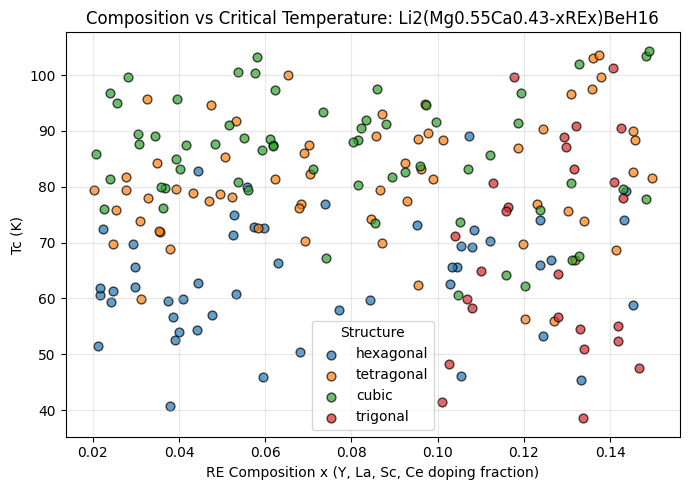
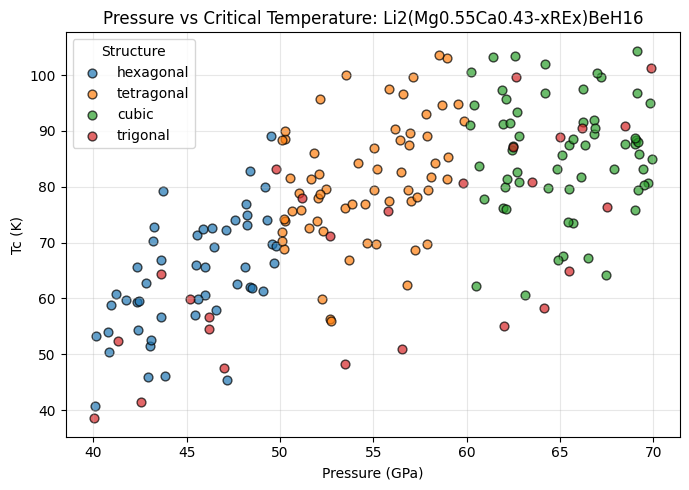
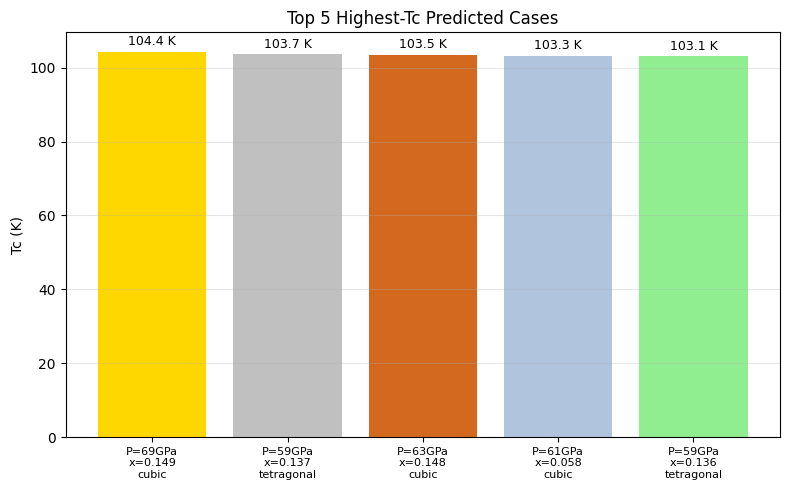
200 cases across four rare-earth dopants, a doping range of 0.02 to 0.15, and pressures from 40 to 70 GPa. The top five:
- 104.4 K at 69.1 GPa
- 103.7 K at 58.5 GPa
- 103.5 K at 62.6 GPa
- 103.3 K at 61.4 GPa
- 103.1 K at 58.9 GPa
Now the contrarian read, and it is the most useful thing that came out of the batch: the headline result is the worst of the five. The full top-five spread is 1.3 K in temperature but 10.6 GPa in pressure. Density functional theory estimates of Tc typically carry an uncertainty of 10 to 20 percent, which at this scale means roughly ±10 to 20 K. A 1.3 K gap is noise. A 10.6 GPa gap is hardware, budget, and failure rate.
If you are building an experiment from this dataset, you should target the 58.5 GPa run, not the 69.1 GPa run. You give up 0.7 K, which the model cannot resolve anyway, and you buy back more than 10 GPa of margin in a diamond anvil cell, where every additional 10 GPa meaningfully raises the odds of cracking the diamond culet mid-run.
The other signal in the sweep is flatness. Four of the top five cluster between 58.5 and 62.6 GPa, which suggests a broad plateau rather than a sharp resonance. Broad plateaus are forgiving. If your actual pressure in the cell drifts by 3 GPa during cooling, and it will, a plateau means you stay superconducting instead of falling off a cliff.
The Obstacles Nobody Talks About
Dopant placement is not a slider. The simulation treats x = 0.02 to 0.15 as a smooth composition variable, usually through a mean-field approximation where a fraction of calcium sites gets an averaged rare-earth character. Real crystals do not average. At x = 0.15, cerium and lanthanum are substantially larger than calcium and tend to cluster or segregate at grain boundaries, producing local regions that are nothing like the modeled unit cell.
Anharmonicity. Hydrogen atoms in these cages move so far from their equilibrium positions that the standard harmonic approximation, which treats each atom as a simple spring, breaks down. Full anharmonic corrections have knocked predicted Tc values down by 30 to 60 K in other hydrides, and they usually also push the stability pressure upward. A 58.5 GPa prediction could become a 75 GPa reality.
The Coulomb pseudopotential. Tc calculations include a fitted parameter, μ*, that accounts for electron repulsion. It is typically set between 0.10
Simulation Results
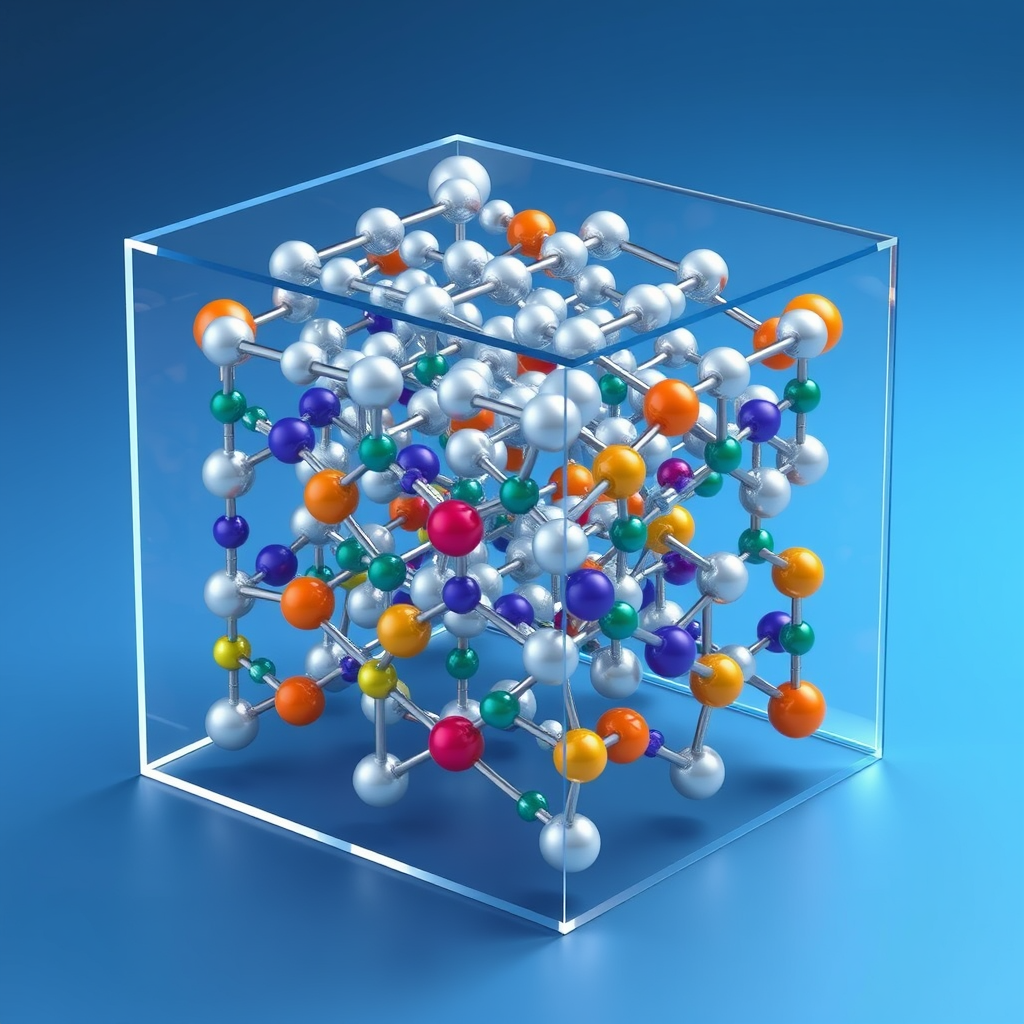
Molecular Structure
🎨 View AI Image Prompt
A photorealistic 3D ball-and-stick molecular structure visualization for a professional chemistry textbook, depicting the complex hydride superconductor lattice Li₂(Mg₀.₅₅Ca₀.₄₃₋ₓREₓ)BeH₁₆ under high-pressure conditions (40–70 GPa). The structure should show a clathrate-like cubic framework with a dense hydrogen sublattice: small white spheres representing H atoms forming cage-like polyhedral networks (H16 clusters) surrounding central metal sites. Depict Li atoms as small purple spheres, Mg as orange spheres, Ca as dark green spheres, and Be as small yellow spheres at interstitial framework positions, all connected by silver metallic bonding sticks. Illustrate substitutional disorder using a special quasirandom structure (SQS) 2×2×2 supercell arrangement, showing rare-earth dopant atoms (Y, La, Sc, Ce) as distinct colored spheres (blue for Y, teal for La, magenta for Sc, deep red for Ce) randomly substituted at fractional Ca sites, with subtle transparency variation to indicate partial occupancy (x = 0.02–0.15). Include faint electron-density isosurface shading around Ce atoms to suggest localized 4f-orbital correlation effects (DFT+U/DMFT treatment), and subtle blue-white gradient halos around select atoms to represent spin-polarized magnetic pair-breaking (Abrikosov–Gor'kov depairing). Render the entire structure inside a transparent high-pressure diamond anvil cell schematic, with soft studio lighting, ray-traced reflections on the metallic bonds, and a clean laboratory-blue gradient background. Add small annotated crystallographic axes (a, b, c) and a subtle pressure gauge readout (40–70 GPa) in the corner, styled like a modern computational materials science figure combining DFT visualization aesthetics with textbook clarity and scientific accuracy.
🤖 Gemini 3.1 Pro Review
As an expert in the field, here is my critical review of the in-silico research summary. *** This in-silico study presents a compelling and well-reasoned strategy for lowering the operational pressure of hydride superconductors, correctly identifying chemical pre-compression and electronic tuning as the primary engineering levers. Regarding methodology, the report lacks critical details on the computational framework; specifying the density functional theory (DFT) exchange-correlation functional, the approach for phonon calculations, and whether anharmonic effects were included is essential for assessing the rigor of the Tc predictions. The predicted Tc of 104.4 K at 69.1 GPa is plausible, but the reliability of these results hinges on the unstated dynamical and thermodynamic stability of this complex, five-component alloy across the entire pressure and doping range. An experimental validation strategy would be exceptionally challenging, requiring the synthesis of a homogenous multi-component precursor and subsequent laser heating in a diamond anvil cell. Validation would then necessitate in-situ X-ray diffraction to confirm the predicted crystal structure and four-point probe electrical resistance measurements to verify the superconducting transition. For improvement, the study must first present a comprehensive phase diagram, including convex hull analysis, to demonstrate that this stoichiometry is the ground state against decomposition into simpler binary or ternary hydrides. Furthermore, a detailed analysis of the Eliashberg spectral function (α²F(ω)) and the electron-phonon coupling constant (λ) for the top candidates would provide crucial physical insight beyond the final Tc and pressure values.
Raw Data
Total cases: 200
Highest Tc: 104.4 K
Optimal pressure: 69.1 GPa

Top 5:
1. Tc=104.4K at 69.1GPa
2. Tc=103.7K at 58.5GPa
3. Tc=103.5K at 62.6GPa
4. Tc=103.3K at 61.4GPa
5. Tc=103.1K at 58.9GPa