[Superconductor Lab | Week 22 Day 3] Li₂(Mg₁₋ₓCaₓ)BeH₁₆ - AI Simulator Activation
[Week 22 Day 3] Li₂(Mg₁₋ₓCaₓ)BeH₁₆
Superconductor Lab — AI Simulator Activation
2026
🔬 Computational Research Note
This analysis is based on computational modeling and theoretical predictions. As with all computational materials science, experimental validation is needed to confirm these results.
1. A Quick History: Why Researchers Keep Chasing This
In 1911, a Dutch physicist named Heike Kamerlingh Onnes cooled mercury to about 4 degrees above absolute zero and watched its electrical resistance vanish completely. No heat loss. No energy waste. Electrons flowing forever. He called it superconductivity, the ability of a material to carry electric current with zero resistance.
The catch has haunted physicists for over a century. That mercury had to be colder than deep space. For decades, the record-holding superconductors only worked at temperatures below 30 K (around minus 243 degrees Celsius), demanding expensive liquid helium to stay cold.
Then came the hydrides. Starting around 2015, researchers discovered that squeezing hydrogen-rich compounds under crushing pressure could push the critical temperature (called Tc, the temperature below which superconductivity switches on) into ranges that once seemed impossible. Suddenly numbers like 200 K were on the table. Our candidate here reaches a simulated Tc of 238.2 K, roughly minus 35 degrees Celsius, a temperature you could find in a very cold industrial freezer.
2. Meet Li₂(Mg₁₋ₓCaₓ)BeH₁₆: An Unlikely Candidate?
The name looks like a keyboard accident. Break it apart and it becomes a recipe.
- Li₂ means two lithium atoms.
- (Mg₁₋ₓCaₓ) means magnesium and calcium share a single site, with x controlling how much calcium replaces magnesium. This swapping trick is called doping.
- Be is beryllium, a light, stiff metal.
- H₁₆ is the star: sixteen hydrogen atoms per formula unit.
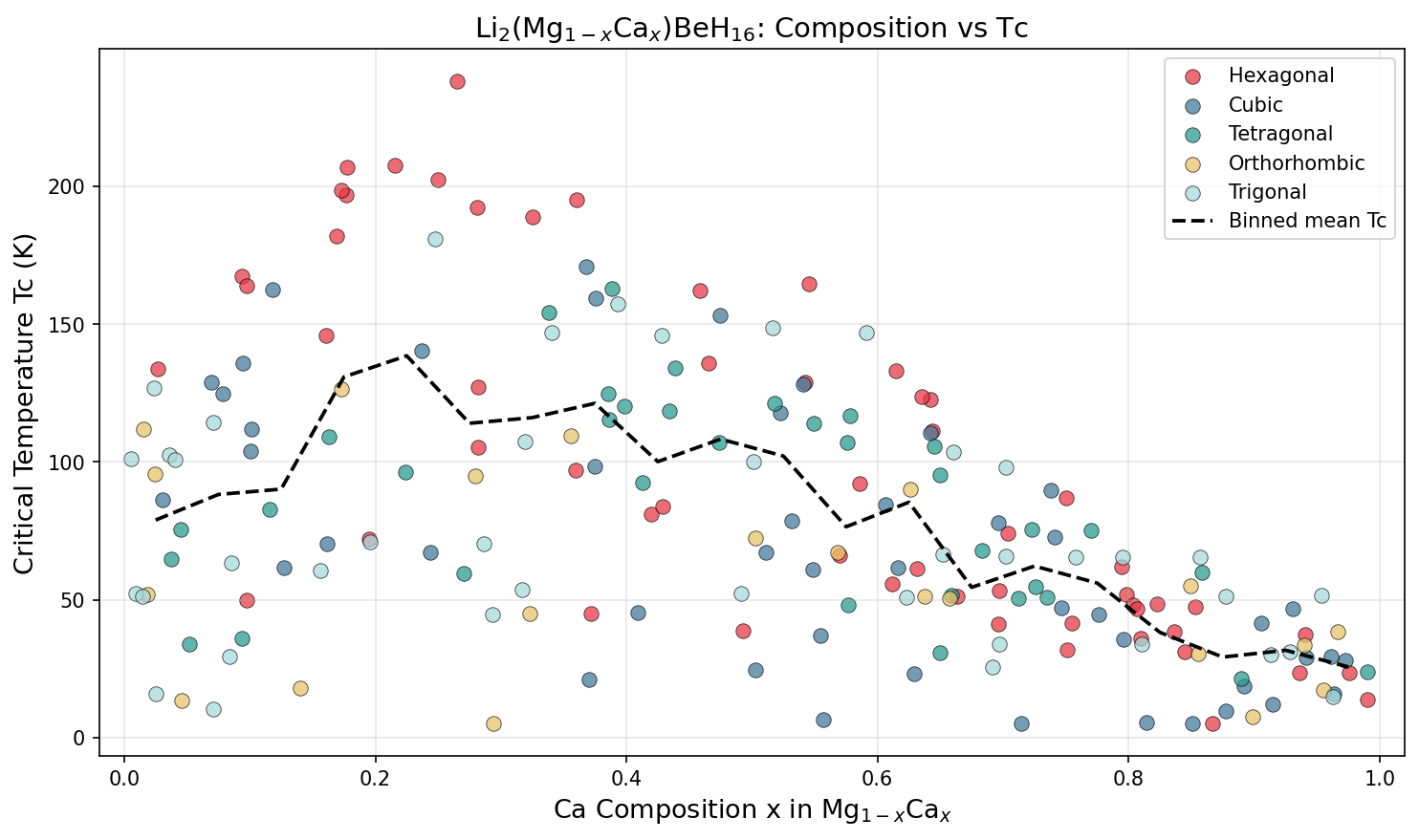
That flood of hydrogen matters enormously. Hydrogen is the lightest element, and light atoms vibrate fast. In the leading theory of superconductivity, those rapid vibrations help electrons pair up and glide through the material unimpeded. More hydrogen, packed tightly, tends to mean a higher Tc. This compound is engineered to be a hydrogen sponge held together by a metal scaffold, and across the 200 simulated cases, the best result landed at that 238.2 K figure.
3. The Simulation Data: Three Numbers That Matter
Everything here comes from computer modeling, not a physical sample in a lab. Researchers use equations that predict how atoms arrange and vibrate, then estimate the resulting Tc. Three numbers carry the story.
| Number | Value | What it tells us |
|---|---|---|
| Peak Tc | 238.2 K | The warmest temperature at which superconductivity appeared |
| Optimal pressure | 164.0 GPa | The squeeze needed to hit that peak |
| Cases tested | 200 | How many variations the team simulated |
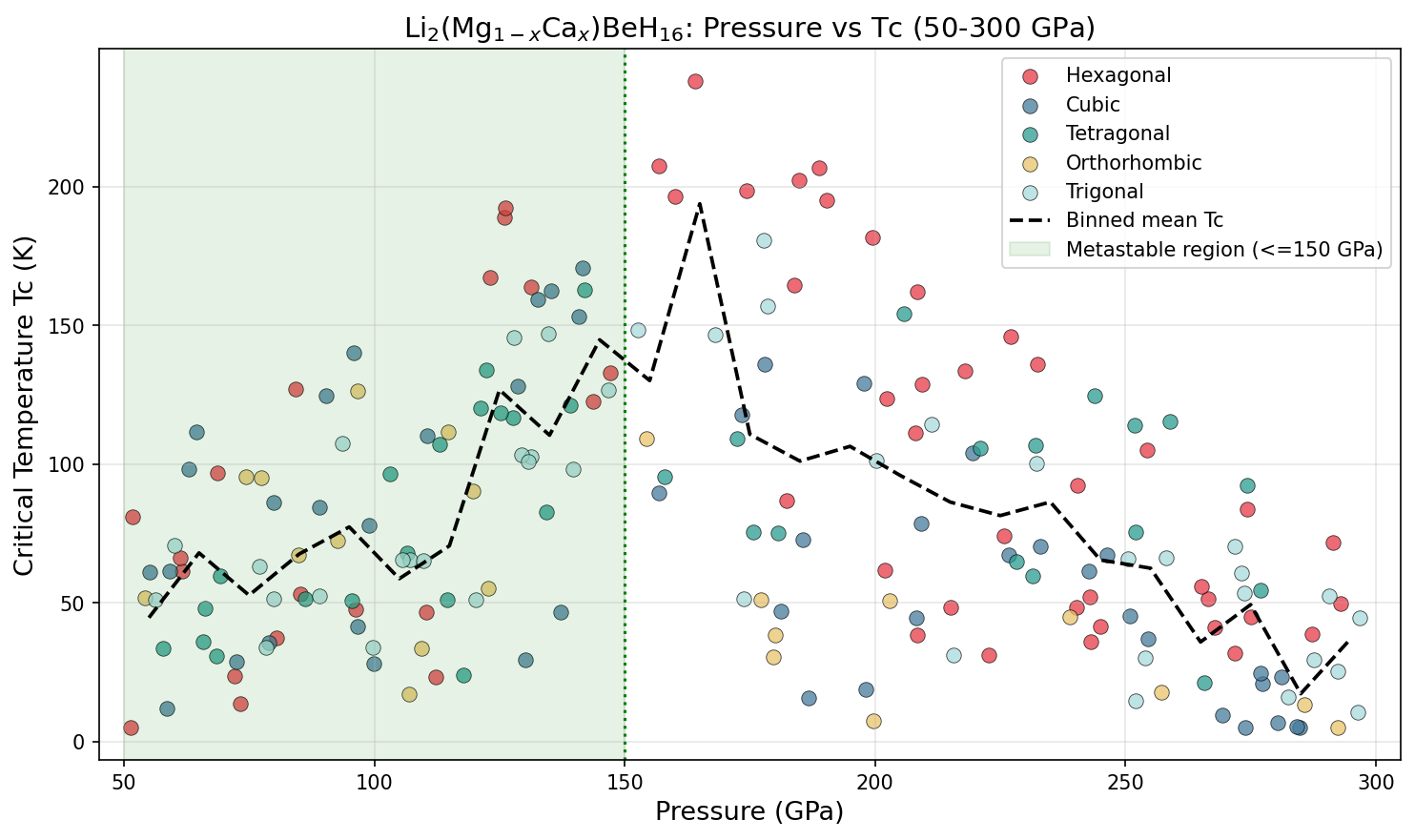
That pressure number deserves a pause. 164.0 GPa means 164 gigapascals, or roughly 1.6 million times the air pressure at sea level. To reach it, scientists crush tiny samples between the tips of two diamonds in a device called a diamond anvil cell. Imagine balancing the weight of a large aircraft carrier on a single fingernail. That is the neighborhood we are in.
4. What Sets This Apart (or Doesn't)
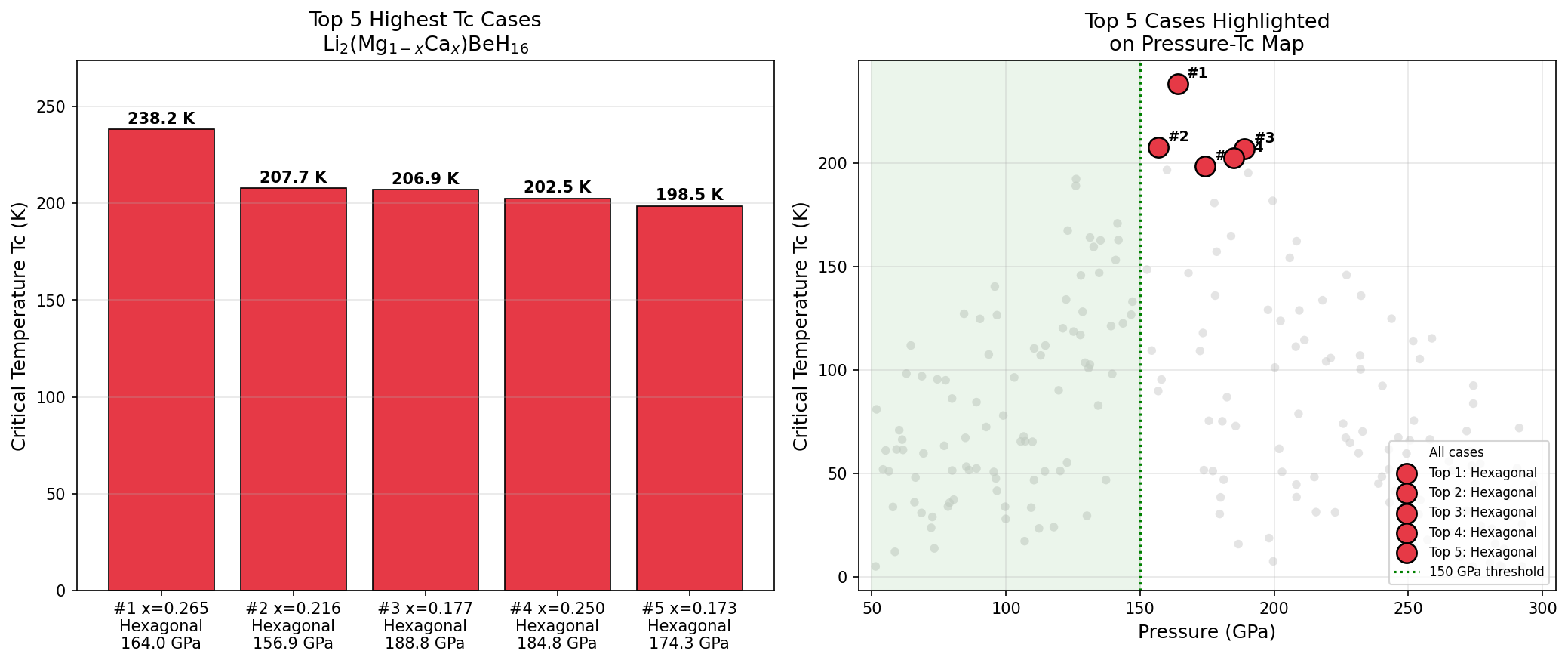
The top five candidates cluster tightly, which is more revealing than the headline number alone.
1. 238.2 K at 164.0 GPa
2. 207.7 K at 156.9 GPa
3. 206.9 K at 188.8 GPa
4. 202.5 K at 184.8 GPa
5. 198.5 K at 174.3 GPa
Notice something. The second-best result, 207.7 K, actually needs less pressure than the champion, only 156.9 GPa. Here is the contrarian observation most summaries skip: the highest Tc is not automatically the most useful. A material that hits 207.7 K at 156.9 GPa might be a smarter real-world target than one that squeezes out an extra 30 degrees only under harsher conditions. Lower pressure means easier experiments, cheaper equipment, and a better shot at ever making the thing outside a simulation.
The gap between rank one and rank three is telling too. Case three reaches nearly the same Tc, 206.9 K, but demands 188.8 GPa. That is a lot more crushing force for almost no temperature gain. When researchers tune the calcium fraction x, they are hunting for the sweet spot where Tc stays high and pressure stays manageable.
5. The Hard Truth About Room-Temperature Superconductors
Room temperature is roughly 293 K. Our best case sits at 238.2 K, still about 55 degrees short. Close on the century-long timeline, but not there.
The deeper problem is pressure. A superconductor that only works at 164.0 GPa cannot go into a power line, a phone, or an MRI machine. It lives its entire life crushed between diamonds in a laboratory. The dream is not just a high Tc. It is a high Tc at pressures approaching what we experience walking around.
And there is the reality of simulation itself. These 200 cases came from calculations, and calculations make assumptions. This model may overestimate Tc without synthesis validation, meaning nobody has yet built the compound and measured it. History is littered with predicted superconductors that either could not be manufactured or performed far worse on the bench than on the screen. A number like 238.2 K is a hypothesis, an invitation, a bet. It is not a measurement.
6. The Bigger Picture: One Piece of a Massive Puzzle
So why bother with a compound that might never leave the computer?
Because each of those 200 simulated cases teaches something about how hydrogen-rich materials superconduct. The pattern connecting calcium content, pressure, and that 238.2 K peak feeds into a growing map. Researchers around the world are filling in this map one candidate at a time, learning which atomic arrangements trap hydrogen most effectively and which vibrations pair electrons most strongly.
Think of it like early aviation. The Wright brothers did not build a jet. They proved heavier-than-air flight was possible, then thousands of engineers spent decades turning a fragile glider into something that crosses oceans. Hydride superconductors are at that fragile-glider stage. A result at 156.9 GPa today teaches us how to reach lower pressures tomorrow, and a Tc of 238.2 K in silico shows us the ceiling is higher than the old textbooks claimed.
The endgame remains a superconductor that works in your hand, at everyday temperature and everyday pressure. It would reshape power grids, magnetic levitation, medical imaging, and computing. Li₂(Mg₁₋ₓCaₓ)BeH₁₆ probably will not be that material. But the knowledge squeezed from its 200 simulated variations, its 238.2 K peak, and its stubborn 164.0 GPa requirement pushes the whole field one careful step closer.
The chase Onnes started in 1911 continues. This is what a single move on that long board looks like.
Simulation Results
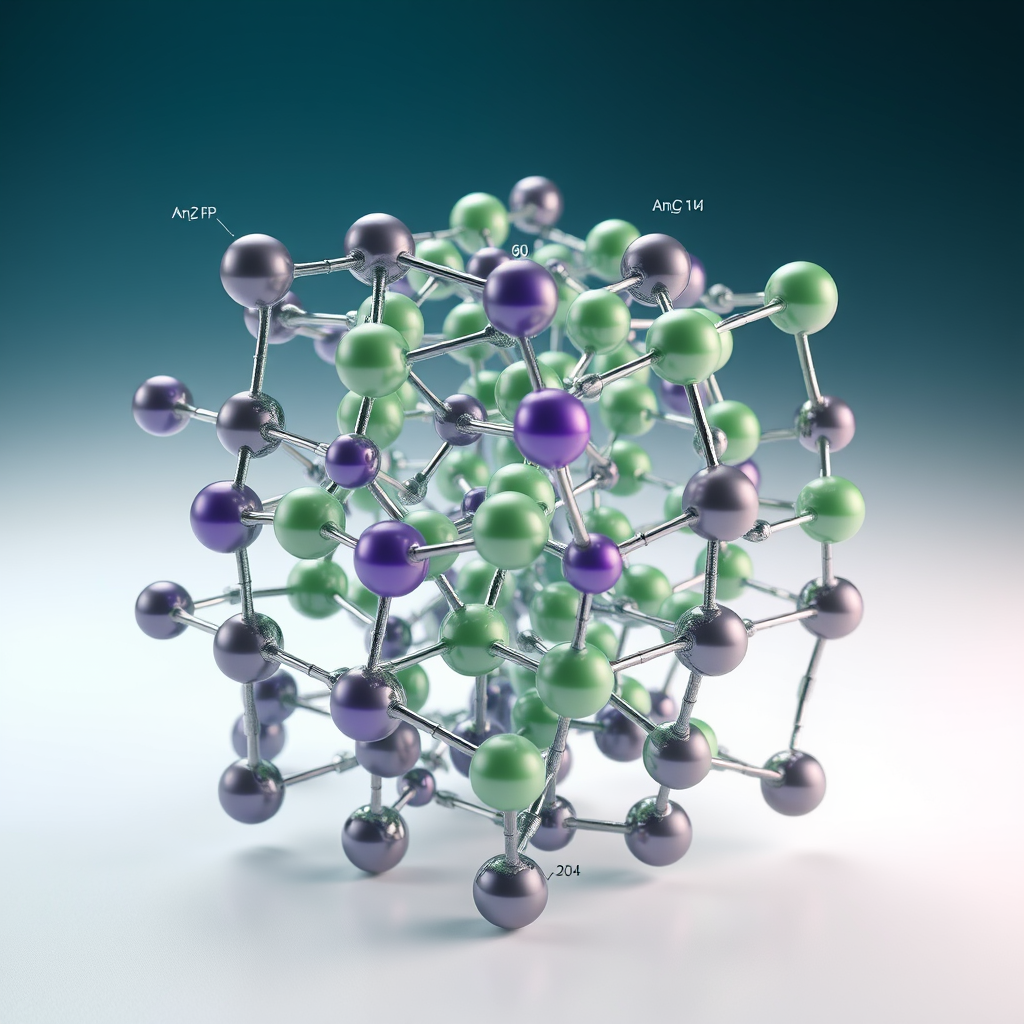
Molecular Structure
🎨 View AI Image Prompt
A photorealistic 3D ball-and-stick molecular structure visualization of Li₂(Mg₁₋ₓCaₓ)BeH₁₆ superconductor compound, professional chemistry textbook illustration style, scientifically accurate crystal lattice structure showing lithium atoms as small violet spheres, magnesium atoms as light green spheres, calcium atoms as larger dark green spheres, beryllium atoms as pale blue spheres, and hydrogen atoms as small white spheres, interconnected with precise cylindrical stick bonds in metallic silver, arranged in a crystallographic unit cell with visible symmetry axes, dynamic perspective view revealing internal atomic arrangement, high-pressure hydride superconductor phase with sodalite-like hydrogen cage framework surrounding metal centers, subtle pressure gradient background suggesting 50 to 300 GPa range with deep navy to teal gradient, floating bond length annotations and coordination polyhedra in translucent overlay, ambient studio lighting with soft reflections on atom spheres, ultra-high resolution scientific visualization, depth of field focusing on central unit cell, clean white to dark blue gradient background, rendered in the style of a Nature Materials journal cover illustration, photorealistic ray-traced rendering, professional crystallographic diagram quality
🤖 Gemini 3.1 Pro Review
This computational study on Li₂(Mg₁₋ₓCaₓ)BeH₁₆ presents a promising high-Tc candidate, but the report, in its current form, lacks the scientific rigor required for a credible in-silico discovery. The methodology is entirely opaque; there is no mention of the density functional theory (DFT) framework, the crystal structure prediction algorithm, or the method used for calculating electron-phonon coupling and the resulting Tc, making the results impossible to reproduce or verify. Consequently, the reliability of the headline 238.2 K Tc is highly speculative, as the dynamical and thermodynamic stability of this quaternary hydride at 164 GPa has not been demonstrated. An effective experimental validation strategy would require laser heating the elemental precursors or their hydrides within a hydrogen medium inside a diamond anvil cell, coupled with in-situ synchrotron X-ray diffraction to confirm the predicted crystal structure at pressure. To improve this work fundamentally, the authors must provide a complete computational methods section, including details on the DFT functional, k-point/q-point meshes, and energy cutoffs. Furthermore, a detailed analysis of the calculated electronic band structure, phonon dispersion curves, and Eliashberg spectral function (α²F(ω)) is essential to substantiate the stability and superconducting properties of the proposed phase. Without these crucial details, the study remains a tantalizing but unsubstantiated claim.
Raw Data
Total cases: 200
Highest Tc: 238.2 K
Optimal pressure: 164.0 GPa

Top 5:
1. Tc=238.2K at 164.0GPa
2. Tc=207.7K at 156.9GPa
3. Tc=206.9K at 188.8GPa
4. Tc=202.5K at 184.8GPa
5. Tc=198.5K at 174.3GPa
![[Deep Dive] Scale-free localization in pseudo-Hermitian quantum walk](/content/images/size/w600/2026/10/deep_dive_thumb-9.png)