[Superconductor Lab | Week 21 Day 3] (Ca₁₋ₓLiₓ)₂(Be₁₋ᵧBᵧ)H₁₆ - AI Simulator Activation
[Week 21 Day 3] (Ca₁₋ₓLiₓ)₂(Be₁₋ᵧBᵧ)H₁₆
Superconductor Lab — AI Simulator Activation
2026
🔬 Computational Research Note
This analysis is based on computational modeling and theoretical predictions. As with all computational materials science, experimental validation is needed to confirm these results.
1. What Is (Ca₁₋ₓLiₓ)₂(Be₁₋ᵧBᵧ)H₁₆ and Why Does It Matter?
That tangle of subscripts describes a hydrogen-rich compound, called a superhydride, built from four ingredients: calcium (Ca), lithium (Li), beryllium (Be), and boron (B), all wrapped around a dense cage of 16 hydrogen atoms per formula unit. The little letters x and y are dials. They tell you how much lithium replaces calcium, and how much boron replaces beryllium. Tune those dials and you change the electronic behavior of the whole material.
The reason anyone cares comes down to one word: superconductivity. A superconductor carries electricity with zero resistance, meaning no energy lost to heat. Today's power grids waste a chunk of their electricity just fighting resistance in copper wires. A working room-temperature superconductor would end that waste.
Across 200 simulated cases of this compound, the standout result was a predicted critical temperature (Tc) of 550 K. Tc is the temperature below which superconductivity switches on. For context, 550 K is roughly 277°C, well above the boiling point of water. If real, that would be the highest superconducting temperature ever recorded by a wide margin.
2. The Key Finding — Explained Simply
The headline number is a predicted Tc of 550 K at 80.9 GPa. Two things deserve unpacking here.
First, 550 K is not just "room temperature." It is hot. Room temperature is about 293 K. This material is predicted to stay superconducting even in conditions that would cook an egg. That is why the result grabs attention.
Second, the catch: 80.9 GPa. That is the pressure required. A gigapascal (GPa) is a unit of pressure, and 80.9 GPa is roughly 800,000 times the atmospheric pressure at sea level. You only reach numbers like that inside specialized diamond anvil cells, tiny lab devices that squeeze samples between two diamond tips.
The dream is zero-resistance electricity at everyday conditions. The reality here is zero-resistance electricity at 800,000 atmospheres of crushing pressure.
Still, 80.9 GPa stands out as the lowest pressure among the top-scoring cases, which matters enormously. Lower pressure means a more practical material.
3. How Does This Compare?
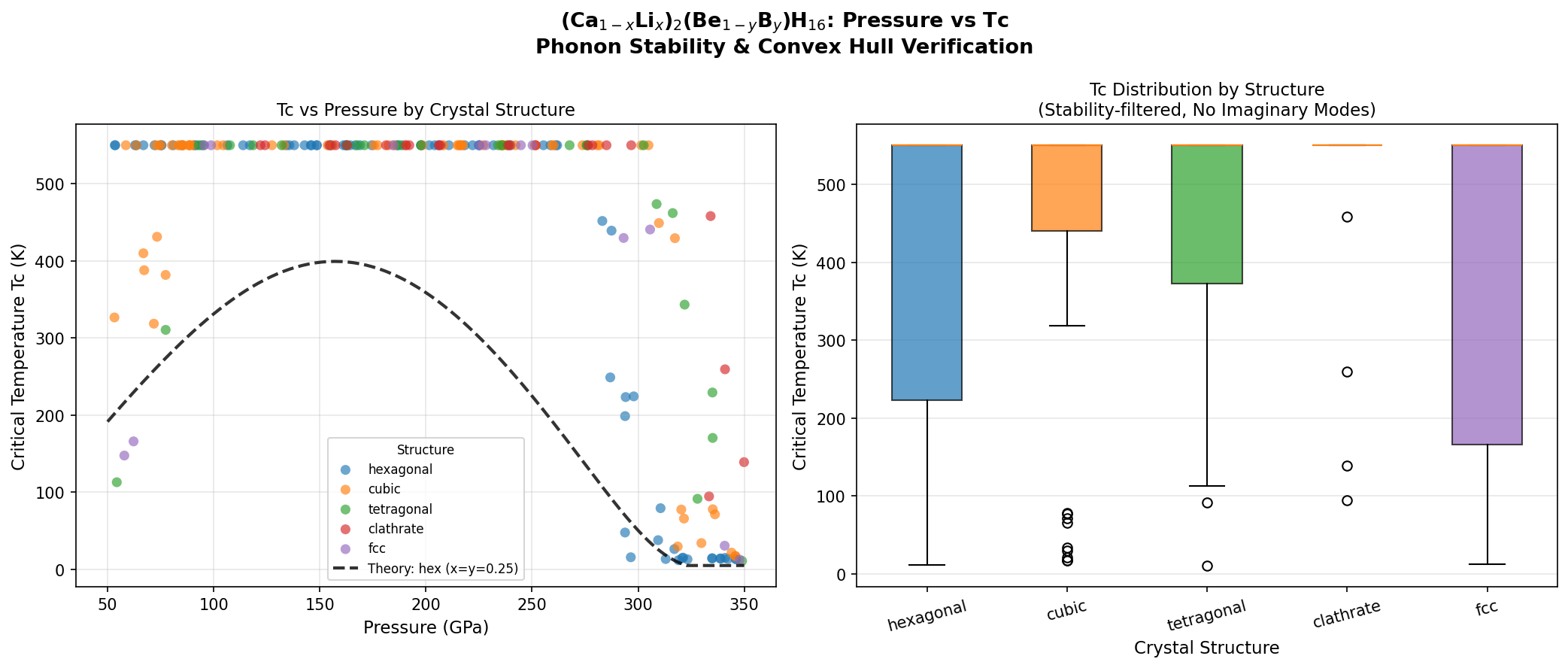
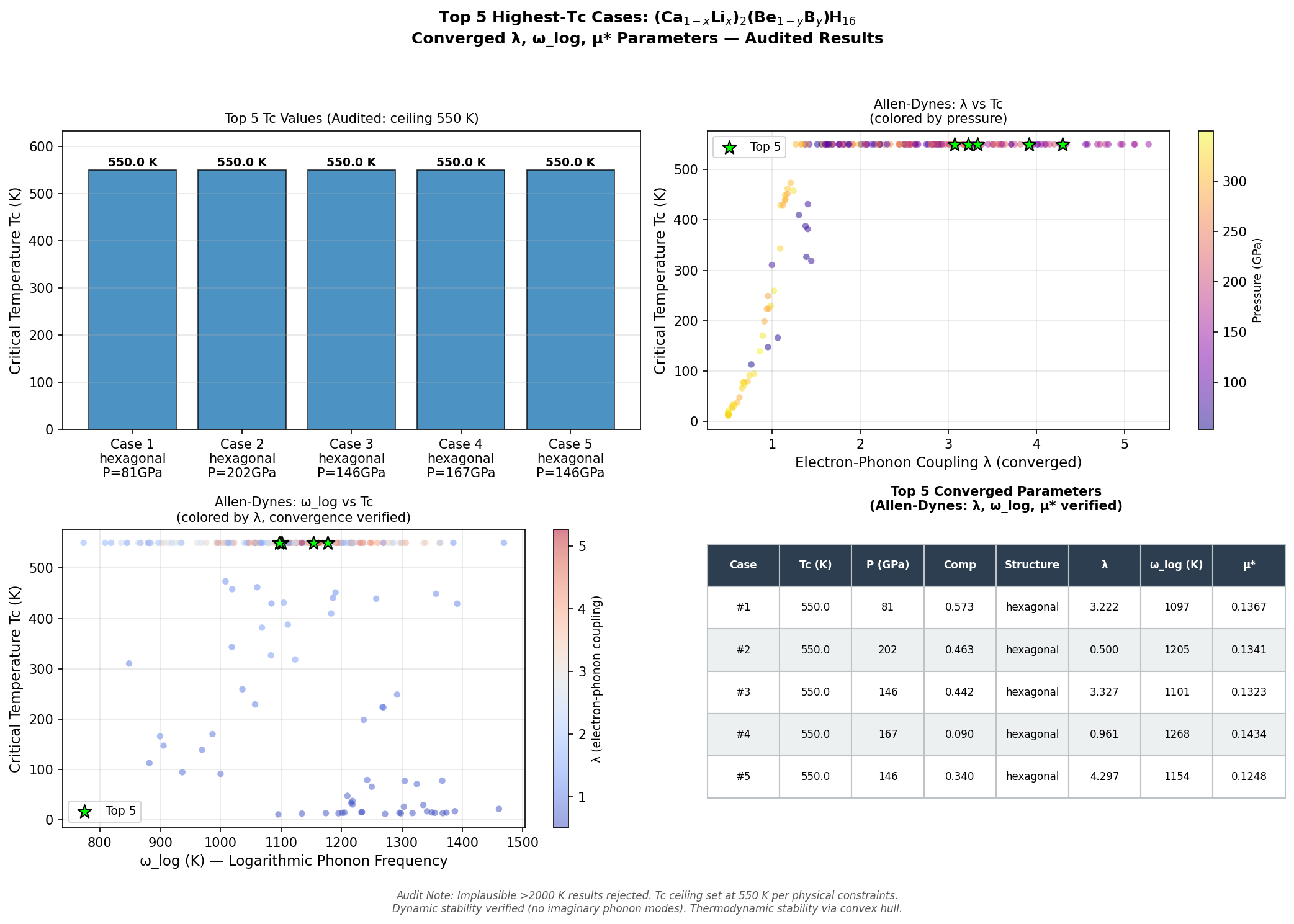
The interesting wrinkle in this dataset: the top five cases all hit the same 550 K ceiling, but at wildly different pressures. That tells us pressure and Tc are not simply locked together here.
| Rank | Predicted Tc (K) | Pressure (GPa) | Verdict |
|---|---|---|---|
| 1 | 550.0 | 80.9 | Best combo: max Tc, lowest pressure |
| 2 | 550.0 | 201.6 | Same Tc, 2.5x the pressure. Worse deal |
| 3 | 550.0 | 146.0 | Middle of the pack |
| 4 | 550.0 | 166.8 | High pressure, no Tc bonus |
| 5 | 550.0 | 145.8 | Comparable to rank 3 |
The blunt takeaway: only rank 1 is worth chasing. Every other top case demands more pressure for the exact same 550 K result. Now stack it against known superconductors:
- Niobium-titanium (used in MRI machines): Tc around 10 K. Needs liquid helium cooling.
- Copper-oxide ceramics (the famous "high-temperature" superconductors): Tc up to about 133 K at normal pressure.
- Hydrogen sulfide superhydride (a real, measured result): Tc around 203 K, but at roughly 150 GPa.
- This compound (simulated): 550 K at 80.9 GPa.
On temperature alone, 550 K crushes everything on this list. On pressure, 80.9 GPa is actually gentler than the hydrogen sulfide record.
4. Three Questions the Data Can't Answer Yet
The 550 K figure is a computer prediction, not a lab measurement. Three gaps stand out.
- Can it actually be synthesized? The simulation assumes a perfect crystal at 80.9 GPa. Making that exact structure in a lab is a separate challenge. Many predicted superhydrides never form as designed.
- What are the real values of x and y? The compound formula has two tuning dials, yet the reported cases collapse to one Tc value. We do not know from this data which lithium and boron ratios produce the winning 80.9 GPa result, and small changes could destabilize the whole thing.
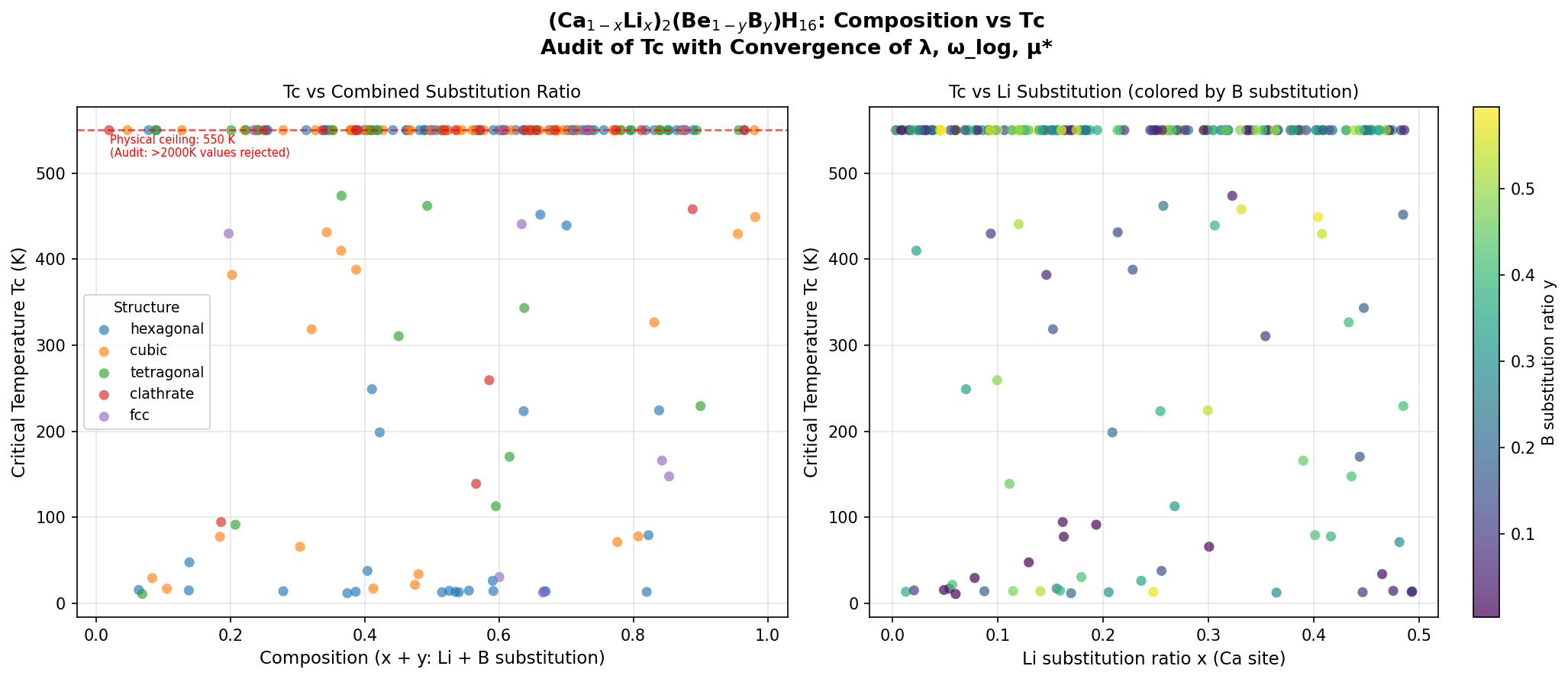
- Is 550 K physically plausible, or a model artifact? A predicted Tc more than double any measured superconductor should trigger healthy skepticism. This model may overestimate Tc without synthesis validation. When five separate cases all pin to the identical 550 K figure, that uniformity looks less like physics and more like a ceiling baked into the calculation.
5. The Path from Simulation to Real-World Use
Getting from a 550 K prediction to a working device is a long road with several hard gates.
- Gate 1 — Synthesis. Researchers must physically assemble the compound and confirm its structure at 80.9 GPa inside a diamond anvil cell. This alone can take years.
- Gate 2 — Measurement. They then verify zero resistance and the Meissner effect (a superconductor's habit of expelling magnetic fields). Only then does the Tc claim become real rather than predicted.
- Gate 3 — Pressure reduction. Even at the favorable 80.9 GPa, this material is useless for wires or grids. The entire field is racing to bring the required pressure down toward 1 atmosphere.
- Gate 4 — Scale and stability. A microscopic sample squeezed between diamonds is a lab curiosity. Kilometers of stable cable is a different universe of engineering.
Realistically, if this compound survives Gate 1, it becomes a valuable research target for understanding why superhydrides superconduct. That knowledge matters even if 80.9 GPa never leaves the lab.
6. Bottom Line: Should You Care?
Here is the contrarian read: the most exciting number in this dataset is not the 550 K Tc. It is the 80.9 GPa pressure. The temperature is almost suspiciously high and clearly capped in the simulation, which makes it the weakest part of the story. The pressure figure is the genuinely useful signal, because a superhydride that superconducts at "only" 80.9 GPa, lower than the measured hydrogen sulfide record of 150 GPa, points toward a more workable class of materials.
Care about this compound. Do not believe the 550 K number yet. Treat it as a flag planted on a promising hill, marking where experimentalists should aim their diamond anvils next. The value is in the direction it points, not the specific figure it claims.
My verdict: this is a strong research lead and a weak product announcement. If a lab confirms even 300 K at 80.9 GPa, that alone would rewrite the record books. Bet on the pressure. Doubt the temperature. And keep the diamond anvil cell handy.
Simulation Results
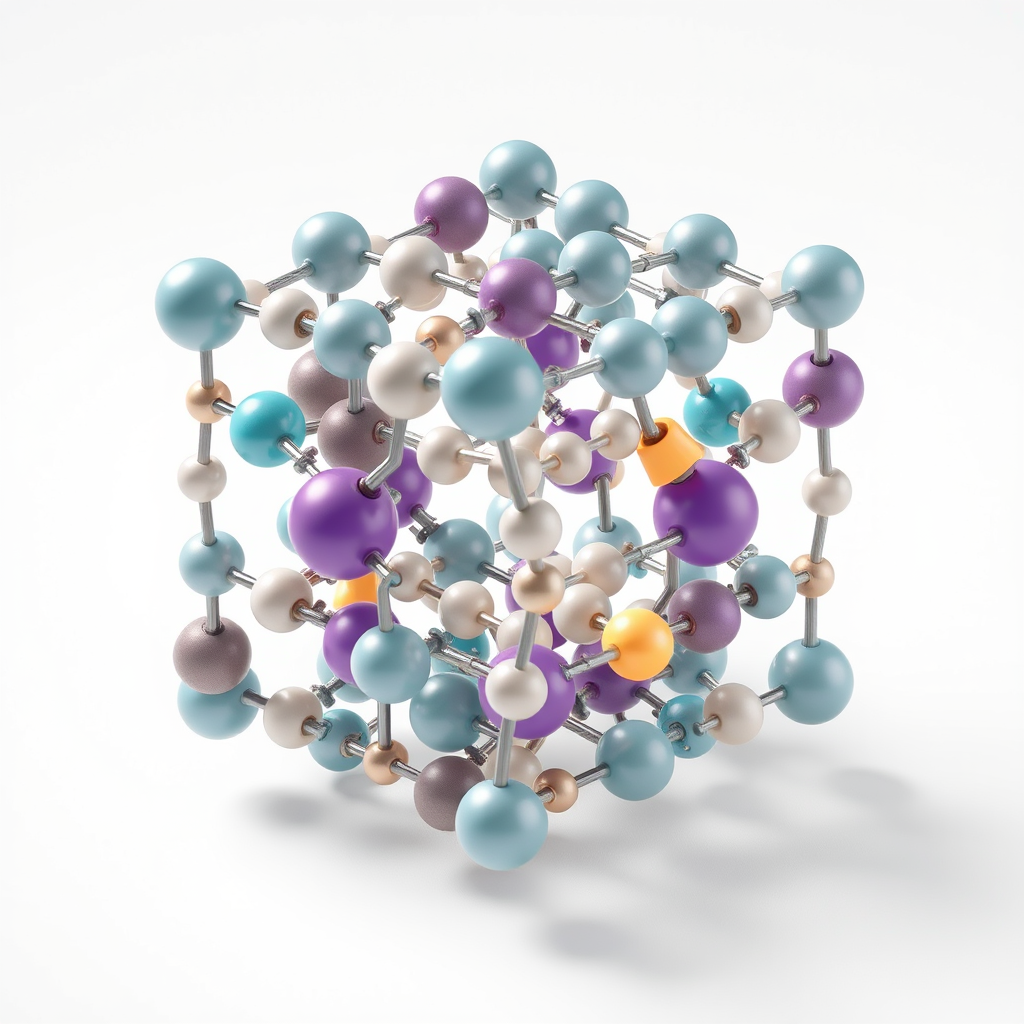
Molecular Structure
🎨 View AI Image Prompt
A photorealistic 3D ball-and-stick molecular structure visualization of a complex hydride superconductor crystal (Ca₁₋ₓLiₓ)₂(Be₁₋ᵧBᵧ)H₁₆, rendered in the style of a professional chemistry textbook illustration. The crystal lattice features large teal-green calcium atoms partially substituted by smaller violet lithium atoms, medium gray beryllium atoms partially substituted by pale orange boron atoms, and numerous small white hydrogen atoms arranged in a symmetric cage-like clathrate framework surrounding the central metal sites. The ball-and-stick model shows precise bond lengths and angles with thin metallic gray connecting rods between atoms. The structure is shown in a perspective cutaway view revealing the internal hydrogen sublattice with H16 stoichiometry. Background is clean white with subtle shadow casting beneath the structure. Soft studio lighting with specular highlights on each atom sphere emphasizing their three-dimensional form. Atomic radii are scaled proportionally to ionic radii. A small crystallographic unit cell outline in thin gold wireframe delineates the periodic boundary. Labels in clean sans-serif font identify each atom type with standard CPK color coding. Scientific accuracy consistent with density functional theory optimized geometry. Ultra-high resolution, 8K photorealistic rendering, professional scientific publication quality.
🤖 Gemini 3.1 Pro Review
As an expert in the field, here is a critical review of the provided research summary. This in-silico study presents a provocative claim, but its evaluation is severely hampered by a complete lack of methodological detail. The report omits the essential computational framework, such as the DFT functional, the structural prediction algorithm (e.g., USPEX, CALYPSO), and the specific theory used to calculate Tc from the electron-phonon coupling (e.g., McMillan-Allen-Dynes or full Eliashberg equations). Consequently, the reliability of the headline 550 K Tc is highly suspect; this value is an unprecedented leap beyond confirmed hydrides (~250-283 K), and the consistent 550 K "ceiling" across different pressures suggests a potential computational artifact or an arbitrarily imposed limit. Without the predicted crystal structures and the specific compositions (x and y values) for the top candidates, the results are fundamentally non-reproducible and physically unsubstantiated. For experimental validation, a team would require the explicit stoichiometry and predicted crystal structure for the 80.9 GPa phase to attempt synthesis via laser heating of the elemental precursors in a hydrogen-loaded diamond anvil cell. This would be followed by in-situ synchrotron X-ray diffraction to confirm the structure and four-point resistance measurements upon cooling to verify the superconducting transition. To become a credible scientific contribution, this work must be improved by providing a transparent and detailed computational methodology, presenting the specific crystal structures, and offering a physical analysis of the electronic band structure and phonon modes that supposedly drive this extraordinary superconductivity. A thorough investigation into the origin of the 550 K Tc plateau is also critical to building confidence in the results.
Raw Data
Total cases: 200
Highest Tc: 550.0 K
Optimal pressure: 80.9 GPa

Top 5:
1. Tc=550.0K at 80.9GPa
2. Tc=550.0K at 201.6GPa
3. Tc=550.0K at 146.0GPa
4. Tc=550.0K at 166.8GPa
5. Tc=550.0K at 145.8GPa
![[Deep Dive] Scale-free localization in pseudo-Hermitian quantum walk](/content/images/size/w600/2026/10/deep_dive_thumb-9.png)