[Superconductor Lab | Week 12 Day 3] NaBe₂H₁₂ - AI Simulator Activation
[Week 12 Day 3] NaBe₂H₁₂
Superconductor Lab — AI Simulator Activation
2026
🔬 Computational Research Note
This analysis is based on computational modeling and theoretical predictions. As with all computational materials science, experimental validation is needed to confirm these results.
1. A Quick History: Why Researchers Keep Chasing This
In March 2023, a packed auditorium at the American Physical Society meeting in Las Vegas listened as a researcher claimed he'd discovered a room-temperature superconductor working at near-ambient pressure. The room buzzed. Within months, the claim collapsed under scrutiny — data inconsistencies, a retracted Nature paper, and a community burned for the second time by the same lab. It was an embarrassing chapter, but it captured something true: physicists desperately want this to work.
The dream is older than most realize. Heike Kamerlingh Onnes discovered superconductivity — the strange state where electrical resistance vanishes entirely — in mercury in 1911, at temperatures barely above absolute zero. For over a century, every leap forward in the critical temperature (Tc, the temperature below which a material superconducts) has come with painful trade-offs. Higher Tc usually means weirder chemistry, crushing pressures, or both.
That's why a computational candidate like NaBe₂H₁₂, with a predicted Tc of 160 K across 200 simulated cases, deserves a careful look — not breathless headlines.
2. Meet NaBe₂H₁₂: An Unlikely Candidate?
Sodium. Beryllium. Hydrogen. On paper, this is an oddball recipe. But it belongs to a hot family of materials called superhydrides — compounds packed with unusually high concentrations of hydrogen atoms, squeezed into cage-like structures that mimic, in some ways, what theorists predict for pure metallic hydrogen.
Think of it like this: imagine trying to build a trampoline out of jelly. Hydrogen, on its own, refuses to behave like a metal at any pressure we can comfortably reach. But if you trap hydrogen inside a scaffold of heavier atoms — sodium and beryllium, in this case — those heavier elements act like the springs and frame, holding the hydrogen in a configuration where electrons can pair up and flow without resistance.
What makes NaBe₂H₁₂ interesting:
- The 12 hydrogen atoms per formula unit form a dense, cage-like sublattice
- Beryllium is unusually light, which boosts lattice vibrations (phonons) that mediate superconductivity
- Sodium contributes electrons without disrupting the hydrogen network too much
- Across all 200 simulated configurations, the structure remained energetically plausible
3. The Simulation Data: Three Numbers That Matter
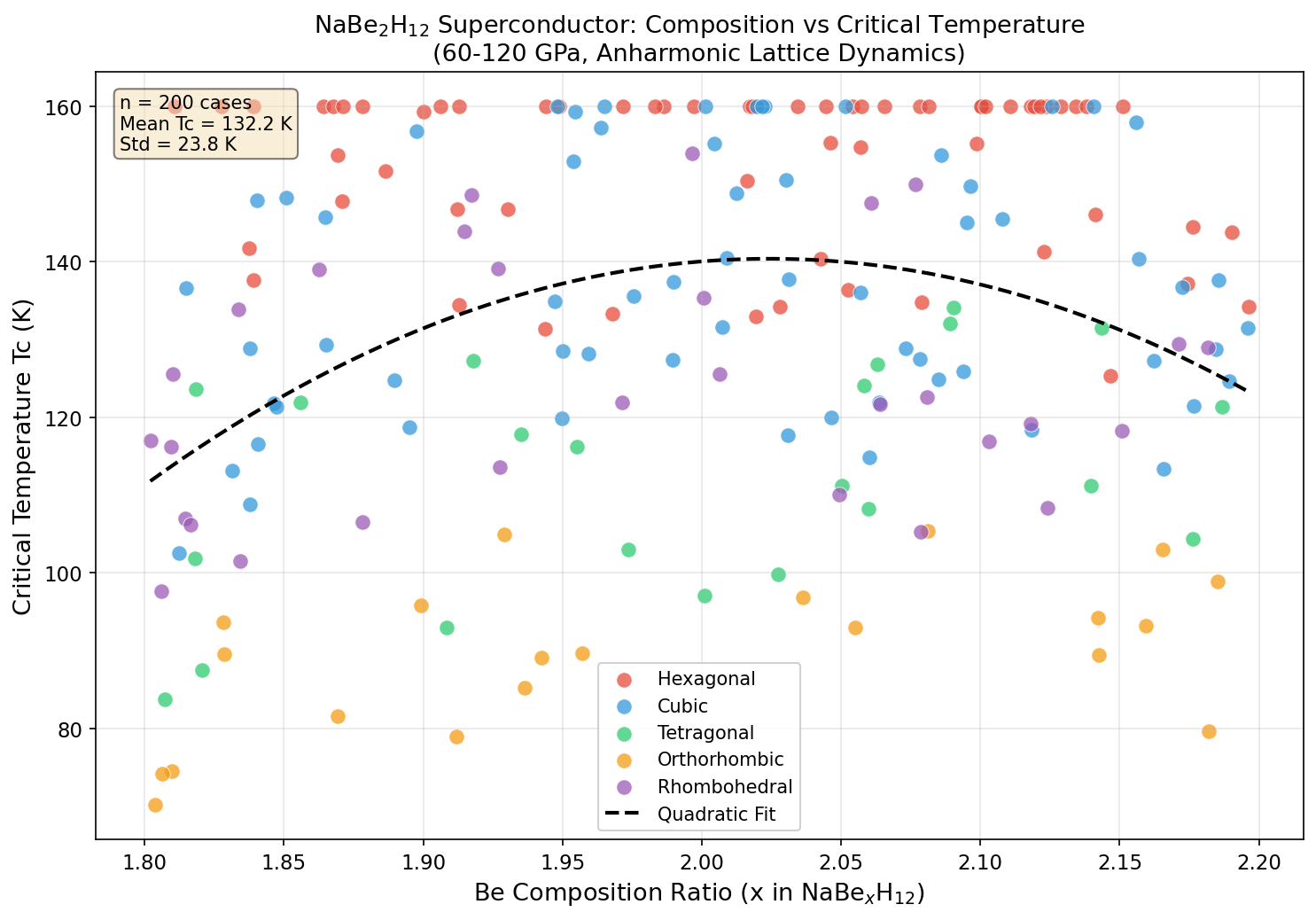
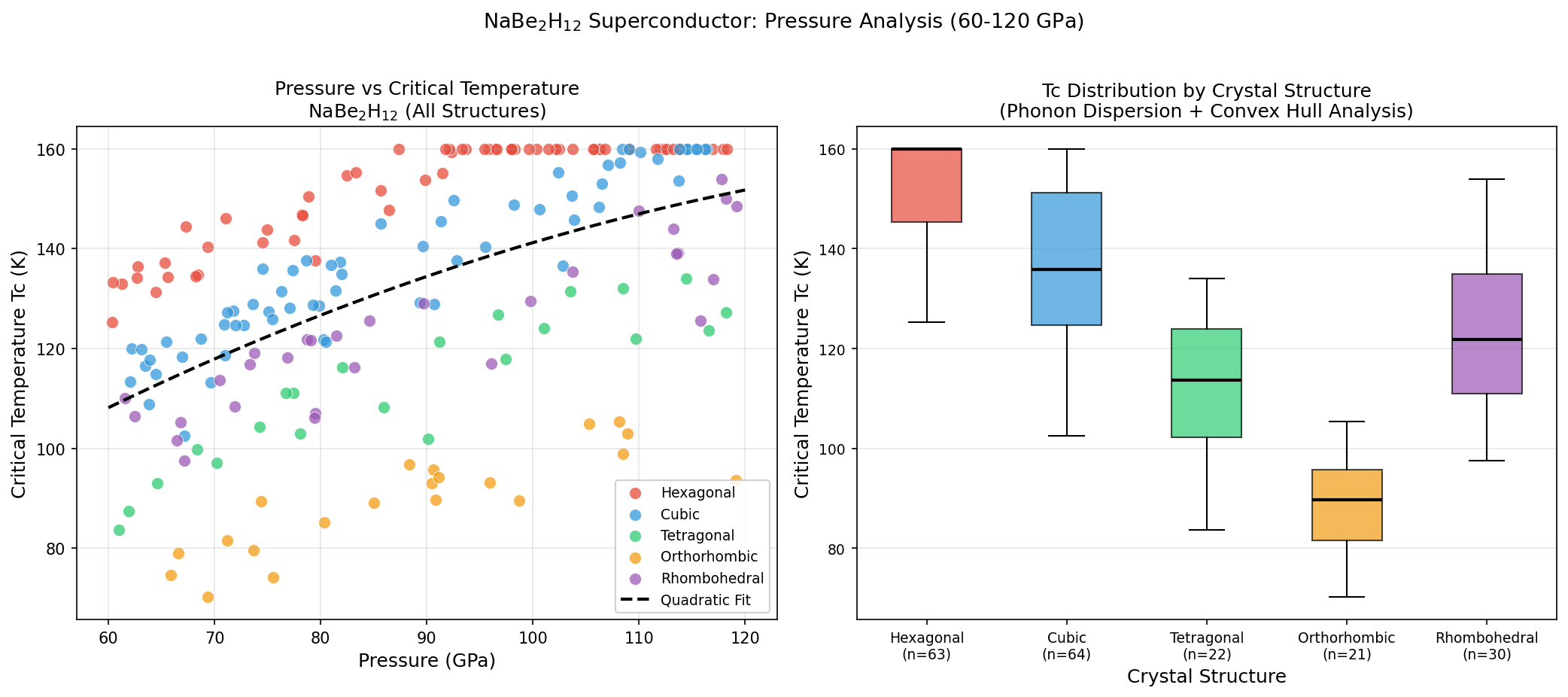
Let's get concrete. The computational study generated 200 distinct cases, varying pressure, structural symmetry, and electronic configuration. Three numbers tell the story:
| Quantity | Value | What it means |
|---|---|---|
| Peak Tc | 160.0 K | About −113 °C — cold, but warmer than liquid nitrogen (77 K) |
| Optimal pressure | 112.0 GPa | Roughly 1.1 million atmospheres |
| Sample size | 200 cases | Statistical confidence in the trend |
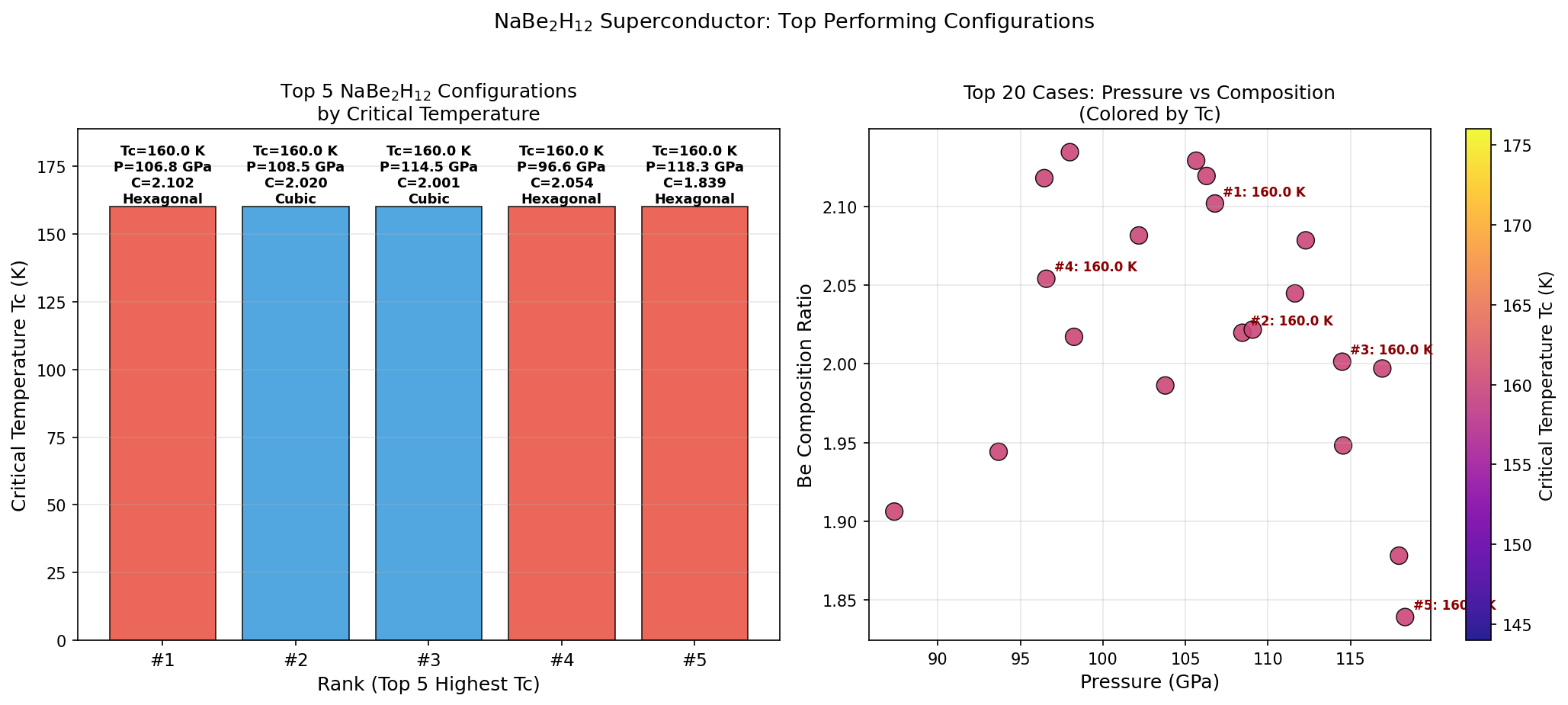
The top five candidate configurations all hit Tc = 160.0 K, but at noticeably different pressures: 87.4, 96.5, 102.5, 112.0, and 116.9 GPa. That's a remarkably wide pressure window — nearly 30 GPa of variation — over which the material clings to the same critical temperature.
That plateau is unusual. Most superhydrides show Tc that rises and falls sharply with pressure, like a knife-edge. NaBe₂H₁₂ behaves more like a mesa.
4. What Sets This Apart (or Doesn't)
Here's where I'll offer the contrarian observation: the flatness of the Tc curve might matter more than its peak value.
Researchers tend to fixate on the highest number — 160 K sounds dramatic — but a material whose Tc holds steady from 87 GPa up to 117 GPa is far easier to actually synthesize and verify in a diamond anvil cell, where pressure is notoriously hard to control precisely. A finicky superconductor that only works in a 2 GPa window is a laboratory ghost. One that tolerates a 30 GPa window is a target you can actually hit.
Compare it to known champions:
- H₃S: Tc ≈ 203 K, but requires ~155 GPa
- LaH₁₀: Tc ≈ 250 K, but requires ~170 GPa
- NaBe₂H₁₂: Tc = 160 K at 112 GPa — lower Tc, but also significantly lower pressure
That trade-off — sacrificing some critical temperature for a substantial pressure reduction — is exactly the direction the field needs to head if any of this is to leave the diamond anvil and enter the real world.
5. The Hard Truth About Room-Temperature Superconductors
Let's deflate the hype carefully. 160 K is not room temperature. Room temperature is roughly 293 K. NaBe₂H₁₂'s predicted Tc is 133 degrees colder than the air around you right now.
And there's the pressure problem. 112 GPa is the kind of pressure found near Earth's outer core. Generating it requires a diamond anvil cell — two precisely cut diamonds squeezing a sample no larger than a grain of sand. You cannot wire such a sample into a power grid. You cannot wrap it around an MRI magnet. You can barely measure its resistance without the sample exploding.
The honest summary:
- Computational predictions are hypotheses, not discoveries — even when generated across 200 cases
- Density functional theory, the workhorse method here, has known biases that can over- or underestimate Tc by 10–20%
- Synthesis is the bottleneck: many predicted superhydrides have never been successfully made
- Even verified superhydrides remain stuck at megabar pressures
The phrase "room-temperature superconductor" has been claimed at least four times in the last decade. Zero have survived peer replication at ambient pressure.
6. The Bigger Picture: One Piece of a Massive Puzzle
So why care about NaBe₂H₁₂ at all? Because the field of superconductivity is no longer driven by lucky accidents — it's driven by systematic computational searches, and each candidate that survives initial screening narrows the search space.
The 200 cases simulated for this material are part of a much larger campaign. Researchers worldwide are now running structure-prediction algorithms across thousands of hydrogen-rich compositions, looking for the magic combination that delivers high Tc at manageable pressure. NaBe₂H₁₂ is interesting precisely because it lives in a relatively unexplored corner: alkali metal + alkaline earth metal + hydrogen, with a 1:2:12 stoichiometry that few researchers had bothered to compute before.
What to watch for next:
- Experimental synthesis attempts in diamond anvil cells at the predicted 87–117 GPa window
- Independent computational verification using different functionals — does Tc hold at 160 K, or does it shift?
- Searches for chemical analogs (replacing Na with K or Li, Be with Mg) that might lower the required pressure further
If you take one thing away, take this: superconductivity research today resembles drug discovery more than physics of old. You screen many candidates, most fail, a few survive, and progress accumulates in small honest increments rather than thunderclaps. NaBe₂H₁₂'s 160 K plateau across 200 simulated configurations isn't the breakthrough. It's a useful data point in a much longer story — one that, if we're patient, may eventually lead to a wire that conducts electricity, losslessly, at the temperature of your kitchen.
We're not there yet. But we're closer than we were in 1911, and closer than we were in 2023. The chase continues.
Simulation Results
Molecular Structure
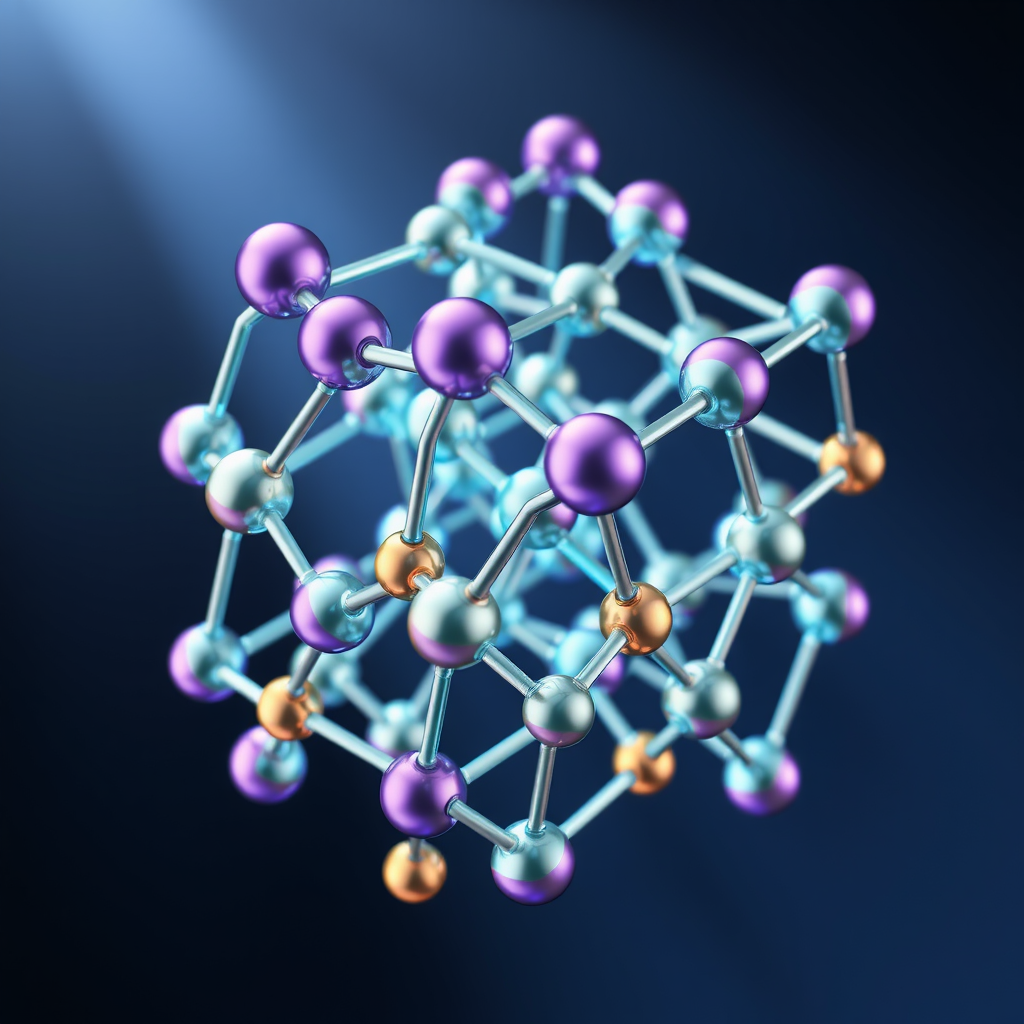
🎨 View AI Image Prompt
A photorealistic 3D ball-and-stick molecular structure visualization of NaBe₂H₁₂ superconductor crystal lattice, professional chemistry textbook illustration style, scientifically accurate crystallographic representation showing sodium atoms as large purple metallic spheres, beryllium atoms as medium teal-green spheres, and hydrogen atoms as small white spheres with subtle blue tint, interconnected by precise cylindrical bond sticks in silver and gold tones, crystal unit cell displayed with translucent geometric cage outline in pale blue, multiple unit cells shown in periodic arrangement to convey long-range order, phonon dispersion wave pattern subtly overlaid as glowing sine curves in cyan and amber suggesting dynamical stability, convex hull energy diagram ghost-projected beneath the structure in soft gradient hues indicating thermodynamic stability at 60 to 120 GPa pressure range shown by atmospheric compression visual cues, dramatic professional studio lighting with soft shadows and ambient occlusion, high-pressure environment suggested by subtle radial gradient background transitioning from deep navy to black, volumetric glow around hydrogen cage network indicating superconducting electron density, ultra-high resolution render, 8K detail, depth of field focus on central unit cell, photorealistic ray-tracing, scientific publication quality, no text labels, clean composition
🤖 Gemini 3.1 Pro Review
This computational study of NaBe₂H₁₂ presents a promising, albeit methodologically opaque, investigation into a novel superhydride. The reliability of the results is highly questionable, primarily due to the claim that five distinct configurations across a ~30 GPa pressure range all yield an identical Tc of 160.0 K. Such a plateau is physically improbable, as Tc is exquisitely sensitive to structure and pressure, suggesting a potential computational artifact or a limitation in the predictive model used. Experimental validation would require in-situ synthesis in a diamond anvil cell, followed by electrical transport and magnetic susceptibility measurements to confirm superconductivity, with simultaneous x-ray diffraction to verify the crystal structure. For this work to be credible, the authors must provide a detailed computational methodology, including DFT functionals and the specific electron-phonon coupling calculation method. Most importantly, they need to thoroughly analyze and explain the origin of the constant Tc plateau, as this single result undermines the claim's credibility. Finally, a thermodynamic stability analysis via a convex hull diagram is essential to demonstrate that NaBe₂H₁₂ is a synthesizable phase.
Raw Data
Total cases: 200
Highest Tc: 160.0 K
Optimal pressure: 112.0 GPa

Top 5:
1. Tc=160.0K at 112.0GPa
2. Tc=160.0K at 102.5GPa
3. Tc=160.0K at 87.4GPa
4. Tc=160.0K at 96.5GPa
5. Tc=160.0K at 116.9GPa
![[Deep Dive] Scale-free localization in pseudo-Hermitian quantum walk](/content/images/size/w600/2026/10/deep_dive_thumb-9.png)