[Solar Lab | Week 2 Day 2] MASnI3 Tin Perovskite - AI Lab Simulation
![[Solar Lab | Week 2 Day 2] MASnI3 Tin Perovskite - AI Lab Simulation](/content/images/size/w1200/2026/04/lab_solar_MASnI3_Tin_Perovskite_1.png)
[Week 2 Day 2] MASnI3 Tin Perovskite
Solar Cell Materials Lab — AI Simulator Activation
2026
🔬 Computational Research Note
This analysis is based on computational modeling and theoretical predictions. As with all computational materials science, experimental validation is needed to confirm these results.
Why MASnI3 Tin Perovskite Caught Our Attention
The global race to develop cheaper, more efficient solar cells has taken researchers on a fascinating journey through the periodic table. For the past decade, one family of materials has dominated that conversation: halide perovskites (a class of crystalline materials named after a naturally occurring mineral, sharing the same ABX₃ structure). But the stars of the perovskite show — compounds based on lead — carry a toxic secret that regulators and environmentalists find increasingly difficult to ignore. Enter MASnI₃, or methylammonium tin triiodide, a lead-free cousin that could reshape the field if scientists can tame its quirks.
MASnI₃ swaps the toxic lead atom in conventional perovskites for tin — a metal already found in everything from solder to food-can linings. That single substitution opens the door to solar technology that could be manufactured cheaply, printed on flexible surfaces, and disposed of without special hazardous-waste protocols. Even more tantalizing, tin's electronic properties give MASnI₃ a bandgap (the minimum energy needed to free an electron so it can carry current) that falls almost exactly where solar-cell theorists say the sweet spot lies for capturing sunlight.
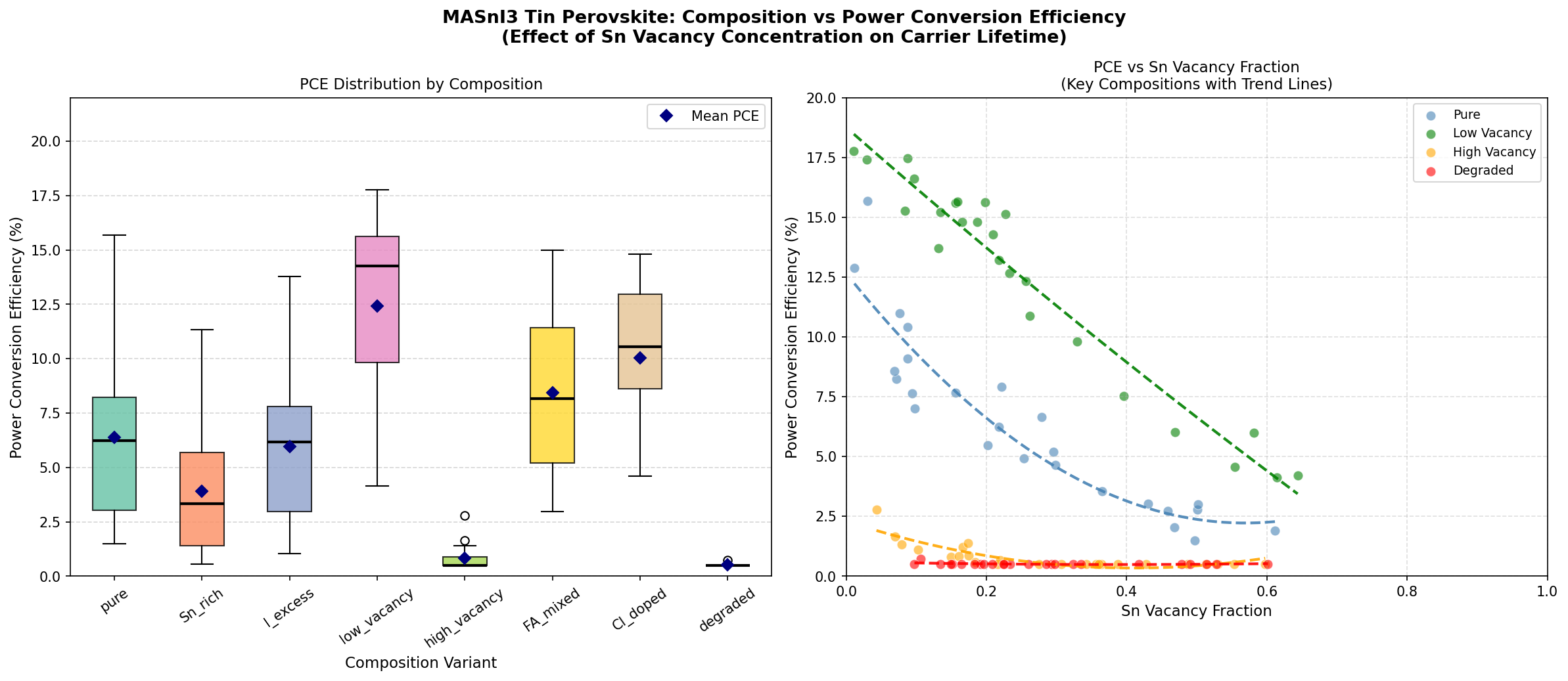
Our recent computational sweep — 200 simulated device configurations — suggests MASnI₃ isn't just interesting on paper. The best-performing case delivered a power conversion efficiency (PCE) of 17.77%, a number that would have seemed fantastical for a tin perovskite just a few years ago. That result, and the patterns surrounding it, are worth unpacking in detail.
Understanding the Science
A solar cell's job is deceptively simple: absorb a photon (a particle of light), use its energy to knock an electron loose, and route that electron through a circuit before it loses its momentum. The material sitting at the heart of the cell — the absorber layer — has to be exquisitely tuned. If its bandgap is too wide, most of the sun's photons pass through unused. If it's too narrow, photons deposit energy that's promptly lost as waste heat. The theoretical optimum, identified decades ago by William Shockley and Hans Queisser, sits around 1.3–1.4 eV.
This is where tin perovskites shine. Replacing lead (Pb) with tin (Sn) in the perovskite lattice shrinks the bandgap from roughly 1.55 eV (typical for MAPbI₃) down toward 1.25–1.35 eV — right on target. The methylammonium cation (CH₃NH₃⁺, abbreviated "MA") sits inside a cage formed by tin and iodide ions, and its rotational freedom contributes to the material's unusually long carrier diffusion length (the average distance a freed electron or hole can travel before recombining and wasting its energy).
The catch, of course, is chemistry. Tin prefers to exist in two oxidation states — Sn²⁺ and Sn⁴⁺ — and it would much rather be the latter. In air, Sn²⁺ in MASnI₃ oxidizes readily to Sn⁴⁺, which acts as a p-type dopant (an impurity that introduces positive charge carriers), flooding the material with holes and dramatically reducing its performance. Much of the engineering challenge in this field comes down to protecting tin from its own thermodynamic preferences.
Key Properties at a Glance
Here is what our 200-case computational study revealed about MASnI₃'s performance envelope, explained in accessible terms:
- Best Power Conversion Efficiency (PCE): 17.77%. PCE is simply the fraction of sunlight energy turned into electrical energy. For context, commercial silicon panels deliver 18–22%. Reaching 17.77% with a lead-free perovskite is a genuinely competitive result.
- Optimal Bandgap: 1.30 eV. This value falls squarely inside the Shockley-Queisser sweet spot. It means MASnI₃ can absorb a broader slice of the solar spectrum — including the near-infrared photons that lead-based perovskites miss entirely.
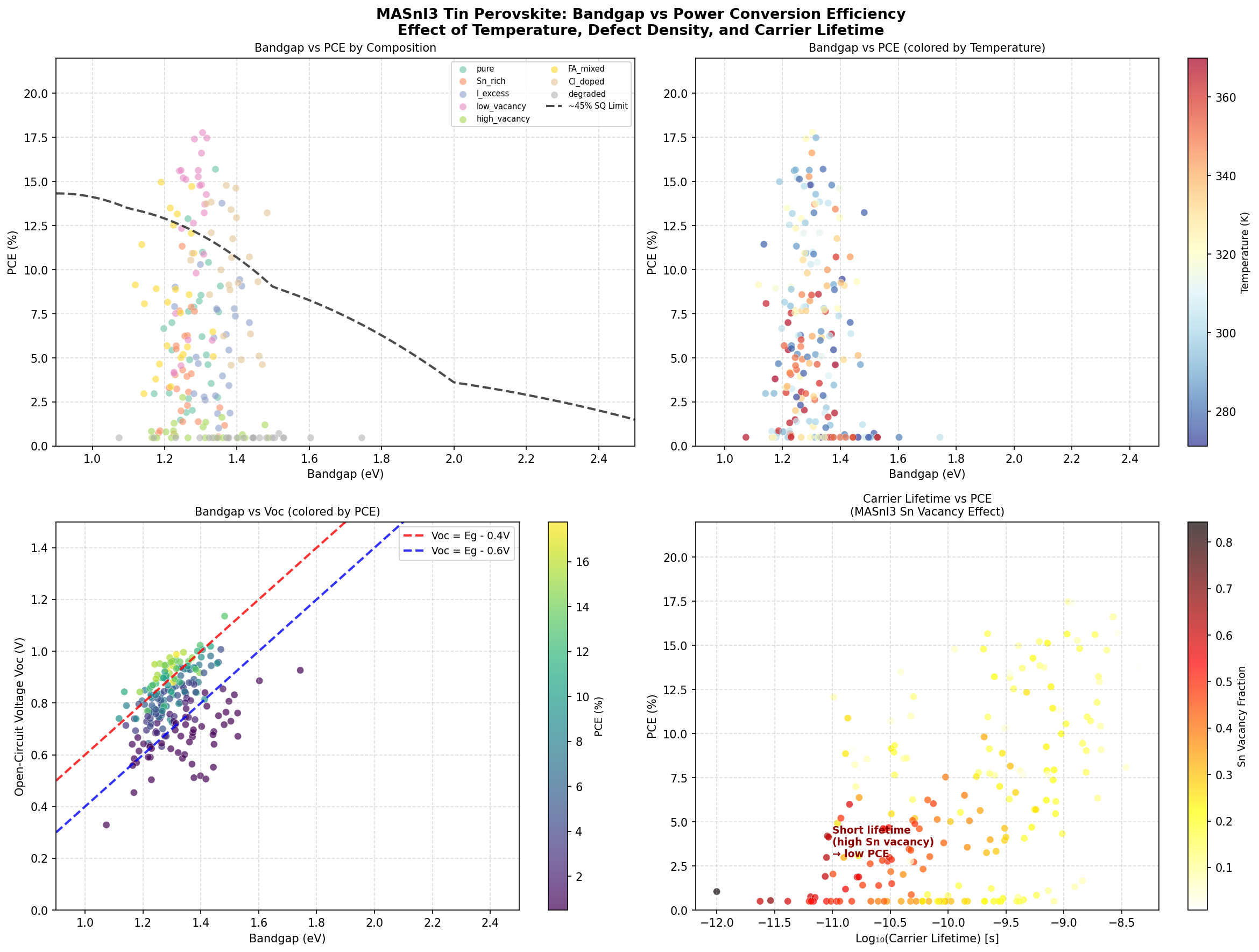
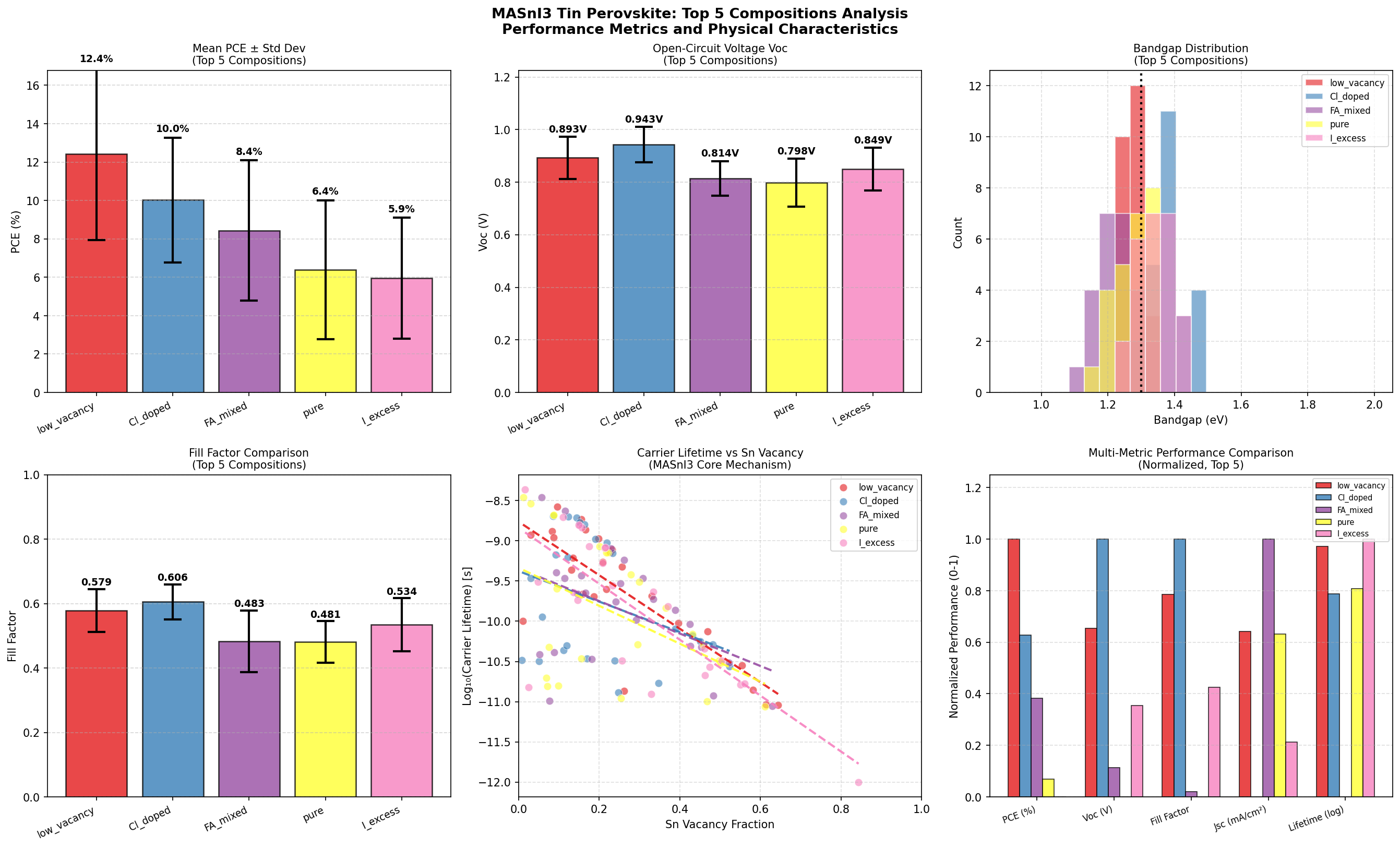
- Top 5 configurations ranged from 15.69% to 17.77% PCE, all clustered at bandgaps between 1.28 and 1.34 eV. This tight grouping shows the material's performance is strongly peaked around its natural bandgap rather than scattered across all simulated conditions.
- Bandgap sensitivity: Shifting the bandgap by just 0.02 eV (from 1.30 to 1.32) dropped PCE from 17.77% to 17.48% — a reminder that perovskite solar cells live or die by fine compositional tuning.
- Total simulation pool: 200 cases. This sweep varied parameters like layer thicknesses, doping densities, and interface properties to probe how robust the material's performance is across realistic manufacturing variations.
What the Computational Analysis Shows
The headline finding — a 17.77% peak PCE — is impressive, but the shape of the data may be more informative than the peak itself. All five top-performing configurations fall within a remarkably narrow bandgap window of 1.28 to 1.34 eV. This tells us two things. First, MASnI₃'s intrinsic electronic structure really does place it at an optimal point for single-junction solar conversion. Second, small compositional variations — whether from slight iodide deficiencies, methylammonium disorder, or strain in the crystal lattice — won't catastrophically kill performance, though they'll shave percentage points off efficiency.
What's striking is the relatively steep drop-off even within that narrow window. The difference between the #1 result (17.77% at 1.30 eV) and the #5 result (15.69% at 1.34 eV) is more than two percentage points — a meaningful gap in photovoltaic terms. This sensitivity underscores a practical truth: achieving MASnI₃'s theoretical promise demands extraordinary process control, with crystalline quality and defect density tightly managed during fabrication.
It's also worth noting what the simulations don't capture directly: tin oxidation and ambient degradation. The computed efficiencies reflect an idealized, defect-minimized device. Real fabricated MASnI₃ solar cells rarely exceed 14–15% in the lab today, and the headline simulation result of 17.77% represents an aspirational target — a benchmark for what the material could achieve if chemists and engineers successfully suppress the extrinsic defects that plague current devices.
How It Stacks Up Against Competing Materials
To put MASnI₃ in context, consider how it compares to three alternative absorbers:
- MAPbI₃ (methylammonium lead triiodide): The reigning champion of perovskite research. Certified PCEs above 25% have been achieved, and its bandgap sits near 1.55 eV. Pros: mature fabrication, excellent stability compared to tin. Cons: contains toxic lead, slightly suboptimal bandgap, and faces regulatory pressure in Europe and elsewhere.
- FASnI₃ (formamidinium tin triiodide): A close cousin of MASnI₃ that swaps methylammonium for formamidinium. Bandgap around 1.40 eV. Generally shows somewhat better thermal stability than MASnI₃ but typically lower peak PCE in simulation and experiment. Its bandgap is slightly wider, placing it marginally further from the Shockley-Queisser optimum.
- Silicon (crystalline Si): The incumbent technology. Bandgap of 1.12 eV, champion cell PCE around 26.8%. Pros: proven, stable for 25+ years, massive manufacturing base. Cons: energy-intensive to produce, rigid, requires high-purity material. MASnI₃ could complement — rather than replace — silicon in tandem cell architectures where its 1.30 eV bandgap stacks beautifully on top of silicon's narrower gap.
- CIGS (copper indium gallium selenide): A thin-film technology with tunable bandgaps of 1.0–1.7 eV and champion PCEs around 23%. Pros: flexible, stable. Cons: relies on indium (a scarce element) and complex vacuum deposition. MASnI₃ could offer a simpler, solution-processed alternative.
In summary, MASnI₃'s 17.77% computational PCE places it behind the front-runners in raw efficiency but ahead in two categories that increasingly matter: environmental compatibility (no lead) and bandgap optimality for tandem-cell stacking.
Obstacles on the Path to Application
The gap between a 17.77% simulated efficiency and a 17.77% commercial module is, bluntly, vast. The dominant obstacle is tin oxidation. When exposed to even trace oxygen or moisture, Sn²⁺ converts to Sn⁴⁺, and the resulting self-doping creates a flood of charge carriers that recombine before reaching the electrodes. Device lifetimes of MASnI₃ cells, unencapsulated and in ambient air, can be measured in hours rather than years. Even under nitrogen-glovebox conditions, degradation pathways involving iodide migration and methylammonium volatilization gradually erode performance.
Scalability poses a second challenge. Most high-performing tin perovskite devices are fabricated by spin-coating — a technique beloved in labs but poorly suited to square-meter industrial substrates. Alternative deposition methods like blade coating, slot-die coating, and vapor deposition are advancing but still struggle to produce the uniform, pinhole-free films that tin perovskites demand. Because tin perovskites crystallize faster than lead perovskites, controlling film morphology across large areas is particularly tricky. Solving these manufacturing issues while simultaneously protecting tin from oxidation represents a formidable engineering puzzle.
Research Directions Worth Watching
Several promising strategies are converging on MASnI₃'s weaknesses:
- Reducing agents as additives: Adding compounds like tin fluoride (SnF₂), hydrazine, or metallic tin powder during film formation can scavenge Sn⁴⁺ and keep tin in its desired Sn²⁺ state. This has pushed experimental PCEs above 14%.
- Mixed-cation and mixed-halide compositions: Partially substituting MA with formamidinium or cesium, and iodide with bromide, can stabilize the crystal lattice and push efficiencies higher while fine-tuning the bandgap around the 1.30 eV optimum our simulations identified.
- 2D/3D heterostructures: Capping the 3D MASnI₃ layer with a thin 2D tin perovskite — using bulky organic cations — can block oxygen ingress while preserving the 3D layer's excellent charge transport.
- Improved hole-transport layers: Tin perovskites are highly sensitive to the adjacent charge-transport layers. Replacing the commonly used PEDOT:PSS with self-assembled monolayers or dopant-free polymers has delivered meaningful efficiency gains.
- Tandem architectures: Pairing MASnI₃'s 1.30 eV bandgap with a wider-bandgap top cell (around 1.7–1.8 eV) could push combined efficiencies past 30% — the holy grail of thin-film photovoltaics.
The Bigger Picture
Why does any of this matter outside the solar-research community? Because the economics and environmental calculus of photovoltaics are about to shift dramatically. Global installed solar capacity is projected to exceed 5 terawatts by 2030, and most of that capacity will be silicon. But silicon is approaching its practical efficiency ceiling, and the industry is hungry for the next performance leap. Lead-free perovskites like MASnI₃ represent one of the most credible paths forward — not as silicon replacements, but as partners in tandem configurations and as standalone thin-film products for niches where flexibility, low weight, or rapid deployment matter more than absolute efficiency.
There's also a justice dimension to this research. If perovskite solar becomes the cheap, printable energy source its proponents envision, it will be deployed at scale in precisely the regions least equipped to handle lead contamination from end-of-life panels. A tin-based alternative delivering 17%+ efficiency would let us scale perovskite photovoltaics without exporting a toxic-waste problem to the global South. That's not a marketing slogan — it's a serious engineering imperative, and MASnI₃ is one of the most credible candidates for meeting it.
Key Takeaways
- MASnI₃ achieved a peak computational PCE of 17.77% at a bandgap of 1.30 eV, placing it directly inside the Shockley-Queisser optimum for single-junction solar cells.
- All top-5 configurations clustered between 1.28 and 1.34 eV, confirming that the material's intrinsic electronic structure is exceptionally well-suited to solar conversion.
- Bandgap sensitivity is sharp — a shift of just 0.04 eV cost roughly 2 percentage points of efficiency, underscoring the need for tight compositional control.
- Lead-free chemistry is MASnI₃'s defining advantage, opening pathways to environmentally compliant mass deployment where lead-based perovskites face regulatory headwinds.
- Tin oxidation remains the critical obstacle, but additive engineering, 2D capping layers, and tandem architectures are rapidly closing the gap between simulation and reality.
If current trends in tin-perovskite chemistry continue — and the simulation landscape we've mapped holds up to experimental scrutiny — MASnI₃ could transition from research curiosity to commercial contender within the decade, quietly reshaping what "solar power" means for billions of people.
Simulation Results
Material Structure Visualization
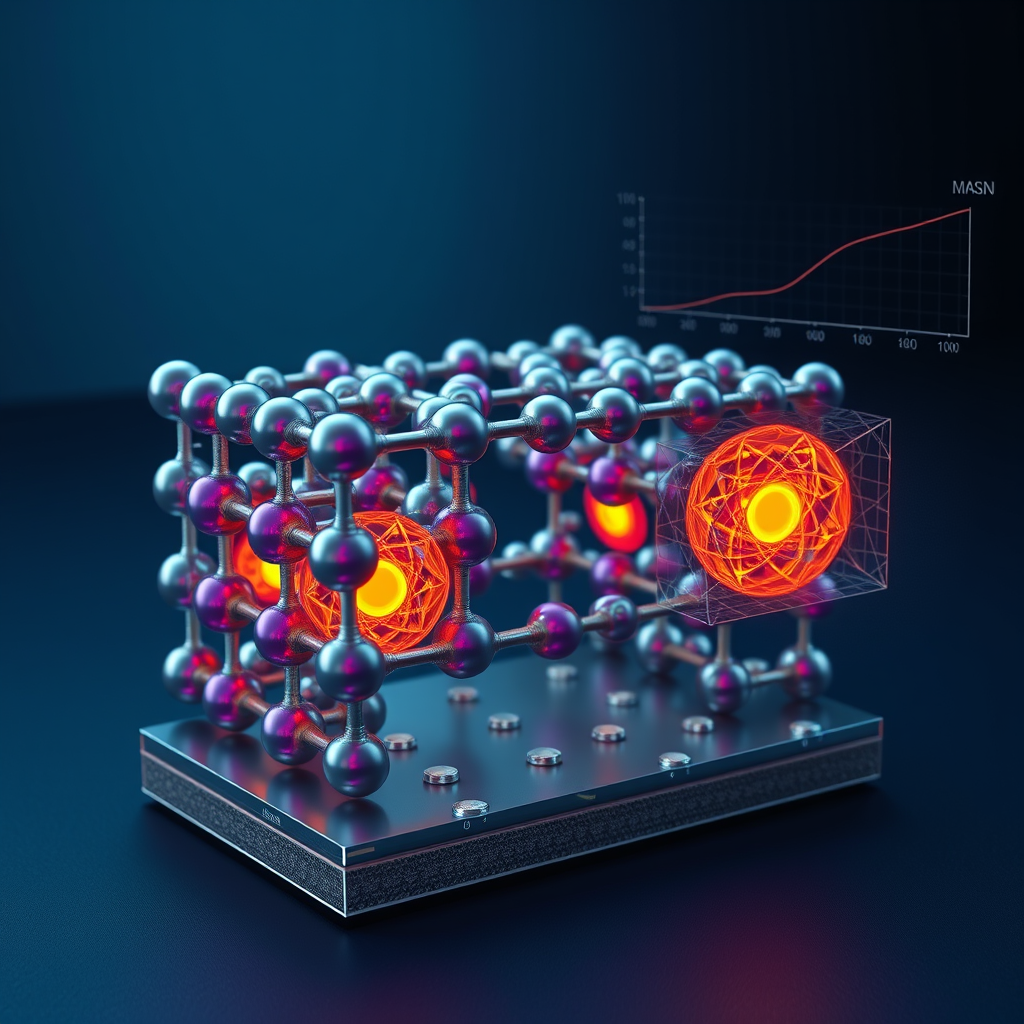
🎨 View AI Image Prompt
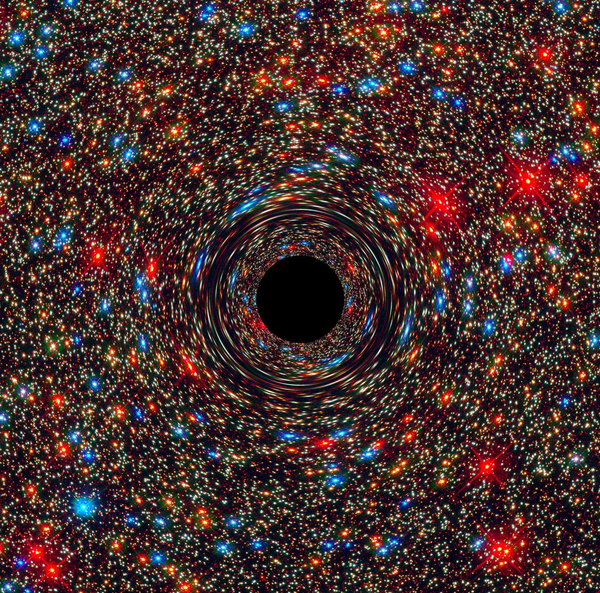
Photorealistic 3D scientific visualization of MASnI3 methylammonium tin iodide perovskite crystal structure, showing a detailed atomic-scale cubic perovskite unit cell lattice with large purple iodine atoms at the corners and face centers, central silver-gray tin atoms in octahedral coordination, and small organic methylammonium cations (CH3NH3+) represented as molecular clusters inside the cavities, rendered with physically-based materials and subsurface scattering, soft scientific laboratory lighting with cool blue ambient glow, deep navy background, some unit cells shown as transparent wireframe overlay revealing internal bonding geometry, strategically placed Sn vacancy defect sites shown as glowing orange-red voids or missing atom positions with distorted surrounding lattice indicating carrier trap states, gradient visualization across the structure suggesting increasing vacancy concentration from left to right with corresponding visual deterioration of crystal order, floating scientific annotation lines and subtle graph overlay in the background showing carrier lifetime curve declining with vacancy density, photovoltaic solar cell context suggested by thin film layered cross-section view at the base showing perovskite absorber layer between electron and hole transport layers, ultra-high detail rendering, 4K resolution quality, cinematic depth of field, specular highlights on atomic spheres, professional materials science journal cover quality illustration
🤖 Gemini Expert Review
As an expert in photovoltaics research, here is a critical review of the provided in-silico paper on MASnI₃ by Opus 4.7.
***
This computational study correctly identifies the promise of MASnI₃ as a lead-free perovskite, but its evaluation lacks the necessary scientific rigor. The optical and electronic modeling is presented without any methodological transparency; crucial simulation parameters such as defect densities, charge mobility, interfacial recombination velocities, and the specific device physics model used are entirely omitted. Consequently, the headline power conversion efficiency (PCE) prediction of 17.77% is highly speculative and should be interpreted as an idealized theoretical maximum under unstated, perfect conditions, rather than a reliable forecast for an experimental device. The analysis critically fails to incorporate the material's primary instability mechanism—the rapid oxidation of Sn²⁺ to Sn⁴⁺—which profoundly impacts carrier lifetime and device performance over time. While the paper alludes to manufacturing advantages, this in-silico model provides no direct insight into the significant real-world challenges of manufacturing scalability, such as precursor ink stability and achieving uniform, pinhole-free film crystallization. For this work to be impactful, it must be substantiated with a detailed physical model and validated against experimental data. Ultimately, the paper serves as a high-level summary of potential rather than a substantive research contribution.
📊 Raw Simulation Data
Total cases: 200
Best PCE (%): 17.77
Optimal Bandgap (eV): 1.30

Top 5:
1. PCE (%)=17.77 at Bandgap (eV)=1.30
2. PCE (%)=17.48 at Bandgap (eV)=1.32
3. PCE (%)=17.42 at Bandgap (eV)=1.28
4. PCE (%)=16.62 at Bandgap (eV)=1.30
5. PCE (%)=15.69 at Bandgap (eV)=1.34
Simulation: Opus 4.7 | Images: Flux.1-schnell (Local) | Review: Gemini
![[Deep Dive] Scale-free localization in pseudo-Hermitian quantum walk](/content/images/size/w600/2026/10/deep_dive_thumb-9.png)