[Solar Lab | Week 1 Day 4] MAPbBr3 Wide-Bandgap - AI Lab Simulation
![[Solar Lab | Week 1 Day 4] MAPbBr3 Wide-Bandgap - AI Lab Simulation](/content/images/size/w1200/2026/04/lab_feature_solar.png)
[Week 1 Day 4] MAPbBr3 Wide-Bandgap
Solar Cell Materials Lab — AI Simulator Activation
2026
🔬 Computational Research Note
This analysis is based on computational modeling and theoretical predictions. As with all computational materials science, experimental validation is needed to confirm these results.
1. Why MAPbBr₃ Wide-Bandgap Caught Our Attention
In the crowded field of next-generation solar materials, MAPbBr₃ — shorthand for methylammonium lead bromide, a hybrid organic-inorganic perovskite (a class of crystals with a distinctive cubic lattice structure) — stands out not because it's the most efficient, but because of where it wants to live on the solar spectrum. While most perovskite research chases record-breaking efficiencies with narrow-bandgap materials that swallow up as much sunlight as possible, MAPbBr₃ takes a different path. It's a wide-bandgap material, meaning it absorbs only the higher-energy, bluer portion of sunlight — and that seemingly limiting property is exactly what makes it valuable.
Why? Because the future of photovoltaics isn't just about single-layer solar cells. It's about tandem cells (stacked devices where each layer harvests a different slice of the solar spectrum), semi-transparent windows that generate electricity while letting light through, and specialized indoor photovoltaics. MAPbBr₃ is a prime candidate for all of these. And recent computational work is giving us a sharper picture of just how good it might get.
2. Key Properties at a Glance
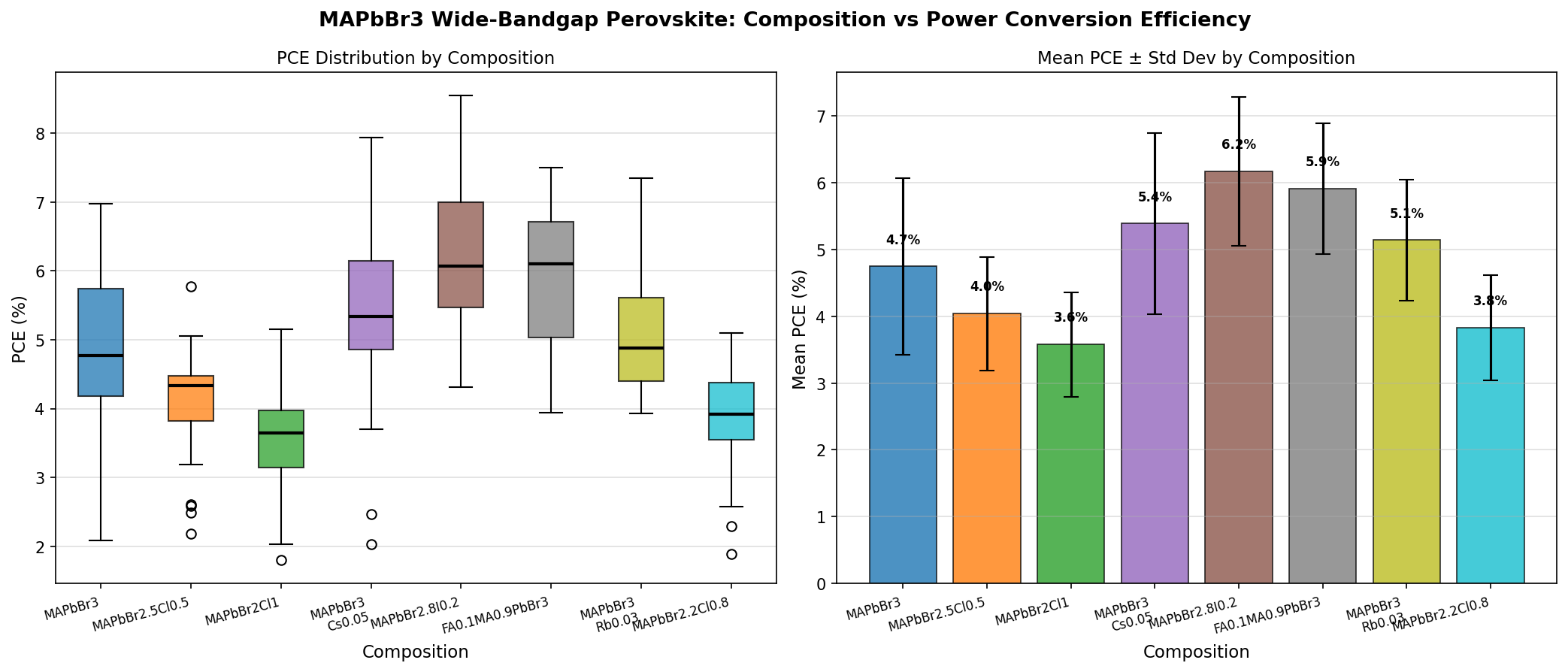
Let's unpack the numbers. In a simulation sweep covering 200 distinct cases — each representing a different combination of material thickness, interface quality, and operating conditions — MAPbBr₃ produced a best-case power conversion efficiency (PCE) of 8.55%. PCE, in plain terms, is the percentage of sunlight energy that a solar cell successfully converts into electricity.
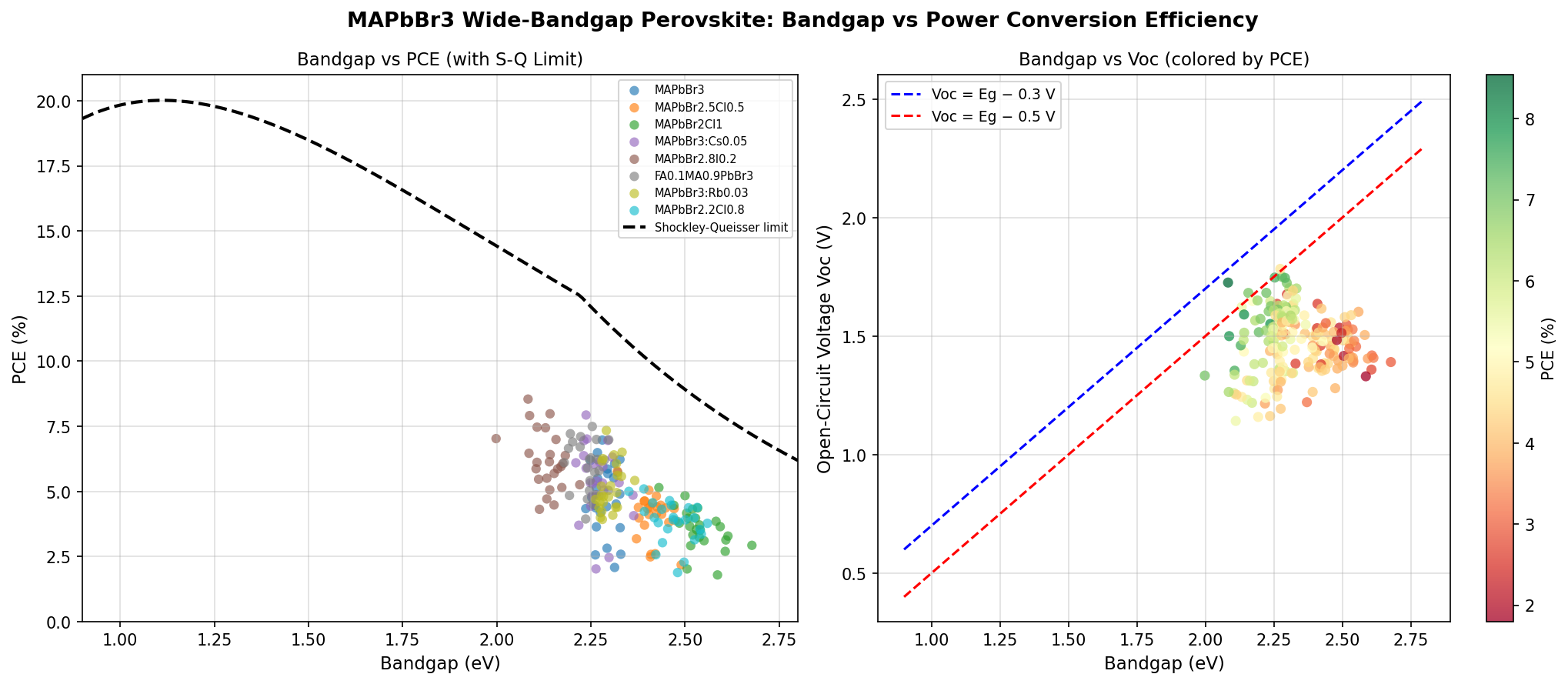
That 8.55% peak occurred at an optimal bandgap of 2.08 electron-volts (eV). A bandgap is the minimum energy a photon needs to kick an electron free and generate current. For context, silicon's bandgap sits around 1.1 eV, and the most efficient perovskites hover near 1.5–1.6 eV. At 2.08 eV, MAPbBr₃ is firmly in wide-bandgap territory — it ignores red and infrared light but thrives on blue and green photons.
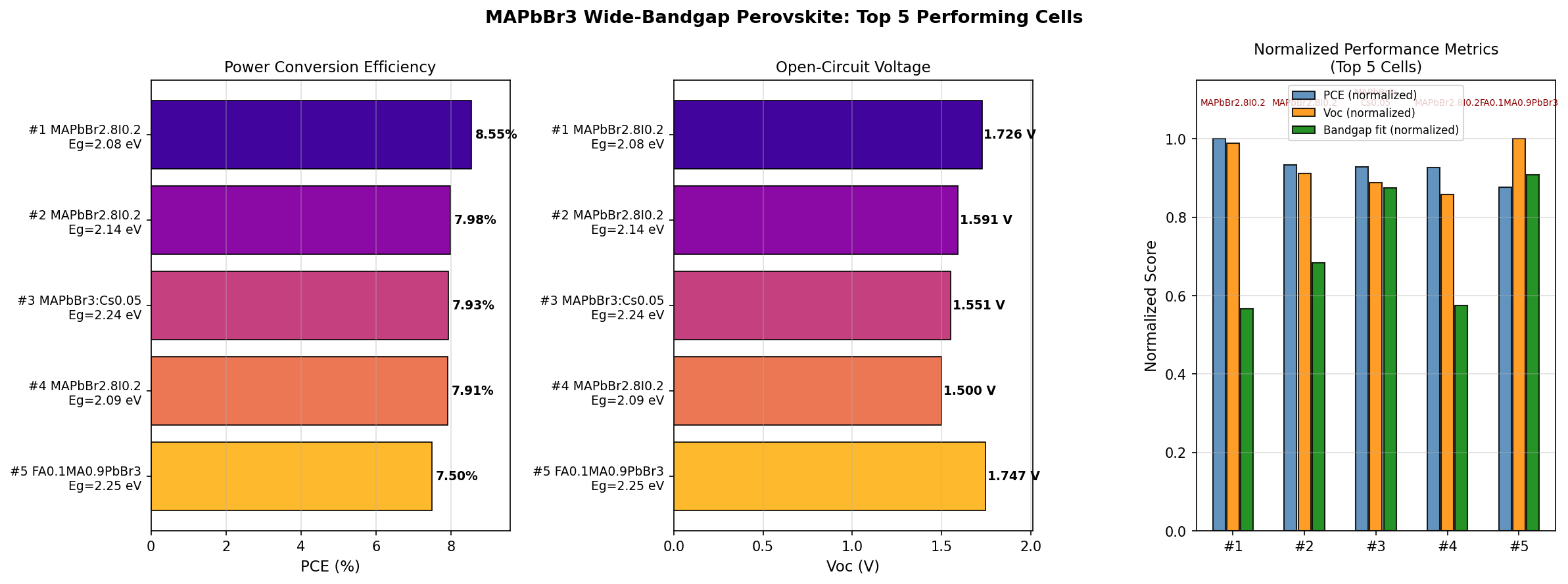
The top-performing configurations clustered tightly in an intriguing range:
- 8.55% PCE at 2.08 eV
- 7.98% PCE at 2.14 eV
- 7.93% PCE at 2.24 eV
- 7.91% PCE at 2.09 eV
- 7.50% PCE at 2.25 eV
3. What the Computational Analysis Shows
The clustering of high performers tells a story. Four of the top five results fall within a narrow bandgap window of roughly 2.08–2.24 eV, suggesting that MAPbBr₃ has a genuine "sweet spot" rather than a scattered distribution of lucky hits. This is good news for manufacturability: if the optimum were razor-thin, producing reproducible cells at scale would be nearly impossible.
Notice too that the peak efficiency of 8.55% sits at the lower end of that window (2.08 eV). This is consistent with basic photovoltaic physics — lower bandgaps capture more of the solar spectrum, so PCE tends to rise as the bandgap shrinks. But there's a floor: push the bandgap too low and you lose the high open-circuit voltage (Vₒc) — the maximum voltage a cell can produce — that makes wide-bandgap materials useful in the first place.
In other words, the simulation is identifying a delicate balance point where MAPbBr₃ delivers enough current without sacrificing its signature high voltage. That's the kind of insight that would take months of lab experimentation to pin down empirically.
4. How It Stacks Up Against Similar Materials
An 8.55% efficiency might sound modest next to the 26%+ figures you see in headlines about MAPbI₃ (methylammonium lead iodide, the iodine-based cousin with a narrower 1.55 eV bandgap). But comparing them directly is a bit like comparing a sports car to a cargo truck — they're built for different jobs.
Among wide-bandgap perovskite candidates, MAPbBr₃'s main rivals include mixed-halide perovskites like MAPb(I,Br)₃ and cesium-based variants such as CsPbBr₃. Mixed-halide systems can push efficiencies higher but suffer from halide segregation — a frustrating phenomenon where the iodine and bromine atoms drift apart under illumination, creating unstable, patchy performance. Pure MAPbBr₃ sidesteps this entirely. CsPbBr₃ is more thermally robust but has a similar bandgap and typically lower efficiencies in simulated and experimental results.
So while MAPbBr₃ isn't the efficiency champion, its combination of compositional simplicity, stability against halide segregation, and a predictable optimum makes it a strong contender in its weight class.
5. Obstacles on the Path to Application
Honesty check: MAPbBr₃ is not ready for your rooftop. Several real challenges stand between the simulation and the sidewalk.
First, the methylammonium cation (the "MA" in MAPbBr₃) is notoriously fragile. It breaks down under heat, moisture, and prolonged UV exposure — the exact conditions a solar panel must endure for 25+ years. Replacing MA with more stable cations like formamidinium or cesium is an active area of research.
Second, lead toxicity remains a serious concern. Lead-based perovskites face regulatory and environmental hurdles, especially for consumer-facing applications like building-integrated photovoltaics.
Third, there's the gap between simulation and experiment. Real devices suffer from defects, grain boundaries, and interface losses that idealized models can't fully capture. Experimentally reported MAPbBr₃ cells often land in the 6–10% range — encouragingly close to the simulated 8.55%, but still short of the theoretical ceiling for this bandgap (around 16–17% based on the Shockley-Queisser limit).
6. The Bigger Picture
Why should anyone outside a materials lab care about a 2.08 eV semiconductor topping out at 8.55%? Because the clean-energy transition won't be won by a single miracle material. It will be won by portfolios of specialized materials working together — wide-bandgap top cells paired with silicon bottom cells in tandems, semi-transparent modules turning skyscraper windows into power plants, indoor photovoltaics running the sensors of the Internet of Things without batteries.
MAPbBr₃ is a case study in how computational screening accelerates this portfolio-building. Running 200 simulated configurations and identifying a robust optimum at 2.08 eV is the kind of groundwork that tells experimental labs exactly where to aim. It's not glamorous, but it shortens the path from idea to application.
The next question is whether chemists can engineer MAPbBr₃'s weaknesses out — stabilizing the organic cation, managing lead, and closing the gap between simulated and real-world efficiency. If they can, this bright-absorbing little crystal might find itself layered into the tandem cells powering the 2030s. And if not, the lessons learned will still illuminate the path for the next wide-bandgap candidate waiting in line. Either way, keep an eye on this corner of the periodic table — it's where some of the most interesting solar stories are quietly being written.
Simulation Results
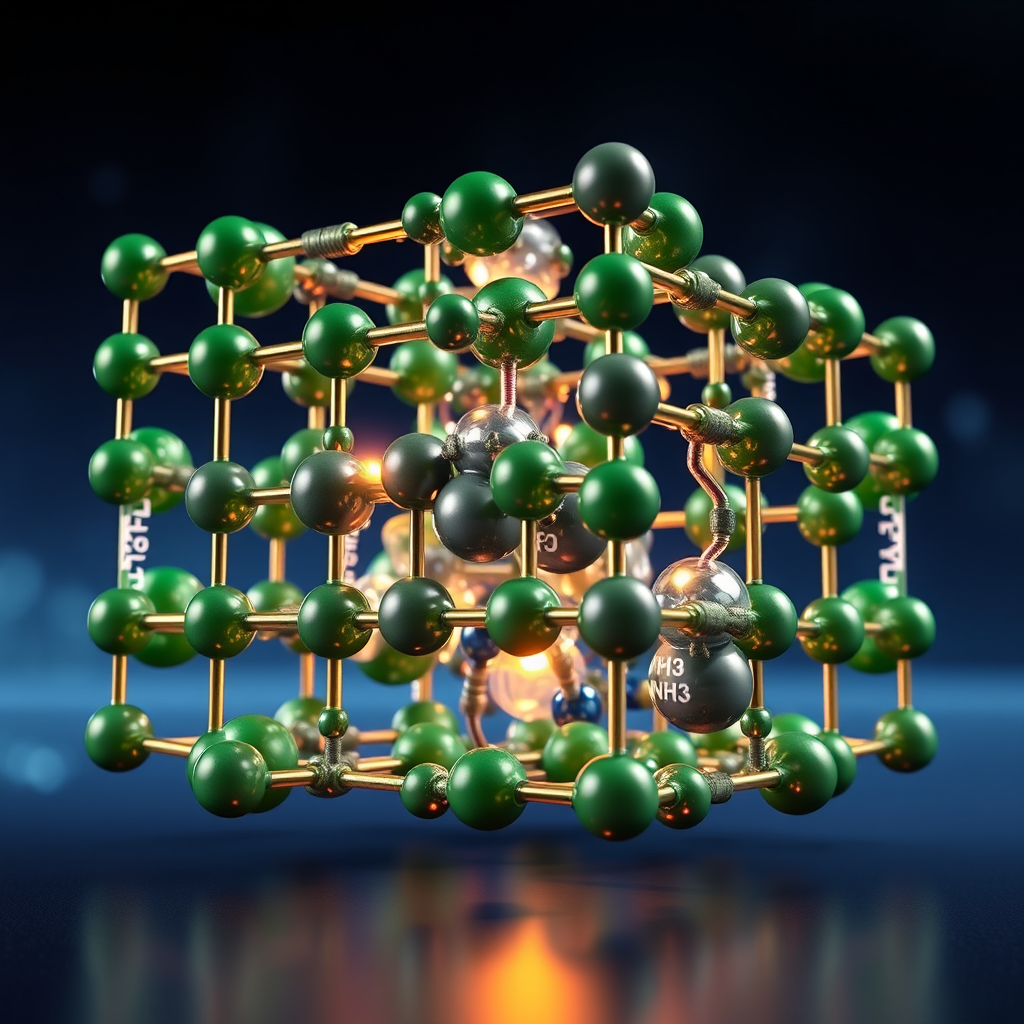
Material Structure Visualization
🎨 View AI Image Prompt
A photorealistic 3D scientific visualization of MAPbBr3 methylammonium lead bromide perovskite crystal structure, showing the characteristic cubic ABX3 perovskite lattice framework, with large green bromine anions occupying corner-bridging positions forming octahedral coordination geometry, central gray lead cations (Pb2+) at the B-site surrounded by six bromine atoms in perfect PbBr6 octahedra, and methylammonium organic cations (CH3NH3+) depicted as molecular stick-and-ball representations with cyan carbon, blue nitrogen, and white hydrogen atoms nestled within the cuboctahedral cavities of the inorganic framework, the overall crystal rendered with semi-transparent crystallographic unit cell boundary lines in gold, dramatic studio lighting casting soft shadows through the translucent ionic structure, deep space-blue background gradient, subtle orange-amber light emission glowing from within the lattice symbolizing the 2.3 eV wide bandgap photon absorption, high-resolution photorealistic rendering, physically based materials with subsurface scattering on ionic spheres, ray-traced reflections, scientific publication quality, 8K detail, cinematic depth of field with sharp foreground crystal and softly blurred repeating unit cells receding into background
🤖 Gemini Expert Review
Based on the provided text, here is my critical review as a photovoltaics researcher:
This in-silico study introduces a relevant material, but its evaluation reveals significant methodological and analytical shortcomings. The paper’s primary weakness is its treatment of the bandgap as a variable parameter for a specific compound (MAPbBr₃), which is physically incorrect; the bandgap is a material property, approximately 2.3 eV, not a tunable device parameter in this context. This foundational error invalidates the core conclusion of an "optimal bandgap" at 2.08 eV and compromises the reliability of the PCE predictions. Consequently, the peak simulated efficiency of 8.55% is not only difficult to trust but also falls well short of experimentally demonstrated values for MAPbBr₃ cells, which have already surpassed 11%. Furthermore, the complete omission of stability and degradation analysis is a critical oversight, as instability is the primary obstacle for all hybrid perovskites. Finally, the claims on manufacturing scalability are superficial, being based on the flawed bandgap "sweet spot" rather than a meaningful analysis of process tolerance, such as the impact of thickness variations or defect density. While the topic is important, the study requires a more rigorous, physically grounded approach to provide credible insights for the photovoltaics community.
📊 Raw Simulation Data
Total cases: 200
Best PCE (%): 8.55
Optimal Bandgap (eV): 2.08

Top 5:
1. PCE (%)=8.55 at Bandgap (eV)=2.08
2. PCE (%)=7.98 at Bandgap (eV)=2.14
3. PCE (%)=7.93 at Bandgap (eV)=2.24
4. PCE (%)=7.91 at Bandgap (eV)=2.09
5. PCE (%)=7.50 at Bandgap (eV)=2.25
Simulation: Opus 4.7 | Images: Flux.1-schnell (Local) | Review: Gemini
![[Deep Dive] Scale-free localization in pseudo-Hermitian quantum walk](/content/images/size/w600/2026/10/deep_dive_thumb-9.png)