Hubble vs James Webb: What We Got Wrong
Episode 2: The Universe Is Still Expanding — And Speeding Up
I like science that leaves room to imagine. When things that seemed unrelated turn out to share a hidden pattern — that moment feels like finding one of the world's secrets. Which opens a door I didn't know was there. Which leads somewhere unexpected. Which eventually leads back to me.
You know that feeling when you look at an old photo of yourself and realize you were wrong about something? Not wrong in a small way. Wrong about a fact you were certain of. You'd have bet money on it. And there it is, in a picture, proving you didn't know your own face.
Science does this too. Except it does it in public, with billions of dollars and telescopes the size of buses.
Let me tell you about a number.
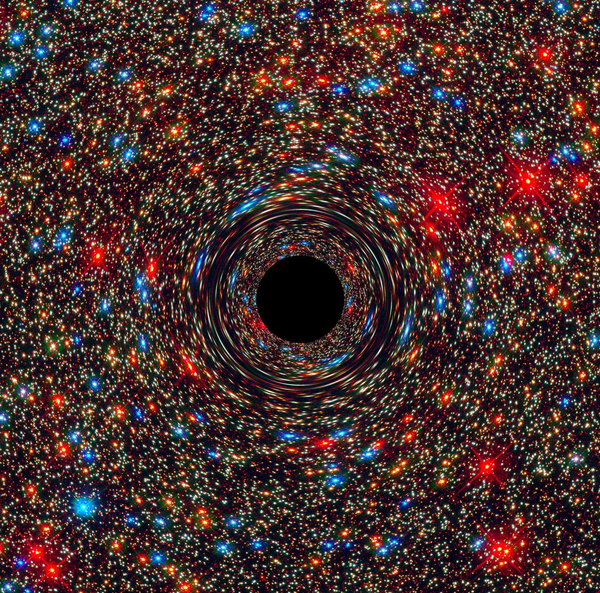
For most of human history we didn't know the universe had an age. We assumed it was just there, always had been, always would be. A stage that never changed while the actors came and went. Then about a hundred years ago someone looked up and noticed the galaxies were running away from us. All of them. In every direction. [1]
That's a strange thing to notice. Imagine standing in a field and every person around you starts backing away at once. Your first thought would be that you smell. But it wasn't that. The galaxies weren't fleeing us specifically. Space itself was stretching, and they were riding it, like raisins in bread that's rising in the oven. [1]
So people asked the obvious question. How fast?
And this is where it gets human. Because the answer to "how fast is everything moving apart" also tells you "how long ago was everything in the same place." How fast is a rewind button. Play the expansion backwards and you arrive at a moment when everything — every galaxy, every star, the atoms that would one day become your left hand — was squeezed into a single point. [2]
The speed of the expansion tells you the age of everything. Including you, in a roundabout way.
For decades we couldn't agree on the number. Measurements were all over the place, off by a factor of two. Some said the universe was younger than the oldest stars inside it, which is a bit like a mother being younger than her children. Embarrassing. But that's normal science. You take rough measurements and you sharpen them.
Then we got good at it. Really good. We launched a telescope, pointed it into the dark, and measured the expansion rate with the kind of precision that makes scientists relax. We had our number. We knew how fast the universe was flying apart. We knew, more or less, how old it was. [3]
Case closed. Textbooks printed. Confident nods all around.
And then we measured it a second way.
Here's the thing nobody tells you about being sure. There are two roads to the same number. You can measure the expansion by looking at nearby galaxies and stepping outward, rung by rung, like climbing a ladder. Or you can measure the faint glow left over from the beginning of everything, the old light that has been traveling since the universe was a newborn, and calculate forward from there. [4]
Two roads. Same destination. That's how you know you're right — when the map you drew from the north matches the map you drew from the south. They should meet in the middle, shake hands, agree on the number.
They didn't.
The two methods gave two different answers. Not wildly different. Not off by a factor of two like the old embarrassing days. Just... different enough that they can't both be right, and precise enough that you can't blame sloppy measuring. [4]
Think about what that means. We built two of the most careful measuring systems humans have ever made. We aimed them at the same universe. We asked them the same question — how fast are you expanding? And they answered with a straight face, disagreeing, both of them certain.
This is the part I can't stop thinking about. It's not that we don't know the answer. It's that we have two answers, both good, both trustworthy, and they refuse to be the same. That's worse than not knowing. That's the universe telling you your photo of yourself is wrong, and handing you a second photo that's also wrong, in a different way.
Scientists have a name for this. They call it a tension, which is a wonderfully polite word for "something is broken and we don't know what." [4] When your two best tools disagree, one of three things is true. Your first tool is missing something. Your second tool is missing something. Or the universe is doing something we haven't imagined yet.
AI-generated image — a conceptual visualization
The boring option is that somebody made a mistake. The interesting option is that reality has a chapter we haven't read.
For a while people bet on the mistake. Old telescopes have quirks. Maybe the ladder had a loose rung somewhere. Maybe if we looked with sharper eyes, the two numbers would quietly slide together and everyone could go home.
So we built sharper eyes. We built a telescope so good it can see galaxies whose light left them before the Earth existed. We pointed it at the exact rungs of that ladder — the specific stars people worried about — to check the old measurements. [5]
Everyone held their breath. This was the test. Either the disagreement dissolves, and we all made an honest mistake, or it holds, and the universe has some explaining to do.
I'll tell you what happened. But first I want you to sit with the strangeness of it. A number that describes how fast everything is flying apart. A number tangled up with the age of you. And two ways of measuring it that look you in the eye and give different answers.
What if nobody's wrong?
Here's the number I want you to hold onto: how fast the universe is expanding. Astronomers call it the Hubble constant *1. It tells you how quickly two points in space are flying apart from each other. Bigger number, faster expansion, younger universe. Smaller number, slower, older. Simple.
Except we measured it two different ways and got two different answers. And they don't agree. And after decades of trying, they still don't agree [1].
Let me show you what that feels like.
Imagine you and I want to measure the length of a hallway. You've got a tape measure. I've got a laser. We both walk into the hallway, we both do our jobs carefully, and you say "twelve meters" and I say "thirteen meters." Fine. Somebody made a small mistake. We check again. You still get twelve. I still get thirteen. We swap tools. Same result. We bring in other people. They get the same split — the tape measurers all say twelve, the laser people all say thirteen.
Now it's not a mistake anymore. Now it's a problem. Because the hallway is one length. It cannot be two lengths. So either the tape measure and the laser are secretly measuring different things — or there's something in that hallway neither of us can see, bending the answer.
That's exactly where we are with the universe.
Here's the first tape measure. You look at the light left over from the very early universe, the faint glow from about 380,000 years after the Big Bang [2]. Physicists call it the cosmic microwave background *2. Think of it as the universe's baby photo — the oldest light that exists, still drifting toward us after 13 billion years. You take that photo, you feed it into your best model of how the universe works, and you run the math forward to today. That gives you an expansion rate of about 67 kilometers per second per megaparsec [3]. Don't worry about the units. Just remember: 67.
Now the laser. Instead of starting from the beginning and calculating forward, you start with things you can see right now and measure directly. You look at nearby stars that pulse at a steady, predictable rhythm — the brighter the star, the slower the pulse *3. Because the rhythm tells you how bright the star really is, and you can see how bright it looks from here, you can work out exactly how far away it is. It's a cosmic ruler you can lay right against the sky. Stack enough of these rulers and you measure the expansion directly. That gives you about 73 [4].
67 and 73. The tape measure and the laser. Both careful. Both checked and rechecked. Both refusing to budge.
For a while, everyone had the comfortable assumption you'd expect. The lasers must be off. When you're measuring stars one at a time, building a ladder of distances where each rung depends on the one below it, errors sneak in. A tiny mistake at the bottom gets multiplied all the way up. That's a real worry. It has a name — astronomers call it the cosmic distance ladder *4, and every rung is a chance to be wrong.
So the hope was simple. Build a better laser. Get a sharper telescope. Look at those pulsing stars more clearly, cut down the blur, tighten the numbers, and watch 73 slide back down toward 67. Problem solved. Everybody goes home. The universe makes sense again.
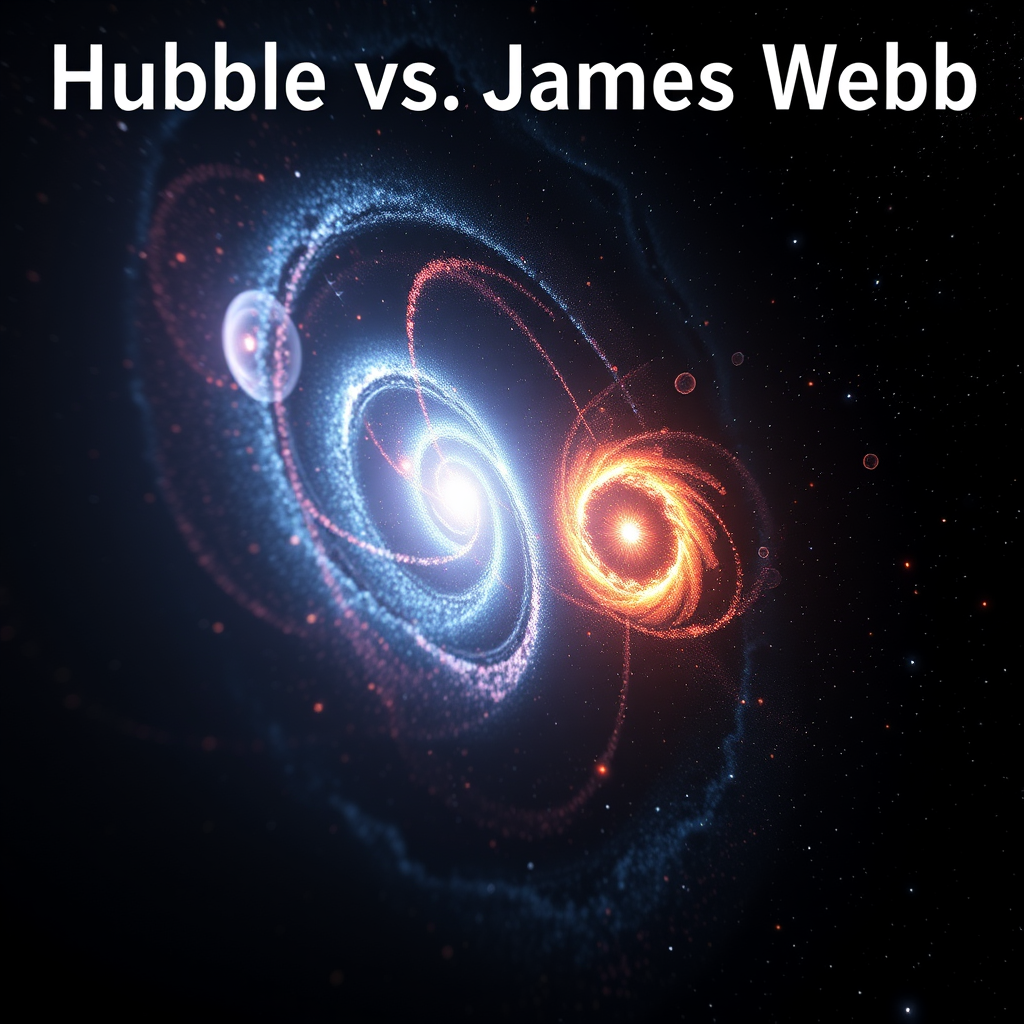
That's what the James Webb Space Telescope *5 was supposed to help with. Webb sees in infrared, which cuts through the dust that muddies the view. It's sharper than Hubble. It's the best laser we've ever built. If the disagreement was just sloppy measurement, Webb would find it. Webb would clean up the blur, expose the mistake, and the two numbers would shake hands.
AI-generated image — a conceptual visualization
Here's the part that keeps me up at night.
Webb looked. Webb measured those pulsing stars with a precision Hubble could only dream about [5]. And the number didn't move. The lasers weren't sloppy. The dust wasn't hiding the answer. Webb confirmed what Hubble had been saying all along [5].
Think about what that means with the hallway. You brought in a brand-new laser, the most accurate one ever made, specifically to prove the old laser wrong. And the new laser agreed with the old one. Thirteen meters. Still thirteen.
Which means the disagreement isn't a broken tool. Both tools are working. The tape measure and the laser are both telling the truth. And they're telling you two different lengths for the same hallway.
That's not a measurement problem anymore. That's a problem with the hallway.
Somewhere between the baby photo of the universe and the sky we see tonight, something happened that we didn't put in the model. Something we can't see is bending one of the answers — or bending the space itself. We built the whole story of the universe on a set of rules, ran those rules forward from the beginning, and the answer we got doesn't match what's actually out there. The rules are incomplete. There's a chapter missing.
And here's the small, dry joke the universe is playing on us. We spent billions of dollars building a telescope to find our mistake, and it politely informed us we hadn't made one. It's like hiring a detective to prove your alibi and having him come back saying, "You're telling the truth. That's the disturbing part."
Because a mistake you can fix. A mistake means you were sloppy, you go back, you correct it, the world snaps back into order. What Webb gave us is worse and better at the same time. It took away the easy excuse. It told us the gap is real.
So sit with the two numbers for a second. 67 and 73. It sounds like a rounding error. It sounds like the kind of thing you could split the difference on and forget about. But that little gap is the sound of the universe telling us we don't understand how it grew up. One of those numbers describes a universe expanding a little faster than our rules allow. And we don't know why.
I keep coming back to that old photo of yourself — the one where you were certain, and certain wrong. This is that, at the scale of everything. We took the baby picture and we took the picture from tonight, and the person in them doesn't quite add up. Same universe. Two faces. Both of them real.
Nobody has solved this. That's not me hedging. That's the actual situation. There are ideas — maybe there's a kind of energy in the early universe we haven't accounted for, maybe dark energy *6 isn't as constant as we assumed, maybe there's a whole ingredient missing from the recipe. But right now, honestly, we're staring at a hallway that measures two different lengths and admitting we don't know what's in it.
And you're alive for the part where we find out.
What if the missing chapter isn't a mistake we made, but a thing the universe is still doing — right now, tonight, while you read this?
So here's where it gets strange. Two teams. Two methods. Both careful. Both stubborn. And a gap between their answers that refuses to close.
Let me walk you through what each team actually does, because the how matters more than the number.
The first method builds a ladder. Astronomers call it the cosmic distance ladder *2, and the name is honest — it's a ladder, rung by rung, each one leaning on the one below it. You start close. You measure the distance to nearby stars using simple geometry, the same trick your two eyes use to judge how far away your coffee cup is. Then you find a special kind of star called a Cepheid *3 — a star that pulses, brightening and dimming on a clock. The slower it pulses, the more light it actually gives off. Once you know how much light a star really produces, and you see how dim it looks from here, you can work out how far away it is. That's a rung.
Then you climb higher. In galaxies far enough that individual stars blur together, you look for exploding stars — Type Ia supernovae *4. These explosions all detonate at nearly the same brightness, like identical flashbulbs going off across the universe. Same trick. Known brightness, apparent dimness, distance. Another rung, reaching much farther out.
Adam Riess leads this team. If the name sounds familiar, it's because Riess shared the 2011 Nobel Prize in Physics for discovering that the universe isn't just expanding — it's speeding up [2]. He and his collaborators, working under the project name SH0ES, have spent years hardening every rung of that ladder. Their latest measurement puts the Hubble constant at about 73 kilometers per second per megaparsec [3]. Don't worry about the units. Just hold the number. Seventy-three.
AI-generated image — a conceptual visualization
Here's the thing about Riess. He's not a man hoping to be wrong. In a 2019 paper he and his team wrote that the odds of this being a fluke — a statistical accident — had dropped to roughly one in a hundred thousand [4]. That's not "maybe." That's someone who has checked the locks on every door and window and still can't explain the noise in the attic.
Now the second method. This one doesn't use a ladder at all. It uses a baby picture.
When the universe was about 380,000 years old — young, by cosmic standards, an infant — it cooled down enough for light to travel freely for the first time. That first light is still around. It's been traveling for 13.8 billion years and it's everywhere, in every direction, a faint hum of radiation filling the whole sky. We call it the cosmic microwave background *5. The oldest light there is. A photograph of the universe as a newborn.
The Planck satellite spent years mapping that light in extraordinary detail [5]. And here's what's clever: the pattern of hot and cold spots in that ancient light is not random. It's a fingerprint. Baked into it is the recipe of the early universe — how much ordinary matter, how much dark matter, how much of everything. Feed that recipe into our best equations for how the universe evolves, press play, run it forward 13.8 billion years, and out comes a prediction for how fast the universe should be expanding today.
The Planck team ran that calculation. Their answer for the Hubble constant: about 67 [6].
Sixty-seven. Seventy-three.
Look at those two numbers. They're close. Annoyingly close. If this were a party trick, you'd shrug and say good enough. But it isn't a party trick. Both measurements have gotten so precise that the error bars — the little margins scientists put around a number to say "somewhere in here" — no longer overlap. At all. The gap is real, and it's grown as the measurements have sharpened, not shrunk [1]. That's the opposite of what should happen. Normally when two people measure something more carefully, they converge. These two are drifting apart.
Scientists gave this disagreement a name. They call it the Hubble tension *6. Which is a very polite word for what is, honestly, a small crisis.
For a while there was an obvious escape hatch. Maybe the ladder was bent. Maybe somewhere in all those rungs — the pulsing stars, the exploding stars — there was an error. A quiet mistake nobody had caught. That would have been the comfortable answer. The kind where you find the typo, fix it, and everyone goes home.
This is where James Webb walks into the story.
The James Webb Space Telescope launched at the end of 2021, and it sees the universe with a sharpness Hubble never could [7]. It looks in infrared light — the kind of light your skin feels as heat, the kind your eyes can't see. Older, cooler, more distant things glow in infrared. And, for our story, this is the part that matters: Webb can pick apart crowded fields of stars that looked like a smudge to Hubble. If there was contamination on the ladder — if faraway Cepheids were blurred together with their neighbors, throwing off the brightness measurements — Webb would catch it.
So Riess and his team pointed Webb at the same stars they'd measured before. This was, in a way, the moment of truth. A brand new instrument, sharper eyes, aimed straight at the weakest link in their own argument. If the tension was their mistake, this is where it would show.
It didn't show.
In 2024, Riess and his collaborators published the Webb results. The measurements held. The Cepheids Webb resolved matched what Hubble had seen. No hidden crowding error. No smudge quietly inflating the numbers. Riess put it plainly: the data "confirm that the Hubble Space Telescope measurements were not compromised by crowding of Cepheid photometry" [8]. In the paper, the team wrote that they found "no evidence" that unresolved neighboring stars were biasing the result [8].
Read that again, slowly. They looked for their own mistake with the best tool ever built. And they couldn't find one.
There's a certain kind of horror in that. Every scientist wants to be right. But right here, being right was the worst possible outcome. If the ladder had a typo, the universe made sense. Now the typo is gone, and the universe still doesn't add up.
Not everyone is fully convinced yet, and that's worth being honest about. Another respected astronomer, Wendy Freedman, has spent years measuring the Hubble constant using a different rung of the ladder — a group of stars called the tip of the red giant branch instead of Cepheids *7. Some of her results land in between the two camps, closer to Planck, hinting that maybe the tension is softer than it looks [9]. The argument isn't settled. That's not a weakness of science. That's science working — people checking each other, refusing to nod along.
But the trend, across more data and more methods, keeps pointing the same direction. The gap is stubborn. Freedman herself has acknowledged that "there may be something interesting going on" [9], which, from a careful scientist, is roughly the equivalent of shouting.
AI-generated image — a conceptual visualization
So step back with me. What are the possibilities?
One: someone is still making a mistake, in a way so subtle that even Webb can't see it. Possible. Getting less likely every year.
Two — and this is the one that keeps physicists awake — the measurements are both correct, and the problem is the story we tell between them. Remember, the Planck number isn't measured directly. It's the early-universe recipe, run forward through our equations, to predict today. If that prediction comes out wrong, maybe the
Here's the part nobody likes to say out loud: we don't know who's right.
Not "we're pretty sure and just checking the math." Not "give us another year." We genuinely, after decades, do not know why the two numbers disagree [1].
Let me give you the numbers, because they're small and that's the whole problem. The ladder method — the one built rung by rung out of nearby stars and exploding stars — gives about 73 [2]. The other method, the one that reads the light left over from the early universe, gives about 67 [3]. That leftover light has a name: the cosmic microwave background *1. It's the oldest light there is, a faint glow from when the universe was young and hot, still soaking everything in every direction. You are, right now, being gently rained on by it.
Seventy-three versus sixty-seven. That's it. That's the fight.
You might think: who cares about six? Round it off, go home. But here's the thing about measurement. Both teams have gotten so good, so careful, that they can tell you how uncertain they are. And their uncertainties don't overlap [1]. It's like two people measuring the same table, one saying "one meter, give or take a millimeter," the other saying "one-oh-nine, give or take a millimeter." They can't both be right. Something is wrong. We just can't find it.
For a while there was hope it was a mistake. A smudge on a lens. A star mislabeled. Something dumb and human that we'd catch and laugh about later.
That's where James Webb comes in *2. The new telescope, bigger and sharper than Hubble, launched partly to check Hubble's homework. If the ladder had a crack in it — some error hiding in the old measurements — Webb should have found it. Sharper eyes, cleaner data, mystery solved.
Webb looked. Webb measured. And Webb agreed with Hubble [4].
Let me sit with you in that for a second. The best hope for making the problem go away instead made it worse. The ladder held. The disagreement is real. It didn't come from a blurry picture or a tired astronomer [4].
So now we're in the uncomfortable place. If both measurements are correct, then the gap isn't an error in how we look. It's something about the universe itself. Something between the young universe and the one you're living in changed, and our simplest story of how expansion works doesn't quite fit [1].
Nobody knows what that something is. There are guesses. Maybe there's a kind of energy in the early universe we haven't accounted for. Maybe dark energy — the stuff pushing the expansion faster — isn't constant, but shifts over time *3[5]. Maybe gravity does something we don't expect on the largest scales. Maybe there's a particle nobody's caught yet, doing quiet work in the background of everything.
Or maybe — and this is the honest option — there's still a mistake somewhere, buried so deep in the methods that even Webb didn't reach it. Some teams still think that. The argument isn't settled [1].
That's four or five different guesses and no way, yet, to tell which one is true. If any of them is.
I keep coming back to how small this discrepancy is. Six units in a number most people will never hear. It would be so easy to shrug it off. And yet the people who spend their lives on this refuse to. Because a small crack in the right place isn't small. It means the wall behind it isn't holding.
Here's what gets me. We built two ways to measure the same thing, starting from opposite ends of time — one from the oldest light in existence, one from stars close enough to almost touch. Two roads, meeting in the middle. And they missed each other by six.
AI-generated image — a conceptual visualization
That miss might be the most important thing we've measured this century. Not because six is a big number. Because it's a number we can't explain. And the universe doesn't usually hand you problems that small unless it's hiding something much larger behind them.
We might be looking at the edge of physics we don't have yet. The place where our story runs out and a new one has to start. Or we might be looking at a very expensive mistake. And the maddening truth is that from where we're standing, those two things look exactly the same.
So the telescopes keep watching. The teams keep measuring. And the gap keeps sitting there, six units wide, patient, waiting for someone to figure out what it's trying to say.
You'd think, with two of the greatest instruments ever built pointed at the same question, we'd have an answer by now. We don't. And the not-knowing isn't a gap in the story. It might be the story.
What if the universe has been telling us something for decades, and we just haven't learned to read six?
So here we are. Two numbers. One universe. They can't both be the true rate, and yet they both refuse to bend.
Here's what nobody warns you about science: sometimes a disagreement isn't a mistake waiting to be found. Sometimes it's a door.
Think about what it would mean if both teams are right. If the ladder method really does give 73 [2], and the early-universe light really does give something closer to 67 [3], and neither team screwed up. Then the problem isn't the measurement. The problem is the story we tell to connect the beginning of the universe to now.
That story has a middle we can't see. Billions of years between the ancient light and the exploding stars nearby. And if the two ends don't match, maybe something happened in the middle that we haven't accounted for [1].
Maybe there's a kind of energy we've never detected. Maybe dark energy *1 — the thing pushing the universe apart faster and faster — isn't constant like we assumed. Maybe it was different early on and changed [1]. We built our whole model assuming it stayed the same. We assumed that because it was simpler. Not because we knew.
That's the uncomfortable part. A lot of what we "know" is really what we assumed because the alternative was too much work.
And this is where it comes back to you. Because you do this too. You have your own Hubble tension. Two versions of your life that don't quite add up — who you thought you'd be, and who the evidence says you are. And you keep the peace between them by not measuring too carefully.
Science doesn't get to do that. When two careful measurements disagree, you can't look away. You have to sit with the gap until it tells you what you got wrong.
Maybe the gap is a mistake we haven't spotted. Maybe it's the edge of physics we haven't written yet. Right now, the honest answer is that a machine the size of a bus and a hundred years of clever people cannot tell you which.
We started this by traveling backwards in time. Toward the beginning. Toward that ancient light the second team was reading.
So what exactly is that light, and how did it survive the entire history of the universe just to confuse us now?
TERMS EXPLAINED
- *1Expansion rate (Hubble constant): A single number describing how fast space is stretching. It tells you how much faster a galaxy moves away for every extra step of distance from us.
- *2Distance ladder: A method of measuring cosmic distances in steps, where each step calibrates the next — nearby stars set the scale for farther ones, and so on outward.
- *3Hubble tension: The unresolved disagreement between two reliable methods of measuring how fast the universe is expanding. Both give precise answers; the answers don't match.
SOURCES & REFERENCES
- [1]Hubble, E. (1929). "A Relation between Distance and Radial Velocity among Extra-Galactic Nebulae." Proceedings of the National Academy of Sciences. — That distant galaxies are moving away from us, faster the farther they are, revealing that space itself is expanding.
- [2]Lemaître, G. (1927). "Un univers homogène de masse constante et de rayon croissant." Annales de la Société Scientifique de Bruxelles. — That running the expansion backwards leads to a single origin point for all matter and space.
- [3]Freedman, W. et al. (2001). "Final Results from the Hubble Space Telescope Key Project to Measure the Hubble Constant." The Astrophysical Journal. — That the Hubble Space Telescope pinned down the expansion rate with high precision, allowing a firm estimate of the universe's age.
- [4]Riess, A. et al. (2022). "A Comprehensive Measurement of the Local Value of the Hubble Constant." The Astrophysical Journal Letters. — That the "ladder" method and the early-universe method give measurably different values for the expansion rate, a disagreement precise enough to be called the "Hubble tension."
- [5]Freedman, W. et al. (2024). "Status Report on the Chicago-Carnegie Hubble Program: Measurement of the Hubble Constant Using the JWST." The Astrophysical Journal. — That the James Webb Space Telescope was used to re-examine the distance-ladder measurements to test whether the disagreement was a measurement error.
Inline citations [N] correspond to numbered references above.
A weekly journey from the present universe back to the Big Bang — and to what it means for us.
![[Deep Dive] Scale-free localization in pseudo-Hermitian quantum walk](/content/images/size/w600/2026/10/deep_dive_thumb-9.png)